|
|
December 2nd, 2013
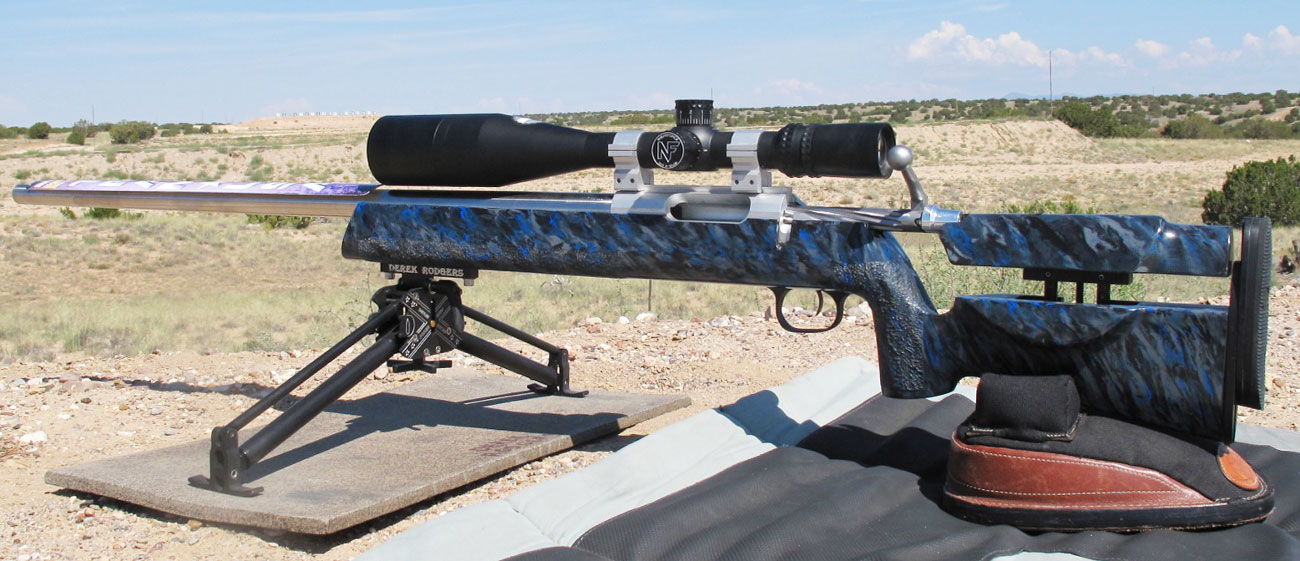
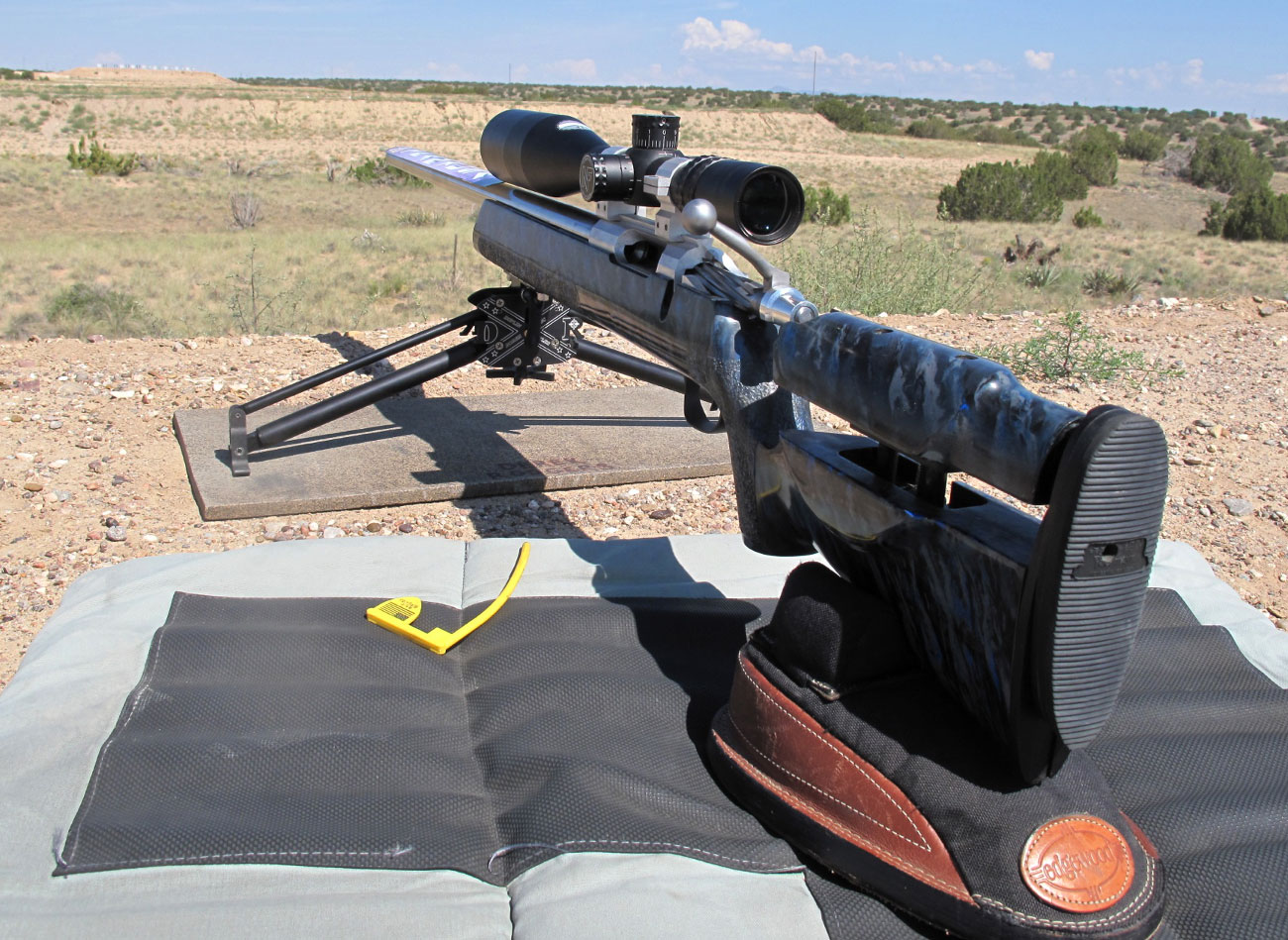
Forum member Jonathan L. (aka ‘Quest-QC’) was a member of the Canadian F-TR team at the F-Class World Championships in Raton, NM this fall. His handsome .308 Winchester rifle features some interesting hardware and a stunning African Padauk-wood stock stiffened with carbon fiber layers. We were impressed by the innovative, adjustable bag-rider assembly Jonathan fitted to the rear of his stock (scroll down for photo). With an Allen wrench, the vertical height and the slope (i.e. fore/aft angle) of the V-shaped bag-rider can be changed easily. This has many advantages. First, Jonathan can set his rifle to the most comfortable height (for his prone position) without using “lifters” under the rear bag. The system also gives him some gross elevation adjustment separate from the bipod. In addition, the angle adjustment allows the bag-rider to better match the geometry of the rear bag. Last but not least, by setting up the bag-rider with some drop (higher in front, lower in back), Jonathan can fine-tune his elevation (while aiming the gun) by simply sliding the rifle fore and aft.

Jonathan says: “This year was my second year shooting at 1000 yards and I managed to find a spot on Team Canada for the FCWC at Raton. Here is the rifle that brought me there…”

The rifle features a Kelbly Panda F-Class RB-LP action, 34″ Bartlein 1:11″-twist, Heavy Palma contour barrel. Fitted to the red-toned Padauk-wood stock is a 23.2 oz., StarShooter CF-SS light weight bipod with custom bench feet. On top is a March 8-80x56mm scope in Kelbly rings. Total weight of the rifle is 18 pounds, 1 oz., complete with the 24 oz. adjustable brass bag-rider at the back. The bag-rider block was modeled in 3D, then machined afterwards to use up the remaining weight available after all the other components. CLICK for StarShooter CF-SS Bipod Video.
African Padauk Wood is Very Stiff
Jonathan chose the red-toned African Padauk Wood because it is stiff for its weight: “The reason for choosing African Padauk is that the weight of the wood is the same as Maple but 45% more rigid.” The downside of Padauk, as Forum member Gstaylorg notes, is that it is a “very oily wood, which can make it somewhat difficult to finish with something like polyurethane. [Padauk] can generate a lot of bubbles and cause cracking problems around joints and/or seams.” Jonathan did note that he has observed a few bubbles in the auto clear coat on his stock. He plans to refinish the stock in the off-season.

Gun Is Extremely Accurate with Berger 200gr Hybrids
Jonathan says this rig was very accurate, at least until his barrel gave up the ghost. He says he has put 15 successive shots in about 1/4 MOA: “I managed to make it twice (1/4 MOA for 15) by taking my time between shots. You don’t want to overheat this barrel. I needed to provide a very strong effort (mentally) to be able to achieve such precision as the rifle is way better than me.” Jonathan shoots Berger 200gr Hybrid bullets (in the lands) with Hodgdon Varget powder, and Federal 205M primers, loaded into neck-turned Lapua .308 Win brass. He has also had good luck with Vihtavuori N150 powder in the past.

In compliance with F-Class rules, the adjustable bag-rider system would not be adjusted “on the fly” during record fire. The bag-rider’s vertical rise and fore/aft slope would be optimized before shooting, then locked in place. The bottom photo offers a good view of the V-shaped profile of the metal bag-rider. We have found that this kind of V-profile, closely matching the triangular profile of the rear ears, makes a rifle more secure in the rear bag and often allows the gun to track better.


November 14th, 2013
 The November 2013 Edition of Target Shooter Magazine is now available. The “cover boy” on this edition is Irish shooter Joe Melia, winner of the 2013 European F-Class Championships held at England’s Bisley Ranges. This month’s Target Shooter Magazine features an in-depth report on the Euro F-Class event, a review of the CZ Sporter rifle by Dick Wright, a feature on Benchrest Shooting by our friend Vince Bottomley, and a variety of other interesting articles. The November 2013 Edition of Target Shooter Magazine is now available. The “cover boy” on this edition is Irish shooter Joe Melia, winner of the 2013 European F-Class Championships held at England’s Bisley Ranges. This month’s Target Shooter Magazine features an in-depth report on the Euro F-Class event, a review of the CZ Sporter rifle by Dick Wright, a feature on Benchrest Shooting by our friend Vince Bottomley, and a variety of other interesting articles.
Download in PDF or iPad Formats
Target Shooter magazine is offered at a reasonable cost of just £0.83 (about $1.33 US) per issue. Target Shooter is currently available in two digital formats: 1) Downloadable PDF file; and 2) Apple iPad eZine available from the App Store.
NOTE: Past editions (prior to July 2013) are available to download for FREE from Target Shooter’s website. GO TO Free Download Page.

November 11th, 2013
Earlier this month, Forum Member Steven Blair won the California Long-Range Championship (F-Open Class) shooting a .300 WSM. Here Steve explains the advantages of the .300 WSM cartridge in long-range competition. Steve also discusses the learning process required to shoot the stout-recoiling .300 WSM successfully. Steve cautions: “It took me months to learn how to shoot my .300 WSM rifle well”.
The Argument for the .300 WSM as an F-Open Cartridge
by Steven Blair
There has been much interest lately regarding .300 WSM (Winchester Short Magnum) in F-Open competition. The cartridge is already well-established in 1000-yard benchrest and has been used successfully in F-Open, notably by Derek Rodgers to win the 2010 National Championship. Derek used, as do most .300 WSM BR shooters, a 210-grain bullet.
 The .300 WSM is a modern design, short and fat with a 35° shoulder. It is a slightly rebated and beltless magnum, capable of approaching .300 Winchester Magnum performance with notably less powder. It has an excellent accuracy reputation and I’ve found it very easy to tune. The .300 WSM is a modern design, short and fat with a 35° shoulder. It is a slightly rebated and beltless magnum, capable of approaching .300 Winchester Magnum performance with notably less powder. It has an excellent accuracy reputation and I’ve found it very easy to tune.
Berger introduced the outstanding .30-caliber, 230-grain Hybrid bullet in 2011. This bullet ballistically eclipses all others, caliber .30 and under. Berger rates it as G7 .380 and G1 .743. Trimmed and pointed, the B.C., estimated from elevation adjustments at 300, 600, and 1000 yards, increases to G7 .410. It is also an exceptionally accurate bullet.
The combination of these two items, .300 WSM cases and Berger 230gr Hybrid bullets, and their application to long range F-Class, is what I will discuss in this article.
|
VOICE FILE: Click Button to hear Steven Blair Explain How to Master the .300 WSM. |
.300 WSM Brass — Choices are largely limited to Norma, Winchester and Remington (Lapua, are you listening?). Since I have only used Winchester and Norma brass, I won’t discuss Remington brass, which may also be a viable choice. I found Norma brass to be exceptionally good and have seen no evidence of short life that I’ve heard elsewhere. Winchester brass can produce results equal to Norma, if first sorted, culled, and prepped. There is a significant price difference between the two brands. It is worth noting that Norma manufactures both .270 WSM and .300 WSM brass. Either can be used. Winchester makes .270 WSM, 7mm WSM, .300 WSM, and .325 WSM brass. Again, any can be used but 7mm WSM requires pushing the shoulder back. The other three have the same shoulder dimension.
Bullet Selection — My approach is to use the highest B.C. bullet available that is accurate. As mentioned above, the hands-down, .30-caliber winner is Berger’s 230gr Hybrid. My loads using 230gr Hybrids produce approximately 2865 fps from 34″ barrels. In order to equal the 1000-yard, 10 mph wind deflection, 215 Hybrids must be run at 3030 fps, a fairly stiff load. By contrast, 7mm 180gr Hybrids must start at 3100 fps, not reliably achievable in most conditions. Lapua now makes a 220gr Scenar-L that Erik Cortina has shot a fair bit and reports that it is very accurate. It has a similar profile to the Sierra 220gr MatchKing, another possible candidate, albeit with much lower B.C. than Berger’s mighty 230gr Hybrid.

Barrel Life — After 1126 and 936 rounds shot at F-Class cadence in two barrels, my best guess is at least 2000 rounds accurate barrel life. The barrels look better than any of my .284 Shehane barrels at this point.


 F-Open Rig with Tuner F-Open Rig with Tuner
Steve’s .300 WSM rifle features a BAT 3-lug action (with integral recoil lug and +20 MOA rail), in a Manners F-Class stock. The barrel is a 34″, 1.25″-straight contour Krieger or Brux fitted with an Erik Cortina 1.25″-diameter tuner (shown at right — note Index Marks). Other hardware includes a Bix ‘n Andy trigger, and Nightforce 12-42x56mm NXS scope (NP-R1 reticle). Some of these components were chosen to aid tracking (given the additional recoil). The rifle weighs 21 pounds, 13.5 ounces — just under the 22-pound F-Open limit.
Accuracy and Tuning Ease — The .300 WSM tunes more easily and is more tolerant than any of the four 6mmBR barrels I’ve shot. It is the most accurate large-caliber cartridge I know. A number of 1000-yard benchrest records were set with the cartridge and my experience reinforces that. During my .300 WSM load development, several 100-yard, five-shot groups were in the “ones”, no mean feat for a rifle pushing 230 grains at nearly 3000 fps. The load tolerance window, the powder charge spread where velocity, ES and accuracy are relatively constant, is 0.8 grains in my loading. That means the same load can be fired confidently in many conditions.
Exterior Ballistics — The extent to which the big bullet reduces wind deflection and vertical movement must be experienced to appreciate. I shoot against 7mm cartridges ranging from .284 Win to 7mm WSM, no slouches among them. When they are blown into the 9 Ring, I stay in the 10 Ring. When range vertical pushes them up or down to lose a point, I see it, too, but don’t drop points. However, there is nothing magic about it. The shooter still must point the gun at the right place. The mistakes just cost less and, since F-Class is an Aggregate game, the point spread will accumulate.
Recoil — This is the big downside of the .300 WSM + 230gr Hybrid combination. My rifle weighs 2½ ounces shy of 22 pounds and still pushes me around. My early testing was done with a load that produced 2950 fps. I still cannot shoot it well. The load is very accurate but I cannot manage the recoil consistently. At 2865 fps, it is manageable but always requires careful attention to body position, shoulder pressure, front rest setup, rear bag characteristics and other ergonomic factors. I have learned that shooting a rig with this much recoil places more emphasis on the factors our sling brothers and sisters have managed for many years. It took me months to learn how to shoot the rifle well. I fired over 1000 rounds before I began to feel comfortable. Persist, the results are worth it.
Summary — If you are willing to put the effort into learning how to shoot the cartridge and have a reasonable recoil tolerance, the investment will pay dividends. My scores have increased and become more consistent. My confidence in the rifle has also increased, no small matter in a game with many mental aspects. Be prepared for what could be a long learning curve. If all that sounds like too much, one of the 7mm cartridges is pretty close and certainly competitive in the right hands. My choice, given all the factors listed above, is .300 WSM.
Left to Right: RCBS Chargemaster, Hoover meplat trimmer, Omega trickler, Sartorius GD-503 scale.
Steven Blair has competed in F-Class competition since December of 2010 and F-Open since November of 2011. He placed fifth in the F-Class National Championship this year and is the two-time winner of both the California Long Range F-Class Championship and Twentynine Palms Long Range Regional. Steve shoots on Team Lapua.

Steve says the .300 WSM may offer an advantage at long range: “The weekend of 2-3 November, I won my second straight California Long Range F-Class Championship. Last year, my .284 Shehane performed well against strong competition. This year, the .300 WSM provided a ballistic edge that certainly gained a few additional points. My final 991-50X was at least partly due to the excellent ballistics and accuracy the big cartridge provided.”
November 8th, 2013

Credit Des Parr for providing match details found in this report.
The 2013 European F-Class Championships are now history. Congratulations to new F-Open Euro Champion Joe Melia of Ireland, and new F-TR Euro Champion Paul Eggerman of Germany. Held at the Bisley Ranges in England, the European Championships drew top shooters from all over the Continent, plus the U.K. and Ireland. Following the individual competitions, national teams competed, and Great Britain emerged the big winner. British teams won gold in F-Open, F-TR, and the Rutland Cup. Hail Britannia!
On the GB F-Class Association website, Des Parr authored a great day-by-day account of the Euro Championships. Des writes: “The 2013 European Championships had a little of everything to keep everyone happy — some very light winds to please the trigger pullers, some very strong winds to please the wind-readers and only a little rain to please everyone! Friday was notable for having remarkably calm and steady wind. This enabled everyone to really see what their rifles were capable of in near to ideal conditions. The result was predictable; some very high scores.”
Individual Championships
In F-Open division, senior Irishman Joe Melia shot 457.39 to capture the title. Des Parr notes: “Joe got a rousing cheer from all his fellow competitors, indicative of his good standing. In second, it was another medal for Ireland, this time the fiercely competitive Anthony Dunne used all his experience to rack up 453.38. In third place was the new GB Captain from Wales, David Lloyd with 452.33.”
In F-TR, the Germany’s Paul Eggemann shot a superb score of 447.35 to win the individual title, ten points ahead of his nearest rival. Ukraine’s Sergei Baranov took second with 437.22, while his countryman Sergei Gorban finished third with 436.26.
Links to Full European F-Class Championship Results
F-Open Championships Results | F-TR Championships Results | Team Championships Results
TEAM COMPETITION
8-Man Event — Top place went to Team GB with 1084.58. Second place was taken by Italy with 1035.46 and in third was BDMP Germany with 1021.32. In F-TR, first place went to Team GB with 1007.32, with Team Italy second (987.31), and Ukraine third (978.26).
4-Man Rutland — There were ten, 4-man teams in the Rutland Competition. In F-Open, Winning Team GB was steered to victory by captain Peter Hobson with a super 524.19. France Open 1 took second with 522.17, while the Europe Open team was third with 497.22.
Irish Teams won silver and bronze in the 4-man Rutland Match at the European Championships.

In related news, Forum member Gary Costello from the U.K. won the GB/Euro National League title for 2013 with a total of 71 points. This multi-match title is based on the best of four (4) League Championship Competitions throughout the year. Gary explains: “We have eight shoots in total, this championship is open to GB F-Class Association members and includes shooters from France, Germany, Ireland, Netherlands, Spain, Ukraine and several other countries. Most of these countries have maximum 300 yards to shoot so the UK is the closest place to compete in long-range competitions. That’s a bit amazing considering the size of the UK to Germany for example.”

Gary used a 300 WSM built by Gunsmith Peter Walker, with a Nesika L action, Benchmark barrel, and a March 8-80x56mm scope. Gary told us that it took some time to master the 300 WSM, which has more recoil than a .284 Win, but in the end, Gary’s choice of caliber helped carry him to victory over a long season of hard-fought competition. Finishing second in League standings was Mark Daish with 70 points, while Des Parr took third place with 64 points. (Point totals based on best four matches.) Complete 2013 GB F-Class League Results are available on the GB F-Class Association website.
Photos courtesy F-TR Ireland and Gary Costello.
October 22nd, 2013

F-Class competition will be featured on this week’s episode of Shooting USA television. This week, Shooting USA takes an inside look at the rapidly-growing sport of F-Class shooting, with coverage of both F-TR and F-Open competition at 600 yards and beyond. This show will air three times on Wednesday, October 23rd, on the Outdoor Channel (see air times by region below). This episode will also feature the historic 1907 Winchester, a choice of gangsters in the 1920s.
 The Shooting USA Hour on Wednesdays: The Shooting USA Hour on Wednesdays:
AIR TIMES BY TIME ZONE
Eastern Time 3:30 PM, 8:30 PM, 12:00 Midnight
Central Time 2:30 PM, 7:30 PM, 11:00 AM
Mountain Time 1:30 PM, 6:30 PM, 10:00 PM
Pacific Time 12:30 PM, 5:30 PM, 9:00 PM
F-Class Basics
The ‘F’ in F-Class stands for Farquharson. Canadian George Farquharson is credited with founding the sport in the 1990s. Farquharson wanted to create a discipline for fellow older shooters whose fading eyesight made it difficult to compete in traditional iron-sight high power matches. In 2007, the United States NRA officially recognized the prone shooting disciple. Since then the sport has grown rapidly. Over 350 shooters attended the 2013 F-Class Nationals in Raton, NM.
F-Class is similar to High Power rifle shooting, with competitors taking turns in the pits, pulling and scoring targets. Unlike conventional High Power shooting with iron sights, F-Class shooters use scopes (with up to 80x max power, though the most popular scope is still probably the 12-42x56mm Nightforce Benchrest).
All F-Class competition is shot prone. Competitors are classified into two divisions, F-TR (Target Rifle) and F-Open. F-TR rifles must be shot from bipod, and must be chambered for either the .223 Rem or .308 Win cartridges. Max F-TR gun weight is approximately 18.18 pounds, including bipod. In the F-Open division, rifles can weigh up to 10 kg (22 pounds) and front rests can be used (but you may shoot from a bipod if you wish). F-Open competitors may shoot any cartridge which is .35 caliber or under.
October 14th, 2013
We like to recognize outstanding shooting accomplishments — this example by one of our Forum members from across the border in Canada. In a regional F-Class match, Gordon Ogg (aka ‘Ont001′) shot a 100-16V, which is believed the highest score shot in a match of this type in Canada. Gord hit all Fives for a perfect 100-point, 20-shot string of fire, with 16 in the V-Ring, the equivalent of the X-Ring in the USA. (A FIVE in Canadian scoring is the equivalent of a TEN in USA scoring.) Here is a photo of the official score card and one of the 3″-diameter Shot Indicators.

In our Shooters’ Forum, Gord Ogg explained how the 100-16V was accomplished:
I was shooting 7mm WSM ammo I had left-over from the U.S. Nationals and F-Class World Championships. The rifle proved it still had life left in it — it continued to make me look good. My first relay went well, with a 99-15V. On the second match, it was working very well and I had not realized ’til after the last shot and Jim, my scorekeeper, gave me the total, did I actually think it could actually be a record. All I can say is… it felt GOOD.
Due to predicted thunderstorms for the afternoon, the match director changed the course of fire from [three matches], to two [20-shot] matches. First match was unlimited sighters and 20 on score and the second was 2 and 20 in string fire. As the weather did continue to deteriorate, it was a wise decision, as we would not have made it through all three matches.
Is This a New Canadian Record?
Though Gord’s fellow shooters believe this was a “best-ever” F-Open performance in Canada, it does not appear to be one for the record-books. Gord tells us: “As the Mons Range Championship was a DCRA/ORA sanctioned match in Canada, and our National body does not have a ‘records’ section to compare for a Canadian F-Open record, at best it can be considered a Mons Championship Match record of sorts.” Still, Gord’s 100-16V (the equivalent of a 200-16X under USA scoring) is an impressive feat. The current United States NRA F-Open Record for 20 shots at 1000 yards is 200-15X which is shared by a number of people but first set by Danny Biggs.
October 13th, 2013
 Get Official Targets, Target Centers, Pasters, Pit Supplies, and Training Targets Get Official Targets, Target Centers, Pasters, Pit Supplies, and Training Targets
Looking for training targets, competition targets, or fun targets? Well Creedmoor Sports has what you need for NRA smallbore and centerfire competition (including target pasters). Creedmoor has the official targets for most popular NRA disciplines along with the “Target Repair Centers” (Bullseye overlays that save money compared to full-size targets). In stock now are official F-Class targets, High Power rifle targets, smallbore targets, pistol targets, and air rifle targets. Creedmoor also now carries Birchwood Casey Shoot-N-C targets and Hi-Viz Orange Target Spots®. When practicing with scoped rifles, we use the 1″ Target Spots at 200 yards, and the 3″ Target Spots at 600.
October 4th, 2013
 Many styles of bipods were used by F-TR shooters at the F-Class U.S. Nationals and World Championships recently held in Raton, NM. Most featured angled arms — either left/right arms or parallel pairs of arms on either side. With such designs, vertical height is controlled by adjusting the angle of the arms (and hence the distance between the feet). Widen the track and the gun goes down; narrow the track and the gun goes up. One bipod design, Dan Pohlabel’s FLEX Bipod, was very different than the norm. On the FLEX, there are no angled arms — the main blade is a solid piece of metal. Each leg has independent control for height via adjustable “feet” on either ends of the main piece. A ratcheting locking lever controls the cant. Many styles of bipods were used by F-TR shooters at the F-Class U.S. Nationals and World Championships recently held in Raton, NM. Most featured angled arms — either left/right arms or parallel pairs of arms on either side. With such designs, vertical height is controlled by adjusting the angle of the arms (and hence the distance between the feet). Widen the track and the gun goes down; narrow the track and the gun goes up. One bipod design, Dan Pohlabel’s FLEX Bipod, was very different than the norm. On the FLEX, there are no angled arms — the main blade is a solid piece of metal. Each leg has independent control for height via adjustable “feet” on either ends of the main piece. A ratcheting locking lever controls the cant.

Click photo below for full-screen version

Monte Milanuk, who tested an early version of the FLEX Bipod, explains: “The FLEX bipod is a very simple design — no Mariner’s wheel for vertical adjustment, no joystick head, no changing width as it goes up and down. And the FLEX bipod is very light (as are most, these days), but also very durable. An added bonus is that it breaks down very flat for airline travel. Once I take the feet off, remove the ratchet lever (with screw), the whole bipod nestles very nicely in the bottom layer of foam in my gun case (with cuts for the head etc. in the foam). If someone bashes the case hard enough to damage what is essentially a plate of spring steel, then I’ve got bigger worries.”

Monte likes the FLEX Bipod, but notes that it works best if you lean into the gun when shooting: “Not everyone wants a bipod that slides around like a hog on ice. Some people manage to get things tracking straight back and forth, almost like it was constrained by a front rest. Personally, I have a hard time doing that in a repeatable fashion. While the FLEX Bipod shoots quite well with a [loose] hold, it was designed for those of us who like to ‘lean’ into the gun a bit. Quite literally, the idea is that you get the feet to dig in slightly, and push against the rifle butt with your shoulder and the bipod will ‘flex’ or bow forward slightly. It is one of those things that sounds wonky until you try it. It may take a few times to get a feel for it, but once you do, it is surprisingly repeatable.”
The FLEX bipod’s designer, Dan Pohlabel, offers these instructions:
The bipod feet are shipped loose. Note there is a left foot and a right foot. Determine the balance point of your rifle and mount the bipod approximately two inches forward of that point. You may want to move it further forward after shooting. Experiment with its placement to minimize movement of the bipod. When setting up, first grab each foot and ‘dig’ them in to the shooting surface, dirt, gravel, grass, carpet — it doesn’t matter. After making sure each foot has a hold, raise or lower the bipod to your target and use the cant adjustment to level your rifle. Loading the bipod with your shoulder is the preferred method of position. For more info, visit Kreativ-Solutions.com or email flex-bipods [at] kreativ-solutions.com .


October 3rd, 2013
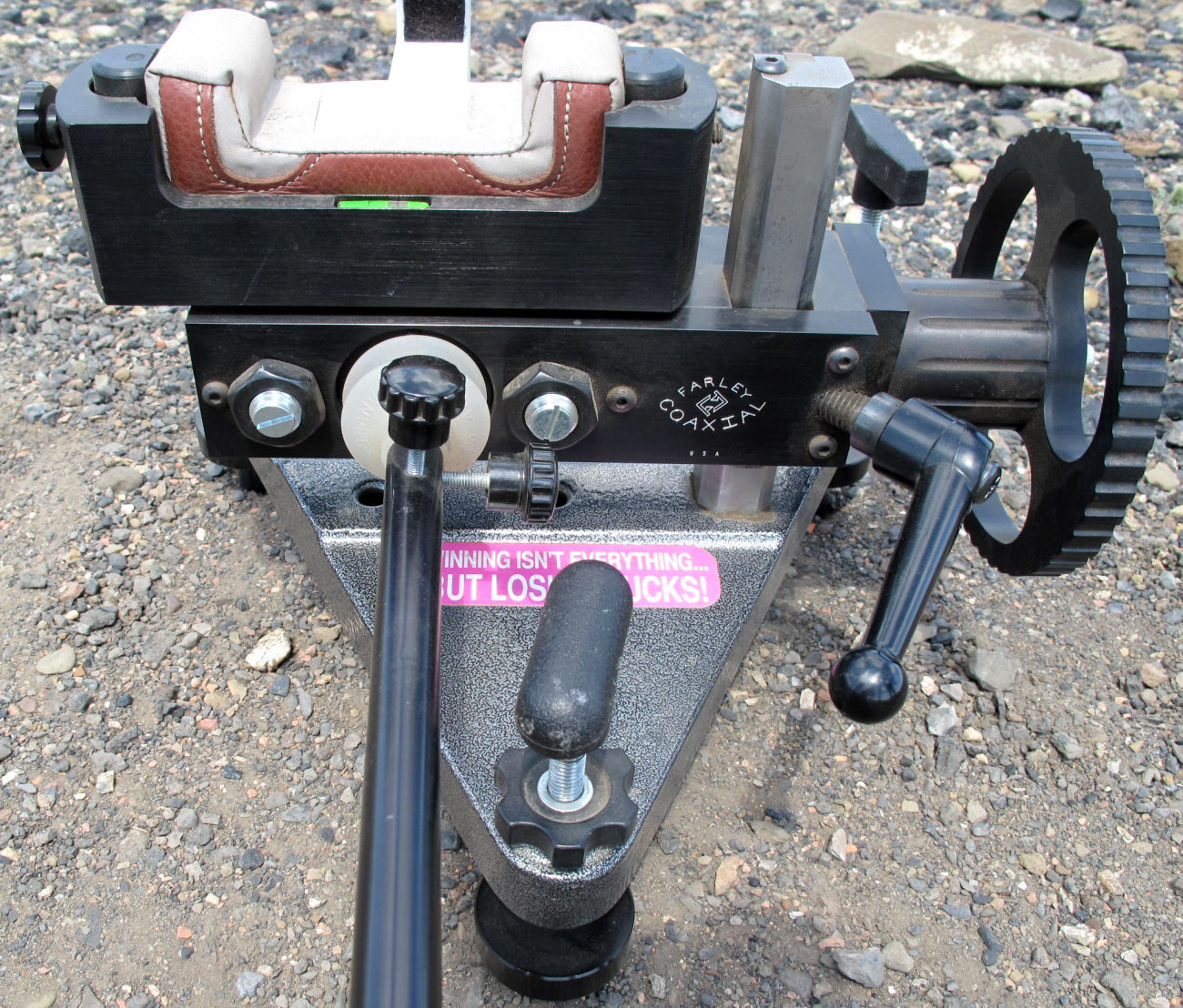
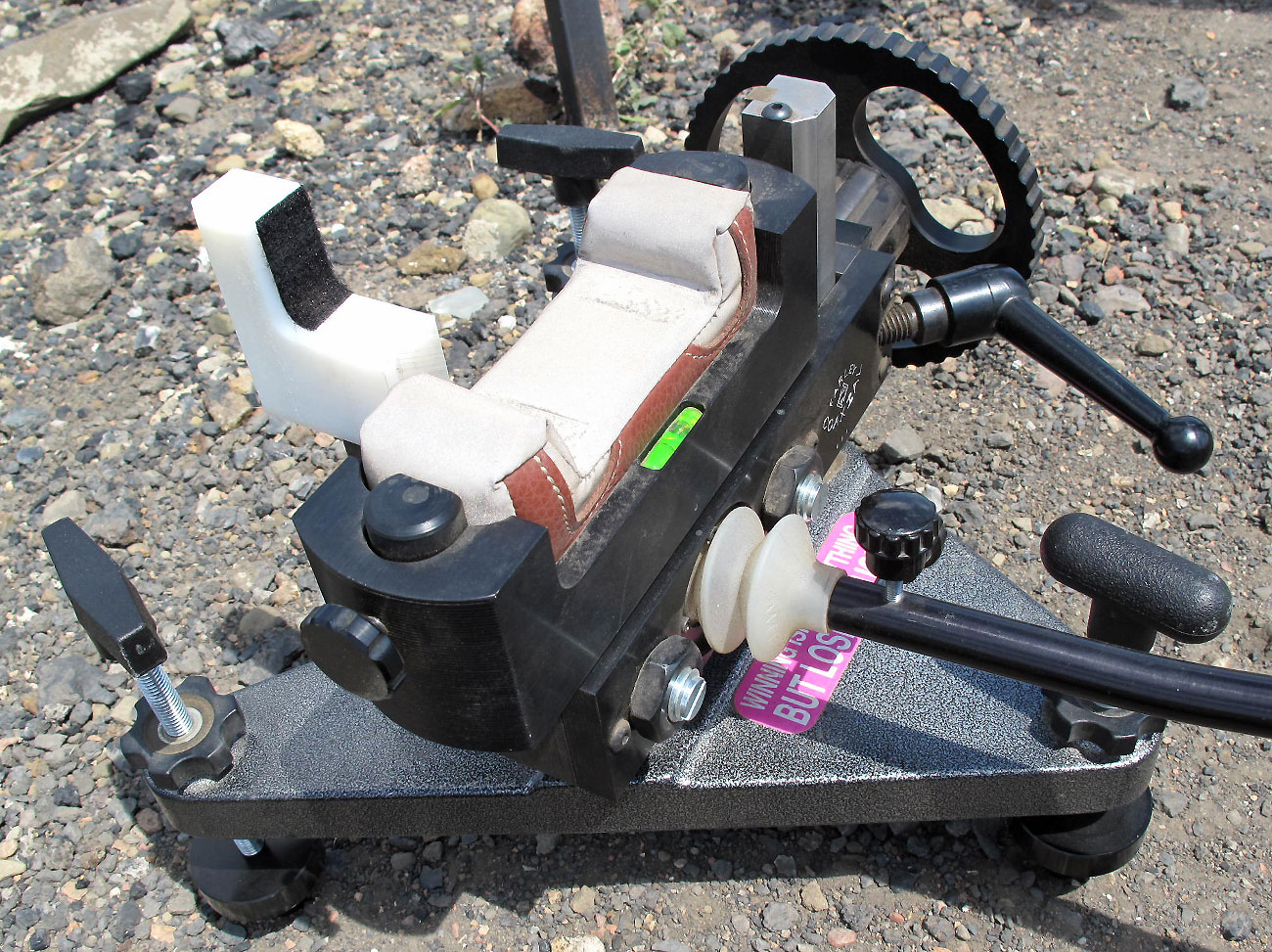
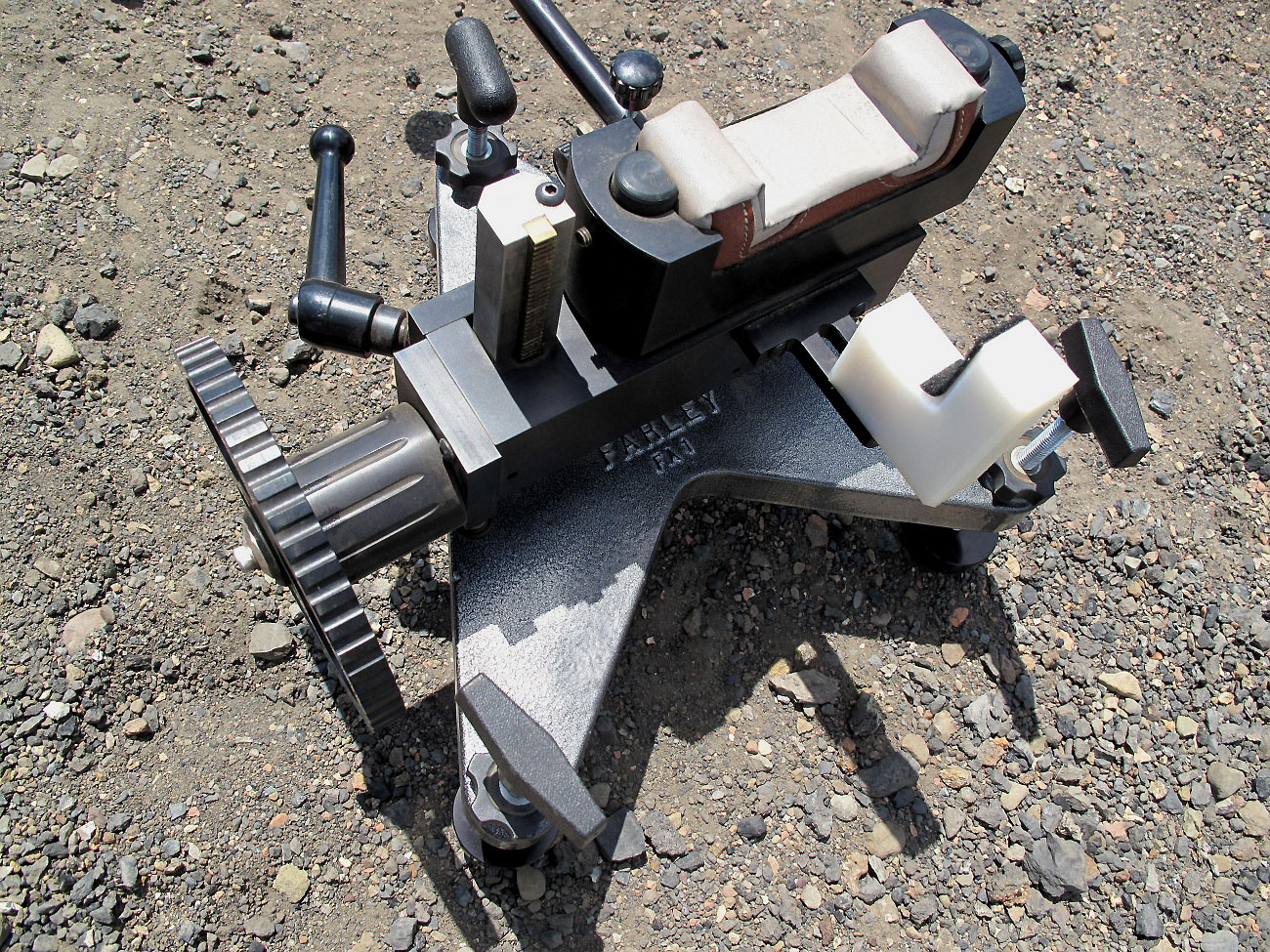
 At the F-Class Nationals in Raton, we saw a wide variety of front rests being used by F-Open shooters. One that caught our eye was a new prototype Farley Coaxial rest brought to the match by our friend Speedy Gonzalez. This one-of-a-kind Farley features a big wheel on the side for gross elevation adjustment, plus an extended locking arm. These two upgrades make the rest easier to use from the prone position. Up front is a new L-shaped Delrin forearm stop (Speedy say this would be black in the production version). Special large-diameter feet with extended “anchor shafts” complete the package. (See bottom photo.) Speedy used this rest at the Nationals and did very well, finishing second in the Master division, and in the top 15 overall among all Open-class shooters. At the F-Class Nationals in Raton, we saw a wide variety of front rests being used by F-Open shooters. One that caught our eye was a new prototype Farley Coaxial rest brought to the match by our friend Speedy Gonzalez. This one-of-a-kind Farley features a big wheel on the side for gross elevation adjustment, plus an extended locking arm. These two upgrades make the rest easier to use from the prone position. Up front is a new L-shaped Delrin forearm stop (Speedy say this would be black in the production version). Special large-diameter feet with extended “anchor shafts” complete the package. (See bottom photo.) Speedy used this rest at the Nationals and did very well, finishing second in the Master division, and in the top 15 overall among all Open-class shooters.
CLICK Photos Below to See Full-Screen Version.

Speedy says the folks at Farley hope to market the Big Wheel Coaxial with these F-Class upgrades by the end of 2013. Some of the items should be available for purchase separately, as upgrades to current Farley rests. Sorry, no pricing is available at this time.

The rest also sported a new Edgewood front bag with the new light-colored, super-slick bag material. Along with the new bag fabric, Speedy explained that there are subtle changes to the bag design and construction so that it holds its shape better and doesn’t “plump up” in the middle.


September 10th, 2013
While attending the 2013 F-Class World Championships at Raton, we had a chance to talk with Derek Rodgers, who had just been named the 2013 U.S. F-TR National Champion. Derek’s F-TR Win at Raton makes him the only shooter to have won U.S. F-Class National titles in both F-Open and F-TR divisions. Derek was excited about his performance at Raton: “F-TR was my first love in competitive shooting and [winning the F-TR title] has always been a personal goal to achieve”. In this Q&A session, Derek tells us about his rifles and his Nationals-winning .308 Winchester load. Derek also provides some advice for new shooters in the F-TR game.

Q: Readers want to know about your rifle. How did your select your stock, action, and bipod? And tell us about working with your gunsmith Doan Trevor and the quality of his work.
Derek: For my F-TR project, I carefully chose as many lightweight components as possible, without compromising performance. I wanted to put the weight savings (from light components) into a heaver, stiffer barrel. The rifle features a left port, left bolt Kelbly F-Class Panda action fitted with a Kelbly trigger. The stock was acquired as an uncut blank. It’s a McMillan Prone stock and is very comfortable in design. It also has a nice vertical pistol grip and gentle palm swell. This makes getting behind the gun feel very natural. [Editor’s Note: Though Derek is a right-hander, he shoots with a Left bolt-Left port action. This allows him to stay in the shooting position, right hand on grip, while manipulating the bolt (and feeding rounds) with his non-trigger-pulling hand.]
CLICK on Rifle Photos for Full-Screen Versions

Rifle photos by Dennis Welker.

 Doan Trevor built the entire rifle. Doan even made all of the hardware on the gun. Doan was able to drop pounds vs. ounces as a result. Doan’s 3-way butt-plate hardware alone weighs just half a pound! Doan was highly attentive in helping me build the gun the way I wanted. His bedding and fitment is clean and he has creative ideas for the competitive shooter. While my stock is fiberglass, Doan really shines when it comes to building stocks from wood blanks. In fact, Doan built the stock used by second-place finisher Lige Harris, and also fourth-place Trudie Fay. I feel fortunate to have Doan so close. He’s truly a master craftsman who can quickly turn a project into reality. Doan Trevor built the entire rifle. Doan even made all of the hardware on the gun. Doan was able to drop pounds vs. ounces as a result. Doan’s 3-way butt-plate hardware alone weighs just half a pound! Doan was highly attentive in helping me build the gun the way I wanted. His bedding and fitment is clean and he has creative ideas for the competitive shooter. While my stock is fiberglass, Doan really shines when it comes to building stocks from wood blanks. In fact, Doan built the stock used by second-place finisher Lige Harris, and also fourth-place Trudie Fay. I feel fortunate to have Doan so close. He’s truly a master craftsman who can quickly turn a project into reality.
I chose a Bartlein barrel on this rifle. It is an 1:11″ twist, 32″ long, heavy-contour barrel to stabilize heavy bullets. This barrel was a real hummer from the start. I shot six shells over the chronograph to determine initial chamber behavior and all six loads shot into 1 hole at 100 yards. Each cartridge had 0.5 grains increase in powder. That’s never happened to me before.

Up front, I used a Duplin Bipod. It weighs just 17.2 ounces and is made in North Carolina by Clint Cooper and supplied through Brownells/Sinclair. It is a new product for them and it has already proved to be an extremely lightweight, solid platform. Kelbly rings and an NXS 8-32X scope top the rifle off.
Q: Could you talk about your experience shooting at Raton — dealing with the challenging winds. Did you have any strategy going into the Nationals? Did that change?
Derek: The Raton winds can be intimidating to a person that has never shot there before. In fact, one of the first comments I heard was that it was ugly and nasty out there as the flags ripped straight out to the NW. I glanced downrange and thought it looked like another beautiful New Mexico day (being from NM does have its perks). There is usually no shortage of big wind out here. I’m fortunate to shoot 1K matches locally at a Del Norte Gun Range located outside of Albuquerque. It prepared me to shoot when I can see the mirage and proceed with caution when I can’t. It is the same elevation as the Whittington Center and gives me true testing with actual come-ups that will work dead on at both ranges. My strategy going in to the match was to shoot heavy 200 grain Berger hybrid bullets. I felt like it was the best compromise between BC and velocity. My load held an incredibly flat water-line and that gave me the confidence to either shoot through the entire string in tough wind or stop and wait until the switching winds returned to what I like to see. I was fortunate to pick the correct wind-sets and jump in when I needed to — or wait when the mirage didn’t look right. It paid off as I saw competitors’ targets raised with wide ring spotters. A few times I watched my clock and let a couple relays tick down to the last several minutes before finishing. The winds are quite challenging here and wind pickups and let-offs are huge! The wind calls are definitely magnified in Raton.

Q: You are the only shooter to have won both the F-Open and F-TR U.S. National Championships. How would you compare and contrast F-Open vs. F-TR?
Derek: Now that I’ve won both F-TR and F-Open National titles, I have finally captured the elusive F-TR national victory. F-TR was my first love in competitive shooting and [winning the F-TR title] has always been a personal goal to achieve. I could not be happier to win in my home state with a spectacular level of expertise in attendance. You really need to remain 100% focused in F-TR and try not to miss any condition change. If you do, you will pay dearly as the .308 Win just doesn’t have the extra horsepower to plow through the minor wind changes like Open guns can. Needless to say, F-Open shooters have their hands full in Raton as well; high BCs and fast, booming magnums aren’t the only way to get good scores. Open shooters need to be just as in-tune with the wind. Most of the Open Class shooters use sophisticated rests and cartridges superior to the .308 Win. However, I saw rough conditions disrupt many top shooters as they handed over their score cards to line officers. Although not in a front rest, I have learned to manage my F-TR gun to keep it tracking straight back under recoil. I had two main concerns in Raton this year with my F-TR rifle: 1) Keep all my shots on paper even if the winds blow 25+ mph; and 2) do NOT shoot another target! It’s very easy to do if your bipod slides over during recoil. That was less of a concern for me when I shot Open. Open Class rifles have a more stable foundation that stays in place better. However, just one crossfire at this level will take you out of contention to win anything in Open or F-TR. Both classes are very tough these days on the upper level and you can’t afford to give away points.

Q. What was your load for Raton and did you have to make any adjustments for the altitude or temperature?
Derek: My load for the upcoming Nationals was something I used earlier in the year to win the 2013 East Coast Sinclair Nationals: Berger 200gr Hybrids, Lapua brass, Varget powder, Wolf LR primers. I felt it was very consistent against some of the best F-TR shooters around. However, my biggest concern was my load being over-pressured in late summer. It was a hot year in New Mexico. In June, I made a couple trips to Raton and discovered my loads that I felt were safe were actually on the hot side. I tested locally in the heat of the day vs. calm cool mornings. I also spent quite a bit of time studying past load data / temperatures and came up with a game plan to work with what I had. I kept my fingers crossed that the ambient temperature would stay in the low 80s. I knew my load shot well from 50-80 degrees, but above that and I thought I may have problems with the groups coming apart late in a string. I saw this happen to me in the past with temp-stable powders in a .308 Win. In fact, .308 Win loads become much more critical when pushing the cartridge to its full capacity. Had the temps been in the mid to upper 90s, I’m sure the rifle would have shot differently.

Q: What advice would you offer to someone getting started in F-TR competition?
Derek: I think shooting F-TR has allowed me to really get an idea of what the wind is doing. If a new shooter is interested in trying it, the best tips I can offer is to partner up with a few experienced shooters that know how to hand-load carefully and compare shooting notes. This helps someone get traction with proven methods. Another tip would be to get matches under your belt–at different ranges. It may seem trivial, but each range is different. The shooter may benefit by seeing something that he hasn’t encountered before. The other thing I’d suggest to new shooters is not to worry about your score when starting. Keep shooting. More trigger time is key. I’d recommend working on eliminating your lowest ring value first. For example, if you’re lowest score was a 6, next match try to only shoot better than 7s. Once that is eliminated work on your 8s. When you consistently shoot 9s and 10s then you can be assured that your technique is solid and manageable. Higher scores and Xs will come….
|