Take heed — if you want to compete at the 2013 U.S. F-Class Nationals and F-Class World Championships this July in Raton (NM) you need to register right away. Don’t delay! Individual registration for both of these events will close on June 15, 2013. That’s just one week away. Match organizers tell us that: “No entries will be accepted after that date.” Also Team entries for the F-Class Worlds will be closed as of June 15, 2013. There will be no late entries accepted at the range.
However, per program announcements, Team entries for the F-Class Nationals (not the Worlds) will be accepted at the range. But individuals MUST still register by June 15, and Teams for the World Championships must be registered by that date also. Currently, 31 teams have registered for the event: 6 F-Open National Teams, 13 F-Open 4-man teams, 7 F-TR National Teams, and 5 F-TR 4-man Teams.
The 2013 F-Class Nationals and World Championpships are being hosted by the Bald Eagles Rifle Club. Click the links below to download further information on the U.S. F-Class Nationals and World Championships at Raton, NM:
Editor’s Comment: All long-range competitive shooters should watch this excellent video — whether you shoot with a team or as an individual. Three cameras were used so you can watch the shooter, the range flags, and the target simultaneously. After a discussion of scoring, the actual shooting starts at the five-minute mark in the video. Under the guidance of wind coach Gary Rasmussen, U.S. F-Class Open Team Captain Shiraz Balolia shoots 100-7X for ten shots, following Gary’s wind calls.
Team Shooting with a Coach Shiraz tells us: “We come across a lot of shooters who have never shot under a coach. This video was produced to give shooters a basic understanding of shooting with a coach and the importance of releasing a good shot. In a team setting, you basically leave all the decision-making to the coach and aim where you’re told to aim. I’ve worked with Gary many times and it shows in the comfort level we have with each other. The coach plots the shots or a plotter advises the coach of any grouping that is not centered.”
Watch Gary Call the Wind and Shiraz Shoot 100-7X for Ten Shots
For best viewing, click the YouTube settings button to watch in 720p or 1080p HD (high definition).
Shiraz was shooting a 7mm F-Open rig: “My .284 Shehane rifle takes about 10 to 12 shots to settle down and that is probably why we made several scope adjustments while shooting. It is a great caliber and a step up from a straight .284 Winchester. The wind was relatively calm, but sometimes that slow wind with subtle angle changes can be very deceiving.”
The video was shot the first week of May 2013 at a range in Custer, WA located about 20 miles from Bellingham, Washington. The production team included Shiraz Balolia, Gary Rasmussen, three cameramen, and a target puller. Big Thanks to Grizzly Industrial for providing the camera crew and post-production talent.
Forum member Keith T. (aka “KT”) is in the U.S. Navy, so he has a fondness for seafaring, nautical color-schemes. Here is KT’s new F-Open rifle, smithed by Accurate Ordnance out of Winder, Georgia. The gun is chambered in .284 Winchester for Lapua brass (necked up) and 180gr Berger Hybrids.
KT admits, “It’s a little bit different than most in appearance!” But KT likes it that way: “When I had Accurate Ordnance build it, the only thing I specified was the stock, action, caliber and barrel length. I left the rest up to them. I think they did a pretty awesome job.”
The gun features a Pierce cone-bolt long action (with Jewell trigger) in a McMillan F-Class stock. The barrel is a Brux 31″, 1:9″ twist in the Brux “F-Class contour”. Sitting on top is the new Nightforce 15-55x52mm Competition scope with turrets and sun-shade coated blue to match the blue-coated action, bolt handle, rings, trigger guard and barrel.
The build came out great, but there were a few “bumps on the road”. KT explains: “This rifle took a long time to finish. When it comes to building guns I always joke and say if it weren’t for bad luck I wouldn’t have any luck at all. We started ordering parts in September 2012. Somehow I managed to order the stock from McMillan for the wrong Pierce action. After a bunch of scrambling and hard work on Accurate Ordnance’s part we were able to get my screw-up fixed. Then we ran into a few more snags. AO wanted to have the scope on hand before doing the coating. The first trigger was not up to standard with AO so they ordered another one and the list goes on. The rifle is finally done though and I couldn’t be happier.”
In most of the country “March Madness” is all about hoops. But in the Sacramento (CA) area, “March Madness” is a popular multi-match shootfest that brings out some of the top F-Class and sling shooters in the region. During this year’s Folsom Shooting Club March Madness series, Forum member Bob A. (aka “Killshot”) brought out his “Forum Classifieds Special” and beat all comers in the F-Class Division in both the American-Canadian Match and the Long Range Regional Match (See Results). Bob’s 6mm Dasher sports a blue-printed Rem 700 action. Who says you need a high-dollar custom action to run with the big dogs? In fact, this same gun, built with components sourced from Forum Classifieds, set a Sacramento F-Class range record of 200-17X. In this story, Bob talks about the build, and he explains his methods for loading ultra-accurate Dasher ammo.
Bob’s Budget-Build Dasher F-Classer
I’m a newcomer to F-Class competition and shot my first match in 2010. After getting accustomed to the match format and seeing what others were using, I wanted to build a proper rifle for F-Open but needed to keep it simple and, well, cheap. I found a solid “base” to build on in the form of a Dave Bruno-built, “pre-owned” 6-6.5×47 Lapua that I located in the AccurateShooter Forum classifieds in late 2011. The base action was a trued and blue-printed Remington 700 receiver circa 1971 with a spiral-fluted bolt. It was in a Shehane ST1000 stock painted sky blue and had a Jewell 1.5-oz BR trigger. I sent the bolt to Greg Tannel (Gretanrifles.com) to have the firing pin hole bushed and sleeved, the ejector removed and the hole filled and the face trued. I ugraded to Tannel’s Light Steel firing pin assembly while it was out.
Having the working bits completed, I needed a barrel. So I went to the AccurateShooter classifieds again and found a 1:8″-twist, 30″ x 1.25″ (diam.) Bartlein with a 0.236″-land bore. I called Dave Kiff and explained my pursuit and he recommended his PT&G “world record” 6 Dasher reamer (.2704″ no-turn neck and .104″ freebore). A month or so later the reamer and gauges arrived.
I had the barrel chambered by Marc Soulie of Spartan Precision Rifles (510-755-5293, Concord, CA). Marc is a great builder and I’m pleased to call him a friend. He is an outstanding shooter himself and developed his lathe skills from several “name smiths” I won’t mention here, all while he continued in his previous profession. Marc went into building custom rifles full-time a couple of years ago and is at the point in his career that word of his work has spread. He was recently selected by Frank Galli to create 25 rifles, each customized to the buyer’s specs, for the Sniper’s Hide 2013 Group Build. Marc has also built a number of tactical-style rifles for the Northern California Practical Precision Rifle Club’s shooters, several of whom have won or placed high in major matches.
After his great shooting in March, Bob reports: “I could not be happier with my little budget build. With a few more good scores I might even stop looking at BAT Machine’s website — my little old Remington action seems able to hold its own with the BATs and Kelblys just fine.
The rifle got its good looks from a Pennsylvania artist named Kenny Prahl. His Prahl Designs shop (724-478-2538) added the white ghost-flames over the existing sky blue metallic paint. Kenny’s work with an airbrush floored me, he does everything from stocks to mailboxes to gas tanks equally well.
“I use a Nightforce Benchrest 12-42x56mm with a NP-2DD reticle. To help my aging eyes I use a 3.5X BulzEyePro lens booster, I found it helped with mirage and target clarity enough that I rarely dial down the magnification even when mirage is bad.”
Looks Great, Shoots Better
Fire-forming showed great promise — ten-shot groups of half an inch at 200 yards were typical. I lost only one case to a split neck and the “blow lengths” are good and consistent.This was followed up with load development which saw 100-yard, five-shot groups in the .1s and .2s as the rifle showed its preference for Reloder 15 over Varget powder, and for CCI 450s over all other primers. The bullet of choice is the ever-popular Berger 105gr Hybrid Target.
In February 2012 I began shooting the Dasher in monthly club matches at the Sacramento Valley Shooting Center, the home range of a number of excellent F-Class, Benchrest and High Power shooters. Using a Farley Coaxial rest up front (also picked up from a WTB ad on AccurateShooter’s Forum) and an Edgewood bag in the back, I gradually improved my gun-handling to the point where I could shoot a respectable score. This was very different from the bipod shooting I’d done in the past in F/TR.
Like many others, I settled on the high-node dose of Reloder 15. Shooting F-Class puts a good number of rounds down the tube in a short time-frame. That can be hard on throats. At roughly the 1,200-round mark the groups started to grow as the throat wore. So, a barrel set-back was needed. The barrel was rechambered by another great California gunsmith, Ken Breda (831-334-2386, Aptos, CA). Ken, a sling shooter and all-around good guy, was able to get me back shooting with little down-time. When I went back to the range, I found the now 1.25″-shorter barrel shot equally well, even with the same load I had previously used.
An October Surprise — New Range Record, 200-17X
The chamber setback and muzzle cleanup brought the Dasher back to life and it was was really shooting well with several “cleans” shot at a few distances at club matches this summer. I shot the Folsom Shooting Club’s October match, this one a 3×600. I drew relay number two and settled in to spot and score for the shooter who drew relay one. The wind was very light and good scores were being posted. I set up for my first string and fired four sighters: three 10s and one X.
“Here we go”, I thought as I went for record. Happily, the first six shots found the X-Ring before a 10 came up out of the pits. The next six shots also found the X-Ring, then another 10 came up. Shots 15 thru 19 were all Xs and I finished the string of twenty shots with a final 10. I’d cleaned the 600-yard F-Class target with 17 Xs! This was by far my best “clean” at any distance.
I followed the first string up with a 199-6X and a 195-7X as the wind was beginning to harrass everyone on their third strings. My final score of 594-30X gave me my first win in F-Open by one point. I was very happy and received many congratulations from fellow shooters after the match. It wasn’t until I arrived at the range for November’s match that I learned that my 200-17X was a new range F-Class record.
I couldn’t believe it. Considering the quality of shooters and the number of big matches held at Sacramento Valley, setting a range record of ANY type there is an accomplishment. I have been fortunate to meet and shoot with some absolutely fantastic people at the Sacramento Valley Shooting Center. It took a little while to find out just how talented some of them were — several are national champions and record-holders but you’d never know it talking to them. These guys have always been helpful to others. Likewise, I try to help out when new shooters need a hand.
Dasher Loading Tips
My chamber is set up for Lapua’s current iteration of 6mmBR brass, in the blue plastic boxes. My case preparation is straight-forward. I fire-form with virgin cases right out of the box. I don’t size them but I will give the primer holes a good look and clean up the flash hole with a .058″ bit in a pin vise. To fire-form, I seat a Berger 108gr BT .030″ into the lands over a standard 6mmBR load of Varget.
For my match load, I use Alliant Reloder 15. We shoot year-’round in Northern California. It was a brisk 28º at the start of our January match this year. Your load needs to be able to carry you from that cold to the 100º+ heat we get in the summer months. While Varget is less sensitive to temperature changes, RL15 gives me lower spreads and better long range control.
I clean my fired cases with stainless steel media in a Thumler’s rotary tumbler after every firing. I anneal after every other firing using a Bench-Source machine which is very well made and easy to operate. I use a Whidden full length bushing die with Redding bushings for sizing.
After sizing, I chamfer the inside of the neck with the K&M tool which has a pilot rod centered in the flash hole. Then I’ll give the neck and mouth a “once over” with some 0000 steel wool. I finish loading off with a Redding Competition Seating Die with the micrometer top.
I use a carbide ball on the expander rod of the full length sizing die. I use a .266″ TiN-coated bushing and the ball just kisses the inside walls of the sized neck. I get very consistent neck tension this way and have had no issue with split necks.
Seating Depth Considerations
With fire-formed brass, the junction of the bullet’s bearing surface and boat-tail is above the neck/shoulder junction of the case, so I have no issues with donuts. You can see how a loaded round looks in the photo at left. For occasional trimming, I use a very nice little Possum Hollow trimmer that indexes on the case shoulder.
Our IT guy, Jay (aka ‘JayChris’ in the Forum) shoots F-Class with a 31.5″-barreled rifle. He wanted a quality soft-case that could protect his F-Class rifle and the large Nightforce 12-42 NSX scope on top. After looking at many options, Jay selected the Bald Eagle BE1021 Long Rifle Case. Jay tells us: “I just bought one of these, after seeing a couple guys with them at the range. They can easily handle a long prone or F-Class rifle and have good padding (similar to the Creedmoor case) and seem well-built. I also noticed a lot of the sling shooters showing up with them.” Bald Eagle offers this case design in two colors: black (BE1021) or red (BE1020). The BE1020/21 soft cases measure 55″ long by 13″ tall. There is a large, zippered compartment on both sides of the case.
Amazon Buyer Review (by Gonzos):
This is a well-made, sturdy case for large rifles with a scope. Easily fits my 31-inch barreled F-Class rifle with a 12X42 Nightforce scope on it. I have no problems with it at all — in fact this is my third one. I wish the side pocket was full length (to hold a cleaning rod) but other than that it is perfect.
Report by Richard King (King’s Armory, Texas; ‘Kings X’ on our Forum)
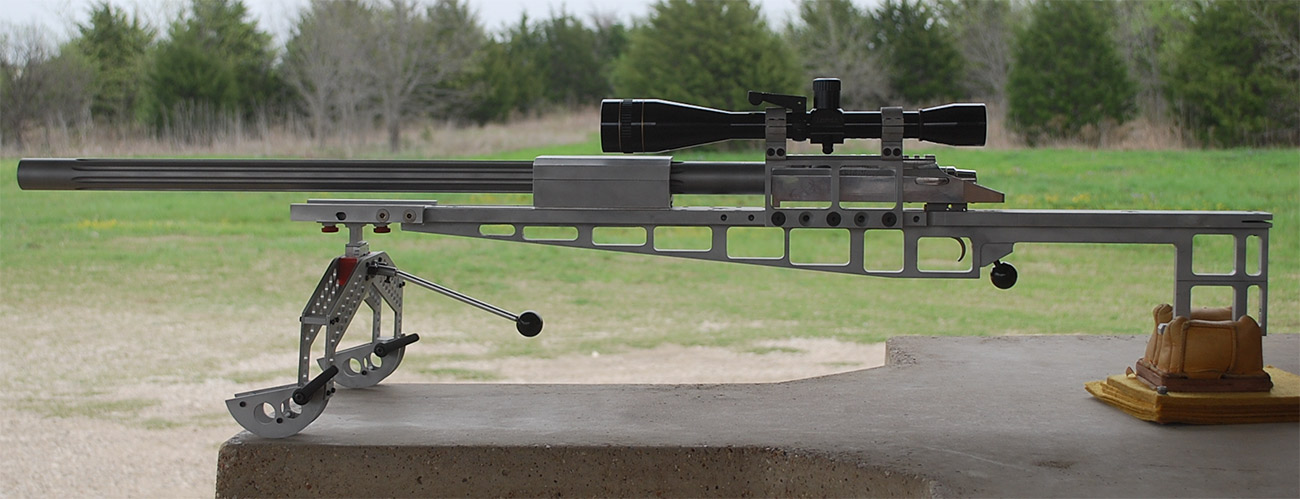
With all the talk from Vince Bottomley in the April issue of Target Shooter about aluminum stocks, I thought you might like to see my latest project. This is my personal gun, built the way I wanted it. I know it’s radical and some may not care for it. But it works.
This is pretty much an all-aluminum rifle. The action is a Kelbly F-Class with a Shilen stainless steel competition trigger. The scope is a 1″-tube Leupold 36X with a Tucker Conversion set in Jewell spherical bearing rings. The .223 barrel is Pac-Nor 3-groove, 1:6.5″-twist mounted in a “V”-type barrel block. The bipod has vertical adjustment only via a dovetail slide activated by a stick handle. It works like a joy-stick, but for vertical only. I adjust for windage by moving the rear sandbag.
The 30″ barrel is 1.250″ in diameter. With the barrel block forward, the vibrations should be at a low frequency. Instead of one long rod whipping, I now have two short rods (barrel haves) being dampened. This is my fourth barrel block gun. They work, but so does a good pillar-bedded action. I just do stuff a little different.
The vertical “keel” down the bottom of the stock stops the “spring” of a flat-bar stock. There is little, if any, noticeable flex before or during recoil. The long length of the stock, the fat barrel, and the forward-mounted barrel block work together to keep the gun from rising off the ground. BUT, remember this is a .223 Rem rifle. A .308 Win version might act very differently. I may try a .308-barreled action soon, just to see what happens. But I will stick with the .223 Rem as my choice for match shooting.
The offset scope idea came from a benchrest “rail” gun. In truth, the whole concept came from a rail gun — just adapted to being shot off a bipod. Sure it isn’t directly over the bore. It is about 1.5″ over to the left. So if you want the scope to be zeroed on the center of the target, you have to adjust for the offset. At 100 yards that is 1.5 MOA. But at 300 it is only 0.5 MOA, at 600 only a ¼-MOA, and at 1000 about 1 click on my scope.
What the offset DOES do for me is eliminate any cheek pressure. My cheek never touches the stock. Since this is only a .223 Rem, I don’t put and shoulder pressure behind it. And I don’t have a pistol grip to hang on to, but I do put my thumb behind the trigger guard and “pinch” the two-ounce trigger.
The offset scope placement could interfere with loading a dual-port action from the left. That’s not a problem for me as I set my spotting scope up on the left side very close to the rifle. I have plenty of time to reload from the right side while the target is in the pits being scored.
Again — this is my rifle. It is designed for my style of shooting. It is not meant to be a universal “fit all” for the general public. However, I will say the design is adaptable. I can easily convert the system to run in F-Open Class. I would drop a big-bore barreled action into the “V” block, slide on a heavier pre-zeroed scope and rings, add plates on the sides up front to bring the width to 3”, and maybe a recoil pad. It might be interesting to offset the wings up from to counter torque of the big bullets. But I would also have to offset the rear bag rider to get the gun to recoil straight back.
How the Gun Performs
I have had “T” to the range only twice for load development. It groups like my present barrel-blocked 223 F-TR gun. But it’s much easier to shoot and it only moves about 3/4” — straight back. I tried to build am omni-directional joy-stick bipod but I could not get all the side-to-side wiggle out of it. So I have set it up so it only moves up and down (horizontal movement is locked-out). As it works now, the joystick on the bipod lets me set elevation on the target quickly (with up/down adjustment). Then, to adjust for windage, I slide my rear bag side-to-side as needed. Once set, I just tickle the trigger and smile.
Gun Handling — Shoot It Like a Bench-Gun
I basically shoot the gun with no cheek or body contact. I don’t grip it, other than maybe a pinch on the trigger guard. The scope was offset to the left to help the shooter move off the gun and avoid the possibility of head/cheek contact with the stock.
Listen to Richard King Explain How He Shoots his ‘Texas-T’ Rifle:
[haiku url=”http://accurateshooter.net/Video/RichKingTalks.mp3″ Title=”Richard King Talks”]
This August the U.S. National and World F-Class Championships will be held in Raton, New Mexico. The U.S. F-Class Open Team has been working hard to prepare for the Worlds in Raton. This will be the fourth F-Class World Championship and first time it is being held in the USA. Team Captain Shiraz Balolia and his team-mates hope to successfully defend “home turf” this summer. The F-Class World Championships will run August 23 to 27, 2013. Preceding the World Championships, the U.S. F-Class National Championships will be held from August 18 to 22, 2013.
Team Members and Selection Process The US F-Class Open Rifle Team consists of the top F-Open shooters in the United States. Some members were on previous teams, but Team Captain Shiraz Balolia explains: “Our try-out process was very stringent and above board, which removed the notion of an ‘old boys club’ and allowed a lot of new blood to try out for the team”.
The selection process was straightforward. Each participant had to have placed in the top 20 of a National Championship or in the top 3 of a regional championship to be able to try out. After that, they had to participate in at least three try-outs over a two-year period. There were about a dozen try-outs at various venues (Houston, Lodi, Raton, Phoenix, Sacramento) which allowed shooters from all over the country to participate. Shooting during all try-outs were conducted at 1000 yards.
The scoring system was based on “Vertical” Score where the goal of the shooter was to hold good vertical elevation with regards to the X-Ring. All try-outs were shot with coaches and the wind calls were the responsibility of the coach. The shooters were not penalized for wide shots if they were on the waterline. The targets had horizontal lines drawn on them and points were deducted for high and low shots.
The targets were photographed and published for the try-out participants to view so everyone knew exactly where they stood. Shiraz notes: “This actually worked really well to raise the overall standard of the team as it increased competitiveness among the shooters”.
From the initial group, the first cut was made to select the Development Team (DT). These DT shooters then continued further try-outs in 2012 with a similar process. The DT group was then culled to the final team members listed below.
Captain: Shiraz Balolia; Head Coach: Bob Mead; Other Coaches: Trudie Fay, Rick Hunt, Emil Praslick
Shooters (alpha sort)
1. Charles Ballard
2. Danny Biggs
3. David Gosnell
4. David Mann
5. Dean Morris
6. Don Nagel
7. Emil Kovan
8. Herb Edwards
9. Jim Murphy
10. John Dunbar
11. John Gaines
12. John Myers
13. Ken Dickerman
14. Kenny Adams
15. Larry Bartholome
16. Mark Walker
17. Rick Jensen
18. Robert Bock
19. Tony Robertson
F-Class Insights: Q&A with Team Captain Shiraz Balolia
We did a Q&A session with Shiraz Balolia, F-Open Team Captain. Shiraz offered candid answers to “hot topic” questions of interest to F-Class shooters. He also observed that his team is working very, very hard in preparation for the World Championships. After being beaten by the Brits in 2009, Shiraz says: “We have a score to settle….”
Q: The F-Open Team has switched calibers. What was the thinking behind that move?
Shiraz: After we lost to the Brits in 2009, it became a foregone conclusion that we needed to shoot a 7mm cartridge. Charles Ballard and Jim Murphy were among the first guys in the USA to recognize the virtue of the 7 mm (.284) caliber. The choices we had within the .284 family were: straight .284 Win, .284 Shehane, 7 RSAUM, or 7 WSM variant. After much experimentation and thought we decided on the 7 RSAUM and 7 WSM family of casings which allowed us velocities of around 3000 FPS with a 180gr bullet. With the advent of new 180gr bullets from Berger and Sierra, we were able to get extremely flat-shooting groups (tight vertical) with the velocities that we needed.
Q: Foreign teams won the last two F-Class World Championships. How are you going to beat the Brits and South Africans in 2013?
Shiraz: In the previous World Championship (at Bisley in 2009), the Brits had a huge advantage. Almost all of their shooters lived within a few hours of the Bisley range. The coaches they used knew that range inside out and they were able to practice as a team many times on that range before the World Championships. Plus, they were ahead of us in terms of caliber selection and were shooting 7mm cartridges, as were the South Africans. By contrast, our team came from all over the USA and we had very little time together as a team. Things are different this time… yes, our shooters are still from all over the USA, but the amount of training we have done as a unit, a whole team, is much better than last time around. We have a lot of depth in our team. In other words, our worst shooter is not that far behind our best shooter. I do not believe that there has ever been a long range U.S. Team that has trained this hard and this many times as a unit. We are ready to take on the Brits or any other country!
Shiraz notes: “We did a lot of training on the range as well as in the ‘classroom’ setting with power point presentations. We had numerous sessions like these…. The behind-the-scenes work to deliver ‘same-day’ power-point results (just hours after the scores were shot) provides immediate feedback.”
Q: How Does Successful Team Shooting Differ from Individual Shooting?
Shiraz: In individual matches, you are responsible for making all the wind calls, corrections on the scope and paying attention to all conditions before taking a shot. Sometimes the condition can change between the time you review the flags and the mirage, make an adjustment and take a shot.
In a team setting, the shooter is responsible for making a really good shot. He/she must be a really good trigger puller who has good equipment, good ammo, and who can follow directions. The coach makes all the calls, he often makes adjustments on your scope and all the shooter has to do is make the shot when asked by the coach. Shooters who second-guess a coach or think they can read the wind better than the coach did not make the team!
Q: Will Team USA Enjoy a ‘Home Court Advantage’ at Raton, NM?
Shiraz: Other than Trudie Fay, one of our coaches, we do not have any team members from the Raton area. We are a very large nation, in size, and our shooters come from all four corners and everywhere in between. Raton is not exactly “home court”, but we have trained there as a team several times. The Brits and the South Africans are no slouches either. The Brits spent a whole week in Raton last year in August to get a feel for the range, the temperature, the wind etc.; the Brits also tested loads for their team members. The South Africans came to shoot against us in September last year at the Stars and Stripes match and also shot at the US F-Class Nationals. The competition is certainly stiff and we can not let our guard down or be over-confident.
Q. Are there special skills and capabilities needed to be a successful team shooter?
Shiraz: To be a really good team member, the shoooter must have all these qualities:
1. He must be able to think in terms of what is best for the team rather than himself.
2. He must have really good equipment. That means a really good barrel, a smooth, trouble-free action, good optics, trigger, rest, etc.
3. He must have superior reloading skills, and be capable of producing really good ammo with bullets that perform consistently shot after shot.
4. He must possess the ability to take direction and put himself at the disposal of the coaches. What we look for in a shooter is consistency over a long period of time, not just a flash in the pan.
The shooters we have on our team have passed all the tests we have put them through and what we have today is, without a doubt, the best United States F-Open Team ever put together.
Support Need for Team Expenses
The U.S. F-Class Open Team may be about $3000.00 short on funds. Any donation will help. Please endorse checks to “US F-Class Open Rifle Team” and mail to P.O. Box 3110, Bellingham, WA 98227.
Many of our readers ask: “Where can I find a top-quality rifle case that will hold my scoped, long-barreled F-Class, or Benchrest rifle?” Most of the cases you’ll find at retailers are only good for guns with max barrel lengths in the 27-28″ range. And many of these cases are a tight fit if you have a large scope with big tall turrets and side parallax knobs.
Well here’s good news for owners of rifles with long barrels (up to 32″ in length). Starlight Cases offers the SC-081454 Double Rifle Case featuring a deep lid that measures 3″ from top to bottom. The increased clearance provided by the 3″-thick lid provides additional protection, without creating side loads on your scope that can cause reliability issues. What’s more, making the lid taller allows the hard case to better fit wide-forearm rifles and rifles with attached bipods.
SC-081454 cases are currently on sale at StarlightCases.com for $288.00 (10% off). That’s not inexpensive…. but when you’re hauling up to $7000.00 worth of rifle and optics, that’s money well spent for the added protection it provides, particularly during airline transport.
Internally, the SC-081454 Double Rifle Case is 8″ Deep X 14″ Wide X 54″ Long. That’s long enough to hold rifles with barrels up to 32″ — so this case can hold Palma, Long-Range Benchrest, and F-Class rifles. Case weight, unladen, is 26 pounds. You can custom-fit the interior to your rifle by cutting the layered foam with a hot knife. The SC-081454 hard-case also includes a molded-in recessed wheel kit for ease of transport. These cases are offered in black, Olive Drab, and “flat dark earth” colors.
Why the Deep Lid is a Good Thing: We’ve seen issues with bulky rifles (with large scopes) jammed into cases with insufficient clearance from top to bottom. This can put side-loads on your scope turrets that can lead to problems down the road. While you don’t want your rifle to shift during transport, at the same time you don’t want the case lid and bottom pressing on the rifle optics. We do recommend cutting the foam to create a fitted recess for your rifle.
The patented Latch-Lock™ System (with O-ring seal) on Starlight Cases ensures an airtight, watertight, chemical resistant protective case. Fitted with a pressure equalizer valve, Starlight cases are tested watertight and airtight to 400′ pressures. These durable hard cases are temp-tested from -65° to 200°. ATA-approved Starlights exceed the stringent Military MIL-C 4150J testing standards. All Starlight cases are Made in the USA and backed by an Unconditional Lifetime Warranty. In addition, If for any reason you are not satisfied with your case when it is delivered, you have 7 days to return the case to the manufacturer for a full refund.
There was quite a bit of interest in our recent Bulletin post about ‘negative’ black-to-white targets for F-Class practice. After seeing that story, some readers wanted to obtain reduced-sized “negative targets” for 300-yard F-Class training. Well guys, you’re in luck. One of our Forum members, Sleepygator, has produced “reduced-distance” targets (with black ring-lines on white background) that he could use at 300 yards for practice. Only the center 10 and X rings are black, so you can see bullet holes easily “in the white” on most of the target (and this uses less ink when printing). There is an official reduced-distanced standard for 300-yard F-Class matches. This utilizes the NRA No. MR-63FC – F-Class Target Center which is pasted over the MR-63 target. It provides a 1.42″ X-Ring, 2.85″ 10-Ring, and 5.85″ Nine-Ring. (The dimensions of F-Class targets are found in the NRA High Power Rules, Sec. 22, part 4.)
To duplicate the 300-yard target, Forum member SleepyGator has prepared a printable version of the MR-63FC Target Center, along with a pair of training targets with two bulls and five bulls. The two-bull and five-bull targets mirror the scoring rings on the MR-63FC, but they display only the innermost three rings and two rings respectively. All three targets are Adobe Acrobat files that can be easily printed. You may need to adjust the scale (sizing) on your printer to get the dimensions exactly correct. As noted above, when printed, the 10-Ring on all three targets should measure 2.85″. This should provide some handy practice targets you can use between matches. Thanks to SleepyGator for providing these targets. You can download all three as a .Zip archive. After downloading the .Zip file, just click on the .Zip archive to extract the individual targets.
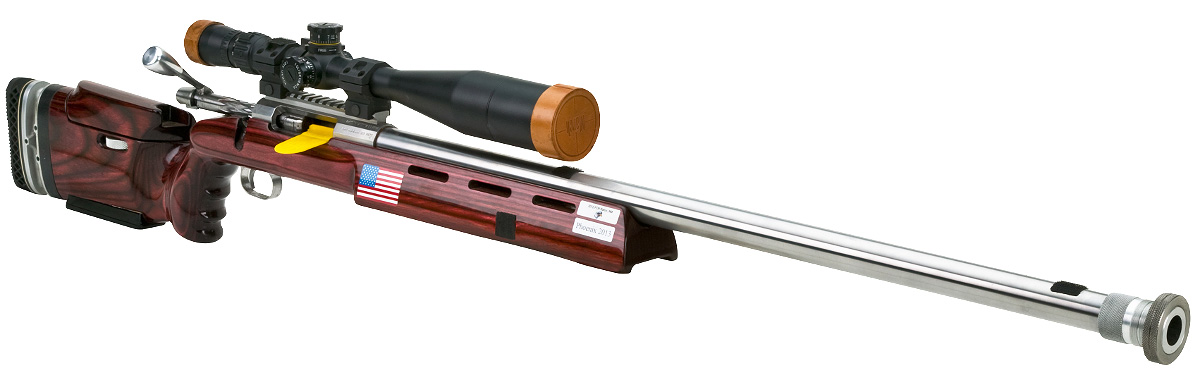
After Shiraz Balolia (President of Grizzly Industrial) won the F-Open Division at the 2013 Berger Southwest Long Range Nationals, folks wanted to know more about Shiraz’s match-winning .300 Winchester Short Magnum (WSM) rifle. That gun is a great piece of work, we can assure you. The Masterclass stock was extensively customized by Shiraz himself, who is a talented wood-worker (as well as a superb F-Class trigger-puller). CLICK PHOTO to see large “centerfold” shot of rifle.
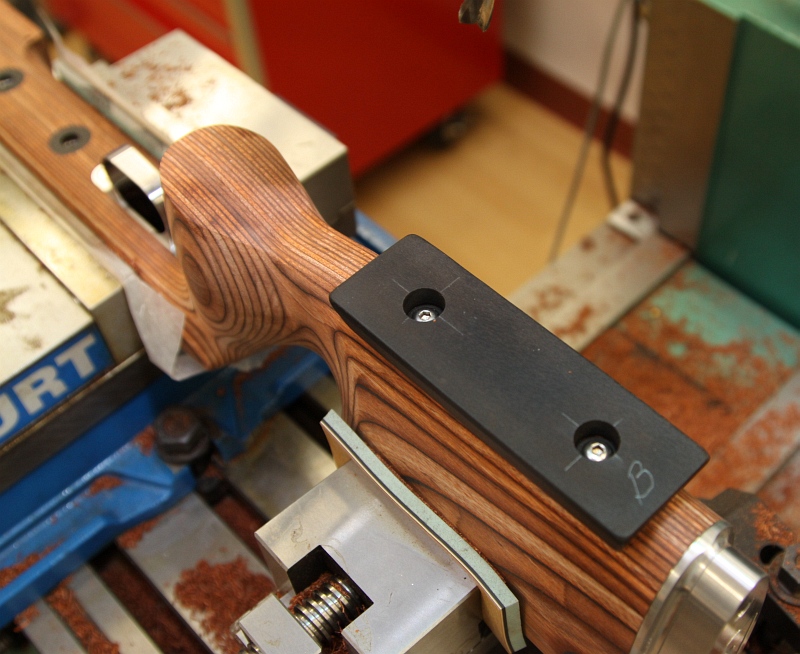
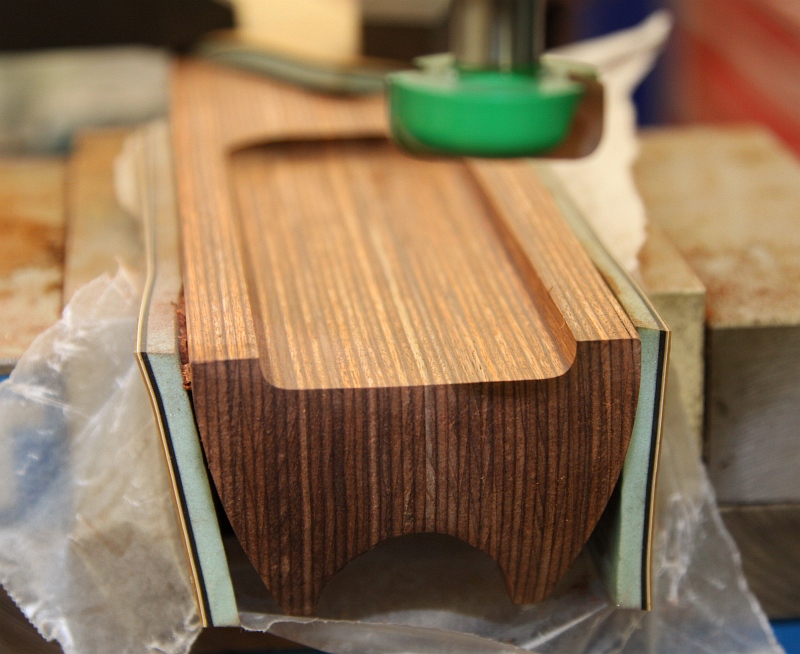
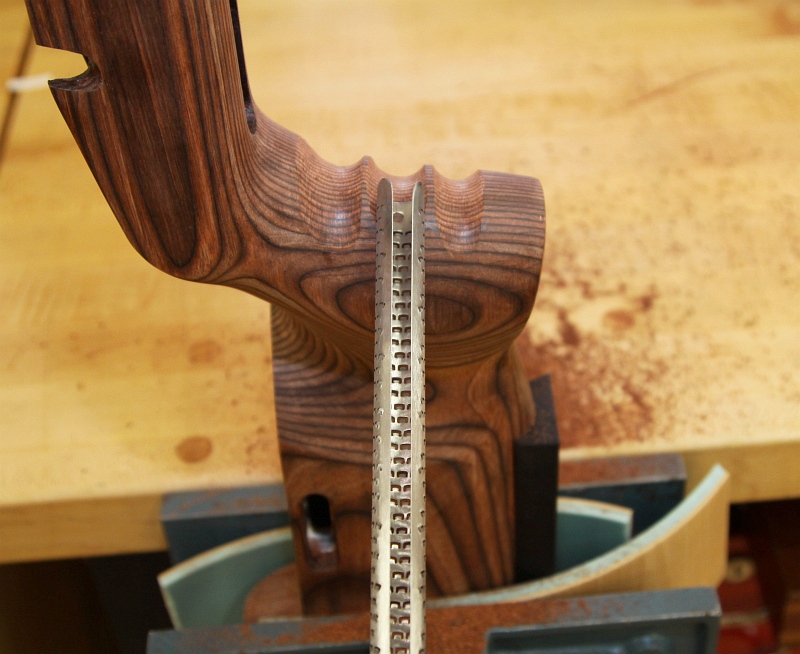
The rifle features a BAT Machine ‘M’ action, with a 32″, 1:10″-twist Bartlein barrel. Metal work was done by Gordy Gritters. The scope is a March 10-60x52mm, which sits on a +20 MOA angled rail. The primary stockwork, including fitting of the adjustable cheek-piece and buttplate, was done by Alex Sitman of Masterclass Stocks. Shiraz customized the stock with finger grooves, fore-end channel, and a bottom rear slide. Shiraz did the final stock finishing as well.
Listen to Shiraz Balolia Talk about his F-Open Victory (Click PLAY to Launch Audio File)
[haiku url=”http://accurateshooter.net/Video/shirazmemo1.mp3″ title=”Shiraz Talks about F-Open”]
Q&A with Shiraz Balolia
Q: Is the .300 WSM the “next big thing” in F-Open Competition?
Shiraz: The .300 WSM takes a bit to get used to. With more powder you have a bigger bang next to your head, plus you have to deal with the mule kick. My gun recoils so hard that it was coming to rest down on the neighbor’s target. I had to be careful about not cross-firing. Once you get these behind you it can be a very accurate caliber to shoot because of the great .30 cal bullet choices. There were about five .300 magnums in Phoenix, but only one in the top ten. You still have to read the wind!
Q: What’s your match load for the .300 WSM?
Shiraz: I use Norma brass with turned necks. At the Berger SW Nationals I used Berger 215gr Hybrids, Fed 215 LR magnum primers, and a stout load of Hodgdon H4831 SC. This drives the 215s at around 2910 FPS. If that sounds fast, remember I’m using a a 32″-long barrel.
Q: Can you tell us about your chamber and your fire-forming process?
Shiraz: On the .300” WSM [I run] a tight-neck .336” chamber for turned necks. Basically, I fire-form all my brass in a fire-form barrel and save the good barrels for matches. Gordy is so good that he can chamber different barrels to within .0002” in the headspace dimension. That way I can have several same-caliber barrels and can use the same brass for all those barrels. I use a .0005″ shoulder bump for my brass. I load the bullets so that the bearing surface sits above the doughnut ring.
Q: Do You Think Tuners Will Become Popular in F-Class?
Shiraz: Tuners are a double-edged sword. In order to use them most efficiently you need to load test the barrel in many different conditions and record the results, fine tuning and turning the dials to find the best harmonic of that barrel in a given condition. When you encounter a similar condition at a match to what you tested previously, you would look up your notes and turn the dials so that it matches your tested condition. I am over-simplifying this, as it is quite complex and there are many articles about tuners. I do not see tuners catching on in F-Class as 99% of the users would not want to go through the aggravation.
Q: The stock looks highly customized. What special work did you do?
Shiraz: The stock is a Master Class F-Class stock that was highly modified by me. I channeled out the fore-end so the stock would ride on two “rails” on the front bag and not rock. I also added a wide 1.25″ base on the bottom of the stock that rides on the rear bag. There is a matching rear bag with a wide slot in it. The gun slides back and forth nicely and is very stable. I wanted finger grooves that fit my hand so I carefully filed those by hand with a round file, making sure to fit it many times during the process. Once all the modifications were complete I sanded and sprayed the stock with clear UV lacquer. My UV booth cures the spray in minutes. I usually assemble the gun the same day I spray it. As you know, I build guitars as a hobby as well.


 Shiraz tells us: “We come across a lot of shooters who have never shot under a coach. This video was produced to give shooters a basic understanding of shooting with a coach and the importance of releasing a good shot. In a team setting, you basically leave all the decision-making to the coach and aim where you’re told to aim. I’ve worked with Gary many times and it shows in the comfort level we have with each other. The coach plots the shots or a plotter advises the coach of any grouping that is not centered.”


 “Here we go”, I thought as I went for record. Happily, the first six shots found the X-Ring before a 10 came up out of the pits. The next six shots also found the X-Ring, then another 10 came up. Shots 15 thru 19 were all Xs and I finished the string of twenty shots with a final 10. I’d cleaned the 600-yard F-Class target with 17 Xs! This was by far my best “clean” at any distance.
 Dasher Loading Tips
 I use a carbide ball on the expander rod of the full length sizing die. I use a .266″ TiN-coated bushing and the ball just kisses the inside walls of the sized neck. I get very consistent neck tension this way and have had no issue with split necks.


 The offset scope idea came from a benchrest “rail” gun. In truth, the whole concept came from a rail gun — just adapted to being shot off a bipod. Sure it isn’t directly over the bore. It is about 1.5″ over to the left. So if you want the scope to be zeroed on the center of the target, you have to adjust for the offset. At 100 yards that is 1.5 MOA. But at 300 it is only 0.5 MOA, at 600 only a ¼-MOA, and at 1000 about 1 click on my scope.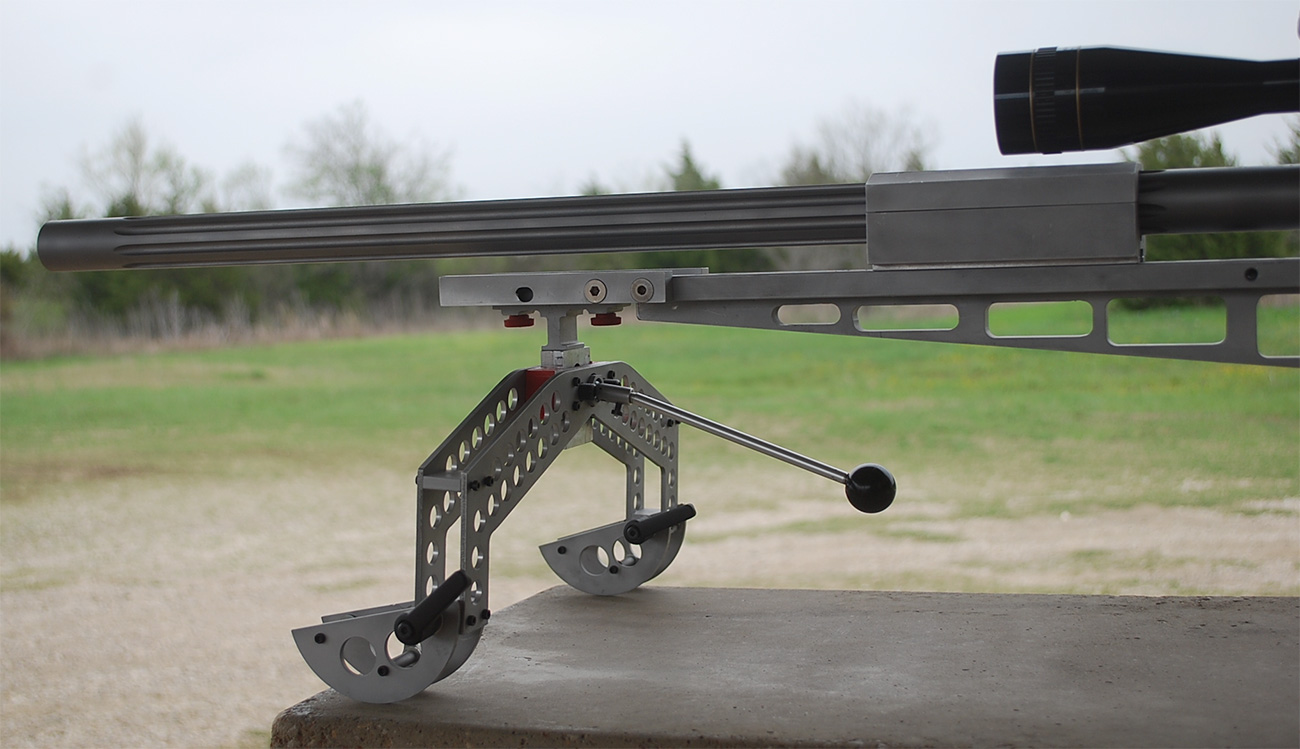





 Shiraz: Tuners are a double-edged sword. In order to use them most efficiently you need to load test the barrel in many different conditions and record the results, fine tuning and turning the dials to find the best harmonic of that barrel in a given condition. When you encounter a similar condition at a match to what you tested previously, you would look up your notes and turn the dials so that it matches your tested condition. I am over-simplifying this, as it is quite complex and there are many articles about tuners. I do not see tuners catching on in F-Class as 99% of the users would not want to go through the aggravation.