How would you like to represent the United States in top-level International Shooting competitions? Well, if F-Class is your game, here is your opportunity. F-Class Team USA will be conducting try-outs for the United States squads who will represent our country in F-TR and F-Open divisions (plus Under-25) at the 2021 World Championships. The try-outs are open to any competitive shooter with a class-compliant rifle and the will to win. Team leadership expressly welcomes newcomers.
Initial and primary tryouts are planned during the 2018 U.S. National Championships in Raton, NM, and the 2019 SW Nationals in Phoenix, AZ. There may also be an early 2019 tryout date at Butner, NC.
Dan Bramley Invites Shooters to Team USA F-Class Try-Outs
Official Invitation to Team USA F-Class Try-Outs To the F-Class Community–
On behalf of Team USA 2021, we are pleased to invite the best of USA F-class to consider joining our effort for the 2021 World Championships in Bloemfontein, South Africa. We are reaching out with this invitation to provide some general information on our plans for 2021 and for upcoming try-out dates for the unified Team USA: F-TR, F-Open, and Under 25.
We are moving forward with F-Open, F-TR, and Under 25 unified as one USA F-class 2021 Team. This will allow us to take advantage of each team’s strengths and provide needed purchasing power and coordination for event and logistic costs. We also believe this will help encourage and grow our sport. We will share ideas, event/facility dates and best practices within this unified team, however, individual team segments will make their own decisions. Therefore, please direct your responses and inquiries to the appropriate team leadership.
Being part of Team USA is a major commitment of time and resources. We do have wonderful and sizable sponsorship partners who we thank and rely on for moderating individual team member costs. However, due to the location of this World Championship effort, one can expect to help cover a commensurate level of the costs.
We are now moving into the USA “development team” stage of the process. This team is open to newcomers… there are many newer names showing up on the top of leader-boards and many new teams that are making positive impacts. If you are interested in being part of Team USA, please consider making that commitment. We would like to hear from you by March 23, 2018.
Team Time Expectations
Attendance at SWN and US Nationals will be expected for 2019 and 2020. We will also likely expect the final team to attend the Berger SWN in 2021 or have an alternative site for a final practice prior to our trip. We will try to have afternoon or evening team sessions during these events however we may have team days just prior or after these events to maximize the use of individual travel dollars and time. We will also likely have additional team training dates in 2019 and 2020, likely on east coast ranges to facilitate best availability for all.
Shooting/Coaching Position Opportunities
We are equally passionate about developing coaching/shooting teams for winning gold medal efforts in both the Richardson Cup (8-man) and Rutland Cup (4-man) World Championship Events. Obtaining a shooting or coaching spot on one of these teams is an absolute gauntlet of a commitment and consistent strong results will be required as the USA is blessed with wonderful depth. We encourage all, with proven success in our sport, to test themselves at this highest of levels.
Team Try-Out Dates and Locations
Initial and primary tryouts are planned during the 2018 US National Championships in Raton, NM and the 2019 SW Nationals in Phoenix, AZ. There may also be an early 2019 tryout date at Butner, NC.
If you are interested in further information, please contact our Team USA leadership:
Dan Bramley, Captain USA F-Open
usrifleteam2021fopen [at] gmail.com
Phil Kelley, Jr., Captain USA F-TR
usarifle2021 [at] gmail.com
Rick Jensen, Captain USA U25
U25USAFclass [at] gmail.com
The 2018 Berger SW Nationals are now history. The fun, action, challenges, and rewards now pass into memories. Once again, the Berger SWN was a great shooting match — a great way to advance your shooting skills, reconnect with old friends, and enjoy warm weather. If you are a serious long-range shooter, this is definitely one of the best-managed, most rewarding matches on the planet. In 2018 the match “sold out” in a matter of hours. If you plan to go next year, watch for the registration notices. You don’t want to be left out.
2018 Berger Southwest Nationals Long Range Results
The SWN has three new individual champions. Congratulations to the three divisional Match Winners: Bob Sebold (F-Open), Phillip Kelley Jr. (F-TR), and Allen Thomas (Sling).
Top Five Overall – F-Open
Bob Sebold, 843-49X
Keith Glasscock, 843-38X
Jay Christopherson, 841-45X
Stephen Potter, 841-37X
James Crofts, 841-34X
Top Five Overall – F-TR
Phillip Kelley Jr., 838-35X
Ellis Berry, 837-42X
Niklas Montin, 836-35X
Peter Johns, 835-36X
Edward Shelley, 832-33X
Top Five Overall – Sling
Allen Thomas, 844-37X
Oliver Milanovic, 843-45X
Trudie Fay, 842-32X
Nancy Tompkins, 840-43X
Angus McLeod, 840-43X
The Berger SW Nationals are made possible through the principal support of Berger Bullets and Lapua, both part of the Capstone Precision Group, which also distributes Vihtavuori powder and SK Ammunition in the USA. Berger and Lapua both generously donated product prizes for 2018 SWN competitors.
Today’s Champions… And Tomorrow’s New Talent
Here is the Sling Winner, Allen Thomas, with Bill Gravatt, President of Capstone Precision Group. (Bill was formerly the President of Sinclair International).
Bob Sebold, of Team Lapua/Brux/Borden also won the individual F-Class SWN Title. He’s definitely one of the nation’s top F-Open pilots.
There were a dozen or so talented juniors competing at the Berger SW Nationals. Some of the youngsters posted scores that would put the “old guys” to shame. We definitely expect to see some of these young shooters standing on the podium at future Berger SWN events. We asked them to strike a “cool pose” and the Harris boys delivered…
Berger SW Nationals Gallery — Parting Shots
Does this competitor know something we don’t know. Perhaps he is testing a new “Stealth” rifle stock from McMillan. Or maybe this is some kind of Zen body/mind melding practice. We do advocate “dry firing”, but that normally involves holding a real rifle…
Look carefully and you’ll see quite a lot reflected in this SWN competitor’s shooting eyewear. Can you identify the type of rifle?
Michelle Gallagher — She’s probably smiling at an ‘X’ — or maybe she just nailed a tough wind call. The SW Nationals is a great event because of the hard work and dedication of talented folks like Michelle.
Can you name all the pieces of hardware in this image? We see at least a dozen. Don’t forget the little items like the bubble level and mirage shield.
How do you anchor a SEB MINI coaxial rest in under ten seconds? With MAXI feet of course! These over-size hooves belong to shooter Mark Fairbairn, a very tall, MAXI-sized Australian. Who needs to pound those F-Class feet into the ground with a mallet when you can simply “stand and deliver”.
We think some competitors came to Ben Avery just for the great Barbecue lunches — well that plus the great weather and the amazing prize table. Everyone goes home a winner in one way or another.
Texas gunsmith Richard King showed us the biggest rifle action we’ve ever seen. This 13-lb monster is the BAT .50 BMG Action. Honestly it was HUGE — with the bolt fully extended it was the size of your forearm (to the finger tips). Richard joked “This weighs almost as much as an F-TR rifle (before optic) all by itself”.
Reigning NRA National Long-Range Champion John Whidden in action on the 1000-yard line. John’s rifle features a centerfire action in an aluminum Anschutz small-bore stock.
There are now two more days left for the 2018 Berger SW Nationals, with the competition heating up. From this point on, all shooting will be at 1000 yards. Friday was challenging, with increasing wind velocities over the day. Shifts were harder to figure out, and some talented shooters dropped 8-10 points. Competition was fierce. In the sling division, our friend Gary Eliseo of Competition Machine came out on top via tie-breaker. Gary and Stuart Mackey shot identical scores on Friday at each distance: 150-8X, 150-7X, and 149-8X, both finishing with 449-23X. That’s as close as it gets.
One shot left… will that last bullet end up in the X-ring? We hope so…
Saturday Shooting — Team and Individual Competition at 1000
Today, Saturday 2/10/18, all shooting will be at 1000 yards, with both Individual and 4-person Team competition. The format calls for two, 20-shot matches for both individuals and teams. Good luck to all!
MATCH RESULTS: Complete Daily Scores and On-Going Match Standings are posted on the McMillan Fiberglass Stocks Facebook Page. Here are Top Five in each Division, at day’s end on Friday, 2/9/2018:
Top Five F-Open
Bob Sebold — 449-30X
Danny J. Biggs — 449-26X
Jay Christopherson — 448-28X
Stephen Potter — 448-23X
Ubaldino De Arellano — 448-23X
Top Five F-TR
Ellis Berry — 448-26X
Peter Johns — 448-25X
Philip Kelley Jr. — 448-21X
Doug Boyer — 447-27X
Greg Barkley — 447-23X
Top Five Sling
Gary Eliseo — 449-23X
Stuart Mackey — 449-23X
Bill Vaughn — 448-28X
Curtis Gordon — 448-23X
Nancy Tompkins — 447-30X
No Worries Mate — Mark Swaps Stocks in Mid-Match
Australian Mark Fairbairn performed a “Quick Fix” during Thursday’s match. His F-Open rifle, in a conventional fiberglass stock, was giving him random vertical during one yardage: “I had a bit of a problem with elevation — the stock was hitting somewhere [causing vertical]. I was X-X-X then a shot popped up in the 9 ring with no good reason. So I figured I better put a new stock on it. I got my old aluminium stock I brought from Australia and quickly adjusted it to fit on the Stolle.” Right on the berm he swapped his barreled action into the metal stock of his own design. The clock was ticking… but the story had a happy ending. For the next yardage Mark shot a brilliant 150-7X, not dropping a point. So the “Quick Fix” did the trick. As they say Down Under — “Good on Ya, Mate!”
Patriotic Pair of Stars and Stripes F-Open Rigs
There were two very patriotic F-Open rifles side-by-side on the firing line yesterday. These Stars and Stripes rigs were squadded right next to each other just by chance — but it made for a great show.
Like Father, Like Daughter — The Cortinas
Erik Cortina, member of Team Lapua/Brux/Borden, is one of the nation’s top F-Class shooters. But on Friday he was only the second-best Cortina at 1000 yards. Erik’s daughter, Amberleeana, posted a 147-7X to edge her Dad by 3 Xs (Erik scored 147-4X) from the 1000-yard line.
F-Class is for Everyone – All Ages, Guys AND Gals
F-Class is not just a man’s game. There were many lady shooters on the firing line, in both F-Open and F-TR Divisions. Some shooting instructors says females learn faster than their male counterparts, so they can excel quickly in the shooting sports.
Cool Gadget (Literally) — The BarrelCool Device
The clever BarrelCool is a dual-purpose device that serves as an Empty Chamber Indicator (ECI) while cooling your barrel with a battery-powered fan. This is American ingenuity at its best.
Spotting Scope Support Arm Attached to Front Rest
Texas gunsmith Richard King of King’s Armory had a very clever set-up for his spotting scope. He has fabricated a support arm that holds the spotter very close to his rifle. With this configuration, Richard can view through the spotting scope without shifting his position on the rifle. This puts the spotting scope’s eyepiece just a few inches from his riflescope eyepiece so he can move easily from one optic to the other. This set-up also reduces the amount of gear Richard carries to the line. No separate spotting scope base, stand, or tripod is needed. This is a simple, elegant solution. We bet, with a little tinkering and design work, a similar system could be mounted to a SEB or Bald Eagle front rest
Labor of Love — Do-It-Yourself F-TR Stock Milled from Aluminum
We saw many interesting F-TR rigs. Here’s an one-of-a-kind stock, machined from aluminum billet by shooter/owner Mark Roberts of Lone Star Tumblers. There are a ton of man-hours in this unique stock.
Bird’s Eye Ben Avery — A Look at the Range
If you’ve never visited the Ben Avery Facility north of Phoenix, Arizona, here is a video shot in 2016 that shows the 1000-yard range (including drone footage). The desert range at Ben Avery is something special — check out this “birds-eye view”. This video also includes an interview with Derek Rodgers, the current F-TR World Champion, King of 2 Miles, and the only man who who has earned both F-Open AND F-TR National titles.
Ben Avery by Air — We are repeating this 2016 video here because it has a great aerial view of the Mid Tompkins 1000-yard Range at Ben Avery
Erik Stecker of Berger Bullets visited the match Friday. Here he talks with members of Team Berger Bullets. Eric now oversees operations of Berger, as part of the Capstone Precision Group (Berger, Lapua, SK, Vihtavuori). That’s Walt Berger in the background in the red shirt.
There were plenty of smiles on the firing line — the Berger SW Nationals event offers great weather, great competition, great camaraderie, and a great prize table.
Swap-Meet at Ben Avery
After the matches concluded on Friday, a Swap Meet was held in the Club House. There were some great bargains to be found. Can you name the past National Champions in the background of this photo?
Parting Shot: Glamtactical by Cerus Rifleworks
We spotted a stunning “Glamtactical” rig from Cerus Rifleworks in the Nightforce booth. Believe it or not, Cerus owner Will McCloskey found this stunning wood buried in a “bargain bin”, and snagged the highly-figured walnut blank for under $10. Steal of the year! This rifle features a carbon-wrapped barrel with muzzle brake.
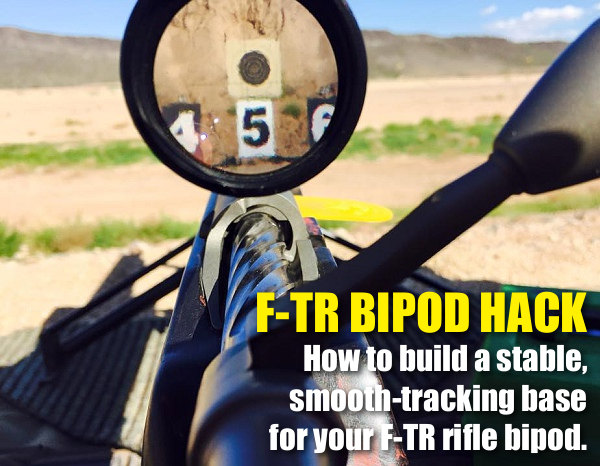
The Berger Southwest Nationals (SWN) is coming up next week at Ben Avery in Phoenix. Many of the nation’s top F-Class shooters will be there. Here are some tips that can help F-TR shooters competing at the SWN. These suggestions will also benefit any F-TR shooter who is looking for a more stable set-up under his bipod, and easier adjustment of the vertical when using a Phoenix-style (non-joystick) bipod.
How to Set up a Stable Front Pad for Your F-TR Bipod
To get peak performance from your F-TR rig, you need good support under the bipod. You want the base to be firm, but you also want a smooth, low-friction surface so the bipod feet can slide properly. Some guys just shoot off a carpet or a slab of wood with some rubber on top. There is a better way.
Forum member PBike shows how a three-element front set-up offers the best of both worlds — a firm platform with low-friction top. PBike’s set-up has three elements. Layer 1 is a thick rubber mat. Layer 2 is a steel plate with thin neoprene glued top and bottom. Layer 3, on which the bipod feet rest, is a thin neoprene door-mat with a low-friction surface, like the top of a MousePad. The video below shows how the three layers are arranged.
Pbike explains that, under F-TR rules, “You can use any series of pads or plates, so long as they are flat and do not include [tracking channels/slots] for the bipod feet”. The plate can be 12″ fore and aft, and the overall width may not extend more than 2″ beyond the bipod feet on either side.
F-TR Bipod Support Components (Bottom to Top)
LAYER ONE (bottom): Thick Rubber Pad, such as a heavy doormat
LAYER TWO (middle) Steel Plate, approximately 12″ x 24″, with attached neoprene
LAYER THREE (top): Neoprene Upper pad (slick upper surface like a MousePad)
NOTE, if the surface is not level, you can use wood shims to level the surface both left to right and front to back. The shims slide under the lowest pad. With a small saw, these can be trimmed so they don’t extend past the pad’s dimensions, maintaining compliance with F-Class rules.
The Phoenix bipod is an excellent product, but some folks like to run their rifles lower for better tracking and less hop. This can be accomplished with the PBike Aetkinz Engineering Lowering Kit. That Kit lowers the entire assembly 1.7 inches. For more information contact Pbike257 [at] gmail.com.
Phoenix Bipod “Rear Drive” and Steering Kit
F-TR rifle stock fore-ends are getting longer, allowing competitors to mount their bipods further forward. This longer “wheelbase” can deliver more stability, less hop, and better tracking. There’s a problem, however — if the bipod is attached way out front, it can be difficult to reach the bipod’s elevation controls. Some shooters grab the back end of the ski foot to adjust the rifle’s lateral position, but that doesn’t help with vertical.
PBike has developed a new accessory that lets you adjust the Bipod’s Mariner wheel easily and precisely. Basically this is a rotating, anodized aluminum tube that extends rearward. It has a 90° gear drive that replaces the Mariner wheel, allowing vertical adjustment by rotating the tube clockwise or counter-clockwise. See how it works in this video, starting at 1:40:
Pbike explains: “This is a really comfortable way to shoot. With this handle I can adjust for elevation and I can also steer the rifle fore and aft, left/right — anywhere I need to. I can make minute adjustments up and down, as needed, with the knurled handle.”
Video Suggestion by Boyd Allen. We welcome reader submissions
There are three notable articles in the latest January 2018 Digital Edition of Shooting Sports USA Magazine. F-Class competitors will definitely want to read the report on the 2017 World Championships. And hand-loaders will appreciate the insightful article on the AMP induction annealing machine. The third recommended article provides tips and techniques for sighting in hunting, tactical, and benchrest rifles. Access the entire SSUSA 54-page January 2018 eZine by clicking THIS LINK.
F-Class 2017 World Championships in Canada Story by Larry Bartholome
Fifteen years ago, the very first F-Class World Championships were held in Canada. In 2017, the Championships returned to Canada for the fifth edition of the match. This year there were triple the number of entries, representing the growing popularity of F-Class competition. Notably, this year’s event was preceded by the Canadian F-Class National Championships. This issue contains a full report on the event, written by Larry Bartolome, a past National F-Open Champion. Shown at right above is the new F-TR World Champion, our friend Derek Rodgers from New Mexico.
AMP Annealing Machine — Annealing .30-06 Brass for Vintage Military Rifles Story by Art Merrill
Produced in New Zealand, the AMP (Annealing Made Perfect) unit is a sophisticated, microprocessor-controlled annealing machine that achieves ultra-consistent results using an electrical INDUCTION process. By contrast, with butane torch systems you may have to adjust the system when the ambient temperature changes, or even if your butane fuel is slightly different. In this month’s issue of Shooting Sports USA, Field Editor Art Merrill uses the AMP to anneal .30-06 brass for vintage military rifles. The review shows how to use the AMP and explains the advantages of the Induction Annealing vs. flame-based annealing.
Sighting In Your Rifle — Tips for All Shooters Story by Jim Shults
This month’s “Rifle Issue” of Shooting Sports USA focuses on rifle shooting in various forms. Author Jim Shults has written an lengthy article offering tips and techniques for sighting-in your rifle. Shults says “The trick in effective sighting-in (zeroing) is shot-to-shot consistency”. To achieve that consistency, you must first eliminate driver error. You need a stable set-up. Good ammo is also essential and Shults offers an important tip: “Keep your ammo cool and out of direct sun at the range”. Shults also explains there is a big difference between load testing and zeroing. You want to finalize your zero AFTER you have developed your match or hunting load.
Here is some serious Sunday “gun glamour” from the folks at Star Shooter Precision, a bipod-builder and stock-maker based in Montreal, Canada. This stunning .308 Win F-TR rifle features a carbon-wrapped Star Shooter stock, angle-adjustable tubular bag-rider, star-shaped escutcheons, and a Kelbly Panda action. Up front is Star Shooter’s signature lightweight bipod.
Click Each Image for Large, Full-Screen Version
About the Rifle Builders Star Shooter Precision is a company located on the south shore of Montreal, Quebec, Canada. Fred Harvey is the designer. Fred says: “Our goal is to perfect the art of competition shooting the best we can with our custom bipods. The Star Shooter bipod is designed for shooters in F-Class competition, varmint hunting, load testing, tactical shooting and sighting in rifles.”
“A big congratulations to Bob Mead (1582-68X), who utterly destroyed the competition in tricky wind conditions to take the Gold.” — Jay Christopherson, F-Open Second Place.
The 2017 F-Class National Championships in Lodi, Wisconsin are now history. Hail the new Champions: Robert Mead, F-Open (1582-68X) and Ian Klemm, F-TR (1557-56X). Hosted by the Winnequah Gun Club, the Nationals drew about 75 F-Open shooters and 45 F-TR competitors, down from last year. In F-Open, Robert Mead shot brilliantly in tough conditions to finish 14 points ahead of his closest competitor, AccurateShooter.com’s System Administrator Jay Christopherson. Erik Cortina was just one point behind Jay, but Erik had the high X-Count for the match at 71X.
Photos of Robert Mead and Ian Klemm courtesy Erik Cortina.
In F-TR, Ian Klemm also won by a margin of 14 points. This was an impressive win by Ian, given the challenging winds and weather. F-TR runner-up Todd Sanders also shot remarkably well, considering he is a relative newcomer to F-Class. Forum member KyBountyHunter observed: “Outstanding shooting this week gentlemen, in some of the most challenging conditions that I’ve seen. Congrats to all the winners. Ian — fantastic job taking First Place (well deserved) [and] special congrats to Todd. For this only being his second year in F-TR, he’s going to be force to be reckoned with for a long time!”.
Final Results for F-Open (TOP 10):
1. Robert Mead: 1582-68X HM
2. Jay Christopherson: 1568-59X HM
3. Erik Cortina: 1567-71X HM
4. John Myers: 1558-64X HM
5. Pat Scully: 1558-50X HM
6. Larry Bartholome: 1554-55X HM
7. Robert Sebold: 1554-41X HM
8. Steve Harp: 1553-58X HM
9. Jeff Hopkins: 1551-49X MA
10. Lou Murdica: 1550-46X MA
Final Results for F-T/R (TOP 10):
1. Ian Klemm: 1557-56X HM
2. Todd Sanders: 1543-43X MA
3. Brad Sauve: 1542-44X MA
4. Laura Perry: 1539-46X EX
5. Daniel Pohlabel: 1534-49X MA
6. Josh Moore: 1529-37X EX
7. Ken Klemm: 1528-38X MA
8. Bob Lorenz: 1525-47X EX
9. Raymond Weaver: 1522-36X HM
10. Alan Barnhart: 1521-31X HM
Strong Performances by Members of Team Lapua-Borden-Brux
Jay Christopherson posted: “A big congratulations to Bob Mead (1582-68X), who utterly destroyed the competition in tricky wind conditions to take the Gold. This was a great end to the 2017 competition season for me as I managed to hang on by the skin of my fingertips to win Silver at the 2017 F-Class US National Championships (F-Open).” For the record, Team Lapua-Borden-Brux ended up with all five present members of the team in the Top 8 of the Grand Aggregate.
Jay Christopherson (2nd, 1568-59X, Silver)
Erik Cortina (3rd, 1567-71X, Bronze)
Pat Scully (5th, 1558-50X)
Bob Sebold (7th, 1554-41X)
Steve Harp (8th, 1553-58X)
In team competition, Team Lapua-Borden Brux won the F-0pen Long Range Championship as well as the Mid-Range Championship. Jay told us: “That was some outstanding shooting by great team members. I’m really looking forward to the 2018 season.” Erik Cortina added: “So proud of our team. We conquered the 2017 LR National Championship as well as the Mid-Range National Championship. We could not have done it without our sponsors: Lapua, Borden Actions, and Brux Barrels.”
In the F-TR Team Competition, mighty Team Sinclair triumphed yet again, winning its 10th Long Range National Championship. Team member Paul Phillips offered this interesting factoid: “This year we won with the original four members we had in 2004 plus Dan Pohlabel. It’s pretty awesome to be shooting with the same guys for 13 years! What a great run since 2004.” And those same four also all hail from Midland, Michigan (Midland County Sportsman’s Club). Team Sinclair still holds the 4-man Team 1000-yard National Record. Shown below, L to R, are team members: Daniel J. Pohlabel, Paul Phillips, Raymond Gross (Coach), Brad Sauve, and John Droelle.
All Team Sinclair members use identical hardware: McMillan XiT stock, Kelbly Panda action, Bartlein barrel, Nightforce scope, and Phoenix Precision bipod. All shoot Berger 200-20X bullets in Lapua brass.
The One that Got Away — Almost Matching F-Open 20-Shot Record
Erik Cortina shot a superb 200-16X during the competition (see electronic target scoring screen below). That was just one X shy of the current 200-17X National Record. Erik observed: “So close, yet so far. Almost matched the National Record of 200-17X but shot a ten on my very last shot. Everything felt good but luck was not on my side.”
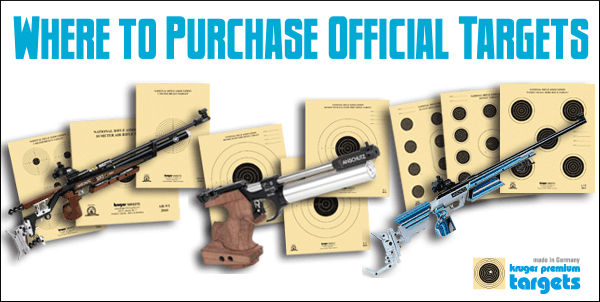
Need targets — not just any old targets, but the correctly-sized targets for specific shooting disciplines (such as NRA Smallbore, F-Class, and 1K Benchrest)? Well you won’t find them at your neighborhood Wally World store. Precise, dimensionally-correct competition targets are producted by a half-dozen specialty printers. In this article we provide links to the leading target sellers, with a chart showing “who’s got what”. Look for your particular discipline and the vendors will be specified.
Sources for Official Shooting Competition Targets:
AccurateShooter.com offers dozens of FREE, printable targets for target practice, load development, and fun shooting. We also offer a few of the most popular NRA Bullseye targets. One or more of these printable targets should work for most training purposes. However, some readers have asked: “Where can we get the real targets… exactly like the ones used in NRA, IBS, and NBRSA shooting matches?”
All these vendors carry nearly all the NRA High Power and Smallbore targets, including the new, smaller F-Class targets. National Target has the F-Class and High Power targets, including 100-yard reductions of the 200, 300, and 600-yard military targets. Germany’s Kruger Targets sells all the important NRA targets, and international (ISSF) air rifle and smallbore targets too.
Orrville Printing currently sells IBS targets for rimfire (50 yard) benchrest, short-range centerfire Benchrest (100, 200, 300 yards), Hunter BR Rifle (100, 200, 300 yards), plus the official 600-yard and 1000-yard IBS targets. National Target Company also has most of the IBS targets. NBRSA short-range, 600-yard, and 1000-yard benchrest targets are available directly from the NBRSA Business Office. Call (307) 655-7415 to order for the season.
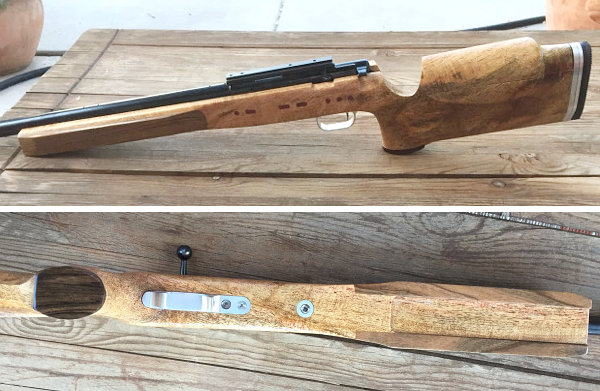
The dots and dashes are Morse Code for the shooter’s initials. The wood is Mango with Walnut fore-end wing inlays. The barreled action is an older Anschutz Model 54 that spent years in a prone stock.
Build Report by Doan Trevor
How do you build a stock for the grand-daughter of an award-winning shooter? Over the years I have built five or six rifles for this shooter, and now his grand-daughter had taken an interest in F-Class. He wanted her new rifle to mirror his own F-Class rifle, and he provided me with an old Anschutz Model 54 barreled action. Her new rifle would get her started in rimfire with the possibility of graduating to High Power (centerfire) shooting. The dots and dashes on the sides of the stock are Morse Code for his grand-daughter’s initials — “AMS”.
Rimfire F-Class Stock Design Factors
Typically when I build a rimfire F-Class stock I use the same pattern as I do for High Power stocks. The pattern has evolved from my prone stocks, as it has proven very successful with time. Also, there is a known issue of using wood for a stock in F-Class. The wood needs to be cured, and unfortunately, finding wood in the specific dimension for the stock is near to impossible. Therefore, I inlay pieces in the fore-end making sure that it is straight and on center. Other materials can be used for an F-Class stock, but keeping them straight and centered can be very difficult. Using cured wood during the build process, I continually check the centerline from fore-end to the rear slider, ensuring that the stock stays centered. This helps ensure good tracking and return to point of aim.
Adapting Prone Stock for F-Class Use
There is a current trend of older Palma and prone shooters to convert their rifles for F-TR and F-Open due to eyesight problems and other disabilities. The stocks that they have been using (and loving) can be recycled to their new shooting styles with a few design changes. I have been doing this successfully for the last several years. Whether it be a new shooter or an older one, you can either plan for the future or adapt older equipment so that all can shoot the style that they want. My philosophy in rifle building is to create every rifle with the potential to win a national or world championship. I am proud to say that I have build rifles for Derek Rodgers, Trudie Faye, Lige Harris, Barry Smith, Eric Rhodes, Kent Reeves, Terry Glen and many more award-winning shooters. And I look forward to many more.
What the Heck is .22 LR Rimfire F-Class?
There is no official NRA F-Class rimfire discipline (at least not yet). However, many F-Class shooters (both F-0pen and F-TR) employ .22 LR rifles for low-cost training. For example, James Crofts practices extensively with his 40X rimfire F-TR rig. In addition, many shooting clubs offer F-Class style rimfire fun matches, shot prone with front rest or match bipod. This rifle was built for an F-Class fun match hosted regularly by the Los Angeles Rifle & Revolver Club (LAR&R).
The photo below displays a different Doan Trevor-crafted rifle, a rimfire benchrest rig with Turbo action. This shows how Doan makes the 3-inch-wide fore-end. Outboard left- and right-side wings are bonded to the central stock material, then the wings are carefully shaped for straightness. Getting the geometry “just right” helps the rig track perfectly.
Review by James Mock
If you were charged with building a scope for F-Class or long range Benchrest, what features would you want? Vortex asked that question, received feedback from many competitors, and then set out to build a new high-magnification, zoom comp scope that would set a new “performance for price” standard.
The new Vortex Golden Eagle has features that this shooter really appreciates. It has a power range of 15x to 60x with a 52mm objective lens. Vortex has attempted to keep the weight as low as possible and the cost reasonable. My initial impression is that Vortex spared no expense in developing this scope. The “street price” for this premium scope is a reasonable $1499.00. Plus it has Unconditional Lifetime Warranty. Given its features, performance, and price, I believe that this scope will sell very well.
Premium HD, extra-low dispersion glass
APO (apochromatic) objective lens system with index-matched lenses
XRP multi-coated lenses for max light transmission
ArmorTek extra-hard lens coating to protect lens from dust, dirt, and smudges
Fogproof and Waterproof (Argon gas purged)
Specifications
Field of View at 100 yards: 6.3 feet at 15X; 1.7 feet at 60X
Main Tube: One-piece 30mm
Length: 16.1 inches; Weight is 29.7 ounces
Objective Lens: 52mm
Eye Relief: 3.9 inches
Reticles: SCR-1 FCH; ECR-1 MOA
Testing the Golden Eagle
I recently tested a Golden Eagle with the ECR-1 reticle. On this model the Hash Marks subtend 1 MOA at 40X. There is also a fine crosshair reticle (SCR-1) available. Initial tests with the scope were done on June 28th and I was very impressed with what I saw. With a new scope I always shoot the square (box test) to test tracking and amount of movement. I shot the square today after shooting a 5-shot group at 250 yards (my longest available distance). Below is a picture of the box test target that I shot. Yes, shot #5 went through the exact same hole as shot #1.
Below is the 250-yard target I shot before doing the box test. To get to the 100-yard target, I clicked down 14 clicks (1/8th MOA) and the scope was spot on. It is really a pleasure to use instruments that do exactly what they are supposed to do. With the Louisiana mirage, I shot this orange/white target at 40X instead of the maximum 60X. I did not have any problem seeing the 6mm bullet holes at 40X. The optics in this scope are to my old eyes are as good as any that I have used (regardless of price).
Competition Test Success — Golden Eagle Delivers a Win
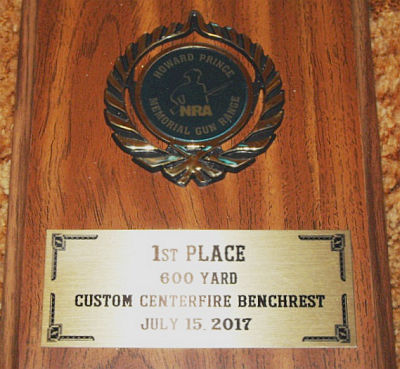
My next use of this scope was at our monthly 600-yard match on July 15th. It was a typical mid-July day in north Louisiana — very hot and humid with light switching winds. The mirage was terrible, but I managed to squeak out a victory with a 188/5X score out of 200/20X possible. I shot the Golden Eagle at 40X all day and it performed perfectly. No one could see bullet holes today, even with the high powered premium spotting scopes. This is a quality scope and it may be a “lucky” scope in that I did not expect a win with a 6mm Dasher barrel with 2500 or more rounds through it.
Point of Aim Test with Hood Scope Checker
I also tested the Golden Eagle for holding Point of Aim (POA). For this procedure, I used the Hood scope checker (loaned to me by Bart Sauter). To use this, one mounts two scopes side by side. Ideally one scope has proven its ability to hold POA. Here I used a Valdada 36X BR model as my control scope. It has proven over an 8-year period of time to hold its point of aim. I mounted these scopes on my BAT/Leonard 6mm PPC and adjusted each to the same point on the target.
As one can see in the above picture, these are big scopes. After the first shot, I noticed that the reticle dot on the Vortex seemed to be about 1/8th MOA to the right of its original position. I stopped to check for ring slippage (which I had experienced in prior tests). There was no apparent slippage, so I checked the parallax and found that there was some parallax correction needed. This was probably the source of the apparent shift in point of aim, but I cannot be sure of that. I fired three more shots (checking after each) and found no shift.
After testing for POA shift, I fired the remaining rounds using different aiming points. I fired 5 rounds (upper left) using the Vortex and 3 rounds to the right of those using the Valdada scope.
CONCLUSION — A Very Fine Optic at a Reasonable Price
While testing this Vortex Golden Eagle scope, I developed a real fondness for it. I appreciate its great optics, eye relief and crispness of adjustments. If I thought that this scope did not hold POA, I would use my old Valdada in the 600-yard matches in which I participate. Further testing has shown no tendency to shift point of aim.
If I am allowed to keep this scope until the fall, I am sure that I will be able to see 6mm bullet holes in the white at 600 yards. Seeing those 6mm holes is very difficult, but that is my dream for a premium high-powered scope. During the summer months in north Louisiana, the air is much too “dirty” to spot small holes at 600 yards. By October, there should be some conditions in which one can use the premium optics to see bullet holes in the white at 600.
In summary, let me say that this scope has become one of my all-time favorites because of its bright, clear images and its great reliability. If you are looking for a great long-range scope that is reasonable in cost, try the Golden Eagle from Vortex.– James Mock


 Being part of Team USA is a major commitment of time and resources. We do have wonderful and sizable sponsorship partners who we thank and rely on for moderating individual team member costs. However, due to the location of this World Championship effort, one can expect to help cover a commensurate level of the costs.




 About the Rifle Builders






 Competition Test Success — Golden Eagle Delivers a Win


