CLICK HERE to see full-screen version of Wind Plot.
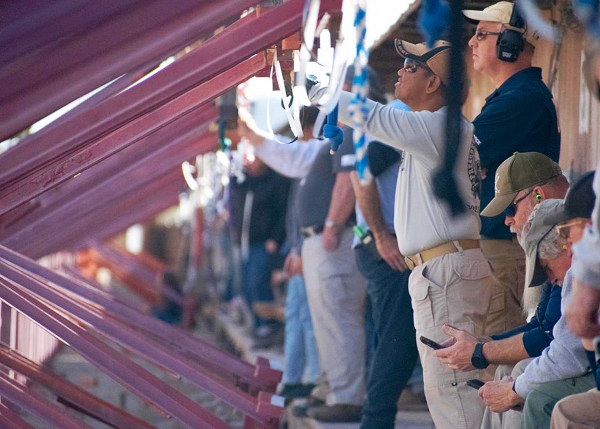
Team shooting is very different than individual competition. Typically a team coach makes the wind calls for the shooters. In some cases (where the rules allow), the wind coach even dials elevation and windage changes for the active shooter. For the wind coach to do his job effectively, he must follow the changes in the wind and determine what the correct wind call should have been for each shot. (In other words — what was the “right call”)
Bryan Litz, founder of Applied Ballistics and Past USA F-TR National Champion, served as wind coach for the winning 4-man F-TR Team at the 2017 Canadian F-Class Championships, which preceded the F-Class World Championships also held in Canada. Here Bryan explains how he has used a Wind Plot to make better wind calls, helping his team-mates maximize their scores.
Wind Plot Methodology by Bryan Litz
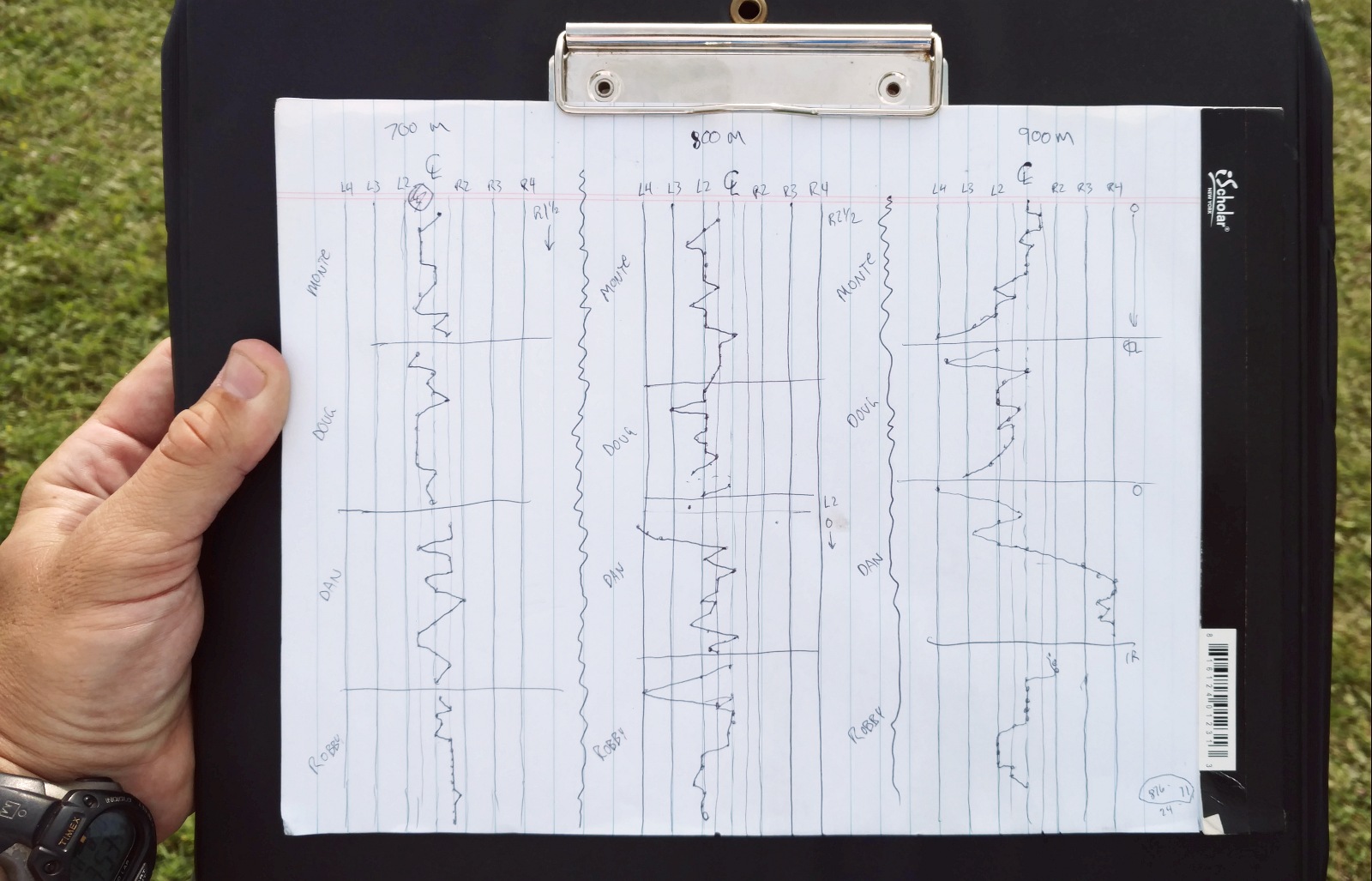
The wind plot I use is a running history of what the correct wind call was for every shot fired. The more you shoot, the more history you have in a condition, and I find that very useful information. This kind of plot IS NOT showing where the bullet hit, and is NOT showing what you held. It’s showing what you should have held to center each shot. IMO, this is the most valuable information to have when guessing where to hold next for each shot. Here are some key points:
1. I always look for blocks of stable conditions to shoot in and wait out the rest.
2. If the wind plot shows drastic changes, either I’m not picking the right time to shoot or it’s just a really unstable wind condition.
3. When you see many shots using the same hold (e.g. Robby’s 700m and 900m strings on plot), it can indicate very fast shooting and fast pit service.
Q. What are the numbers and Markings on this Wind Plot?
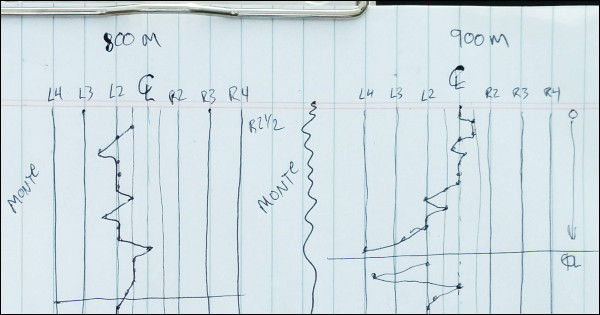
Litz: The wind plot represents the rings on the target. Left 2 for example, is the 5 line on the international target, while Left 2 is the 10 line on the USA target. F-Class shooters and coaches talk about wind holds in relation to these rings. A Left 2 hold isn’t left 2 MOA or 2 MILS, it’s the second ring from center. The vertical lines on the plot represent the rings going out from center, 4 or 5 in each direction. A left or right 5 hold is edge of black on the int’l target.
Q: What Does this Specific Plot Reveal?
Litz: Looking at the plot, from left to right is 700m, 800m, and 900m that we shot progressively through the day. Top to bottom shows each shooter in sequence (shooters names are shown by their blocks). To the right I note what was on the gun for that shooter, and note when it changes. Often times we run the same wind on the gun for several shooters but if it changes, I note what the new windage is and continue on. For example if we’re settled into a condition where we’re shooting Vs with a right 3 hold, I might adjust the scope 1 MOA right because a right 3 hold is equal to 1 MOA. So we can move the scope and start shooting with a center hold.
Q. Are you Plotting Where the Bullet Hits?
Litz: Not exactly. This kind of plot IS NOT specifically showing where the bullet hit, and IS NOT showing what the shooter held. It’s showing what the shooter should have held to center each shot. IMO, this is the most valuable information to have when guessing where to hold next for each shot.
On each shot, the shooter or coach takes a guess about where to hold, and fires the shot. If the bullet hits the center, you plot the point right where you held because it was the correct hold. However, if you miss the call, you plot what hold was required to put that shot in the center. For example if you shoot a right 3 and hit where you held, the correct call would have been “center”. In this way, you’re building a history of what you should have done, which may or may not be what you actually did. This shows you the trends, and brackets which can be used to make future decisions.
Q: Is this Type of Wind Plot Something New?
Litz: I didn’t invent this method, it’s been around a long time. Vertical can be plotted the same way. In team matches, we have a plotter who is advising on elevation trends and suggesting corrections. But, as wind coach, my job is the horizontal so I only keep the wind plot. I have learned lots of strategies from my coaches Emil Praslick and Steve Hardin.
There are many ways to plot and many standard work sheets for this. They’re all tools and the key is to find something that works for you in different situations. I don’t keep a plot when I am personally behind the trigger string firing because I lose more points when I take the time to do it vs. just shooting fast. When pair firing or coaching, I can keep the wind plot without compromising the shooting.
Here Team Australia used plots and communication gear linking coaches. This helped the Aussies win the 2013 F-Open Team World Championship held at Raton, NM.
Know Your Goal — Keep It Simple
Know your goal of plotting. The simplest plot is where you write the shot number where it hit on a target face. This kind of plotting is useful for evaluating shooter performance because it shows how big the group is (in particular the vertical dispersion). However keeping a plot like this does little to help you figure out the wind. It just shows you what shots you messed up on. It does nothing to help you find the center. [Editor: That’s a whole different matter with many variables.] The wind plot I use is a running history of what the correct wind call was for every shot fired. The more you shoot, the more history you have in a condition, and I find that very useful information.
The 2022 Southwest Nationals are history. This was a very successful mid-range and long-range event, with 330+ participants and some great shooting in F-Open, F-TR, and Sling divisions. We congratulate the 2022 SWN Champions: Tod Hendricks (F-Open, 1243-73X); Keith Trapp (F-TR, 1233-62X); and Kimberly Rowe (1231-63X). Shown below are Sling Winner Kimberly Rowe, and F-TR Champ Keith Trapp.
Here are the TOP TEN for each of the three divisions. CLICK HERE for ALL results:
2022 Southwest Nationals Top Ten Competitors by Division
F-Open Class
Tod Hendricks, 1243-73X
Tim Vaught, 1241-71X
Ken Dickerman, 1238-66X
John Masek, 1237-65X
William Kolodziej, 1235-57X
Doug Skogman, 1235-56X
Eric Wuestenhoefer, 1233-60X
Omar Alonzo, 1233-59X
Emil Kovan, 1233-57X
C.J. Sitton, 1232-62X
F-TR Class
Keith Trapp, 1233-62X
Fritz Braun, 1228-58X
James Crofts, 1224-36X
Brad Sauve, 1221-40X
Carl Matthews, 1217-50X
Drew Rutherford, 1217-45X
Matt Schwartzkopf, 1216-45X
Anthony Jordan, 1214-37X
Michael Waters, 1212-43X
Ellis Berry, 1210-48X
Sling Class
Kimberley Rowe, 1231-63X
Bobby Gill, 1231-55X
Oliver Milanovic, 1230-69X
Justin Skaret, 1229-58X
Curtis Gordon, 1228-63X
Ron Zerr, 1227-63X
Robert Gustin, 1226-49X
Trudie Fay, 1225-57X
Eron Ahmer, 1224-47X
Ken Shomber, 1222-51X
Click the links below for full results, including Grand Aggs and day-by-day performances. You can also find further results plus a large collection of photos at SouthwestNationals.net.
The Berger SW Nationals is one of the few American events where sling shooters compete on the same firing line as F-Class competitors (though in separate groups).
Reading the wind can be challenging at Ben Avery. What’s your wind call here?
Top competitors show focus and concentration in mid-range match.
Stunning F-Open rifle with SEB Mini front rest with Blake Machine accessories.
Looking downrange during Team Match.
Here is the 1000-yard firing line on the final day of competition.
Competitor’s Thoughts about the 2022 SW Nationals
Our friend John Masek (“F Class John” in our Forum) shot great to finish 4th overall in the F-Open division. Here is his “take-away” from this year’s SWN:
The 2022 SWN saw what I can only describe as the largest collection of tight-shooting guns I’ve even seen. As we approached the 800-yard line for the first day of the Long Range program, it was absolutely dead calm and everyone knew some high scores were going to get posted. By the end of the 800-yard match, the vast majority of the 134 F-Open shooters shot a clean 150 with a staggering eight of them shooting a perfect 150-15X (even 11-year-old Ethan Blake). By the end of the day, after shooting 15 rounds each at 800, 900, and 1000 yards, the entire first page of F-Open shooters was separated by only 7 points — a crazy tight margin.
On the following day we started with a very difficult 10-15 mph headwind that derailed many shooters. After the dust settled, there were 22 points separating the first page of shooters but still just 9 points spread among the top 20. The final day was fairly mild and it was anyone’s game, but there was just enough wind to keep shooters on their toes, giving many a chance at redemption from the previous day.
At the end of the day, Tod Hendricks, Tim Vaught, and Ken Dickerman kept their heads in the game and held onto their leads to finish 1st, 2nd and 3rd respectively in F-Open. Tod shot an amazing 200-15X in his final round, proving that he was indeed deserving of the F-Open gold medal after three days of fierce competition.
As always, this match, along with the F-Class Nationals and V2 Finale, bring out the finest shooters in the country (and others from around the world). I highly encourage anyone who is able to attend these matches to do so. It’s an experience like no other. No matter your score, you’ll leave with more experience and certainly more friends than you arrived with.
There was construction behind the Ben Avery Range. Note the many tall cranes.
Competitors being transported for their sessions pulling targets in the pits.
Working in the pits is part of the Berger SWN experience.
Over 300 Competitors from Many Countries
On opening day of the 2022 SW Nationals Nancy Tompkins posted: “We started the day off with National anthems for Brazil, Canada, Puerto Rico, Scotland, the United Kingdom, and the USA. We have 282 shooters today and 333 for the Long Range portion of the match. It is fantastic seeing so many targets up and so many competitors after the last two years.”
Photo by Nancy Tompkins near Ben Avery Shooting Facility the evening before the Southwest Nationals. Nancy posted: “Thank you to all of the sponsors, volunteers, and shooters who have traveled from all over… to make this match so special.
Parting Shot: Norm Harrold Target, 200-17X
Paul Phillips posted: “Today I pulled a target for Norm Harrold. This was his 1000-yard target that scored 200-17X. This was the best F-Class score I ever pulled for. It sure is nice when they’re all in the X-Ring. Nice shooting Norm! This is a 5-inch X-Ring.” NOTE: This was from the first 20-shot competition on Day 2 at 1000 yards. We believe Norm had the second highest score for this particular 20-shot match, behind Steven Zock who shot an amazing 200-19X.
The Berger SW Nationals competition is back! After being cancelled in 2021 due to Covid concerns, one of America’s best shooting matches returns in 2022. The match kicks off tomorrow, February 9, 2022, and continues through Sunday February 13, 2022 at the Ben Avery Shooting Facility in Phoenix, Arizona.
This is a unique match that combines F-Class competition with High Power (Palma) prone sling shooting. The nation’s top F-Open and F-TR shooters will be in Phoenix, along with top “hard-holders” with their bolt-action long-range target rifles.
If you’re curious about the equipment favored by Berger SWN competitors, here are the equipment lists from the last SWN match in 2020. This list was compiled by the match directors from info supplied by 2020 F-Class and High Power competitors. This covers hardware (actions, barrels, stocks), optics (riflescopes, spotting scopes), and cartridges (brass, bullets, powders). As you’d expect, .284 Win (and variants) dominated the F-Open ranks. Though some guys did try the .223 Rem for F-TR, the .308 Win was still used by the vast majority of F-TR shooters.
Matt Schwartzkopf, USA F-TR Team member (and Ben Avery Range Supervisor), collected comprehensive gear reports during the 2020 Berger SW Nationals. Matt then created charts showing competitors’ choices for Actions, Barrels, Stocks, Riflescopes and Spotting Scopes. In addition, Matt compiled bullet choice and powder preferences for all classes along with cartridge rankings for F-Open Division.
ACTIONS Listed by Division (Sling, F-TR, F-Open)
ACTIONS by Brand (Combined Listing — All Divisions)
BARRELS by Brand (Combined Listing — All Divisions)
BULLETS by Brand (Combined Listing — All Divisions)
CARTRIDGE BRASS by Brand (Combined Listing — All Divisions)
POWDER by Brand (Combined Listing — All Divisions)
STOCKS by Brand (Combined Listing — All Divisions)
RIFLESCOPES by Brand (Combined Listing — All Divisions)
SPOTTING SCOPES Listed by Class (Sling, F-TR, F-Open)
The best F-Class and Sling shooters in the nation compete each year at the Berger Southwest Nationals at the Ben Avery range in Arizona. Walk down the firing line and you’ll see the absolute “best of the best” in equipment — from $3500 optics to $2000 stocks and $400 triggers. Berger SWN shooters have some of the best equipment you can buy. In this game, where just 1 or 2 points can separate first from third place (considering X-Count), it’s important to have top-flight equipment. That means a custom action, custom barrel, and high-end stock or chassis system.
Cartridge Selection in F-Open Division
In addition, Matt produced an interesting listing of cartridge/caliber types for the F-Open division. This is helpful because cartridge choice is unrestricted in the F-Open class. By contrast, the F-TR division is limited to .223 Remington (5.56×45) or .308 Winchester (7.62×51). You can see that the .284 Winchester (and variants) currently dominate F-Open.
Shooters’ Forum Thread about SWN Gear Selection
There was a discussion of the 2020 SWN Gear Selection in our Shooters’ Forum. CLICK HERE to view that Forum thread. Many top SWN shooters, including past F-Open National Champion Larry Bartholome, contributed to this Forum discussion about gear options.
Texas action pistol and 3-Gun competitor Tracy Slayton Self has been taking up the F-Class game. On Facebook, she recently posted a nice training session with her Krieger-barreled F-TR rifle. You can watch her shooting video HERE on her Facebook page. She used a battery-powered, Chamber Chiller fan unit to cool the barrel.
On August 8th, Tracy posted: “Very, very windy day today but pulled off a 444/450 18X which is a High Master score. My Krieger barrel is the bomb and my Kahles scope allows me to see that target at 600 yards clearly. My Chamber Chiller really cools my barrel down in between matches and my Stiller action is as smooth as butter.”
Click Photo for short video of Tracy’s shooting session, with shots called on audio:
The NRA F-Class Team Championship was held July 29, 2021. Congrats to the winning squads, Team Indiana (F-Open) and Team USA Blue (F-TR). Conditions were fairly difficult with plenty of rapid wind switches to challenge the wind callers. It was great to see a large number of teams on the firing line, both in F-TR and F-Open.
Second place was very close in both divisions. F-TR was decided on X-count. In F-0pen, Team Kelly McMillan finished second by just one point, but with a huge edge in X-count. Team Kelly McMillan had 83 Xs compared to 66 Xs for Team Indiana. Tim Vaught and Norm Harrold both drilled 23 Xs while Doug Skogman had 20 Xs. Kelly, who sadly passed away recently, would have been proud of this team. His team’s outstanding performance honored his memory.
In F-TR division, Team USA Blue’s Luke Ramsey shot brilliantly to score 396-21X to lead his team. Ian Klemm, currently in first place in the individual F-TR competition, also shot great to tally 392-16X.
Ray Gross joined six good friends to squad up as Team Creedmoor, which finished a very close second in the F-TR division. The top two squads had the same 1559 Aggregate point total with Team USA Blue earning Gold with 57Xs vs. 44Xs for Team Creedmoor.
Ray was proud of his team’s performance: “After a 3-year hiatus, we got the band back together to finish Silver (by Xs) at the U.S. F-Class Long Range Nationals. It was a fairly tough day, living off the flags, with a lot of quick switches. I’ll coach you guys anytime!”
Team Creedmoor team-mates (L to R): Daniel Pohlabel, Paul Phillips, Ray Gross, Brad Sauve, John Droelle, and Jeff Rorer.
The 2021 NRA Mid-Range F-Class Championships are complete, with the Long-Range competition running right now. We commend the new Mid-Range Champions who both shot spectacular matches. Roger Mayhall didn’t drop a point in F-0pen, finishing with 1800-131X to win F-Open. That’s a brilliant performance.
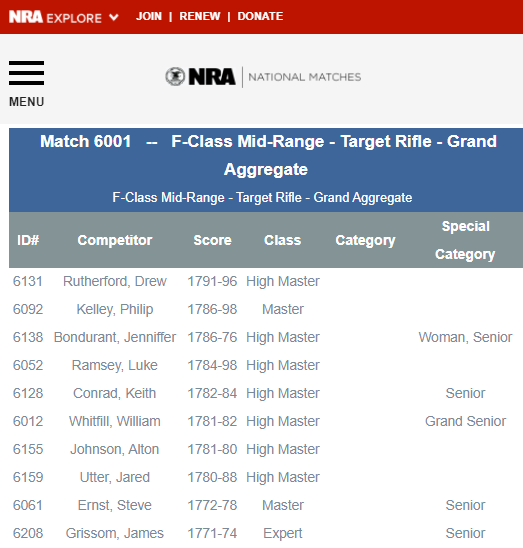
In F-TR division, Drew Rutherford topped a competitive field with 1791-96X. Hail the new Champions!
Roger Mayhall Wins F-Open Mid-Range with Stunning 1800-131X
6mm Dasher Rifle Takes F-Open Title
Roger shot a 6mm Dasher, a wildcat based on the 6mmBR cartridge. Roger said his rifle was a tack-driver: “I think I owe my gunsmith a beverage or two!” Roger did a superb job of wind-reading to finish 3 days without dropping a point.
“I’ve known Roger for over 5 years. Great man, always willing to help a fellow shooter. Shooting clean all three days with an incredible X-count. Well done! So much for the claim that a 6mm can’t win an Aggregate!” — Jason Simes
“Good job buddy — I told you those Dashers could shoot. Just outstanding shooting.” — Chris Ford
“Awesome shooting Roger! Chalk up a national championship to the 6mm.” — Dan Bramley
About Roger Mayhall’s Championship-Winning Dasher
Posting on Facebook, Roger wrote: “I’ve had a few people ask about the equipment I used in the Mid-Range at Nationals. Here are the particulars:
The gun was a 6 Dasher, supported by a Defiance Deviant action, Bix ‘N Andy trigger, Alex Wheeler LBR F-Class stock, Sightron SV ED 10-50x60mm scope, Dan Bramley tuner on a 30″ Krieger [1:8″-twist] barrel. Also used were a SEB NEO front rest, Dima Rifle Systems Rear Bag with a Dead Bottom Bag. My load consisted of the 105gr Berger Hybrid in a fire-formed 6BR Lapua case propelled by Varget powder and a CCI 450 primer. Barrel work was done by Dan Bramley[.]”
Drew Rutherford Wins F-TR Mid-Range Championship
Drew Rutherford put on a strong performance to win the F-TR Mid-Range Championship. Rutherford was using Eliseo R1 Tubeguns fitted with SEB JoyPod coaxial bipod. Chassis-maker Gary Eliseo noted: “Congratulations to Drew Rutherford, national midrange FTR champion! Drew used his .223 Rem and .308 Win R1 rifles to win the Mid-Range Championship, well done Drew!”
The Competition Machine (Eliseo) R1 Chassis is a very versatile system. As fitted with rear bag-riders and SEB JoyPods, Drew used his R1s with great success. But the same chassis, less bag-rider and bipod, can be used for “hard-holding” Palma Matches, or even High Power competition.
Solomon Sets New Nat’l F-Open 1-Day Record with 600-53X
Finishing second in the F-Open Mid-Range Championship was Bret Solomon with 1798-135X. That was notable because Bret posted the high X-Count, AND set a single-day National Record in the process. Gunsmith Thomas “Speedy” Gonzalez posted: “Congratulations to my friend Bret Solomon on shooting a 200-20X and then setting a new [1-Day] 600-yard National Record of 600-53X at the U.S. F-Class Nationals. Bret was shooting the Lil’ Red Devil in 7mm RSAUM with a new Bartlein 4-groove barrel I forced him to shoot!”
Christened the “Little Red Devil” by Speedy, this ruby red, flame maple-stocked beauty is chambered in .284 Winchester. It features a Melonited BAT 3LL action with two bolts (regular and magnum bolt face). The stock is crafted by Will McCloskey using advanced CNC machines, allowing ultra-precise tolerances for improved tracking and perfect geometry.
Torrefied Wood from Yamaha, CNC-Milled to Perfection
This wood is very special — the flame maple was sourced from Yamaha which used a torrefaction process to stabilize the wood and prevent warping. Yamaha’s proprietary ARE process was developed by Yamaha for musical instruments. Speedy explained that Yamaha uses heat and pressure (we think) to stabilize the wood and dampen vibrations. During torrefaction, the sap in the wood actually crystallizes.
For this rifle build, the torrefied wood blank was CNC-milled by Will McCloskey to “best-in-industry” tolerances. A special red-tone polyester finish Lee Garver, a noted guitar painter. This very hard, yet glossy finish makes the stock “pretty nearly scratch-proof” according to Speedy.
For those headed to the Nationals, we are sharing some smart tips from a past F-Class Champion who is both a great shooter AND a ballistics wizard. In 2015, Bryan Litz won the F-TR Mid-Range AND Long-Range National Championships hosted at Ben Avery. And at the 2014 Berger SW Nationals (SWN), Bryan took top honors among all sling shooters. If you only know Bryan Litz from his Applied Ballistics Books and DVDs, you may not realize that this guy is a also great marksman along with being an actual rocket scientist!
Given his impressive track record in both F-Class and Palma (Fullbore) out to 1000 yards, we asked Bryan if he had any advice for other long-range competitors.
First Bryan provided three tips concerning Ballistics, his special area of expertise. Next Bryan offered three more general tips about long-range competition — how to analyze your shooting, how to choose your ‘wind strategy’, and how to avoid the most costly mistakes, i.e. how to avoid the “train-wrecks”.
Bryan Litz won the 2015 F-TR Mid-Range and Long-Range Championships with this sleek rig:
Litz Ballistics Tips
Ballistics TIP ONE. If you’re having trouble getting your ballistic software to match actual drops, you need to look at a number of possible reasons. Here are some common issues that can cause problems.
Click Values Are Not Exact. Scopes and iron sights don’t always produce accurate adjustments. In other words, if your ballistics program predicts 30 MOA of drop, and you dial 30 MOA but hit low, it might be that your sight actually only moved 28 MOA (for example). To see if your sight is adjusting accurately, shoot a tall target at 100 yards and measure group separation when dialing your sight.
Barometric vs. Station Pressure. This is a commonly misunderstood input to ballistics programs. You can avoid this pitfall by remembering the following: station pressure is the actual measured pressure at your location, and you don’t need to tell the program your altitude when using station pressure. Barometric pressure is corrected for sea level. If you’re using barometric pressure, you also have to input your altitude.
Muzzle Velocity. Chronographs are not always as accurate as shooters think they are — your true MV may be off by 10-20 fps (or more). If your drop is different than predicted at long range, it might be because your muzzle velocity input is wrong.
Mixing Up BC (G1 vs. G7). Knowledgeable long range shooters know that the G7 standard is a more representative standard for modern LR bullets. However, using G7 BCs isn’t just a matter of clicking the ‘G7′ option in the program. The numeric value of the BC is different for G1 and G7. For example, the G1 BC of the Berger 155.5 grain Fullbore bullet is .464 but the G7 BC is .237. If you were to enter .464 but click on G7, the results would be way off.
Ballistics TIP TWO. A properly installed level is absolutely essential for long range shooting. Without a good level reference, your long range wind zero will be off due to minor canting of the rifle from side to side. You can verify that your level is installed correctly on a 100-yard ‘tall target’. Draw a plumb line straight up the target and verify that your groups track straight up this line as you go up in elevation.
Ballistics TIP THREE. If your long range ballistic predictions aren’t tracking, always come back and verify your 100-yard zero. Sometimes a simple zero shift can be misconstrued as errors in long range ballistics predictions.
Litz Competition Shooting Tips
Competition TIP ONE. Improving your scores in long range competition is a constant process of self-assessment. After each match, carefully analyze how you lost points and make a plan to improve. Beginning shooters will lose a lot of points to fundamental things like sight alignment and trigger control. Veteran shooters will lose far fewer points to a smaller list of mistakes. At every step along the way, always ask yourself why you’re losing points and address the issues. Sometimes the weak links that you need to work on aren’t your favorite thing to do, and success will take work in these areas as well.
Competition TIP TWO. Select your wind shooting strategy carefully. For beginners and veterans, most points are typically lost to wind. Successful shooters put a lot of thought into their approach to wind shooting. Sometimes it’s best to shoot fast and minimize the changes you’ll have to navigate. Other times it’s best to wait out a condition which may take several minutes. Develop a comfortable rest position so you have an easier time waiting when you should be waiting.
Competition TIP THREE. Actively avoid major train wrecks. Sounds obvious but it happens a lot. Select equipment that is reliable, get comfortable with it and have back-ups for important things. Don’t load on the verge of max pressure, don’t go to an important match with a barrel that’s near shot out, physically check tightness of all important screws prior to shooting each string. Observe what train wrecks you and others experience, and put measures in place to avoid them.
The first Annual V² Finale, held this weekend in Tennessee, has concluded. This new-format match pitted F-Class competitors against each other in a bracket-style double elimination match. This was a very elite field, selected via a Points series. All targets were placed at 1000 yards, with a Euro-Style 5V target. In something unusual for an American F-Class match, ALL shooting was done via PAIR FIRING, with shooters going head-to-head with alternating shots, 15 per shooter in the brackets and then 10 per shooter in the final two-man showdowns for F-TR and F-Open divisions.
The competition was fierce but we have final results of this tough F-Class tournament. Congratulations to the V² Finale 2021 winners who earned fame, glory, and large cash pay-outs: Tracy Hogg (F-TR) and William (Bill) Kolodziej (F-Open). Additional top finishers are listed below, with links for FULL RESULTS below the table.
The event, hosted at the modern Dead Zero Shooting Park in Tennessee, was sponsored by Vihtavuori and Vortex Optics. Along with helping to defray the range costs, these sponsors provided prizes to top shooters. In 2021 shooters qualified for the event through a nationwide points series, with 32 slots for F-Open and 32 slots for F-TR. The match organizers encourage F-Class competitors to shoot points series matches in the future, to qualify for next year’s event: “Earn some points so you can be part of V² Finale II in 2022.”
Big Pay-Outs for Participants
The V² Finale was first and foremost a money match. This event offered the highest payout ever for F-Class competition. Cash awards are distributed to the top 8 shooters for each equipment category, as a percentage of the overall match fee pool. The actual amounts will depend on match fees and attendance. We don’t have final numbers yet but payouts for positions 1-8 in each class were estimated to be:
V² Finale Double Elimination Tournament at 1000 Yards
A new kind of F-Class Tournament is being held in Tennessee over the next three days. The V² (“V-Squared”) Finale, sponsored by Vihtavuori and Vortex Optics, is a double-elimination shooting match, conducted much like a basketball tournament. There are 32 competitor places each in F-Open Division and F-TR — for 64 places total. In each round there is “pair firing”. Two shooters compete head-to-head with three, 15-round strings, all at 1000 yards. The winner of each two-person match-up proceeds, while the loser goes into a loser’s bracket… so everyone has a second change to win some of the prizes. This event is about more than trophies and glory — it is also about winning big piles of cash — $28,000 in total.
64 shooters, who earned entry with points garnered in previous matches, have been invited to compete for $28,000 in prize monies. The V² Finale is held at the Dead Zero Shooting Park in Tennessee, an impressive, modern facility. The Dead Zero 1000-yard range is equipped with ShotMarker electronic targets. That means that scoring is quick, there is no waiting for targets to be marked, and, importantly, no pit duties for the competitors.
This video, created last year explains the V² Finale Rules and Course of Fire.
The V² Finale itself is conducted over three (3) days. It’s a double-elimination tournament — this means that everybody has the opportunity to shoot at least two matchups. A loss in the primary bracket will seed you into the elimination bracket, where you will have the opportunity to continue on and potentially work your way back to shoot for the overall Championship.
The V² Finale is a pair-fire, best two of three format, with 15-shot strings (45 rounds max per person per bracket). If one shooter wins the first TWO strings, the third string is not fired. The idea behind this pair-firing is to have both competitors for each stage shooting at the exact same time, in the exact same conditions, on the exact same target. The only person you are competing against is the person next to you. The competitors who wins two out of three matches in the matchup will advance.
V² Finale Bracket Match Results
READ THIS!! You can scroll UP and Down with your mouse, and thereby see the Loser’s bracket for both F-Open and F-TR.
READ THIS!! You can use the BRACKET Pull-Down Menu (Upper Right) to select Winner’s and Loser’s Brackets, or choose Top 16 and Top 8.
READ THIS!! You can pull box to left to see more on the right side, using mouse (or finger on smartphone).
READ THIS!! The boxes below are live feeds from the Match Website. Click links below to view Bracket Results on FULL SCREEN.
READ THIS!! This is NOT a static image, it will change as results are filled in. You can come back to this page and see more results as the event progresses.
F-Open Event Results in Real Time — Use Mouse to Scroll!
F-TR Event Results in Real Time — Use Mouse to Scroll!
The V² Finale match, sponsored by Vihtavuori Powders and Vortex Optics, takes place June 11-13 at the Dead Zero Shooting Park in Tennessee. This is a limited-field event for the top 32 F-Open and 32 F-TR competitors who have accrued the most points for the 2020-2021 season. The match will be a double-elimination bracket system (e.g. NCAA March Madness) where shooters are matched up against a single opponent for each round. As opposed to a typical match where you shoot against the entire field, this type of competition allows for two shooters to go head to head pair-fire style, competing under the exact same conditions. No wind alibis. No relay roulette. No excuses. Keep advancing and you will find yourself in the finals where you’ll have a chance to win the prestige of being the best F-Open or F-TR shooter in the country plus some serious prize money and awards.
The V² Finale firing line on 6/11 at the Dead Zero Shooting Park.
Thanks to the generous support from Vihtavuori Powders and Vortex Optics, more than 85% of the entry fees are awarded back to the shooters in the form of cash prizes, awarded all the way down to 8th place for each category. The creators of the V² points series noted: “This type of reward for performance is one of the core reasons why we created the V² Finale and why you won’t find any prize tables.”
Vihtavouri Supports Innovative V² Finale Match Format
“Vihtavuori is honored to partner with Vortex Optics for the inaugural V2 F-Class Point Series Finale. We’re excited to be onsite and support the world’s best long range shooters who will compete in a match they designed themselves,” stated Geoff Esterline, Marketing Director for Capstone Precision Group.
Why Was the F-Class Points Series Created? (Official Statement)
Everyone in the F-Class world knows about their local, state and regional matches and many of those shooters attend the Southwest Nationals and F-Class National Championship each year. These matches are often challenging and feature some of the best shooters in the country at any given time. As great and exciting as those matches are, they have some key limitations – they don’t answer the question of consistency over peak performance. They allow for random chance to play a role in results, in the form of target service, conditions, or “relay roulette”, among other factors. Basically, they don’t allow for a true measure of shooter performance over time, and more specifically, in a true test of head-to-head competition. It was partly with this in mind that we created the F-Class Points Series to collect and award points with the ultimate goal of putting on a one-of-a-kind, limited-field, matchup-style event that will give competitors a format to prove that the best indicator of skill is reliable consistency, not peak performance. A points system will allow us to track consistent performance over the course of a yearlong FPS season, culminating in an invitation to join the limited field of the V² Finale for the top 64 qualifying competitors.
Posting on the F-Class Competition Shooting Facebook Group Page, F-TR competitor Tony H. said he was very impressed with the new JoyPod-X coaxial bipod made by SEB Rests. The upgraded JoyPod-X features an enhanced head unit and new rapid height adjustment for the legs. The new JoyPod-X is also offered now in a variety of colors: Blue (as shown), Red, Green, Purple, Black, and Bronze.
Click to Zoom Photo CLICK HEREto view larger side-view image.
Tony H. stated: “First match today [shot] with the brand new JoyPod-X. What a GREAT bipod — thank you Sebastian Lambang for the outstanding product! Also want to thank Ernie Bishop for the awesome service he provides! Even getting used to the new setup made made that 597-38X even sweeter!”
Leg Height Adjustment System
on New 2021 JoyPod-X
JoyPod-X designer Sebastian Lambang tells us: “Now height adjustment of the JoyPod-X can be much easier quicker and more precise. With a simple, adjustable brake and improved ratchet system. Thanks to Bob Bock for the design suggestions”.
Watch the video to see how this works. You can adjust each leg individually in seconds. You can do individual clicks up and down, with ratcheted steps. Or slide the entire leg unit rapidly up and down for gross elevation changes. So you have the choice of small, precise increments or big movements — whichever you want. This is very slick.
JoyPod-X Is Shipping Now
in Six Bright Colors
The new 2021 JoyPod-X has started shipping with the first units arriving in the USA in late May 2021 (as you can see). The new JoyPod-X is available in blue, red, green, purple, black, and bronze colors.







 The NRA F-Class Team Championship was held July 29, 2021. Congrats to the winning squads, Team Indiana (F-Open) and Team USA Blue (F-TR). Conditions were fairly difficult with plenty of rapid wind switches to challenge the wind callers. It was great to see a large number of teams on the firing line, both in F-TR and F-Open.


 6mm Dasher Rifle Takes F-Open Title
 Drew Rutherford put on a strong performance to win the F-TR Mid-Range Championship. Rutherford was using Eliseo R1 Tubeguns fitted with SEB JoyPod coaxial bipod. Chassis-maker Gary Eliseo noted: “Congratulations to Drew Rutherford, national midrange FTR champion! Drew used his .223 Rem and .308 Win R1 rifles to win the Mid-Range Championship, well done Drew!”



 The
The 


