|
|
October 25th, 2016
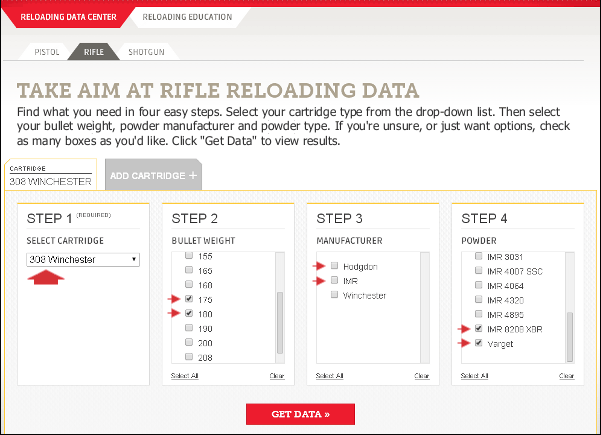

Hodgdon and IMR powders, including H4198, Varget, H4350, and IMR 4451, are some of the most successful propellants used by competitive shooters. If you want to find solid, reliable load data for these and other Hodgdon and IMR powders, we recommend you go right to the source — visit the Hodgdon/IMR Reloading Data Center, at www.HodgdonReloading.com. There you’ll find the latest, updated load recipes for pistol, rifle, and shotgun reloaders.
In the Data Center, you’ll find thousands of load recipes for pistol, rifle, and shotgun. Rifle shooters will find dozens of loads for their favorite Hodgdon, IMR, and Winchester powders such as H4198, Varget, H4350, and IMR 8208 XBR. And Hodgdon’s Reloading Center is now faster and easier to use. Navigation is simplified and the whole interface is more user-friendly.
Precise Search Results for your Cartridge and Favorite Powders

The online Reloading Data Center allows you to get precise search results for any listed cartridge. You can select your preferred powders and bullets. After choosing a cartridge, you can pre-select specific bullet weights and powder types. That quickly delivers just the information you want and need. You won’t have to scroll through scores of entries for bullets or powders you don’t use.
Data Center Works Well with Mobile Devices
Mobile users will notice Reloading Center is very “user-friendly” for smart-phone and tablet users. Controls have been optimized for touch-screens, and buttons are large and easy to use. Likewise the results are displayed in a large, easy-to read format.
Hodgdon tip from EdLongrange. We welcome reader submissions.
August 19th, 2016

Here’s an important announcement for anyone who uses a powder in the 4350 range. Alliant is now shipping the all-new Reloder 16 powder. The burn rate is slightly faster than Reloder 17, and a bit slower than Varget or Reloder 15. Notably, this new Reloder 16 powder is very temp stable. AccurateShooter.com was shown “top secret” test results comparing Reloder 16 with other popular propellants, including Hodgdon Extreme series powders. The results for Reloder 16 were remarkable. Reloder 16 showed extremely constant velocities even with very high ambient temps — so this is a powder you can shoot even on hot Arizona summer days.
CLICK HERE for Reloder 16 Suggested Load Recipes
This is NOT just a slower version of Alliant’s double-based Reloder 15 (which words great in the 6mmBR and Dasher cartridges). Reloder 16 is a completely new formulation, produced in Sweden by Bofors for Alliant. Reloder 16 utilizes TZ technology, which manipulates the response of the propellant and resists the natural tendency to generate more pressure at higher temperatures and less pressure at lower temperatures.

As a result, Reloder 16 offers outstanding temperature stability. Based on the test results we’ve seen, if you are using H4350 or IMR 4451 currently, you should definitely give Reloder 16 a try. The powder also boasts excellent lot-to-lot consistency and contains a proprietary de-coppering additive.

Match and Hunting Cartridge Applications:
Alliant tells us that Reloader 16 “is ideal for traditional hunting cartridges, such as .30-06 Springfield and .270 Winchester, as well as 6.5mm target loads and tactical applications wherein temperature stability is required.” We also think the powder may work very well in these popular match cartridges: 6XC, .243 Win, 6.5×47 Lapua, 6.5 Creedmoor, .260 Rem, .284 Win, and .300 WSM. For example, Alliant’s Load Data Sheet shows a 2772 FPS load with 142gr SMKs in the .260 Rem.
July 19th, 2016

PrecisionRifleBlog.com (PRB) recently published results from a field test PRB conducted to quantify the temperature stability of the popular Hodgdon H4350 and Varget powders and compare those to IMR’s new Enduron line of powders, specifically IMR 4166 and 4451.
Hodgdon Extreme Series powders have attracted quite a fan base, with over 90% of the top shooters in the Precision Rifle Series choosing to run one of those powders. IMR recently released a new line of powders “with Enduron Technology” — which is also marketed to have “extreme temperature stability”. Sounds familiar! These new powders should compete directly with the Hodgdon Extreme Series, which gives shooters more temp-stable powder options to consider.
CLICK HERE to Read Full Powder Temperature Stability Test on Precision RifleBlog.com.
The top shooters in the PRS and veteran long-range shooters in other disciplines have learned to value a temperature-stable powder. That’s because a change in temperature can affect the trajectory or “flight path” of the bullet in two well-known ways:
1. Assuming all other environmental conditions remain the same, an increase in air temperature will cause a flatter trajectory due to a lower air density (easier for the bullet to cut through the air).
2. The same increase in temperature also causes the nitrocellulose-based powder inside the cartridge to burn at a higher rate, producing approximately four times the Point of Impact (POI) shift than just air temperature alone. (SEE: Temperature Effects On Zero on KestrelMeters.com.)
“The initial heat condition of your powder will affect the burn rate,” Bryan Litz explained at a recent Applied Ballistics Seminar. That means swings in ambient outside temperature can affect your internal ballistics, which will directly affect your muzzle velocity, which will change your bullet’s trajectory. Some powders are more affected by changes in temperature than others. So if your goal is first-shot hits and you may shoot in a variety of conditions — you should care about temperature stable powders.

The folks at PrecisionRifleBlog.com meticulously loaded 6.5×47 Lapua ammo with each powder using some of the best equipment available. This included the top-of-the-line Prometheus Gen II Powder Scale, which is capable of loading to the nearest kernel of powder. This ensured the powder charges were identical for each round of ammo. PRB’s testers explain the full set of equipment and steps in their loading process in the Full Test Report.
Once they had a couple dozen rounds loaded with each powder, they went and shot them with each powder at 25° F, 65° F, and 140° F. The muzzle velocity of each shot was recorded using both a LabRadar Doppler Radar and a MagnetoSpeed Chronograph. The LabRadar is a new type of device that allows you to measure muzzle velocity within at least +/- 0.1% of the reading.

Here are the results from the PRB Powder Temp Stability Tests:

You can see Hodgdon H4350 had the least variance in muzzle velocity, with just 25 fps over the 115° swing in temperature! That is very, very low. Hodgdon Varget was the second least temperature sensitive powder in this test, with 46 fps of variance in muzzle velocity between temperatures of 25° F and 140° F. IMR 4166 performed very similar to Varget, and proved to be fairly insensitive to large swings in temperature. IMR 4451 had the largest swing in muzzle velocity of the powders tested, but keep in mind just 68 fps over 115° F swing is still a good performance.
Most powders aren’t specially formulated to be temperature stable. So they would likely show much larger swings than what these four top-performing powders showed.
PRB’s test team also noticed other interesting trends in the data. For example, variation in velocity does NOT appear to be linear across the full range of temperatures. By that, they mean the change per degree from 20° to 65° might be smaller or larger than the change per degree from 65° to 140°.
PRB’s testers talk about those things, provide a few other insightful views of the data, and discuss tools that can help you manage temp/muzzle velocity in the field in their full post. You can find that here: http://precisionrifleblog.com/2016/06/19/powder-temp-stability-hodgdon-extreme-vs-imr-enduron/
July 10th, 2016

Many Forum members have been looking for a good substitute for Hodgdon H4350 powder, which remains hard-to-find in many parts of the country. One of the best alternatives is IMR 4451, part of IMR’s new Enduron line of powders. Last year, top F-Class shooter Rick Jensen did a comparison between H4350 and IMR 4451, shooting the two powder in a wide range of temperatures. His data suggests that both powders show good temp stability.
Powder Comparison Test: H4350 vs. IMR 4451
Rick Jensen, Captain of the U.S. F-Open Rifle Team, has tested some of the new IMR 4451 powder. Rick and other team members were looking for a good powder that could replace Hodgdon 4350 which is difficult to obtain currently. The makers of IMR 4451 claim that it is not sensitive to temperature and that it delivers competitive accuracy. So far, Rick’s tests, done with a .284 Winchester and 180gr Berger Hybrids, appear to confirm those claims. Rick posts:
 “I did a little informal powder comparison of H4350 versus the new IMR 4451. Rifle used was a Kelbly Panda with a 30″, 1:8.75″ twist 5R Bartlein barrel [chambered in .284 Win]. All charge weights were 50.0 grains using CCI BR2 primers. I was very impressed with this new powder and I believe it to be equal to H4350 as far as temperature sensitivity. “I did a little informal powder comparison of H4350 versus the new IMR 4451. Rifle used was a Kelbly Panda with a 30″, 1:8.75″ twist 5R Bartlein barrel [chambered in .284 Win]. All charge weights were 50.0 grains using CCI BR2 primers. I was very impressed with this new powder and I believe it to be equal to H4350 as far as temperature sensitivity.
I did not test for accuracy but I will tell you my groups were pretty much equal between the two and all were in the .2-.3 MOA range. I will defiantly be shooting more of this powder in the weeks to come, assuming the supply chain will allow. It looks very encouraging to finally have a alternative to H4350 that we might actually be able to buy.”

Chronograph Results with Temps from 23° F to 101°
Here are chronograph results of a comparison test between IMR 4451 and H4350. Rick’s rifle was cleaned and allowed to cool between each test. Five fouling shots were fired before each test. Important: Note that for both Test #1 and Test #2, the powder order is reversed in the mid-temp fields (IMR 4451 first, then H4350). For the low and high temp entries, H4350 is listed first.

Here are the IMR 4451 fired cases, displayed Left to right, coldest to the hottest (in terms of case temp when fired). All charge weights were the same: 50.0 grains.

June 25th, 2016

Behold… the Holy Grail, Hodgdon Varget powder. Among all the rifle propellants on the market, Varget may have been the hardest to find in the last couple of years. But take heart, Midsouth Shooters Supply and Powder Valley Inc. now have 1-pound containers of Varget in stock for immediate delivery. To get to the PVI order screen, from the PVI Home page, click “Powders” then click “Hodgdon”.

 Over the years, Hodgdon Varget has proven to be one of the most accurate powders ever created. And it is also exceptionally temp-stable. In the .308 Win, 6mmBR, 6mm Dasher and other popular cartridges, Varget has set many records and won countless matches. It meters well (for an extruded powder) and can be used in a very large range of calibers and cartridge types. If you need Varget… don’t hesitate. Supplies are limited. This may sell out by the end of the day today.. Over the years, Hodgdon Varget has proven to be one of the most accurate powders ever created. And it is also exceptionally temp-stable. In the .308 Win, 6mmBR, 6mm Dasher and other popular cartridges, Varget has set many records and won countless matches. It meters well (for an extruded powder) and can be used in a very large range of calibers and cartridge types. If you need Varget… don’t hesitate. Supplies are limited. This may sell out by the end of the day today..
TIME STAMP: This Notice Issued at 9:30 am EST Saturday, June 25, 2016.
July 11th, 2015

Article by Bill, Editor of Rifleshooter.com
A few years ago I built a custom switch-barrel Remington 700 on an AICS Chassis chambered in .243 Winchester and .308 Winchester. I found the .243 Win finicky during load development and started looking at other options for the 6mm Bartlein 1:8″-twist HV barrel.
 Initially drawn to the 6mmBR and 6mm Dasher, I realized these cartridges wouldn’t feed from an AICS magazine system without extensive modification. I took a look at the 6mm Creedmoor, 6XC, and 6mm-6.5×47 Lapua (aka 6×47 Lapua), all of which feed well from a detachable magazine. At right you can see the 6×47 Lapua in an AICS magazine. It has the “Goldilocks factor” — not too long, not too short. Initially drawn to the 6mmBR and 6mm Dasher, I realized these cartridges wouldn’t feed from an AICS magazine system without extensive modification. I took a look at the 6mm Creedmoor, 6XC, and 6mm-6.5×47 Lapua (aka 6×47 Lapua), all of which feed well from a detachable magazine. At right you can see the 6×47 Lapua in an AICS magazine. It has the “Goldilocks factor” — not too long, not too short.
The ability to simply convert 6.5×47 Lapua brass to 6×47 brass by running the parent 6.5mm brass through a full-length Forster sizing die in a single step was what made me choose the 6×47 Lapua over the 6mm Creedmoor and 6XC (both excellent cartridges in their own right). I also own a 6.5×47 Lapua rifle, so I had a supply of 6.5×47 brass ready to neck-down. Being able to create 6×47 brass easily (one pass and done) was very appealing.
Left to right, below: 6mmBR, 6-6.5×47 Lapua, 6.5×47 Lapua, and .243 Winchester.
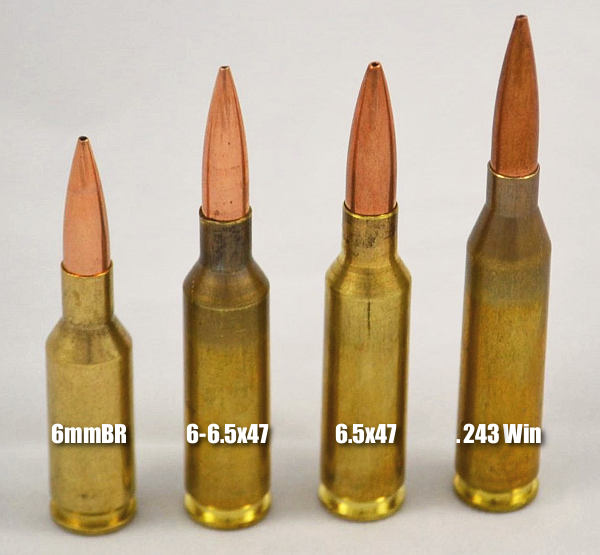
I cut the chamber end off my .243 Win barrel, threaded and chambered my rifle for the 6×47 Lapua cartridge. I have written a lengthy article on this cutting and re-chambering process. Home gunsmiths interested in this process can READ MORE HERE.
When the re-chambering was complete, I headed to the range and worked up a set of eight loads using Berger 108 BTHPs, H4350, Lapua brass, and CCI 450 primers.

Load development was a little trickier than with the 6.5×47 Lapua parent cartridge. The accuracy nodes were smaller. However, once I dialed in a load with Hodgdon H4350 and the 108-grain Berger BTHP, the rest was history. The 6×47 rig is now one of the most consistent rifles I own, holding just above 0.3 MOA for 5-round groups. Below is a 100-yard test target with 108-grain Berger BT in the 6×47 Lapua. Five-shot group sizes are (L to R): .369″, .289″, and .405″. The average size was .354″ or .338 MOA. [Editor: We think that is excellent accuracy for a tactical-type rifle shot from bipod.]

Learn More about this 6×47 Lapua Project
I’ve written more about this 6×47 rifle on my Rifleshooter.com website. To learn more about my experience with the 6×47 Lapua, click this link: 6-6.5X47 Lapua Review.
About the author: Bill has been a serious shooter for over 20 years. A former Marine Corps Sergeant, he’s competed and placed in High Power Rifle, ISPC, USPSA, IDPA, 3-Gun, F-Class, and precision rifle disciplines. In addition to being an NRA-certified firearms instructor and range officer, Bill has hunted big game in North America, South America, and Africa. Bill writes extensively about gunsmithing, precision rifles, and the shooting sports on his blog, Rifleshooter.com.
January 24th, 2014
 Here’s good news for short-range benchrest shooters. The two most popular powders for the 6PPC, Vihtavuori N133 and Accurate LT-32, are now in-stock at Powder Valley Inc. (PVI). In fact, Powder Valley even has the hard-to-find 8-lb jugs of N133. If you need LT-32 or VV N133, visit PowderValleyinc.com. Here’s good news for short-range benchrest shooters. The two most popular powders for the 6PPC, Vihtavuori N133 and Accurate LT-32, are now in-stock at Powder Valley Inc. (PVI). In fact, Powder Valley even has the hard-to-find 8-lb jugs of N133. If you need LT-32 or VV N133, visit PowderValleyinc.com.
– PVI has 1-lb containers of LT-32 for $24.90
— PVI has 1-lb containers of N133 for $30.35
— PVI has 8-lb jugs of N133 for $196.50.
Consider Norma Powders for Large Cartridges
Can’t get H4350 or H4831sc? If you need slower-burning powders for your .260 Rem, .284 Win, 7mm WSM, or magnum caliber, consider Norma powders. While the popular Alliant and Hodgdon medium-to-slow burn-rate powders are still very hard to find, you can get similar Norma powders from many vendors right now, no waiting.
 Powder Valley has Norma 204, 217, MRP, and URP in stock. MidwayUSA.com has 204, 217, MRP, and URP in stock. MidsouthShootersSupply.com has Norma 204 in stock. The Lapua Burn Rate Chart (shown below) places URP in the burn range of H4350 and Vihtavuori N150, and Norma says “burning rate for URP is close to our 204 but on the quick side.” Norma 204 is slower than H4350 but a little faster than H4831sc. MRP is close to the original H4831. Download Chart as PDF. Powder Valley has Norma 204, 217, MRP, and URP in stock. MidwayUSA.com has 204, 217, MRP, and URP in stock. MidsouthShootersSupply.com has Norma 204 in stock. The Lapua Burn Rate Chart (shown below) places URP in the burn range of H4350 and Vihtavuori N150, and Norma says “burning rate for URP is close to our 204 but on the quick side.” Norma 204 is slower than H4350 but a little faster than H4831sc. MRP is close to the original H4831. Download Chart as PDF.
Norma 217 does not show on the Lapua chart, but it is a good powder for the heavy magnums. Norma says that “Norma 217 is slightly slower than the discontinued MRP2. It was developed for the 30-378 Weatherby from start. Matches the .338 Norma Mag and .338 Lapua Mag perfect with heavy bullets. It is also a good candidate for [overbore cartridges] such as 7mm Rem Mag[.]”.

May 1st, 2011
What’s a “wallet group”? It’s a singularly spectacular proof target that entitles its bearer to bragging rights. The wallet group may or may not have been shot in competition, and, by definition, it may not be repeatable. But it exists as incontrovertible proof that, at least once, the stars aligned, and the wind gods smiled on the shooter.
 Five Shots in 0.178 MOA at 1000 Yards Five Shots in 0.178 MOA at 1000 Yards
A couple seasons back, Forum member and F-Class shooter Gary Wood was testing his 6.5-284 rifle at the 1000-yard range in Coalinga, California, getting ready for an up-coming long range match. In practice, Gary nailed a witnessed 1.859″ five-shot group, with four of the five shots well under an inch. Use this as proof to win those club-house arguments about whether it is possible to shoot “in the ones” at 1000 yards. Gary’s group worked out to 0.178 MOA!
Gary reports: “I was load testing with 5-shot groups. Each group was shot on a new F-Class center and pulled by Ret. Master Chief Jerry Pullens and spotted by an other long-range shooter. The second 5-shot load group looked really small … by our reckoning four out of five shots measured under an inch. I was amazed. What’s more, when I shot the group, the 4th shot blew the spindle out of the 3rd shot. My spotter saw that in his scope and Jerry Pullens told me about it afterwards”.
As measured with the OnTarget Software, using a scan of the target, Gary plotted the group size at 1.859″ total for five shots, or 0.178 MOA. Gary noted: “I had everyone sign the target which I saved and photographed.” Yes, Gary, this may be the wallet group to end all wallet groups. You should have that target framed.

Gary’s Load and 6.5-284 Rifle Specs
Gary’s load was 48 grains of Hodgdon H4350 and CCI BR-2 primers, pushing 142gr Sierra MKs, in Lapua 6.5-284 brass. The rifle features an F-class, single-shot Surgeon action with a Bartlein 5R barrel chambered with a no-turn neck. Gary says “The barrel only has 70 rounds through it… yep, I think it will shoot.” Gary did all of the gunsmithing and barrel work himself.
Did Gary have any special reloading tricks? Apparently not: “Other than weighing the cases and the powder very carefully, there really were no magical reloading secrets used. The Sierra 142s were moly-coated straight from the box of 500, but they were not weighed or checked for bearing surface. The powder was dropped with a RCBS ChargeMaster then checked with an Acculab scale (to under a tenth). The Lapua cases were not neck-turned, but I did weight-sort them. The five cases for the small group weighed: 195.05, 195.03, 195.03, 195.03, 195.01.”
July 22nd, 2010
John Hoover of Accuracy One Shooting Supplies is the 2010 Williamsport World Open Two-gun Overall Champion. Shooting a 6.5×284 in both Light Gun (LG) and Heavy Gun (HG) classes, John shot consistently, placing 3rd in Light Gun class, and 6th in Heavy Gun to win the overall Two-Gun with 34 rank points. It was a solid win. The next closest shooter was Paul Chackan with 59 rank points.

 Hoover’s Reloading Tips Hoover’s Reloading Tips
We interviewed John after his World Open victory, and he shared his World Open-winning load, and some of the reloading secrets that allow him to craft ultra-accurate long range ammo. For his 6.5x284s, John loaded was Sierra 142gr MatchKings pushed by 48.0 grains of Hodgdon H4350, in “white box” Winchester .284 brass. Both rifles used exactly the same load. John revealed: “I have 9 match rifles, and they all shoot 48.00 grains of H4350.” John pointed his 142gr SMKs, using his own Accuracy One bullet-pointing tool: “I don’t shoot anything that isn’t pointed. All the loads we shoot use pointed bullets. I find that bullet pointing, combined with meplat trimming, reduces vertical dispersion at 1000 yards.”
Hoover’s Secret Ingredient? RWS Primers
Hoover lit his loads with RWS primers — the “Holy Grail” of rifle primers. Where did John get these superior German-made RWS primers, which are virtually unobtainable in the USA these days? John explained: “I bought those primers a long time ago, as a stocking dealer. I had about 100,000 at one time before they quit importing them, I kept a fair amount for us to use. I’m down to about 8000. When they’re gone I’ll have to change to something else.”
Hoover Now Anneals Brass “Early and Often”
Recently Hoover has changed his brass annealing procedure; he now anneals his Winchester brass earlier and more frequently: “I anneal more often now. I used to shoot my cases five to six times before annealing. Now before I shoot a case the very first time, I anneal it. That has help keep the ES and SD down. I anneal before I shoot the first time, and then every third firing. I use the Ken Light annealing machine.”
Ace Smiths Built Hoover’s Winning Rifles
John’s heavy gun was chambered by Al Warner of Warner Tools, while the light gun was chambered by 8-time National High Power Champion Carl Bernosky. Both light and heavy guns had Bartlein 1:8.5″ twist 5R barrels. All the stock work was done by Alex Sitman of Master Class Stocks. John credited these smiths: “I had good equipment from top to bottom, I had good smithing help from Alan, Carl, and Alex, who all did excellent work. When you’re walking to the firing line you get peace of mind from having the best equipment.”
READ MORE: To learn more about John Hoover’s successful 6.5-284s, read this Gun of the Week article.
|