Eurooptic vortex burris nightforce sale


teslong borescope digital camera barrel monitor


As an Amazon Associate, this site earns a commission from Amazon sales.


December 2nd, 2025

CMP Announces Release of Four 2026 Competition Rulebooks

cmp new 2026 rifle pistol rulebook pdf release cmp.org

CMP Announces the Early Release of Four 2026 Competition Rulebooks
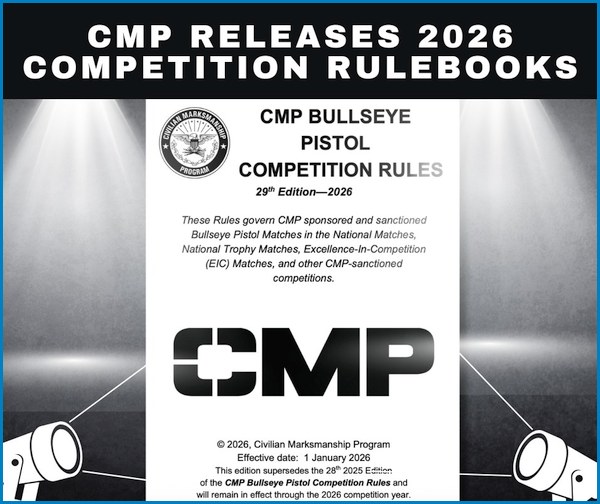
Four rulebooks that govern CMP Highpower Rifle, CMP Games, Bullseye Pistol and Action Pistol competitions in 2026 have been updated and approved by the CMP Rules Sub-Committee. These four rulebooks were published on 12/1/2025, one month before they will take effect on January 1, 2026. This early release will give competitors and match sponsors a head start on preparing for their next competition year. Download these Four New Rulebooks at https://thecmp.org/competitions/cmp-competitions-rulebooks/.

The following 2026 rulebooks are now posted on the CMP website:

29th Edition 2026 CMP Highpower Rifle Competition Rules
13th Edition 2026 CMP Games Rifle and Pistol Competition Rules
29th Edition 2026 CMP Bullseye Pistol Competition Rules
4th Edition 2026 CMP Action Pistol Competition Rules

cmp new 2026 rifle pistol rulebook pdf release cmp.org

Copies of these new rulebooks can be downloaded from the CMP Competition Rulebooks Webpage. On that CMP webpage, the listings of downloadable documents will include the 2026 rulebooks, lists of changes in each 2026 rulebook, and the Range Officer scripts that are to be followed.

Notable CHANGES IN 2026 CMP RULEBOOKS

The four CMP rulebooks that are being released now contain some important changes that may impact your 2026 competition plans. Here are some of the most significant 2026 rule changes.

New F-Practical F-Class Category (HIGHPOWER RIFLE). The 2026 CMP Highpower Rifle rulebook introduces a new F-Practical F-Class Category that is limited to factory production rifles and equipment. Cartridges cannot exceed .308 in bullet diameter; “magnums” will not be allowed. Rifles may not weigh more than 14.0 pounds and must have a minimum trigger pull of 2.0 pounds. Optics are limited to 16X. Total retail cost of a competitor’s rifle and equipment is limited to $3,000. This new category will be offered in all CMP Mid- and Long-Range Matches. Clubs are encouraged to include it in their sanctioned matches.

Suppressors and Silencers (HIGHPOWER RIFLE). The use of silencers or suppressors is already widespread in some shooting sports disciplines. Their use is promoted as a means of reducing range noise levels and mitigating the possibility of hearing loss. The CMP has taken its initial steps in approving suppressors for use in CMP Matches. In 2026, competitors in most F-Class categories (F-TR, F-O, AR Tactical) will be allowed to shoot with suppressors.

Highpower Rifle Scoring (HIGHPOWER RIFLE). Several years ago, the CMP adopted the highpower rifle scoring protocol used by the NRA. This calls for scoring highpower rifle targets according to the size of the competitor’s bullet. This meant that competitors with AR-Type rifles had their shots scored with a .223″ gauge while competitors firing M14-Type rifles had their shots scores with a larger .308″ gauge. Starting in 2026, electronic targets used in CMP Highpower Rifle events will have the same sized scoring rings. Electronic targets, of course, score to the center of the shot hole, not the outside edge, so those targets will now assume that all shots were fired with a 7.62mm/.308 bullet to determine precise scoring ring sizes. All shots fired on paper targets will be scored with a uniform .308 inch scoring gauge.

Nat’l Trophy Match New Shooter Rule (HIGHPOWER RIFLE & BULLSEYE PISTOL). National Trophy teams will get a break if they have two or more new shooters on their National Trophy Teams. They must designate one of them as their new shooters. Any other new shooters retain their new shooter eligibility.

At-Large Teams (HIGHPOWER RIFLE, BULLSEYE PISTOL). The new rules for both Highpower Rifle and Bullseye Pistol changed “Out-of-Competition” teams to “At-Large” teams. This rule is used extensively in the National Trophy Rifle and Pistol Team Matches to allow teams that could not comply with eligibility requirements to still shoot in the match even when they could not win awards. To give status to these teams, the name was changed to “At-Large” and the possibility of giving awards has been added.

Smallbore Rifle and Air Gun Rulebooks Delayed. The completion of two 2026 CMP rulebooks is being delayed while the shooting world awaits final decisions from the International Shooting Sport Federation (ISSF) regarding major proposals to change rifle clothing and rifle 3-position finals.

Permalink Competition, Handguns, News, Shooting Skills No Comments »
July 2nd, 2023

Sunday Gunday: AR Service Rifle — Reloading and Ammunition

High Power service rifle AR15 reloading 600 yard Danny Arnold powder kernels
The 600-yard target has an X-Ring 6 inches (1 MOA) across, while the 10-Ring spans 12 inches (2 MOA).

The following article is about reloading for NRA/CMP Highpower Rifle competition and is geared toward competitors shooting the AR15 Service Rifle. In Highpower Rifle competition, shooters fire in four stages: Standing slow-fire at 200 yards, Sitting rapid-fire at 200 yards, Prone rapid-fire at 300 yards, and Prone slow-fire at 600 yards. Competitors use a sling for support in all positions but standing. A typical AR15 Service Rifle sports a 20″ free-floated barrel and a 4.5-pound trigger. Service Rifle scopes are limited to maximum power of 4.5X.

Thoughts on Loading for Service Rifles, Particularly for 600 Yards

by Danny Arnold, Team CMP
Article originally published in CMP Shooting News

Before we get started, I want to stress that all of the information that follows is geared toward the .223/5.56 Service Rifle. That doesn’t mean that there’s nothing here for anyone else, but the .223/5.56 Service Rifle platform is where I’ve spent the majority of my time, so here we go.

There is only one “Perfect” 600–yard load for my rifle, True or False? This example is more anecdotal than scientific, but it provides some food for thought….

Team CMP spent the early part of March competing in the Orange Blossom Regional. As soon as we got on the range, Sara Rozanski (Team CMP member) started having problems with her 600-yard ammunition. Nearly 1/3 of her cases were exiting the chamber minus the primers. I offered to swap my ammunition for hers, suspecting that my Wylde chamber would be more forgiving than her CLE chamber — a solution that seemed to solve the problem. At least neither of us was blowing primers!

High Power service rifle AR15 reloading 600 yard Danny Arnold powder kernels

Sara’s ammunition was a factory load using a well-known 80+ grain bullet with an unknown primer and powder, using brass from a respected manufacturer. My load was a different brand of 80-grain bullet, with my choice of powder and primer, all in brass made by someone else. Given the color of the primers, the only thing that our ammunition could possibly have had in common was the brand of powder… maybe. So, how did we shoot?

Sara and I shot the two-person team together and the entire 2,400 Aggregate, although on different relays. Sara’s combined 600-yard score was 780-28X (97.5%). Mine was a 783-24X (97.87%). Our scores were never more than two points apart on any of the four days. Keep in mind that we were using each other’s ammunition the entire time.

So, we had different barrels, chambers and ammunition, but similar results. That goes back to the idea that a good load will perform similarly if fired in a good barrel.

Are We Too Focused on Ballistic Coefficients (BCs)?
The revailing wisdom has always trended toward loading the highest-BC bullet we could find and pushing it as fast as possible. Back in the early ’90s when I got started with the AR15, the 80-grain Sierra was state of the art. Actually, I picked up all of my Leg points with it, although today it looks a bit dated — kinda like me.

So, the question I’ll pose is this: Would you rather shoot a high-BC bullet that groups 3/4-MOA (minute of angle) or a lower-BC bullet that groups into one-half-MOA traveling 50 feet-per-second faster? The reason that I posed this question is a situation I found myself in a decade ago. Our coach decided that he wanted us to pair-fire some 600-yard for practice. Unfortunately, I hadn’t gotten the memo and all that I had available was my normal short-line ammunition, loaded with a 77-grain bullet. The shooter I was paired with was using a higher-BC bullet than I was, but in the end, we both shot 198s.

Admittedly, using 77-grainers meant that coach had to work a little harder to keep us together on target, but it was a teaching moment for me. I knew that my upper shot 77s better than the available bullets in the 80-grain range, so I cranked out a windage table for the 77-grain bullet at 600 yards and shot those for the rest of the season. After all, the wind blows ALL bullets around. It’s just a matter of knowing what YOUR bullet is doing.

With the shortages that we’re experiencing right now, a lighter bullet may be all that you have available for the 2021 season. That doesn’t mean that you’re disadvantaged though.

High Power service rifle AR15 reloading 600 yard Danny Arnold powder kernels
Danny Arnold teaching Highpower Clinic at 2021 CMP Eastern Games

Loading High-BC Bullets
In the past decade, several bullets have appeared that weigh 80-grains or more. One thing that many of them have in common is a very sharp nose profile, whether metal or polymer. The question is: Are you using the right seating stem?

The jacket material in the bullet’s nose is very thin. If you section a bullet, you’ll find that there is a surprising amount of air space in the nose. If you’re using older seating dies, your seating stem may be contacting the bullet nose too close to the tip, where the jacket is the both thinnest and is unsupported by the lead core. This can manifest itself either as a deformation at the very tip of the bullet or as a circular dent around the bullet nose that you can see and feel with your thumbnail. I think we can all agree that denting a bullet is usually considered a bad thing.

High Power service rifle AR15 reloading 600 yard Danny Arnold powder kernels

One company goes so far as to recommend their proprietary seating stem for use with their high-BC bullets. Other companies leave it up to you to find a seating stem that will allow the bullet nose to go deeper into the seating stem, moving the contact point further down the bullet where the jacket is thicker and supported by the core material.

Seating Depth and Bullet Preferences
Some bullets don’t mind some “jump” into the lands, but some really do. Unfortunately, manufacturers don’t tell you much about that. Your chamber configuration (Wylde, CLE, or some hybrid of the two) and the bullet that you choose will determine your optimal seating depth. Long and short of it, a quality measuring tool to determine seating depth is a necessity these days. Keep in mind that if you’re doing this with a brand new barrel, the throat is likely going to change slightly in the first 200 rounds and may need to be re-measured. Actually, since all of your short range ammunition has to be loaded to magazine length, you’re probably better off developing your short range loads before starting on long range load development. That gives the throat a chance to wear in a bit on a new barrel.

Brass Prep — Why It Is Important
When match-grade AR15s first arrived on the scene, it was amazing how little it took to get them to shoot well. Other than making sure that I had brass from the same lot and running it through a set of match-grade dies, I did nothing. Of course, we were also using a post front sight. Was the occasional bad shot me, the rifle, the load or just an archaic sighting system?

Transitioning to optics has caused me to reconsider how and what I do in my reloading process: That, and having some extra time on my hands to experiment.

A little (or a lot) of time spent with a neck turning tool, a primer-pocket uniformer and a flash-hole reamer will quickly show you how consistent brass is by manufacturer and even by individual lot. That exercise also makes the prices charged for high-quality brass seem ridiculously cheap. That doesn’t mean that I advocate neck-turning or other uniforming practices, nor do I advocate spending scandalous amounts of money on long-range brass. However, our sport is about consistency. The consistency of your brass is a matter of choice, whether you choose to simply segregate cases by weight (cheap option), neck turn (labor intensive) or open your wallet a little wider for premium brass.

High Power service rifle AR15 reloading 600 yard Danny Arnold powder kernels

Weighing Charges vs. Throwing with Powder Measure
To measure or weigh? For a long time, I used a powder measure to throw all of my 600-yard loads. The powder I was using metered well, and the results downrange didn’t justify the extra time spent with a scale. That was in the day of iron sights though. Nowadays, I’m throwing my charges and trickling up to the desired weight as measured on a scale that weighs to a 100th of a grain.

To quantify the difference between individually weighing each charge versus throwing charges with a powder measure, I weighed six kernels of powder that I trickled into the pan and then dumped them into the hopper. Going through that process 10 times, I came up with an average weight of .08 grains for six kernels. Next, I threw 50 charges for weighing using my powder measure. If I felt the measure hanging up as it cut kernels, I put the charge back into the hopper without weighing it.

High Power service rifle AR15 reloading 600 yard Danny Arnold powder kernels
That’s six kernels of powder sitting in the pan — average weight .08 grains.

Those 50 smoothly-thrown charges varied .26 grains from lowest to highest, with the majority varying no more than .16 grains from highest to lowest. If the desired weight was exactly in the middle, at worst you’d be .13 grains (9-10 kernels) low or high, with the majority being off no more than .08 grains (6 kernels) above or below the desired charge weight. Is that enough to send a shot outside the 2-MOA 10-Ring? Probably not.

Has more consistent brass and weighing charges to one-hundredth (0.01) of a grain added up to higher scores? Honestly, this question is hard to answer. Looking at the results on paper at 200 yards, using a powder that meters well combined with a consistent touch on the loading lever doesn’t appear measurably different than meticulously weighing each and every powder charge. Looking back over my 600-yard plots however, I can see a trend toward a group that is closer to X-Ring height.

Since the bullseye is widest at the center, shooting groups that are the height of the X-ring gives you more room for error when the wind is blowing. That can translate into higher 600-yard scores.

How You Load Your Ammunition vs. How You Load Your Rifle
The loading/chambering cycle of the AR-15 is, in a word, violent. You have a relatively heavy bolt and carrier assembly under power of a stout buffer spring slamming forward to chamber each round of ammunition. By design, those rounds were supposed to be held securely by the magazine feed lips until the bolt stripped them off the follower. Obviously, due to their overall length, 600-yard loads can’t be chambered that way. Although the barrel extension is funnel-shaped, it’s also got a lot of “teeth” ringing the inside of it (see below).

High Power service rifle AR15 reloading 600 yard Danny Arnold powder kernels

Whether you’re using a standard magazine or a single-round loading device (SLED), dropping a round in the loading port and releasing the bolt is an act of faith in that you’re trusting the bullet to arrive in the chamber undamaged.

Ask yourself, how many times have you seen someone drop a round on the follower, press the bolt release and watch as the bolt jammed on a cockeyed round? If that happens once every 100 tries, how many times did the bolt close on a scratched, dented, or misaligned bullet? Could that be the cause of the occasional errant shot?

My technique is to drop each round on top of the SLED and then push it slightly forward with my finger, partially chambering it before releasing the bolt. Admittedly, some people may be unable to do this due to body configuration or left-handedness, but why go to all the trouble of loading “perfect” ammunition and then damage it on the way into the chamber?

Now that we’ve covered bullets, brass, and assorted errata we can move on to discussing loads for 600 Yards…

High Power service rifle AR15 reloading 600 yard Danny Arnold powder kernels highpower target
The NRA Highpower 600-yard target has a 6-inch (1 MOA) X-Ring, and a 12-inch (2 MOA) 10-Ring.

Load Development for 600 Yards

Finding a load for 600 yards is a lot like finding a load for short range. Once I decide on a bullet, powder, primer, velocity range and a measured guesstimate of seating depth, I load 10 rounds of each test load, increasing in 0.2 (2/10) grain increments. I test them from the prone position at 200 yards. Ideally, I want to see two loads that are 0.2 (2/10) of a grain apart that shoot almost identical groups. The load that I choose will fall in between the two best shooting loads that I tested. If the first load is XX.2 grains and the second is XX.4 grains, my chosen load will be XX.3 grains.

Why develop loads in 0.2-grain (tenths) increments if I have a scale that measures in 0.01-grain (hundredths) increments? Or, why not test in 0.1-grain increments?

For me, working in 0.2-grain increments gets me to the results quicker. Also, there is a difference between accuracy and consistency in this scenario. Developing loads in 0.2-grain increments gets me to an accurate load. Producing that load using a scale that accurately measures to .01-grain insures a consistent load, assuming that I do my part.

Once I’ve settled on a load, it’s time to play with seating depth, if I choose to. If I’m lucky and the groups are acceptable as-is, I won’t do anything. If I think there’s room for improvement, I’ll experiment a little. Depending on the bullet, changing the seating depth by a couple of thousandths one way or the other may change the group size. During this phase of testing, it’s a good idea to chamber a round and see if the entire round will then extract. If you leave a bullet stuck in the throat, your rounds are too long. Finding that out at a match can ruin an otherwise good day.

High Power service rifle AR15 reloading 600 yard Danny Arnold powder kernels
Danny Arnold shooting his AR15 Service Rifle, standing position at 2021 CMP Eastern Games.

Another thing to keep in mind is that your barrel is not static. Every round fired has an effect on the throat, vaporizing and scouring away metal until the distance the bullet travels before meeting the rifling measurably increases. If you have chosen a bullet that shoots best when close to the lands, you’ll need to periodically re-measure and possibly change your bullet seating depth to maintain that optimal relationship.

The Elephant in the Room — User Skill Level

There’s really not a delicate way to put this, so I won’t try. There’s little point in spending time and effort developing a load that shoots into half-MOA off the bench if you’re only capable of shooting 2 MOA using a sling right now.

That doesn’t mean that there’s no hope. On the contrary, it just means that your time and effort is better spent practicing with some good short-range ammunition on reduced targets at a 100 or 200-yard range. At that distance, wind is not a factor and your technique can be improved more quickly so you’re in a position to benefit from that ½ MOA ammunition.

About Team CMP
CMP has created a Highpower Team with top competitors. Team CMP competes at several events throughout the year and most importantly, helps to teach Highpower Clinics at CMP Competition Events. Learn from Team CMP at Camp Perry during the Advanced Highpower Clinic, scheduled this year for July 30 through August 1, 2021. Visit the Highpower Clinic Web Page for more information.

The Civilian Marksmanship Program is a federally-chartered 501(c)(3) non-profit corporation. It is dedicated to firearm safety and marksmanship training and to the promotion of marksmanship competition for citizens of the United States. For more information about the CMP and its programs, visit www.TheCMP.org.

Permalink - Articles, Competition, Reloading No Comments »
June 6th, 2021

Sunday Gunday: AR Service Rifle — Focus on Ammo & Reloading

High Power service rifle AR15 reloading 600 yard Danny Arnold powder kernels
The 600-yard target has an X-Ring 6 inches (1 MOA) across, while the 10-Ring spans 12 inches (2 MOA).

The following article is about reloading for NRA/CMP Highpower Rifle competition and is geared toward competitors shooting the AR15 Service Rifle. In Highpower Rifle competition, shooters fire in four stages: Standing slow-fire at 200 yards, Sitting rapid-fire at 200 yards, Prone rapid-fire at 300 yards, and Prone slow-fire at 600 yards. Competitors use a sling for support in all positions but standing. A typical AR15 Service Rifle sports a 20″ free-floated barrel and a 4.5-pound trigger. Service Rifle scopes are limited to maximum power of 4.5X.

Thoughts on Loading for Service Rifles, Particularly for 600 Yards

by Danny Arnold, Team CMP
Article originally published in CMP Shooting News

Before we get started, I want to stress that all of the information that follows is geared toward the .223/5.56 Service Rifle. That doesn’t mean that there’s nothing here for anyone else, but the .223/5.56 Service Rifle platform is where I’ve spent the majority of my time, so here we go.

There is only one “Perfect” 600–yard load for my rifle, True or False? This example is more anecdotal than scientific, but it provides some food for thought….

Team CMP spent the early part of March competing in the Orange Blossom Regional. As soon as we got on the range, Sara Rozanski (Team CMP member) started having problems with her 600-yard ammunition. Nearly 1/3 of her cases were exiting the chamber minus the primers. I offered to swap my ammunition for hers, suspecting that my Wylde chamber would be more forgiving than her CLE chamber — a solution that seemed to solve the problem. At least neither of us was blowing primers!

High Power service rifle AR15 reloading 600 yard Danny Arnold powder kernels

Sara’s ammunition was a factory load using a well-known 80+ grain bullet with an unknown primer and powder, using brass from a respected manufacturer. My load was a different brand of 80-grain bullet, with my choice of powder and primer, all in brass made by someone else. Given the color of the primers, the only thing that our ammunition could possibly have had in common was the brand of powder… maybe. So, how did we shoot?

Sara and I shot the two-person team together and the entire 2,400 Aggregate, although on different relays. Sara’s combined 600-yard score was 780-28X (97.5%). Mine was a 783-24X (97.87%). Our scores were never more than two points apart on any of the four days. Keep in mind that we were using each other’s ammunition the entire time.

So, we had different barrels, chambers and ammunition, but similar results. That goes back to the idea that a good load will perform similarly if fired in a good barrel.

Are We Too Focused on Ballistic Coefficients (BCs)?
The revailing wisdom has always trended toward loading the highest-BC bullet we could find and pushing it as fast as possible. Back in the early ’90s when I got started with the AR15, the 80-grain Sierra was state of the art. Actually, I picked up all of my Leg points with it, although today it looks a bit dated — kinda like me.

So, the question I’ll pose is this: Would you rather shoot a high-BC bullet that groups 3/4-MOA (minute of angle) or a lower-BC bullet that groups into one-half-MOA traveling 50 feet-per-second faster? The reason that I posed this question is a situation I found myself in a decade ago. Our coach decided that he wanted us to pair-fire some 600-yard for practice. Unfortunately, I hadn’t gotten the memo and all that I had available was my normal short-line ammunition, loaded with a 77-grain bullet. The shooter I was paired with was using a higher-BC bullet than I was, but in the end, we both shot 198s.

Admittedly, using 77-grainers meant that coach had to work a little harder to keep us together on target, but it was a teaching moment for me. I knew that my upper shot 77s better than the available bullets in the 80-grain range, so I cranked out a windage table for the 77-grain bullet at 600 yards and shot those for the rest of the season. After all, the wind blows ALL bullets around. It’s just a matter of knowing what YOUR bullet is doing.

With the shortages that we’re experiencing right now, a lighter bullet may be all that you have available for the 2021 season. That doesn’t mean that you’re disadvantaged though.

High Power service rifle AR15 reloading 600 yard Danny Arnold powder kernels
Danny Arnold teaching Highpower Clinic at 2021 CMP Eastern Games

Loading High-BC Bullets
In the past decade, several bullets have appeared that weigh 80-grains or more. One thing that many of them have in common is a very sharp nose profile, whether metal or polymer. The question is: Are you using the right seating stem?

The jacket material in the bullet’s nose is very thin. If you section a bullet, you’ll find that there is a surprising amount of air space in the nose. If you’re using older seating dies, your seating stem may be contacting the bullet nose too close to the tip, where the jacket is the both thinnest and is unsupported by the lead core. This can manifest itself either as a deformation at the very tip of the bullet or as a circular dent around the bullet nose that you can see and feel with your thumbnail. I think we can all agree that denting a bullet is usually considered a bad thing.

High Power service rifle AR15 reloading 600 yard Danny Arnold powder kernels

One company goes so far as to recommend their proprietary seating stem for use with their high-BC bullets. Other companies leave it up to you to find a seating stem that will allow the bullet nose to go deeper into the seating stem, moving the contact point further down the bullet where the jacket is thicker and supported by the core material.

Seating Depth and Bullet Preferences
Some bullets don’t mind some “jump” into the lands, but some really do. Unfortunately, manufacturers don’t tell you much about that. Your chamber configuration (Wylde, CLE, or some hybrid of the two) and the bullet that you choose will determine your optimal seating depth. Long and short of it, a quality measuring tool to determine seating depth is a necessity these days. Keep in mind that if you’re doing this with a brand new barrel, the throat is likely going to change slightly in the first 200 rounds and may need to be re-measured. Actually, since all of your short range ammunition has to be loaded to magazine length, you’re probably better off developing your short range loads before starting on long range load development. That gives the throat a chance to wear in a bit on a new barrel.

Brass Prep — Why It Is Important
When match-grade AR15s first arrived on the scene, it was amazing how little it took to get them to shoot well. Other than making sure that I had brass from the same lot and running it through a set of match-grade dies, I did nothing. Of course, we were also using a post front sight. Was the occasional bad shot me, the rifle, the load or just an archaic sighting system?

Transitioning to optics has caused me to reconsider how and what I do in my reloading process: That, and having some extra time on my hands to experiment.

A little (or a lot) of time spent with a neck turning tool, a primer-pocket uniformer and a flash-hole reamer will quickly show you how consistent brass is by manufacturer and even by individual lot. That exercise also makes the prices charged for high-quality brass seem ridiculously cheap. That doesn’t mean that I advocate neck-turning or other uniforming practices, nor do I advocate spending scandalous amounts of money on long-range brass. However, our sport is about consistency. The consistency of your brass is a matter of choice, whether you choose to simply segregate cases by weight (cheap option), neck turn (labor intensive) or open your wallet a little wider for premium brass.

High Power service rifle AR15 reloading 600 yard Danny Arnold powder kernels

Weighing Charges vs. Throwing with Powder Measure
To measure or weigh? For a long time, I used a powder measure to throw all of my 600-yard loads. The powder I was using metered well, and the results downrange didn’t justify the extra time spent with a scale. That was in the day of iron sights though. Nowadays, I’m throwing my charges and trickling up to the desired weight as measured on a scale that weighs to a 100th of a grain.

To quantify the difference between individually weighing each charge versus throwing charges with a powder measure, I weighed six kernels of powder that I trickled into the pan and then dumped them into the hopper. Going through that process 10 times, I came up with an average weight of .08 grains for six kernels. Next, I threw 50 charges for weighing using my powder measure. If I felt the measure hanging up as it cut kernels, I put the charge back into the hopper without weighing it.

High Power service rifle AR15 reloading 600 yard Danny Arnold powder kernels
That’s six kernels of powder sitting in the pan — average weight .08 grains.

Those 50 smoothly-thrown charges varied .26 grains from lowest to highest, with the majority varying no more than .16 grains from highest to lowest. If the desired weight was exactly in the middle, at worst you’d be .13 grains (9-10 kernels) low or high, with the majority being off no more than .08 grains (6 kernels) above or below the desired charge weight. Is that enough to send a shot outside the 2-MOA 10-Ring? Probably not.

Has more consistent brass and weighing charges to one-hundredth (0.01) of a grain added up to higher scores? Honestly, this question is hard to answer. Looking at the results on paper at 200 yards, using a powder that meters well combined with a consistent touch on the loading lever doesn’t appear measurably different than meticulously weighing each and every powder charge. Looking back over my 600-yard plots however, I can see a trend toward a group that is closer to X-Ring height.

Since the bullseye is widest at the center, shooting groups that are the height of the X-ring gives you more room for error when the wind is blowing. That can translate into higher 600-yard scores.

How You Load Your Ammunition vs. How You Load Your Rifle
The loading/chambering cycle of the AR-15 is, in a word, violent. You have a relatively heavy bolt and carrier assembly under power of a stout buffer spring slamming forward to chamber each round of ammunition. By design, those rounds were supposed to be held securely by the magazine feed lips until the bolt stripped them off the follower. Obviously, due to their overall length, 600-yard loads can’t be chambered that way. Although the barrel extension is funnel-shaped, it’s also got a lot of “teeth” ringing the inside of it (see below).

High Power service rifle AR15 reloading 600 yard Danny Arnold powder kernels

Whether you’re using a standard magazine or a single-round loading device (SLED), dropping a round in the loading port and releasing the bolt is an act of faith in that you’re trusting the bullet to arrive in the chamber undamaged.

Ask yourself, how many times have you seen someone drop a round on the follower, press the bolt release and watch as the bolt jammed on a cockeyed round? If that happens once every 100 tries, how many times did the bolt close on a scratched, dented, or misaligned bullet? Could that be the cause of the occasional errant shot?

My technique is to drop each round on top of the SLED and then push it slightly forward with my finger, partially chambering it before releasing the bolt. Admittedly, some people may be unable to do this due to body configuration or left-handedness, but why go to all the trouble of loading “perfect” ammunition and then damage it on the way into the chamber?

Now that we’ve covered bullets, brass, and assorted errata we can move on to discussing loads for 600 Yards…

High Power service rifle AR15 reloading 600 yard Danny Arnold powder kernels highpower target
The NRA Highpower 600-yard target has a 6-inch (1 MOA) X-Ring, and a 12-inch (2 MOA) 10-Ring.

Load Development for 600 Yards

Finding a load for 600 yards is a lot like finding a load for short range. Once I decide on a bullet, powder, primer, velocity range and a measured guesstimate of seating depth, I load 10 rounds of each test load, increasing in 0.2 (2/10) grain increments. I test them from the prone position at 200 yards. Ideally, I want to see two loads that are 0.2 (2/10) of a grain apart that shoot almost identical groups. The load that I choose will fall in between the two best shooting loads that I tested. If the first load is XX.2 grains and the second is XX.4 grains, my chosen load will be XX.3 grains.

Why develop loads in 0.2-grain (tenths) increments if I have a scale that measures in 0.01-grain (hundredths) increments? Or, why not test in 0.1-grain increments?

For me, working in 0.2-grain increments gets me to the results quicker. Also, there is a difference between accuracy and consistency in this scenario. Developing loads in 0.2-grain increments gets me to an accurate load. Producing that load using a scale that accurately measures to .01-grain insures a consistent load, assuming that I do my part.

Once I’ve settled on a load, it’s time to play with seating depth, if I choose to. If I’m lucky and the groups are acceptable as-is, I won’t do anything. If I think there’s room for improvement, I’ll experiment a little. Depending on the bullet, changing the seating depth by a couple of thousandths one way or the other may change the group size. During this phase of testing, it’s a good idea to chamber a round and see if the entire round will then extract. If you leave a bullet stuck in the throat, your rounds are too long. Finding that out at a match can ruin an otherwise good day.

High Power service rifle AR15 reloading 600 yard Danny Arnold powder kernels
Danny Arnold shooting his AR15 Service Rifle, standing position at 2021 CMP Eastern Games.

Another thing to keep in mind is that your barrel is not static. Every round fired has an effect on the throat, vaporizing and scouring away metal until the distance the bullet travels before meeting the rifling measurably increases. If you have chosen a bullet that shoots best when close to the lands, you’ll need to periodically re-measure and possibly change your bullet seating depth to maintain that optimal relationship.

The Elephant in the Room — User Skill Level

There’s really not a delicate way to put this, so I won’t try. There’s little point in spending time and effort developing a load that shoots into half-MOA off the bench if you’re only capable of shooting 2 MOA using a sling right now.

That doesn’t mean that there’s no hope. On the contrary, it just means that your time and effort is better spent practicing with some good short-range ammunition on reduced targets at a 100 or 200-yard range. At that distance, wind is not a factor and your technique can be improved more quickly so you’re in a position to benefit from that ½ MOA ammunition.

About Team CMP
CMP has created a Highpower Team with top competitors. Team CMP competes at several events throughout the year and most importantly, helps to teach Highpower Clinics at CMP Competition Events. Learn from Team CMP at Camp Perry during the Advanced Highpower Clinic, scheduled this year for July 30 through August 1, 2021. Visit the Highpower Clinic Web Page for more information.

The Civilian Marksmanship Program is a federally-chartered 501(c)(3) non-profit corporation. It is dedicated to firearm safety and marksmanship training and to the promotion of marksmanship competition for citizens of the United States. For more information about the CMP and its programs, visit www.TheCMP.org.

Permalink - Articles, Bullets, Brass, Ammo, Competition, Reloading, Shooting Skills No Comments »