This past weekend the IBS 600-yard Nationals were held at the Bench Rest Rifle Club of St. Louis. Attendance was strong, with 78 Light Gun shooters and 74 Heavy Gun competitors. Initial results are posted below. Forum member Mike Moses was the Two-Gun Overall winner, claiming the 2013 600-yard Title as National Champion. In the Two-Gun rankings, Johnny Powers finished second, followed by Dallas Johnson, Sam Hall, and Ryan Hunt. In the Light Gun Division Charlie Macke (shooting a big 7mm) finished first, ahead of second-place Mike Moses, and third place Ryan Hunt. In the Heavy Gun Class the top three were: Johnny Powers, Andy Ferguson, Dallas Johnson.
Past IBS 600-yard National Champ Sam Hall said conditions were brutal on the first day: “On Saturday, the wind was switching and gusting to 30 mph. Though there still were some crazy switches, Heavy Gun on Sunday was calmer thank The Lord! Day One was just about survival!”.
We will provide additional match details and photos as soon as they are available. Here are the unofficial standings for Two-Gun, Light Gun, and Heavy Gun. The order of finish is determined by combined rank points for Group Aggregate and Score Aggregate.
Two-Gun Overall
Light Gun Division
Heavy Gun Division
1. Mike Moses
2. Johnny Powers
3. Dallas Johnson
4. Sam Hall
5. Ryan Hunt
6. Andy Ferguson
7. David Dorris
8. Charlie Macke
9. Richard Schatz
10. Mike Hanes
JR Champion: Rory Jacobs
1. Charlie Macke
2. Michael Moses
3. Ryan Hunt
4. Rich Elijah
5. Samuel Hall
6. David Dorris
7. Dallas Johnson
8. Steven Hall
9. Johnny Powers
10. Richard Schatz
1. Johnny Powers
2. Andy Ferguson
3. Dallas Johnson
4. Mike Hanes
5. Danny Forehand
6. Sam Hall
7. Mike Moses
8. Jeff Godfrey
9. Ryan Hunt
10. Steve Hoskin
Yes old dogs can learn new tricks. Just five years ago Forum member Henry Pasquet (aka “HenryP”) got started in 1000-yard benchrest shooting. He was 66 at the time. Henry worked hard, learned fast, and pursued accuracy with a vengence. That all paid off when Henry won the 2013 IBS 1000-yard Nationals this summer, finishing as the Two-Gun Overall National Champion. Henry was kind enough to talk about his rifle, his reloading methods, and his strategy for success. In fact, Henry was eager to share “everything he knows, so that other guys can fast-track their learning process”. Henry told us: “I want to share every lesson I’ve learned, so that other guys can improve their game and enjoy the sport more.” Henry also wants to encourage other senior shooters: “If you pay attention to details (when reloading), and get a good rifle with a good barrel, age is not a handicap. With a good set-up, older guys can compete with anyone out there. This is one sport where you can be a champion in later life.”
Click on Rifle Photos to View Full-screen Versions
Q&A with Henry Pasquet, IBS 1000-Yard National Champion
Q: First, do you have any advice for older shooters getting started in their golden years?
Henry: You’re never too old. In this sport, you can excel even in your 60s, 70s and beyond. At this stage in life, we now have the time and money to get good equipment and rifles. Plus, our years of work experience help us to think, analyze, and thereby make progress. In this game, we older guys can definitely compete on a par with younger shooters.
HARDWARE
Q: Tell us about your Nationals-winning rifle and bench gear. Is there anything unique about your hardware that gave you an edge?
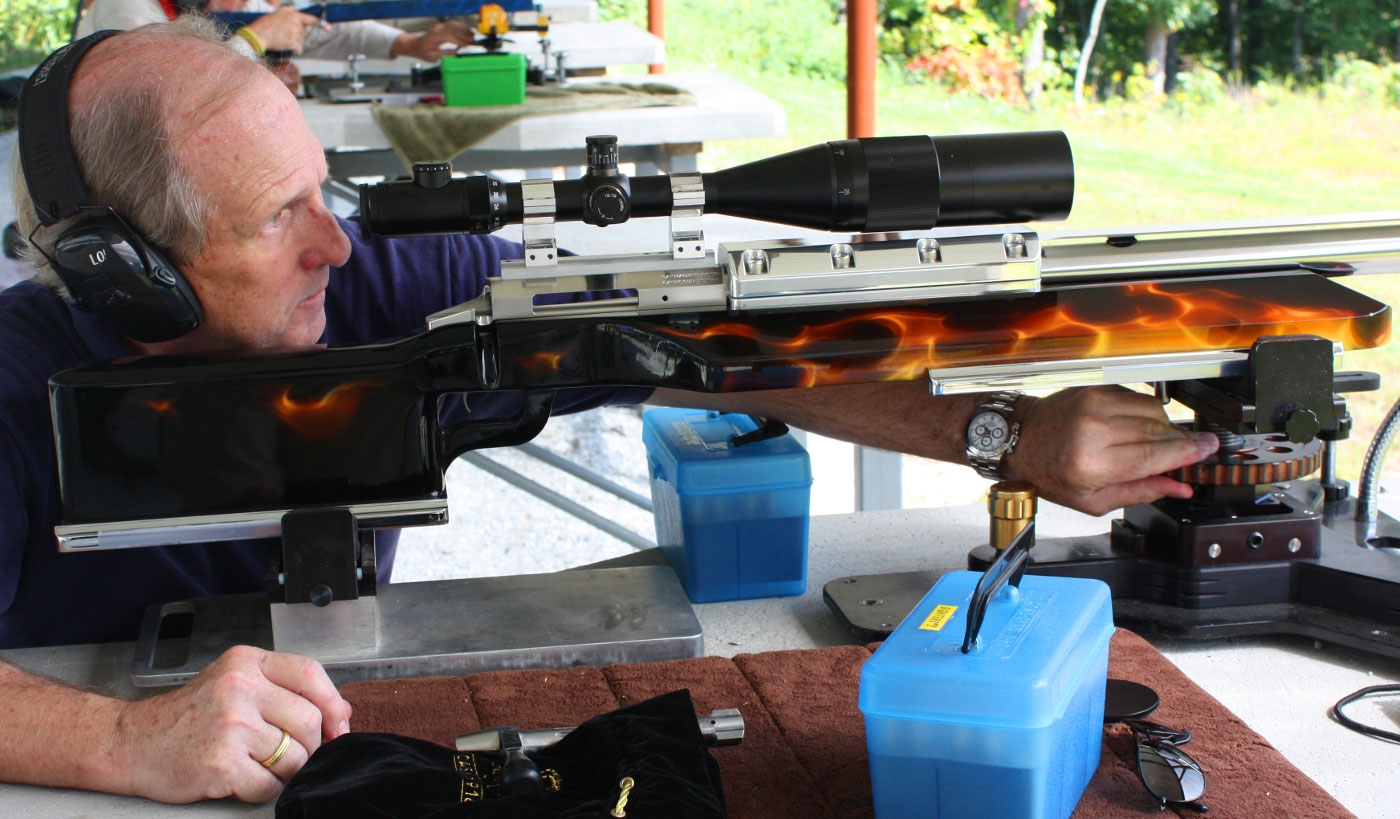
Henry: At the Nationals, I used my 17-lb Light Gun for both Light and Heavy Class. This rifle has a 1.55″, round BAT LP/RE action, fitted with a Bartlein barrel chambered for the .284 Shehane (an improved version of the .284 Winchester). The barrel was near-new; this was the first time I had used it this year. A great barrel and great batch of Berger 180gr VLDs all made a difference. Jay Cutright chambers my barrels. Jay’s metal-work is so precise that I can screw any barrel he’s chambered to any BAT action I own. The laminated stock was modified by Tommy Shurley from a standard 3″-wide fore-end to a 5″-wide True-Trac with an adjustable 3″-wide rear plate. It’s not pretty but it tracks like a Heavy Gun stock. Tommy made my other stocks as well.
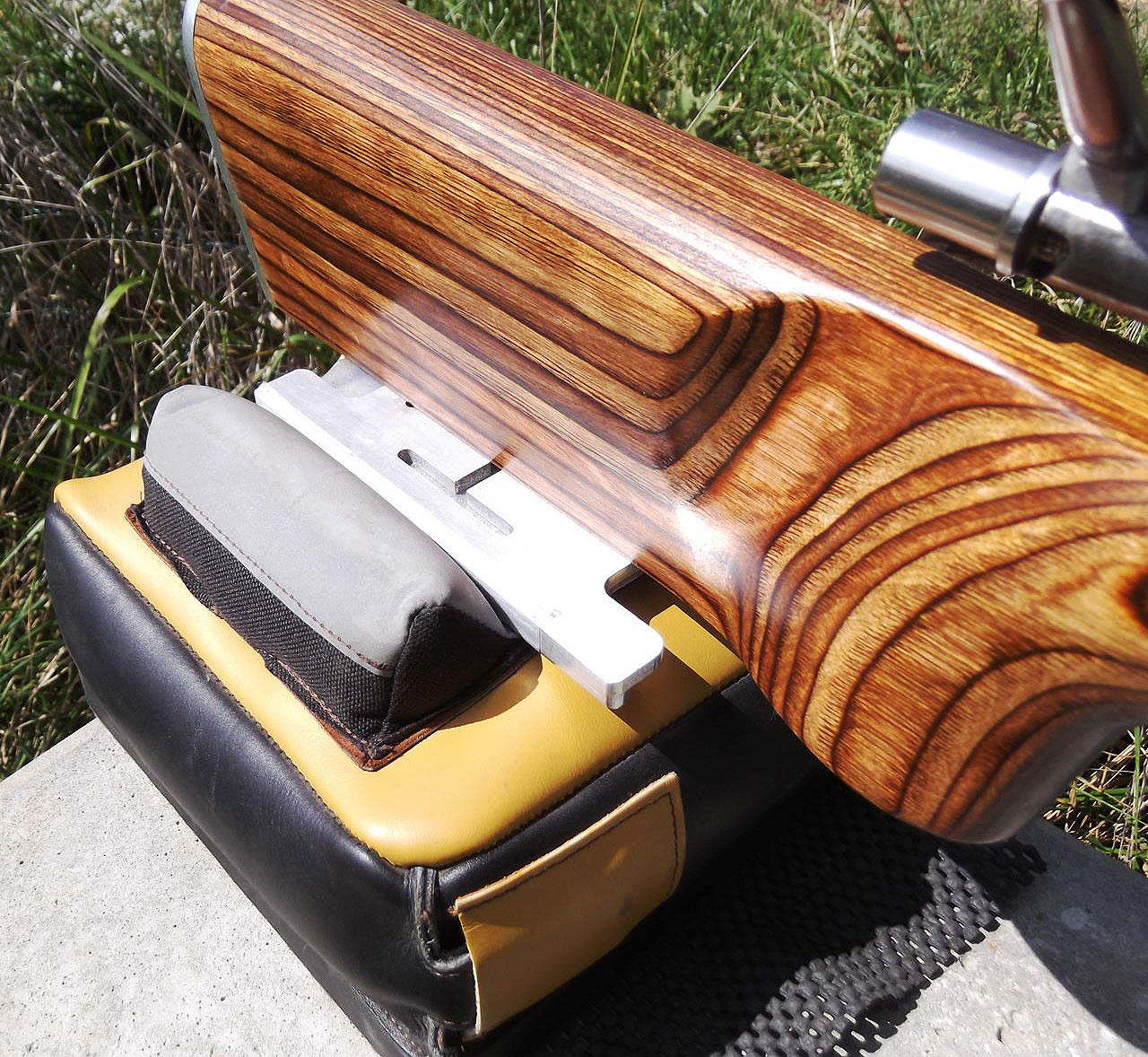
On top is a Nightforce 12-42x52mm Benchrest scope with CH-3 reticle. I used a Fulghum (Randolph Machine) front rest with an Edgewood bag made with the low-friction 3M material. In the rear I use a special-order Protekor rear “Doctor” bag with ears spaced 3 inches apart. The rear bag also has the new 3M material on contact surfaces (photo at right).
Q: During the Nationals, at the last minute you switched guns. Why did you go from a 6mm Dasher to a 7mm Shehane?
Henry: I had planned to use my Light and Heavy Dashers, but after placing the Dasher on the ready line, decided to switch to the .284 Shehane. It was still early in the morning and I felt that the heavier bullets would be easier to see against the berm. The Dasher had actually been giving tighter groups under perfect conditions, but seeing the impact is important.
Q: Tell us about the combined tuner/muzzle brake on some of your barrels. How does this improve rifle performance and how do you set the “tune”? Do you tune the barrel to the load?
Henry: I use a tuner or tuner/brake on every barrel. I started with Time Precision tuners. Art Cocchia advised getting a load with a good known accuracy node with minimum extreme spread, which controls vertical. Do not go for the hottest loads, which just reduces brass life. Then use the tuner and tune the barrel to the load. The .284 Light Gun needed a muzzle brake and tuner. I had a local gunsmith cut a thread on the muzzle brake for a tuner I got from Sid Goodling. (Eric Bostrom developed an almost identical unit at the same time. I use Eric’s tuner/brakes on all my new barrels.) Just before Nationals, I tried going up and down one marker. Down one mark cut the group in half! Think how much range time (and barrel life) that saved me. Using a tuner is easier than messing around changing loads and tweaking seating depths. Tuners definitely can work. Last year I shot a 3.348″ 10-shot group at 1000 with my .284 Win Heavy Gun fitted with a Time Precision Tuner.
Q: What are the advantages of your stock’s 5″-wide fore-end and 3″-wide rear plate? Is there a big difference in tracking and/or stability? Does the extra width make the rifle easier to shoot?
Henry: I had true Heavy Guns with 5-inch fronts and 3-inch rears. They tracked well. I felt the same result could be had with a Light Gun. I talked two stock makers into making them. I initially had the standard rear stock until Tommy Shurley and Mike Hearn came out with an adjustable rear plate. The stocks track perfectly. You can see your scope’s crosshairs stay on the target the whole time and push the rifle back for the next shot. There is no torquing (gun wobbling) when cycling the bolt. Us old guys need all the help we can get. I am getting rid of my 45-pound Heavy Guns and replacing them with Light Guns with heavy barrels.
Q: Some people say the .284 Shehane is not as accurate as the straight .284 Winchester. You’ve proved them wrong. Why do you like the .284 Shehane? More speed, less pressure?
Henry: The reason I rechambered my 7mm barrels to .284 Shehane was not velocity, pressure, or brass life. It was all about bolt lift. My straight .284 almost required me to stand up to eject brass. I damaged an extractor and had to send the bolt back to BAT. With the .284 Shehane, my bolt cycles like there is no case to eject.
Reloading Methods
Q: People want to know about your load and your loading methods. What can you reveal?
Henry: For my .284 Shehane at the Nationals, I loaded 52.5 grains of Hodgdon H4350 and Federal BR-2 primers behind Berger 180gr VLDs. I usually anneal the brass each winter. I have used the same brass for years. I use Redding bushing dies, apply Imperial sizing wax, resize, wipe off wax, clean and uniform the primers pockets using the RCBS Trim Mate Case prep center, then apply Imperial dry neck lube with a bore mop.
To dispense powder, I use a RCBS ChargeMaster set 0.1 grain below my desired load and then weigh them on a Sartorius GD-503 magnetic force restoration scale to get identical charges. I use a K&M Arbor Press with seating force gauge when seating the bullets with a Wilson inline die. My “target” seating force on the K&M dial is 20-23 units for Dashers and 35-40 units for the .284 Shehane. I put any variables aside for sighters. I do not weigh brass, bullets, or primers. My bullets were so consistent that I did not sort by bearing surface. I did trim the Berger VLDs to the shortest bullet length with a Hoover Trimmer, and then pointed the meplats just enough to close them with a Whidden pointer. I sort my bullets to 0.005″ overall length, rejecting about five percent.
Q: What kind of precision are you looking for in your reloads? Do you trickle to the kernel? Does this really help reduce extreme spread?
Henry: I try to keep my charge weights consistent to one kernel of powder. I use the Omega powder trickler with a Sartorius GD-503 lab-grade balance to achieve that. For accurate dispensing, put very little powder into the Omega so you can drop one kernel at a time. Single digit ES (Extreme Spread) is the goal. This does make a difference at 1000 yards. If you get the same push on the same bullet with the same neck tension, good things are going to happen.
Q: You believe consistent neck tension (i.e. grip on the bullet) is really important. What methods are you using to ensure consistent bullet release?
Henry: I apply Imperial dry neck lube to the inside of my case-necks with a bore mop. The K&M arbor with seating force gauge shows the need to do this. If you put a bullet into a clean case, it will be jerky when seating the bullet. You may see 40 units (on the K&M dial) dropping to 20, then slowly increasing pressure. I explained to a friend that not lubing the neck is like overhauling an engine without lubing the cylinders. Smooth entry gives the bullets a smooth release.
Barrel Cleaning
Q: You go 60-80 rounds between cleaning and the results speak for themselves. What is your barrel cleaning procedure? Do you think some guys clean too often or too aggressively?
Henry: I cringe when I see people wearing out their barrels with bronze brushes between relays. I clean my barrels at the end of each day when I get home. I shot my best-ever 1K Heavy Gun group (3.348″) at day’s end after 60 to 80 rounds. After trying other solvents, I have gone back to Wipe-out’s Carb-Out and Patch-Out products. I use about four patches of Carb-Out, let it sit a few minutes, then use one stroke of a nylon brush followed by Patch-Out until the barrel is clean. I use a bore mop to clean inside the chamber, then some Break Free LP on the bolt followed by bolt grease on the lugs and cocking part. I use a bore guide when anything goes down the barrel.
Shooting Skills and the Learning Process
Q: Henry, you can shoot long-distance on your own property in Missouri. How important is practice, and what do you do during a typical practice session?
Henry: I can shoot 1000 yards on my farm. I have a concrete bench using a slab from a yard furniture place on concrete blocks. Two 4 x 8 sheets of plywood hold four IBS targets. I never practice. I only test, keeping a notebook with all the info. I do most of my testing at 300 to 500 yards, shooting off my deck so I can see my shots immediately.
Q: How much of your success do you credit to really accurate rifles, versus superior shooting skills?
Henry: I do not consider myself another Carlos Hathcock or some master marksman. I am an average 1000-yard shooter, but I do work hard getting the most out of my rifles. Four other people have shot their first 1000-yard matches with my rifles, including my wife, and all of them won relays! I loaned my Dasher to another shooter two years ago and he got second at the 600-yard Nationals. Others will tell you that the rifle must be “on” to win. If your barrel or bullets are average, don’t expect to perform above average in competition.
Q: What you do enjoy most about long-range benchrest shooting? What are the attractions of this sport?
Henry: The sport offers good people and a real challenge. 1000-yard shooting keeps us all humble, but we still keep trying to see how good we can do. I am thankful for Robert Ross providing the only match location that I can shoot regularly.
Q: Henry, you have been a Forum member for many years. Have you learned important techniques from other Forum members and other shooters?
Henry: I have followed the AccurateShooter Forum since 2008. At my age I am not good at computers. I copied and analyzed many articles, especially on the .284 and the Dashers. Without AccurateShooter.com, I would probably still be shooting double-digit (10″+) groups at 1000 yards, and I sure wouldn’t have my name on a National Championship trophy.
Q: You are in your 70s now and have only been shooting competitively for a few years. How did you get so good so fast? How did you manage to beat shooters who are decades younger?
Henry: I had 20/10 vision when I was young, but am down to only 20/20. I have been interested in long range shooting for a long time including ground hog hunting. I went to some VHA jamborees also. In 2008, I went to the Williamsport Benchrest School with a friend from Pennsylvania, John Haas. We would compare notes frequently. I bought a BAT three lug from Tom Mousel in Montana. We also compared notes and made each other better. At IBS matches I studied other shooters’ equipment and techniques. I tried some, accepting some and rejecting some.
Here’s my advice:
Always be ready to learn something new. If it makes sense, try it. I would also encourage other older shooters not to quit. Stick to it. You can make enormous progress in a few seasons.
Report for International Benchrest Shooters (IBS) On August 30-31, 2013, Robert and Chrissy Ross hosted this year’s 2013 IBS 1000-Yard National Championships at their Midwest Benchrest range in Yukon, Missouri.
This year’s format was run with all the Light Gun (LG) relays shot on Friday, followed by all the Heavy Gun (HG) relays on Saturday. The competition was very tight as the Two Gun Overall Champion, Henry Pasquet from Elsinore, Missouri, didn’t even realize he had won until his name was called out at the award ceremony. Henry, an active AccurateShooter Forum member, secured a well-deserved National Championship with strong performances in both classes. Henry registered a fifth place in LG Group along with tenth place in LG Score. Henry then finished first in HG Score along with eleventh in HG Group to earn the 2013 Two-Gun Overall Title.
Matthew Kline traveled from Pennsylvania to take second place in the Two Gun competition. He garnered that honor with an eighth Place in LG Group and a fourth place in LG Score. Matthew followed up these with a ninth place in HG Group and eleventh place in HG Score.
Kansas’ Jim Bauer came in a close third in the Two Gun rankings, by finishing first in LG Score and 21st in HG Group, then adding a second place in HG Group and 16th place in HG Score. Jim’s wife Sally, last year’s IBS long-range Shooter of the Year winner, was the Top Female Shooter. Rory Jacobs, from Vapor Trail Valley Shooting Club in Spickard, MO was the Top Junior Shooter.
Hot Temperatures and Fickle Winds Challenge Shooters
The Midwest Benchrest range is literally in the Ross’ back yard and is cut right out of the middle of a Missouri forest, which gave the shooters new to the range a false sense of confidence, thinking the trees would block the winds. The shooters had to deal with temperatures in the upper 90s (and the shade trees offered little relief). With the incredible humidity present, it felt it was even hotter. Although the winds weren’t very high, they weren’t very cooperative either, as they were never consistent throughout both days. One minute it was directly behind the shooters and the next it was quartering to the right. A moment later it was to the left.
The early relay winners seemed to favor the end benches, while later in the day, they seemed to favor the middle benches. There was was nothing but bright sunshine for the two-day event. Cloud cover and cooler temps, which were earlier forecast for the shoot, finally showed up the day after the tournament. Needless to say, the “heat monkeys” were making small groups difficult at this year’s shoot. Most small groups that were shot, were followed up with larger groups, in both the LG and HG events.
All in all, everyone still had a great time competing, seeing friends and fellow shooters from other parts of the country, and enjoying the Ross’ hospitality. It wasn’t long after the shoot was over before everyone started talking about where the 2014 Nationals would be. Perhaps, Robert Ross said it best: “Ultimately, the competition yields to the resulting friendships, which are fostered as part of a common goal: Raising the bar in long range precision shooting.”
The two-day competition was run as smoothly as any monthly shoot is run. The weekend’s shoot really started off on Thursday night though. Jim and Sally Bauer, Hornady, and Midwest Benchrest, sponsored a fantastic fish fry for all the competitors and their spouses. This provided some neutral ground to meet up and catch up with both new and old friends alike before the actual shooting began. If possible we will add equipment lists and individual relay results to this story on Accurate Shooter.com.
Featured Hardware at the 1K Nationals (Click Photos to Zoom)
IBS Report and photographs by Dick Grosbier
Over Labor Day weekend the Union County Sportsmans Club (Weikert, PA) hosted the 43rd annual IBS 100/200 Score Nationals. This club has a reputation for hosting fine events, and this match certainly lived up to that reputation. With 63 guns on the line, this year’s Score Nationals was well-attended. All in all this was as good a Score Nationals as I have attended in quite a while. I tip my hat to the Union County crew for running an excellent match. Weather was warm and a little muggy both days. I do not believe we ever had a drop of rain (despite a 30% chance of rain forecast). Mirage was very minimal as it was overcast both days. Winds started out very calm and slowly increased all day long both days.
Left to Right: IBS Score 2-Gun Winner Dean Breeden, Varmint For Score Grand Agg Winner Herb Llewellyn, Hunter Class Grand Agg Winner Gary Long.
On Saturday, Herb Llewellyn started out on a tear in Varmint For Score (VFS) class and stayed hot, finishing the 100-yard event with a 250-25X score. We witnessed some really fine shooting in less-than-perfect conditions. Junior Shooter Kevin Donalds Jr. (photo below) laid down a fine 250-24X to finish second. Kevin, who turns a ripe old 13 years of age in a few days, shot a remarkable 250-25X Aggregate a few months back. To the best of my memory those are the only two 250-25X scores in IBS this year. A.R. Edwards was third with 23X.
In Hunter Class Dean Breeden shot 250-17X beating more than 50% of the VFS shooters, and for those of you who do not fully understand Hunter Class, the big thing to remember is they shoot 6-power scopes. Peter Hills from Maine also shot a 250 in HTR with 9X.
Sunday the shooters lined up for the 200-yard event. Shooting his 6 PPC, Hal Drake shot a 250-14X, proving that a PPC can still win in a Score match (at least at the longer ranges). Second place (as at 100 yards) went to a Kevin Donalds, but this time it was Kevin Donalds Senior who was the runner-up, posting a 250-13X. Third place honors went to Dean Breeden also with 250-13X. In Hunter Class, veteran shooter Gary Long shot 248-5X to beat K.L. Miller under Creedmoor tie-breaker rules. Dave Thomas was third with 247-7X.
You may have noticed that nobody in the top three on Saturday was in the top three on Sunday. This led to some interesting results in the VFS Grand Aggregate. Top Man was Herb Llewellyn, with a 500-36X. Herb’s victory at the Nationals pretty much puts the last nail in the coffin of anybody trying to catch Herb in the Score Shooter Of the Year race.
Second in the Grand was Herb’s lovely wife Kim with a 500-34X. Third place went to Randy Jarvais who learned the hard way to not drop the first X! Randy tied with Kim for total score all weekend but Kim shot a 5X on the first target and Randy got a 4X. Fourth in the Grand went to 200-yard winner Hal Drake with 500-33X, and Ricky Read rounded out the Top Five with 500-32X.
Gary Long won the Hunter Grand division with 497-22X, Dean Breeden was second with 496-20X, and third was Dave Thomas with 496-14X. It was great to see Dave back shooting again. Dean Breeden put in a repeat performance as IBS Score 2-Gun winner with a 996-51X score, Larry Feusse was second with 990-46X and Dudley Pierce was third with 987-44X.
IBS 43rd Annual 100 / 200 Yard Score Nationals
Union County Sportsman’s Club — August 31st to September 1st, 2013
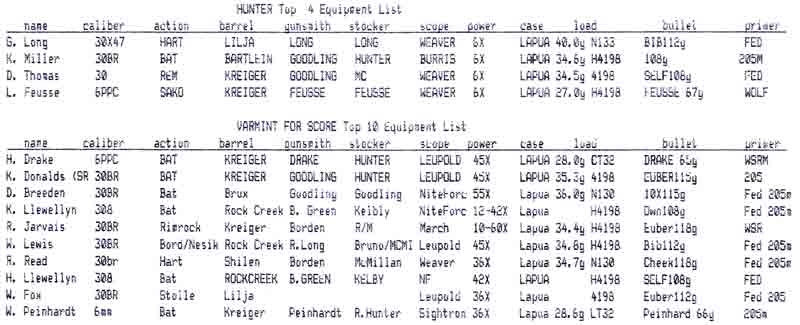
CLICK Equipment Lists Below to See LARGE Versions
Praise for the Match Crew and Kitchen Crew
I cannot say enough good things about the target crew and range officer Mark Trutt. They ran a very efficient match. I do not recall a single delay all weekend from loose- or erroneously-hung targets. We started promptly at 9:00 am and finished around 2:00 pm both days. Range officer Mark Trutt did an outstanding job when confronted with a tricky situation regarding IBS Score 2-Gun shooters. The range has 40 benches and we had a very nice turnout of 63 guns on the line but it simply was not justified to run a third relay so Mark judiciously added around 10 minutes between each relay to allow 2-gun shooters some time to reload. I don’t think the time would even have been noticed but the target crew was speedy and efficient, so we ended up with a little extra time on the line. I personally felt it made for a very nice, laid-back pace for competitors shooting only one gun. Scoring was fast and efficient for the most part.
The Kitchen crew deserves praise for the fine breakfasts and lunches. In good Weikert tradition, we were treated to “Mama Trutt’s” fresh-baked cookies each afternoon. — Dick Grosbier
One of the most remarkable shooting records — and one that has stood for four decades — is the 0.009″ five-shot group credited to Mac McMillan. The NBRSA Light Varmint Record of .009″ for five shots (at 100 yards) was set on 9/23/1973, forty years ago. Experts have considered that record “untouchable”, “unassailable” — in other words “unbreakable.”
Well records are meant to be broken. It appears that Texan Mike Stinnett has broken the “unbreakable” .009″ NBRSA record. Mike shot a .0077″ five-shot group at 100 yards in a registered short-range benchrest match at Denton, Texas. This will be a new NBRSA record (and all-time world record) if approved. Mike was shooting a .30-caliber cartridge, listed as a 30 PPC, but there’s some talk that the cases were formed from a Lapua 6.5 Grendel case. No matter — this is a mind-blowing accomplishment, particularly considering that Stinnett was shooting a .30-caliber gun, which has considerably more recoil than a 22 PPC or 6 PPC.
Forum member Wes J. (aka “P1ZombieKiller”) reports: “My buddy Mike Stinnett was just confirmed as having beat the world record LV group at 100 yards in a registered match. His group measured .0077″ and he did it with his 30 caliber.”
Wes adds: “Mike shoots thousands of rounds a year… I have sat on the bench right next to him several times, and he has rattled off five shots down range in a matter of 2-3 seconds, and the groups have measured in the .1s. The guy can flat shoot. His wind reading abilities are mind-blowing. When he gets the right condition, he is fast. REALLY FAST.”
NOTE: We will publish photos of Mike Stinnett and his target as soon as they are available.
Report by Samuel Hall (AccurateShooter.com Field Editor)
July 13th was a great day for breaking records. Three shooters have potentially broken four IBS 600-yard records (pending final approval) at the Piedmont Range in Rutherfordton, NC. Conditions were excellent and three shooters had outstanding multi-target performances. Mike Hanes, Chad Jenkins, and Randy Peele were tuned in and took advantage of the great weather. The entire day was overcast with a slight 3-5 MPH breeze, misting rain at times. It was one of the only days I can remember we could see bullet holes all day!
Chad Jenkins Shoots a 199 Four-target Score at 600 Yards
In Light Gun, Chad Jenkins posted a 199 Score Agg, just one point shy of a perfect 200 score for four targets. Consider this — at 600 yards, Chad put 19 out of 20 shots into a circle 2.8″ in diameter, dropping just one shot out of the 10-Ring on four consecutive targets. That’s impressive. We believe this is the highest 4-target Score Agg ever shot with any rifle. (In Light Gun, Stephen Hall posted a 198 in 2012, and in Heavy Gun class Eric Wilson had a 198 in 2011). Chad took advantage of the good conditions to post his 199 score (with 1.954″ group size tie breaker). Chad was shooting a standard (not improved) 6mmBR with no-turn necks. Chad’s Light Gun features a BAT MB dual-port action, Shehane ST-1000 stock, Krieger 1:8″ twist barrel, and Leupold 45X scope. Chad has several hundred rounds on this rifle and has one other record with it. Chad has done a lot of winning the last couple of years with his 6BR. He shoots Berger 105gr Target VLDs in blue box Lapua brass, pushed by 30.3 grains of Varget and CCI 450 primers. Chad shoots with a modestly-priced Caldwell joystick front rest. Chad proved that you don’t need the most exotic equipment to set records.
Mike Hanes Sets New Light Gun and Two-Gun Group Agg Records
Mike potentially broke the Light Gun (LG) four-target group aggregate record with a 1.496 Agg, bettering the old record of 1.5009 shot by Chad Jenkins in 2012. Mike also potentially broke the eight-target, Two-Gun (LG and HG) Group Agg record with a 1.7885 Aggregate. The old record was 1.8120 shot by Charlie Macke in 2012. In LG Mike was shooting a no-turn-neck 6 Dasher with a Brux 1:8″ twist barrel and Shehane ST-1000 stock. On his Light Gun, Mike was using one of the new Nightforce 15-55x52mm Competition scopes. I looked through it and I will have to say it is great glass! Mike’s load was: Berger 105 VLDs, with 32.7 grains of Reloder 15 powder sparked by CCI 450s. In Heavy Gun class, Mike shot a 6mm Dasher in a true heavy chassis — a 55-pound aluminum Gary Alvey stock formerly owned by Mike Davis. (See this beast below. This same stock had set a record in the hands of Mike Davis.)
Randy Peele Ties Heavy Gun 4-Target Score Record
Later in the afternoon in the Heavy Gun division, Randy Peele was on fire. Randy posted a first in group (1.894″) and a first in 4-target score (198) against some fierce competition. This ties the HG score record and is just off the tie-breaker group by a few thousandths. It will be submitted to the IBS Record Committee also. Congratulations of some fine shooting guys!
In the spring of 2004, IBS 600-yard benchrest competition was born. Piedmont Gun Club in Rutherfordton, NC was one of the three initial ranges across the country to host this new competition. Bridgeville (DE) and the Bench Rest Rifle Club of St. Louis (MO) were the other two. 600-yard benchrest was the brainchild of several IBS and club officers, Dave Tooley and Joe Goforth among them. The idea was to have a new competition at a distance far enough that short-range cartridges would not dominate, but not so far that the new mid-range discipline would duplicate 1000-yard competition. After initial “test matches” at 500 yards, in late 2003, officers at Piedmont Gun Club decided to push the targets out another 100 yards. That was the beginning of the 600-yard benchrest game.
IBS 600-Yard Match at Piedmont Gun Club (June 8, 2013) Report for IBS by Sam Hall Piedmont Gun Club is a legendary venue in the 600-yard Benchrest game because so many records have been set at this range. Throughout the 600-yard seasons at Piedmont Gun Club, June has been one of the best months for shooting small groups and high scores. Most all records have been shot there in the summer months of June, July, and August. And speaking of records, more records have been set, broken, and re-broken at Piedmont than all other IBS 600-yard ranges combined! I know of 29 separate records that have been set by just three shooters. Joel Kendrick, Terry Brady, and myself, Sam Hall. Many, many more records have been broken there also.
After a couple of rainy days, the weather cleared up for our June 8, 2013 match. It was to be one of Piedmont’s IBS 600 Yard “Shooter of the Year” points matches also. 35 seasoned veterans showed up… plus a new shooter, Jimmy Norman. There were high expectations for more records to fall. Although the weather was fair with sun and the occasional cloud, a light wind, switching from right to left, kept any records from being set this day. Many small groups were shot in the morning in the Heavy Gun session, but the switching wind picked up in the afternoon during the Light Gun competition and the groups showed it.
Thomas Parker Wins HG with a Rem-Actioned Rifle
The day started with Heavy Gun shooting first at 09:00 sharp. The wind was very light from left to right at 2-3mph with temps about 70 degrees. Thomas Parker showed us that a Remington actioned benchrest rifle can still whip the all-out custom “Race Guns” in the hands of a good shooter. Thomas won the Heavy Gun overall placing first in score (193) and second in group (1.965″) for four targets. Note: a group Agg (or aggregate) is the 4 target groups added together and averaged (divided by four). Sam Hall snuck in the small group of the day 0.986″ to help him win the HG Group Aggregate with a 1.820″. This was the only first place that Thomas did not capture. Thomas shot the standard 6mmBR cartridge, pushing Berger 105gr Hybrid bullets. His rifle featured a Remington 700 action, Brux barrel, and a custom wood benchrest stock.
Watch Heavy Gun Winner Thomas Parker Shoot at Piedmont
Mike Hanes Captures Light Gun and Sam Hall Takes the Two-Gun
After the Heavy Gun segment concluded, as always, a great lunch was served by a local church group. Lunch is held in Piedmont’s new club located just beside the 600-yard range.The club house also has bathroom facilities for men and women, a kitchen and large banquet room. Light Gun (LG) started just after the break for lunch. The winds had picked up to 5-8 mph and switching left to right now. Temps were 80-84 degrees for the rest of the day. Groups were sure not as good as they were in the morning for Heavy Gun. Mike Hanes (2012 IBS 600-yard Shooter of the Year) had small single target group of 1.423″ in LG to help him win LG Group Agg with a 2.371. Mike had second place in score with a 184 to help give him the “Overall” LG win. Mike was shooting a custom 6mm Dasher “Race Gun”. It featured a BAT dual port action, Shehane fiberglass ST-1000 stock, Jewell 2 oz. trigger, Brux barrel.
Sam Hall won the Two-Gun Overall with 8 rank points. Thomas Parker finished second in the Two-Gun with 29 rank points with Steve Jordan finishing a close third with 30 rank points. Sam said the match was great, and he invites readers to join the fun: “Come on out to Piedmont with us and give 600-yard benchrest a try. I guarantee you will be welcomed and will have a great time!”
Piedmont Gun Club — Home of the Record-Breakers
Piedmont has seven IBS 600-yard matches a year from March though September. Five matches are IBS “Shooter of the Year” matches where IBS points can be accumulated. Piedmont also has its own Shooter of the Year. All Piedmont’s 600-yard matches count toward it. They give a very nice standing trophy to the winner at the end of the year. Attendance at Piedmont for 600-yard competition is usually 30 to over 40 shooters. Most guys are regulars and have been at the 600-yard game for years. The competition is tough! I have heard many shooters say that shooting at Piedmont is like shooting at the Nationals every match. The atmosphere is very friendly though. We welcome new shooters. There is always someone there to help you when needed, whether it be a fellow shooter or range officer. On many occasions I have witnessed a fellow shooter lend his own rifle to a new shooter who wants to give it a try, someone who forgot ammo, or had equipment failures.
Not only does Piedmont Gun Club have IBS 600-yard competition, but the Club also hosts several other shooting disciplines. Piedmont has a 50-yard pistol range, trap and skeet range, 25-50-75-100 meter small bore silhouette rifle range and 50-600 yard rifle range. Piedmont hosts NRA Smallbore Rifle and 22 Cowboy Silhouette matches in March and ending in October. Piedmont also hosts three IBS 100/200 yard VFS (Varmint For Score) Benchrest matches a year including a NC State match in September 2013. They have 16 covered benches at their VFS range and 16 separate covered benches for their 600 yard range. Tommy Williams is the Club President and also is match director of the 600-yard matches to boot! Piedmont Gun Club is located in the beautiful foothills of western North Carolina.
Hardware Choices — Sam Hall Talks about 600-Yard Rigs
Over the years, 600-yard equipment has evolved. We now have a good idea of what works the best in 600-yard competition. Several varieties of long-range stocks work well so long as the geometry of the key surfaces in the fore-end and butt are parallel (or very close). Custom actions are desirable, with dual port (right bolt, left load port, right eject) or drop-port for faster shooting. The standard 6mm BR or any of its improved versions seem to be equally competitive and accurate at 600 yards. You’ll want a match-grade, stainless barrel, 26-30 inches in length, with a 1:8″ to 1:8.5″ twist rate (depending on your bullet and velocity).
Do you really need a true Heavy Gun? Both Mike Davis and I experimented with true Heavy Guns in 2007. Mine was a 61-pound, 6 Dasher built with a Shehane Aluminum Maxi-Tracker stock. Mike shot a 50-pound, 6 BRX in a massive, aluminum Bruce Baer stock. Both these “true heavies” (Mike’s and mine) had dual-port BAT actions and Brux 1:8″-twist barrels. Mike set the HG 4-target group aggregate record that year with a 1.467″ Agg and I set the HG 4-target score record with a 197. These true Heavy Guns shined when the mirage and/or wind were really bad. If they are tracking back on target well, you can rip off 5 shots in mere seconds! That said, I don’t think a “true heavy” is needed to be competitive.
Folks have certainly experimented with exotic equipment in the 600-yard game. But, for a new shooter it is good to know that fancy, ultra-expensive rifles are not necessary to win at 600 yards. You can shoot one rifle and do just as well as the man with several long-range rifles. You don’t need a separate rifle for Light Gun and Heavy Gun. Just look at what Richard Schatz has done over the years with one rifle. As the saying goes, beware of the man with one gun! To boot, matches are still being won with affordable, factory-actioned rifles. Never count out a skilled shooter with an accurate Remington- or Savage-actioned benchrest rifle — he may beat you! That was the case at our most recent match at Piedmont.
Report by Dick Grosbier for theIBS
This past weekend, score shooters from as far away as Florida and Maine gathered at the beautiful Thurmont Conservation & Sportsman’s Club (TCSC) range in Thurmont, Maryland. They were there for the 19th Annual Bud Pryor Memorial Match. This match is also the Maryland State 100-200-300 championship. It is a pivotal match in the Score Shooter Of the Year (SSOY) race because 60 points are up for grabs (as many as are awarded at the Score Nationals).
The Bud Pryor Match is a three-day event. Competitors shoot at 100 yards on Friday, and at 200 yards on Saturday. On Sunday is the infamous 300-yard stage — the “great equalizer” that separates the good shooters from the great shooters.
On Friday morning the 100-yard stage started rainy and miserable (though not too cold). As the day went on the wind picked up some and before we were done I actually compared it to how wet and windy it was in Orrington, Maine two weeks earlier. Herb Llewellyn set a blistering pace at 100 yards, turning in a 250-24X performance in some challenging conditions. He was followed closely at 23X by David Apple. A total of twenty-seven “clean” 250s were shot in VFS class at 100. Also very noteworthy, in Hunter class Dean Breeden shot 250-17X and Gary Long shot 16X.
Saturday at 200 the rain was gone (mostly), and the temperature got up to around 80. All eyes were on Herb Llewellyn after his performance on Friday. He shot the only 50-5X target in match one so many were watching as he planted a 9 on his target on match 3. So much for him (we thought). But Kim Llewellyn ended up on the top of the pile at the end of the day with a 250-10X score. (Kim edged Ricky Read, who also shot 250-10X, under Creedmoor rules). On Saturday, there were six 250s in VFS and Gary Long won Hunter class with a fine 247-3X score. Saturday night we had a great BBQ dinner at the Club House and the 100-yard and 200-yard awards were distributed. (This permitted shooters to leave earlier on Sunday afternoon.)
Score Shooter of the Year — How the Point System Works
The Score Shooter of the Year is determined on a point basis. For a regular two-yardage (with Grand) match (not a State or National Championship), a maximum of 30 Points are available to the winner. That’s 10 for each yardage (100/200) and 10 for the Grand. The same match in a State Championship situation has 45 points available. A National Championship with up to 50 guns in class is worth 20+20+20 or 60 Points. Because it includes three yardages plus a Grand Agg, the Bud Pryor event is a 60-point match just like the Nationals. Likewise the Maine Firecracker held over Memorial Day weekend is also a 60-point match. These 60-point matches are very important because no matter how many matches in which the shooter competes, he only gets to count his ten best in the final standings. My friend Allie Euber, Score Shooter of the Year in 2007 and 2010, notes that these 60-point matches are essential if you want to make a serious run at Score Shooter Of the Year.
Sunday promised to be a tough day of shooting at 300 yards. The warm 83° temperatures, combined with the very wet ground, might have made for horrible mirage. Luckily the day was overcast for the most part. Mirage did get bad a few times but never as horrible as I have seen at Thurmont. Wind was constant and switchy. At the end of the day one lone shooter, Roy Hunter, was clean for the weekend with a 750-26X (and 250-5X at 300). Roy was shooting a 6PPC and his performance was no fluke as Roy was one of only two clean shooters at last years “Bud”.
All in all it was a very full three days of shooting. We had a number of first time attendees most of whom told me they had a great time and looked forward to next years “Bud”. — Dick Grosbier
You may recall that Forum member Rodney Wagner (aka “Eggman”) shot a 0.349″ (50-2x) group at 600 yards to set two IBS records. This is the smallest 600-yard group in history. With his BAT-actioned Dasher, Rodney put five shots inside a dime at six hundred yards. This is one of the most amazing feats of shooting ever. And now the gun is gone. It was stolen, along with a second benchrest rifle. The combined value of the two guns is over $11,000, but the record gun is priceless.
Rodney’s Record-Setting Rifle Stolen — We Need Your Help
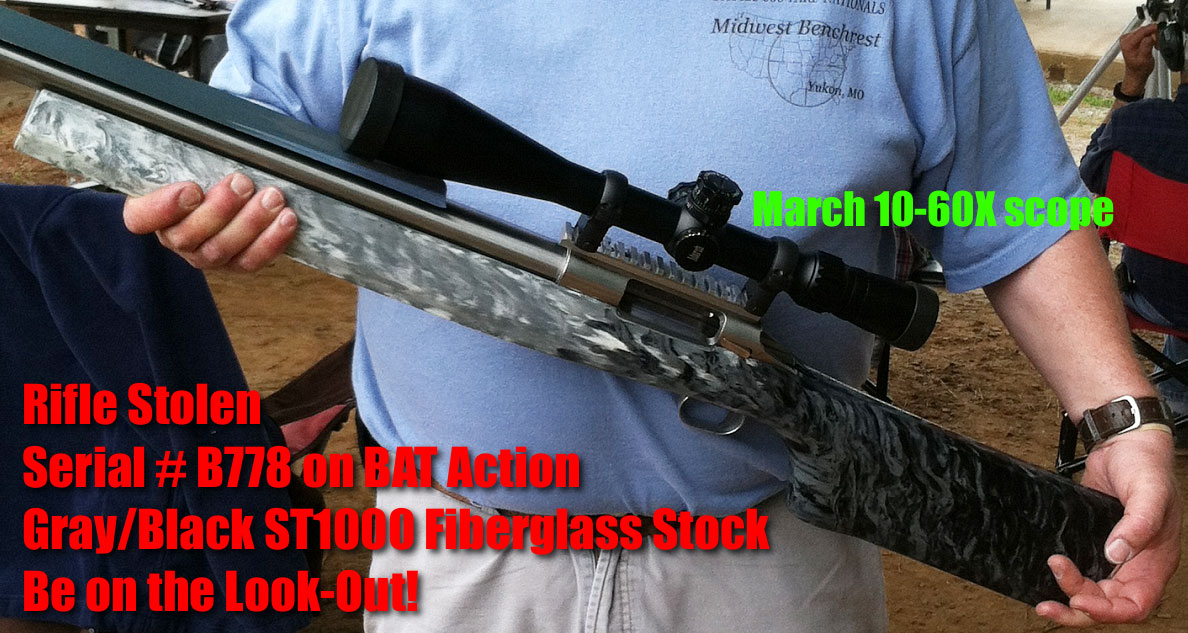
Over the weekend, Rodney Wagner had two valuable benchrest rifles stolen from his truck. Yes, the BAT-actioned Dasher that shot the historic 0.349″ 5-shot group was stolen, along with a second long-range Benchrest Rifle. The theft took place at a motel in Hendersonville, NC.
We request the help of our readers in recovering these two rifles for Rodney. Help us get the word out — talk to your shooting friends, post this story on other forums, link to it on Facebook. Insurance, if any is available at all, will only cover a small part of the loss. But we all know that this isn’t all about the money. You can’t just write a check and buy a rifle that shoots an 0.349″ group at 600 yards. Ironically, the thieves probably have no idea of the special nature of the guns they stole.
Stolen Rifle One: IBS Record-Setting 17-lb benchrest rifle. The BAT B action has serial number B778. It has a white, gray, and black Shehane ST-1000 fiberglass stock, and a Brux 6mm barrel chambered for the 6mm Dasher. A March 10-60x52mm scope (with tactical knobs) is fitted in Burris Signature rings on top. The action is a Right bolt, Left Port, Right Eject.
Stolen Rifle Two: IBS 17-lb Benchrest Rifle. Borden Rimrock action has serial number BR0253. It has a red and black Shehane ST-1000 fiberglass stock, and Brux 6mm barrel fitted with a VAIS muzzle brake. A March 10-60x52mm scope with tactical knobs was on top. We are still looking for photos of this rifle. It appears very similar to the first rifle, but with a red and black stock and a Rimrock action.
It does NOT appear that thieves were specifically targeting the record-setting rifle. The Hendersonville Police told us that another theft was reported at about the same time in the same neighborhood. They called this “an ordinary crime of opportunity”.
Folks, please keep your eyes out for these two rifles. These are distinctive guns — not what you’d see everyday at a pawn shop (or even at most gun ranges). Please tell other folks in the firearms community to be on the look-out. Also, the thieves might try to unload the two March 10-60X Scopes separately. Look for March Serial Numbers X341 and X291. You can use this link to point people to this story: http://bit.ly/14PtT5o.
If you have any information, please contact officer Peter Laite of the Hendersonville (NC) Police Department. Call 828-697-3025 or email: plaite [at] cityofhendersonville.org
$1000.00 Reward Offered
AccurateShooter.com will provide a Five Hundred Dollar ($500.00) reward to any individual who returns the two guns in undamaged condition or provides information that leads directly to the recovery of the two guns in undamaged condition.
In addition, Rodney Wagner will pay a $500.00 reward if the two rifles are recovered intact and undamaged. This makes the total reward $1000.00. That’s $500 from AccurateShooter.com, and $500 from Rodney Wagner.
Back in May, IBS shooter Rodney Wagner shot a 0.349″ (50-2X) 5-shot group that became the talk of the shooting community. This was the smallest 600-yard group shot in the history of recorded rifle competition. Rodney’s group cuts the existing IBS 600-yard record in half. Rodney put five shots under the size of a dime at the distance of six football fields. Just pause and think about that…
News of this amazing feat spread like wildfire via the internet. People were amazed at what Rodney accomplished. Here are some actual comments posted on various shooting forums:
308Nut: Simply Astounding.
Coues Sniper: That’s insanity.
PapaJohn: I strut around like a peacock if my rifles will shoot under a half-inch at 100 yards. His group was better than that at six times the distance… that’s just unfathomable. I don’t see anyone breaking that record for a loooooooooooong time!
Given the spectacular (and historic) nature of Rodney’s 600-yard group, many folks wanted to learn more about Rodney’s equipment and his shooting techniques. For that reason, we’ve compiled this follow-up report. Rodney was kind enough to provide a short video showing his equipment and shooting technique. In his video demonstration, Rodney runs off a 5-shot group in about 19 seconds. When he actually shot the 0.349″ group, Rodney estimates he got the five shots down-range in 12-15 seconds. (He slowed down a bit for the video!)
Watch Rodney Wagner Fire Five Shots in Under 20 Seconds
Rodney comments: “You’ll notice I hold the stock with my left hand while working the bolt to keep it from losing its ‘track’ (that slows me down a lot). I have just gotten into the habit of doing that because I feel tracking is one of the most important things not to take for granted. With this technique I don’t have to ‘saw’ the stock into the bags as much when I get on to the record target.”
Record-Setting Load: Varget Powder, CCI Primers, and Berger 108s Jumped
Rodney’s record 0.349″ group works out to 0.055 MOA at 600 yards. To shoot a “zero” group at 600 yards you need the finest components and insanely good reloading techniques (not to mention the grace of God.) As he does with all his 600-yard ammo, Rodney pre-loaded before the match. This particular ammo had been loaded 5-6 days before the match. Here are specs on Rodney’s load:
32.5 Grains of Hodgdon Varget Powder and CCI 450 Primers.
108gr Berger BT Match bullets seated 0.020″ away from the lands.
Lapua 6mmBR brass fire-formed to 6 Dasher and turned to 0.265″ loaded round for a 0.268″-neck chamber.
Neck-sized with a 0.262″ Redding bushing.
Note that Rodney was using Berger 108s, not the 105gr VLDs or Berger’s popular 105gr Hybrids. Rodney found his Brux barrel shot best with the 108s: “I’d get really nice 4-shot groups with the VLDs, but it seemed there would be four together and one out. The 108s seem to have less fliers.” Rodney experimented with seating depths before he settled on a .020″ jump: “I shot them for a long time 3 to 5 thousandths in the lands, just barely in the lands. But I knew Sam Hall had really good luck jumping. So I went to .020″ jump and it all came together. The 108s have shot good like that in three different Brux barrels (all chambered with the same reamer) so I just start at that setting now — twenty off the lands.”
Record-Setting Equipment
Rodney was shooting a 17-lb Light Gun. It features a BAT Machine ‘B’ action, and a 29″ Brux barrel chambered for the 6mm Dasher with a 0.268″ neck. The 0.236″-land, 4-groove barrel was fairly new when the record group was shot — it had about 300 rounds through it, and had shot 30 rounds since its last cleaning. Rodney chambered the barrel himself. The stock is a Shehane ST-1000 fiberglass tracker, inletted and bedded by Tom Meredith. A March 10-60x52mm scope is held in Burris Signature Zee rings on a +10 MOA rail. These rings are inexpensive, but they work just fine, notes Rodney: “With the inserts I can align the scope mechanically and keep the windage pretty much centered in its travel.”
Supporting his rifle, Rodney used a Farley co-axial rest up front (on Super-Feet) and a Protektor Doctor bag in the rear. The Farley features a Borden top carrying an Edgewood bag. Rodney notes: “In the front, I use the black diamond blasting sand, because it doesn’t pack as hard as regular sand. You can buy it at tractor supply stores in the welding section. It’s not as heavy as heavy sand.”
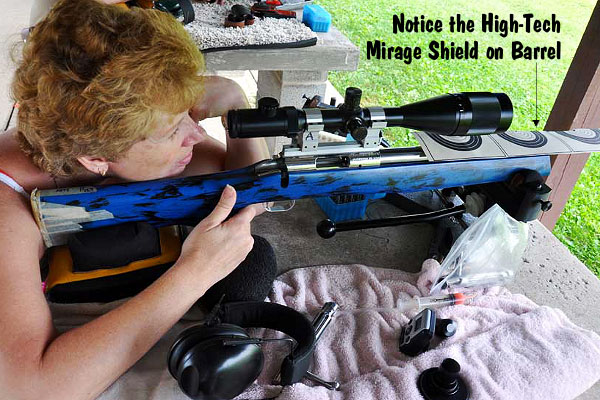
In the rear, Rodney runs a flat-top Protektor Doctor bag with Cordura ears. Rodney uses Sinclair heavy sand in his rear bag. He says “it’s got some squish — not much but just a little — call it a medium-hard fill”. Interestingly, Rodney sets up the bag so that the flat on the bottom of the stock rides on the stitches between the ears: “I like the stock to touch the top of the bag between the ears — I don’t like to see daylight.”
Conditions for the Record — You May Be Surprised
Many folks who have commented on Rodney’s 0.349″ group have wrongly assumed that the 0.349″ group was shot in “perfect” zero-wind conditions. Not so. There were switchy 5 mph winds with gusts to 10 mph. Rodney notes that on his second target of the day, he had to hold in three different places to manage a decent-sized group. So for those who think the group was shot in miraculous conditions, we have to say that wasn’t the case.
Creating Ultra-Accurate 6mm Dasher Ammunition
Rodney takes great care in loading his brass, and he employs a few tricks to get superior consistency.
Fire-Forming — To prepare his cases for fire-forming, Rodney starts by turning his Lapua brass to just past where the new neck-shoulder junction will be: “I just cut enough for the 6mm Dasher neck. A little bit of the cut shows on the shoulder after forming.” Then Rodney runs a .25-caliber K&M mandrel through the whole neck, expanding the neck diameter. After the entire neck is expanded, Rodney re-sizes the top section with a Wilson bushing, creating a false shoulder. Then, as further insurance that the case will be held firmly in place during fire-forming, Rodney seats his bullets long — hard into the lands. When fire-forming, Rodney uses a normal 6mmBR load of 29.8 grains of Varget: “I don’t like to stress my brass before it has been hardened. I load enough powder to form the shoulder 95%. Any more than that is just wasted.” Rodney adds: “When fire-forming, I don’t want to use a super-hard primer. I prefer to use a Federal 205, CCI 200, or Winchester — something soft.” Using a softer primer lessens the likelihood that the case will drive forward when hit by the firing pin, so this helps achieve more consistent “blow lengths”.
Ammo Loading — Rodney is fastidious with his brass and weighs his charges very precisely. Charges are first dispensed with an RFD manual powder measure, then Rodney trickles kernel by kernel using a highly-precise Sartorius GD-503 laboratory scale. He tries to maintain charge-weight consistency within half a tenth of a grain — about two kernels of Varget powder.
One important technique Rodney employs is sorting by bullet-seating force. Rodney batch-sorts his loaded rounds based on seating force indicated by the dial gauge on his K&M arbor press: “I use a K&M arbor press with dial indicator strain gauge. When I’m loading I pay lots of attention to seating effort and I try to batch five rounds that feel the same. For record rounds I try to make sure I get five of the same number (on the dial). When sorting based on the force-gauge readout, you need to go slow. If you go too fast the needle will spike up and down before you can see it.”
In practice, Rodney might select five rounds with a gauge value of 25, then another five with a gauge read-out of 30 and so on. He places the first five like-value rounds in one row of his ammo caddy. The next like-value set of five will go in the next row down. By this method, he ensures that all five cartridges in a five-round set for a record target will have bullets seated with very consistent seating force.
Unlike some top shooters, Rodney does not regularly anneal his cases. However, after every firing, he does tumble his Dasher brass in treated corncob media. After sizing his brass, before seating the bullets, he runs a nylon brush in the necks: “The last thing I do before firing is run a well-worn 30 caliber nylon brush in the necks, using a small 6-volt drill for power. This is a quick operation — just in and out the neck”. Sometimes, at the end of the season, he will anneal, but Rodney adds: “If I can get 10 firings out of the case I’ve done good.” He usually makes up new brass when he fits a new barrel: “If it is a good barrel (that I may shoot at the Nationals), I’ll usually go ahead and prepare 200 pieces of good brass.”
Shooting Techniques — Piloting a 600-yard Group into the Zeros Gun-handling and Rate of Fire — As you can see from the video, Rodney shoots with very minimal contact on the rifle. He normally shoots a string fast, but he remains calm and steady — almost machine-like. In the video he runs five shots in about 19 seconds, but he figures he shot the 0.349″ group in 12-15 seconds. Rodney says: “I’m not quite as fast as Sam Hall but I can usually run ‘em under fifteen seconds, sometimes closer to 10 on a good day. But when I shot the 0.349″ I couldn’t see the flags for the last shot so I dipped the joystick down between 4th and 5th shots, and that took a couple seconds. The flags had not changed, so I kept the same point of aim for 4th and 5th shot. I’d been watching that flag all morning, so to satisfy my curiosity I kind of dipped down for a second.”
Aiming for the Nine — To shoot ultra-small at long range, you must aim very, very precisely. When shooting at 600 yards, Rodney lines up his cross-hairs on the white number “9” in the blue field above the ten ring. This is visible through his rifle-scope at 600 yards, and it provides an aim point smaller than the center “X”.
Rodney explains: “I always aim for the number 9 up in the blue field. It provides for a smaller aim point. I noticed a difference when I started doing that. I learned that from some guys from South Dakota. It made sense so I’ve been doing it ever sense.”
Tips for 600-Yard Shooters New to the Game
In the course of our interview with Rodney, we asked if he had any tips for shooters who are getting started in the 600-yard Benchrest Game. Rodney offered some sensible advice:
1. Don’t try to go it alone. Find an old-timer to mentor you. As a novice, go to matches, watch and ask questions.
2. Go with a proven cartridge. If you are shooting 600 yards stick with a 6mmBR or one of the 6BR improveds (BRX or Dasher). Keep it simple. I tried some of the larger cartridges, the 6XC and 6-6.5×47 Lapua. I was trying to be different, but I was not successful. It wasn’t a disaster — I learned something. But I found the larger cases were not as accurate as a 6BR or Dasher. Those bigger cartridges are competitive for score but not for group.
3. You don’t have to spend a fortune to be competitive. Buy a used rifle from somebody and find out if you like the sport. You can save a lot with a used rifle, but do plan on buying a new barrel immediately.
4. Don’t waste weeks or months struggling with a barrel that isn’t shooting. My best barrels, including this record-setting Brux, started shooting exceptionally well right from the start.


 This past weekend the IBS 600-yard Nationals were held at the Bench Rest Rifle Club of St. Louis. Attendance was strong, with 78 Light Gun shooters and 74 Heavy Gun competitors. Initial results are posted below. Forum member Mike Moses was the Two-Gun Overall winner, claiming the 2013 600-yard Title as National Champion. In the Two-Gun rankings, Johnny Powers finished second, followed by Dallas Johnson, Sam Hall, and Ryan Hunt. In the Light Gun Division Charlie Macke (shooting a big 7mm) finished first, ahead of second-place Mike Moses, and third place Ryan Hunt. In the Heavy Gun Class the top three were: Johnny Powers, Andy Ferguson, Dallas Johnson.
 Yes old dogs can learn new tricks. Just five years ago Forum member Henry Pasquet (aka “HenryP”) got started in 1000-yard benchrest shooting. He was 66 at the time. Henry worked hard, learned fast, and pursued accuracy with a vengence. That all paid off when Henry won the 2013 IBS 1000-yard Nationals this summer, finishing as the Two-Gun Overall National Champion. Henry was kind enough to talk about his rifle, his reloading methods, and his strategy for success. In fact, Henry was eager to share “everything he knows, so that other guys can fast-track their learning process”. Henry told us: “I want to share every lesson I’ve learned, so that other guys can improve their game and enjoy the sport more.” Henry also wants to encourage other senior shooters: “If you pay attention to details (when reloading), and get a good rifle with a good barrel, age is not a handicap. With a good set-up, older guys can compete with anyone out there. This is one sport where you can be a champion in later life.”

 On top is a Nightforce 12-42x52mm Benchrest scope with CH-3 reticle. I used a Fulghum (
 To dispense powder, I use a RCBS ChargeMaster set 0.1 grain below my desired load and then weigh them on a Sartorius GD-503 magnetic force restoration scale to get identical charges. I use a K&M Arbor Press with seating force gauge when seating the bullets with a Wilson inline die. My “target” seating force on the K&M dial is 20-23 units for Dashers and 35-40 units for the .284 Shehane. I put any variables aside for sighters. I do not weigh brass, bullets, or primers. My bullets were so consistent that I did not sort by bearing surface. I did trim the Berger VLDs to the shortest bullet length with a Hoover Trimmer, and then pointed the meplats just enough to close them with a Whidden pointer. I sort my bullets to 0.005″ overall length, rejecting about five percent.
 Q: You go 60-80 rounds between cleaning and the results speak for themselves. What is your barrel cleaning procedure? Do you think some guys clean too often or too aggressively?


 On August 30-31, 2013, Robert and Chrissy Ross hosted this year’s 2013 IBS 1000-Yard National Championships at their




 IBS Report and photographs by Dick Grosbier





 One of the most remarkable shooting records — and one that has stood for four decades — is the 0.009″ five-shot group credited to Mac McMillan. The NBRSA Light Varmint Record of .009″ for five shots (at 100 yards) was set on 9/23/1973, forty years ago. Experts have considered that record “untouchable”, “unassailable” — in other words “unbreakable.”


 On Friday morning the 100-yard stage started rainy and miserable (though not too cold). As the day went on the wind picked up some and before we were done I actually compared it to how wet and windy it was in Orrington, Maine two weeks earlier. Herb Llewellyn set a blistering pace at 100 yards, turning in a 250-24X performance in some challenging conditions. He was followed closely at 23X by David Apple. A total of twenty-seven “clean” 250s were shot in VFS class at 100. Also very noteworthy, in Hunter class Dean Breeden shot 250-17X and Gary Long shot 16X.



 Back in May, IBS shooter Rodney Wagner shot a 0.349″ (50-2X) 5-shot group that became the talk of the shooting community. This was the smallest 600-yard group shot in the history of recorded rifle competition. Rodney’s group cuts the existing IBS 600-yard record in half. Rodney put five shots under the size of a dime at the distance of six football fields. Just pause and think about that…


 Aiming for the Nine — To shoot ultra-small at long range, you must aim very, very precisely. When shooting at 600 yards, Rodney lines up his cross-hairs on the white number “9” in the blue field above the ten ring. This is visible through his rifle-scope at 600 yards, and it provides an aim point smaller than the center “X”.


