4-Gun winner Wayne Campbell is arguably the best group benchrest shooter in the world right now.
IBS 100/200 Yard Group Benchrest National Championships
Story by IBS President Jeff Stover President based on report by Harley Baker
Western Michigan was the site of the 2019 IBS Group Nationals. This major event was held August 12-17, 2019 at the Holton Gun & Bow Club. This club hosts many quality group benchrest matches throughout the season, and this one was no exception. The Holton team, especially match director Nancy Scarbrough, made everything seem easy. The shooters, however, don’t find conditions easy at all.
Summer Sun, Mirage, and Switchy Winds
In the middle of August, Holton’s sandy soils can generate fierce mirage. It can get so bad that competitors may not be able to see bullet holes clearly and target rings can become indistinguishable. In Warren Page’s classic gun book, “The Accurate Rifle”, he speaks of mirage as “shooting through the swimming pool”. Well Warren Page must have shot Holton. When mirage was not the problem at Holton, switchy winds were the order of the day. CLICK HERE for 2019 IBS Group Nationals Results.
IBS Group Nationals Course of Fire
The IBS Group Nationals can be an endurance test as the event spans six days. The sequence of competition has 100-yard targets shot the first three days, followed by three days at 200 yards. It is done this way to require only one change of wind flags. Nationals competition requires “full rotation”. That means that every time a shooter goes to the line for the next match target, he or she must move a requisite number of benches to the right. At the end of the day a shooter will shoot across the full width of the line. Some ranges offer unique properties that render some parts of the range harder or easier to shoot small groups. Bench rotation is important to even out those factors.
Classes At the IBS Group Nationals
It takes thirty targets of 5-shot groups and ten targets of 10-shot groups to win a “4-Gun Nationals”. That covers FOUR classes: Light Varmint, Heavy Varmint, Sporter, and Heavy Bench. For all practical purposes, the first three are known as “bag guns” while the heavy bench rifles are “rail guns”. In fact, most competitors shooting a bag gun opt for a single rifle, which has been benchrest standard for decades: a 10.5-lb rifle chambered in 6PPC.
Day by Day Report — Group Nationals Highlights
The first day of competition was for the Heavy Bench class — the Rail Guns. That is what Heavy Bench is these days. Jeff Peinhardt had a handle on conditions for his five 10-shot groups. His largest group was only a .202″. The rest were small dark holes where the 10 bullets honed away any paper fuzz. His average for the five groups in this aggregate was .1710″. Really small, but only .0074″ behind was Paul Mitchell. Rounding out third place was Michigander Lee Hachigian with a .1866″.
The “bag guns” come out on Tuesday for the 100-yard competition for Light Varmint and Sporter rifles. These are the 10.5-lb rifles. The only difference is that in Sporter you must have your rifle chamber with at least a 6mm bore. Since virtually everyone shoots a 6PPC it really doesn’t matter. Wayne Campbell from Virginia nailed a tight .1556” aggregate in Sporter at 100. Tony Alexander (.1758”) and Jack Neary (.1792”) rounded out the top three.
For Light Varmint at 100 yards. Larry Costa led the way with a .2022” when conditions were a little harder to read. Jack Neary and Kevin Donalds Sr. were close behind.
Wednesday morning of Nationals Week is Heavy Varmint at 100. Ken Donalds Sr. still had his rifle tuned to perfection as he won this aggregate with a .1624. Jack Neary and Harley Baker shot well with five-target averages in the .18XX. Wednesday afternoon the shooters take a break and hold a Powder Puff competition for non-shooters, including children and spouses were allowed to shot a group with bench coaching from seasoned competitors.
On Thursday the targets get moved to 200 yards along with a expanding sea of wind flags. Eventual multi-gun winner Wayne Campbell smoked the field Light Varmint 200 with a .1674 MOA Aggregate. His average group size at 200 yards was O.334 inches but in short-range group competition the scores are converted to minute of angle (MOA). The only other shooter Agging under 0.2 MOA was upstate New York restaurateur Pando Vasilovski with a 0.1927.
It was time for Sporter at 200 and Don Rosette from Ohio was the only shooter in the “teens” with a .1997 MOA Agg. Pando still had it working and was second.
Here are some of the “Top Guns” from the 2019 IBS Group Nationals in Holton, MI.
Former Super Shoot winner Larry Costa won the Heavy Varmint 200 with a .2007 MOA Agg and he had room to spare to beat Kevin Donalds Jr. and Jeff Peinhardt with a .22 and .23 respectively.
The last day, Saturday, the rail guns were hauled out again for the Heavy Bench 200. Mark Buettgen topped the field with a .2572 MOA Agg. No need to check the equipment list to know what barrel brand Buettgen used. Mark works for Bartlein Barrels in Wisconsin. Wayne Campbell was just on Mark’s heels.
Grand Aggregate (100+200)
Winners (all MOA):
Light Varmint: Wayne Campbell, .1939
Sporter: Wayne Campbell, .2133
Heavy Varmint: Larry Costa, .2026
Heavy Bench: Don Powell, .2342
Multi-gun results:
2-Gun (HV+LV 20 targets): Larry Costa, .2197
3-Gun (LV+SP+HV 30 targets): Wayne Campbell, .2205
4-Gun (LV+SP+HV+HB 40 targets): Wayne Campbell, .2279
(in 4-gun Tony Alexander was second with .2404, followed by Larry Costa with .2451)
Hardware Choices: Actions, Stocks, Barrels, Optics and More Tech Talk by Jeff Stover
Let’s examine the Top Ten rifles from this year’s IBS Group Nationals in the 10.5-lb Light Varmint Class. We’ll focus on the most popular rifle components — the choices for Actions, Stocks, Barrels, and Scopes.
For some years now, BAT has been the predominant action. This year BAT actions held nearly 100% of the Top Ten places in all the Bag Gun equipment lists. Bruce Thom’s Idaho-crafted actions, except for a couple stray actions in Heavy Bench, swept the top rankings.
Next, look at barrels. Bartlein or Krieger seem to rule with upstate New York’s venerable Hart barrels as competitive. Shooters tend to go with winners, so Wayne Campbell and Jeff Peinhardt dominate as gunsmiths for the top benchrest shooters.
In stocks there seems to be variety, but there is some commonality. The Scoville and Scarbrough stocks, both Michigan-made, are laminated wood (balsa and other wood) with carbon fiber and wrapped in carbon fiber. The Scoville stock on my 10.5-lb rifle weighs 18 ounces but is full size with a nice long fore-end. Bob Scarbrough makes a very similar product. Both are winners — it’s a choice of Ferrari or Lamborghini. The Roy Hunter and Terry Leonard stocks among these top rifles take a different route to winner’s circle. Both are wood (cedar or other), but super high-tech as they are laminated with carbon fiber. They are beautiful to boot. High-magnification Leupold, March, and Nightforce scopes rule the roost among benchrest optics.
Bullets and Powder
Bullets are important. Really important. A hot bullet gives you “Teen Aggs” and lots of trophies. An average bullet does not. Most of these are 68 grain 6mm boattails. The Peinhardt (StaMoly Precision) bullet is well represented on this list, but some top shooters make their own as you can see. Bullet jackets are likely StaMoly or J4. For powder, nearly everyone shoots Vihtavouri N133 except a few guys running LT30/32 or surplus 8208.
IBS Brings New Editor Onboard
International Benchrest Shooters is pleased to announce that Blake Wilson of Macon, Georgia is the new IBS Editor. In that role, Blake will help prepare Match Reports and short features on gear and notable competitors.
IBS President Jeff Stover reports: “We welcome Blake to our management team. He is a young and energetic long-range shooter with benchrest interest across the board. Over the past several years, he has been shooting mostly 1000-yard IBS matches with a few 600-yard competitions mixed in. He has competed at IBS ranges across the country, and calls the Hawk’s Ridge Gun Club in Ferguson, NC his home range.”
In his role as IBS Editor, Blake will work closely with AccurateShooter.com, interviewing competitors from all disciplines, communicating with match organizers, receiving match reports and equipment lists, and managing digital images. Blake will also help with some special IBS features and equipment articles, providing insights about the Benchrest shooting sports.
Blake is married with two adult children. He is a huge University of Georgia football fan who also enjoys hunting and fishing.
The bar is raised yet again — the standards for long-range accuracy keep improving. Two talented Montana shooters have both gone sub-four inches for a 1K 10-Match Aggregate. What that means is that over TEN matches, these guys have averaged under 0.4 MOA at 1000 yards. Think about that. Most shooters will be happy with half-MOA at ONE HUNDRED yards. These guys are beating that by a significant margin at ONE THOUSAND yards, and they have done it for a whole season.
1000 Yard Multi-Match IBS Records Fall at Deep Creek
David Torgerson and Tom Mousel both broke the 10-match Light Gun Group Aggregate (Agg) record. Tom also broke the 6-Match Light Gun Group Agg record. Prior to these brilliant performances, the existing IBS 10-Match Agg record was 4.3155″. David crushed that with a 3.7946″, as did Tom with a 3.8734″. The existing IBS 6-Match Agg Record was 3.072″ and Tom shot a 2.954″, which will be a new record.
This is the first time in history that anyone has Agg’d in the threes for the 10-Match and in the twos for the 6-Match! For those not familiar with 1000-yard IBS matches, the Season Aggregate is based on ten matches. All ten are averaged for the 10-match Agg and the best six are averaged for the 6-Match Agg.
Shooters Established New Records with Multiple Guns and Multiple Barrels
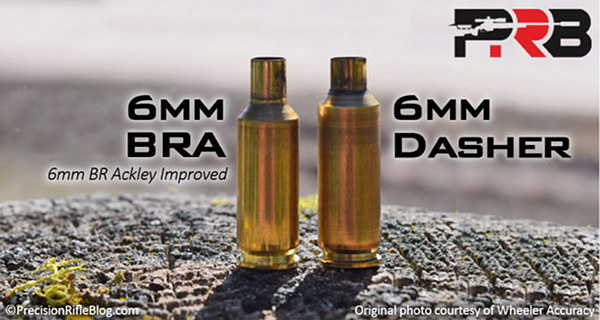
David shot the majority of his targets with a Bat B action and Broughton 5C barrel. But he also shot his BAT SV and Borden BRM with Krieger and Lilja barrels. David’s 1K rifles feature Deep Creek Tracker stocks and March scopes. He shot Vapor Trail 103gr bullets in the all the rigs, and all his barrels are chambered in 6BRA — a 40° wildcat based on the 6mmBR Norma. The 6BRA retains the long neck of the parent case, but has more case capacity. Some people say the 6BRA is a bit easier to tune than the 6mm Dasher, but it still achieves that ultra-accurate 2920-2960 FPS velocity node.
Tom Mousel shot his 6- and 10-match Aggs with two rifles, splitting time between his BAT Neuvo LR and Borden BRM. Both are chambered in 6BRA and he shot multiple Krieger barrels. Tom told us: “Thanks everyone. David was pretty steady all year, while I took more of an up-and-down route. At one point early on I thought there’s no way this would be salvaged.”
The Neuvo-actioned gun (shown below) features a McMillan/Wheeler LRB stock, with a March scope on top. In that rifle, Tom shot 103gr Vapor Trails. Mousel’s Borden BRM gun features a Deep Creek Tracker stock and Sightron scope. In that 6BRA rifle he shot 103gr Roy Hunter bullets.
Tom Mousel Rifle with BAT Neuvo LR action. This action is a Left-loading Drop Port — cartridges eject out the bottom of the action.
COMMENT by Alex Wheeler
If this doesn’t make you give up the idea you need that one hummer barrel to win I don’t know what will. Yes, you need the best equipment, but you also need the best tune and knowledge to stay on top of it. These two guys are some of the most dedicated tuners and testers I know. Well done! And well deserved!
It IS noteworthy that multiple rigs were used. Posting on Facebook, Alex H. said: “Holy ****! Tom did it not only with multiple barrels, but with two rifles AND multiple barrels? That is some outstanding performance! And Glenn K observed: “It was an awesome season to watch unfold. Congrats guys!”
Want to see the details?CLICK HERE to view full-screen photo.
Five targets, each with FIVE shots in essentially one hole. The events of this story happened two years ago. We are reprising our report because this five-target Aggregate arguably represents the most impressive feat of 100-yard accuracy in the history of marksmanship on this planet.
Check out those five targets. The Aggregate (average) of all five targets is a tiny 0.0840 inches! These were shot by Gary Ocock at 100 yards in a California benchrest match on August 6, 2017. Though Gary’s 0.0840 Agg beats existing records, this was not a “sanctioned” match, so Gary’s killer Agg will NOT be submitted for IBS or NBRSA records. So, sadly, the Agg won’t appear in the record books, but this remains a spectacular, verified feat of rifle accuracy, accomplished in competition.
The argument can be made that this is the Most Accurate Gun Ever Built. As far as we can determine, no one has ever shot a smaller 5-target Agg anywhere, at any time.
The Unlimited Benchrest Record That Will Never Be (Official)
Report by Boyd Allen
Gary Ocock’s stunning unlimited Aggregate is beyond amazing. That’s an average of five, 5-shot groups of .0840. Shot under sanctioned match rules, but at an unsanctioned 100-yard fun match, this Aggregate is well under the current 100-yard official records of the IBS (.1386), and the NBRSA (.1242). The fourth of the five groups measured a minuscule .018, less than half the size of the existing NBRSA Unlimited record of .049 (also shot by Gary). Check it out:
When the top 15 shooters all post teen Aggs, conditions must be pretty favorable. However there were some light switchy winds — Gary said that he shot better in the left to right condition.
GUN SPECIFICATIONS
Ocock’s red Jay Young Unlimited Railgun features one major difference from Young’s typical Railgun designs. The bottom of the barrel block is integral with the top (moving part), of the gun. The barrel is Ocock’s usual 1:13.5″-twist Krieger chambered for the 6 PPC. The BAT Neuvo action* is unusual in that its lugs are horizontal at lock-up instead of the usual vertical. With horizontal lugs, both lugs maintain contact with their abutments when the action is cocked. In the more normal configuration when cocked the top lug is forced off of its seat by a combination of the angle of the trigger cocking piece interface, the pressure of the striker spring, and bolt clearance at the rear of the action.
LOAD SPECIFICATIONS
Gary shot this remarkable Agg with well-used brass, Vihtavuori N133 powder, and self-made 66gr BT bullets** seated at “jam”. This amazing Agg was shot on the second day of a 2-day Unlimited Benchrest match. On Day 1 Gary had experimented with various loads using both surplus IMR 8208 and Vihtavuori N133, but was not satisfied with the results. For his first group on Day 2, Gary tried a light load of N133. After seeing the result, however, he decided to go to the other extreme — a super stout N133 load — with the same powder. As you can see, Gary’s willingness to experiment paid off.
Notably, Gary used light neck tension. Ocock found that for these bullets and this barrel, light neck tension worked best (contrary to “normal” N133 benchrest practice). Ocock used a bushing that only produces .001″ difference between the diameters of sized and loaded case necks.
Comment on Ocock’s Achievement
Congratulations to Gary Ocock for superb shooting (and smart loading). Even though the match was not sanctioned (so the Agg will never be a record), Ocock has raised the bar very high, and given us a new standard of ultimate accuracy.
Though this 0.0840 Aggregate and 0.018 group will never go into the record group, they are still noteworthy. There’s virtually no doubt that they would have survived inspection by any record committee. Except for the lack of fixed backers, an IBS requirement (for detecting cross-fires), all other conditions were met for an officially-sanctioned match.
*The new BAT Neuvo actions are the result of a collaboration between Dwight Scott, and Bruce Thom, featuring Dwight’s ideas and BAT’s proven manufacturing expertise.
** Ocock shot his own, boat-tail match bullets, made with George Ulrich-crafted dies using Hood cores. Although he said that it had been a while since he had weighed any, his best guess was that they weigh something around 66.5 grains.
7mm (.284) remains the caliber to beat in F-Class Open Division (though some shooters have had success with .30-Cal short magnums.) With a standard .284 Winchester, or better yet, a .284 Improved, you can drive the high-BC Berger 180gr and 184gr bullets to competitive velocities.
The straight .284 Win is an excellent cartridge, quite capable of winning F-class matches. However, in most barrels, it can’t push the 180s at 2900-2950 fps velocity levels*. A lot of barrels will top out at about 2850 fps. That’s where the .284 Shehane comes into play.
The .284 Shehane is a slightly modified wildcat that retains the same 35° shoulder as the parent case. However, by blowing the sidewalls out 0.010″, the .284 Shehane picks up about 3.3 grains of extra case capacity. That enhancement makes a BIG difference. The extra boiler room is enough to drive the 180s at 2900-2950 fps with H4831sc. With N560 or Reloder 17 you can go even faster.
Norm Harrold Won 2018 F-Class Open Division Nationals with .284 Shehane Rifle
Norm Harrold (above) won the 2018 USA F-Class Nationals shooting a .284 Shehane. Norm’s F-Open rig features a McMillan Kestros ZR stock and Bartlein barrel chambered for the .284 Shehane, which has a bit more case capacity than a standard .284 Winchester. Norm loaded Berger 184gr 7mm bullets in Lapua brass. Norm revealed his load in an Erik Cortina YouTube Video.
F-Class shooter Erik Cortina notes that the .284 Shehane has a velocity edge over the straight .284 Win because it holds more powder: “The Shehane has more capacity than the .284 Winchester. Ryan is using 54.0 grains simply as a fire-forming load. Typical load for a Shehane is around 57.0 grains of Hodgdon H4831 SC.” By blowing the sidewalls out 0.010″, the .284 Shehane picks up about 3.3 grains of extra case capacity. That enhancement makes a BIG difference. The extra boiler room is enough to drive the 180s at 2900-2950 fps with H4831sc, with long barrels.
Forum member Jim Hardy has shot the .284 with great success. He tells us: “In my humble opinion, the .284 Shehane is the best balanced long-range round there is — bar none. Here is why:
You have to shoot a 30 Cal Magnum with a 240gr bullet to equal the performance of most 7mm chamberings with the 180 Berger VLD. With the .284 Shehane, you have a .308 bolt face, medium action, and Lapua brass. You use less powder than the 7 mags, and have great accuracy and ballistics even while fire-forming. The .284 Shehane shoots inside the 6.5 AND the straight .284, the .300 WSM, and the .300 Win Mag with less recoil. What is not to love about the 284 Shehane? It is a no-brainer for long range — F-Class or Prone or 1000-yard Benchrest.”
Scotland’s Grant Taylor. who used the .284 Shehane to finish third at the 2009 F-Class Worlds in England says the .284 Shehane is “very accurate with superb vertical spreads at 1000 yards. [This] caliber… has awesome accuracy. I’m getting 2930-2950 fps with spreads in the 3-5 fps range. I use Hodgdon H4831sc powder, CCI BR2 primers, and pointed 180gr Bergers.”
.284 Shehane Shines in 1K Benchrest Competition Too
The .284 Shehane has won in Benchrest as well as F-Class competition. In 2013, Henry Pasquet won the IBS 1000-Yard Nationals shooting a .284 Shehane. Henry’s Championship-winning rig is shown below. Note the 5″-wide fore-end which is not legal for F-Class. Henry also runs a combo tuner/muzzle-brake.
Amazing Accuracy When Fire-Forming .284 Shehane
If you look at that 5-round group you might think it was shot with a 6 PPC or maybe a 6mmBR. But no, this was done with heavy 180gr Berger Hybrid bullets and the .284 Shehane. In fact, this impressive sub-quarter MOA group was shot while fire-forming with a very well-worn barrel! Gun builder Ryan Pierce of Piercision Rifles explains: “Here’s a 5-shot 0.191″ group at 100 yards with my .284 Shehane fireforming loads. This barrel has 2200 rounds through it. It had 2000 as a straight .284 Win and then I set it back to .284 Shehane to form brass with. [The load was] 180 Hybrids with 54.0 grains of H4831 SC.”
*Some exceptional barrels chambered in straight .284 Win can reach 2900 fps with the 180s. Ryan Pierce has a 32″ Brux barrel that is delivering 2900 fps with the straight .284. However, Ryan acknowledges that his velocities are not typical: “A lot of .284 Win barrels top out at around 2850 fps with the 180s”.
Firing line at 2019 Super Shoot. Photo courtesy Armeria Regina.
What components do world-class, short-range group benchrest shooters use? BAT actions, Krieger barrels, and Bix’n Andy triggers (and Jewells) are the components of choice. And barrel tuners are now widely used by the top shooters. As for powder, Vitavuori N133 is still the choice of virtually all top competitors. And yes the 6PPC definitely rules the roost. Every Top 20 shooter at the 2019 Super Shoot shot a 6PPC. Every one. Read on to learn more about the Top 20 Equipment used at this year’s Super Shoot.
We recently reviewed the Top 20 Equipment List for the 2019 Super Shoot at the Kelbly’s Range in Ohio. This Top 20 List reveals the gear choices for the 13.5-lb Heavy Varmint Class and the 10.5-lb Light Varmint/Sporter Class (20 entries for each division). Here are notable gear choices for Top 20 Competitors (both divisions) at the 2019 Super Shoot:
Actions: 14 of 20 HV and 16 of 20 LV/SP shooters used BAT actions. So there were 75% BATs for both classes combined. Barrels: 10 of 13 listed HV barrels and 9 of 12 listed LV/SP barrels were Kriegers. Overall, of the barrels identified in the Top 20 Equipment lists, 76% were Krieger. That’s dominance! [Note: We have been informed that entries with no barrel-maker listed may have been Bartlein barrels.] Triggers: Notably 10 of 20 HV triggers were Bix’n Andy — 50%. For the other class, 7 of 19 listed triggers were Bix ‘N Andy. All others were Jewells. Tuners: In HV Class, 12 of 20 shooters used tuners, mostly Bukys. 11 of 20 LV/SP shooters had tuners. Overall that is 57.5% tuner usage for both classes combined.
Cartridge: For both classes, every single Top 20 competitor shot the 6PPC. ‘Nuf said. Powders: 19 of 20 HV Shooters used Vihtavuori N133. Likewise 19 of 20 LV/SP shooters used VV N133, with one not reporting. That is total dominance for N133.
Bullets: There was a wide selection of bullets used in both classes. Custom bullets by “boutique” bullet makers were certainly favored by Top 20 shooters. Sta Moy 65s were popular, as were Hottenstein 68s and Bart’s bullets among others.
Shown are funnel with ultra-long drop tube (which helps get more kernels in the cases), RCBS Chargemaster (in wood box), and Hood Press (similar to Harrell’s Combo press).
Loading at the range remains important in the Benchrest for Group discipline. In a Special Report below, IBS President Jeff Stover explains how loading methods (and hardware) have evolved over the years. The advent of accurate, affordable electronic powder dispensers, such as the RCBS ChargeMaster and Frankford’s new Intellidropper, have changed the game and made it easier to load efficiently at the range. And quality manual powder measures are fast and can be very consistent, with a little practice. Loading at the range permits competitors to tune their load to the conditions, change seating depths, or even choose different bullets to suit the barrel’s preferences on any given day.
Although pre-loading is not uncommon, most 100/200-yard group shooters usually load at the match, often between relays. The goal is to shoot smaller groups by staying “in tune”. In a game where 5-shot groups “in the 1s and Zeros” is the goal, tuning loads for the conditions helps deliver match-winning accuracy. Nearly all competitors in this short-range discipline shoot the 6mm PPC cartridge, or a PPC variant.
Loading at the Range — Then and Now
In benchrest shooting for group, loading at the range has been de rigueur for decades. In the Score discipline, preloading is usually the custom. The main reason is that, in Score competition, only one Aggregate (warm-up match and five record targets) per day is usually shot. That would be less than 50 shots, assuming a few sighter shots. Also, the 30BR, the dominant Benchrest-for-Score cartridge, is very amenable to pre-loading.
By contrast, the Group discipline includes 21 targets (two warm-ups and twenty record targets) over a weekend, usually shot with 6PPC-chambered rifles. Many times, the 6PPC shooters may tweak their loads through the day given changing atmospheric conditions or simply trying to find the correct tune to “dot up”. This term, “Dot up”, means the shots are essentially going through the same hole, or closely so.
Loading at the range was a bit different when benchrest competition was in its infancy. The 1951 book, Modern Accuracy by Bob Wallack, is the best of the early benchrest books. Copies can be found, from time to time, on eBay or Alibris. It is a fascinating survey of benchrest as it existed more than six decades ago. There’s even coverage of a controversial target that was argued over at the time. In it, there is a photo of Wallack using the rear bumper of a car at the bench to clamp his reloading tools. Things have come a long way compared to the range loading set-ups of modern shooters. Here you can see Bob Wallack way back in 1950:
Modern loading bench set-ups shown in this Special Report belong to top shooters Howie Levy, Bob Hamister, and Kent Harshman.
Looking 1000 yards downrange at the Deep Creek Range outside Missoula, Montana.
On Facebook recently, we saw an eye-catching rifle. Owned by top 1000-yard competitor (and past IBS Champ) Tom Mousel, this rifle was smithed by Alex Wheeler of Wheeler Accuracy. This rig features the McMillan-crafted Wheeler LRB stock with adjustable keel. It also has BAT Machine’s very impressive new Neuvo LR (aka “Neuvo M”) action, serial number LR0001. The Neuvo LR has some important design features — horizontal lug orientation, full-diameter bolt body, and advanced fire control system. More about those features below.
This gun is a shooter. Tom has already shot a 1.5″ four-shot group at 1000 yards. How does he do that? First you need a great barrel, great bullets, and superior hand-loading skills. But then it comes down to great gun-handling. You can see that in the video below. NOTE to ALL Long-Range Benchrest shooters — Watch this video! You’ll definitely learn from watching Tom shoot — he’s one of the best in the business.
Tom Mousel shoots 1000-yard ladder test with first-released Neuvo LR action, SN LR0001.
Rifle chambering is 6BR Ackley (6BRA) in 28″ Krieger barrel.
Rifle Components and Build INFO:
This rifle has a BAT Neuvo LR (aka Neuvo “M”) action glued and screwed into the LRB stock using a special bedding block, a Boyd Allen concept that Tom has requested to use on every future build. The 28″ Krieger 1:8″-twist HV barrel was indexed using a little different method than most use. It is “panning out well” says Alex, who adds: “So far it has shot [multiple low ones] with two barrels and three different bullet types. This rifle is definitely one of the better shooters I have seen.” We’d agree — owner Tom Mousel has had a 1.5″ 4-shot group at 1000 yards in testing, plus some “zero” 3-shot groups at 100 yards.
Chambering is the 6mmBR Ackley (6BRA). The stock is a Wheeler/McMillan LRB stock with vivid orange and black paint job. It features an adjustable keel in the rear. Trigger is a Bix N Andy unit from Bullets.com.
This BAT Neuvo LR action is a Left-loading Drop Port. Cartridges eject out the bottom of the action.
BAT Machine Neuvo Long Range “M” Action
This is the “Long Range” version of the BAT Neuvo. Dwight Scott and Chris Harris were the original inspiration. I worked with Chris to come up with a version for long range. The main differences for the LR Neuvo (compared to the shorter Neuvo) are this has integral lug and rail, with flat bottom and sides for better bedding. The BAT Neuvo LR is available in drop port, dual port, and single port as well as magnum.
Take a look at the bolt. Notice the lug orientation and full diameter bolt body. There are no bolt raceways in the action and the two lugs sit HORIZONTALLY when the bolt is closed — that’s different than the vast majority of other two-lug actions.
Alex Wheeler says the Neuvo is a winner. He thinks some of the action’s design features really do contribute to enhanced accuracy: “The … fire control (firing pin assembly) carries a lot of energy and has a very “clean” release. This is an excellent design with many small details that combine to deliver superior function. In addition, the full-diameter bolt can be fitted tighter than one with lugways. Also the horizontal lugs may be why we see less vertical stringing in the groups. They are timed perfectly as well.”
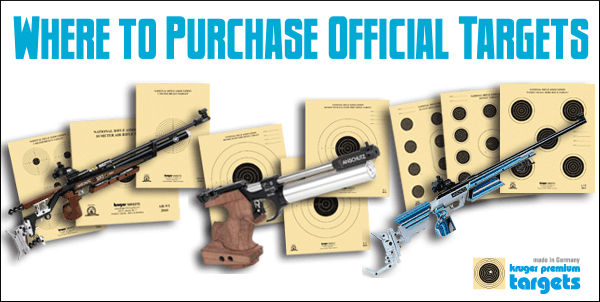
AccurateShooter.com offers dozens of FREE, printable targets for target practice, load development, and fun shooting. We also offer a few of the most popular NRA Bullseye targets. One or more of these printable targets should work for most training purposes. However, some readers have asked: “Where can we get the real targets… exactly like the ones used in NRA, IBS, and NBRSA shooting matches?”
All these vendors carry nearly all the NRA High Power and Smallbore targets, including the new, smaller F-Class targets. Germany’s Kruger Targets sells all the important NRA targets, and international (ISSF) air rifle and smallbore targets too.
Orrville Printing currently sells IBS targets for rimfire (50 yard) benchrest, short-range centerfire Benchrest (100, 200, 300 yards), Hunter BR Rifle (100, 200, 300 yards), plus the official 600-yard and 1000-yard IBS targets. National Target Company also has most of the IBS targets. NBRSA short-range, 600-yard, and 1000-yard benchrest targets are available directly from the NBRSA Business Office. Call (307) 655-7415 to order for the season.
At Western CMP Games, veteran rifle competitors Leon Rutherford, left, and Don Rutherford, demonstrate how to score targets at the GSM new shooter clinic. Note the use of a separate Target Center, which is available from many of the vendors listed above.
When a shot is fired through it, a barrel will exhibit harmonics. Tuning these harmonics (the “waves” that propagate through the barrel) can alter point of impact and, if you’re lucky, reduce group size. Barrel tuners have been used successfully in rimfire benchrest for many years (see photo above). While there are competing theories as to how and why barrel tuners work on rimfire rifles, there is no question that the accuracy of some rimfire barrels can be improved with the addition of a tuner. By changing the position of weights at the end of the barrel, we’ve seen shooters shrink their average group size as well as adjust the “sweet spot” for different lots of rimfire ammo. On the other hand, tuners can be the source of great frustration; some installations may yield little or no benefit. A shooter may have to experiment with a variety of different tuner designs (and weights) to find the optimal configuration.
Centerfire Tuners–Still a Work in Progress
In centerfire benchrest competition, the vast majority of competitors do not use tuners, though a few short-range shooters such as Gene Bukys and Jackie Schmidt have enjoyed considerable success. Gene has won major championships with tuned rifles. In 2011 Gene won both the Super Shoot and World Benchrest Championship (WBC), and Gene recently set a new NBRSA Sporter Class Grand Agg Record.
Centerfire benchrest guns typically employ shorter barrels with a much fatter contour (larger diameter) than rimfire rifles. Because centerfire rounds produce much higher pressures and velocities that a 22LR, a centerfire barrel also exhibits much different vibration characteristics than a typical rimfire barrel. Nonetheless, there are pioneers working with centerfire tuners who believe that tuning may be the “next leap forward” in centerfire accuracy.
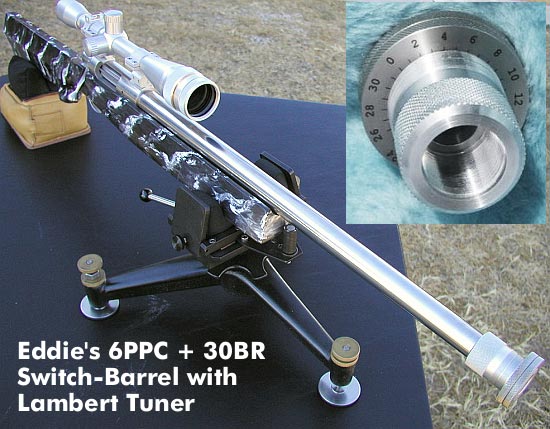
Shown below is a switch-barrel benchrest rifle built by Forum member Eddie W. of Texas. It features a dual-port Hall “M” action with a ShadeTree Engineering Tuner crafted by Butch Lambert. The gun is designed to take both a 6PPC barrel for group shooting and a 30BR barrel for score shooting. The gun was barreled by Wayne Shaw, and Eddie did the stock work himself. Eddie reports: “It is a very accurate rifle.”
Will we see more tuners on centerfire rifles? Only time will tell. Some folks believe that, since one can easily adjust the loads shot by centerfire guns (by tinkering with the powder charge and seating depth), tuners have limited utility. On the other hand, tuner advocates such as Gene Beggs believe tuners can help keep your group sizes small even as conditions (temperature, humidity) change. Gene believes that, with an appropriate tuner, you can spend less time fiddling with the load specs (changing your powder charge) and instead “dial in” your sweet spot using the tuner.


 IBS Brings New Editor Onboard




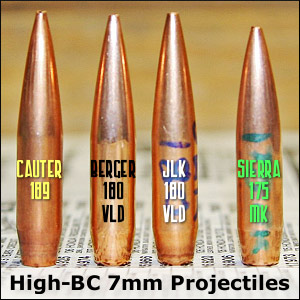 7mm (.284) remains the caliber to beat in F-Class Open Division (though some shooters have had success with .30-Cal short magnums.) With a standard .284 Winchester, or better yet, a .284 Improved, you can drive the high-BC Berger 180gr and 184gr bullets to competitive velocities.




 Centerfire Tuners–Still a Work in Progress