Report by Boyd Allen, IBS Vice President
Over the weekend of October 27-28, 2018 forty-four shooters competed at the IBS 2018 Score Nationals held at the Ashe County Wildlife Club in Laurel Springs, North Carolina. The match had been rescheduled from its original, earlier date because of Hurricane Florence. Forty-three shooters shot Varmint for Score, and two of those also shot Varmint Hunter. One competitor strictly shot in Varmint Hunter class, for a total of three in that category.
Despite challenging winds and weather, there were some impressive performances. Brud Sheats won the VFS Grand Aggregate with 499-35X, with Richard Sissel second, 499-24X. Brud also topped the 200-yard VFS field, while Chris Gibby was the leading 100-yard VFS shooter.
This photo was taken on the cold and damp Saturday morning. Ashe County Wildlife Club’s 30 benches are generously proportioned and extremely well-built.
The Weather/Conditions
According to my source, Saturday morning was cool and cloudy, after a morning low of 40 degrees the day would only get up to a high of 48. As you can see from the picture of the firing line there was a little rain. The wind light and shooting conditions generally good, but on Sunday things changed. The wind became a more significant factor. According to my good friend Lee Martin, who shot the match and was kind enough to send me many good pictures, “Sunday brought 20 mph gusts that switched constantly.” Weather records show that the temperature ranged from an early morning low of 39 degrees with an eventual high of 56 and just a .01” of rain.
Photos by Clint Johnson and Lee Martin.
The Ashe County Wildlife Club
This impressive rural facility is far more than just a benchrest range. It has a Trout Pond, Skeet Field, Sporting Clays, 5-Stand Sporting, Wobble tower, Trap field, 300-yard Rifle range with 30 covered benches, and a 50-yard Pistol / Rimfire range. The 300-yard benchrest range has a newly constructed firing line and loading/multipurpose building that any club would be proud of. The firing line runs along the north east wall of the building and is covered by its extended eave.
Top Shooters, Results, and Equipment List
The above photo includes most of the “top guns” at the 2018 IBS Score Nationals. Shown, from left to right: Dean Breeden – 1st 100 Hunter, High X-Count Hunter & 2 Gun Grand Agg Hunter; Wayne France – 5th 200 & 4th Grand Agg; Dewey Hancock – 2nd 100; Chris Gibby – 1st 100 & 5th Grand Agg; John Cascarino – 4th 200 & 5th Grand Agg; Rick Hudak – 3rd 100 plus 2017 defending Grand Agg Winner; Brud Sheats – 1st 200 & 2018 Grand Agg Winner; Nick Breeden – 1st youth; David Richardson – 3rd 200; Orland Bunker – 1st 200 Hunter & 1st Grand Agg Hunter; K.L. Miller – 2nd 100 Hunter; Richard Sissel – 2nd 200 & 2nd Grand Agg. (Anything not designated as Hunter refers to VFS.)
Brud Sheats, 1st @ 200 & 2018 VFS Grand Agg Winner; Right — Richard Sissel, Grand Agg Runner-Up.
See More Match Photos from the 100/200 Score Nationals
If you want to see more photos from the Score Nationals, here are links to two web photo albums with many more images from the event:
If you’ve never been to a benchrest match, visit the IBS website to find an affiliated club in your area. You’ll find schedules for upcoming events where you can learn about the sport.
This article describes an impressive complete benchrest rifle that will be awarded next month to an IBS competitor in the IBS Southeastern Region. This premium benchrest rig was a collaborative effort, with components and build labor donated by many companies. The rifle and scope prize will be awarded at a Banquet on November 10, 2018. The winner will be chosen from shooters who have accumulated “tickets” (essentially prize credits) over the course of the year. Tickets are earned through match attendance and shooting performance: 1 ticket for each match attended in the SE region ranges listed above (AFTER attending five matches). Shooters get additional tickets for a perfect 2,500 score, plus 10 additional tickets for attending at least one match at each and every participating range.
A Magnificent Prize by Boyd Allen, IBS Vice President
Coming up with prizes for shooting events is always a challenge, and results can vary considerably from match to match. This rifle is at the apex of the prize pyramid. Few complete rifles are seen on prize tables, because of their cost, and because they are generally built to order from select components, produced by multiple manufacturers. There are no off-the-shelf benchrest rifles, and if there were, the price of one, complete with a quality scope, would be too great to ask of a single source, given the size of the typical businesses that serve this sport.
Any score shooter would be glad to have this rifle and feel quite fortunate to win it. It is a fine example of its type, made of top components, and stocked with a “Indian Blanket” pattern Obeche laminate that will not be seen again once the supply runs out, because the factory that produced it burned down. As you would expect for this type of competition, it is chambered for the 30 BR.
This prize rifle was built to increase interest and participation in centerfire score shooting in the Southeast Region of the International Benchrest Shooters (IBS), as well as to encourage competitors to visit more ranges and attend more IBS matches. Ranges participating in this prize campaign are:
Good luck to everyone for the remainder of the 2018 season. NOTE: There are more detailed rules than we can reproduce here (for space reasons). If you intend on taking a serious run at this prize, take the time to inquire about all of the specifics.
Left to Right: Jim Cline, Doyle Anglin, and Ronnie Milford.
Background of the IBS Rifle Prize
Ronnie Milford explained: “Near the completion of the Southeastern Regional, I [asked] some of our fellow shooters about increasing participation. One of them suggested that we have one big prize that would be participation-based. I ran the idea of building a complete rifle by my personal gunsmith Doyle Anglin. He warned me that he had seen others try to do the same thing, and that it would be hard to get people to donate products. That lit a fire. First phone call was to Jim Kelbly who offered to donate the action. For the trigger Jim recommended a Bix & Andy from Chris at Bullet Central. I then called Jim Cline, and he got Brux to donate the barrel. Then, I talked to my NightForce contacts, Allen Stillwell and Wayne Dayberry. They donated a competition scope.
My next phone call was back to Doyle Anglin and I told him what had been donated. He then talked about ‘fitting and chambering, pillar bedding, and stock by Dixie Guns’. When Dave Short heard what we were doing, he donated a trigger guard, chamber cleaning kit, and a barrel tuner. Jim called Linwood Harrell who donated our scope rings. We were almost complete, and I told them that I would spray the finish on the stock. When this news got out, it caused a great deal of excitement.”
Prize Rifle Eligibility and Award Procedures
This custom rifle will be given away at the awards banquet on November 10, 2018 in Orangeburg, SC. The winner will be chosen using tickets earned during the season. A shooter will “earn” 1 prize chance ticket for each match attended in the SE region ranges listed above, AFTER attending five (5) matches. (If you attend four matches or less you will receive 0 tickets for attendance.) You can get 5 additional tickets for a perfect 2,500 score and 10 additional tickets for attending one match minimum at each participating range. We will keep track of the tickets earned and they will be passed out at the banquet for you to personally place them in the container.
Prize Rifle Being Constructed at Doyle Anglin and Ronnie Milford shops:
Support the Sponsors — This is a very impressive prize. Keep the generosity of all who donated to the project in mind the next time that you are in the market for products they make or sell. In the future we may offer a follow-up story about the rifle winner and his/her first competition with this 30 BR benchrest rifle. In any case, on November 10, 2018, someone is going to be very happy with their valuable prize.
Built to Shoot — Remember this rifle was created by donations, to grow the sport, and promote shooting, not to sell for monetary gain. If you do not plan on shooting this rifle, please donate it to an upcoming shooter. Ronnie Milford, and Jim Cline worked hard to make this dream become a reality. Let’s not let down the sponsors who continue to support us.
Get a video view of 1000-yard Benchrest competition tomorrow on Shooting USA television. This week’s Wednesday episode of Shooting USA features the 2017 IBS 1000-Yard National Championship held at the Whitehorse Shooting Center in Peeltree, West Virginia. This Shooting USA episode takes you to the Whitehorse 1K Range in September 2017. You can see the action on the firing line and the Shooting USA team also interviews many competitors. Watch this episode on the Outdoor Channel at these times: 9:00 PM Eastern and Pacific; 8:00 PM Central.
If you want to learn about the 1000-yard Benchrest game, definitely tune in to Shooting USA on September 26, 2018 (tomorrow) to watch last year’s IBS action. There were nearly 120 shooters competing (118 in Light Gun, 107 in Heavy Gun).
To learn more about on this event, read our detailed 2017 IBS 1K Nationals Match Report. At the 2017 Nationals, conditions were challenging to say the least, with rain storms, spiraling winds, and fog. In fact, rain and fog on Saturday (with cancelled relays) caused the Nationals to be extended by one day through Monday. What’s more, of the 107 shooters listed in the Two-Gun Overall results who actually shot both guns, there were dozens of DQs. (Yes, the wind was very tricky at this year’s Nationals.)
Top Guns at the 2017 IBS 1000-Yard Nationals were Edward Kenzakoski (Two-Gun Overall Champion), Mike Gaizauskas (Light Gun Overall, plus LG Score Agg), and Mike Brennan (Heavy Gun Overall, plus HG Score Agg). Group Agg winners were Richard Schatz for LG, and Charlie Lentz for Heavy. Two ladies also deserve mention. Sally Bauer shot the smallest group of the match, a 1.923″ 5-shot group in LG — that’s 0.184 MOA! Ruth Edwards drilled a 2.104″, also mighty impressive. Here’s Sally below with her very patriotic Heavy Gun…
Report by Boyd Allen, IBS Vice President Photos by Hillary Martinez
Many of the nation’s best Score Benchrest shooters came to Maryland last month for the IBS 200/300-Yard Score Nationals. This is a one-shot-per-bullseye discipline dominated by accurate 30-caliber cartridges such as the 30 BR. Over the weekend of the 4th and 5th of August, 42 shooters participated in the 2018 IBS 200/300-Yard Score Nationals, held at the Thurmont Conservaton & Sportsman’s Club, in Thurmont, Maryland. Forty-one competitors shot Varmint for Score (VFS). Between the two 6X disciplines there were six competitors, equally divided between Hunter (H) and Varmint Hunter (VH). Dewey Hancock was “Top Gun” for the match, winning the VFS 200/300 Grand Agg with 500-23X, a possible new record.
There are six bullseyes on an IBS Score target. Competitors take one shot per bull for five scored shots. The sixth (bottom right) bullseye is reserved for sighter shots.
Rising River After Rain
This match had some unique challenges — caused by a river that overflowed after a rain. Thankfully, the match proceeded without major problems once needed equipment was moved. It rained nearly half an inch the Friday night before the match, as it had for several days. Given the flooding, there was a slight delay Saturday morning. The scoring trailer had to be moved because it been parked (before the rain) in a low area adjacent to where Big Hunter Creek empties into the Monocacy River. (In the satellite view, the firing line cover is in the middle, about one-third up from the bottom.)
Hot and Humid in Maryland — The match director described the weather as very hot and humid. On Saturday, the temperature varied from 66 to 81 degrees, the humidity from 62 to 100 %, and the wind speed from 0 to 9 mph. On Sunday, things warmed up a bit, the humidity was reported as a little lower, as was the wind speed.
The Green Fields of Thurmont — With recent rains at Thurmont, lush green grass stretched from firing line to targets. This elicits envy from a shooter who has spent all of his time on ranges that do not have a single blade of green anywhere, except for a few weeks during a short rainy season. To my eyes, this range is beautiful.
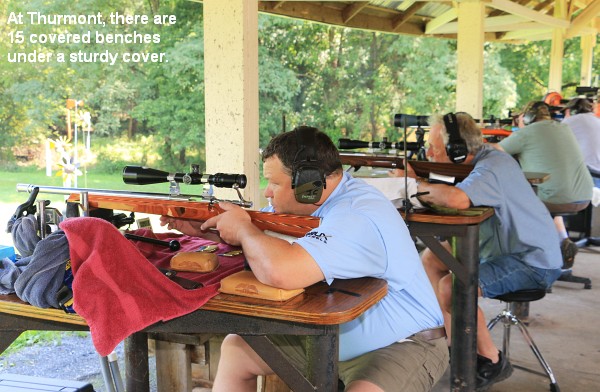
Thurmont shooters are blessed with a truly outstanding facility that serves all types of shooting. There are fifteen covered benches of mixed construction under a sturdy cover, with plenty of parking both for vehicles and RVs. Learn more about the Thurmont Club at TCandSC.org.
TOP TEN Match Results, and Equipment List
Can anyone identify that big gold-tone coaxial rest on the right?
The VFS Grand Aggregate Top Five were: Dewey Hancock (1st Place), John Bosley (2nd), Ronnie Milford (3rd), Brian Fitch (4th), and Jim Cline (5th). VFS winner Dewey Hancock shot a possible new 200/300 yard record with a 500-23X.
Top shooters left to right: Dewey Hancock, Nick Breeden, Brian Fitch, Glen Olenick, Robert Brooks, Steve Cameron, Dean Breeden (arms raised), KL Miller, Jim Cline, Ronnie Milford, John Bosley.
Wayne France — with the “I just won a Nightforce” smile!
Steve Eller smiling — BIB Bullets from Randy Robinette are always a good choice.
Dean Breeden, Match Director and Competitor
Match directors do not get the appreciation they deserve. The match calendar would be blank without them. Score Nationals Match director Dean Breeden ran a great show here. In addition to rescuing a trailer from flood waters, and running the 200/300 Score Nationals, Dean also himself competed at the Nationals, shooting two rifles. He did well, with Top Ten finishes at both distances, in both VFS and Hunter classes (3rd in Hunter at 300 yards).
While Dean may be under-appreciated as a match director, Dean is widely recognized as one of the best IBS score shooters out there. Dean holds six (6) current IBS Score Shooting records.
In his Match Report, Dean acknowledged and thanked the generous match sponsors:
BIB Bullets
Brunos Shooter Supply
Brux Barrels
Dave Short Customs
Eddie Harren
Krieger Barrels
Nightforce
PMA Tool
Redding Reloading
ShadeTree Engineering
Wilson Dies
Report by Boyd Allen, IBS Vice President Photos by Gordie Gritters and Alex Wheeler
The 2018 IBS 1000-Yard Nationals event was hosted by the Montana NW 1000 Yard BR Club, which has an active and well-run 1K benchrest shooting program. Over eighty shooters from as far away as Indonesia participated, 82 in Light Gun, and 85 in Heavy Gun. By all accounts it was a very well-run match, that was enjoyed by all who attended.
The Deep Creek Range is a beautiful place to shoot, with normally favorable conditions. But the winds were challenging at the 2018 IBS 1000-yard Nationals.
One man, Carroll Lance, dominated the match, taking the 2-Gun Overall Aggregate, while also winning HG Score Agg, HG Group Agg, and HG Overall Agg. It was a masterful performance — Carroll shot his Light Gun in both classes, beating dozens of bigger, heavier, and much more expensive rifles. Carroll’s name will be placed on four IBS perpetual trophies. Here’s Carroll with his line-up of trophies.
Winning Form — Carroll Lance Talks Technique
When asked for his advice to a new shooter, Big Winner Carroll Lance said: “Shooters should concentrate on being smooth, so as not to disturb the rifle in the bags. Speed will come naturally. The common mistake is to try to run the shots faster than can be done smoothly.”
Aerial Drone Video Shows Deep Creek Range outside Missoula, Montana. Worth Watching!
Challenging Conditions at Match
While Deep Creek is renown for often having good, “readable” conditions, this was a tough year according to Deep Creek veterans. As proof, there were five DQs on a single relay.
Tom Mosul (who ran the firing line for most of the event) noted that conditions were not extreme but could be tricky, with max wind speed s10-15 mph. It varied enough that being on some relays could effectively put a competitor out of the tournament. Tom also mentioned that indicators that he normally could depend on were not reliable this year.
Leo Anderson, who has been present at nearly all the 1000-yard matches ever held at Deep Creek, said this 2018 match had some of the trickiest conditions he has seen in 20 years of competition. Leo said you could not see the conditions causing POI changes. Alex Wheeler agreed, and added that although it was pretty calm at the benches, that the scorer who was running targets (from the pits to the firing line) said there was a strong cross wind half way down range that could not be felt at the pits or firing line…typical for Deep Creek, tough to read when it does decide to be nasty.
Summary of IBS 1000-Yard Nationals Match Results
For those who are unfamiliar with long range benchrest results, there are seven categories of winners, with seven corresponding traveling trophies (the big ones that bear the names of each year’s winners). For each of the two rifle classes (Light Gun and Heavy Guun) there are group, score, and overall aggregate winners (every target is both measured for group size and scored.) Finally, there is a 2-Gun winner for both rifle classes combined, based on group AND score.
With over eighty competitors, the PDF of the complete results, including those of every relay plus a very detailed list of the equipment used by every competitor for both classes, is a whopping 52 pages long. Links Below:
Equipment List Light Gun and Heavy Gun Classes
The seven travelling trophies went to just three shooters. Cody Finch won the LG Group aggregate. Tim Gonnerman won the LG Score aggregate and LG Overall aggregate. Carroll Lance won everything else — HG Score aggregate, HG Group aggregate, HG Overall aggregate, and the 2-Gun Overall.
Big winner Carroll Lance shot his 6mm Dasher Light Gun for both classes. The rifle, smithed by Jay Cutright, features a Borden BRM drop port action, Krieger barrel, Wheeler LRB stock, and Nightforce scope. Carroll’s match-winning load consisted of Vapor Trail bullets, in front of H4895 powder and CCI primers.
Cody Finch’s Light Gun was a 6BR Ackley (6BRA) with Lederer barrel, BAT action, Nightforce scope, and a DCT stock. His load consisted of Vapor Trail bullets, Hodgdon powder, and CCI primers. Alex Wheeler smithed the rifle.
Tim Gonnerman’s Light Gun, smithed by Mike Bigelow, featured a Krieger barrel (6mm Dasher), BAT action, Nightforce scope, and McMillan stock. The load consists of Vapor Trail bullets, H4895 powder, and CCI 450 primers.
Equipment List by Class Based on Two-Gun Overall Agg Rankings Light Gun Equipment List (click to zoom):
I called the major Aggregate winners (Carroll Lance, Cody Finch, and Tim Gonnerman), and asked them about the 1K Nationals. My questions fell into five major categories: 1) how the wind compared to other matches (including other locations); 2) how each handles his rifle and equipment; 3) how they shot the match; 4) how they clean their barrels (and what their barrel accuracy life is); and 5) How they reload.
They all described the conditions as challenging. This was not a match to use for spotting small differences in accuracy between similar calibers. Even with the rotations of relays and benches, there was an inescapable luck factor, with some relays having significantly more challenging conditions than others. Changes could be rapid, with reversals that could be extreme.
Gun-Handling: On the subject of how the rifle is handled, Cody Finch shoots with only trigger contact, while Tim Gonnerman and Carroll Lance have light stock contact. Tim said that he is so focused on shooting that he is really not aware of the details of how he handles the rifle. Carroll said that he makes light contact with his trigger hand and has the butt touching his shoulder so lightly that he can barely feel it, but solidly enough that it only recoils about a quarter inch.
Shooting Strategies: Cody uses his sighter period to investigate how differences in mirage affect bullet impact location and then holds off shot by shot during his record string. Tim and Carroll do not, they adjust their scopes using the last sighter shot (which they can see because there is target service like an high power match with spotter disks) and then hold center for their record, trying to do as little with their rest adjustments as possible. Carroll mentioned that he only made one adjustment for the whole weekend and that his usual practice is to make small corrections with hand pressure.
Barrel Cleaning: Tim shot the whole weekend, without cleaning. When he does clean he uses Pro Shot Copper Solvent, patches, a nylon brush, and does a lot of soaking. Periodically he uses IOSSO with a patch on a nylon brush. He breaks in his barrels with the common one-shot-and-clean progressing to three and then five, and, sees a velocity increase at about 120 rounds from new. Tim cleans with patches and bronze brushes. I smiled when he told me what he cleans with, CLR, ThorroClean (Bullet Central) and IOSSO. CLR has been the topic of some discussion on the internet, and a friend found that it did a good job on carbon. It has been a controversial topic. Of note, Tim shot the smallest group for the tournament.
Barrel Life: All three Top Guns said that accurate barrel life varied from barrel to barrel. I got the general impression that most were done or close to done by 1,500 rounds, at least for the Dasher, with the BRA being too new to tell if it would stretch that far, but that it might.
Reloading Methods: On the reloading side, none of them anneal regularly, if at all. Carroll’s cases had 15-20 firings on them, and had only been annealed once, early on, but they still felt good when he was seating bullets. Last year he tried to anneal after every event.
Most of his competition has been at 600 yards, where Varget did a good job, with bullets seated .010 to .012 into the lands, but it did not perform well at 1K so he switched to H4895, which likes its bullets .005 into the lands. The chamber has a .268 neck. Case necks were turned to .0105 for a loaded round clearance of about .003. He used a .263 bushing.
Starting with a fired case, he sizes in a FL bushing die, tumbles in corn cob media to remove the lube, and just before seating bullets applies graphite to the insides of case necks with a Q-Tip.
Course of Fire at 1K Nationals (as explained by Tom Mosul):
“Relays were rotated along with bench assignment within each relay. The match is a three-target Aggregate, so what we did was divide the total number of relays and benches by 3, and then rounded down. Due to the number of benches (13) and shooters there were seven relays per target. Saturday morning started with LG target #1, followed by HG target #1, finishing the day with LG target #2. Sunday morning began with HG target #2, then LG target #3, and finished with HG target #3. For each relay six minutes are allowed for sighter shots, followed by a cease fire, and within a minute after that, a ten-minute record period.”
True Treasure Trove of Prizes at Deep Creek
There was a very rich prize table, including BAT, Borden, Curtis Custom, and Defiance actions; McMillan, McMillan/Wheeler and Shehane stocks; Kahles, Nightforce, Swarovski, and Vortex Scopes; SEB NEO Rest; Benchsource Annealing machine; Bartlein, Brux, Lilja, Krieger, and Rock Creek barrels; Zeiss Binoculars; many gift certificates (incl. Kelbly’s and McMillan) and much more.
The Top Guns got the pick of the prizes. Carroll Lance chose a Kahles 10-50 rifle scope, Tim Gonnerman chose a BAT Neuvo action, and Cody Finch chose a Borden BRM action.
NOTE: Prizes that manufacturers and vendors contribute are an important part of any successful match. I am sure that everyone who was connected with this event is grateful to all the generous sponsors who donated prizes and gift certificates. Sebastian Lambang (shown below), creator of SEB Rests, shot the match and donated a SEB NEO rest.
More Photos — Hundreds of Photos
Here are links to ALL pictures that Gordy Gritters and Alex Wheeler were kind enough to take at the 2018 IBS 1000-Yard Nationals. There are 359 images altogether:
This shows Tom Jacobs of Vapor Trail Bullets holding his match rifle while Gordy Gritters drills a couple of ounces out of the butt. We’re told Tom knew he was an ounce heavy when he got there.
Many of the nation’s top 100/200-yard Benchrest Shooters came to central Pennsylvania this month for the IBS Group Nationals, held August 13-18 at the Union County Sportsmen’s Club. This major event encompassed six days of shooting, making this one of the lengthiest benchrest matches of the year. There were nearly 90 registered competitors, plus competitors’ spouses and kids were able to shoot in a fun match on Wednesday afternoon. This is a prestigious match — with National titles up for grabs in four classes: Sporter, Light Varmint, Heavy Varmint, and Heavy Bench. CLICK HERE for Full Results.
IBS Group Benchrest Nationals 2018
Report by Jeff Stover, IBS President The Range and Conditions
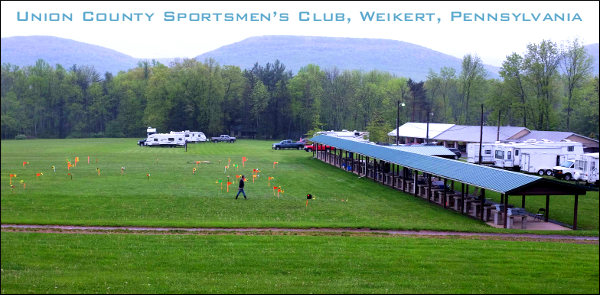
This year’s venue was a return to one of the premier benchrest rifle ranges in the country. Union County Sportsmen’s Club is located near the center of Pennsylvania. It gets its name from the nearby village of Weikert. The range faces east, not ideal, but that is what the topography dealt the club. This week of competition had the usual prevailing conditions: mostly from the west, meaning from 4 o’clock to 8 o’clock. A switch green to orange and back again, with changing velocities. Sometimes readable. Many times, however, conditions are confounding.
The Course of Fire
The IBS Group Nationals event is a bit of an endurance test as it spans six days for those shooting. The sequence of competition groups has 100-yard targets shot the first three days followed by three days at 200 yards. It is done this way to require only one change of wind flags. Nationals competition requires “full rotation”. That means that every time a shooter goes to the line for the next match target, he or she must move a requisite number of benches to the right. At the end of the day a shooter will shoot across the full width of the line. Some ranges offer unique properties that render some parts of the range harder or easier to shoot small groups. Bench rotation is important to even out those factors.
Hall of Famer Jeff Gaidos taking aim. Note both eyes are open. Jeff picked up two more HOF points at Weikert this year.
Light Varmint, Heavy Varmint, Sporter, and Heavy Bench Equipment
It takes thirty targets of five shots each and ten targets of 10-shot groups to win a “4 Gun Nationals”. That would be the classes of Light Varmint, Heavy Varmint, Sporter, and Heavy Bench. For all practical purposes, the first three are known as “bag guns” while the Heavy Bench rifles are “rail guns”. In fact, most competitors shooting a bag gun opt for a single rifle, which has been the benchrest standard for decades: a 10.5-pound rifle chambered in 6 PPC.
Peinhardt Wins 2-Gun & 3-Gun, Costa Wins 4-Gun, and Mitchell Smashes HB Record
Jeff Peinhardt won the 2-Gun and 3-Gun to dominate the “bag guns” (Light Varmint, Heavy Varmint, and Sporter). Larry Costa won the 4-Gun, with the top combined Agg for all four classes. Paul Mitchell turned in the notable railgun performance in the Heavy Bench division. Mitchell posted a 200-yard Agg of 0.1687 MOA. That should smash the old record of .2224 MOA set by Ed Watson way back in 1990! Note those figures are for MOA at 200 yards. Mitchell’s average 10-shot group size was 0.3374” (MOA x 2). That is only slightly larger than the Aggregate record for 5-shot groups with a rail gun. Mitchell said his rail has a superb Krieger barrel: “My rail gun was originally built by Bud Welch in the early ’90s. I took about ten years off from shooting from the late ’90s until 2008. When I got back I had Bruce LaChapelle take the action out of a sleeve and clamp the barrel in a Delrin sleeve. Dwight Scott chambered this Krieger barrel in January of 2017 and let me know that he thought it could be one of the hummers we all dream of and don’t waste it. This is the fourth 10-Shot teen Agg I have shot with it. It will be a sad day when it’s shot out!”
Click links below for Day-by-Day Results. Complete results may be found at the IBS Match Report Page.
Multi-Gun Results:
There are awards for combined results in multiple classes. Jeff Peinhardt won the both the 2-Gun (HV-LV) and 3-Gun (LV-HV-SP). Long time top shooter Larry Costa won the overall 4-Gun. Both Costa and Wayne Campbell (4-gun runner-up) are Hall of Famers. 4-Gun 3rd-place finisher Hugh Williamson, a Canadian, is also a barrel-maker.
The 3-Gun Top Three (from left): Jeff Peinhardt, Larry Costa, and Ronald Burdick:
IBS Score Benchrest Nationals Multi-Gun Results
2-Gun Top Three
3-Gun Top Three
4-Gun Top Three
1. Jeff Peinhardt
2. Ronald Burdick
3. Larry Costa
.2104
.2138
.2148
1. Jeff Peinhardt
2. Larry Costa
3. Ronald Burdick
.2035
.2040
.2164
1. Larry Costa
2. Wayne Campbell
3. Hugh Williamson
.2191
.2238
.2331
On Wednesday Afternoon first timers/novices (including spouses and children) were allowed to shot a group with the assistance of a coach. Here is PowderPuff winner Dena Wise with Coach David Halblom. Note Dena’s impressive 0.148 group. Dena is sister to Dale and Russ Boop.
Benchrest State of the Art — Equipment
Want to know what the Top Guns were shooting at Weikert? Here is a complete Top Ten Equipment list for all four classes: Sporter, LV, HV, and Heavy Bench (Railgun):
Thanks to the Hard Working Team at Weikert
The IBS is indebted to Nancy Scarbrough who did a fabulous job as match director. Mark Trutt, once again, devoted a full week as range officer and getting the range and grounds ready. The target crew was very efficient under the experienced direction of Steve Dodge.
Target Analysis from the “Wailing Wall”
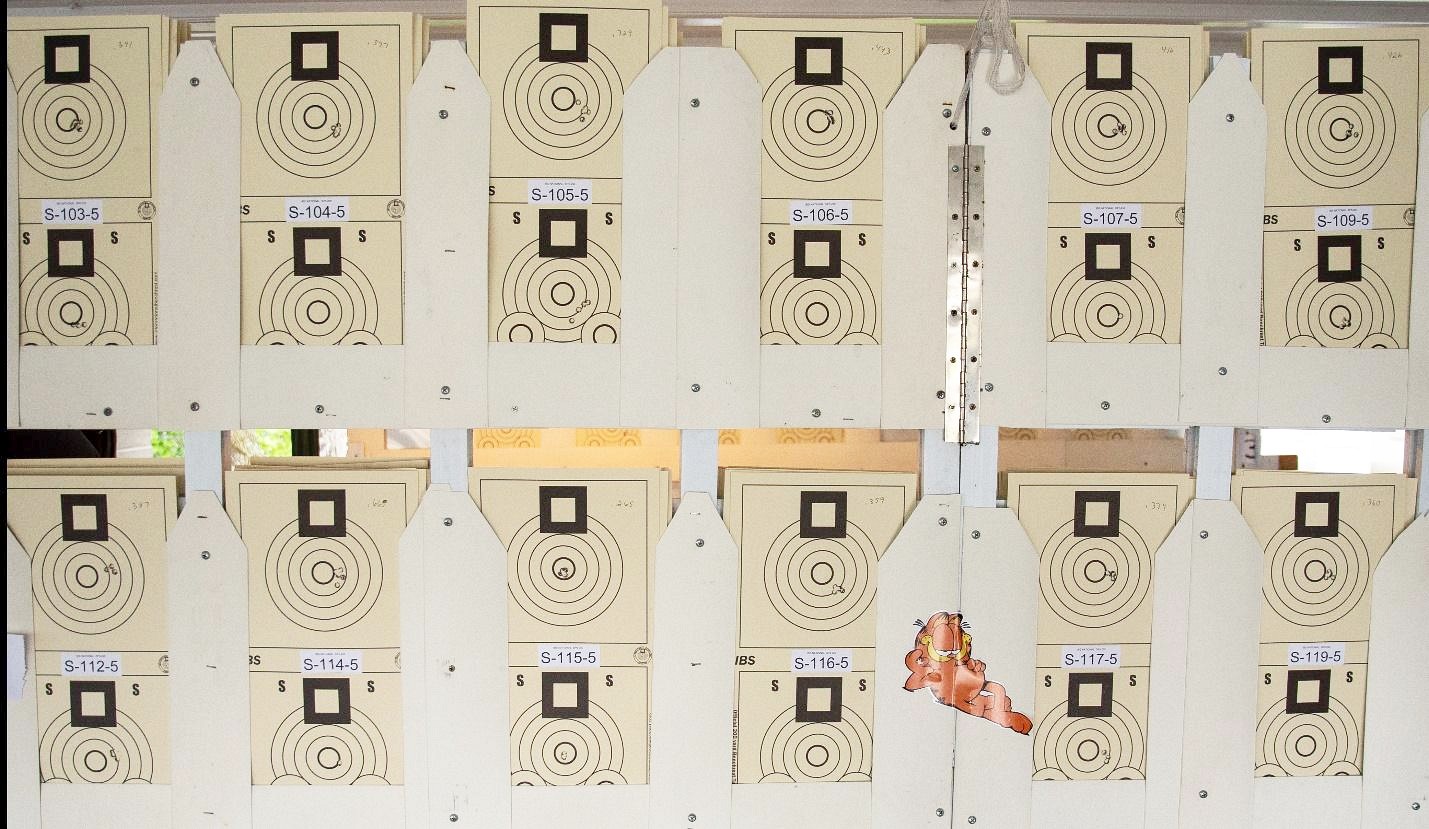
This photo shows 200-yard targets for one of the relays in the Sporter Class (10.5-lb riles, all 6 PPC). At the match, the scored, 5-shot targets are put up on a board, euphemistically called the “Wailing Wall”. These groups are revealing. Note that almost all the groups are located below and to the right of the moth ball (the 10 Ring in the center). The second set of target rings denoted by an “S” are for sighters, and are not scored.
Click photo to view large image
These targets were shot in a left to right drift (flags showing GREEN due to convention) drift. The targets show that most of the shooters sighted in during dead calm with point of impact at or below the 10 ring (mothball) for easier holding. So in a “green” condition the groups will move to the right of dead calm. These targets also demonstrate what modern benchrest bag guns can do at 200 yards! Some of those would be 100-yard ‘wallet groups’ for non-benchrest shooters. Remember these are 10.5-lb rifles, not heavy, “unlimited” rail guns. Mighty impressive precision.
IBS Shooter Profile — Bill Brawand
by Jeff Stover There are few “characters” left in the benchrest world, but Bill Brawand is one of them. He is still competing at age 84. He started in the game way back in 1973 and has been a stalwart on both the IBS and NBRSA circuits ever since.
He grew up on a dairy farm in north central PA near the town Wilcox. In the early days he earned $100 per week. That was not near enough to support a family and a competitive benchrest habit. That was one reason he got into bullet making. If he wanted to attend a match he had to do extra farm and dairy work to justify being gone for a weekend. Those chores were in addition to making bullets to both shoot and sell. He has worked hard his entire life and earned everything he has achieved.
Some time ago, oil and gas were discovered on the large Brawand farm. With production underway, many years ago the dairy was closed so Bill could focus on real estate and managing his wells. The oil/gas boom resulted in a dramatic change in his economic fortunes but Bill did not change at all. Before he finally got a small RV, he was known to sleep on a clubhouse couch.
Benchrest is now a family affair for Bill. One of Bill’s daughters, Sam, usually meets him at the shoots to assist him as needed. His knee problems keep him in a motorized scooter to get around the range. Sam memorialized Bill’s shooting accomplishments by sewing his many patches earned in shooting onto both a quilt and his shooting jacket (above). Check it out — that represents many decades of trigger pulling!
Report By Boyd Allen, IBS Vice President Huge credit to Ken Frehm for all of the photos and most of the information.
On July 14th and 15th, at the Camillus Sportsmen’s Club, Camillus, NY, thirty-two shooters vied to win the Two Gun (and Class titles) at the NY State IBS Championship & 19th Annual Pro-Am Group Shoot. The Pro-Am is a cash match. Twenty-five of thirty-two shooters participated in the cash option — five dollars per gun per day. They were the Professionals. The remaining seven were the Amateurs.
The weather was balmy and mild, the prize table and cash awards were generous, and the new range improvements were extensive, expensive, and well executed. Overall temperatures were seasonally moderate and the wind, while not difficult, was challenging enough that there were no Teen Aggregates shot in any class.
IBS Competitors Talk about their Sport
Definitely check out this video — it is excellent, and well worth your time. It shows the Camillus Club Range and features informative interviews with many shooters:
The Two-Gun Overall match winner was Bob Brushingham, with Don Francis in second place, and Bob White in third. Don, who finished with a .2600 Grand Agg, edged Bob (.2601) by a mere .0001! That’s close! (SEE Full Two-Gun Results).
Two Gun top finishers (L to R): Bob White (3rd), Bob Brushingham (1st), Don Francis (2nd)
Click image for large version.
Below are the LV and HV Class winners, Class Top Ten results, and respective equipment lists.
Light Varmint top finishers were (above, L to R): Bob Brushingham (2nd LV 100), Henry Miller (1st LV 200), Don Francis (1st LV 100, 3rd LV Grand), Leonard Burdick (2nd LV 200, 2nd LV Grand), Don Jeffers (3rd LV 100, 1st LV Grand).
Click image for large version.
Heavy Varmint top finishers were (above, L to R): Bruce Lachapelle (1st HV 100), Robert Blanchard (3rd HV 100), Bob Brushingham (2nd HV 200, 1st HV Grand), Don Francis (2nd HV 200), Ron Burdick (2nd HV 100, 3rd HV Grand), and Bob White ( 1st HV 100, 2nd HV Grand).
Click image for large version.
Here is the winning Pro-Am Team: Jennaro (Jerry) Corigliano (1st Amateur), Bruce Lachapello (1st Pro).
IBS 100/200-Yard Benchrest Competition
As with all Registered IBS 100/200-yard Group Matches, the N.Y. Championships at Camillus employed moving backers. This system ensures that a completed group includes the requisite five shots. With extremely small groups in the “ones” and “zeros” it may be impossible to distinguish five holes.
Although pre-loading is not uncommon, most 100/200-yard group shooters typically load at the match, often between relays. This enables them to tune their loads for the current conditions. Nearly all competitors in this short-range discipline shoot the 6mm PPC cartridge, or a PPC variant.
With group sizes so small, and group dimensions listed to the thousandth of an inch, precise measurement is an important part of the process.
The Camillus Sportsmen’s Club Range
This is not just a benchrest club, but a complete, multi-discipline shooting sports facility. To my California eyes, the Camillus range is a thing of beauty, with a vast expanse of well-trimmed grass between the firing line and the berms, and a substantial wooded hill beyond. The club has just completed a host of brand new improvements that required a significant investment and, I am sure, a lot of hard work. I believe that this was the first time that an event was held after they were finished. The improvements include a new shooting pavilion (firing line cover), with the latest safety features, new all masonry benches, new berms, new target boards, and may others that are too numerous to mention.
Backing up the range berm is a 120-foot high wooded hill. Behind the firing line, running northwest along the club’s western boundary, is the old, abandoned Erie Canal. The Club’s land is relatively flat, which has allowed it to be well-utilized for multiple shooting sports. See Google Map.
Parting Shot… I had to smile at this picture of the target crew. Evidently the club has excellent relations with the Syracuse Police Department.
Story based on report by Sam Hall
Look at that target by Mike Wilson. This is one of the most remarkable displays of accuracy (and precision) in the history of long range shooting. This past weekend, Mike (aka “GA. Dawg” in our Forum) drilled a truly spectacular 1.068-inch, 5-shot group at 1000 yards, all centered up in the X-Ring. Yes, you read that right, a group barely over an inch at 1000, shot in competition at an official IBS benchrest match on July 21, 2018.
How small is that in angular measurement? Well 1 MOA at 1000 yards is 10.47 inches, so Mike’s 50-5X masterpiece is 0.102 MOA! Yes that will be pending IBS group size (and score) World Records. This best-ever 1K group* was shot at an IBS registered 1000-yard match at Hawks Ridge Gun Club in North Carolina. Other records have been shot at Hawks Ridge in the past, but this is the most jaw-dropping.
Sam Hall, past IBS National Champion and IBS 600-Yard Shooter of the Year, was stunned by Wilson’s accomplishment: “This is a truely awesome marksmanship feat — one of the best in history. I think I would trade all 14 of my 600-yard records for that one!”. Mike’s amazing target will be submitted for approval as new Group Size and Score IBS World Records. Official approval is pretty much a certainty. The previous 5-shot, 1000-yard IBS record is 1.397″ (50 score) by Tom Sarver in 2007. (The NBRSA 1000-Yard 5-shot LG record is 1.473″ by Bill Schrader in 2002.)
Posting on our Shooters’ Forum, Mike wrote: “Thanks everyone for the kind words. As humbling as this game is, when it comes together makes it all worthwhile! A very special THANK YOU to my traveling buddy, my son, Blake, and my wife Debra for allowing me to enjoy this crazy game.” Mike also wanted to thank his smiths and component suppliers.
Mike Wilson IBS 1000-Yard Light Gun Specifications
Action: BAT ‘B’ 1.550 Melonited Action with Jewell Trigger
Barrel: Brux HV 28″ Finished Length, 1:8″ Twist Rate
Chambering: 6BRAW (6mmBR Ackley Improved Wilson), Chambered by Darrell Jones
Chamber Specs: 0.272″ No-turn Neck with 0.135″ Freebore
Stock: Shehane ST 1000 Fiberglass Stock (with stock work by Larry “Bullet” Archer)
Optics: Nightforce 12-42x56mm Benchrest NP-2 DD
Leonard Baity front rest with Protektor Bag. Italian Lenzi bag in rear.
World Record-Setting Cartridge and Load
Mike was shooting a 40-degree Improved version of the 6mmBR Norma cartridge. Long popular with Benchrest and 300M shooters, the 6mmBR was the original inspiration for this website. Yep, we started as www.6mmBR.com. The Improved version has extra capacity, allowing about 100 FPS more velocity when chambered with a long throat. For his record group, Mike shot Vapor Trail 103-grain bullets in Lapua brass. He loaded Hodgdon H4895 powder with CCI 450 (small rifle magnum) primers.
Praise from Fellow Competitors
Here are some reactions to Mike’s amazing group by our Forum members:
“Amazing target Mike Wilson! Your group might last forever as ‘the goal’ of 1000-yard Benchrest! Heck that’s a great target even at 600 yards.” — Mike J.
“Unbelievable!! Doing that under chosen prime conditions is an amazing feat but to do that in competition and to have everything to come together is just unbelievable. Amazing how far skill, precision, knowledge, and the products of this sport have come. Never thought we would see a group this small and well placed especially in the hills of North Carolina where the wind always blows. Congratulations. A true lifetime achievement.” — Yote Hunter
“I think that one will stand for a while. Hard work does pay off, but it don’t hurt to be one of the givers in the sport. Mike, you are ‘The Man’!” — Bill Shehane
“Awesome, awesome, awesome. Now the goal is to shoot UNDER an inch!” — Alex Wheeler
The 6mmBR Ackley Improved
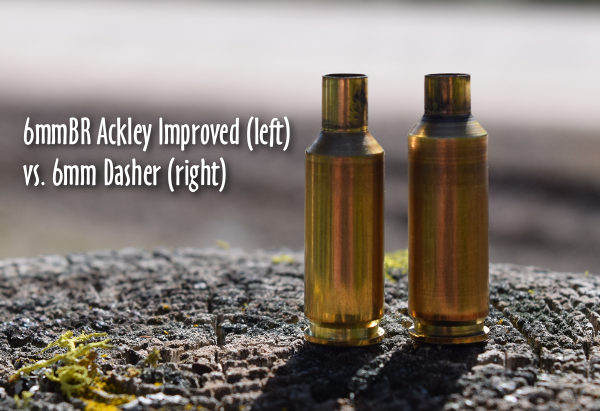
Mike Wilson shot his spectacular group with a 40° Improved version of the 6mmBR cartridge with less body taper than a standard 6BR — the design is 0.463 at the body/shoulder junction (vs. 0.460 for standard 6BR). Mike calls his version of the 6BR Ackley a 6BRAW (“W” for Wilson). Sam Hall explained: “The 6BRAW is pretty much the same as a 6BRA or 6BR-AI (Ackley Improved). I sold the reamer to Mike last year. This has a 0.272 ‘No-Turn’ chamber with a 0.135 Freebore”.
This photo shows a 40° 6mmBR Ackley Improved (6BRA), as used by Tom Mousel in Deep Creek, Montana. Mike Wilson’s 6BRAW may be very slightly different. For Mousel’s 6BRA with 28″ Krieger barrel, the accuracy node is about 2980-2990 fps, so this gives up only 30-50 fps compared to typical Dasher velocities. Mike Wilson’s load runs about 2980 fps also.
In the past couple of years, the 6BR Ackley-type cartridges have been hugely successful in 600-yard and 1000-yard Benchrest. Sam Hall notes: “This year the little 6BR-AI has shot the smallest groups ever fired in 600-yard and 1000-yard competition. Back in April 2018, Bart Sauter, using a 6BRA, shot a 0.282″ 5-Shot group at 600 yards.” Bart’s stunning 0.04 MOA group is a pending 600-yard IBS World Record. (Read Sauter Story). Now Mike Wilson has a pending 1000-yard World Record with his 6BRAW.
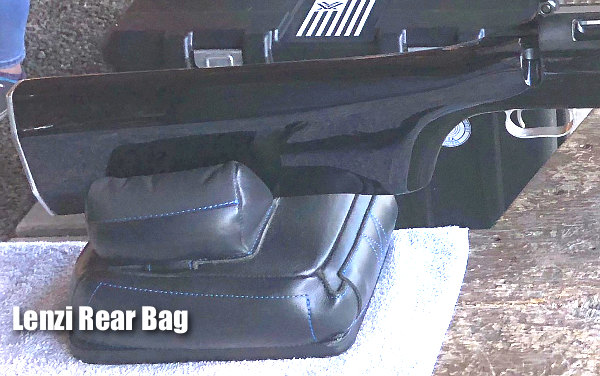
Mike used an Italian Lenzi rear bag. Mike says the super-slick nylon on the ears of this high quality rear bag make for better tracking. The ears provide support but don’t “grab” the stock, reports Mike.
* There are two North American sanctioning bodies for 1000-Yard Benchrest, the IBS and the NBRSA. The previous 5-shot, 1000-yard IBS record is 1.397″ (50 score) by Tom Sarver in 2007. The existing NBRSA 1000-Yard 5-shot Light Gun record is 1.473″, shot by Bill Schrader in 2002.
Do you enjoy working with computers? Have some experience designing and/or maintaining websites? Then here is an opportunity for you — the IBS needs a Webmaster. If you enjoy precision shooting, all the better. Through this part-time webmaster position, you’ll have a chance to work with one of the world’s top competitive shooting organizations, the International Benchrest Shooters (IBS).
The IBS organizes benchrest competition for short-range, mid-range, and long-range disciplines. Affialiated clubs are active through the nation. It’s an excellent organization, with a rich history, and a fine set of officers, lead by IBS President Jeff Stover.
IBS Webmaster Job Opening — Part-Time
The International Benchrest Shooters (IBS) is seeking a webmaster. This is a part-time position. Principal duties are to maintain the IBS website by posting submitted match reports, news items, match schedules, and other items. The IBS is launching a new site within 30 days built upon the PYRO CMS website management tool. The ideal candidate should have some experience maintaining websites. Knowledge of PYRO CMS or similar and html is a plus. Additionally, knowledge of IBS shooting disciplines is preferred. Salary is negotiable. Submit resumes to Jeff Stover, IBS President, at jstover33@comcast.net or call 570-660-6102.
World Record group shot by Bart Sauter in IBS 600-yard Match on April 21, 2018 in Memphis, TN.
0.282 inches, 0.04 MOA… at 600 Yards. Simply amazing…
What can we say… this 0.282″ 5-shot group 600 yards represents one of the most impressive feats of rifle accuracy in history. Shot in competition, this five-shot group at 600 yards easily fits inside a dime with plenty of room to spare!
Bullet-maker Bart Sauter recently shot this 0.282″ five-shot group at a 600-yard IBS match. Yep, you read that right — 0.282″ at 600. Most shooters would be happy with that group at 100 yards. At 200 it would be remarkable. But at 600 — it is truly amazing. Readers, 0.282″ at 600 works out to 0.04 Minutes of Angle (MOA). Not point four MOA, but point ZERO four MOA, and it was all in the TEN RING for a 50 score. Even measured outside edge to outside edge, that group is just 0.525″, so Bart’s group will easily fit inside a dime (0.705″ diameter).
Sauter’s amazing 0.282″ 50 group smashes the existing IBS Heavy Gun 600-yard record, a 0.404″ shot by John Lewis way back in 2008. It also happens to beat the existing IBS Light Gun group record — the stunning 0.336″ by Rodney Wagner in 2013. (A group many said could never be bettered). Bart’s group will be a new score record too — many 50s have been shot before, but the group size is the tie-breaker, and no one has ever shot smaller at 600 than Bart.
Sauter Smashes IBS World Records with Stunning 600-Yard Group
Report by Boyd Allen, IBS Vice President
On the 21st of April, at the beautiful Memphis Sport Shooting Assn. 600-yard benchrest range, bullet-maker Bart Sauter made history. About 11:00 O’clock with 12-15 MPH switchy winds, Bart Sauter waited for his chosen condition and then ran five shots into an incredible 0.282″ record-breaking group, with a score of 50. Shot in Heavy Gun Class (with his Light Gun), this combination of group and score bettered the previous HG group and score records with sufficient margins that their records in both categories are virtually guaranteed. The previous group record, a 0.404″, belonged to John Lewis and stood for ten years. The previous score record was 50/.513 (group size being the tie breaker) shot by B.J. Francis last year. Bart’s target was 50/.282.
To put it in perspective Bart’s record has the equivalent angular dispersion (MOA) of a .04″ group shot at 100 yards. (Bart’s exact MOA is 0.0448) But consider that crosswinds have roughly 36 times more effect at 600 yards than at 100 yards (by the “Rule of the Square”).
Record-Setting Cartridge and Load with Bart’s Own 105gr Bullets
Bart shot a 6mmBR Ackley Improved (6BRA) wildcat cartridge with an 0.272″ neck. This is basically the 6mmBR Norma with a 40° shoulder. The neck is long like the parent cartridge, not short like a 6mm Dasher. Bart was shooting his own 105 grain, 13 Ogive VLD bullets. He calls this new bullet design “The Hammer” (for good reason). Bart’s Hammer 105s were loaded in Lapua brass with Hodgdon H4895 powder and Wolf primers. Bullet tips were trimmed on a Giraud bullet point trimmer, but not pointed. Bart feels that there is too much potential for damaging bullets during pointing, so he does not point his match bullets. Bart had his LabRadar chrono on the bench during the match. Velocities were 2970-2975 fps with single-digit ES.
Record-Setting Rifle — IBS Light Gun Shot in Heavy Gun Class
Bart’s rifle features a melonited BAT B action, with a 26″, 1:8″-twist, HV contour James Lederer barrel, fitted with a Mike Ezell tuner. The Jewell trigger was set to 1.5 ounces. On top was a March 40X in BAT rings. The initial build was by Mike Moses, with chambering by Dean Stroud, and final (glue and screw) bedding by Billy Stevens. The handsome wood JB 1000 stock (3″-wide fore-end) boasts an aluminum keel added by Alex Wheeler after the initial build. Bart said that it only took him 15 minutes to adjust the keel so that the cross hairs did not wiggle on the target when the gun was pulled back a full 2 ½ inches. Bart is definitely a fan of the adjustable keel.
Bench Equipment and How Rifle Was Shot
Bart used a Farley Coaxial front rest with soft leather Edgewood front back sprinkled with baby powder. In the back was a Protektor Model DR rear bag with Cordura ears and no added lube (not needed with aluminum keel) borrowed from Mike Moses. Bart shot the rifle lightly pinned between his shoulder and the fore-end stop. Interestingly, Bart kept his Labradar chronograph on his bench throughout the day, and recorded velocities during the record group: 2970-2975 fps with single-digit ES.
Reloading Equipment and Methods
After firing, cases are annealed with a Benchsource flame annealer. The inside of the case-necks are brushed with a nylon brush (no lubricant is used). Cases are sized with a custom Whidden Full-length sizing die (with bushings), and a cut-down Wilson micrometer seater that was originally made for the Dasher.
Bullets are seated with a 21st Century Shooting Hydro Bullet Seater, used with the Wilson cut-down Wilson seating die. This state-of-the-art arbor press boasts a hydraulic seating pressure cylinder and gauge. During seating, the force gauge reads about 27.
The powder charge is first thrown from a manual measure and usually trickled onto an A&D 120 FXi magnetic force restoration scale using an Adams automatic trickler, but this time Bart had to settle for his old RCBS trickler because the drive band of the Adams auto-trickler wore out.
Brass Prep — The chamber is a 0.272″ no turn. Bart lightly skims the necks AFTER the first firing just enough to achieve batch to batch uniformity in neck thickness. He uses a .266 bushing which gives him .003 neck tension.
Pre-Loading vs. Loading at the Range
I asked Bart if he pre-loads, or loads at the range. Unexpectedly his answer was “Both…depending”. Bart will identify his “in tune” velocity at his home range and then pre-load that load before the match. However, Bart takes all of his reloading equipment to the match, and if the conditions are such that his pre-loaded ammunition does not give the velocity he wants (as revealed by the LabRadar), he will load at the match.
Another test that he feels is important is to be able to pass a bullet all the way through the neck of his fired cases. Bart thinks that even if the shank of a seated bullet does not directly contact a doughnut, that doughnut can have a negative effect on accuracy.
Bart has brought short range benchrest know-how to 600-yard competition. He uses a full set of short range flags, shown above. At last year’s Nationals, at the same Memphis range, Bart was one of the only shooters with a set of flags. Now other 600-yard competitors are following suit.
Final Throughts — The 6BR Ackley vs. 6mm Dasher
Given its prominence, it is inevitable that comparisons be made between the 6mmBR Ackley Improved and the Dasher. On this subject Bart told me that, based on his experience, he is a “Dasher basher”. He believes the Dasher can be finicky, and has a tendency to flip shots out of the group. For Bart, the 6BR Ackley has been a lot easier to work with and more predictable.
Below is a test target Bart shot at 100 yards. The load yielding the smallest 3-shot group, measuring 0.092″, was the load Bart took to the match. As you can see, the positions of the various load adjustments did not change on the targets. Bart said that that is the kind of positive compensation that he likes to see.
While Bart does most of load testing at short range, he can shoot out to 500 yards near his home. He says his record-setting gun has produced multiple 500-yard, 3-shot groups in the “three-quarter inch range” when testing in calm conditions. That’s 0.14 MOA for three shots. At 500…
Congratulations to Bart on His Great Shooting
Finally, I would like to add my congratulations to Bart Sauter for this spectacular group. I also want to thank Bart for generously taking the time to share the details of his load, reloading methods, and rifle components. Bart has shown that applying some short-range benchrest techniques to the mid-range game can produce remarkable results.


 Report by Boyd Allen, IBS Vice President






 The VFS Grand Aggregate Top Five were: Dewey Hancock (1st Place), John Bosley (2nd), Ronnie Milford (3rd), Brian Fitch (4th), and Jim Cline (5th). VFS winner Dewey Hancock shot a possible new 200/300 yard record with a 500-23X.




 There are few “characters” left in the benchrest world, but Bill Brawand is one of them. He is still competing at age 84. He started in the game way back in 1973 and has been a stalwart on both the IBS and NBRSA circuits ever since.


 This is not just a benchrest club, but a complete, multi-discipline shooting sports facility. To my California eyes, the Camillus range is a thing of beauty, with a vast expanse of well-trimmed grass between the firing line and the berms, and a substantial wooded hill beyond. The club has just completed a host of brand new improvements that required a significant investment and, I am sure, a lot of hard work. I believe that this was the first time that an event was held after they were finished. The improvements include a new shooting pavilion (firing line cover), with the latest safety features, new all masonry benches, new berms, new target boards, and may others that are too numerous to mention.




 Reloading Equipment and Methods


