|
|
August 31st, 2017

 The White Horse Center Range near Peeltree, West Virginia, will host the 2017 National IBS 1000-Yard Nationals from September 1-3, 2017. This will be a great match — over 100 shooters have signed up so far, including many of the nation’s top 1K benchrest aces. It’s not too late to sign up. You can register (on-site) up until 5:00 pm on Friday, September 1. The current match fee is $90.00 per gun class, or $175.00 for both classes (Light Gun and Heavy Gun). The White Horse 1000-yard range will be open on Friday for sight-in and practice. The White Horse Center Range near Peeltree, West Virginia, will host the 2017 National IBS 1000-Yard Nationals from September 1-3, 2017. This will be a great match — over 100 shooters have signed up so far, including many of the nation’s top 1K benchrest aces. It’s not too late to sign up. You can register (on-site) up until 5:00 pm on Friday, September 1. The current match fee is $90.00 per gun class, or $175.00 for both classes (Light Gun and Heavy Gun). The White Horse 1000-yard range will be open on Friday for sight-in and practice.
» CLICK HERE for IBS 2017 1000-Yard Nationals Registration Form
This record-setting offset (assymetical) Heavy Gun belongs to talented shooter Mike Gaizauskas.

2016 IBS 1000-Yard Overall (2-Gun) Champion Tom Mousel (below) will travel to West Virginia to defend his title this weekend at White Horse. Last year Tom posted a stunning 3.356″ Group Agg to win Light Gun Group as well. That’s a 1/3 MOA Agg at 1000 yards — truly remarkable precision.

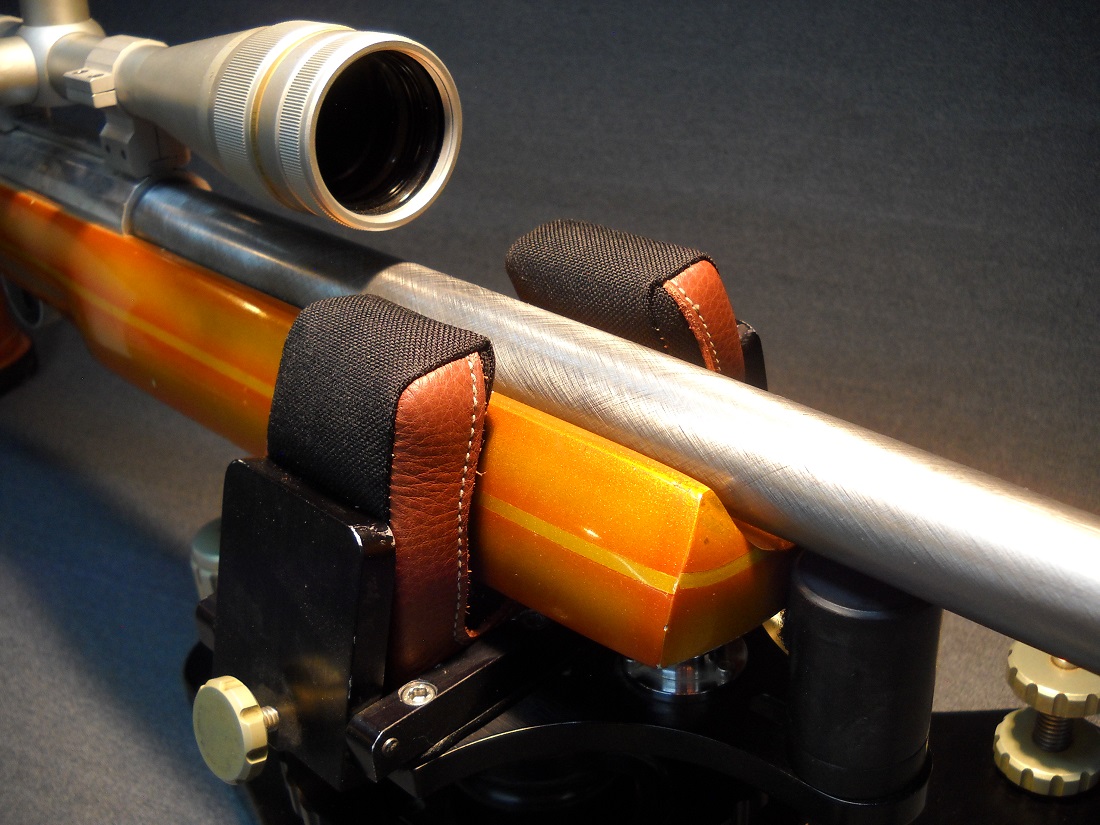
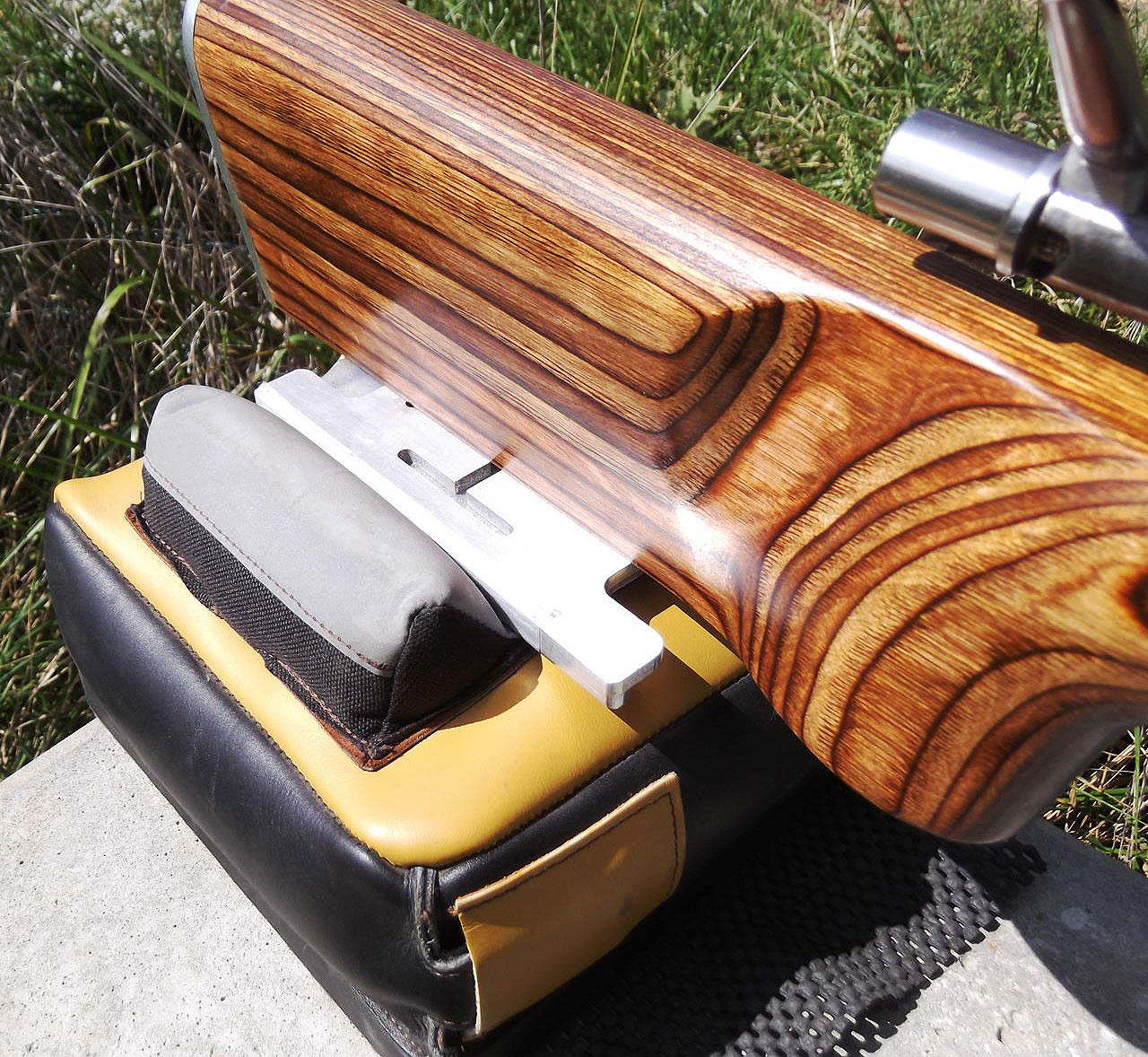
The Deep Creek Tracker stock, with adjustable “keel”, is the hot ticket now in the 17-lb Light Gun class.

Match Schedule and Fees
 The 1K Nationals will be a 3-target Aggregate match for both Light Gun (LG) and Heavy Gun (HG) with six (6) targets total. Practice and Sight-in will be available Friday (9/1/2017). NOTE: There will be a $10.00 per target fee during practice days. Match fees for the Nationals are now $90 per gun ($45 per gun for juniors). All registrations MUST be received by 5:00 pm Friday, September 1st. No walk-up registrations will be accepted on match days. The 1K Nationals will be a 3-target Aggregate match for both Light Gun (LG) and Heavy Gun (HG) with six (6) targets total. Practice and Sight-in will be available Friday (9/1/2017). NOTE: There will be a $10.00 per target fee during practice days. Match fees for the Nationals are now $90 per gun ($45 per gun for juniors). All registrations MUST be received by 5:00 pm Friday, September 1st. No walk-up registrations will be accepted on match days.
How to Get There
The Center is located 9.7 miles south on State Route 20 from I-79, exit 115 or 10.1 miles north of Route 20 from Buckhannon. Look for a brown and yellow Dept. of Natural Resources sign on Route 20. Take Crouse Road to the next sign, turn right at the sign, and proceed up the hill to the Center. Map coordinates are: 39°, 7′, 11″ North latitude; 80°, 13′, 4″ West longitude. The White Horse Center website has information on area hotels and campgrounds.

August 18th, 2017

 IBS Scoring Reticle Updated with Brighter Circles IBS Scoring Reticle Updated with Brighter Circles
In an ongoing effort to improve the two-piece IBS scoring reticle, a material change has been made to the plate showing bullet diameters. The new material displays white circles that are brighter than the previous version and does not require the circles to be colored.
The complete scoring reticle continues to have two components: 1) the Plate, and 2) the Domed Magnifier. The reverse laser-etched Plate displays 12 bullet diameters: .224, .243, .257, .264, .277, .284, .308, .323, .338, .358, .375 and .408. The etched circles are in direct contact with the target. The 4X domed magnifier provides a clear visual image that aids in accurate scoring.
New Laser-Etched Scoring Plate (12 Bullet Diameters):

| UPGRADE Your Scoring Reticle
Plate Only Upgrade for $15.00
The new “plate only” is available to customers who have purchased the complete reticle package in the past. This is an upgrade for past customers. The price for the “plate only” is $15.00 which includes shipping within the USA.
Complete Scoring Reticle for $40.00
The complete reticle package is being shipped with the improved plate. The price for the complete reticle package is $40 which includes shipping within the USA. |
If you have questions, contact Frank at: (603) 878-1474 or by e-mail at frank30br@comcast.net
Send your payment to:
Frank Danisienka
P.O. Box 97
New Ipswich, NH 03071
|
HOW to USE IBS SCORING RETICLE — INSTRUCTIONS
1. Depending on the condition of the hole, it may be necessary to turn the target onto its face and fold the torn pieces of the target back toward the center of the hole.
2. Lay the target face up and place the plate on the target centering the proper circle (bullet diameter) over the bullet hole.
3. At times the scribed hole will be larger than the bullet hole making the positioning of the scribed circle critical for accurate measurement.

4. Place the plate and magnifier on the target over the hole to be scored.
5. With the magnifier remaining on the plate and the scribed circle of the correct diameter PERFECTLY CENTERED over the bullet hole — score the target using the OUTSIDE EDGE of the scribed circle to determine the results.
Scoring Reticle Maintenance
When not in use, place the scoring plate on the magnifier carton to keep it clean and away from abrasive or dirty surfaces. Fine scratch remover, such as Novus #2, can be used with a paper towel to remove scratches.
June 30th, 2017

23rd Annual Bud Pryor Memorial Match, June 10-11, 2017
Match Report by Josh Shrum
For 23 years now, Benchrest Score shooters have flocked to the Thurmont Conservation & Sportsman’s Club outside of Frederick, Maryland for “The Bud”. This year, competitors from as far south as Georgia and as far north as Vermont came to try their hand against the always-challenging conditions of “The Bud”. Traditionally held in mid-June’s tricky conditions, the Bud Pryor Memorial is an event to challenge even the most skilled Benchrest competitor.

Day One started with the 100-Yard Aggregate, which pretty much set the tone for what was to come all weekend long. Of the 33 shooters competing in the Varmint For Score (VFS) class, thirteen shooters dropped at least one point at 100 yards. “The Bud” had begun.
100-Yard Winner Wayne France

By the end of the 100-Yard Agg, five competitors finished with top scores of 250-21X, with Wayne France taking the win under Creedmoor tie-breaker rules. Wayne would continue to shoot well for the entire weekend, finishing in the Top 10 at 200 and taking second (by Creedmoor) at 300, shooting his Lederer-barreled BAT in a Dixie stock. Wayne does his own gunsmithing, makes his own bullets, and shoots his own cartridge design. He is truly a “Do-It-Yourselfer”.
200-Yard winner Ronnie Milford checking conditions…

Ronnie Rocks at 200, with an Impressive X-Count
Georgia shooter Ronnie Milford won the 200-Yard Agg with an impressive 250-13X. Ronnie was one of only six shooters to finish “clean” at 200, as traditional Bud weather was punishing even the smallest errors in judgment by shooters. Built by gunsmith Doyle Anglin, Ronnie’s Lederer-barreled Panda beat the field at 200 yards by three Xs, a significant margin. The next three shooters (places 2-4 at 200 yards) all shot 250-10X. Interestingly, Ronnie was shooting Accurate LT-30 powder, not the more widely used Hodgdon H4198 or Vihtavuori N130.
Of special note, Mrs. Carol Grosbier came on Saturday to visit during the match. Nearly every single shooter there stopped by to visit and offer their condolences on the passing of her husband Dick Grosbier, former IBS Vice President and Webmaster. It was great to see Carol and everyone’s actions showed just how great of a community of shooters the sport of Benchrest has.
The longest challenge, the 300-Yard Agg, was shot on Day Two. While conditions were not quite as “tough” as the previous day, they were anything but forgiving. High heat and gusting winds kept shooters on their toes as they strove for victory at 300 yards. A mere seven shooters would manage to stay clean through the first match, and only Maryland shooter Dewey Hancock managed to stay clean through Match Two. Dewey would go on to win the 300-Yard Agg shooting a 248-3X, beating 100-Yard winner Wayne France by Creedmoor and edging out Joey Whittington’s score of 248-2X. Dewey’s Goodling-built rifle uses a BAT action, Krieger barrel, and sits in a beautiful Roy Hunter stock.

Dewey Hancock Wins with Strong Performances at 100, 200, and 300
Dewey Hancock’s excellent performance at 300, coupled with his second-place finish at 200 and his Top Ten finish at 100 put him on the throne. Hancock won the Grand Aggregate for the 23rd Annual Bud Pryor with a score of 748-31X. Just one point behind, Wayne France took second with a score of 747-31X. Joey Whittington took third with 746-35X.
Hunter Class was contested by both K.L Miller and Brian Fitch (Brian competed in both VFS and Hunter) with K.L Miller taking the Grand Aggregate in Hunter with a 723-11X while Brian posted a 717-11X. Mark Ukishima shot the events only Factory Class gun. It was great to have so many different classes contested at this year’s Bud Pryor.

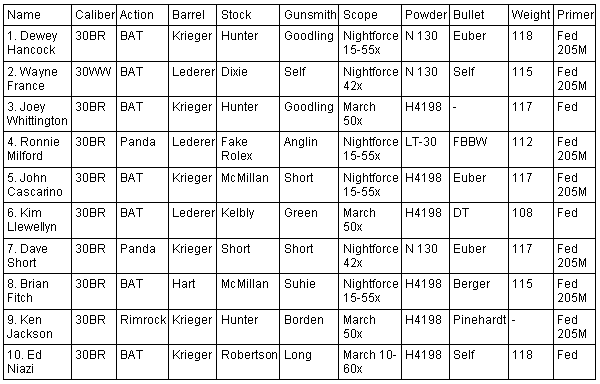
TOP 10 EQUIPMENT LIST:


About the Bud Pryor Memorial Match
 Bud Pryor was a fine gentleman who started shooting IBS matches in 1983. He was a machinest turned gunsmith who made friends and got many people started in shooting IBS registered matches over the next few years. Bud and Dick Grosbier ran the first IBS match at the Thurmont range in April 1983. CLICK HERE to see vintage photos of the 1983 match. Bud Pryor was a fine gentleman who started shooting IBS matches in 1983. He was a machinest turned gunsmith who made friends and got many people started in shooting IBS registered matches over the next few years. Bud and Dick Grosbier ran the first IBS match at the Thurmont range in April 1983. CLICK HERE to see vintage photos of the 1983 match.
After Bud’s untimely passing a few years later, the club decided to put on a big match and dedicate it to him. As Thurmont is one of the few ranges around with 100/200/300 yard capabilities, we decided to put on a 3-yardage Grand Aggregate match. This was not as simple as it seems, since the three-yardage 100/200/300 was not an IBS-recognized Aggregate. After an agenda item was approved at an IBS winter meeting, 100/200/300 records were set at Thurmont. Over the years, most records have stayed at this scenic range. There are a total of four IBS ranges now holding 100/200/300 yard matches.
June 23rd, 2017

Al Auman, 2-Gun Second Place finisher, takes aim…
IBS 31st Annual Memorial Match at Union County Sportsmen’s Club, Weikert, PA
Reported by Jeff Stover, IBS President
The “Boop Shoot” is traditionally held on Mother’s Day in May, but this year it was moved to June due to a club conflict. No matter, as 63 shooters showed up on June 10th and 11th, 2017 to compete at one of the best benchrest ranges in the country. “Weikert” is nestled in a narrow valley in pastoral central Pennsylvania and has a wide following since the IBS Nationals have been held there a number of times.

The 2-Gun Aggregate represents “all the marbles” — the overall win for a weekend of Short Range Group shooting. Accuracy gunsmith Dave Bruno won the 2-Gun with a .2606 Agg shooting his 6PPC built on a Borden action in a Roy Hunter stock. On Dave’s heels was Al Auman, shooting a Goodling-built 6PPC BAT. In third place was Paul Mitchell with his BAT 3-Lug in a Scarborough stock built by Dwight Scott. The 2-Gun Aggregate is the combined average group size for 20 targets total, 10 each for both the Light Varmint (10.5-lb) and Heavy Varmint (13.5-lb) classes, with shooting at both 100 and 200 yards. Despite the class distinctions based solely on rifle weight, a vast majority of shooters opt for a 10.5-lb rifle for the entire course of fire. You get a lot of shooting at an IBS Registered Group match.

Two-Gun Overall Winner Dave Bruno (center) flanked by second place Al Auman (right) and third place Paul Mitchell (left).
The Tailwind from Hell
The real story of this match was the shooting conditions. For the entire weekend, there was a tail wind. When the wind blows hard, a pure tailwind is favored by many veteran shooters as velocity changes are less apparent on the target compared to a pure crosswind where pickups and letups can be mapped on the record target of a less-than-observant trigger puller. At this match, it was a tailwind from hell. The over-the-shoulder wind veered from red (right to left) to green (left to right) as quickly as it took you to read this sentence. The point of impact in the extremes could cause groups of 1.5 inches at 200 yards. It was one of those shoots where posting a .824” 200-yard group could move you up in the standings. Normally shooting an “eight” would assure a “bottom of the pile” finish.
Sunday morning saw that nefarious tailwind doing its dirty work once again, but it was not quite as bad as the afternoon would turn out to be. The tailwind’s impact, however, could be seen in the fact that the Heavy Varmint 200-yard winner was upstate NY shooter, Jim Miller with a .2817 (200-yard Aggregates are recorded in MOA, so Jim’s average group at 200 yards was .563”). He was the only competitor in the “twos”. Bob White shot well but his .3012 was not enough.
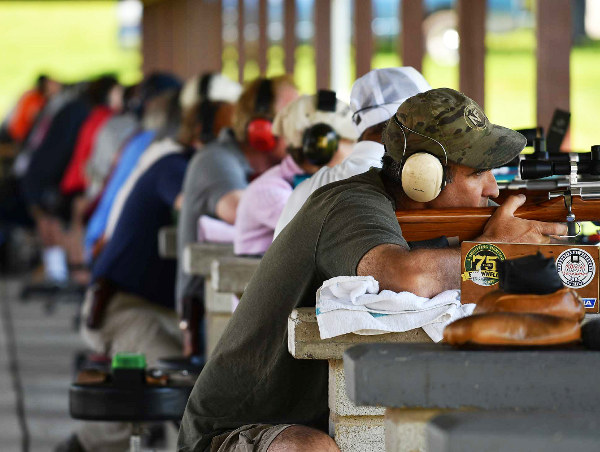
Scott Miller ready to pull the trigger on the firing line…
Dave Bruno Dominates Light Varmint 200
Light Varmint 200 was shot after lunch on Sunday. The winds had picked up while the shooters were enjoying burgers and hot dogs from the range house. This last Aggregate was the climax of the entire weekend. Two-gun winner Dave Bruno set the stage for his overall win by shooting as if he were from another planet. He was on fire with a .2388 Aggregate. Next was Bob Brushingham with a .3024. That is a difference of .0636” in average group size, or about 1/16th of an inch. A sixteenth is not much in most things, but in short range benchrest it is a chasm that Evel Knievel would not dare to test. Most Aggregates in benchrest are won and lost by a few thousands, or even ten-thousands of an inch. Dave blew out the field with his singular performance. When asked what condition he shot, Dave said “the tailwind” — go figure.
Yes, 100-yard was also contested. Back in the day, a “Teen Agg” (an aggregate of targets under .200”) was usually shot in perfect, or mild, readable conditions. The level of shooting in recent years, however, has seen Teen Aggs shot in tough conditions. The aforementioned tailwind prevailed on Saturday too, but was just a bit less nasty.
Loading at the range remains important in the Benchrest for Group discipline. In a Special Report below, IBS President Jeff Stover explains how loading methods (and hardware) have evolved over the years.


Pat Hurley checking his aim (notice bolt is out).
|
Two Gun Overall
1. Dave Bruno: .2604
2. Al Auman: .2727
3. Paul Mitchell: .2776
4. Bob Brushingham: .2851
5. Kent Harshman: .2969 |
Heavy Varmint Grand
1. Jim Miller: .2582
2. Bob White: .2622
3. Allen Arnette: .2706 |
Light Varmint Grand
1. Dave Bruno: .2375
2. Al Auman: .2717
3. Paul Mitchell: .2770 |
Light Varmint 100 was won by veteran Howie Levy (he started shooting in 1968!) with a .1794. He was not alone below .2, as Dale Boop was close at .1848. He was shooting Norma 201 to boot. This powder was the ticket to small 6PPC groups in the 1980s, but has been little seen for many years.
More Teen Aggs were shot in the Heavy Varmint relays. Benchrest Hall of Fame shooter Allen Arnette recorded a tiny .1686. On the podium with Allen were Howie Levy with a .1808 and Willie Bauer who shot a .1980.
Light Varmint Trophy Winners (L to R): Hensley, Boop, Auman, Brushingham, Francis, and Bruno.


Memorial Shoot Is a Family Affair
The 2017 Annual Boop Memorial Shoot ran like clockwork, as usual, and once again the success of this annual shoot can be attributed to the Trutt and Boop families. Mark Trutt serves as range officer extraordinaire. Dale Boop is match director while his mother, Linda, handles the administrative and scoring chores. Target crew honcho Steve Dodge, once again, ensured a rapid and accurate changing of the target.
NOTE: It has yet to be determined whether 2018 Memorial Match will be on Mother’s Day or in June.
Loading at the Range — Then and Now

In benchrest shooting for group, loading at the range has been de rigueur for decades. In the Score discipline, preloading is usually the custom. The main reason is that, in Score competition, only one Aggregate (warm-up match and five record targets) per day is usually shot. That would be less than 50 shots, assuming a few sighter shots. Also, the 30BR, the dominant Score cartridge, is amenable to pre-loading.
By contrast, the Group discipline includes 21 targets (two warm-ups and twenty record targets) over a weekend, usually shot with 6PPC-chambered rifles. Many times, the 6PPC shooters may tweak their loads through the day given changing atmospheric conditions or simply trying to find the correct tune to “dot up”. This term, “Dot up”, means the shots are essentially going through the same hole, or closely so.

Loading at the range was a bit different when benchrest competition was in its infancy. The 1951 book, Modern Accuracy by Bob Wallack, is the best of the early benchrest books. Copies can be found, from time to time, on eBay or Alibris. It is a fascinating survey of benchrest as it existed more than six decades ago. There’s even coverage of a controversial target that was argued over at the time. In it, there is a photo of Wallack using the rear bumper of a car at the bench to clamp his reloading tools. Things have come a long way compared to the range loading set-ups of modern shooters. Here you can see Bob Wallack way back in 1950:

Modern loading bench set-ups shown in this Boop Memorial Match Report belong to top shooters Howie Levy, Bob Hamister, and Kent Harshman.

May 13th, 2017

Report by Kristina Holden
Even with a bit of snow left on the ground, some great long range shooting took place up in Montana recently. March 25th, 2017 was opening day for the first 1000-yard IBS match of the year at Montana’s Deep Creek Shooting Range, just outside of Missoula, Montana. With temperatures during both matches at a consistent low to mid 40s and winds blowing at a slight 2-4 mph from the south, the weekend was sure to produce some excellent results.
Framed by forested hills, the Deep Creek Range is a beautiful place to shoot.

CLICK HERE for Deep Creek IBS Match Results | CLICK HERE for LG and HG Equipment List
Jeff Read takes aim…

Fifteen (15) shooters braved the cool Montana spring weather for what would turn out to be a very competitive match. On Saturday, both Richard Schatz and David Torgerson made the first Light Gun (LG) shoot-off, posting two-inch groups, with Richard taking the win (check out his targets above). David and Richard made it into the Heavy Gun (HG) shoot-off as well, this time with David taking the win. Leo Anderson took the LG score crown with a 47, while Shawn Williams took the HG title with a perfect 100.
Here Scott Stanko sets up his Light Gun. Scott won Sunday’s LG shoot-off.

Sunday’s conditions were even better and the shooters took advantage of them. Once again, some truly excellent groups were shot by Tom Mousel and Scott Stanko, both making the LG shoot-off with 2 inch groups. Scott, shown above, prevailed in the shoot-off. Richard Schatz, once again, made his way into the shoot-offs and took the HG win from Tom Mousel with a 4.889″. Jeff Reed took the HG score win over Leo Anderson with a 96. In the LG Score shoot-off, Jim Williams nailed a real stunner of a group, taking the Score win with a 2.018” – 49. Check out the group below. That sure would have helped his Aggs if it happened in the relay!
Jim Williams with his 2.018″- 49 group. That works out to 0.19 MOA — amazing accuracy at 1000 yards.

New Cartridge Debuts — the 6mmBR Ackley Improved (6mm BRA)
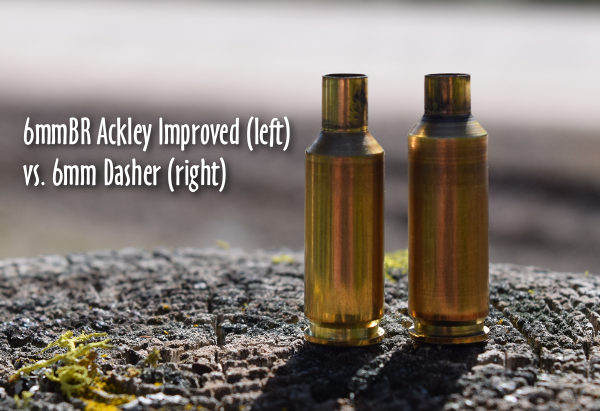
The 2017 season has brought some new gear/cartridge developments and many shooters were able to put them to good use in the first match of the year at Deep Creek. Leo Anderson and Tom Mousel were both shooting the new 6mm BRA (6mmBR AI), a 6mmBR Norma with a reduced body taper and a 40 degree (40°) shoulder. Fire-forming is as simple as turning the necks and shooting, as the factory 6mmBR case will headspace in the AI chamber. Sizing with a 6mm Dasher die with .080″ turned off the bottom is the ticket. Tom Mousel, reigning IBS 1K Champ, “believes this case to have a little wider tune window and far less throat wear”. That means this case might be easier on barrels. For Tom’s 6mm BRA with 28” Krieger barrel, the accuracy node is about 2980-2990 fps, so this gives up only 30-50 fps compared to typical Dasher velocities. Both of Tom’s HG groups held in the 3s for vertical, proving the 6mmBR Ackley’s accuracy potential.
Vapor Trail Bullets and Deep Creek Tracker Stock
Tom Jacobs at Vapor Trail Bullets has been working with a new die for his excellent 6mm 103gr Vapor Trail bullet. Four of the weekend’s competitors were shooting bullets off the new Vapor Trail die. The new die seems to be producing a bullet every bit as good as the old die, maybe even better. Several groups in the 2s (two inch) were shot this weekend. As well as Richard Shatz’s impressive 3.671″ 10-shot group in Heavy Gun (see top of this article).
Finally, the new Deep Creek Tracker 4″-wide stock is becoming a favored option, with half of the competitors at the match shooting these stocks from Wheeler Accuracy. That extra inch in the stock’s fore-end seems to be provide more stability and less rocking on the front rest when opening and closing the bolt. Also, the adjustable tracking rudder makes for perfectly parallel tracking surfaces, an absolute “must have”.
The weekend ended with the sun finally breaking through the clouds. Competitors enjoyed some great grilled Polish dogs with all the fixings prepared by Mark and Angie Candau; who also shot in the match. There were plenty of smiling shooters with awards/prizes for their efforts. It was a great opening match of the season!
Here are the Top Guns at the match: Dave Torgeson, Jim Williams, Jeff Read, Shawn Williams, Richard Schatz, Leo Anderson, Lonnie Anderson, and Tom Mousel.

Deep Creek is one of America’s best 1000-yard shooting centers — many records have been set here.


April 13th, 2017

This story involves a match held last fall, but we know many of our readers compete in the Mid-Range (600-Yard) Benchrest discipline and follow developments in this sport. Accordingly we’re offering this report on the 2016 IBS Nationals held at the Big Piney Sportsman’s Club in Houston, Missouri.
The 600-Yard Nationals at Big Piney last September was a great event that drew 82 shooters from 14 different states. Competitors traveled from as far away as Florida, Idaho, and North Dakota to compete in the 2016 600-Yard International Benchrest Shooters National Championship. The weather was great and so was the food. A good time was had by all, and shooters praised the facility and the efficient way the match was run. The IBS offers a big “thank you” to everyone involved in running this excellent match. Their hard work and dedication deserves recognition.
On the forearm of this Heavy Gun was painted: “Give Me Liberty or Give Me Death”

Two Gun Group Results | Heavy Gun Group Results | Light Gun Group Results
Here are the Class Winners at the 2016 IBS 600-yard Nationals in Missouri

The opening morning for Light Gun class proved to be challenging, as the start time was pushed back one hour due to the fog settling in the firing line. By the second half of the eight targets to be shot, shooters began to settle in and take control of the conditions. The Missouri shooters stayed on top with Ben Peters winning light gun score with a 385. Jason Walker took the group win with a 2.008” through 8 targets. With Tom Jacobs, Darrel Dacus, Jim Bauer, and Carrol Lance rounding out the top 5 in Light Gun overall it was going to be a hard fight to the finish.
Click Image to View Larger Equipment List

Look at the Caliber Column — Every Top 10 shooter in Light Gun Class shot either a 6mm BR Norma or a 6mm Dasher, an “Improved” version of the 6mm BR. In Heavy Gun it was 9 of 10 (with one unidentified 6.5mm). Hard to beat the 6mm BR and the Dasher for pure accuracy at 600 yards.
This competitor shot the match with a Labradar chronograph on his bench.

On Sunday the Heavy Gun class started right on time with the clouds keeping Saturday’s fog in check. Relay 3 started the day off strong, putting it on top shelf for everyone to follow. The conditions seemed to stay pretty steady and helped create opportunities for competitors to shoot some amazing groups. Tom Jacobs came through with a 1.685 Heavy Gun group Aggregate. Rookie shooters Jim Kowske and TJ Stroop put on great Heavy Gun performances. Jim was second in Heavy gun group with 1.996” and TJ shot his way to second in score with a 384. Jason Walker hung on winning Heavy Gun score with a 389. This set up Jason as the Heavy Gun overall winner.
The Big Piney Range is a pretty facility surrounded by trees.

Jason dominated the weekend landing himself a 2-Gun Overall Championship. The top Rookie honors went to T.J. Stroop. Sally Bauer won the Overall top female. Rory Jacobs was able to seal the top Junior spot. The Big Piney crew would like to thank everyone for being great friends and great competitors! We could not have done it without everyone!
The match organizers provided tasty BBQ banquets for hungry shooters.

Here competitors relax between relays at the Big Piney facility.

April 4th, 2017

 We know that many of our readers have never seen a “Hammerhead” benchrest stock before. This is a design with an extra wide section in the very front, tapering to a narrow width starting about 6″ back. When paired with a super-wide front sandbag, the hammerhead design provides added stability — just like having a wider track on a racing car. Some folks think mid-range and long-range benchrest stocks can only be 3″ wide. Not so — IBS and NBRSA rules now allow much wider fore-ends. While F-Class Open rules limit fore-end width to 3″ max, there is not such restriction on IBS or NBRSA Light Guns or Heavy Guns for 600- and 1000-yard competition. Here’s a 5″-wide Hammerhead design from Precision Rifle & Tool (PR&T). We know that many of our readers have never seen a “Hammerhead” benchrest stock before. This is a design with an extra wide section in the very front, tapering to a narrow width starting about 6″ back. When paired with a super-wide front sandbag, the hammerhead design provides added stability — just like having a wider track on a racing car. Some folks think mid-range and long-range benchrest stocks can only be 3″ wide. Not so — IBS and NBRSA rules now allow much wider fore-ends. While F-Class Open rules limit fore-end width to 3″ max, there is not such restriction on IBS or NBRSA Light Guns or Heavy Guns for 600- and 1000-yard competition. Here’s a 5″-wide Hammerhead design from Precision Rifle & Tool (PR&T).
Ray Bowman of PR&T sent us some photos of another hammerhead benchrest rig. Ray reports: “Here’s another benchrest rifle that Precision Rifle & Tool crafted. The customer shot this rifle at the 2014 IBS 1000-yard Nationals in West Virginia.” This IBS Light Gun sports PR&T’s “Low Boy Hammer Head” stock in red/black laminate. Other components are a 6mm BRUX 30″, 1:8″-twist barrel, Borden BR Action, and a PR&T 20 MOA scope rail.


March 2nd, 2017


The NBRSA has liberalized its rules regarding front sandbags. Until this year, NBRSA rules required that benchrest competitors be able to lift their rifle fore-ends freely from the front bag. Accordingly, front bags could not “capture” the forearm or hold the gun down (i.e. keep it from rising). In order to meet this requirement, “legal” bags had straight sides that didn’t stand too far up.
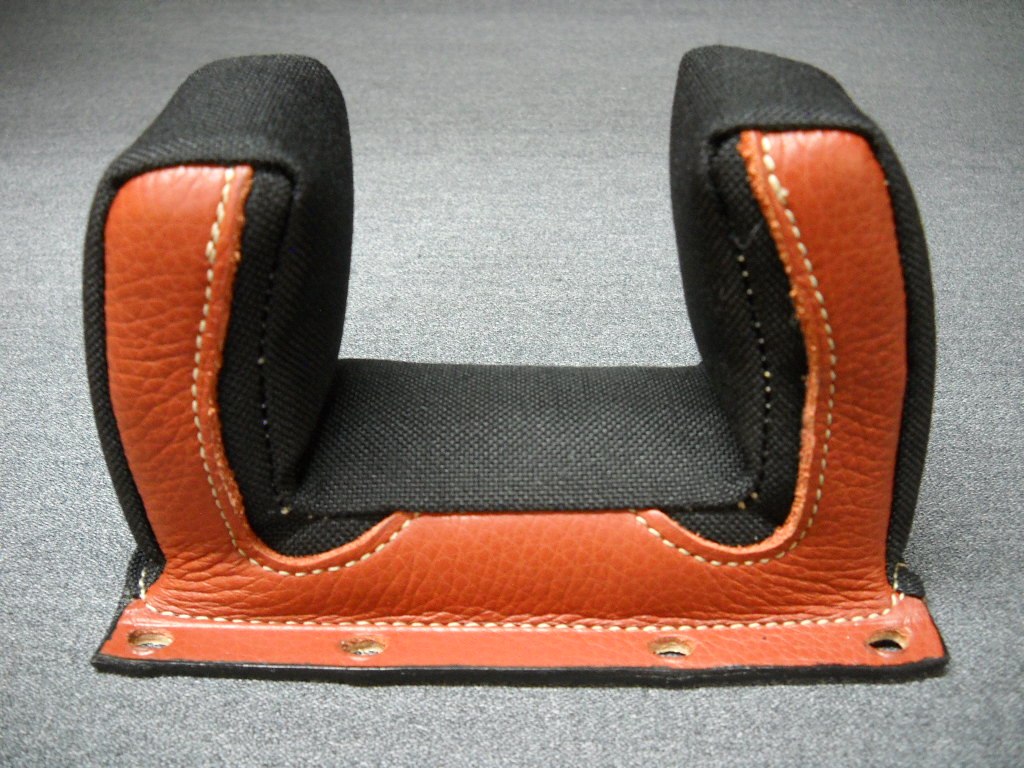
Now the NBRSA rules have changed. You no longer have to be able to lift the gun up freely from the bag without interference. It’s now permissible to have a bag that offers some up/down retention. Check out this new bag from Edgewood Shooting Bags. Call “The EDGE”, it offers taller side sections that can hold the fore-arm in place and counter torque.

Edgewood’s designers state: “There are a couple of [NBRSA] rule changes for 2017. The change we found most intriguing was that the requirement of being able to lift your fore end freely from the front rest has been removed. So, we came up with a new design with super tall ears which will allow the innovators to push the envelope. Let’s see what you can do with these…”
We expect this new type of front bag will help stabilize short-range benchrest rifles, particularly in the 10.5-lb Sporter and Light Varmint classes. But we expect the biggest gains will be had with the big-caliber rifles used in Mid-Range and Long Range benchrest competition. In the 1000-yard game, heavy-recoiling 7mm and .30 caliber cartridges are popular with many shooters. These big guns generate considerable torque despite their ample weight. We predict these “super-sized” front bags will reduce both hop and rolling motion (torque) in the big guns.
We also expect that some varmint hunters will experiment with high-sided front bags that wrap around the fore-end. Such front bags may prove a real boon for guns with narrower, sporter-style fore-ends. And it would be interesting to see if this kind of tall-sided bag design will be incorporated into portable sandbags for the PRS game. We shall see…
Rule Change and Product Tip from EdLongrange. Product Tip from Boyd Allen. We welcome reader submissions.
February 25th, 2017

We’ve been giving a lot of coverage to tactical rigs and gas guns lately, so we though it was time to showcase a purebred, state-of-the-art 1000-Yard Benchrest rig. This article features the impressive .284 Shehane Light Gun used by Henry Pasquet to capture the 2013 IBS 1000-yard Nationals.
With a 5″-wide “hammerhead” front and a special 3″-wide bag-rider plate in the rear, this 17-lb rig is ultra-stable in the bags, and tracks like a dream. In this story, Henry explains his set-up plus his processes for loading super-accurate ammo. Every long-range shooter can benefit from some of tips revealed here. And F-Class guys — if you’re shooting a .284 Win-based case in F-Open you should definitely read Henry’s precision reloading advice.
EDITOR: Guys, there is a ton of solid gold information in this article — take your time and read it carefully.
 Yes old dogs can learn new tricks. Just five years ago Forum member Henry Pasquet (aka “HenryP”) got started in 1000-yard benchrest shooting. He was 66 at the time. Henry worked hard, learned fast, and pursued accuracy with a vengence. That all paid off when Henry won the 2013 IBS 1000-yard Nationals this summer, finishing as the Two-Gun Overall National Champion. Henry was kind enough to talk about his rifle, his reloading methods, and his strategy for success. In fact, Henry was eager to share “everything he knows, so that other guys can fast-track their learning process”. Henry told us: “I want to share every lesson I’ve learned, so that other guys can improve their game and enjoy the sport more.” Henry also wants to encourage other senior shooters: “If you pay attention to details (when reloading), and get a good rifle with a good barrel, age is not a handicap. With a good set-up, older guys can compete with anyone out there. This is one sport where you can be a champion in later life.” Yes old dogs can learn new tricks. Just five years ago Forum member Henry Pasquet (aka “HenryP”) got started in 1000-yard benchrest shooting. He was 66 at the time. Henry worked hard, learned fast, and pursued accuracy with a vengence. That all paid off when Henry won the 2013 IBS 1000-yard Nationals this summer, finishing as the Two-Gun Overall National Champion. Henry was kind enough to talk about his rifle, his reloading methods, and his strategy for success. In fact, Henry was eager to share “everything he knows, so that other guys can fast-track their learning process”. Henry told us: “I want to share every lesson I’ve learned, so that other guys can improve their game and enjoy the sport more.” Henry also wants to encourage other senior shooters: “If you pay attention to details (when reloading), and get a good rifle with a good barrel, age is not a handicap. With a good set-up, older guys can compete with anyone out there. This is one sport where you can be a champion in later life.”
Click on Rifle Photos to View Full-screen Versions

Q&A with Henry Pasquet, IBS 1000-Yard National Champion
Q: First, do you have any advice for older shooters getting started in their golden years?
Henry: You’re never too old. In this sport, you can excel even in your 60s, 70s and beyond. At this stage in life, we now have the time and money to get good equipment and rifles. Plus, our years of work experience help us to think, analyze, and thereby make progress. In this game, we older guys can definitely compete on a par with younger shooters.
HARDWARE
Q: Tell us about your Nationals-winning rifle and bench gear. Is there anything unique about your hardware that gave you an edge?
Henry: At the Nationals, I used my 17-lb Light Gun for both Light and Heavy Class. This rifle has a 1.55″, round BAT LP/RE action, fitted with a Bartlein barrel chambered for the .284 Shehane (an improved version of the .284 Winchester). The barrel was near-new; this was the first time I had used it this year. A great barrel and great batch of Berger 180gr VLDs all made a difference. Jay Cutright chambers my barrels. Jay’s metal-work is so precise that I can screw any barrel he’s chambered to any BAT action I own. The laminated stock was modified by Tommy Shurley from a standard 3″-wide fore-end to a 5″-wide True-Trac with an adjustable 3″-wide rear plate. It’s not pretty but it tracks like a Heavy Gun stock. Tommy made my other stocks as well.

 On top is a Nightforce 12-42x52mm Benchrest scope with CH-3 reticle. I used a Fulghum (Randolph Machine) front rest with an Edgewood bag made with the low-friction 3M material. In the rear I use a special-order Protekor rear “Doctor” bag with ears spaced 3 inches apart. The rear bag also has the new 3M material on contact surfaces (photo at right). On top is a Nightforce 12-42x52mm Benchrest scope with CH-3 reticle. I used a Fulghum (Randolph Machine) front rest with an Edgewood bag made with the low-friction 3M material. In the rear I use a special-order Protekor rear “Doctor” bag with ears spaced 3 inches apart. The rear bag also has the new 3M material on contact surfaces (photo at right).
Q: During the Nationals, at the last minute you switched guns. Why did you go from a 6mm Dasher to a 7mm Shehane?
Henry: I had planned to use my Light and Heavy Dashers, but after placing the Dasher on the ready line, decided to switch to the .284 Shehane. It was still early in the morning and I felt that the heavier bullets would be easier to see against the berm. The Dasher had actually been giving tighter groups under perfect conditions, but seeing the impact is important.
Q: Tell us about the combined tuner/muzzle brake on some of your barrels. How does this improve rifle performance and how do you set the “tune”? Do you tune the barrel to the load?
Henry: I use a tuner or tuner/brake on every barrel. I started with Time Precision tuners. Art Cocchia advised getting a load with a good known accuracy node with minimum extreme spread, which controls vertical. Do not go for the hottest loads, which just reduces brass life. Then use the tuner and tune the barrel to the load. The .284 Light Gun needed a muzzle brake and tuner. I had a local gunsmith cut a thread on the muzzle brake for a tuner I got from Sid Goodling. (Eric Bostrom developed an almost identical unit at the same time. I use Eric’s tuner/brakes on all my new barrels.) Just before Nationals, I tried going up and down one marker. Down one mark cut the group in half! Think how much range time (and barrel life) that saved me. Using a tuner is easier than messing around changing loads and tweaking seating depths. Tuners definitely can work. Last year I shot a 3.348″ 10-shot group at 1000 with my .284 Win Heavy Gun fitted with a Time Precision Tuner.

Q: What are the advantages of your stock’s 5″-wide fore-end and 3″-wide rear plate? Is there a big difference in tracking and/or stability? Does the extra width make the rifle easier to shoot?
Henry: I had true Heavy Guns with 5-inch fronts and 3-inch rears. They tracked well. I felt the same result could be had with a Light Gun. I talked two stock makers into making them. I initially had the standard rear stock until Tommy Shurley and Mike Hearn came out with an adjustable rear plate. The stocks track perfectly. You can see your scope’s crosshairs stay on the target the whole time and push the rifle back for the next shot. There is no torquing (gun wobbling) when cycling the bolt. Us old guys need all the help we can get. I am getting rid of my 45-pound Heavy Guns and replacing them with Light Guns with heavy barrels.

Q: Some people say the .284 Shehane is not as accurate as the straight .284 Winchester. You’ve proved them wrong. Why do you like the .284 Shehane? More speed, less pressure?
Henry: The reason I rechambered my 7mm barrels to .284 Shehane was not velocity, pressure, or brass life. It was all about bolt lift. My straight .284 almost required me to stand up to eject brass. I damaged an extractor and had to send the bolt back to BAT. With the .284 Shehane, my bolt cycles like there is no case to eject.
Reloading Methods
Q: People want to know about your load and your loading methods. What can you reveal?
Henry: For my .284 Shehane at the Nationals, I loaded 52.5 grains of Hodgdon H4350 and Federal BR-2 primers behind Berger 180gr VLDs. I usually anneal the brass each winter. I have used the same brass for years. I use Redding bushing dies, apply Imperial sizing wax, resize, wipe off wax, clean and uniform the primers pockets using the RCBS Trim Mate Case prep center, then apply Imperial dry neck lube with a bore mop.
 To dispense powder, I use a RCBS ChargeMaster set 0.1 grain below my desired load and then weigh them on a Sartorius GD-503 magnetic force restoration scale to get identical charges. I use a K&M Arbor Press with seating force gauge when seating the bullets with a Wilson inline die. My “target” seating force on the K&M dial is 20-23 units for Dashers and 35-40 units for the .284 Shehane. I put any variables aside for sighters. I do not weigh brass, bullets, or primers. My bullets were so consistent that I did not sort by bearing surface. I did trim the Berger VLDs to the shortest bullet length with a Hoover Trimmer, and then pointed the meplats just enough to close them with a Whidden pointer. I sort my bullets to 0.005″ overall length, rejecting about five percent. To dispense powder, I use a RCBS ChargeMaster set 0.1 grain below my desired load and then weigh them on a Sartorius GD-503 magnetic force restoration scale to get identical charges. I use a K&M Arbor Press with seating force gauge when seating the bullets with a Wilson inline die. My “target” seating force on the K&M dial is 20-23 units for Dashers and 35-40 units for the .284 Shehane. I put any variables aside for sighters. I do not weigh brass, bullets, or primers. My bullets were so consistent that I did not sort by bearing surface. I did trim the Berger VLDs to the shortest bullet length with a Hoover Trimmer, and then pointed the meplats just enough to close them with a Whidden pointer. I sort my bullets to 0.005″ overall length, rejecting about five percent.
Q: What kind of precision are you looking for in your reloads? Do you trickle to the kernel? Does this really help reduce extreme spread?
Henry: I try to keep my charge weights consistent to one kernel of powder. I use the Omega powder trickler with a Sartorius GD-503 lab-grade balance to achieve that. For accurate dispensing, put very little powder into the Omega so you can drop one kernel at a time. Single digit ES (Extreme Spread) is the goal. This does make a difference at 1000 yards. If you get the same push on the same bullet with the same neck tension, good things are going to happen.
Q: You believe consistent neck tension (i.e. grip on the bullet) is really important. What methods are you using to ensure consistent bullet release?
Henry: I apply Imperial dry neck lube to the inside of my case-necks with a bore mop. The K&M arbor with seating force gauge shows the need to do this. If you put a bullet into a clean case, it will be jerky when seating the bullet. You may see 40 units (on the K&M dial) dropping to 20, then slowly increasing pressure. I explained to a friend that not lubing the neck is like overhauling an engine without lubing the cylinders. Smooth entry gives the bullets a smooth release.
Barrel Cleaning
 Q: You go 60-80 rounds between cleaning and the results speak for themselves. What is your barrel cleaning procedure? Do you think some guys clean too often or too aggressively? Q: You go 60-80 rounds between cleaning and the results speak for themselves. What is your barrel cleaning procedure? Do you think some guys clean too often or too aggressively?
Henry: I cringe when I see people wearing out their barrels with bronze brushes between relays. I clean my barrels at the end of each day when I get home. I shot my best-ever 1K Heavy Gun group (3.348″) at day’s end after 60 to 80 rounds. After trying other solvents, I have gone back to Wipe-out’s Carb-Out and Patch-Out products. I use about four patches of Carb-Out, let it sit a few minutes, then use one stroke of a nylon brush followed by Patch-Out until the barrel is clean. I use a bore mop to clean inside the chamber, then some Break Free LP on the bolt followed by bolt grease on the lugs and cocking part. I use a bore guide when anything goes down the barrel.
Shooting Skills and the Learning Process
Q: Henry, you can shoot long-distance on your own property in Missouri. How important is practice, and what do you do during a typical practice session?
Henry: I can shoot 1000 yards on my farm. I have a concrete bench using a slab from a yard furniture place on concrete blocks. Two 4 x 8 sheets of plywood hold four IBS targets. I never practice. I only test, keeping a notebook with all the info. I do most of my testing at 300 to 500 yards, shooting off my deck so I can see my shots immediately.

Q: How much of your success do you credit to really accurate rifles, versus superior shooting skills?
Henry: I do not consider myself another Carlos Hathcock or some master marksman. I am an average 1000-yard shooter, but I do work hard getting the most out of my rifles. Four other people have shot their first 1000-yard matches with my rifles, including my wife, and all of them won relays! I loaned my Dasher to another shooter two years ago and he got second at the 600-yard Nationals. Others will tell you that the rifle must be “on” to win. If your barrel or bullets are average, don’t expect to perform above average in competition.
Q: What you do enjoy most about long-range benchrest shooting? What are the attractions of this sport?
Henry: The sport offers good people and a real challenge. 1000-yard shooting keeps us all humble, but we still keep trying to see how good we can do. I am thankful for Robert Ross providing the only match location that I can shoot regularly.
Q: Henry, you have been a Forum member for many years. Have you learned important techniques from other Forum members and other shooters?
Henry: I have followed the AccurateShooter Forum since 2008. At my age I am not good at computers. I copied and analyzed many articles, especially on the .284 and the Dashers. Without AccurateShooter.com, I would probably still be shooting double-digit (10″+) groups at 1000 yards, and I sure wouldn’t have my name on a National Championship trophy.
Q: You are in your 70s now and have only been shooting competitively for a few years. How did you get so good so fast? How did you manage to beat shooters who are decades younger?
Henry: I had 20/10 vision when I was young, but am down to only 20/20. I have been interested in long range shooting for a long time including ground hog hunting. I went to some VHA jamborees also. In 2008, I went to the Williamsport Benchrest School with a friend from Pennsylvania, John Haas. We would compare notes frequently. I bought a BAT three lug from Tom Mousel in Montana. We also compared notes and made each other better. At IBS matches I studied other shooters’ equipment and techniques. I tried some, accepting some and rejecting some.
Here’s my advice:
Always be ready to learn something new. If it makes sense, try it. I would also encourage other older shooters not to quit. Stick to it. You can make enormous progress in a few seasons.
February 16th, 2017

Newly-Appointed IBS Executive VP Josh Shrum was IBS 2016 Score Shooting Rookie of the Year.
The International Benchrest Shooters (IBS) organization has appointed Mr. Josh Shrum of Whitney, PA to be its Executive Vice-President (EVP), effective March 1, 2017. Josh will work with the IBS Executive Board to promote the IBS, expand IBS membership, boost match attendance, and grow Benchrest shooting in general.

“With Josh on-board, we will take IBS to new levels to achieve visibility, results and growth that a group of volunteers simply cannot achieve.” said IBS President Jeff Stover. While Josh’s EVP position is part-time, Josh will bring a full-time amount of energy and a passion for Benchrest shooting in all its disciplines. Working under the direction of the President and IBS Board, Josh will complement the existing IBS staff of webmaster Dick Grosbier and recording secretary Joan Borden.
Josh will greatly expand IBS’s association with the AccurateShooter.com website. In recent years, the IBS partnered with this popular precision rifle shooting site which draws over 500,000 unique visitors per month, a very large audience focused on rifle accuracy. “By far, Accurateshooter.com is the world’s largest stage for accuracy shooters. The IBS needs to take full advantage of this opportunity to grow Benchrest.” added Stover.
You can expect to see Josh shooting in all the disciplines: Score, Group, 600 and 1000. In 2016, he was IBS Score Shooting Rookie of the Year and solidified his benchrest shooting bona fides by snagging a 25X 100-yard aggregate in his first full year of shooting.
Josh, just 31 years old, brings a youthful perspective to the IBS. For his “day job”, he manages a 1,600-acre estate owned by the Benedictine monks of St. Vincent College in Latrobe, PA. He holds a degree in History and English from St. Vincent College. “I am excited and looking forward to working to promote the IBS. I already have a list of ideas to present to the Board” Josh said after hearing of his selection.
International Benchrest Shooters (IBS) was formed in 1970 to foster uniform competition to achieve the ultimate accuracy in firearms, ammunition, components, equipment and shooting methods. Benchrest disciplines contested include group and score at 100, 200 and 300 yards. The Long Range program is especially active with competitions at both 600 and 1000 yards. IBS Registered matches are held from Maine to Missouri and from Montana to Georgia.
IBS WEB INFO
www.InternationalBenchrest.com
www.Accurateshooter.com/category/ibsbenchrest/

|