|
|
February 19th, 2010
 Bushnell Outdoor Products has sued Leupold & Stevens for infringing on two Bushnell U.S. Patents covering the Bushnell Angle Range Compensation™ (ARC™) and Rain™ Mode laser rangefinder technology. The lawsuit was filed in the United States District Court for the District of Kansas on February 9, 2010 and alleges that Leupold is infringing on Bushnell U.S. Patent Nos. 5,926,259 and 7,658,031. Bushnell Outdoor Products has sued Leupold & Stevens for infringing on two Bushnell U.S. Patents covering the Bushnell Angle Range Compensation™ (ARC™) and Rain™ Mode laser rangefinder technology. The lawsuit was filed in the United States District Court for the District of Kansas on February 9, 2010 and alleges that Leupold is infringing on Bushnell U.S. Patent Nos. 5,926,259 and 7,658,031.
Angle Range Compensation is important for both rifle shooters and bow-hunters. When a shooter or archer takes a shot at an extreme up or down angle, there will be less drop than with a non-angled shot (given the same line of sight distance to target). By fitting an inclinometer to its rangefinders, Bushnell is able to plot the shot angle and display the “effective ballistic distance” to the target. You can then quickly calculate the hold-over you actually need.
 Bushnell pioneered the sportsman-oriented laser rangefinder, and Bushnell was selling rangefinders long before Leupold even entered the laser rangefinder market. Bushnell earned U.S. Patent No. 7,658,031 for its rangefinder technology that provides hold-over info for angled shots. Bushnell pioneered the sportsman-oriented laser rangefinder, and Bushnell was selling rangefinders long before Leupold even entered the laser rangefinder market. Bushnell earned U.S. Patent No. 7,658,031 for its rangefinder technology that provides hold-over info for angled shots.
“Bushnell has invested an enormous amount of time and resources into developing our patented technology and we will vigorously enforce our rights against all infringers,” said Phil Gyori, Executive Vice President of Marketing at Bushnell Inc. “While we prefer to resolve disputes with our competitors without resorting to litigation, we felt we had no choice but to defend our intellectual property against Leupold’s infringement.”
February 4th, 2010
Forum member Thomas Haugland (aka “Roe”) from Norway has created an excellent video comparing the features on four long-range scopes: Schmidt & Bender PMII 3-12x50mm, Schmidt & Bender PMII 12-50x56mm, Leupold MK IV, and Zeiss Diavari Victory 6-24x56mm. Thomas shows how the adjustments function, he records the available vertical elevation, and he takes apart the turrets to show how the weather seals work. While the Leupold MK IV has MOA clicks, the three Euro scopes tested by Thomas have mil-based or mil/cm adjustments. These mil-based clicks work well with first focal plane reticles that have mil or half-mil hash marks.
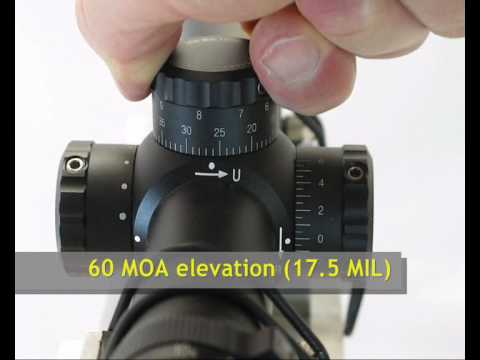
Thomas explains:
These films emphasize the shooter’s Point of View (POV) and ‘user friendliness’. ALL these scopes get the job done, but they have some similarities and differences in the details and your own personal preferences would decide what scope can be labeled ‘best’. The perfect scope doesn’t exist, you’ll have a compromise somewhere — be that economy, magnification, reticle, turret, optical quality, sturdiness…
In these films I’ve set the Schmidt & Bender PMII 3-12×50 as the benchmark for comparison. Not because it is ‘best’ (it isn’t!) but because S&B is one of the manufacturers which first recognized the needs of professional Long Range shooters and put together products [optimized to work well] in high stress environments. The features that are important are: First focal plane, MIL reticles and MIL turrets, plenty of adjustment and suitable magnification.
Note that S&B and Zeiss scopes are also available in the USA with MOA-based turrets and/or second focal plane (SFP) reticles, for those shooters who prefer the MOA system, and SFP. A first focal plane reticle is best for ranging, but a target shooter working at known distances will probably prefer a second focal plane reticle that doesn’t change in size with magnification.
December 26th, 2009
 Speaking of Leupold scopes, Midsouth Shooters Supply is running a big sale on genuine Leupold scopes, 2008 modelsr. A wide selection of these 2008-vintage Leupolds are discounted 30%. Note: These are new, full-warrantied scopes, not factory refurb or “blemished” models. All 2008 close-outs are being sold at 30% off to make room for the 2010 inventory. Speaking of Leupold scopes, Midsouth Shooters Supply is running a big sale on genuine Leupold scopes, 2008 modelsr. A wide selection of these 2008-vintage Leupolds are discounted 30%. Note: These are new, full-warrantied scopes, not factory refurb or “blemished” models. All 2008 close-outs are being sold at 30% off to make room for the 2010 inventory.
LEUPOLD VX-L Low Mount 3.5-10X56mm Duplex Reticle Matte: $615.99 (reg. $877.99)
LEUPOLD VX-L Low Mount 3.5-10X56mm German #4 Reticle Matte: $650.99 (reg. $929.99)
LEUPOLD VX-L Low Mount 3.5-10X56mm Boone & Crkt. Reticle Matte: $671.99 (reg. $959.99)

December 1st, 2009
 The Redfield Gun Sight Company was founded in 1909 by John Hill Redfield. The company’s product line expanded from open sights to include riflescopes, mounts, binoculars, and spotting scopes. In 1998 Redfield closed its doors in Denver, Colorado, marking the end of an era. Redfield changed hands several times until April 2008 when Leupold & Stevens, Inc. purchased the Redfield brand name and associated intellectual property. The Redfield Gun Sight Company was founded in 1909 by John Hill Redfield. The company’s product line expanded from open sights to include riflescopes, mounts, binoculars, and spotting scopes. In 1998 Redfield closed its doors in Denver, Colorado, marking the end of an era. Redfield changed hands several times until April 2008 when Leupold & Stevens, Inc. purchased the Redfield brand name and associated intellectual property.
Leupold has revived Redfield, positioning the new Redfield scope line at the low end of the market. The latest generation of Redfield scopes are priced from $130.00 – $150.00 retail. Revolution™ riflescopes, the first products in the new Redfield line, are American-made at Leupold’s plant near Beaverton, Oregon. Revolution models include 2-7x33mm, 3-9x40mm, 4-12x40mm, and 3-9x50mm models, all with either 4-plex or Accu-Range reticles. The Accu-Range reticle provides hold-over points from 200-600 yards. Other product offerings will include imported Rebel™ and Renegade™ binoculars, Rampage™ spotting scopes and Raider™ rangefinders.
 Editor’s Comment: We’re pleased to see the revival of a storied American optics brand. However, we wonder how much quality and long-term durability Leupold can deliver for $130.00, when Leupold is having trouble with quality control on its high-end scopes which sell for $800 or more. But Leupold & Stevens is a business first and foremost and its bean counters obviously feel there is money to be made in the low end of the market. This is like General Motors saying: “Well, since Cadillac can’t compete with Lexus and Mercedes, let’s sell more Geo Prisms”. We all know how well that strategy worked. Editor’s Comment: We’re pleased to see the revival of a storied American optics brand. However, we wonder how much quality and long-term durability Leupold can deliver for $130.00, when Leupold is having trouble with quality control on its high-end scopes which sell for $800 or more. But Leupold & Stevens is a business first and foremost and its bean counters obviously feel there is money to be made in the low end of the market. This is like General Motors saying: “Well, since Cadillac can’t compete with Lexus and Mercedes, let’s sell more Geo Prisms”. We all know how well that strategy worked.
April 6th, 2009
Leupold has released a new ultra-compact laser rangefinder, the RX-1000. This thing is tiny — not much larger than a pack of cigarettes. The pocket-sized RX-1000 measures 3.8 inches long and weighs just 7.8 ounces. The “street price” for the basic RX-1000 unit is about $350.00 while the TBR® model with built-in ballistics compensation runs about $400.00 (OpticsPlanet.com prices). Both the RX-1000 and RX-1000 TBR units feature an aluminum frame, inside a weatherproof, matte-black, rubber-armored exterior. The RX-1000 TBR is also available in Mossy Oak® camouflage.
Beyond the reduction in size and weight, the notable feature of the RX-1000 is an improved optic with better light transmission. Leupold claims the RX-1000’s 80% light transmission is superior to most other rangefinders. In addition, the RX-1000 features a RED OLED read-out. In low light conditions, the OLED is definitely easier to view that conventional LCD displays.
Leupold claims the RX-1000 has a maximum effective range of 1,000 yards (914.4 meters) on reflective targets. Based on the performance of other Leupold rangefinders, we expect this claim is grossly optimistic and you shouldn’t count on reliable ranging much past 700 yards.
One feature we like about the new RX-1000 are the selectable reticles: a small “Plus Point” crosshair for ranging small targets, a larger outer crosshair, or a combination of the two. This is a feature we’d like to see added to premium rangefinders like the Swarovski laser guide. Choosing a tight reticle lets you aim the device more precisely, which reduces the chance of errant laser returns.
We think it’s wise to pay the money for the TBR model which automatically calculates the shot angle and provides the actual Ballistic Range rather than the straight-line distance to the target. This can be very helpful for hunters shooting at extreme up or down angles in mountainous country. To learn more about the RX-1000, check out Jeff Quinn’s Gunblast.com Review, visit www.leupold.com, or call 1-800-LEUPOLD.
March 29th, 2009
Review by LARRY BANEY
The Sightron 6-24×50mm Mildot is the latest in Sightron’s SIII line-up of side-focus, 30mm riflescopes. This follows the hot-selling 8-32×56mm SIII, which we reviewed last fall. While our 6-24x50mm test sample has a Mildot reticle, Sightron’s new 6-24x50mm scope is also offered with a fine cross-hair (FCH) with target dot reticle. Both Mildot and FCH versions are 14.96″ overall with a near-constant 3.6-3.8 inches of eye relief. Clicks are 1/4 MOA (15 MOA per revolution), and total elevation (and windage) adjustment is listed as 100 MOA (50 MOA on either side of center). That’s a class-leading amount of elevation, which should make the new 6-24×50mm popular with long-range shooters.

Shown above is the Sightron 6-24×50mm Mildot, flanked by a Leupold 8-25×50mm LRT and the Sightron 8-32×56mm. The controls on the 6-24 Sightron are identical to those of its big brother, but it is shorter, with a smaller objective. The shorter length and 50mm front objective allow a 2.8 ounce weight savings over the larger model (21.9 oz. vs. 24.7 oz.).

Sightron 6-24x50mm Quick Review
Assistant Editor Jason Baney has been evaluating the optical qualities of the new Sightron 6-24 Mildot scope. Jason also had a chance to test the scope’s real-world performance in a tactical match. Here is Jason’s report:
“When the new 6-24x50mm mil-dot Sightron SIII arrived, it looked like the little brother of the Sightron 8-32x56mm. Controls and “styling” are similar. This family relationship was made clear as my review of its performance progressed. It shared the same ergonomics, same superior glass, and same unbeatable tracking.
 I had a Leupold 8.5-25x50mm LRT for comparison purposes. The Leupold, which is actually 24.3x at max power, is a popular scope with a good reputation for clarity and sharpness. However, the new 6-24x50mm Sightron seemed better in many respects than the Leupold LRT. The Sightron’s glass appeared superior, giving better color rendition, a brighter field of view, and better contrast. I had a Leupold 8.5-25x50mm LRT for comparison purposes. The Leupold, which is actually 24.3x at max power, is a popular scope with a good reputation for clarity and sharpness. However, the new 6-24x50mm Sightron seemed better in many respects than the Leupold LRT. The Sightron’s glass appeared superior, giving better color rendition, a brighter field of view, and better contrast.
Also, with the Sightron, there was no noticeable parallax lash in the side-focus system. There was no need to start the side-focus at a travel stop every time. You could simply dial the side parallax adjustment and get the observed target in sharp focus with minimal parallax. This has been a problem with some Leupolds (i.e. you can’t get minimal parallax and best focus at the same time.) While observing bullet holes in different colored targets at 300 yards, the Sightron also appeared to show slightly better resolution than the Leupold and therefore better ability to locate individual bullet holes in the paper.”
Field Testing at the Allegheny Sniper Challenge (ASC)
In any competition riflescope, precise, repeatable tracking is absolutely vital. When you crank-in elevation and/or windage you want the reticle to move the exact value you dialed. Then you want the scope to repeat exactly when you return to the original zero. To test the Sightron’s tracking, Jason did more than a simple range test. He tested the scope’s tracking in the “real world”, during a two-day tactical comp.
Jason reports: “The 6-24 was thrown into action right away at the Allegheny Sniper Challenge (ASC) in Seneca Rocks, WV in August 2008. This was a team match that I shot with my father. ASC entails interesting weather, and even more interesting shots. In a matter of two days, over 100 shots are expended and a scope’s adjustments are REALLY put to the test. Maintaining zero is very important, because there are no sighters to check your zero. Shots range from less than 100 yards to nearly 1200 yards, and in the end, everyone has clicked their scope up-and-down 40 times or more. This means 40+ up/down repetitions on the elevation knob. This is as tough a test of a scope’s tracking ability as you’ll find.”
Great Tracking Ability, Excellent Value
So how did the Sightron’s tracking rate? The new Sightron 6-24×50 returned from ASC with the EXACT same 100-yard zero as when it started. This scope maintained its zero as well or better than any other scope out there, including those costing $3000.00+. The scope’s great elevation range was also much appreciated. Jason reports: “With 100+ MOA of elevation available and a 20 MOA base on the rifle, I had enough ‘up’ to shoot all the way out to 1200 yards with no problem.”

In Jason’s opinion this scope will be very hard if not impossible to beat in its price range in many aspects. The new Sightron 6-24 certainly rivals the overall optical quality of the Sightron 8-32×56, and that’s saying a lot. But since it is a Mildot scope there is another level of scrutiny needed. This scope is not a purpose-built tactical scope, but it represents a good base on which to build if Sightron offers enhancements in the future. If a shooter wishes only to use the mil-dots for holdover, he will be well served, but a Front Focal Plane (FFP) reticle would be more useful for serious tactical work. An illuminated reticle would also be welcome, and Jason would like to see a different reticle design with half-mil markings.
Also, some tactical shooters would prefer to have mil-based click values, rather than 1/4 MOA clicks. In raising these points, we need to stress that the $800.00 Sightron 6-24x50mm Mildot is affordable and works well as a general-purpose scope with reticle marks that allow hold-overs. This scope was not designed to compete with a $2700.00 Schmidt & Bender PMII. Jason explains: “I just want the serious tactical guys to understand that the Sightron won’t give you all the features of a dedicated FFP mildot optic with mil-based clicks. However, at about $800.00 average retail, the Sightron 6-24x50mm costs less than a third of what you’ll pay for high-end tactical scopes from S&B or U.S. Optics.”
|


