Eurooptic vortex burris nightforce sale


teslong borescope digital camera barrel monitor


As an Amazon Associate, this site earns a commission from Amazon sales.


August 23rd, 2015

New Screw-On Knurled Dials for Leupold Scope Turrets

Leupold Stevens scope turret windage elevation dial optic MIL MOA replacement accessory cap aluminum
New S1 and S5 Knurled Dials can be user-installed in place of older Leupold turret caps.

Leupold & Stevens makes good scopes, but the standard turrets with screw-on caps are inconvenient for some users. It’s too easy to misplace the caps. Also the standard turrets are not the easiest to grip, particularly with gloved hands. To improve the “gripability” of its scope turrets, Leupold now offers new S1 and S5 screw-on knurled dials that fit in place of the cap covers. These aluminum dials offer large, knurled surfaces that are easy to grip, even when wearing gloves. “These screw-on dials mean no more lost caps or the need for a coin to make adjustments in the field,” said Tim Lesser, Leupold’s Product Development Director. The S1 is for MOA scopes while the S5 is for MIL scopes.

Leupold Stevens scope turret windage elevation dial optic MIL MOA replacement accessory cap aluminum

The S1 and S5 dials simply replace Leupold’s screw-on turret caps, so the user can install these easily without tools. It is NOT necessary to send your scope(s) back to the factory. Just remove the caps on your windage and elevation turrets, and screw the knurled dials in their place. The S1/S5 dials automatically align with the adjustment slot and securely tighten down. These dials are interchangeable between different riflescopes in the field. MSRP is $50 per dial set (either S1 or S5).

The S1 dial is engraved in ¼-MOA increments while the S5 (for mil-based turrets) is marked in 0.1 MIL. Both come with a locking zero stop and can be equipped with the Custom Dial System® (CDS) through the Leupold Custom Shop. The Leupold S1 and S5 dials are compatible with most Leupold riflescopes with click adjustments, with the exception of the VX-1 series and older riflescopes with friction adjustments. For those with bullet-drop-compensating reticles, the S1 and S5 are completely compatible. The screw on dials are covered by Leupold’s full lifetime guarantee.

Permalink New Product, Optics 15 Comments »
October 7th, 2014

MIL vs. MOA Reticles — Which Are Better for Tactical Tasks?

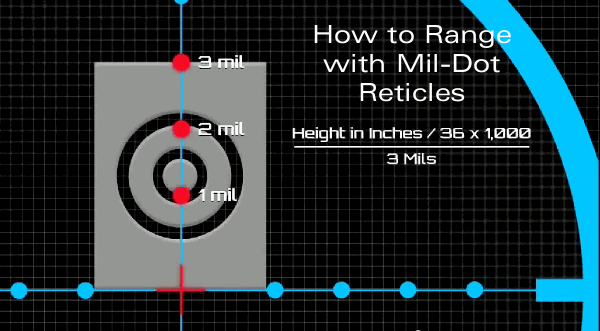
MIL or MOA — which angular measuring system is better for target ranging (and hold-offs)? In a recent article on his PrecisionRifleBlog.com website, Cal Zant tackles that question. Analyzing the pros and cons of each, Zant concludes that both systems work well, provided you have compatible click values on your scope. Zant does note that a 1/4 MOA division is “slightly more precise” than 1/10th mil, but that’s really not a big deal: “Technically, 1/4 MOA clicks provide a little finer adjustments than 1/10 MIL. This difference is very slight… it only equates to 0.1″ difference in adjustments at 100 yards or 1″ at 1,000 yards[.]” Zant adds that, in practical terms, both 1/4-MOA clicks and 1/10th-MIL clicks work well in the field: “Most shooters agree that 1/4 MOA or 1/10 MIL are both right around that sweet spot.”

Mil MOA reticle ranging PRS tactical minute angle precision rifle series

READ MIL vs. MOA Cal Zant Article.

Zant does note that a whopping 94% of shooters in the Precision Rifle Series (PRS) used a mil-based reticle. However, Zant says: “This does NOT mean MIL is better. It just means MIL-based scopes are more popular.” Zant agrees with Bryan Litz’s take on the subject: “You can’t really go wrong with either (MIL or MOA). They’re both equally effective, it comes down to how well you know the system. If you’re comfortable with MOA, I wouldn’t recommend switching to MIL. I have a few MIL scopes but primarily because they’re on rifles used for military evaluation projects, and that community is now mostly converted to MILS, so when in Rome….”

We recommend you read Zant’s complete article which is very thorough and is illustrated with helpful graphics. Here are the key points Zant makes in his MIL vs. MOA analysis:

MIL vs. MOA — Key Points
There are a handful of minor differences/trade-offs between MIL & MOA, but there are no inherent advantage to either system. Most people blow the small differences WAY out of proportion….Here are the biggest differences and things to keep in mind:

  • Whatever you decide, go with matching turret/reticle (i.e. MIL/MIL or MOA/MOA)
  • 1/4 MOA adjustments are slightly more precise than 1/10 MIL.
  • MIL values are slightly easier to communicate.
  • If you think in yards/inches the math for range estimation is easier with MOA. If you think in meters/cm the math is easier with MIL.
  • When your shooting partners are using one system, there can be some advantage to having the same system.
  • Around 90% of the PRS competitors use MIL.
  • There are more product options (with ranging reticles) in MIL.

Range Card Print-Outs
Zant makes an interesting practical point regarding range card print-outs. He suggests the MIL System may be easier to read: “You can see in the range card examples below, 1/4 MOA adjustments take up more room and are a little harder to read than 1/10 MIL adjustments.”

mil vs moa reticle scope

Permalink Optics, Tactical 11 Comments »
October 3rd, 2014

Swarovski’s New 80mm Spotting Scope Offers Illuminated Reticle

STR 80 Swarovski Spotting scope with ReticleSwarovski has a new STR 80 spotting scope with an illuminated reticle. That’s right, this new STR 80 spotter has a ranging reticle like a riflescope, with adjustable brightness levels. This 80mm spotting scope can be used for estimating range to targets, using MIL-based or MOA-based stadia lines on the cross-hairs. This allows you to range targets optically, as you could with a ranging reticle in a riflescope.

Revolutionary Reticle “ON”, Reticle “OFF” Technology
The STR 80’s illuminated ranging reticle makes the new STR 80 a fairly unique product among high-end, imported spotting scopes. Thanks to a new technology, Swarovski is the first manufacturer to successfully project a reticle directly in a spotting scope. The reticle (MOA or MRAD) can be activated or deactivated as required. Notably, because the reticle appears via electro-illumination, it can be “turned off” for un-obstructed viewing. So you can have a totally clear field of view when desired, OR a ranging reticle when that functionality is desired. Having the ability to turn OFF the reticle is great — that’s a very intelligent feature.

STR 80 Swarovski Spotting scope with Reticle

When viewing targets, the STR 80’s sharp HD (high-definition) lenses will resolve bullet holes at long range. Current Swaro 20-60X and 25-50X (wide) eyepieces can be used with the new STR 80 spotter. Optional accessories include Picatinny mounting rail, digiscoping attachment, and a winged eye cup.

How to Range with STR 80 Reticles
The new STR 80 scope offers a choice of either MOA or MRAD reticles with 15 brightness levels, 10 day levels, and 5 night levels. For convenient ranging, set the magnification level so that the MOA reticle displays ¼ MOA divisions, while the MRAD Reticle displays 0.1 MIL divisions. (NOTE: the reticle will change in size relative to the target at different magnifcation levels. Therefore ranging is normally done at one standard magnification level).

STR 80 Swarovski Spotting scope with Reticle

Dustin Woods, Sales Director for Swarovski Optik NA said: “Long range shooters asked for a premium spotting scope with integrated reticle and we have listened. With our new STR spotting scope we now have MOA and Mil-Radian reticle models. Because the reticle is illuminated, the user can have the reticle turned on when they are judging hits and misses but also turn it completely off for an unobstructed view during observation. This product is a real game changer in the precision shooting segment.”

Permalink New Product, Optics 5 Comments »