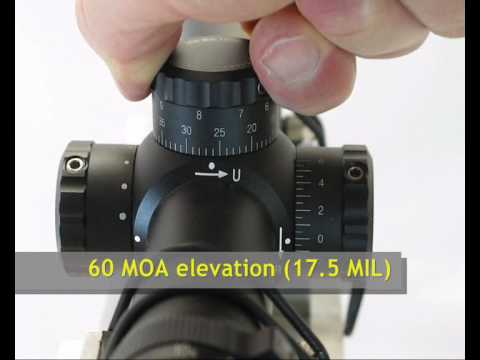
Hey Burris, Leupold, Sightron and Weaver — are you reading this? If you want to dominate the market for varmint scopes, give us a large elevation knob offering at least 20 MOA in a single revolution. IOR and U.S. Optics already offer this “one-rev” option on tactical scopes and it is clearly superior when moving back and forth between multiple yardages. Schmidt & Bender offers a single-turn option on some S&B PMII Tactical scopes, along with a color-coded, double-turn elevation turret option.
IOR’s big 9-36×56 scope offers 25 MOA of elevation in ONE ROTATION (and about 75 MOA overall). If you use the zero stop, that one rotation (25 MOA) will get most rifles to 850 yards with ease (and very few varmint shots are made beyond that). That means you should never loose track of your elevation setting. Right in front of your nose is a large visible number that corresponds to your actual come-up: “7” for 7 moa, “12” for 12 moa, and so on. Wow–this is so easy compared to other systems that require multiple revolutions and leave you staring at unlabeled hash marks wondering how many clicks you just dialed in or out.
When this Editor first tried a one-rotation elevation knob I had the same reaction I did years ago when I watched a ultra-high-grade flat screen TV for the first time. Then I thought… “wow, this flat screen is just better in every respect and, eventually, will change everything.” Scopes aren’t TV sets, but I think the large one-rotation knob IS a huge advancement — a breakthrough in scope design. When used with a come-up table showing the elevation needed for various yardages (50-1000 yards), the one-rev system makes it really hard to be “way off” in your elevation. With conventional elevation knobs it is very easy to lose track of clicks (and whole revolutions) as you move up and down to different yardages.
The IOR and U.S. Optics products offering 20+ MOA in one-revolution are large, heavy, expensive scopes. The big elevation knob on the IOR Ultra Long Range scope has about 125 MOA total elevation (25 MOA per turn) with 1/4-MOA clicks. The large flat EREK (Erector Repositioning Elevation Knob) on the U.S. Optics scopes offers 22.5 MOA per revolution, with a total of about 62 MOA in a 5-25 SN-3 model with 1/4-MOA clicks.
Scope-Makers Should Adapt Technology to Varmint Scopes
It’s time for the mainstream scope makers to bring this techology to the market. Adding a one-revolution elevation knob (with 25 moa of travel) to a $600.00 varmint scope would make a huge difference in practical functionality in the field. You could reliably click back and forth between yardages all day long and never lose track of your elevation setting. This is almost as easy as a yardage-calibrated elevation knob (but not limited to a single load.) So, you scope makers out there… How about giving us a one-revolution elevation knob on an affordable hunting scope?
For months now, we’ve heard rumors of an all-new, high-magnification Nightforce scope, to be introduced in 2012. Unfortunately, Nightforce had no new “super-scope” on display at SHOT 2012, but Nightforce reps did indicate that “important announcements will be forthcoming in a few months”. Possibly we will see the new model(s) at the NRA Annual meeting, but that’s not definite. The only thing we can tell you — and this is NOT official — is that more magnification may be on tap on the high-end, giving Nightforce something to compete with the latest high-magnification competition scopes from other optics-makers.
We were pleased to see that Nightforce is offering an enhanced MOA-marked reticle with 1 MOA stadia (hash marks), and a center floating “X” that is 2 MOA high and 2 MOA wide. This new “MOAR” reticle should be a good choice for long-range shooters who prefer to hold off for windage corrections, rather than dial windage turrets. By comparison, the popular NP-R1 has 1 MOA marks on the elevation bar and 2 MOA marks on the windage bar. With the MOAR you get 1 MOA stadia (dividers) on the horizontal line as well. This should help shooters make more precise wind holds. NOTE: Initially the MOAR reticle will only be available for new NXS 3.5-15, 5.5-22, and 8-32X models (MOAR will NOT be offered in current Benchrest Models). ETA for the first MOAR-equipped NXS scopes is June, 2012.
In the video above, a Nightforce spokesman covers the function of the New Nightforce Velocity Reticle Calculator. This interactive program helps Nightforce scope owners select the particular velocity reticle (from a series of eight available) which best matches the ballistics of their particular rifle and load. Once you input the bullet velocity and BC data for your load, the calculator selects one of the eight velocity reticle options. This gives the scope owner a reticle with vertical hold-over points that closely match the actual trajectory of his ammunition.
Nightforce Adds Workers and Expands Production Facilities
In other Nightforce news, Nightforce Marketing Director Kyle Brown announced that Nightforce is beefing up its workforce and expanding its production facilities. With Nightforce scopes being in such high demand, there have been extended delivery times for some of the most popular Nightforce models. With more assemblers and a larger assembly plant, Nightforce hopes to keep up with growing demand for its products. We commend Nightforce for committing added resources to scope production. This will certainly benefit scope buyers by increasing “on-the-shelf” inventory at Nightforce stocking dealers.
While we were somewhat disappointed that we didn’t see many all-new precision rifles at Media Day 2012, there were plenty of new riflescopes on display. Among the most impressive new optics were rugged new high-zoom-range, First Focal Plane (FFP) tactical scopes from Hensoldt (Carl Zeiss), Leupold and Trijicon. These new scopes all featured fat tubes, compact overall length, and abundant elevation travel. These lastest top-end FFP tactical scopes offer as much as 26-power in a form factor not much bigger than a “normal” 4-16X scope.
New 3.5-26x50mm Hensoldt Was Outstanding
Hensoldt showcased a very impressive, prototype 3.5-26x56mm FFP tactical scope. Though this scope offers a whopping 7.4X zoom range and 26-power on top, this new Hensold is relatively compact. The reticle in these prototype versions was a very useful (and simple) milradian-based reticle that we hope Hensoldt retains in the production versions. The Hensoldt boasted an impressive 36 Mils of total elevation travel in two (2) turns of the turret. The new Hensoldt still shares the same superior glass and compact size that puts these scopes at the top of their class. We tested a prototype mounted to an Accuracy International AX 338. Expect the production version to be the same size and cost approximately $4000.00.
As you can see in the video, the new Hensoldt coupled with the new Accuracy Int’l AX in 338 Lapua Magnum worked very effectively at 900 meters in some tricky winds. This combination made it fairly easy to break clay pigeons on the bank at 900 meters. Off camera this combination continued to show great accuracy and very effective design features.
New Leupold MK-8
Leupold showed off a brand new MK-8 3.5-25x56mm with a Horus reticle and a beefy main tube. Again, this featured a lot of elevation in one turn as well as a pinch-and-turn locking turrets. This is a big leap forward for Leupold and we feel this will be well-received in the tactical world. Along with the new MK8, we also sampled Leupold’s new MK6 3-18x50mm. This shared similar features as the 3.5-25, and was incredibly compact as well. We expect the MK8 to sell near $4000 and the MK6 to be substantially less, likely under $3000 according to company reps.
Trijicon made a departure from their standard fare and jumped into the tactical scope world with a beefy Front-Focal Plane 3-15x50mm. This featured a well-executed MOA-based reticle and turrets with 30 MOA per turn (a Milrad version offers 10 Mils per turn). The Trijicon showcased the “short and fat” appearance that seems to be the latest design trend in tactical scopes. But though the Trijicon had a fairly short OAL (for its zoom range), it was still quite heavy at 47 ounces. The glass in this prototype version was disappointing for a scope that will retail in the $4K range. Reps told us the production version glass would be much improved. (It had better be, if Trijicon hopes to play in this stratospheric price range.)
It was apparent at Media Day 2012 that scope companies have worked hard to provide more features and more performance in their high-end tactical scopes. Consequently, the latest generation of scopes offer some very interesting and useful innovations — wider zoom range, more compact size, more elevation travel per rotation, and “goof-proof” turret mechanisms. We can only hope that, with more competition in this market, prices may become more reasonable. $4000 is an awful lot of money to pay for a scope.
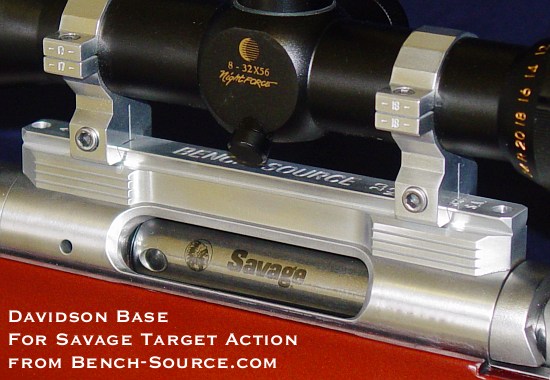
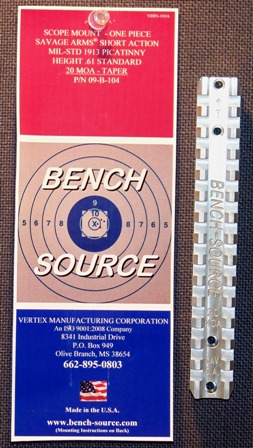
Bench-Source, founded by David Dorris, President of Vertex Mfg. Corp., and benchrest shooter Darrell Jones, is now producing precision scope-mounting bases for the Savage round-top Target Action. CNC-machined to exact tolerances from 7075-T6 aircraft aluminum, these bases are extremely light (under two ounces) yet strong. Both Picatinny-style bases and Davidson dovetail bases are offered with either zero taper (flat) or with +20 MOA of built-in elevation. Bench-Source rails also feature precision-cut reliefs to match the loading ports on the Savage Target Actions.
The Picatinny (Weaver) base costs $84.95 (either flat or +20 MOA) while the Davidson dovetail base is just $69.95 (either flat or +20 MOA). This is a good price considering the quality of the materials and machining. (The 7075-T6 aircraft grade aluminum is three times as expensive as the aluminum alloy used by some other rail-makers.) Either style base is available with either a “luster” or polished finish. The price includes a Torx wrench and mounting screws.
Technical Specifications
The Picatinny M1913-A Mounting Rail features 14 symmetrically spaced cross-slots. The base is long enough to mount any popular scope. The Picatinny base is approximately .610″ tall. Parallelism deviates less than .002″ between the dovetail clamping area and top of the receiver after mounting. The screws used are #6-48 x 3/8″ long and holes are drilled and counter-bored to the correct depths. This ensures that users will not damage their barrel threads or encounter interference with the locking lugs when closing the bolt.
The Davidson 1/2″ x 60º Mounting Rail dovetail is parallel over its entire length. The rail is held to very tight tolerances to minimize windage correction (at different ring positions). The Davidson rail should self-center on your action when installed per the included instructions. Both ends of the mount are chamfered slightly on a 30° angle to let the sharp corners of the mating rings align themselves without binding. The 60º dovetails are machined +/- .001″ and measured over two optimum-diameter pins to minimize over-clamping of your rings.
For more information, visit Bench-Source.com or phone: (662) 895-0803.
Forum member Thomas Haugland (aka “Roe”) from Norway has created an excellent video comparing the features on four long-range scopes: Schmidt & Bender PMII 3-12x50mm, Schmidt & Bender PMII 12-50x56mm, Leupold MK IV, and Zeiss Diavari Victory 6-24x56mm. Thomas shows how the adjustments function, he records the available vertical elevation, and he takes apart the turrets to show how the weather seals work. While the Leupold MK IV has MOA clicks, the three Euro scopes tested by Thomas have mil-based or mil/cm adjustments. These mil-based clicks work well with first focal plane reticles that have mil or half-mil hash marks.
Thomas explains:
These films emphasize the shooter’s Point of View (POV) and ‘user friendliness’. ALL these scopes get the job done, but they have some similarities and differences in the details and your own personal preferences would decide what scope can be labeled ‘best’. The perfect scope doesn’t exist, you’ll have a compromise somewhere — be that economy, magnification, reticle, turret, optical quality, sturdiness…
In these films I’ve set the Schmidt & Bender PMII 3-12×50 as the benchmark for comparison. Not because it is ‘best’ (it isn’t!) but because S&B is one of the manufacturers which first recognized the needs of professional Long Range shooters and put together products [optimized to work well] in high stress environments. The features that are important are: First focal plane, MIL reticles and MIL turrets, plenty of adjustment and suitable magnification.
Note that S&B and Zeiss scopes are also available in the USA with MOA-based turrets and/or second focal plane (SFP) reticles, for those shooters who prefer the MOA system, and SFP. A first focal plane reticle is best for ranging, but a target shooter working at known distances will probably prefer a second focal plane reticle that doesn’t change in size with magnification.


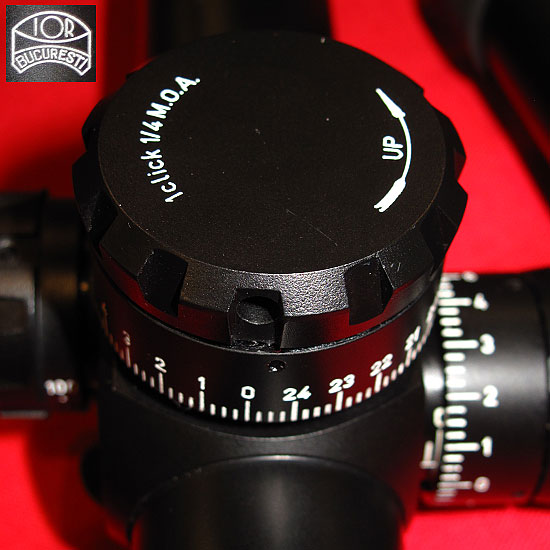

 The IOR and U.S. Optics products offering 20+ MOA in one-revolution are large, heavy, expensive scopes. The big elevation knob on the IOR Ultra Long Range scope has about 125 MOA total elevation (25 MOA per turn) with 1/4-MOA clicks. The large flat EREK (Erector Repositioning Elevation Knob) on the U.S. Optics scopes offers 22.5 MOA per revolution, with a total of about 62 MOA in a 5-25 SN-3 model with 1/4-MOA clicks.
 For months now, we’ve heard rumors of an all-new, high-magnification Nightforce scope, to be introduced in 2012. Unfortunately, Nightforce had no new “super-scope” on display at SHOT 2012, but Nightforce reps did indicate that “important announcements will be forthcoming in a few months”. Possibly we will see the new model(s) at the NRA Annual meeting, but that’s not definite. The only thing we can tell you — and this is NOT official — is that more magnification may be on tap on the high-end, giving Nightforce something to compete with the latest high-magnification competition scopes from other optics-makers.


 Trijicon made a departure from their standard fare and jumped into the tactical scope world with a beefy Front-Focal Plane 3-15x50mm. This featured a well-executed MOA-based reticle and turrets with 30 MOA per turn (a Milrad version offers 10 Mils per turn). The Trijicon showcased the “short and fat” appearance that seems to be the latest design trend in tactical scopes. But though the Trijicon had a fairly short OAL (for its zoom range), it was still quite heavy at 47 ounces. The glass in this prototype version was disappointing for a scope that will retail in the $4K range. Reps told us the production version glass would be much improved. (It had better be, if Trijicon hopes to play in this stratospheric price range.)


 Technical Specifications