|
|
April 22nd, 2014
 Our IT guy, Jay (aka JayChris in the Forum), was having some issues with his .260 AI. A load with known accuracy had suddenly and mysteriously stopped shooting well. Jay couldn’t figure out what was going wrong. Then he remembered he had cleaned his brass using a powerful ultrasonic machine. Our IT guy, Jay (aka JayChris in the Forum), was having some issues with his .260 AI. A load with known accuracy had suddenly and mysteriously stopped shooting well. Jay couldn’t figure out what was going wrong. Then he remembered he had cleaned his brass using a powerful ultrasonic machine.
He inspected his brass carefully and saw that the ultrasonically-cleaned necks were so “squeaky clean” that he was actually scratching the jackets on his bullets when seating them. As well, Jay noticed that it took more force to seat the bullets and the seating force became less uniform case to case. Jay solved the problem by applying NECO Moly dry-lube inside the necks of his brass before seating the bullets.
The Perils of Ultrasonic Brass Cleaning by JayChris
I rotate my brass so that I can keep track of each firing, so I keep a “clean/ready to load” bin and a “fired” bin. I have 400 pieces of .260 AI brass. So, all of it was on its first firing (after doing a Cream of Wheat fire-forming) until I hit the 400-round mark. To my surprise, things went south at the 500-round mark. The first time I noticed it (according to my range log) was at a match last year, when I dropped several points and had some vertical stringing issues. After that match, I had 400 rounds through the barrel and all of my brass had a single firing on it. So, it was time to clean.
 I have used an ultrasonic cleaner for a while now. I recently got a more powerful Ultrasonic cleaner, although I don’t know if that makes a difference. My brass comes out dry and squeaky. Emphasis on the “squeaky”. I have used an ultrasonic cleaner for a while now. I recently got a more powerful Ultrasonic cleaner, although I don’t know if that makes a difference. My brass comes out dry and squeaky. Emphasis on the “squeaky”.
I found that my new US machine may have been getting the necks TOO clean. After ultrasonically cleaning my brass, I had noticed that it required a little more force to seat the bullets, but I didn’t really think too much about it. But then, after going over my ordeal with a shooting buddy and going over my process in minutiae, we had an “AH HA” moment when it came to cleaning (he uses good ol’ vibratory cleaning).
So, I used some moly dry-lube to pre-lube the case necks and took some rounds out to test at 200 yards. I used my last known good load and sure enough, the vertical flyers disappeared! I shot two, 10-rounds groups with .335 and .353 MOA vertical dispersion, which is consistent with the results I was originally getting.
Other folks have suggested necks may get “too clean” after ultrasonic cleaning. It was pretty sobering to actually witness, first hand, what can happen when brass is “too clean”. I had read some discussions of issues with neck friction/bullet seating after ultrasonic cleaning, but, frankly, I dismissed the idea. Now I understand. The “too clean” effect doesn’t seem to affect my Dasher at all (perhaps because Dasher necks are very short), but on the bigger .260 AI, it definitely does.
Close-Up Photos of Case-Necks
Here are photos Jay took with a microscope. You can see the difference between tumbled brass and ultrasonically-cleaned brass. Jay says: “Here, in sequence, are the Ultrasound-squeaky-clean case neck, a case neck after treatment with NECO moly dry-lube (you can see the particles that will help coat the neck during seating), and, finally, the neck from a case cleaned with corncob media in a vibratory tumbler. You can clearly see how much smoother the inside of the tumbled neck is. Yes, it’s dirty, but it’s also very, very smooth.


Close-Up of Scratched Bullet
Here is a close-up of a bullet that was seated in an ultrasonically-cleaned (“squeaky clean”) neck, with no lubrication. You can clearly see the damage done to the jacket — in fact, in a couple spots you can see the lead core through the scratches! Jay also observed that quite a bit more seating force was required to seat the bullet in a “squeaky clean” neck.

NOTE: The bullet jacket is naked — NOT coated in any way. It looks a little dark because of the shadow from the microscope lens, and the high contrast.
March 8th, 2014
 In our article on Bullet Coating we covered the basic principles of applying dry lubricants to “naked” bullets. This article covered the three main coating options: Molybdenum Disulfide (Moly), Tungsten Disulfide (WS2 or “Danzac”), and Hexagonal Boron Nitride (HBN or “White Graphite”). All three compounds can be impact-plated on to bullets with relative ease, using inexpensive equipment. Moly is still the most popular choice, but many more shooters are considering HBN because it is ultra-slippery, it is less messy, and it offers some advantages over Moly or WS2. In our article on Bullet Coating we covered the basic principles of applying dry lubricants to “naked” bullets. This article covered the three main coating options: Molybdenum Disulfide (Moly), Tungsten Disulfide (WS2 or “Danzac”), and Hexagonal Boron Nitride (HBN or “White Graphite”). All three compounds can be impact-plated on to bullets with relative ease, using inexpensive equipment. Moly is still the most popular choice, but many more shooters are considering HBN because it is ultra-slippery, it is less messy, and it offers some advantages over Moly or WS2.
After we published our Bullet Coating feature, many readers asked for more info on HBN. Some current moly users had questions about switching over to Boron Nitride. Forum member Larry Medler has published an excellent web article discussing the process of applying 70nm HBN using plastic jars and a Thumler’s rotary tumbler. If you are working with HBN currently, or plan to experiment with Boron Nitride, you should read Medler’s HBN-Coating Article.
After coating some bullets for his 6XC, Medler seems “sold” on the merits of HBN. Larry writes: “The coating process is much better than Moly — no black mess. My coating process times are the same as for Moly. Three hours of tumbling in the corn cob and three hours of tumbling in the steel balls with 3.0 grains of hBN Powder. The bullets look something like sugar-coated donuts when I dump the jar of steel balls with the freshly coated bullets into my sieve to separate. The coated bullets wipe clean to the touch with a little towel rub down and remain very slippery. So far I am very pleased with my coated bullets’ smoothness and appearance.”

Field Tests Are Very Promising
Interestingly, Larry’s HBN-coated bullets are shooting flatter, with tighter vertical, than his moly-coated bullets. Since he has also pointed the tips of this batch of bullets, it’s not clear whether the reduced drop is due to the pointing or the HBN coating, but the results are certainly encouraging: “I have shot the HBN-coated bullets a couple of times now at 600 yards and everything seems to be okay or a lot like Moly. Funny thing is the HBN-coated bullets are shooting higher by 7/8 MOA. I have to check the speed and see if it has changed enough for that POI change. Good news is I had a string of 15 shots with less than 1.5 inches of vertical which is the best I have ever seen with my rifles. Is that due to the hBN or bullet pointing?”
Photos courtesy Larry Medler, All Rights Reserved
January 28th, 2014
Coating bullets with a friction-reducing compound such as Molybdenum Disulfide (Moly) offers potential benefits, including reduced barrel heat, and being able to shoot longer strings of fire between bore cleanings. One of the effects of reduced friction can be the lessening of internal barrel pressures. This, in turn, means that coated bullets may run slower than naked bullets (with charges held equal). To restore velocities, shooters running coated bullets are inclined to “bump up” the load — but you need to be cautious.

Be Careful When Increasing Loads for Coated Bullets
We caution shooters that when your start out with coated bullets in a “fresh barrel” you should NOT immediately raise the charge weight. It may take a couple dozen coated rounds before the anti-friction coating is distributed through the bore, and you really start to see the reduced pressures. Some guys will automatically add a grain or so to recommended “naked” bullet charge weights when they shoot coated bullets. That’s a risky undertaking.

Instead we recommend that you use “naked” bullet loads for the first dozen coated rounds through a new barrel. Use a chronograph and monitor velocities. It may take up to 30 rounds before you see a reduction in velocity of 30-50 fps that indicates that your anti-friction coating is fully effective.
We have a friend who was recently testing moly-coated 6mm bullets in a 6-6.5×47. Moly had not been used in the barrel before. Our friend had added a grain to his “naked” bullet load, thinking that would compensate for the predicted lower pressures. What he found instead was that his loads were WAY too hot initially. It took 30+ moly-coated rounds through the bore before he saw his velocities drop — a sign that the pressure had lowered due to the moly. For the rounds fired before that point his pressures were too high, and he ended up tossing some expensive Lapua brass into the trash because the primer pockets had expanded excessively.
LESSON: Start low, even with coated bullets. Don’t increase your charge weights (over naked bullet loads) until you have clear evidence of lower pressure and reduced velocity.
Procedure After Barrel Cleaning
If you shoot Moly, and clean the barrel aggressively after a match, you may want to shoot a dozen coated “foulers” before starting your record string. Robert Whitley, who has used Moly in some of his rifles, tells us he liked to have 10-15 coated rounds through the bore before commencing record fire. In a “squeaky-clean” bore, you won’t get the full “benefits” of moly immediately.
 To learn more about the properties of dry lubricants for bullets, read our Guide to Coating Bullets. This covers the three most popular bullet coatings: Molybdenum Disulfide (Moly), Tungsten Disulfide (WS2 or ‘Danzac’), and Hexagonal Boron Nitride (HBN). The article discusses the pros and cons of the different bullet coatings and offers step-by-step, illustrated instructions on how to coat your bullets using a tumbler. To learn more about the properties of dry lubricants for bullets, read our Guide to Coating Bullets. This covers the three most popular bullet coatings: Molybdenum Disulfide (Moly), Tungsten Disulfide (WS2 or ‘Danzac’), and Hexagonal Boron Nitride (HBN). The article discusses the pros and cons of the different bullet coatings and offers step-by-step, illustrated instructions on how to coat your bullets using a tumbler.
February 1st, 2010
Many of our readers know Joel Kendrick, one of America’s top mid-range shooters. Joel is a two-time IBS 600-yard Shooter of the Year, and we have featured Joel’s match-winning 6×44 as one of our Guns of the Week. Joel now works with MMi-Trutec, specializing in the salt-bath nitriding process. This is a surface-hardening procedure for steel that creates a super-hard, low friction layer for the top 10-20 microns of the metal. Barrels treated with salt-bath-nitriding show much improved wear resistance and reduced friction.
For match rifles, varmint rifles, and hunting rifles, the most significant benefits of salt-bath nitriding are enhanced barrel life, and easier cleaning. Joel’s own F-Class rifle has a nitrided stainless barrel with over 5000 rounds — and it still holds 1/4 MOA at 100 yards. Other well-known shooters, such as John Whidden, have observed that nitrided barrels can shoot longer strings of fire between cleanings, with no reduction of accuracy. What is the cost of nitriding? As Joel explains in the video below, nitriding a single barrel costs $60.00, but there is a minimum first-time lot charge of $200.00. If you submit multiple barrels at the same time, the price per barrel can be reduced significantly. For more info, visit the MMI-Trutec website or contact Joel Kendrick by phone (704) 616-6442, or via email: joelkndrck [at] aol.com .
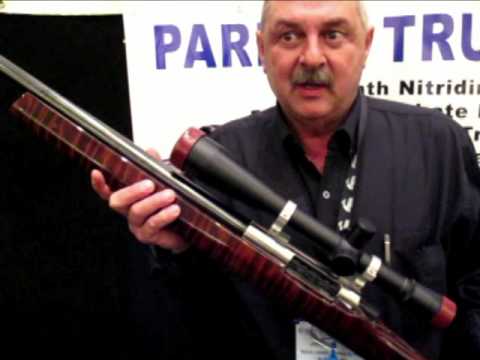
Is there a downside to nitriding? First, the nitriding process results in a BLACK matte or satin finish. If you like the natural silver finish of stainless steel, you shouldn’t nitride your barrel. Second, and most importantly, the salt-bath-nitriding process creates a surface so hard that you can NOT re-cut the chamber with normal reaming tools. Therefore, before nitriding, the barrel must be finished chambered. Basically the barrel should be fully finished, crowned, chambered and headspaced before nitriding. NOTE: MMi Trutec CAN mask the crown during nitriding so that the barrel can be re-crowned at a later time.

March 18th, 2009
 Berger Bullets has kicked off a special sale on Berger moly-coated bullets. Berger let us release this information first in today’s Daily Bulletin, so that AccurateShooter.com readers will have “first crack” at these super deals. Berger Bullets has kicked off a special sale on Berger moly-coated bullets. Berger let us release this information first in today’s Daily Bulletin, so that AccurateShooter.com readers will have “first crack” at these super deals.
PURCHASE TERMS
The following bullets are available at significant discounts while supplies last. These prices apply to listed inventories of moly-coated bullets only. Bullets that are not sold by the end of March will be scrapped. (Berger will still produce these bullets uncoated at regular prices, but the moly version is being closed out.)
Bullets must be paid by credit card only unless someone has already established an account with us. Berger will NOT not hold bullets for payment by check. Add a 5% discount if you buy ALL available boxes of a given caliber, weight, and style. Orders placed for 30 boxes or more get free shipping.
Place your order with Andrea Cobos at (714) 447-5456 or contact andrea.cobos [at] bergerbullets.com.

LIST UPDATED as of 09:04 PST on 3/20
Here is the list of bullets still available. (Everything is selling fast…)
Berger 17 cal 30 gr Varmint Moly – 48 boxes – $27.21 per box (200 count)
Berger 22 cal 30 gr Varmint Moly – 18 boxes – $13.52 per box
Berger 22 cal 90 gr VLD Moly – 138 boxes – $17.30 per box
Berger 25 cal 87 gr Moly – 107 boxes – $24.14 per box
Berger 30 cal 110 gr Moly – 14 boxes – $20.69 per box
Berger 30 cal 155 gr BT Moly – 44 boxes – $25.70 per box
Berger 30 cal 168 gr BT Moly – 30 boxes – $24.00 per box
NOTE: The bullets listed above will remain in production in “naked” form, without moly-coating. These bullet designs are NOT being discontinued — just the moly-coated versions.
|


