The Range Report, the NSSF’s “Magazine for Shooting Facilities” has been reborn as a digital eZine AND a full-featured website, RangeReport.org. This gives readers multiple ways to access information about range operations. If you prefer a conventional website format, with headlines, links, and thumbnail graphics for navigation, then visit RangeReport.org. In addition to hosting the latest Range Report feature articles, the new website also provides Range News, Q&A, and instant access to other features. The website also boasts a Digital Archive of all past Range Report issues in three, handy digital formats: eZine (flip-page), iPad, and PDF.
Read The Range Report in a Magazine-Style (Flip-Page) Format
If you favor a print magazine-style experience, which allows you to flip pages and view full two-page spreads, then visit the new Range Report Digital eZine. Just like a hard-copy magazine, the Range Report eZine begins with a index section and has feature articles placed sequentially, like chapters in a book. The Summer 2012 debut Range Report eZine is 51 pages long, with many interesting articles, including a report by Tom Carpenter on how to conduct shooter training classes, plus a feature by William Kendy on how to promote your range through Co-Op Advertising.
Anyone involved in range operations (whether commercially or as part of a shooting club) should find The Range Report a useful resource. Now that Range Report contents are available in multiple formats, it’s easier than ever to access hundreds of articles that can help your club run your range safely and profitably. Readers can also also Subscribe to the magazine’s monthly e-newsletter.
The Bureau of Alcohol, Tobacco, Firearms and Explosives (ATF) has released its 2011 interim Annual Firearms Manufacturers and Export Report (AFMER). The report shows U.S. firearms production in 2011 totaled 6,398,854 units, a 17.2% increase over 2010.
Rifle production showed a big gain, with 2,293,247 rifles produced in 2011 vs. 1,830,556 in 2010, a 25.3% increase. We think the large increase in rifle production is a good sign for the shooting sports, as the buyers of many of these long guns may join the ranks of competitive shooters.
Compared to the previous year, in 2011 large increases were seen in the production of 9mm pistols (up 33.3%) and large-caliber (.40 to .50 Cal) pistols (up 32.9%). On the other hand, production of most classes of centerfire revolvers declined. Overall production of centerfire revolvers (.23 to .50 caliber) dropped 1.9%, with the biggest decline in the small (.32 cal and under) revolvers. Production of these smaller wheelguns dropped 39.8%, probably due to the stagnation of the Cowboy Action market. But production of big-bore (.45 to .50 cal) revolvers did rise 29.2%. Americans like big wheelguns, and the manufacturers ramped up 2011 production to fill the demand.
The National Shooting Sports Foundation (NSSF), a longtime USA Shooting sponsor, has donated $100,000 to help support the USA Shooting Team and shooter development programs. This large donation will help the USA Shooting Team at the London Olympics and help support USA Shooting’s ongoing operations.
In April, the NSSF visited USA Shooting’s Colorado training center and interviewed marquee USA Shooting athletes and coaches. These video interviews, hosted on the NSSF’s YouTube Channel, feature noted Olympians, who provide useful tips on target shooting. In the video below, Olympic shooter and Team USA member Matt Emmons explains how to shoot a rifle from the kneeling position:
NSSF Previously Provided Funds for USA Shooting’s Electronic Targets
The NSSF has been a valuable contributor to USA Shooting for many years now. NSSF funds helped USA Shooting purchase electronic targets for its indoor ranges in Colorado Springs. In addition, the NSSF showcases USA Shooting Programs at the annual SHOT Show. This provides valuable exposure for USA Shooting’s talented shooter-athletes.
“The firearms and ammunition industry takes great pride in being a longtime sponsor of the USA Shooting Team,” said NSSF Managing Director of Business Development Randy Clark. “From its introductory junior programs to its elite athletes who soon will be representing our country in London at the Summer Olympic Games, USA Shooting broadens awareness of the challenging and fun sport of target shooting.”
Based on data from the National Instant-Check System (NICS), gun sales continue to rise. Halfway through this election year, the number of guns sold continues to climb, and the trend is expected to continue throughout 2012. The May 2012 NSSF-adjusted National Instant Criminal Background Check System (NICS) figure of 840,412 represents an increase of 20.6% over the NSSF-adjusted NICS figure of 696,947 in May 2011*. For comparison, the unadjusted May 2012 NICS figure of 1,305,392 reflects a 7% increase from the unadjusted NICS figure of 1,219,872 in May 2011. This marks the 24th straight month that NSSF-adjusted NICS figures have increased compared to the same period the previous year.
With President Obama’s campaign looking strong at this time, Americans are stocking up on guns and ammo in anticipation of new gun-control legislation that could be enacted during the next 4-year Presidential term. In addition, there is the possibility that the next President could nominate one or more Supreme Court Justices to replace aging members of the High Court. That creates uncertainty about future rulings on Second Amendment issues.
*Though not a direct correlation to firearms sales, the NSSF-adjusted NICS data provide a more accurate picture of current market conditions. In addition to other purposes, NICS is used to check transactions of firearms sales and transfers on new and used handguns and long guns.
For the second year, the National Shooting Sports Foundation (NSSF) will make available $100,000 in challenge grants to help expand shooting sports programs at local Boy Scouts of America Councils. The challenge grants from NSSF are available to qualifying BSA Councils that plan to expand their activities in the shooting sports. Such programs teach Scouts marksmanship skills, firearm and range safety, and teamwork.
“Our challenge grant program extends our longstanding partnership with the Boy Scouts of America and presents councils with a great opportunity to teach Scouts about the shooting sports and safe, responsible firearms ownership,” said Melissa Schilling, NSSF’s director of recruitment and retention. “Target shooting is one of the most popular Scouting activities, and NSSF hopes even more Scouts will gain knowledge of the shooting sports by taking advantage of these grants.”
NSSF Grants Supplement Matching Funds
BSA Councils applying for a grant must specifically earmark funds for shooting sports programs and provide matching funds at least equal to the grant request. NSSF will provide funding to the first 50 qualifying applicants up to a maximum of $2,000 in matching support.
Councils must use awarded funds toward the purchase of equipment and supplies for their shooting sports activities from an NSSF member retailer. Examples of qualifying purchases are ammunition, eye and ear protection, firearms, targets and shooting vests.
How to Apply for NSSF Grants
Applicants may view NSSF BSA Council Challenge Grant guidelines and application procedures at www.nssf.org/bsagrant. For more info, contact Melissa Schilling at NSSF at mschilling [at] nssf.org.
On April 17th, the Sportsmen’s Heritage Act of 2012 (H.R. 4089) passed the House of Representatives with a 274-146 vote. Sponsored by Rep. Jeff Miller (R-Fla.), the bill combines four legislative priorities that will expand recreational hunting, shooting and fishing opportunities and also reaffirms existing law and heads off determined bureaucratic efforts to deny hunters and shooters from using traditional ammunition. This important legislation is supported by more than 35 national conservation and sportsmen’s groups.
“NSSF thanks Rep. Miller for his exceptional leadership in helping to expand access and opportunities for sportsmen and in protecting and preserving America’s hunting and shooting heritage,” said Lawrence G. Keane, NSSF senior vice president and general counsel. “We look forward to seeking passage of the bill in the Senate.”
Bill Would Bar EPA from Banning Lead-Core Ammunition
Included in H.R. 4089 is the Hunting, Fishing, and Recreational Shooting Protection Act. The bill amends the Toxic Substances Control Act to clarify the original intent of Congress to exclude traditional ammunition — ammunition containing lead-core components — and fishing tackle from regulation by the Environmental Protection Agency.
H.R. 4089 includes other key legislative priorities of the sportsmen’s community:
The Recreational Fishing and Hunting Heritage Opportunities Act, which requires federal land managers to support and facilitate use and access for hunting, fishing and recreational shooting.
The Recreational Shooting Protection Act, which requires National Monument land to be open to access and use for recreational shooting.
The Polar Bear Conservation and Fairness Act, which will allow the importation of polar bear parts taken in a hunt in Canada, if legally harvested before certain dates.
We’ve stated that getting more young people and women involved in shooting is key to the preservation of shooting ranges and the protection of our rights as gun-owners. The good news is that CNBC reported last week that more women than ever before are acquiring firearms and learning to shoot.
CNBC reports: “A good part of the [increase in gun sales] is women. While gun sales last year were up 14% nationwide from the year before, 47% MORE women are now shooting than they were ten years ago. And 23% of all women now own a gun — according to Gallup (2011 Gallup Poll)”. As a result of this trend, gun manufacturers’ profits are up and their stocks are rapidly climbing on Wall Street. Both Ruger and Smith & Wesson equity share prices are way up this year. Moreover, CNBC reports that mainstream retailers such as Cabela’s and Dick’s Sporting Goods are seeing “big profits from guns”. The NSSF observes that, across the nation, many local gun shops are now holding “Ladies Nights”, and enrollments in womens’ training classes is up significantly.
In this NSSF Video, Ryan Cleckner, a former Sniper Instructor for the 1st Ranger Battalion, defines the term “MilliRadian” (Milrad) and explains how you can use a mildot-type scope to range the distance to your target. It’s pretty simple, once you understand the angular subtension for the reticle stadia dots/lines. Cleckner also explains how you can use the milrad-based reticle markings in your scope for elevation hold-overs and windage hold-offs.
Even if you normally shoot at known distances, the hold-off capability of milrad-reticle scopes can help you shoot more accurately in rapidly-changing wind conditions. And, when you must engage multiple targets quickly, you can use the reticle’s mil markings to move quickly from one target distance to another without having to spin your elevation turrets up and down.
GOOD RESOURCE: If you want to learn more about using Milliradians and Mildot scopes, we suggest the excellent article The Truth about Mil Dots by Michael Haugen. This article explains, in considerable detail, the use of U.S. Army and U.S.M.C. Mildot scopes. Haugen begins with basic definitions: 1 radian = 2 PI; 1 Milliradian (Milrad or ‘Mil’) = 1/1000th of a radian; 1 Milliradian = .0573 degrees.
Forum member Stan C. (aka BigBamBoo) has created an impressive FREE online database of shooting ranges and clubs throughout the fifty United States, plus Canada. Stan’s new website, ShootingPlaces.com, is simple to use — and it is wicked fast. A handy state/province pull-down menu lets you instantly find all the shooting venues in any particular U.S. State or Canadian Province. Alternatively, you can search for ranges within a given radius of a location or zip code — that’s great when you want to narrow your focus to a particular metropolitan area. The database is very comprehensive, and search results came up almost instantly for us. We ran searches for a number of zip codes near the AccurateShooter.com offices in southern California. Overall the results were impressive, though there was a prominent omission — the Ojai Valley Gun Club, our ‘home range’, didn’t appear. So be aware that the database may not be 100% just yet. But with time, it should become more complete, as users can submit their entries to augment the database.
ShootingPlaces.com employs Google mapping technology that automatically maps the location of all search results. Each shooting facility (returned by the search) is shown by a “bullseye” tag on a regional map. Click the name of a particular facility, and the display switches to a site-specific layout with details about the facility, plus a street map you can use to get there. See example below:
ShootingPlaces.com vs. WheretoShoot.org
Credit Stan C. for working very hard over the last couple of years to create a database that is comprehensive, powerful, fast, and easy to use. ShootingPlaces.com is a great resource for shooters throughout the USA and Canada. ShootingPlaces.com is a genuine rival to the well-established WheretoShoot.org, an online database of shooting facilities, maintained by the National Shooting Sports Foundation (NSSF).
You may be thinking, “OK, if ShootingPlaces.com and WheretoShoot.org both locate shooting venues, which online directory should I use?” Well, it depends… ShootingPlaces.com is “faster” but WheretoShoot.org is “deeper”. If you simply want to locate and map a shooting range, ShootingPlaces.com is hard to beat for speed and ease of use. However, if want to find out what kind of programs and facilities are offered at a particular shooting range or club, then you should use WheretoShoot.org. The typical site profiles on Wheretoshoot.org are more detailed. For larger clubs, you’ll find details such as range yardages, disciplines supported (silhouette, high power etc.), and specific facilities (clubhouse, on-site camping).
Because ShootingPlaces.com and WheretoShoot.org both have their strengths, we suggest you bookmark both sites. Use ShootingPlaces.com for super-quick searches, and then switch to WheretoShoot.org if you want additional details on specific programs and site facilities.
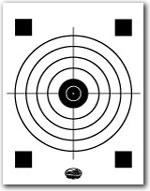
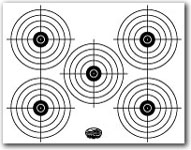
Here, from the National Shooting Sports Foundation (NSSF), are eight (8) Free Targets that can be downloaded as PDF files and printed. All targets are available as PDFs and print on standard 8.5″ x 11″ paper. In the future, other targets may be posted on the NSSF Target Page. Want more FREE targets? Visit AccurateShooter.com’s Target Archive to access dozens of FREE, printable target designs, including load-testing targets, varmint targets, NRA bullseye targets, and fun targets.
Click a target to view and print. Right-click and ‘Save As’ to save PDF to your computer.


 The Bureau of Alcohol, Tobacco, Firearms and Explosives (ATF) has released its 2011 interim Annual Firearms Manufacturers and Export Report (AFMER). The report shows U.S. firearms production in 2011 totaled 6,398,854 units, a 17.2% increase over 2010.
 The
The 
 For the second year, the
  On April 17th, the Sportsmen’s Heritage Act of 2012 (H.R. 4089) passed the House of Representatives with a 274-146 vote. Sponsored by Rep. Jeff Miller (R-Fla.), the bill combines four legislative priorities that will expand recreational hunting, shooting and fishing opportunities and also reaffirms existing law and heads off determined bureaucratic efforts to deny hunters and shooters from using traditional ammunition. This important legislation is supported by more than 35 national conservation and sportsmen’s groups.
 In this NSSF Video, Ryan Cleckner, a former Sniper Instructor for the 1st Ranger Battalion, defines the term “MilliRadian” (Milrad) and explains how you can use a mildot-type scope to range the distance to your target. It’s pretty simple, once you understand the angular subtension for the reticle stadia dots/lines. Cleckner also explains how you can use the milrad-based reticle markings in your scope for elevation hold-overs and windage hold-offs.

 ShootingPlaces.com vs. WheretoShoot.org