Eurooptic vortex burris nightforce sale


teslong borescope digital camera barrel monitor


As an Amazon Associate, this site earns a commission from Amazon sales.


September 29th, 2015

2015 F-Class Nationals At Ben Avery Coming Soon

F-Class Nationals Phoeniz Berger Arizona
Here’s 2014 F-TR National Champion James Crofts, with his PR&T-built rig.

Are you ready? The 2015 F-Class Nationals event is just three weeks away. The combined mid-range and long-range F-Class National Championships will be held October 23 – 31, 2015 in Phoenix, Arizona.

CLICK HERE for 2015 F-Class National Championships Program and Entry Form.

For 2015, the Nationals will include both Mid-Range and Long-Range competitions. The NRA F-Class Mid Range National Championship will be held 23-27 October 2015. The F-Class Long Range National Championship then runs from October 27 through 31. The competition consists of two different Divisions: F- Open and F-TR (Target Rifle). Each Division is made up of five different Categories: High Master, Master, Expert, Sharpshooter and Marksman. There will also be a series of four-person team matches. The event is limited to 320 competitors maximum. All matches will be held at the Ben Avery Shooting Facility outside Phoenix.

You’ll see some serious hardware on the firing line at Ben Avery. Here’s a modern F-Open rig with a handsome maple stock. The gun, belonging to David Mann of Texas, shoots as good as it looks.

F-Class Nationals 2015 Ben Avery Phoenix Arizona AZ

Under Two Inches at 500 Yards
To be competitive at the Nationals, one needs a tack-driving rifle and an ultra-accurate load. Shown below is one of Paul Phillips’s F-TR load development targets at 500 yards. The total 5-shot group size is under two inches. Impressive. That’s with 200gr Bergers, Varget powder, and large primer Lapua brass. Paul tell us: “The X-Ring is 5 inches at 1000 yards (equivalent to 2.5 inches at 500). We strive to be all in the X-Ring. However, wind is the big obstacle. A gust of wind can move you 1-2 feet away.”

Fall foliage F-TR F/TR Nationals Paul Phillips .308 Win F-Class Phoenix 2014

F-Class National Championship Registration and Deadlines
Competitors must submit the official Registration & Entry Form (include NRA Membership ID#). Entries MUST be accompanied by check, money order or NRA Points. Make Check payable to Desert Sharpshooters Rifle Club.

Fees are $375.00 for both Mid-Range and Long-Range matches (combined), or $200 for just one match only (either Mid-Range or Long-Range). Team Matches cost $60 per entry.

Mail Entry Forms and checks to:
Middleton Tompkins
P.O. Box 11684
Prescott, AZ 86304.
Phone: (928) 776-8576.

Entry Deadline: The deadline for entries is 6:00 PM Monday, 12 October 2015. Entries after this time are considered late entries and may be accepted to fill vacancies on existing relays only. An additional $20.00 will be charged for late entries, on top of the basic fees.

2015 F-Class Nationals Ben Avery Phoenix Nightforce

2014 F-Class Nationals Photos copyright Nightforce Optics, used with permission.

Permalink Competition, News No Comments »
June 27th, 2015

New F-TR Stock from McMillan

McMillan Fiberglass Stock F-Class F/tr F-TR Derek Rodgers Sinclair

McMillan has developed a new stock for F-TR competition. The front half is like a prone stock while the rear section has a straight underside (toe) section for smooth tracking in the rear bag. This stock appears to be designed for hard-holding, with a vertical grip and a fairly tall adjustable cheekpiece. The stock weighs just five pounds complete with adjusting hardware, so F-TR rigs built with this new stock should “make weight” easily. (The F-TR limit is 8.25kg or 18.188 pounds including bipod.)

Paul Phillips of Team Sinclair revealed the new McMillan stock on his Facebook page. Paul reports: “McMillan has been a leader in the industry for 40 years. I can’t thank the McMillan family enough for all they have done for our Military, Law Enforcement and Competitive shooting communities. Kelly McMillan and Team Sinclair worked together on what stock profile and features would be the best for FTR competition and this is what came out of the oven. Kelly also came up with some strong, super-light hardware that put the entire weight of the finished stock after bedding at 5 pounds even.

After Alex Sitman from Masterclass Stocks bedded my new stock, he told me that this new stock design is a true work of art and will fill a huge void in F-TR. Derek Rodgers set the current 1000-Yard F-TR record, 200-12X, with a McMillan prone-style stock. Team Sinclair holds the current 1000-Yard Team Record, 792-38X, and McMillan also contributed to that. McMillan [helps sponsor] the USA F-TR Team and Team Sinclair. Team USA will also be using these stocks in the upcoming 2017 World Championships hosted in Ottawa, Canada.”

Making Weight in F-TR — Every Ounce Counts

One Facebook reader asked why the new F-TR stock was so light. Here is Paul’s response:

Question: Paul, 5 pounds seems a little light. My Anschutz [stock] is heavier. Wouldn’t you want a heavier stock for stability, particularly for long range shooting?

Answer: It’s a fine line making an 18.18-pound weight limit. We need longer barrels to get the velocity to push 185- and 200-grain bullets. We also have a scope and bipod that add weight. It’s a balancing act. As I mentioned before, the current National record is with the same weight McMillan prone stock, just different profile. It works.

Permalink Competition, New Product No Comments »
October 29th, 2013

Extreme Long-Range Accuracy — Making the Mile Shot

As a member of the World Champion Team USA F/TR squad, Paul Phillips regularly competes (and wins) at 1000 yards. Paul is also a long-range hunter. Here’s his story about developing his ultimate long-range hunting rifle. Chambered for the .338 Lapua Magnum, this rig is accurate out to 1800 yards.

The Long-Range Challenge By Paul Phillips
Being an avid big game rifle hunter, my goal was to build the most accurate long-range hunting rifle possible that would still be light enough to carry. My thought was to use the same type of high-quality components as what I used on my US F/TR Team Rifle, except in a bigger caliber — a caliber that would have plenty of knock-down power at very long ranges. After extensive research, including both ballistic data analysis, as well as discussion with top gunsmiths and champion long-range shooters, I chose the .338 Lapua Magnum. My past experience from being a member of a USMC Scout Sniper Platoon and a shooting member of two World Champion U.S. F-Class F/TR teams, I knew that this rifle was more than capable of performing the task. After establishing that the rifle had half-MOA accuracy at 600 yards, we wanted to see how far the rifle could maintain sub-MOA accuracy, to see what the cartridge and rifle could achieve. Could this gun shoot sub-MOA at a mile? That was our challenge.

Paul Phillips .338 Lapua Magnum rifle one mile Brux Barrel McMillan A5 stock

Rifle Components and Gunsmithing
My rifle was built on a Stiller Tac-338 single-shot action. It has a 30″, 1:10″-twist Brux barrel, a McMillan A-5 stock with Magnum fill, a Sinclair Bipod, and a Remington X-Mark trigger set at two pounds. The rifle wears a Nightforce NXS 8-32x56mm scope in Nightforce rings on a +40 MOA rail. I chose David Tooley to install the barrel, custom brake, apply a Cerakote dark earth finish and bed the stock. After speaking with Mr. Tooley in great length, I chose his no-neck-turn match .338 Lapua chamber specifically designed for the 300 grain Berger Bullet. This rifle weighs 17 pounds and, with the muzzle brake, it recoils like a standard .308 Winchester.

Paul Phillips .338 Lapua Magnum rifle one mile Brux Barrel McMillan A5 stock

Load Development and Accuracy Testing
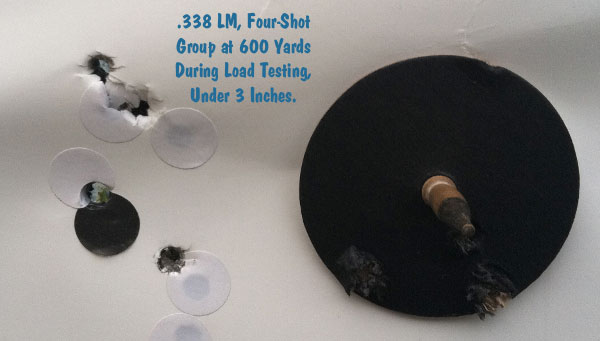
I used the 600-yard range at the Midland County Sportsman’s Club. If I was going to have any chance of hitting small targets at a mile, I would need to find a load that could produce half-minute (0.5 MOA) or better accuracy. I found an accurate load that gave me consistent half-minute groups that chronographed at 2825 FPS. My load consisted of Lapua brass, Federal 215M Primer, Alliant Reloder 25, and Berger 300gr Hybrid OTM bullet. With the Berger 300-grainer’s listed 0.419 G7 BC, this load would be good enough to reach 1880 yards before going subsonic. This load’s calculated energy at one mile is 960 ft/pounds. This is similar to a .44 magnum pistol round at point-blank range.
Paul Phillips .338 Lapua Magnum rifle one mile Brux Barrel McMillan A5 stock

With my +40 MOA scope rail, my 100-yard zero ended up with the elevation at the bottom of the tube and the windage just 2 MOA left of center. This left a full 65 Minutes of Elevation — enough to get out to 1800 yards. This gave me the capability to aim and shoot from 100 yards to 1800 yards with a projectile that is still supersonic at 1800.

Hitting a 10″ Balloon at One Mile
For a one-mile target, I chose a balloon inflated to 10″ in diameter. The balloon would be a challenging, reactive target that would show up well on video. I teamed up with a fellow long-range shooter, John Droelle and friend Justin Fargo to attempt this feat. Using my known 600-yard Zero, my ballistics program showed my come-up for 1783 yards to be 53 MOA. After two sighters that measured 4 inches apart, I adjusted up one minute from my spotter shot and nailed my 10″ balloon at one mile. This video was recorded with my iPhone attached to my 25-power Kowa spotting scope, so it may seem a lot closer than it really is. Below is a video of the shot. Needless to say I achieved my goal and was very excited.

Watch Hit on 10″-Diameter Balloon at One Mile with .338 Lapua Magnum

After my balloon shot, I let my friend Justin Fargo, a novice shooter, try his skills. Justin told me that he had never shot past 100 yards using a common deer rifle. Surprisingly, Justin not only kept all his shots under 1 MOA, he hit the 9-inch white circle in the middle of the target. This bullet hole measured only 4.3 inches from the center of where he was aiming. Truly amazing! The target below shows Justin’s shots at one mile. Note that All the hits are located within the 24-inch black circle.

Paul Phillips .338 Lapua Magnum rifle one mile Brux Barrel McMillan A5 stock

What I Learned — With the Right Equipment, Even a Novice Can Make Hits at a Mile
The above results demonstrate that even a novice shooter with a high-quality, custom rifle and match-grade ammo can make extreme long range shots with great accuracy. It is very important to understand the ballistics of the bullet and the effect of wind drift to make precision, first-shot hits on your target. It is also important that you know your target, backstop and beyond when making these shots. To date, I have shot approximately 40 shots at a mile in calm conditions while averaging 3-shot groups between ½ to 1 MOA (1 MOA is about 18.5″ at that distance). My next experiment is to see how well these bullets perform traveling at subsonic speeds out to 1.5 – 2 miles. Stay tuned!

Special thanks to the following people that helped out with this project: Geoff Esterline, David Tooley, Dick Davis, John Droelle, Ray Gross and Bryan Litz.

Editor’s Comment: The point of this article is to show the kind of accuracy a precision rifle system can achieve, consistently, at extreme long range. Though this rifle will do duty as a hunting arm, Phillips is not advocating that a .338 LM be used to harvest animals at the full limit of its supersonic range. Because winds are hard to predict at extreme long range in a hunting situation, Phillips cautions that the practical distance at which he would shoot game with a rig like this is much, much shorter.

Permalink Gunsmithing, Hunting/Varminting 9 Comments »