Eurooptic vortex burris nightforce sale


teslong borescope digital camera barrel monitor


As an Amazon Associate, this site earns a commission from Amazon sales.


June 29th, 2010

U.S. Army Issues New M855A1 Ammo to Troops in Afghanistan

The U.S. Army has begun shipping its new, improved 5.56×45 cartridge, the M855A1 Enhanced Performance Round, to U.S. troops in Afghanistan. The Army will procure over 200 million rounds of the new M855A1 ammo in the next 12-15 months, and soldiers in Afghanistan will begin using M855A1 ammo in the summer of 2010. The new round replaces the current M855 cartridge used by U.S. troops since the early 1980s.

M855A1 ammunition ammo EPR

The military sought to replace current M855 ammo because M855 has not performed adequately in the Afghan theater. Specific complaints include: 1) inability to effectively penetrate vehicle windshields; 2) poor long-range performance; and 3) failure to fragment even in short-range anti-personnel use. The Army’s Picatinny Arsenal claims that the new M855A1 has improved hard target capability, more consistent performance at all distances, improved accuracy, reduced muzzle flash, and higher velocity. M855A1 ammo is tailored for use in M4 carbines but should also give enhanced performance in M16s and M249s.
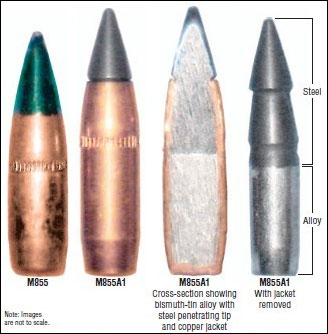
M855A1 ammunition ammo EPRNew Steel-Tip Bullet Design
The 62-grain bullet for the new M855A1 ammo is a completely new design. While it may appear to have a plastic “ballistic tip”, that’s deceiving. The new bullet created for M855A1 ammo has a bismuth-tin alloy core with a steel “stacked-cone” penetrating tip. The photo at right shows the version from last year; the final production version may be slightly different (e.g. the final version tip is a different color). Apparently the latest bullet design is a winner. During testing, M855A1 ammo performed better than current 7.62mm ball ammunition against certain types of targets. According to Lt. Col. Jeffrey K. Woods, the program’s product manager, the new M855A1 ammo is “the best general purpose 5.56mm round ever produced. A true general purpose round, the M855A1 exceeds the performance of the current M855 against the many different types of targets likely to be encountered in combat.” The chart below illustrates how M855A1 ammo performs on hard targets compared to M855.

M855A1 hard target

Over One Million Rounds Fired in Army Tests
Prior to initial production, the new M855A1 round underwent vigorous testing. Official qualification of the round consisted of a series of side-by-side tests with the current M855. Overall, the Army fired more than one million rounds to ensure the new cartridge met all expectations. The new M855A1 round is the “most thoroughly tested small caliber round ever fielded” according to Lt. Col. Woods. The new M855A1 is sometimes called “Green Ammo” because it uses a lead-free projectile. Woods said the M855A1’s bullet design shows how “greening” a previously hazardous material can also provide extremely beneficial performance improvements.

Permalink Bullets, Brass, Ammo, New Product, News 14 Comments »
September 22nd, 2009

Ruger Reveals New SR-22 — Rimfire AR Look-alike

Ruger has just announced the new SR-22, which is a Ruger 10/22 shamelessly tarted up to look like an AR-15. For tactical and 3-gun competitors needing a practice weapon that shares the ergonomics of their AR15 match gun, the SR-22 makes sense. Otherwise, frankly, we lament the addition of the wobbly and poorly-designed AR-style collapsible stock to a firearm that works just fine with a conventional stock. We do like the integrated Picatinny-style rail on top of the action. This allows you to easily mount Red Dot sights or other optics. But does anyone really need rails on the forearm or a Mini-14 flash suppressor on a 22LR? No, but these features will probably sell more rifles. Anything that looks “tacticool” these days seems to sell well.

Ruger SR-22

CLICK HERE for SR-22 Specifications Sheet

MSRP for the new SR-22 is $625.00 and we expect street price to be about $575.00. That’s more than twice the price of a standard 10/22 that, frankly, performs pretty well once you’ve upgraded the trigger. Is it worth paying double to get a pistol grip, AR-style buttstock, and Picatinny scope rail? Ruger is banking on the fact that AR devotees will say yes and shell out big bucks for the SR-22.

AR Egonomics with 10/22 Economy and Simplicity
According to Ruger, the “SR-22 Rifle allows shooters to use economical .22 LR ammunition, while still enjoying the look and feel of an ‘AR’. [The gun] faithfully replicates the AR-platform dimensions between the sighting plane, buttstock height, and grip. Like the 10/22, the AR-style SR-22 Rifle also has an extensive array of accessories available, allowing shooters to select a custom configuration that best suits their tastes and needs.”

Ruger SR-22

The SR-22 uses standard SR-22 rotary magazines. Indeed, at its heart, the SR-22 is pretty ordinary. It features a standard 10/22 action inside an aluminum Nordic Components chassis that provides the rail mount, buttstock mount, and AR-style grip mount. The SR-22 ships with a six-position, telescoping M4-style buttstock (on a Mil-Spec diameter tube), plus a Hogue pistol grip. Buttstocks and grips may be swapped out for any AR-style compatible option. The wobbly, collapsible buttstock is the first thing this editor would toss on the SR-22.

Interestingly, the round handguard/float tube is secured with a standard-thread AR-style barrel nut, and the handguard is drilled and tapped for rails at the 3, 6, 9 and 12 o’ clock positions. Picatinny handguard rails are available from Ruger so you can add rail-mounted gizmos to your heart’s content. There is a barrel support V-block in the handguard so you can easily swap barrels or install after-market 10/22 barrels. The SR-22’s 16-1/8″ barrel is capped with an Mini-14 flash suppressor mounted with AR-spec ½”-28 thread.

YouTube Preview Image
Permalink New Product 7 Comments »
February 28th, 2009

TECH TIP: Picatinny vs. Weaver Rail Specifications

Readers often ask “What’s the difference between a Weaver scope rail and a Picatinny Rail?” The answer is not as simple as it seems. The dimensions of a Picatinny Rail should be consistent (from one rail-maker to another), since there IS a government spec. Conversely, there is some variance in “Weaver-style” rails. The width of the groove is the most important difference between Picatinny Rails and weaver rails. “Mil-spec” Picatinny rails will have a grove width of 0.206″ while Weaver rails typically have a narrower, 0.180″ groove width.

Brownell’s has a helpful GunTech Article that discusses the Picatinny Rail vs. Weaver Rail. That article explains:

“What are the differences between the ‘Picatinny’ and the ‘Weaver’ systems? The profile of the two systems is virtually identical. Depending on the quality of the machining done by the manufacturer, the two systems should be indistinguishable from the profile. The key difference lies in the placement of the recoil grooves and with width of the grooves. MIL-STD-1913 (Picatinny) grooves are .206″ wide and have a center-to-center width of .394”. The placement of these grooves has to be consistent in order for it to be a true ‘Picatinny’MIL-STD system. Weaver systems have a .180” width of recoil groove and are not necessarily consistent in a center-to-center measurement from one groove to the next.

In many instances, a Weaver system has a specific application that it is machined for, so interchangeability is not necessarily an issue. A MIL-STD-1913 system must adhere to the specifications listed above in order for it to be considered MIL-STD, since the military desires uniformity in the recoil grooves to allow for different systems to be mounted on the weapon with no concern for compatibility.

Now, what does this mean to you? Boiled down, it means that accessories designed for a Weaver system will, in most cases, fit on a ‘Picatinny’ system. The reverse, however, is probably not the case. Due to the larger recoil groove, ‘Picatinny’ accessories will not fit a Weaver system. There are, of course, exceptions to every rule, but for a good rule-of-thumb, [full-width] ‘Picatinny’ won’t fit Weaver, but Weaver will fit ‘Picatinny’.”

Permalink Optics, Tech Tip 3 Comments »