|
|
January 14th, 2018

 Looking for the highest ballistic performance for your benchrest, F-Class, or tactical rifle? Sierra now offers a wide selection of ultra-high-BC bullets in a wide range of popular calibers. Looking for the highest ballistic performance for your benchrest, F-Class, or tactical rifle? Sierra now offers a wide selection of ultra-high-BC bullets in a wide range of popular calibers.
New Heavy .224 SMK – We just learned that Sierra will release a new-for-2018 95-grain MatchKing. This new .224 projectile, Sierra product #1396, has a claimed G1 BC of 0.600 — mighty impressive for a .22-caliber bullet. There are also two new .308-caliber MatchKings, a 200-grainer with 0.715 G1 BC, and a new 230-grainer with a stunning 0.800 G1 BC.
More High-BC MatchKings in All Your Favorite Calibers
Sierra previously released four other very slippery, heavy-for-caliber MatchKings that have raised the BC Bar for their respective calibers. For example, the 150gr 6.5mm bullet really “pushes the envelope”. In past years, 140-142 grains was considered “high end” for a 6.5mm match projectile. Here are Sierra’s BC Leaders for 6mm, 6.5mm, 7mm, and .308 calibers. Many of these New Generation MatchKings now come “tipped” from the factory for more uniform BC.
| Heavy-for-Caliber, Ultra-High BC Sierra MatchKings |
|
6mm (.243 Caliber)
110 grain MatchKing #1575
0.617 G1 BC
|
7mm (.284 Caliber)
197 grain MatchKing #1997
0.780 G1 BC
|
|
6.5 mm (.264 Caliber)
150 grain MatchKing #1755
0.713 G1 BC
|
7.62mm (.308 Caliber) NEW
230 grain MatchKing #2251
0.800 G1 BC
|
SPY PHOTO Reveals New High-BC Sierra MatchKings
One of our Forum members captured a spy photo with all the new-generation High-BC Sierra MatchKings in a line-up. This includes the new 95gr .224 SMK right at the top. The new 200gr and 230gr 30-cal SMKs are near the bottom. NOTE: Sierra already had a 30-Cal 200 grainer, #2230, in its line-up. This is a NEW 200 grain MatchKing, #2231, with a much higher BC — 0.715 vs. 0.565 for the older 200gr bullet. That’s a huge difference in BC, a 26% improvement.

December 20th, 2017

NOTE: There are ten (10) shots in the group, but for simplicity we are only displaying five (5) shot circles. Adding more circles won’t change the measurement because the two most distant shots, which determine group size, ARE included.
What kind of 200-yard accuracy can you get in an enclosed, underground test range? Would you believe 0.162 MOA at 200 yards with a .338? Have a look at these test targets from Sierra Bullets. Like most bullet manufacturers, Sierra does live-fire bullet testing to ensure that Sierra projectiles perform as promised, with repeatable accuracy. Sierra tests bullets in its own underground test complex. Sierra’s 300-meter test range is the longest, privately-owned underground bullet test facility in the world. Sierra offers free tours of the test tunnel as part of Sierra’s Factory Tour Program.

Day in and day out, various bullet types are tested using a big collection of barreled actions. These barreled actions are clamped in stout, return-to-battery test fixtures. These big, heavy test fixtures provide near-perfect repeatability (with no human-induced holding or aiming errors).
Sierra Bullets 10-Shot Groups at 200 yards
Check out these 10-shot test groups shot at the Sierra Test Range at 200 yards. Note that the numbers listed on each sample are actual measurements in inches. To convert to MOA, cut those numbers in half (to be more precise, divide by 2.094, which is 1 MOA at 200 yards). For example, the 0.340″ middle group works out to 0.162 MOA at 200 yards.

 Scan-Verified 0.162 MOA Accuracy at 200 Yards Scan-Verified 0.162 MOA Accuracy at 200 Yards
To verify the accuracy of Sierra’s measurements, we measured the middle (.338 caliber) 10-shot group with our On-Target Group Measurement software. We registered a group size reading of 0.339″ — within one-thousandth of the Sierra measurement. The calculated group size in MOA (Minute of Angle) is 0.162.
That’s amazingly good for ten rounds of big .338 caliber bullets. A FIVE-shot 0.162 MOA group at 200 would be considered excellent at any benchrest match. But remember this target has TEN shots. The current, one-target IBS world record for ten shots at 200 yards is 0.245″, set by Ed Watson in 1999.
Bevy of Barreled Actions for Bullet Testing
Sierra Bullets uses dozens of barreled actions for testing bullets in its enclosed, 200-yard test range. Each barrel has its own logbook to track the barrel’s usage.

Click Photo to Zoom
December 13th, 2017

Are you feelin’ lucky? Well here’s your chance to win. For 12 Days in December (through the 22nd), Powder Valley is giving away a total of $15,000 worth of products from big name suppliers. That averages well over $1,000 worth of product prizes every day. This is top-of-the-line stuff, including Powder from Accurate, Alliant, Hodgdon/IMR, Ramshot, and Shooters’ World, Bullets from Berry’s, Nosler, Sierra, Speer, and Zero, Ammunition from Hornady, Nosler, and Zero, plus Reloading Hardware from Hornady. Each day there will be a new set of prizes. Today’s prizes (for December 13, 2017) are Zero Bullets and Zero Ammunition.
It’s easy to qualify to win one of the Daily Giveaway prize packages. Simply visit Powder Valley’s Facebook Page, and make a comment on the featured Daily Giveaway Post. You don’t have to fill out any forms, but you must have a Facebook account so you can comment. Each day the folks at Powder Valley will select winners from among the visitors who commented. In days ahead there can be multiple daily winners. And on Day 12 there will be very special prize give-aways including Powder Valley Gift certificates. NOTE: You can enter multiple times by commenting on multiple days, but sorry, if you win, you are no longer eligible.
Powder Valley Daily Giveaway — New Prizes Every Day
Powder Valley’s 12 Days of Christmas promo kicked off Monday, December 11th, 2017. To enter, you must visit the Powder Valley Facebook Page. Once there, scroll down to find the Giveaway of the Day. You need to comment on that post to be entered. Winners will be selected by lottery from those who comment. Each successive day, through December 22nd, there will be another product giveaway post.

To be entered in this Powder Valley Contest, you need to go to the Powder Valley Facebook Page and post a Facebook Comment for the Daily Prize story. NOTE: You MUST post your comment on Powder Valley’s Facebook Site, NOT HERE. And you need to comment each day to be entered in that particular day’s contest. To have repeat chances to win you need to comment on multiple days. Got it?
December 5th, 2017

This article, which originally appeared in the Sierra Bullets Blog, provides a new terminology that helps describe the geometry of bullets. Once you understand the meaning of “Caliber(s) of Ogive”, you can quickly evaluate potential bullet performance by comparing listed Caliber of Ogive numeric values.
by Mark Walker, Sierra Bullets New Product Development Manager
During one of our recent product releases, we listed the “caliber of ogive” of the bullet in the product description. While some understood what that number meant, it appears that some are not aware of what the number is and why it is important. In a nutshell, the “caliber of ogive” number will tell you how sleek the front end of the bullet is. The higher the number is, the sleeker the bullet. It also makes it easy to compare the ogives of different caliber bullets. If you want to know if a certain .308 caliber bullet is sleeker than a 7mm bullet, simply compare their “caliber of ogive” numbers.
So exactly how do you figure “caliber of ogive”? If you look at the drawing of the .30 caliber 175 gr HPBT bullet #2275 (at top), you will see that the actual radius of the ogive is 2.240. If you take that 2.240 ogive radius and divide by the diameter (or caliber) of the bullet you would get 7.27 “calibers of ogive” (2.240 ÷ .308 = 7.27). (See top photo).
In a nutshell, the “caliber of ogive” number will tell you how sleek the front end of the bullet is. The higher the number is, the sleeker the bullet.
Next let’s look at the print (below) of our 6.5mm 142gr HPBT #1742 bullet for comparison. The actual radius of the ogive is 2.756. Like with the .30 caliber 175 gr HPBT bullet #2275, if you divide 2.756 by the diameter (or caliber) of the bullet you get 10.44 “calibers of ogive”.
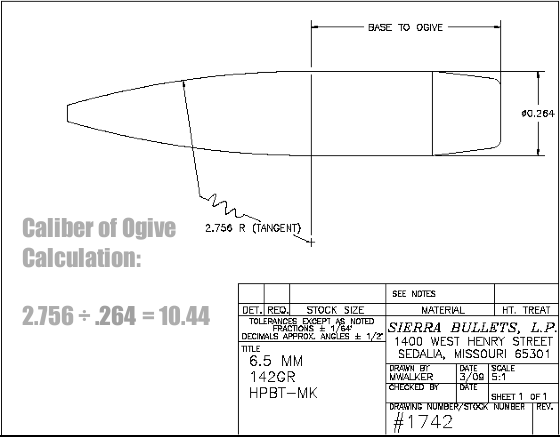
As most people know, it has been determined through testing that the 6.5mm 142gr HPBT #1742 has a significantly higher ballistic coefficient than the .30 caliber 175 gr HPBT bullet #2275. However by simply comparing the “caliber of ogive” number of each bullet you can easily see that the 6.5mm 142 gr HPBT #1742 is significantly sleeker than the .30 caliber 175 gr HPBT bullet #2275 even without firing a shot.
Some people would say why not just compare the actual ogive radius dimensions instead of using the “caliber of ogive” figure. If we were comparing only bullets of the exact same diameter, then that would be a reasonable thought process. However, that idea falls apart when you start trying to compare the ogives of bullets of different diameters. As you can see with the two bullets presented above, if we compare the actual ogive radius dimensions of both bullets the difference is not much at all.
However, once again, testing has shown that the 6.5mm 142 gr HPBT #1742 has a significantly higher BC. The only way that this significant increase shows up, other than when we fire the bullets in testing, is by comparing the “caliber of ogive” measurement from both bullets.
Hopefully this will help explain what we mean when we talk about “caliber of ogive” and why it’s a handy number to use when comparing bullets. This information will help you to make an informed decision the next time you are in the market to buy bullets.

Story tip from Grant Ubl. We welcome reader submissions.
November 17th, 2017
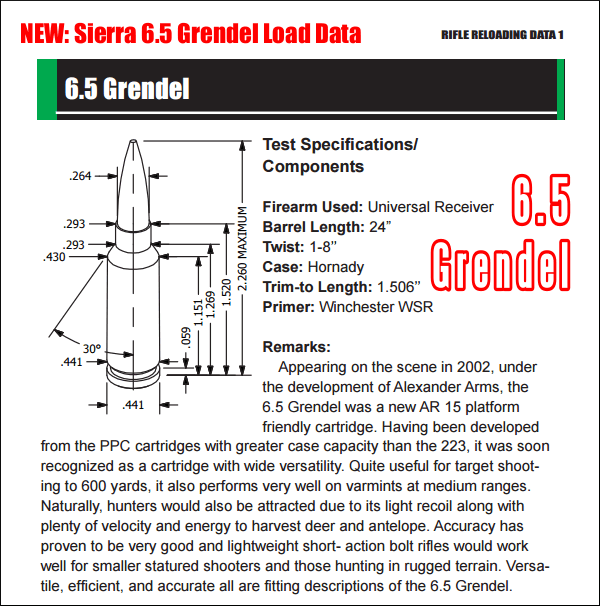
Sierra Bullets has just released load data for the 6.5 Grendel, a popular cartridge that works equally well in bolt guns and AR15-platform gas guns. Sierra published comprehensive 6.5 Grendel load data, covering 19 powders and eight (8) different bullets from 85 to 130 grains. NOTE: Hornady-brand brass (see below) was used for Sierra’s 6.5 Grendel tests, not the stronger Lapua 6.5 Grendel brass. Hand-loaders using Lapua 6.5 Grendel brass may need to adjust their loads. Also Winchester WSR primers were used. We imagine most precision hand-loaders will prefer CCI or Federal primers.
| Sierra Bullets Tested for 6.5 Grendel Load Data |
85gr HP (#1700)
100gr HP (#1710)
107gr HPBT (#1715) |
120gr Spitzer (#1720)
120gr HPBT (#1725)
123gr HPBT (#1727) |
130gr HPBT (#1728)
130gr TMK (# 7430) |
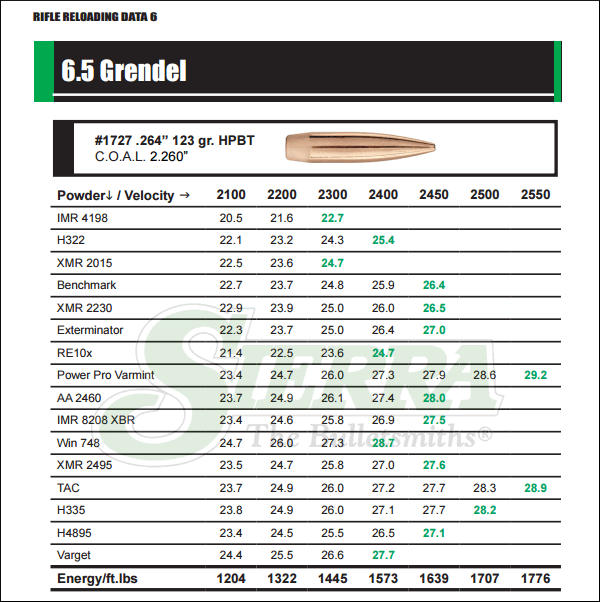
In developing its 6.5 Grendel load data, Sierra tested a very wide selection of propellants, 19 in all. For the 85gr to 100gr varmint bullets, modern powders such as XMR 2230, Power Pro Varmint, and Ramshot TAC offered the best velocity in the 24″ test barrel. For the heavier 120gr to 130gr match bullets, Sierra tested a selection of powders. Highest velocities came with Power Pro Varmint and TAC. If you’re looking for best accuracy, consider the slower burn-rate powders such as IMR 8208 XBR and Varget — but you’ll sacrifice some speed. Overall, Sierra’s latest 6.5 Grendel load data is an excellent addition to the 6.5 Grendel knowledge base. Thanks Sierra!
Here are Sierra’s 6.5 Grendel Load Data Charts for Sierra’s 123gr HPBT, 130gr HPBT, and 130gr TMK. There are a five other tables for lighter-weight Sierra bullets.


History of the 6.5 Grendel Cartridge
The 6.5 Grendel originated as a 6mm PPC necked up to 6.5 mm. After Alexander Arms relinquished the “6.5 Grendel” Trademark, the 6.5 Grendel was standardized as an official SAAMI cartridge. It has become popular with target shooters and hunters alike because it is accurate, efficient, and offers modest recoil. Good for small to medium game, the 6.5 Grendel is becoming a popular chambering in lightweight hunting rifles, such as the Howa Mini Action Model. It is one of the most accurate cartridges you can shoot in the AR-15 platform.
 CLICK HERE for 6.5 Grendel Cartridge History (Wikipedia entry).
November 14th, 2017

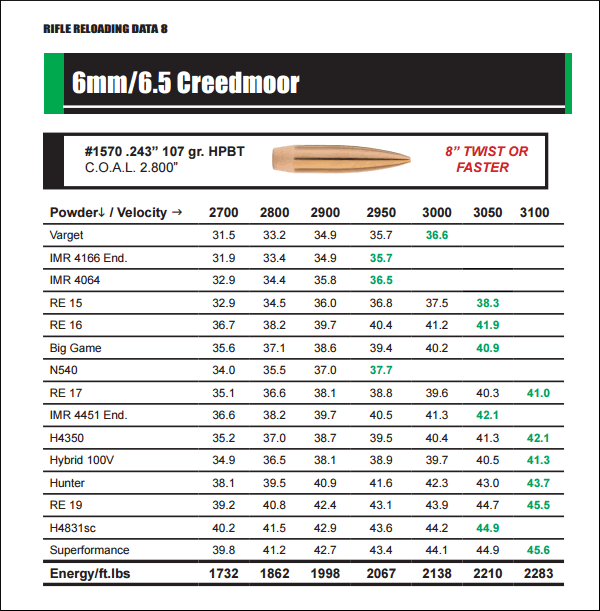
Sierra Bullets has recently released load data for the 6mm Creedmoor cartridge, a necked-down version of the 6.5 Creedmoor, a popular PRS, tactical, and hunting cartridge. Sierra has released very comprehensive 6mm Creedmoor load data, covering fifteen (15) different bullets from 55 to 110 grains. NOTE: Hornady-brand brass was used for Sierra’s 6mm Creedmoor load tests, not the newer, stronger Lapua 6.5 CM brass with small primer pockets. Hand-loaders using Lapua 6.5 Creedmoor brass necked to 6mm may have to adjust their loads.
Sierra writes: “As soon as the 6.5 Creedmoor was released in 2007, a 6mm version was being envisioned. After the 6mm Creedmoor demonstrated its worth at 1000 yards it began to catch the attention of Precision Rifle Series (PRS) competitors. The 6mm/6.5 Creedmoor is a great fit for those looking for an AR platform-friendly cartridge. It delivers velocities very similar to the .243 Win and yet fits the AR10 magazine length[.] The 30-degree shoulder makes this a very efficient case and helps prolong case life as well. The 6mm/6.5 Creedmoor works well with powders such as H4350, RE-17, and Ramshot Hunter for heavier long-range bullet weights. Slightly faster powders such as RE-15, Win 760, and Vihtavuori N540 work well with lighter weight bullets.”
| Sierra Bullets Tested for 6mm Creedmoor Load Data |
55gr BlitzKing (#1502)
60gr HP (#1500)
70gr HPBT (#1505)
70gr BlitzKing (#1507)
75gr HP (#1510) |
80gr SBT (#1515)
85gr Spitzer (#1520)
85gr HPBT (#1530)
90gr FMJBT (#1535)
95gr HPBT (#1537) |
95gr TMK (#7295)
100gr Spitzer (#1540)
100gr SBT (#1560)
107gr HPBT (#1570)
110gr HPBT (#1575) |
In developing its 6mm Creedmoor load data, Sierra tested a very wide selection of propellants, two dozen overall. For the smaller bullets, fast-burning powders such as Benchmark, H4895, and CFE223 were tested. For the heavier 100+ grain bullets, Sierra tested a selection of medium-burn-rate powders including H4350, Reloder 16, Reloder 17, Varget, and Superformance. Sierra did a very thorough job. We know this information will be welcomed by 6mm Creedmoor shooters.
Don’t know what powder to try first? For the 107-110 grain bullets, if you want best accuracy and low ES/SD, our Forum members recommend Alliant Reloder 16 and Hodgdon H4350. If you are seeking max velocity with the 110-grainer, look at Hodgdon Superformance and Reloder 19.
Here are Sierra’s 6mm Creedmoor Load Data Charts for the 107gr MK and 110gr MK. There are a half-dozen other tables for lighter-weight bullets.

November 1st, 2017
This article was written in 2014 for the Sierra Bullets Blog. It describes one method of load development that is commonly used. There are other methods that can work also. Some guys first isolate seating depth and then fine-tune velocity with charge weights. Other guys may aim for a known velocity node (speed range) and then optimize accuracy by adjusting seating depth. Still others look for smallest ES and tightest vertical to minimize 1000-yard vertical dispersion. There are many ways to skin a cat. Different rifles (and even different barrels) can demand different styles of load development.
In this instance the writer achieved desired results seating his bullets .007″ back from max “jam” length. For other applications (and other barrels) you may get the best, most consistent results seating off the rifling by .020″ or more. In disciplines with quick-fire such as PRS, it may be wise to develop loads that “jump” the bullet.
F-Class Long Range Load Development Methodology
by Mark Walker, Sierra Bullets Product Development Manager
Since I just put a new barrel on my F-class rifle… I figured it might be a good time to discuss load tuning for long range shooting. Getting the most accuracy out of your rifle is one of the most important aspects of load tuning. For long range shooting in particular, using a load that produces the least amount of vertical variation is vital. There are several steps to the process that I use, so I will go through the basics of each.
When I first get a new barrel installed, I like to determine what the loaded cartridge “jam” length is. I do this by taking an empty case (no powder or primer) that has been neck sized with the proper bushing (I like to shoot for 0.002 smaller than the loaded cartridge neck diameter) and seat a bullet long in it so that the throat of the rifle will move the bullet back into the case when I close the bolt. I close the bolt several times until the bullet stops moving back into the case at which point I use a comparator with my calipers and get a length measurement on the cartridge. This is what I consider to be the “jam length” for this barrel and chamber. I came up with 3.477″ as the “jam length” for this particular barrel. [Editor: In this instance, Mark is using “Jam length” to mean max seating depth he can achieve without bullet set-back.]
Next, I will fire-form some brass using a starting load of powder and bullets seated to “jam” while breaking in the barrel. My barrel break in process is not very technical; it’s mostly just to get the brass formed and the rifle sighted in. I do clean every 5 rounds or so just because I feel like I have to.
Once I have the brass formed, I use them to load for a “ladder test” to see what powder charge the rifle likes. With a ladder test, you take your starting load and load one round each with a slightly increasing amount of powder until you reach your max load for that cartridge. You then fire each round using the same aiming point to see where the bullets start to form a group. For this barrel and cartridge, I started at 53.3 grains of H4831SC powder and increased the load by 0.3 grains until I reached 55.7 grains. I always seat my bullets to “jam” when doing a ladder test. We will determine the final seating depth in another test later. It’s usually best to shoot this test at a minimum of 200 yards because at closer ranges the bullets will impact too close together making it hard to determine which load works best. I shot this test at 300 yards.

As you can see from the target, the lightest load #1 had the lowest velocity and impacted lowest on the target. Shots #2 and #3 were a little higher and in the same hole. Shots #4 thru #6 were slightly higher yet and all had the same elevation. Shots #7 and #8 were the highest on the target however pressure signs were starting to show. For some reason shot #9 went back into the group and the chronograph didn’t get a reading so I ignored that shot.
When picking a load, I am looking for the most shots at the same vertical location on the target. As you can see that would be shots #4 through #6 so I would pick a powder charge from those shots which would be 54.2 grains to 54.8 grains. As a side note, shots #2 and #3 are only 0.851 lower so I wouldn’t be afraid of using one of those loads either. I settled on 54.5 grains as the load I wanted to use. It’s right in the middle of the group so if the velocity goes up or down slightly, the bullet should still hit in the same place on the target.
Now that we’ve settled on a powder charge, I want to find the seating depth the rifle likes. I usually start at jam length and [shorten the COAL] in 0.003 increments until I get to 0.015 deeper than jam. [Editor: By this he means he is seating the BULLET deeper in the case, NOT deeper into the lands. He ended up at .007″ shorter than his hard jam length of 3.477″.]
I load 3 rounds at each depth using the 54.5 grain powder charge and shoot a group with each depth at 150 yards. As you can see from the target, the first two groups are not good at all. Next one looks good and is the smallest group on the target. The next three are not quite as small but the vertical location on the target is almost the same which indicates a sweet spot which will help keep the vertical stringing to a minimum on target. I went with 3.470″ which is right in the middle once again and should give some flexibility with the seating depth.

So after all of that, my load is 54.5 grains of H4831SC and a cartridge length of 3.470. I plan on loading up enough ammo to shoot five groups of five shots and see exactly how this load works on target as well as what the extreme velocity spreads are over several groups.
I sincerely hope some of this information helps you to get the best accuracy out of your rifle. I do not take credit for coming up with any of this, a whole lot of good shooters use this same method or a variant of it when working up their loads.
For more information about load development, please contact the Sierra Bullets technical support team at 1-800-223-8799 or by email at sierra [at] sierrabullets.com.
Disclaimer: Load data represented here may not be safe in your rifle. Always start low and work up, watching for pressure signs.
October 13th, 2017

Up until now, 147 grains was the high end of 6.5 mm (.264 diameter) match bullets offered by major bullet-makers. Now Sierra has “raised the bar” — releasing a 150-grainer with a killer 0.713 G1 Ballistic Coefficent (BC). You read that right — 0.713! Compare that to the 0.626 G1 BC for Sierra’s well-known 142gr MatchKing, 0.697 for the Hornady 147gr ELD Match, and 0.607 for the Berger 140gr Hybrid Target. To increase (and uniform) the BC, Sierra’s new 150-grainer is pointed at the factory. Recommended barrel twist rate is 1:7.5″.

CLICK HERE for 6.5 Creedmoor LOAD DATA for this new 150gr Matchking.
Sierras’ product announcement states: “Shooters … will appreciate the accuracy and extreme long range performance of our new 6.5 mm 150 grain HPBT (#1755). A sleek 27-caliber elongated ogive and a final meplat reducing operation (pointing) provide an increased ballistic coefficient for [reduced wind drift] and velocity retention. To ensure precise bullet-to-bore alignment, a unique bearing surface-to-ogive junction uses the same 1.5-degree angle commonly found in many match rifle chamber throats. This bullet requires a twist rate of 1:7.5″ or faster to stabilize.”
Sierra’s new 6.5 mm 150 grain HPBT MatchKing bullet is available in 100-count boxes (#1755) for $50.98 MSRP, and 500-count boxes (#1755C) for $226.45 MSRP.
August 23rd, 2017

Here is the original Sierra manufacturing facility in Whittier, CA.
On August 22, 2017 it was announced that Sierra Bullets has been sold to Clarus Corporation (NASDAQ: CLAR), a Utah-based holding company that also owns Black Diamond Equipment Ltd., makers of ski and mountain gear/apparel. Given the importance of this acquisition, we thought our readers might want to learn more about Sierra’s history, and how it makes its bullets…
Sierra Bullets — How It Got Started
Report Based on Story by Carroll Pilant, Sierra Bullets Media Relations Manager
What became Sierra Bullets started in the late 1940s in a Quonset hut in California. In 1947, three aircraft machinists, Frank Snow, Jim Spivey, and Loren Harbor, rented machine space to produce rivets for the aircraft industry along with fishing rod guides and rifle front sight ramps. In the post-WWII years, sport shooting was becoming hugely popular, but quality ammunition was in short supply. For shooting enthusiasts, reloading was the solution to the ammo supply shortage. Snow, Spivey, and Harbor recognized this, creating Sierra Bullets to help fill the void. Before long, they were selling a 53-grain match bullet to the Hollywood Gun Shop. These bullets are still in production today as the Sierra #1400 53-grain MatchKing.
A few years later, an accomplished competitive shooter named Martin Hull joined Sierra. Hull helped develop new bullet types and served as manager of Sierra’s ballistics laboratory for nearly 20 years. With Hull’s help, Sierra’s output grew rapidly. The California company outgrew several locations before it moved to a large facility in Santa Fe Springs, CA, in 1963.
New Owners and New President in the Late Sixties
In 1968, the Leisure Group bought Sierra Bullets. Other Leisure Group companies included Lyman Reloading, High Standard Manufacturing Company, Yard Man, Thompson Sprinkler Systems, Flexible Flyer Sleds, and Dodge Trophies (Which made the Oscar and Rose Bowl Game trophies).
Soon after purchasing Sierra, the Leisure Group hired Robert Hayden as President and General Manager. Hayden was a mechanical engineer who had worked for Remington Arms. Hayden remained the president of Sierra for 42 years, retiring in 2012 when Pat Daly became president.
Sierra Moves to Missouri
In 1990, Sierra relocated to Sedalia, Missouri, where the company remains today. Sierra Bullets now employs over 100 people including five full-time ballistic technicians who answer daily reloading and firearms questions by both phone and e-mail.

The Making of MatchKings — How Sierra Produces SMKs
All Sierra bullets begin life as a strip of gilding metal, an alloy consisting of 95% copper and 5% zinc. To meet Sierra’s strict quality requirements, the gilding metal requires three times more dimensional and quality control standards than is considered standard in the copper manufacturing industry.

A blanking press stamps out a uniform disc and forms the cup that will be drawn into the MatchKing jacket. The cup is then polished and sent to a draw press to be drawn into a jacket that is longer than needed for the future MatchKing, thus allowing for the trim process. Press operators constantly check concentricity to make sure we have only quality jackets. The jackets then go to a trimmer where they are visually inspected again.

After being polished a second time, the jacket travels to the bullet press. In the meantime, 80-pound lead billets are being extruded into lead wire for the cores where great care is taken so that the core wire is not stretched. The core wire is lightly oiled before continuing to the bullet press to be swaged.
The lead core wire and trimmed jacket meet at the bullet press where the first stage forms a boattail on the jacket. The lead core is then formed on top of the bullet press and fed down into the jacket. In one stroke of the press, the MatchKing is formed.

Quality control technicians pull samples from each lot of MatchKings to make sure they meet Sierra’s stringent standards. Samples are then sent to Sierra’s 300-meter underground test range (shown below) to be shot for accuracy on mechanical mounts referred to as “unrestricted return to battery rests” that Sierra designed and built in-house.

After inspection, the bullets are placed in the familiar green box along with reloading labels. They are then shrink-wrapped and shipped all over the world.
August 22nd, 2017

Sierra Bullets has been acquired by Clarus Corporation (NASDAQ: CLAR) for the sum of $79,000,000, “subject to a post-closing working capital adjustment”. Sierra is one of the world’s leading producers of bullets for hunters, sportsmen, and target shooters. With revenues topping $30,000,000 per year, Sierra has long been a major force in the firearms world. Clarus, formerly Black Diamond Inc., is a Utah-based holding company which “seeks opportunities to acquire and grow businesses that can generate attractive shareholder returns”. Clarus also owns Black Diamond Equipment, Ltd., maker of outdoor equipment/clothing for the climbing, skiing and mountain sports markets.
StreetInsider.com reports: “The transaction is expected to be immediately accretive to Clarus’ earnings per share. For the unaudited 12 months ended June 30, 2017, Sierra’s total revenues were approximately $32 million with EBITDA of approximately $12.5 million, representing a purchase price multiple of approximately 6.3x EBITDA. Sierra has a strong cash flow profile, generating free cash flow conversion of approximately 95% with limited ongoing capex requirements.”
“The team at Sierra has continued building on a 70-year legacy dedicated to the highest-level of precision in design, world-class manufacturing and quality control,” said Warren B. Kanders, executive chairman of Clarus. “These attributes have cultivated a diverse customer base of enthusiasts and industry OEMs that drive high recurring revenue and strong cash flow, which we expect to maximize through the utilization of our net operating loss carry forwards.”
Sierra’s President Pat Daly commented: “Our team takes great pride in developing and manufacturing the most precise and accurate bullets in the world. This is supported by our deep institutional knowledge of highly-specialized manufacturing processes that have produced leading products and created a significant competitive advantage. As the only pure-play bullet brand, it was important for us to partner with a team that shares our values and commitment to excellence, and we are excited to join the Clarus family. I look forward to staying on to continue driving our brand growth.” All senior management are expected to remain with Sierra under Clarus’ ownership.

About Sierra Bullets
Founded in 1947 in California, Sierra Bullets is an American manufacturer of bullets. Based in Sedalia, Missouri since 1990, Sierra manufactures a wide range of bullets for both rifles and pistols. Sierra’s product line, recognized by iconic “green box” packaging, includes popular brands such as MatchKing, GameKing, and BlitzKing. Sierra bullets are used for precision target shooting, hunting, and defense purposes. For more information, visit SierraBullets.com.
News Tip from Boyd Allen. We welcome reader submissions.
|


