This article originally appeared in the Sierra Bullets Blog
Get the Sierra Bullets tech staff together and you have an impressive brain trust, with a vast amount of knowledge about all things shooting- and hunting-related. We asked a variety of Sierra Bullets staffers, all avid hunters, about their favorite hunting venues. Here are their answers to the question: “If you could hunt anything, anywhere in the world, where would you go and what would you hunt?”
Africa topped the list of “dream hunting locations” by a landslide. Canada and Alaska were both picked twice, with other destinations each favored by one staffer:
Africa 6 votes (Kudu, Eland, Cape Buffalo, Leopard, Lion, Plains Game)
Canada 2 votes (Moose, Black Bear)
Alaska 2 votes (Dall Sheep)
Wyoming 1 vote (Antelope)
US Rocky Mountains 1 vote (Elk)
Argentina 1 votes (Doves)
Australia 1 vote (Non-specific)
Carroll Pilant (Ballistics Technician): “Back to Africa for kudu and eland.”
Rich Machholz (Ballistic Technician): “African Cape Buffalo with my longtime friend Lloyd in Zimbabwee.”
Tommy Todd (Chief Ballistician): “Free Range African plains game”
Matt Reams (VP Sales & Marketing): “Probably a leopard. Africa is cool to see and that is a pretty scary/dangerous hunt that would be very thrilling.”
Dan Mahnken (Production Resource Mgr.): “Africa and the African lion. More exciting that way it’s a 50/50 chance for both of us.”
Brad Vansell (Toolsetter): “Anything in Africa, or Australia.”
Philip Mahin (Ballistic Technician): “Canadian Moose”
Duane Siercks (Ballistic Technician): “What? I can’t make a list! My next hunt that I dream about would be to go to Canada for a very large black bear.”
Paul Box (Ballistic Technician): “Alaska – Dall Sheep.”
Craig Westermier (Machine Shop Lead): “Dall Sheep in Alaska.”
David Palm (Process Engineer): “Elk anywhere in the Rockies.”
Gary Prisendorf (Ballistician): “Doves in Argentina.”
Chris Hatfield (Production Manager): “Anything in Australia would be cool.”
Darren Leskiw (Plant Engineer): “I’ve been hunting one time near Douglas, Wyoming and it was beautiful country. I’d love to go back and spend more time there and tag another antelope.”
Hunting in Wyoming
SNS Outfitters & Guides is the largest pronghorn antelope outfitter in North America with over 750,000 acres of leased land. SNS boats a 96% success rate on antelope hunts.
Ever wonders what the bar code (and all those numbers) mean on the side of a box of Sierra bullets? Well here’s the answer, thanks to something we uncovered in the archives of the Sierra Bullets Blog.
How to Decipher Sierra Bullets Barcodes
The Lot Number (indicated in green below) identifies a specific batch of bullets. The lot number remains the same for bullets made at the same time from the same material.
The Packaging Code (indicated in blue below) is an internal number representing the number assigned to the persons who inspected and packed the box of bullets.
The Serial Number (indicated in yellow below) is a computer generated number sequentially added to each box of bullets made.
Sierra Bullets Product Development Manager Mark Walker recently acquired a barrel with canted lands. It turns out he needed to modify his bore-cleaning methods. His brushes and patches were not following the rifling… and he was well on his way to ruining his barrel before he figured out the solution. Read about Mark’s interesting (and puzzling) experience. This article first appeared in the Sierra Bullets Blog.
Lessons Learned (The Canted Land Mystery) by Mark Walker
Sometimes when you have done something so often, you take for granted that it will work for all equipment. In this case, I had used my cleaning process and equipment for years with no problems however a new barrel on a rifle caused me to rethink how I clean.
Last year, the barrel on my mid-range benchrest rifle decided to give up the ghost. After doing some research and asking fellow shooters, I decided to purchase a barrel that had rifling with “canted” lands. The barrel arrived and after looking it over, everything looked great.
Threading and chambering went very well with the barrel indicating in very straight and cutting very smoothly. After torqueing the barrel to the action, I went about loading some ammunition to break the barrel in with. At the range, the barrel shot as good as any I have ever had. Even with loads that were thrown together with no tuning whatsoever.
During the break in, I would clean the barrel after every five shots or so just because that’s what everyone says to do. The barrel cleaned up extremely well, however I noticed that the first patches down a dirty barrel would cause the cleaning rod to vibrate as I pushed them down the tube. That was something that I had never experienced before so I was a little concerned….
After looking at the barrel with a bore scope, everything looked clean and no indication of what might have caused the vibration in the rod. I did notice some surface marks in the bore that traveled perpendicular with the bore. Usually when a barrel is lapped, all marks follow the rifling twist so these marks parallel to the bore where another phenomenon that I had never seen before. The mystery was getting deeper.
After another range session where the barrel shot lights out, I brought it home to clean it as before. The first patches down the barrel again caused the strange vibration in the rod. After stopping and thinking about the vibration and the strange marks in the bore, I checked the bearings in cleaning rod handle to make sure it was spinning freely and everything seemed to be in working order. I then decided to mark the cleaning rod to make sure it was actually turning when it went down the barrel. Bingo — this revealed the problem.
When the first patch went down the barrel and the rod didn’t even attempt to turn, the light bulb went on. The patches and even the bronze brushes were simply skipping over the tops of the rifling and not following the rifling at all. I tried tighter patches and larger brushes, but the only thing that seemed to fix the problem was pushing them down the bore as slowly as possible while watching the mark on the rod to make sure it was turning. Had I continued to clean as I normally do, I surely would have ruined the barrel!
Once I figured out the problem, the barrel shot great and my cleaning process worked just like every other barrel I have ever owned except for having to go slow with the rod. This just goes to show that even though you may have done something a thousand times before, you should always be aware of what your equipment is telling you.
Sierra BulletsBallistic Technician Gary Prisendorf has written a nice essay about how reloading can become a life-time hobby, a rewarding pastime that can bring together a father and son…
by Gary Prisendorf
For as long as I can remember I have been around reloading. I have tons of childhood memories of my father reloading and shooting. I remember how he would let me help him load his ammunition, by letting me clean primer pockets or wipe the sizing lube off of his cases. I really thought I was doing something. Well, I guess I was, I was spending quality time with my father doing something that would become a great hobby and eventually land me a great job working for Sierra Bullets.
I remember watching my father sizing cases on his Herters press, dropping his powder charges with a Belding & Mull powder measure and weighing powder charges with his Texan scales. Heck, I can even remember when he would buy powder at a local pawn shop, and they would weigh it out and put it in a paper sack. He would save his empty powder cans, wrap them with masking tape and write what the powder was on them with a black magic marker.
When I was in Junior High, I got my first shotgun, a 20 gauge Mossberg 500 and within a couple of weeks my father came home with a 20 gauge Lee Load-All and a pound of Blue Dot. He gave me a crash course on how to use it, and got me up and running with a couple of safe loads. I put a lot of shells through that old 20 gauge.
From that day forward I was hooked. If I got a new gun, I was loading ammunition for it. I don’t buy factory ammunition unless I just want to shoot it up so I can get some once fired brass. I reload everything that I shoot, except for rimfire stuff, and if I could figure out how to do that safely, I would probably load that too.
Through the years I have learned to appreciate things — such as once-fired military .30-06 cases that can be converted to obscure cartridge types. And I know the value of a five-gallon bucket of lead wheel weights that will be melted down and cast into bullets.
I remember finding 19 once-fired Norma 7.7×58 Arisaka cases laying on the ground at a public shooting range, and it was like Christmas came early. I must have looked for that 20th case for about thirty minutes, but I never did find it.
I can’t thank my father enough for getting me started in reloading, he gave me a great hobby, many wonderful memories and taught me the skills that gave me a career doing something that I love.
If you are a reloader, teach someone. You may just give them a hobby for the rest of their life and who knows, you could help them find an enjoyable career, doing something that they love.
Sierra has announced a new line of plastic-tipped MatchKing bullets. “Say What!? — that can’t be right…” you may be thinking. MatchKings have always been jacketed, hollowpoint bullets. Until now, plastic tips have been reserved for other Sierra projectiles, such as BlitzKing varmint bullets. But that is changing with the introduction of Sierra’s line of Tipped MatchKing (TMK) bullets featuring green acetal resin tips.
Plastic Tips Offer Better BC
Sierra says the plastic tips on TMKs enhance the Ballistic Coefficient (BC): “The major advantage of adding a tip to the bullet is the reduction of drag, producing a more favorable ballistic coefficient.” Stated BCs for the new TMK bullets are listed below. These BC numbers look good, and they have been verified with real-world testing: “We shot [all the new TMKs] multiple times (we actually test our BC numbers instead of letting a computer tell us what it is) and those numbers are all proven out!”
There will be six (6) new TMK bullets, two in .224 caliber, and four in .308 caliber. The six new tipped bullet types should be available in “early 2015″. Sorry, Sierra will not be offering 6mm, 6.5mm, or 7mm TMKs for the time being, although Sierra will introduce more TMK varieties in the future. Currently, Sierra is focusing on “the most popular calibers”. Notably, the new 22-Cal 77gr TMK has a 0.420 BC — identical to the BC of Sierra’s 80gr non-tipped HPBT MatchKing. So, you get the BC of a heavier bullet in a lighter projectile that can be pushed faster. That’s big news for .223 Rem and 22-250 shooters.
New Bullet Shapes Along with Plastic Tips
In addition to the bullet tip, some of these new TMK bullets have slightly modified shapes compared to previous-generation, non-tipped MatchKings (SMKs) of like caliber/weight. Sierra’s technicians reported: “The [plastic] point on the tip is smaller than the meplat on a SMK and if you look, you will also see the ogive on most of these [new TMKs] have been changed as well. Most of the big BC gains are from the reshaped ogives from the legacy SMK product.”
Sierra Bullets has released Version 7 of its respected Infinity Exterior Ballistics software, available now for $39.95 for Windows computers. Renowned Sierra Ballistic Consultants Ted Almgren and Dr. Bill McDonald, who have written all Sierra Software since 1970, also wrote Infinity Version 7. Both are retired scientists from a major aerospace company. Infinity Exterior Ballistics Software version 7 is a sophisticated solver that can output multiple trajectory charts. A built-in database includes bullets and cartridges offered by 15 manufacturers, both U.S. and foreign.
This 13-minute Video Demonstrates the Many Features of Infinity 7 Ballistics Software:
This sophisticated program computes the effects on the bullet trajectory of variations in firing conditions. For example, you can change altitude of the firing point, target angle (uphill/downhill), wind speeds, or even modify the Ballistic Coefficient. In fact, you can change any inputted firing condition or combination of conditions.
One very handy function is the “back-to-zero” calculation. Infinity 7 software will compute where your gun is zeroed if you know that it shoots high by a measured amount at a known range.
Compare Trajectories with Five Different Bullets
One very powerful feature of Infinity 7 is its trajectory comparison capability. With most ballistics programs (such as the JBM online ballistics calculator), you can only view one bullet’s trajectory (and associated drop chart) at a time. Not so with Infinity 7. This software handles up to five different bullets at a time. You can compare downrange velocity, energy, drop, bullet path height, or crosswind drift with results shown in bolt tabular and graphical format. That helps you select the best bullet for your gun and application. The ability to compare downrange ballistics of five different bullets at once is particularly helpful for hunters, who can compare the “hitting power” of different projectiles at various distances.
You can purchase Infinity 7 Ballistics Software as a standalone product for $39.99, or you can buy the Infinity 7 Suite for $59.95, which includes the Sierra Bullets 5th Edition Reloading Manual on CD-ROM. If you prefer a printed loading Manual, a combo pack with Infinity 7 software CD-ROM plus published (hard-back) Reloading Manual is offered for $64.95.
The ANSI / SAAMI group, short for “American National Standard Institute” and “Sporting Arms and Ammunition Manufacturers’ Institute”, have made available some time back the voluntary industry performance standards for pressure and velocity of centerfire rifle sporting ammunition for the use of commercial manufacturers. [These standards for] individual cartridges [include] the velocity on the basis of the nominal mean velocity from each, the maximum average pressure (MAP) for each, and cartridge and chamber drawings with dimensions included. The cartridge drawings can be seen by searching the internet and using the phrase ‘308 SAAMI’ will get you the .308 Winchester in PDF form. What I really wanted to discuss today was the differences between the two accepted methods of obtaining pressure listings. The Pounds per Square Inch (PSI) and the older Copper Units of Pressure (CUP) version can both be found in the PDF pamphlet.
Image by ModernArms, Creative Common License.
CUP Pressure Measurement
The CUP system uses a copper crush cylinder which is compressed by a piston fitted to a piston hole into the chamber of the test barrel. Pressure generated by the burning propellant causes the piston to move and compress the copper cylinder. This will give it a specific measurable size that can be compared to a set standard. At right is a photo of a case that was used in this method and you can see the ring left by the piston hole.
PSI Pressure Measurement
What the book lists as the preferred method is the PSI (pounds per square inch or, more accurately, pound-force per square inch) version using a piezoelectric transducer system with the transducer flush mounted in the chamber of the test barrel. Pressure developed by the burning propellant pushes on the transducer through the case wall causing it to deflect and make a measurable electric charge.
Q: Is there a standardized correlation or mathematical conversion ratio between CUP and PSI values?
Mahin: As far as I can tell (and anyone else can tell me) … there is no [standard conversion ratio or] correlation between them. An example of this is the .223 Remington cartridge that lists a MAP of 52,000 CUP / 55,000 PSI but a .308 Winchester lists a 52,000 CUP / 62,000 PSI and a 30-30 lists a 38,000 CUP / 42,000 PSI. It leaves me scratching my head also but it is what it is. The two different methods will show up in listed powder data[.]
So the question on most of your minds is what does my favorite pet load give for pressure? The truth is the only way to know for sure is to get the specialized equipment and test your own components but this is going to be way out of reach for the average shooter, myself included. The reality is that as long as you are using printed data and working up from a safe start load within it, you should be under the listed MAP and have no reason for concern. Being specific in your components and going to the load data representing the bullet from a specific cartridge will help get you safe accuracy. [With a .308 Winchester] if you are to use the 1% rule and work up [from a starting load] in 0.4 grain increments, you should be able to find an accuracy load that will suit your needs without seeing pressure signs doing it. This is a key to component longevity and is the same thing we advise [via our customer service lines] every day. Till next time, be safe and enjoy your shooting.
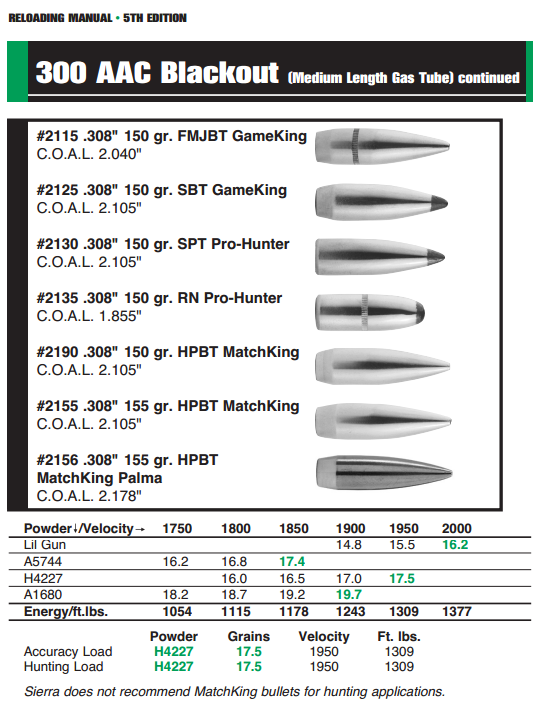
Sierra Bullets has just added extensive load data for the 300 AAC Blackout (300 BLK) cartridge. Developed for the AR15 platform, the 300 BLK offers AR shooters a large-caliber option in both subsonic and supersonic variants. The 300 BLK can be made from modified .223 Rem brass or necked-up .221 Fireball cases. We like to form our .300 BLK brass by necking-up the excellent Lapua .221 Fireball brass.
Sierra Has 5 Pages of Load Data for the 300 AAC Blackout. Here is one sample page:
Sierra Cartridge Comments: 300 AAC Blackout
The 300 AAC Blackout (300 BLK, or 7.62x35mm) was created by Advanced Armament Corp. and Remington in order to provide the military with a way to shoot .30 caliber bullets from the M4 platform with only a barrel change. It has since become popular for a wide range of uses including hunting and home defense.
The cartridge shares case-head dimensions and body taper with the .223 Remington. Not only does this allow for compatibility with existing magazines and bolts, but it allows reloaders to form 300 BLK brass from the vast supply of 5.56mm or .223 cases. However, since .223/5.56 cases need to be cut-down and reformed, it can be simpler to neck up .221 Fireball brass.
The 300 AAC Blackout is similar to previous wildcats, such as the .30-221 and .300 Fireball, as well as the proprietary 300 Whisper®. However the 300 BLK was the first SAAMI-approved (and standardized) cartridge of this type. Moreover, any company is free to make firearms or ammunition for the 300 BLK.
300 AAC Blackout is popular with hunters, who may not be allowed to legally hunt with .223 in their state, and who prefer .30-caliber bullets for medium-sized game. It provides similar effectiveness to the 7.62×39mm or the slightly more powerful 30-30 cartridges, while working in the more up-to-date AR15 platform. Effective range for hunting is about 100-150 yards.
How would you like to have the entire collection of Sierra rifle and pistol bullets at your fingertips, complete with bullet Ballistic Coefficients (BCs) and parts numbers? Well we’ve got you covered. Sierra publishes a handy PDF chart that displays all of Sierra’s popular projectiles, from .20 caliber all the way up to .50 caliber. CLICK HERE to download Sierra Bullets Chart.
CLICK Image to Download PDF Chart with All Sierra Bullet Types (2 MB file)
Detail Sample from Chart
Order Free Sierra Catalog
You can also get a free, hard copy poster with all Sierra’s bullet types. The current Sierra Bullets catalog has a printed insert that folds out into a large poster for your loading room or workshop. To order the current Sierra Catalog (with fold-out poster), visit Sierra’s Catalog Request Page.
“Where are the bullets, where is the powder?” (ad infinitum) is what you hear from shooters around the country these days. Well we can’t promise more powder, but Sierra Bullets has invested in machinery that should help increase bullet output. Sierra has acquired a 550-ton rated extrusion press that should pump out lead wire faster (for bullet cores). Sierra tells us: “This is a lead extrusion press we had shipped in from the state of Washington. We are diligently working on getting this thing set up and pumping more lead into our process.”
If you’re curious how this beast works, Alan Slocum posted an explanation: “It works kinda’ like this”, referring to the photo below. Sierra’s big machine uses a horizontal hydraulic ram instead of the push-down yellow Play-Doh lever, but yes the basic principle is the same.


 Lessons Learned (The Canted Land Mystery)
 During the break in, I would clean the barrel after every five shots or so just because that’s what everyone says to do. The barrel cleaned up extremely well, however I noticed that the first patches down a dirty barrel would cause the cleaning rod to vibrate as I pushed them down the tube. That was something that I had never experienced before so I was a little concerned….








 CUP Pressure Measurement