Sierra Bullets has recently released load data for the 6mm Creedmoor cartridge, a necked-down version of the 6.5 Creedmoor, a popular PRS, tactical, and hunting cartridge. Sierra has released very comprehensive 6mm Creedmoor load data, covering fifteen (15) different bullets from 55 to 110 grains. NOTE: Hornady-brand brass was used for Sierra’s 6mm Creedmoor load tests, not the newer, stronger Lapua 6.5 CM brass with small primer pockets. Hand-loaders using Lapua 6.5 Creedmoor brass necked to 6mm may have to adjust their loads.
Sierra writes: “As soon as the 6.5 Creedmoor was released in 2007, a 6mm version was being envisioned. After the 6mm Creedmoor demonstrated its worth at 1000 yards it began to catch the attention of Precision Rifle Series (PRS) competitors. The 6mm/6.5 Creedmoor is a great fit for those looking for an AR platform-friendly cartridge. It delivers velocities very similar to the .243 Win and yet fits the AR10 magazine length[.] The 30-degree shoulder makes this a very efficient case and helps prolong case life as well. The 6mm/6.5 Creedmoor works well with powders such as H4350, RE-17, and Ramshot Hunter for heavier long-range bullet weights. Slightly faster powders such as RE-15, Win 760, and Vihtavuori N540 work well with lighter weight bullets.”
Sierra Bullets Tested for 6mm Creedmoor Load Data
55gr BlitzKing (#1502)
60gr HP (#1500)
70gr HPBT (#1505)
70gr BlitzKing (#1507)
75gr HP (#1510)
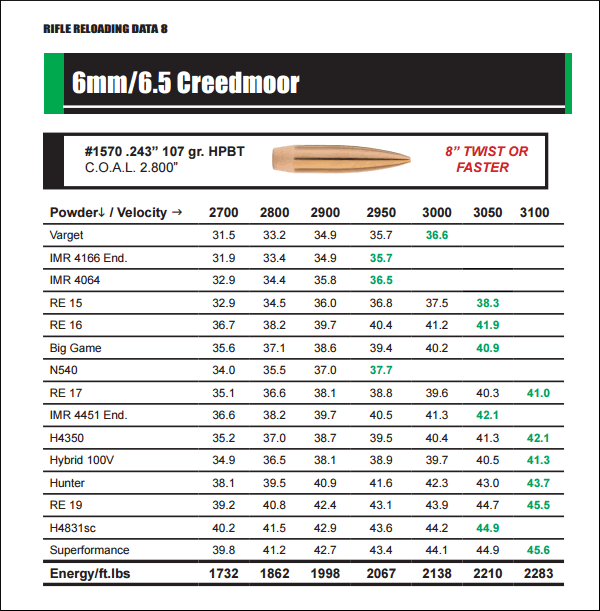
In developing its 6mm Creedmoor load data, Sierra tested a very wide selection of propellants, two dozen overall. For the smaller bullets, fast-burning powders such as Benchmark, H4895, and CFE223 were tested. For the heavier 100+ grain bullets, Sierra tested a selection of medium-burn-rate powders including H4350, Reloder 16, Reloder 17, Varget, and Superformance. Sierra did a very thorough job. We know this information will be welcomed by 6mm Creedmoor shooters.
Don’t know what powder to try first? For the 107-110 grain bullets, if you want best accuracy and low ES/SD, our Forum members recommend Alliant Reloder 16 and Hodgdon H4350. If you are seeking max velocity with the 110-grainer, look at Hodgdon Superformance and Reloder 19.
Here are Sierra’s 6mm Creedmoor Load Data Charts for the 107gr MK and 110gr MK. There are a half-dozen other tables for lighter-weight bullets.
by Sierra Bullets Ballistic Technician Paul Box
One thing that plays a major role in building an accuracy load is neck tension. I think a lot of reloaders pretty much take this for granted and don’t give that enough thought.
So, how much neck tension is enough?
Thru the years and shooting both a wide variety of calibers and burn rates of powder, I’ve had the best accuracy overall with .002″ of neck tension. Naturally you will run into a rifle now and then that will do its best with something different like .001″ or even .003″, but .002″ has worked very well for me. So how do we control the neck tension? Let’s take a look at that.
First of all, if you’re running a standard sizing die with an expander ball, just pull your decapping rod assembly out of your die and measure the expander ball. What I prefer is to have an expander ball that [can give] you .002″ in neck tension [meaning the inside neck diameter is about .002″ smaller than the bullet diameter after passing the expander through]. If you want to take the expander ball down in diameter, just chuck up your decapping rod assembly in a drill and turn it down with some emery cloth. When you have the diameter you need, polish it with three ought or four ought steel wool. This will give it a mirror finish and less drag coming through your case neck after sizing.
Tips for Dies With Interchangeable Neck Bushings
If you’re using a bushing die, I measure across the neck of eight or ten loaded rounds, then take an average on these and go .003″ under that measurement. There are other methods to determine bushing size, but this system has worked well for me.
Proper Annealing Can Deliver More Uniform Neck Tension
Another thing I want to mention is annealing. When brass is the correct softness, it will take a “set” coming out of the sizing die far better than brass that has become to hard. When brass has been work hardened to a point, it will be more springy when it comes out of a sizing die and neck tension will vary. Have you ever noticed how some bullets seated harder than others? That is why.
Paying closer attention to neck tension will give you both better accuracy and more consistent groups.
by Tommy Todd, Sierra Bullets Chief Ballistician for Sierra Bullets Blog
I have shot several disciplines of shooting competitions over the years and have learned a few things regarding ammunition and bullet function during this time. Frequently the matches I shoot require 40 to 100 shots before a person gets a chance to clean his rifle. Just as frequently, a good shooting match rifle will still shoot very good scores and groups with that many rounds fired through them. However, those guns do not deliver the same accuracy as when they were clean, but the drop-off in accuracy is not a huge change unless a set of accumulative issues arise.
In one situation, very dirty powder created more serious problems…
Pressure Issues — Extraction Problems Caused by Bad Fouling
Problem: Pressures Increased as Powder Fouled Barrel and Carbon Ring Formed
Solution: Clean Barrel Every Ten Rounds.
I witnessed a set of problems that occurred with a fellow competitor’s rifle at a recent F-Class match. He was using a large case capacity cartridge for the bore diameter and he was shooting a powder that was burning extremely dirty. As the match progressed, the carbon buildup caused most likely a carbon ring in the throat of the rifle and pressures kept increasing to the point that the cases were hard to extract, bolt lift was excessive, and eventually he quit shooting the rifle due to these issues. Accuracy also suffered as could be evidenced by the gun’s performance on target. This load looked fine when he was developing it, none of the excessive pressure signs appeared when he worked the load up, but he was cleaning the gun every ten shots.
When he was shooting multiple, 20-shot strings during the match is when the issues appeared. He was able to give the gun a thorough cleaning and the issues went away, for several rounds and then the pressures started appearing again. These pressure signs were not due to ambient temperatures as it was a cool spring morning and the temperature was in the low 40° range.
Accuracy Issues — Tune Lost with Higher Ambient Temps
Problem: Accuracy Lost When Outside Temp Much Hotter than When Load Developed
Solution: Pull Bullets, Reload Ammo with Lighter Charge
A couple of years ago, I attended a match early in the shooting season and it was unusually hot for that time period. I heard a competitor worrying before the match about his gun “blowing up”. At first I was concerned, but after thinking about what he had said I realized that he meant his “accuracy” blowing up, meaning he knowingly had loaded his ammunition at the top end of an accuracy tune that he established via a ladder test. The next day I asked him how his scores were and he said the gun was not shooting very well initially, but he had found enough equipment from friends that were at the match and had pulled the bullets, reduced the powder charge by a few tenths of a grain and re-seated the bullets and his gun was now shooting normally. The temperature difference between his home range the weekend before when he established his load and the match conditions was about 30 degrees and that was enough to cause an accuracy change at 1000 yards.
To learn more about how ambient temperature (and primer choice) affect pressures (and hence velocities) you should read the article Pressure Factors: How Temperature, Powder, and Primer Affect Pressure by Denton Bramwell. In that article, the author uses a pressure trace instrument to analyze how temperature affects ammo performance. Bramwell’s tests yielded some fascinating results.
For example, barrel temperature was a key factor: “Both barrel temperature and powder temperature are important variables, and they are not the same variable. If you fail to take barrel temperature into account while doing pressure testing, your test results will be very significantly affected. The effect of barrel temperature is around 204 PSI per F° for the Varget load. If you’re not controlling barrel temperature, you about as well might not bother controlling powder temperature, either. In the cases investigated, barrel temperature is a much stronger variable than powder temperature.”
The 6.5 Creedmoor cartridge is now one of the most popular cartridges for new factory rifles. Ruger, Savage, Howa and other gun-makers all offer 6.5 Creeemoor rifles. The 6.5 CM has been a leading cartridge for tactical/practical gun games (although many shooters have moved to a 6mm Creedmoor or even a 6mm Dasher). It offers excellent ballistics, moderate recoil, and good accuracy with a variety of powder and bullet combos. Along with the 6.5×47 Lapua, the 6.5 Creedmoor has demonstrated that a .264-Caliber mid-sized caliber is truly a jack of all trades — it can be accurate on paper, win PRS matches, and also harvest game during hunting season. If you own a 6.5 Creedmoor (or plan to get one) and hand-load your ammo, this post should provide a good start. Sierra Bullets now offers 6.5 Creedmoor Load Data for bullets from 120 to 142 grains — the most popular weight range for this chambering.
Sierra Bullets has released very complete load data for the popular 6.5 Creedmoor cartridge. This medium-sized cartridge has become one of the most popular chamberings for tactical and PRS shooters. The 6.5 Creedmoor combines excellent accuracy, good mag-feeding, good barrel life, moderate recoil, and reasonable component cost. That’s why this cartridge has caught on quickly.
The Springfield M1A is now available in 6.5 Creedmoor. For Gas Guns like this, be sure to full-length-size your brass after every firing, with adequate shoulder bump.
Developed in 2007 by Dennis DeMille and Dave Emary, the 6.5 Creedmoor is a shortened and improved 30 TC cartridge case that was inspired by the .308 Winchester design. This short action design was created to maximize case capacity and a wide range of loading lengths, while still fitting in standard short action magazines. With the correct twist barrel, the versatile 6.5 Creedmoor can take advantage of the wide range of bullet weights available in 6.5 mm (i.e. .264 caliber).
Reloaders should keep in mind that the 6.5 Creedmoor works best with medium to medium-slow powders such as H4350, Reloder 16, Varget, and IMR 4451. The light recoil and adaptability of the efficient 6.5 Creedmoor cartridge has already proven itself in high power and PRS matches, and in the hunting fields. Couple that with respectable barrel life and its intrinsic accuracy potential and you have a recipe for success.
Here are three tables from the Sierra Bullets Reloading Manual (5th Edition). IMPORTANT — This is just a sample!! Sierra has load data for many other 6.5mm bullet types, including FB, Spitzer, SBT, HPBT, and Tipped MK from 85 grains to 142 grains. To view ALL 6.5 Creedmoor DATA, CLICK HERE.
INDICATES MAXIMUM LOAD – USE CAUTION
LOADS LESS THAN MINIMUM CHARGES SHOWN ARE NOT RECOMMENDED.
INDICATES MAXIMUM LOAD – USE CAUTION
LOADS LESS THAN MINIMUM CHARGES SHOWN ARE NOT RECOMMENDED.
INDICATES MAXIMUM LOAD – USE CAUTION
LOADS LESS THAN MINIMUM CHARGES SHOWN ARE NOT RECOMMENDED.
At the request of our readers, we provide select “Deals of the Week”. Every Monday morning we offer our Best Bargain selections. Here are some of the best deals on firearms, hardware, reloading components, optics, and shooting accessories. Be aware that sale prices are subject to change, and once clearance inventory is sold, it’s gone for good. You snooze you lose.
1. Midsouth — Frankford Arsenal Rotary Tumbler LITE, $99.99
Wet-tumbling with stainless media gets large quantities of cartridge brass clean inside and out. If you’ve wanted to try wet-tumbling, here’s your chance. Midsouth has the Frankford Arsenal Platinum LITE Tumbler on sale for just $99.99 — a total steal. If you run large quantities of brass, you can get the larger-capacity Frankford Arsenal Platinum Tumbler for $179.99. Either one of these is a reliable, durable (and watertight) machine that should provide years of worry-free tumbling.
2. Grizzly Bald Eagle — Great Range Bag and Rifle Case Sale
Grab one of these Bald Eagle rifle cases or range bags at up to 50% off. These are way better than typical too-skinny rifle cases or flimsy fabric bags. The rifle cases have plenty of storage for your match needs and the padding is very good. The box-style range bags have thick closed-cell foam panels in the base, top, and sides. That gives these bags good “wall strength”, so they don’t collapse like typical range bags. These are more like a quality camera-case.
AccurateShooter.com Editor’s Bald Eagle 20″ Range Bag with Spotting Scope:
As you can see, the Bald Eagle 20″ range bag is quite big inside with lots of padding. We use this bag to carry our spotting scope and a small tripod, plus lots of other gear in the pockets. The near-full-width front pocket is very handy. We really like this 20″ range bag, which is a total steal at just $15.97. In fact the Editor likes his 20″ Bald Eagle bag so much he just ordered a second, along with two 15″ bags.
3. Graf’s — Frankford Arsenal M-Press + Extras, $249.99
Frankford Arsenal has been getting a lot of press since SHOT Show with a bounty of new products. Topping the list of must-have items is the M-Press. This press takes all the proven concepts of a Co-Axial press and improves on them. It has reversible cam-over bars plus an LED light, quick-adjusting shell-holders, and many other notable features. Right now Grafs.com is offering the new Frankford M-Press for $249.99. If you need any more incentive, Graf’s is offering a FREE set of three (3) additional die blocks, plus a handy kinetic bullet puller. Nobody else is offering anything like this especially since the M-Press is so new. [Editor: Watch for our M-Press review later this month.]
4. Midsouth — Sierra Loaded Ammunition Sale
Sierra is renowned for making quality bullets but did you know Sierra also produces great loaded ammo for hunters? Available in many of the most popular calibers and featuring GameKing bullets, Sierra’s GameChanger Ammunition could just be the edge you’re looking for on your next hunt. Midsouth has GameChanger ammo on sale right now. Stock up before hunting season arrives and prices go up.
5. Bruno Shooters Supply — Nightforce NXS 5.5-22 Scope, $1699
Nightforce NXS scopes are some of the best optics in their price range. Given their popularity, it’s rare to find NXS models on sale. Right now Bruno’s is discounting these fine scopes, so this is a great buying opportunity. Grab either the Nightforce NXS 5.5-22x50mm or the Nightforce NXS 5.5-22x56mm at a blow out price of $1699. This power range is one of the most popular out there so to buy one of these for over $300 off is a deal you can’t pass up.
6. Bullet Central — Bix’N Andy Trigger with Free Cleaning Kit
Bix’N Andy makes some of the very best trigger systems on the planet. It’s rare that you ever see them associated with any kind of promotion. If you’ve been waiting for a good reason to get a Bix’N Andy trigger, here is your chance. Bullet Central is now offering a free 8 oz. ThorroClean kit with every Bix’N Andy purchase. ThorroClean by Iosso works is a two-part bore flush/bore cleaning package that removes fouling with minimal dwell time. Trust us, you won’t be disappointed with a Bix’N Andy trigger, and the deal provides a little extra incentive.
7. Amazon — 60 Jourdak Quality Earplugs for $12.95
Ever arrived at the range and realized you left your earmuffs at home? It’s happened to us all. That’s why you should keep some extra ear-plugs in your rifle cases and range bags. Right now you can buy a 60-count bottle of Jourdak soft earplugs for $12.95. Buyers say these SNR 35 dB plugs, which “heat-mold” to your ear canal, are very comfortable and effective. Plus there is a 10% Off instant coupon for the Jourdaks. We also recommend the Howard Leight Max-1 ear-plugs. These NRR 33 plugs are comfortable and easy to insert. You can get 20 pairs of Max-1s for just $4.95. Either option comes with free shipping. Remember, always wear effective hearing protection while at the range.
TECH NOTE Concerning NRR (Noise Reduction Rating) and SNR (Single Number Rating)
The highest NRR rating for earplugs is 33, and the highest available NRR rating for earmuffs is 31. These values reflect the level of noise protection available for each device when worn alone. Combining earplugs with earmuffs can offer a NRR protection level of 36. The SNR (single number rating) is a rating system used in the European Union to indicate the amount of protection offered by correctly-fitted hearing protection devices. Source: Protectear.com
8. Palmetto State Armory — S&W M&P 15-22, $299.99
In our view, every gun guy (and gun gal) should own a nice self-loading .22 LR rimfire rifle. And if you own an AR, it makes sense to have a rimfire rig with the same balance and ergonomics. That’s what the M&P 15-22 is all about — AR ergos with rimfire economy. With bulk .22 LR ammo, your cost-per-shot is under nine cents per round! Right now at Palmetto State Armory, the popular Smith & Wesson M&P 15-22 Sport is just $299.99 on sale. That’s not much more than a basic Ruger 10/22 and we like this S&W 15-22 much better — it’s great for plinking and rimfire action disciplines. This rifle can use most AR15-family accessories, and it comes with Magpul MBUS sights, and M-Lok rails.
9. Amazon — TACVASEN Long Sleeve Tactical Shirt, $29.99
Let’s face it, looking good at a match can be almost as important as feeling good. Now you can do both with lightweight TACVASEN Long Sleeve Shirts. The TACVASEN Men’s Slim Fit Long Sleeve Combat Shirt is available in nine different colors, including four with camo sleeves. PRS guys would like these shirts. They fit right so you can run stages without snagging range carts or barriers. These zip-collar shirts feature 65% polyester, 35% cotton fabric for breathability and quick drying. These shirts have earned a 4-star rating with 163 buyer reviews.
Are you considering the Frankford Arsenal tumbler featured above? It’s a great machine. But you’ll also need stainless media for it. Here’s your solution. Amazon sells 2.5 lbs of stainless tumbling media for a mere $19.50. Amazon also offers even larger quantities of stainless steel tumbling pins if you need more than a couple pounds for those really big jobs.
The Making of MatchKings — How Sierra Produces SMKs
All Sierra bullets begin life as a strip of gilding metal, an alloy consisting of 95% copper and 5% zinc. To meet Sierra’s strict quality requirements, the gilding metal requires three times more dimensional and quality control standards than is considered standard in the copper manufacturing industry.
A blanking press stamps out a uniform disc and forms the cup that will be drawn into the MatchKing jacket. The cup is then polished and sent to a draw press to be drawn into a jacket that is longer than needed for the future MatchKing, thus allowing for the trim process. Press operators constantly check concentricity to make sure we have only quality jackets. The jackets then go to a trimmer where they are visually inspected again.
After being polished a second time, the jacket travels to the bullet press. In the meantime, 80-pound lead billets are being extruded into lead wire for the cores where great care is taken so that the core wire is not stretched. The core wire is lightly oiled before continuing to the bullet press to be swaged.
The lead core wire and trimmed jacket meet at the bullet press where the first stage forms a boattail on the jacket. The lead core is then formed on top of the bullet press and fed down into the jacket. In one stroke of the press, the MatchKing is formed.
Quality control technicians pull samples from each lot of MatchKings to make sure they meet Sierra’s stringent standards. Samples are then sent to Sierra’s 300-meter underground test range (shown below) to be shot for accuracy on mechanical mounts referred to as “unrestricted return to battery rests” that Sierra designed and built in-house.
After inspection, the bullets are placed in the familiar green box along with reloading labels. They are then shrink-wrapped and shipped all over the world.
We’re starting to see barrel tuners employed in more competitive disciplines than ever — from 100 yards to 1000 yards. And even some varmint hunters are employing tuners or tuner/brakes now. This allows them to dial in accuracy with different loads (when shooting hundreds of rounds in a weekend). Here’s a quick over-view of the potential benefits of tuners.
Commentary by Mark Walker, Sierra Bullets Product Development Manager This story originally appeared in the Sierra Bullets Blog. Visit SierraBullets.com.
Some people love tuners and others hate them. I use them on my rifles and I’ve had more than one person ask me why on earth I would put one of those things on my barrel. I’ve even had a national long range champion tell me to unscrew it and throw it into Lake Erie on my next trip to the pits at Camp Perry. However, there are other shooters that swear by them and have many match wins to back it up.
It’s an indisputable fact that tuners do have an effect on a rifle’s accuracy, however how much is somewhat open for debate. The large heavy target barrels that we use for benchrest or F-class may not be affected as much by a tuner as a lighter weight sporter type barrel. Each barrel that I’ve installed a tuner on not only showed improvement in accuracy but also displayed a wider load window. The increased accuracy is because of the ability to adjust the tuner to the load, however I believe the wider load window is due to the added weight of the tuner slowing down the barrel vibrations. These are both very important aspects of having a very accurate rifle.
While better accuracy and a wider load window are two areas of improvement, I believe the most important feature of a tuner is the ability to adjust the tune during the middle of a match. This is especially important during matches where you must load all your ammo earlier and cannot make adjustments to the load during the match. If you happen to miss the load, instead of having to deal with a gun that isn’t shooting you can make an adjustment to the tuner and hopefully improve the accuracy of the rifle.
While I’ve laid out several ways that a tuner can help, there are also a few ways that tuners can cause problems. They add weight so if you are shooting a discipline that has weight limits on the rifle, you may not be able to install a tuner and still make weight. Sometimes, a barrel just doesn’t show improvement with a tuner installed. These are few and far between, but it is something to consider. If you make an adjustment to the tuner in a match, you need to make sure you move it in the right direction. Adjusting a tuner in the wrong direction can cause very large groups. And finally, if they aren’t tightened properly, tuners can come loose during firing which will cause a lot of problems as well.
As you can see, tuners have both positive and negative aspects. In my personal experience, the positives far outweigh the negatives so I will continue to use them on all of my competitive rifles. If you’ve been thinking about installing a tuner, hopefully some of the information that I’ve presented will help you make an informed decision.
Sierra Bullets has released very complete load data for the popular 6.5 Creedmoor cartridge. This medium-sized cartridge has become one of the most popular chamberings for tactical and PRS shooters. The 6.5 Creedmoor combines excellent accuracy, good mag-feeding, good barrel life, moderate recoil, and reasonable component cost. That’s why this cartridge has caught on quickly.
Developed in 2007 by Dennis DeMille and Dave Emary, the 6.5 Creedmoor is a shortened and improved 30 TC cartridge case that was inspired by the .308 Winchester design. This short action design was created to maximize case capacity and a wide range of loading lengths, while still fitting in standard short action magazines. With the correct twist barrel, the versatile 6.5 Creedmoor can take advantage of the wide range of bullet weights available in 6.5 mm (i.e. .264 caliber). Reloaders should keep in mind that the 6.5 Creedmoor works best with medium to medium-slow powders such as H4350, Varget, Win 760, and RE-17. The light recoil and adaptability of the efficient 6.5 Creedmoor cartridge has already proven itself in high power, precision rifle series and benchrest competitions. Couple that with respectable barrel life and its intrinsic accuracy potential and you have a recipe for success which should insure its legacy for decades to come.
Here are three tables from the Sierra Bullets Reloading Manual (5th Edition). IMPORTANT — This is just a sample!! Sierra has load data for many other 6.5mm bullet types, including FB, Spitzer, SBT, HPBT, and Tipped MK from 85 grains to 142 grains. To view ALL 6.5 Creedmoor DATA, CLICK HERE.
INDICATES MAXIMUM LOAD – USE CAUTION
LOADS LESS THAN MINIMUM CHARGES SHOWN ARE NOT RECOMMENDED.
INDICATES MAXIMUM LOAD – USE CAUTION
LOADS LESS THAN MINIMUM CHARGES SHOWN ARE NOT RECOMMENDED.
INDICATES MAXIMUM LOAD – USE CAUTION
LOADS LESS THAN MINIMUM CHARGES SHOWN ARE NOT RECOMMENDED.
Posted on June 21, 2017 by Sierra Bullets Written by Sierra Bullets Ballistic Technician Gary Prisendorf
I recently purchased 1,000 rounds of once-fired 5.56 LC brass that was fully processed and ready to load. The brass had been wet tumbled, using stainless steel pins and looked great inside and out, including the primer pockets.
I had always used a vibrating tumbler with either corn cob or walnut media and I always thought my brass looked pretty good until I saw what the wet tumbling and pin combination did.
Being the budget minded reloader that I am, I started looking for a cheap way to wet tumble my brass using stainless steel pins. Harbor Freight had recently opened a store nearby and I had received coupons in the mail, one of the coupons was 20% off any one item.
So I headed for the Harbor Freight store and after roaming around for 20 minutes or so I found a dual drum rotary rock tumbler for $55.00 and thought it would do just fine for what I was planning. The drums are rather small and only have a 3 pound maximum load limit each, but I figured that was big enough for around 150 .223 cases or maybe 300 9MM cases at a time.
I pulled the wrinkled up coupon out of my pocket, paid, and walked out with my new $47.00 brass cleaning machine. I didn’t have any stainless steel pins and couldn’t find any locally. At our local hardware store I picked up some brass plated ½” finishing brads that I thought might work until I could get some pins ordered.
I bought two small packages of the finishing brads (1.75 oz.), for $1.69 each then headed to my local Walmart to pick up some Dawn dish soap (.99 cents) and a bottle of Lemi Shine ($3.27). I had read online that is what a lot of people use for cleaning their brass.
I bought two small packages of the finishing brads (1.75 oz.), for $1.69 each then headed to my local Walmart to pick up some Dawn dish soap (.99 cents) and a bottle of Lemi Shine ($3.27). I had read online that is what a lot of people use for cleaning their brass.
When I got home, I started depriming .223 brass for my new toy, I mean brass tumbler. I deprimed 100 cases, put 50 in each drum, dropped a package of brads in each one, filled them ¾ of the way with water, gave each drum a small squirt of Dawn dish soap and a tablespoon of Lemi Shine. I sealed up the drums and fired up the tumbler.
After an hour and a half, I just couldn’t stand it any longer and had to see the results. The water was filthy but the cases were super clean, I couldn’t be happier. For a total investment of around $55.00, I can now get my cases looking almost new.
Here are the before and after pictures of my first run of brass:
I have since ordered two pounds of stainless steel pins, I put one pound in each drum. To be honest the brass really doesn’t look any better, but the pins don’t seem to get stuck inside of the cases near as bad as the brass-plated brads did.
Tip: Make sure to inspect your cases and look inside each case to ensure all of the brads/pins are removed.
Just lay the brass and brads/pins out on a towel and let them dry. Mine were dry after about 12 hours.
If you want your cases to look like new without breaking the bank, give it a try. You can’t clean 1000 at a time like the $200.00 tumbling machines that are made for specifically for brass, but this is a much cheaper alternative and the results speak for themselves. — Gary Prisendorf, Sierra Bullets
EDITOR: Actually you can get a machine for a whole lot less than $200.00! See the next paragraph.
Lyman Cylone Rotary Tumbler with Factory Rebate
Sierra’s Technician got his rotary tumbler and brass media for $55.00. For eighty bucks more that you can get a much better, higher-capacity system from Lyman. The Lyman Cyclone Rotary Tumbler features a large, polymer drum that holds up to 1000 .223 Rem cases. The kit includes media separation trays, plus five pounds of correct STAINLESS media. The Lyman Cyclone system costs $139.39 delivered from Amazon.
Yep you can get a complete Lyman Cyclone system WITH stainless media for under $140.00. To be honest we think that’s money well spent, compared to the “El Cheapo” Harbor Freight unit. The Lyman will run six times as many .223 Rem cases, be easier to operate, AND get the job done faster. We suspect long-term durability will be better with the Lyman tumbler as well.
Sierra Bullets asked a few hand-loaders to reveal their favorite reloading tool or accessory: “What is your favorite ‘don’t know how you ever lived without it’ piece of reloading equipment?” Some of the answers are listed below. We were interested to see some high-tech, micro-processor items mentioned, such as the AMP Annealer, and the AutoTrickler powder dispenser. Old standbys, such as the rugged RCBS Rockchucker and Dillon 650, also made the favorites list. You can nominate your own favorite reloading hardware in the comments section of the Sierra Bullets Blog.
Sierra Bullets Ballistic Technician Philip Mahin answered: “A comparator gauge to measure from the base of a case to the ogive of the bullet. This bypasses the tip of the bullet, so I can repeat the same seating depth the next time I visit a specific combination.”
Bill, Editor of Rifleshooter.com, answered: “I have so many favorite reloading tools, it’s hard to pick one. But if I had to, it would be my Forster Co-Ax press. I like the ease [with which] you can change dies and that it doesn’t require traditional shell holders. It’s a great tool to have!”
Sierra Bullets Ballistic Technician Duane Siercks answered: “I don’t know that you would actually call this equipment, but the item that comes to mind would be my reloading room/shoot house. I had always had to squeeze everything into a corner or even an unheated shed. After we bought our current house, I built a garage and placed it so that I had a window looking down a 250-yard range. I built a dedicated room with heat and A/C. It contains my reloading bench and a shooting bench. The shooting bench lets me slide open the window and shoot down the range. It is very handy to not have to load everything up to go to the range. It also makes load development a lot simpler and efficient. I don’t know how I ever got along without it.
I also wonder what I did before I acquired the Lyman 1200 DPS Powder Dispenser. This has made the process so much simpler and much easier. I also have a Lee Precison Universal Decapping Die that I would gladly spend the money on again. This may be a small thing, but it certainly is handy. The Lee would accommodate some very large cases that some of the others were too small for.”
Jon Addis answered: “Putting an A&D FX-120i scale with AutoTrickler and Auto-Throw on the bench has changed the way I reload. It’s kernel accurate in about 15 seconds. Saves time and reduces a variable. And of course, the system is made better by the Area 419 Billet Adjustable base for the trickler and Billet Powder Cup.”
This video shows the AutoTrickler V2 and Auto-Throw Combo:
Sierra Bullets Chief Ballistician Tommy Todd answered: “A brass annealing machine and a RCBS Chargemaster complimented with a Sartorious scale.”
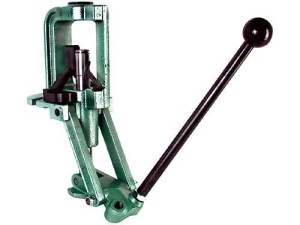
Sierra Bullets Ballistician Gary Prisendorf answered: “RCBS Rock Chucker Press, it’s built like a tank, and it will last me a lifetime.”
Sierra Bullets Production Manager Chris Hatfield also answered: “RCBS Rock Chucker single-stage reloading press.”
Jeremy Kisner answered: “My Giraud trimmer has taken [three operations] and combined them into one easy task. I can now size my brass and then sit down and trim, chamfer, and debur to a 0.001″ tolerance in one motion.”
Dan Blake answered: “My Annealing Made Perfect (AMP) annealer. With consistent neck tension being one of the largest contributions to small Extreme Spread on muzzle velocities, I believe this induction annealer is truly the best on the market.”
This manufacturer-produced video shows how the AMP annealing machine operates:
Trevor Aldinger answered: “Area 419 Master Funnel Kit. In the past I’ve used plastic funnels and even other metal ones. This system fits case necks and flows much better than any others I’ve used, and there is no static since it’s metal. We spend a lot of time and money to get precise charges, I don’t want to lose or miss a kernel because of a cheap funnel.”
Tyler Riley answered: “My RCBS bench primer (priming tool). It has a lot more leverage than a hand primer and still has a good feel to how tight primer pockets are. Makes it much easier on my hands to prime large runs, especially new brass with tight pockets.”
Craig Arnzen answered: “My Annealeez [annealing machine] is one of the best tools in my reloading room. Neck tension is SO important, and annealing every firing really helps with that. This is an inexpensive tool that can anneal a lot of cases at once, and help me produce more consistent ammo.”
Josh Temmen answered: “Time is critical for me so my RCBS Chargemasters are indispensable (pun intended.) They cut down on time at my reloading bench while maintaining the weight tolerances required for long range shooting.”
Josh Bartlett answered: “I have my Dillon 650 set up with Whidden floating tool heads to do decapping and sizing on my match ammo. The case feeder and progressive function of the press save me a TON of time when doing lots of several hundred rounds.”
Ryan Brandt answered: “… A quality set of calipers. My reloading room is full of very nice equipment but little does more to satisfy my perfectionism than a good check with the calipers.”




 To learn more about how ambient temperature (and primer choice) affect pressures (and hence velocities) you should read the article


 Developed in 2007 by Dennis DeMille and Dave Emary, the 6.5 Creedmoor is a shortened and improved 30 TC cartridge case that was inspired by the .308 Winchester design. This short action design was created to maximize case capacity and a wide range of loading lengths, while still fitting in standard short action magazines. With the correct twist barrel, the versatile 6.5 Creedmoor can take advantage of the wide range of bullet weights available in 6.5 mm (i.e. .264 caliber).




 Sierra Bullets Ballistician Gary Prisendorf answered: “


