In 2010, the staff of AccurateReloading.com Forum completed a massive .22LR Rimfire Ammunition Testing Project. Some 55 different types of ammo were tested, using a highly-accurate Swiss-made Bleiker rifle, with a 2-stage trigger. All ammo varieties were tested at 50 yards, 75 yards, and 100 yards, shooting five, 5-shot groups at each distance. Though these tests were completed some time ago, many readers have requested a “reprint” of the ammo rankings, so we’ve republished this data below.
The results are fascinating to say the least (and perhaps eye-opening). The tester observed: “I got some amazing groups, and some which are, frankly, absurdly bad! This has re-enforced what I had experienced with 22 ammo in the past — that is being consistently inconsistent.”
While we strongly caution that .22LR rimfire ammo may work well in one gun and not another, and ammo performance can be improved through the use of barrel tuners, the AccurateReloading.com research provides invaluable guidance for smallbore shooters. Overall, the testers burned through over 4,000 rounds of ammo, and you can see the actual test targets online. To read all the test reports, and view target photos visit AccurateReloading.com.
0.162 Eley Tenex Ultimate EPS
0.164 Lapua Midas Plus
0.177 Lapua Polar Biathlon
0.187 Eley Match EPS
0.193 Eley Match
0.203 Lapua Midas M
0.215 Lapua Center X
0.216 Western Value Pack
0.229 Lapua Signum
0.241 Lapua Master L
0.243 Eley Pistol Match
0.256 Olin Ball
0.256 Akah X-Zone
0.261 Lapua Midas L
0.261 Lapua Master M
0.263 Eley Tenex Semi Auto
0.270 Lapua Super Club
0.272 Eley Tenex
0.303 Lapua Standard Plus
0.312 CCI Standard Velocity
0.319 RWS R 50
0.319 Eley Standard
0.328 SK High Velocity
0.339 Eley Club Xtra
0.340 Winchester T22
0.356 Federal Champion
0.362 Eley Subsonic HP
0.371 CCI Mini Mag
0.376 Federal American Eagle
0.377 Norinco Target
0.380 Sellier & Bellot Club
0.384 Eley Club
0.387 Eley Sport
0.388 Totem
0.392 Swartklip Match Trainer
0.398 Federal Gold Medal
0.403 Swartklip HV
0.409 Eley Match Xtra Plus
0.424 Sellier & Bellot Std
0.443 Remington Target
0.461 Lapua Crow HP
0.475 Eley Silhouex
0.479 Magtech
0.498 Eley High Velocity
0.513 Winchester Super X
0.516 Kassnar Concorde
0.539 CCI Blazer
0.560 Winchester Supreme Pistol
0.576 Norinco Pistol Revolver
0.593 SK Standard
0.611 Sellier And Bellot HP
0.626 SK Standard HP
0.686 Logo HV
0.956 Pobjeda Target
0.274 Lapua Center X
0.283 Lapua Standard Plus
0.295 Eley Tenex Ultimate EPS
0.307 Lapua Midas M
0.329 Lapua Master M
0.346 Eley Match
0.373 Lapua Polar Biathlon
0.399 RWS R 50
0.432 Lapua Midas L
0.448 Eley Tenex Semi Auto
0.467 Eley Match EPS
0.474 Lapua master L
0.491 Eley Match Xtra Plus
0.494 CCI Standard
0.496 Eley Subsonic HP
0.507 Eley Sport
0.512 Federal American Eagle
0.513 SK High Velocity
0.514 Eley Standard
0.516 Eley Tenex
0.516 Lapua Crow HP
0.532 Western Value Pack
0.533 Fed. Champion Target
0.535 Lapua Midas Plus
0.564 Akah X Zone
0.566 Olin Ball
0.573 Eley Club Xtra
0.616 Lapua Signum
0.631 Winchester T22
0.639 Swartklip HV HP
0.641 Eley Club
0.642 Eley Silhouex
0.647 CCI Mini Mag
0.679 Eley Pistol Match
0.682 Swartklip Match Trainer
0.690 Federal Gold Medal
0.692 Remington HV
0.703 Lapua Super Club
0.720 Winchester Super X
0.738 Eley High Velocity
0.759 Kassnar Concorde
0.765 Sellier And Bellot Club
0.770 Winch. Supreme Pistol
0.770 Norinco target
0.775 CCI Blazer
0.802 Norinco Pistol Revolver
0.841 LVE Logo HV
0.855 Sellier & Bellot Std
0.871 Magtech
0.923 Sellier & Bellot HP
0.934 SK Standard HP
1.017 Remington Target
1.257 Totem Standard
1.442 SK Standard
1.578 Pobjeda target
0.455 Eley Match
0.510 Lapua Midas Plus
0.549 Lapua Midas M
0.611 Lapua Polar Biathlon
0.611 Eley Tenex Ultimate EPS
0.619 Eley Match EPS
0.622 Eley Club
0.630 Lapua Center X
0.631 RWS R50
0.679 Eley Tenex Semi Auto
0.694 Lapua Midas L
0.729 Eley Tenex
0.739 Lapua Master L
0.753 Lapua Super Club
0.785 Lapua Master M
0.831 Eley Sport
0.851 Eley Match Xtra
0.859 Lapua Standard Plus
0.867 Akah X-Zone
0.877 Eley Pistol Match
0.907 Norinco Target
0.924 Eley Silhouex
0.939 CCI Standard
0.952 Eley Subsonic HP
0.963 Magtech
0.970 Olin Ball
0.978 Kassnar Concorde
0.995 Eley Club Xtra
1.009 Western Value Pack
1.032 Federal Champion
1.087 Norinco Pistol Revolver
1.100 CCI Mini Mag
1.112 Lapua Crow HP
1.143 Winchester T22
1.142 Federal Gold Medal
1.144 federal American Eagle
1.156 Swartklip Hollo Point
1.165 Lapua Signum
1.170 Swartklip Match Trainer
1.175 Fed. Champion Value Pk
1.182 SK high Velocity
1.201 Totem
1.224 Winchester Super X
1.358 Eley Standard
1.367 Remington High Velocity
1.375 CCI Blazer
1.414 Eley High Velocity
1.450 Remington Target
1.504 LVE Logo
1.813 SK Standard
1.879 S&B Club
1.947 S&B Hollow Point
2.073 SK Standard HP
2.221 S&B Standard
2.266 Pobjeda Target
Because of draconian restrictions on handguns in the United Kingdom, Olympic smallbore pistol shooters from the UK have been forced to conduct their training in neighboring countries, such as Belgium and France. Obviously, the need to travel overseas to practice their sport has been a major handicap for UK shooters who will compete with Team GB* at the upcoming London Olympics. Said one smallbore pistol shooter: “Our goal is to win a medal for mother England, the 2012 host nation. But it is hard to compete on a world-class level when we can’t even train at home. Going overseas every time we need to practice wastes precious time and money. Other Olympic shooters don’t face these kind of obstacles.”
With the 2012 London Olympics soon approaching, UK Olympic officials have been looking at ways that Team GB pistol shooters can avoid the need to travel abroad just to practice shooting. Now, through a special act of Parliament, it appears that UK Olympic pistol shooters may finally be able to hone their marksmanship skills at home. A new law will allow qualified Olympic-level pistol shooters on Team Great Britain to import a new, non-lethal training device recently introduced in the United States. With the aid of the American-made Trigger Trainer, UK Olympic shooters can now practice their trigger-pulling skills without risking a trip to prison. The Trigger-Trainer is a plastic device with a pistol grip, and spring-loaded “trigger”. However, it is incapable of firing a projectile because it lacks a barrel, magazine, firing pin, and sights.
Some of Team GB’s shooters have expressed doubts about the usefulness of the rather primitive Trigger Trainer. (As it lacks front and rear sights, the Trigger Trainer is difficult to align precisely on the target). But top British Olympic decision-makers believe that the shooters’ complaints are unjustified. British Olympic Association official Nigel Wensleydale observed: “Complaints? That’s just idle whinging if you ask me… nothing’s perfect you know. Perhaps the Trigger Trainers do leave something to be desired as they come out of the box. But our Olympic shooters are clever lads. I think, with a little imagination and some sticky tape, these Trigger Trainers will be tip-top. Goodness, you could simply tape a drinking straw on top and sight through that. I mean how much precision do these chaps really need — the target’s only 10m away for goodness sake.”
*Great Britain is the name under which the United Kingdom of Great Britain and Northern Ireland competes at the Olympic Games. Great Britain was one of 14 teams to compete in the first Games, the 1896 Summer Olympics, and has competed at every Games. Great Britain is the only team to have won at least one gold medal at every Summer Games.
Based on Report By Kyle Jillson forthe NRA Blog
Over the past few days, the NRA Intercollegiate Rifle Club Championship has been held at Fort Benning, Georgia, home of the United States Army Marksmanship Unit (USAMU). The rifle competition began with Air Rifle matches. The USAMU’s indoor range was large enough to accommodate every rifle shooter into one relay. Lead by Amos Peck (590), Tyler Luce (577), and Clayton Peck (566), Michigan State took the Air Rifle Team Title with a 2285 Aggregate, followed by Penn State (2216) and Michigan (2201). Amos Peck (photo below) was the top individual Air Rifle Shooter.
Spartans Win Smallbore Title
The next phase was the Smallbore Rifle Championship. Although heading into the finals of team competition with a 69-point lead, Michigan State needed strong performances from Tyler Luce and the Peck brothers if the Spartans were going to win the 2012 NRA Smallbore Rifle Championship. The Spartan shooters delivered. Amos Peck finished first in smallbore, edging Michigan’s Anne Sullivan by one (1) point. Amos Peck’s win, combined with strong showings by teammates Tyler Luce and Clayton Peck, carried Michigan State to victory in the smallbore Team event.
Michigan State Wins Both Team and Individual Combined (Air Rifle/Smallbore) Titles
That smallbore victory, on top of the Spartans’ impresssive win in the Air Rifle event, secured Michigan State the overall title. Michigan State took the combined Intercollegiate Rifle Championship with a final score of 4457 — 96 points better than second place Penn State (4361). Michigan again finished third with a 4306. Michigan State’s Amos Peck took the Aggregate individual title, with a score of 1149, following by Spartan Teammate Tyler Luce with an 1130 total score.
2012 Rifle Team Championship
1. Michigan State – 4457
2. Penn State – 4361
3. Michigan – 4306
4. Clemson – 4155
5. Wisconsin-Oshkosh – 4135
6. Purdue – 4026
7. North Dakota State – 3857
8. Indiana U of Penn – 3416
2012 Individual Aggregate Championship
1. Amos Peck – 1149 Michigan State
2. Tyler Luce – 1130 Michigan State
3. Abi Winegarden – 1129 UNC-CH
4. Anne Sullivan – 1128 Michigan
5. Clayton Peck – 1118 Michigan State
6. Tonya Kocher – 1110 PSU
7. Kyle Freeley – 1095 PSU
8. Brandon Godbout – 1094 NDSU
9. Rebecca Picone – 1093 PSU
10. Kevin Tuten – 1085 Clemson
The TCU rifle team used a dominating effort in air rifle to erase a five-point deficit to claim its second national championship in the last three seasons. TCU’s top-scoring Air Rifle shooter, Sarah Scherer, finished third in the air rifle individual finals, which was won by another lady shooter, West Virginia Mountaineer Petra Zublasing. Congrats to Petra!
In addition to the Team National Championship, the Frogs took home the air rifle title after firing a 2,353, topping West Virginia’s team score of 2,350. Kentucky finished the smallbore competition on day one in first place, but the KY Wildcats couldn’t hold off the TCU squad. TCU’s “Horned Frogs” fired a 2,353 in air rifle to record an impressive 4,676-4,661 overall victory over the defending champion Wildcats. Alaska-Fairbanks took third place overall in the team competition behind TCU and Kentucky.
Final NCAA Rifle Championship Team Rankings:
1. Texas Christian University (TCU)
2. Univ. of Kentucky
3. Univ. of Alaska – Fairbanks
4. U.S. Military Academy (West Point)
5. Univ. of Texas El Paso (UTEP)
6. West Virginia Univ.
7. Jacksonville State Univ.
8. Univ. of Nevada – Reno
Story by By Kyle Jillson forThe NRA Blog
The Kentucky Wildcats won the 2012 NCAA team smallbore championship yesterday, shooting a 2328 to win the Smallbore Title and secure a 3-point lead over 2nd place Army in the overall (combined smallbore and Air Rifle) 2012 NCAA Rifle Championships. Last year the Wildcats came into the second day’s Air Rifle competition with a 7-point lead and held on by three to claim the school’s first National Championship. Today at the French Field House Kentucky hopes to maintain the lead in the Air Rifle championship and take home a National Championship for the second consecutive year.
Heading into Saturday’s Air Rifle competition, here are current Team Scores and rankings::
1. University of Kentucky: 2328
2. U.S. Military Academy (West Point): 2325
3. Texas Christian University: 2323
4. Alaska-Fairbanks: 2312
5. University of Nevada Reno: 2306
6. Jacksonville State University: 2304
7. UTEP: 2303
8. West Virginia University: 2297
TCU’s Sarah Scherer Wins Individual Smallbore Championship
Friday afternoon the top eight shooters from the smallbore relays stepped up to the firing line for the 2012 individual smallbore finals. When the final scores were totaled, TCU’s Sarah Scherer was the victor, edging West Point’s Michael Matthews by just one point. Scherer, who recently qualified for the US Olympic Team, took the individual smallbore title with a 99.6 in the finals and a total aggregate of 688.6. This was her second win in smallbore; the first coming in TCU’s national championship run in 2010.
The nation’s top collegiate men and women shooters have converged on Ohio State University to compete in the 2012 NCAA Rifle Championships. The Championships run March 9-10 (Friday and Saturday) at the Converse Hall and French Field House in Columbus, Ohio. The undefeated Horned Frogs from Texas Christian University (TCU) look to upset the reigning champion Wildcats from the University of Kentucky (UK). You can follow the NCAA Rifle Championships on the NCAA.com website (rifle page). Event coverage will include live streaming video of some relays. The 8-minute video below includes profiles of top male and female shooters.
The following eight teams qualified (based on regular season aggregate scores) to compete in both air rifle and smallbore events: University of Alaska-Fairbanks (UAF), West Point Army, Jacksonville State, University of Kentucky, West Virginia University, University of Nevada, University of Texas El Paso (UTEP), and TCU. On Friday, March 9, the three-position smallbore shooters (both team and individual competition) will shoot 60 shots. The next day, air rifle competitors will take the line for 60 shots as well. According to NCAA rules: “the overall team champion will be determined by combining smallbore and air rifle team scores into one aggregate score for each institution.” The NCAA Rifle program has been in existence since 1980 and currently has 29 schools participating.
Individual and team competitions in smallbore three-position (60 shots) will be held Friday, March 9. Individual and team competitions in air rifle (60 shots) will be held Saturday, March 10. The overall team champion will be determined by combining the smallbore and air rifle team total scores into one aggregate score for each institution.
As the National Governing Body (NGB) for the sport of Olympic-style shooting in the United States, USA Shooting (USAS) welcomes the dialogue created by the recent article in the Wall Street Journal by Mark Yost titled: Taking Aim at an Old Debate: Can female athletes compete against men?. In shooting, yes — but not in the Olympics. In this article, Yost points out several interesting facts and observations about our sport. This dialogue allows us to engage the shooting community, expand our thinking and establish pathways for bettering our sport for the future.
You will get little argument from many of today’s top shooters, both male and female, as to the shooting abilities of women throughout USA Shooting’s ranks. The success of the collegiate programs like TCU and many intercollegiate programs in the U.S. only echo these beliefs as do some of the sport’s elite shooters like Kim Rhode, a four-time Olympic medalist in trap and skeet shooting, or Katy Emmons, a three-time Olympic medalist from the Czech Republic who is married to [U.S. Olympian] Matt Emmons.
“I am a born competitor and whether it is men or women I want to win,” said Jamie Gray, a 2008 Olympian in Rifle. “In a sport that is equal between men and women I would most definitely enjoy the competition. I started out only knowing that men and women compete against each other. It wasn’t until I learned shooting was an Olympic sport that I realized men and women didn’t compete against each other. It is exciting to me that there are still sports out there that men and women can be equal, however for other reasons it may be better that there are different categories for each.”
From 1968 through the 1980 Olympic Games, Olympic shooting events were mixed, with opportunities for women and men to participate regardless of gender. At the 1980 Games in Moscow, there were six shooting events contested. At the upcoming Games in London, there will be 15 events contested. Opportunities for women to compete in Olympic shooting have not shrunk with the dissolution of “mixed” events, but rather have grown as a result not only in our brand of shooting but across all platforms of the shooting sports. In Olympic competition, 14 women got the opportunity to compete in shooting at the 1980 and 1976 Olympic Games combined. Since that time, the numbers have risen from 77 in 1984 to 145 female competitors at the 2008 Olympic Games in Beijing.
Shan Zhang Won Gold in 1992
Recent history also suggests that woman can perform alongside men in shooting competitions. At the 1992 Olympic Games in Barcelona, female competitor Shan Zhang of China became the Olympic gold medalist that year in mixed-event skeet, topping a field of both men and women. Over two days of competition she produced a score of 373 out of 375, a new Olympic and world record. She also became the first woman in the history of the Olympic Games’ shooting competition, to beat all the male shooters in her event. Since that time, no mixed events have been held in an Olympic shooting competition.
“As a proud American female citizen, participating in a sport where gender-specific characteristics are not advantageous, I would overwhelmingly favor a chance to compete in a mixed event — or at least a women’s event with an equal number of targets as the men,” said Kelsey Zauhar, a USA Shooting National Team member in Shotgun.
“I think that anytime you have competition where size or strength is not a factor, females can absolutely compete with the males,” said USA Shooting National Team Pistol shooter and USAS Board member Sandra Uptagrafft. “The fundamentals of executing a good shot work the same regardless of gender, size or age. The question of why females no longer compete with males or why we have differing number of shots in the same events comes up often when I explain our sport to new people. It does seem sexist, but the fact that we have separate events from males in the Olympics actually is a good thing since more females can compete this way. There can only be so many people on the shooting line at one time. I personally am just happy to have a sport like shooting in which I can excel.”
FACTOID: Research by the National Sporting Goods Association shows female participation in target shooting grew by 46.5% between 2001 and 2010. And an October 2011 Gallup Poll found 23 percent of women own a gun. According to the National Shooting Sports Foundation, from 2001 to 2010, female participation in hunting grew by almost 37 percent.
How would you like to be able to shoot a rimfire rifle or pistol that only makes 25% as much noise as a standard .22 LR gun? And no, we’re not talking about a suppressor-equipped firearm. CCI claims that its new Quiet-22 rimfire ammo “generates one-quarter the perceived noise level of standard velocity .22 LR rounds.” So this stuff is very quiet indeed, and it’s also affordable — a 50-round box sells for under $4.00 at major online vendors.
CCI’S 710 fps Quiet-22 Ammo only produces 68 Decibels (dB) of sound at the shooter’s ear (compared to 132-139 dB for a standard .22LR). How do we put that in perspective? Consider this: 68-70 dB is the noise level inside a typical family sedan cruising at 70 mph. For additional comparisons, a typical alarm clock ringer produces 80 dB of noise, while a hair dryer can deliver 90 dB. The sound levels at rock concerts can top 115 dB, and a chain saw can hit 125 dB.
To achieve its low sound levels, CCI’s Quiet-22 ammo sacrifices both speed and energy. Rated velocity is just 710 fps, and the 40gr LRN bullet only has about 36 ft-lbs of energy at 100 yards. So this ammo may not be a great choice for varminting, except for very small prey. On the other hand the ammo could be ideal for short-range plinking and fun shooting. For paper punching, CCI notes that Quiet-22 ammo offers better performance than an air rifle with similar noise levels. CCI’s Quiet-22 Ammo may also be perfect for areas where shooting is allowed, but noise pollution is a concern.
Do You Need To Wear Muffs?
CCI says you can shoot this ammo without hearing protection. The 68 dB report of this ammo is well below the 85 dB(A) noise level at which OSHA requires hearing protection in the workplace. However, remember that, when you’re at a range with other shooters, you must shield your ears from the noise produced by other firearms. So even if you use Quiet-22 ammo, you’ll need muffs/plugs if other shooters nearby are using conventional rimfire and centerfire ammo.
Many readers will be considering purchasing a rimfire rifle this season for a young family member, or grandchild to use as his/her “first gun”. Of course you can source a 10/22 or other bargain-basement firearm from Walmart, but why not acquire a rifle your boy or girl can use for a lifetime? If you get a high-quality, used bolt-gun, you’ll be providing a rifle that will deliver years of shooting enjoyment, and that will remain competitive as a young shooter’s skill level advances over time.
Where can you find a very high-quality, match-grade rimfire rifle at an affordable price? You can spend weeks watching the auction boards, or you can save time and money by contacting MT Guns in California. Run by Mac Tilton, MT Guns has the nation’s largest selection of quality used rimfire match rifles.
Vast Inventory of Target Rifles
Mac, owner of MTGuns.com, has hundreds of “previously owned” rimfire rifles in inventory, including scores of Anschütz models. Most have model 54 or 64 actions in prone or position stocks. Mac also stocks many BSA Martini and Walther match rifles. For a young shooter Mac recommends an Anschütz model 64 action rifle or a model 1407 with a 54 action. Another good choice, according to Mac, is the Walther KK ISU model. Mac’s gunsmiths can cut down the buttstocks of these rifles to fit young marksmen.
Rifles Sourced from Europe
In recent years, Mac has acquired hundreds of match rifles from Europe. Among these were a couple dozen Anschütz prone rifles that are essentially “as new”, still “in the wrap”. Most of the rifles have seen more use, however. For more info, call Mac at (805) 720-7720, from 10 am to 5 pm, Eastern Time.
By Steve Cooper, CMP Writer Calm conditions and sunny skies prevailed as three previous champions set new national records in all three classes in the 2011 National Rimfire Sporter Championship fired here Sunday, 24 July. Charles J. Opalewski II, Lucas Boord and Ron Villanueva, all past champions, once again reached the top of the podium at this year’s event which also brought out a record 480 match entries. Opalewski, Boord, and Villanueva ALL set new National Records in their respective classes.
Record-Setting Performances in ‘O’, ‘T’ and Tactical Classes
Opalewski, 21, of Vicksburg, Michigan, won the open sights class (O-Class) with a national record aggregate score of 586-21X in the six-stage, 600-point, three-position match. He fired a clean 100-3X in the standing slow-fire stage en route to the win. The 2010 champion, CSM Steven Slee, U.S. Army Reserve, 47, of Dimondale, Michigan, finished one point behind Opalewski with a 585-19X performance. Opalewski surpassed Slee’s 2010 record score of 584-25x.
Lucas Boord defended his 2010 telescopic class (T-Class) championship with a total score of 597-39X, smashing his own national record of 593-34X in the process. Boord, 21, of New Stanton, Pennsylvania, fired perfect 100s in prone slow-fire and rapid-fire, sitting slow-fire and standing slow-fire, dropping one point in sitting rapid-fire and two in standing rapid-fire.
In junior shooting, Amos Peck, 18, of Leslie, Michigan, won the overall O-Class competition with an aggregate score of 570-5X, followed by Aaron Ward, 18, Ypsilanti, Michigan (554-8X) and Stephenie Sabin, 17, of Curtice, Ohio (542-7X).
Ron Villanueva captured the Tactical Rimfire Class title at the 2011 National Rimfire Sporter Championship. Villanueva, a perennial rimfire finalist, also ranked third in this year’s T-Class. Villanueva set a new National Record Agg of 590-27X while winning his first tactical rifle class championship. Villanueva cleaned his first three stages of fire and also fired a 99-4X in standing rapid-fire.
Increased Interest in ‘Tactical Rimfire’ Class
This was the second year for the tactical class at the national event. The tactical rimfire category is growing rapidly, as this year’s entry of 55 shooters more than doubled last year’s 22. Legal tactical rimfire rifles must comply with the requirements for overall weight and trigger pull and have a configuration that is similar to common AR and modern military rifles. Tactical rimfire rifles may have either aperture or optical sights (no higher than 6X).


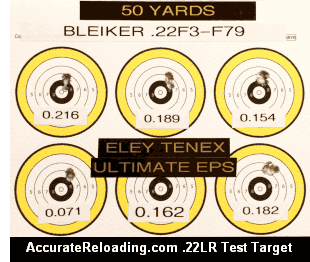 In 2010, the staff of AccurateReloading.com Forum completed a massive .22LR Rimfire Ammunition Testing Project. Some 55 different types of ammo were tested, using a highly-accurate Swiss-made Bleiker rifle, with a 2-stage trigger. All ammo varieties were tested at 50 yards, 75 yards, and 100 yards, shooting five, 5-shot groups at each distance. Though these tests were completed some time ago, many readers have requested a “reprint” of the ammo rankings, so we’ve republished this data below.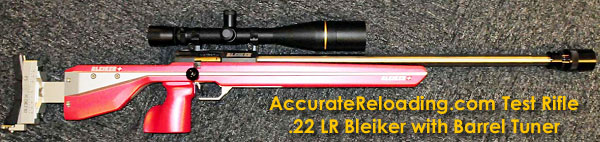
 Because of draconian restrictions on handguns in the United Kingdom, Olympic smallbore pistol shooters from the UK have been forced to conduct their training in neighboring countries, such as Belgium and France. Obviously, the need to travel overseas to practice their sport has been a major handicap for UK shooters who will compete with
  With the 2012 London Olympics soon approaching, UK Olympic officials have been looking at ways that Team GB pistol shooters can avoid the need to travel abroad just to practice shooting. Now, through a special act of Parliament, it appears that UK Olympic pistol shooters may finally be able to hone their marksmanship skills at home. A new law will allow qualified Olympic-level pistol shooters on Team Great Britain to import a new, non-lethal training device recently introduced in the United States. With the aid of the American-made


 Spartans Win Smallbore Title
 The TCU rifle team used a dominating effort in air rifle to erase a five-point deficit to claim its second national championship in the last three seasons. TCU’s top-scoring Air Rifle shooter, Sarah Scherer, finished third in the air rifle individual finals, which was won by another lady shooter, West Virginia Mountaineer Petra Zublasing. Congrats to Petra!


 The nation’s top collegiate men and women shooters have converged on Ohio State University to compete in the 2012

 Shan Zhang Won Gold in 1992
 How would you like to be able to shoot a rimfire rifle or pistol that only makes 25% as much noise as a standard .22 LR gun? And no, we’re not talking about a suppressor-equipped firearm. CCI claims that its new
 Many readers will be considering purchasing a rimfire rifle this season for a young family member, or grandchild to use as his/her “first gun”. Of course you can source a 10/22 or other bargain-basement firearm from Walmart, but why not acquire a rifle your boy or girl can use for a lifetime? If you get a high-quality, used bolt-gun, you’ll be providing a rifle that will deliver years of shooting enjoyment, and that will remain competitive as a young shooter’s skill level advances over time.
 Vast Inventory of Target Rifles
 Calm conditions and sunny skies prevailed as three previous champions set new national records in all three classes in the 2011 National Rimfire Sporter Championship fired here Sunday, 24 July. Charles J. Opalewski II, Lucas Boord and Ron Villanueva, all past champions, once again reached the top of the podium at this year’s event which also brought out a record 480 match entries. Opalewski, Boord, and Villanueva ALL set new National Records in their respective classes.
  In junior shooting, Amos Peck, 18, of Leslie, Michigan, won the overall O-Class competition with an aggregate score of 570-5X, followed by Aaron Ward, 18, Ypsilanti, Michigan (554-8X) and Stephenie Sabin, 17, of Curtice, Ohio (542-7X).


