Here is an interesting project by one of our Forum members. Martin C. (aka “Killick”) modified an Anschutz 1411 Match 54 rimfire prone stock to become a comfortable, great-tracking F-Class Open Division Stock. No Killick didn’t sacrifice a perfectly good rimfire rifle for this project — he bought the Anschutz stock by itself on eBay, then transformed it…
Killick explains: “This project started about seven years ago. I bought the Anschutz prone stock on eBay and whittled it a bit into a Palma rifle with a Barnard action and block and a Doan Trevor cheek piece and scope rail. Then about two years ago I decided to re-task the stock/action assembly into an F-Open rig. With more whittling, gluing, sanding, body fillering, sanding, filling, sanding, more sanding…and sanding, forming, priming, sanding, painting, waiting, painting, painting…painting and before you know it, Bob’s your uncle.”
Here is the eBay-sourced Anschutz 1411 stock, with new high-gloss blue finish, as initially modified for use in Killick’s centerfire Palma rifle. Looks nice!
Next step was the addition of a 3″-wide wood fore-end for F-Open duties with front rest:
Almost done here… just needs priming and final painting:
Here is Killick’s completed F-Open rifle with its much-modified Anschutz stock now finished in fire-engine red lacquer. This image shows the detail of the grip and customized cheekpiece.
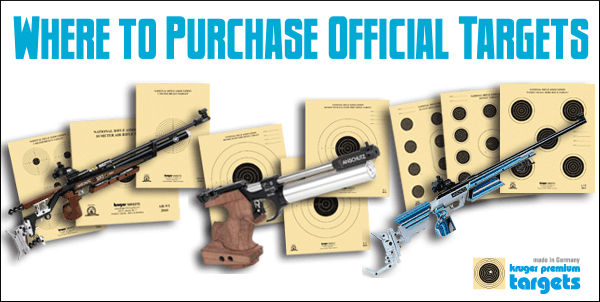
Need targets — not just any old targets, but the correctly-sized targets for specific shooting disciplines (such as NRA Smallbore, F-Class, and 1K Benchrest)? Well you won’t find them at your neighborhood Wally World store. Precise, dimensionally-correct competition targets are producted by a half-dozen specialty printers. In this article we provide links to the leading target sellers, with a chart showing “who’s got what”. Look for your particular discipline and the vendors will be specified.
Sources for Official Shooting Competition Targets:
AccurateShooter.com offers dozens of FREE, printable targets for target practice, load development, and fun shooting. We also offer a few of the most popular NRA Bullseye targets. One or more of these printable targets should work for most training purposes. However, some readers have asked: “Where can we get the real targets… exactly like the ones used in NRA, IBS, and NBRSA shooting matches?”
All these vendors carry nearly all the NRA High Power and Smallbore targets, including the new, smaller F-Class targets. National Target has the F-Class and High Power targets, including 100-yard reductions of the 200, 300, and 600-yard military targets. Germany’s Kruger Targets sells all the important NRA targets, and international (ISSF) air rifle and smallbore targets too.
Orrville Printing currently sells IBS targets for rimfire (50 yard) benchrest, short-range centerfire Benchrest (100, 200, 300 yards), Hunter BR Rifle (100, 200, 300 yards), plus the official 600-yard and 1000-yard IBS targets. National Target Company also has most of the IBS targets. NBRSA short-range, 600-yard, and 1000-yard benchrest targets are available directly from the NBRSA Business Office. Call (307) 655-7415 to order for the season.
American Silhouette shooter Eric Mietenkorte delivered a superb performance at the recent Canadian National Silhouette Championships in Fort Steel, British Columbia. Eric recorded a 1-2-3 Trifecta with 1st Place in Master Standard Rifle, 2nd Place in Master Hunter Rifle, and 3rd place in Master Smallbore Hunter. Eric is coming home with quite the trophy harvest. Other top shooters included Team Lapua members Mark Pharr and Cathy Winstead-Severin.
Erich called this a “target rich environment”…
Eric tells us: “The Canadian National Championships are all wrapped up. Thanks to the Bull River Shooters Association (B.R.S.A.) for hosting an incredible event! What a great [week] of shooting! Such a beautiful range with the nicest people! It was great seeing old friends and making new ones. [There were] definitely some challenging wind and mirage conditions, but lots of great shooting, and I even took home some hardware.” Erich has posted these photos from the event.
Erich was quick on the trigger shooting pigs at 300 meters. He says “I love hearing that clang from hitting the steel.” Click speaker icon to hear audio.
6.5mm Chamberings Favored for Centerfire (High Power) Silhouette
The 6.5mm caliber seems to be the “sweet spot” for High Power Silhouette shooters. Erich says: “I use the .260 Bobcat (6.5×250) wildcat. Most still use the .260 Remington and 6.5×47 Lapua.” Other popular chamberings for High Power Silhouette include the 6.5 Creedmoor, 6mmBR, 6mm Dasher, 6×47 Lapua, and 7mm-08.
One wicked cool paint job — the Fighter Plane graphics on Erich’s smallbore rifle drew admiring glances.
Here Erich spots for fellow American shooters Mark Pharr and Cathy Winstead-Severin of Team Lapua.
The Cranbrook Daily Townsman News did a nice story on the Championships, complete with this informative video.
Fort Steele in British Columbia is a beautiful venue. Stunning scenery all around…
The NRA National Smallbore Championships (Conventional and Metric) took place July 8-17 at the Wa-Ke’-De Range in Bristol, Indiana. The NRA’s Shooting Sports USA website has extensive coverage of the event written by correspondent Hap Rocketto.
In team competition, the USAMU shooters dominated: “The [conventional] paper team match was an AMU runaway — they carded a 4766-338X to have a 30-point pad on the second place Coast to Coast Team’s 4736-267X effort. The Illinois State Association finished third with a 4679-210X.”
USAMU shooters on the firing line at the Wa-Ke’-De outdoor range in Bristol, IN. Photo courtesy USAMU.
There were some great individual performances. In early prone competition, three shooters didn’t drop a point: “The U.S. Army Marksmanship Unit’s (AMU) Patrick Sunderman… opened the tournament with a 400-38X. Mike McPhail, perhaps one of the best prone shooters in world, followed up with a score of 400-37X and … civilian Daniel Martz closed out the top three with his 400-36X.” Later, in kneeling position, McPhail shot his second perfect score of the day, 400-30X, to win the kneeling match.
Iron Man Competition
There was a special “Iron Man” title for the best performance over the entire 8-day cycle. Rocketto writes: “The final prone match, 40 shots on the metric target with any sights, was the deciding factor in the Iron Man competition when McPhail beat George Norton by four points. Over eight days, McPhail shot a 9504-711X, Norton 9501-655X, and last year’s Iron Man Sunderman scored 9478-640X.” Overall the Army swept the top three places.
The Iron Man podium: SFC Mike McPhail (Center), SSG George Norton, & SPC Patrick Sunderman.
The last shot of the any sight metric position championship marked the end of the 2017 NRA National Smallbore Championships. The target frames have been stacked away until next year — when smallbore rifle shooters will again converge upon the Wa-Ke’-De Range in Bristol, Indiana.
Men and women now compete on equal terms at the National Smallbore Championship, gunning for the same honors in “gender-neutral” classifications. Photo courtesy Shooting Sports USA.
The Key to 3P — Beginner’s Guide to Smallbore Position Shooting
Would you like to try smallbore position shooting? Here are some tips from one of the best 3P shooters on the planet, Olympian Matt Emmons. Matt Emmons competed in the Three-Position Event at the Rio Olympics his fourth Olympic appearance. Matt has competed on the U.S. National Team since 1997, medaling in three Olympic games: Gold in 2004 in Men’s 50m Prone; Silver in 2008 in Men’s 50m Prone; and Bronze in 2012 in Men’s 50m 3X40. Although his specialty is Men’s 3-Position rifle, Emmons’ World Championship and Olympic Gold are in Men’s 50m Prone. He usually shoots an Anschütz or Bleiker .22LR rifle, with Eley Tenex ammo.
Here are shooting tips from Matt, courtesy Anschütz. Click image below to launch a large, full-screen PDF file.
Rimfire Benchrest can be fun and rewarding. It can also be frustrating because sourcing superior lots of ammo is a never-ending challenge. Still we like rimfire benchrest because you don’t need to load at the range. Plus rimfire barrels last a very long time (our friend Joe Friedrich set an ARA Benchrest record with a 100,000+ round-count barrel). Here’s a great video from the National Rimfire Benchrest Association of Ireland (NRBAI). Production quality is excellent! We highly recommend you watch this video, which does a great job illustrating both the fun and challenge of rimfire benchrest competition.
If you’ve never seen 50m Rimfire Benchrest competition, this video is well worth watching:
“If you need to get your mind away from everything… then look down a scope, concentrate, and be disciplined.”
“Comradery is one of our organization’s key traits… there are no barriers of gender, age or mobility. Just a very diverse, bunch of good people enjoying a sport together.”
“The skill, in brief, is having the ability to hit the equivalent of the top of a pinhead at 50 meters, in all conditions with a .22 round. Not easy, especially when you have to do it 50 times to get a maximum score of 500 [points], 250 per sheet.”
Credit Boyd Allen for finding this NRBAI Benchrest Video, released on 6/28/17.
On the Shooting Sports USA website, there’s a great profile of Kevin Nevius, one of America’s leading competitive marksmen. Kevin is best known for his smallbore success but he has also an impressive record in long-range centerfire competition — In 2005 and 2006 he won the Sierra Trophy at Camp Perry in 1000-yard competition. This was followed by smallbore National Championships in 2008, 2010, and 2014. This story, penned by gunwriter Hap Rocketto, covers Kevin’s career, which has included multiple championships and many records.
“My brother got me into long range varmint hunting and I started building my own guns very early,” Nevius told Dan Holmes in a Pronematch.com interview. “I had a hunting friend who shot indoor smallbore who started me in three position and I was hooked.”
Here are highlights from Hap Rocketto’s Profile of Kevin Nevius:
Champion shooter Kevin Nevius grew up in a household that did not allow firearms, an unlikely beginning for one of the United States’ premier prone rifleman and gunsmiths. Once out on his own he fell in with his brother who enjoyed long-range varmint hunting. His natural bent for things mechanical (he is a professional structural engineer) soon had him tinkering with rifles, which eventually led him to building his own.
Everything fell into line for him in smallbore during the 2008 season. After shooting a series of training matches in which he was most successful, he arrived at Camp Perry at the peak of performance and won his first National Smallbore Rifle Conventional Prone Championship. Kevin came back strong in 2010, winning the inaugural individual National Smallbore Rifle Metric Prone Championship, as well as the team title at Bristol, IN. [Kevin then won the Smallbore Conventional Prone Championship in 2014 with a practically perfect score of 4799-390X (LINK).]
Along the way, Nevius has won some impressive national records. In conventional competition he co-holds the 1200-shot metallic sight aggregate record of 1200-102X. He was just one shot short of perfection in the 480 aggregate, where he holds the civilian record of 4799-412X, just one point behind, and 11 Xs ahead of, Joe Hein’s 4800-401X open record.
Kevin Nevius hopes to build a smallbore rig capable of 3/8-MOA at 100 yards.
Building the Ultimate Rimfire Prone Rifle
Kevin is not just a great trigger-puller. He also smiths his own rifles. His current goal as a gunsmith is to build a rimfire rifle that will shoot 3/8″ groups at 100 yards. That’s a big challenge — 3/8-MOA represents very good accuracy for a centerfire rifle with handloaded ammo. But if any rimfire smith can build a rifle that will shoot that well at 100, it’s probably Kevin.
Photo by Lapua’s Adam Braverman. Lapua match ammo was used by many competitors.
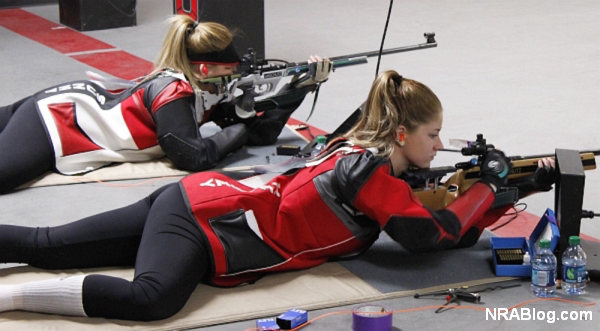
The NCAA Rifle Championship was held at Ohio State University March 10-11, 2017. The team National Championship went to the powerful West Virginia University squad. The No. 2-ranked WVU Mountaineers rifle team claimed its fifth straight NCAA title in commanding fashion, shooting a championship-record 4723 Aggregate score at Ohio State’s French Field House. This was the Mountaineers’ nineteenth national championship, a remarkable record of excellence.
WVU shooters also secured top honors — the individual titles were both won by West Virginia freshman. Morgan Phillips won the small-bore titles on March 10, 2017. Milica Babic won the air rifle championship the next day.
The Mountaineers’ NCAA championship five-peat is the third in the sport since 1980. WVU previously won six straight titles from 1988-1993, and Alaska-Fairbanks won six straight from 1999-2004.
NCAA Rifle Championship Rules
The NRA Blog has listed some of the more important rules in effect for the NCAA Rifle Championship.
Modern Electronic Targets
The 2017 NCAA Championships used electronic targets, with monitors at each shooting station. That allows spectators to view the scoring in real time. For air rifle, shot at 10 meters, and smallbore, shot at 50 feet, all NCAA competitions using electronic scoring targets shall comply with USA Shooting Rule 6.3.2 and be at least ISSF Phase I approved.
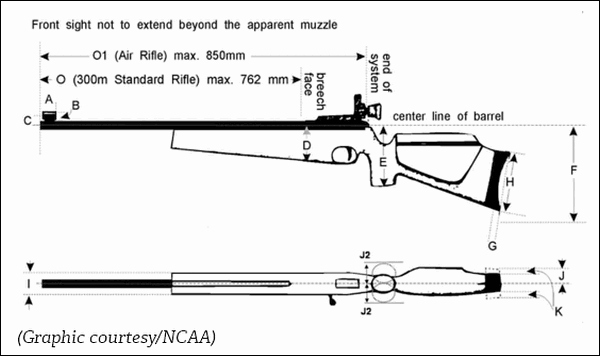
Max Rifle Weight is 8kg (17.64 lbs)
The maximum weight for a complete smallbore rifle cannot exceed 8 kilograms. Previously, a maximum weight of 6.5 kilograms was imposed for female shooters, but as of this season, both men and women can use up to an 8 kg rifle. [Editor: That’s actually a pretty heavy rifle to hold off-hand in the standing stages — it approaches the weight of an F-TR rifle.]
Single Shot Only
NCAA shooters aren’t worried about magazine capacity. Only single shot rifles that must be manually loaded before each shot are permitted in competition. Additionally, only one rifle can be used in the Elimination, Qualification and Finals rounds of an event. The action, barrel and stock cannot be changed, but the shooter can swap detachable buttstocks or accessories (subject to 8kg weight limit).
A new .22 LR rimfire shooting discipline has been developed, copying the PRS series. Call it “PRS Lite” — a practical-style match shot with .22 LR bolt-action and self-loading rimfire rifles. This series will be called the Practical Rimfire Challenge (PRC) with ELEY as Title Sponsor. The first three matches will be held at the Peacemaker National Training Center in Glengary, West Virginia. Match Dates are March 25, May 13, and September 30, 2017.
PRC Matches Will Feature Multiple Positions and Movement
ELEY Practical Rimfire Challenge series matches are positional shooting events in field conditions out to 300 yards. You can use either a bolt-action or semi-auto .22 LR rimfire rifle. Much like PRS (Precision Rifle Series), competitors will shoot from a variety of positions: prone, strong/weak shoulders, standing, sitting, and kneeling. There will be shots from barricades, and movement from position to position during stages.
PRC rules will, to a large degree, mirror PRS rules. However, shooters will see some different type of stages than what is normally seen at a PRS match. For example, there may be unsupported standing or unsupported kneeling shots in some stages. Peacemaker’s goal, along with ELEY, is not to replicate PRS in Rimfire, but rather to create the ultimate challenge for shooters on the rimfire rifle platform.
Cole McCulloch, owner of Peacemaker, says that the PRC should appeal to a wide variety of shooters: “We expect to see recreational, action, Olympic, NRA and PRS shooters all competing and having fun”. McCulloch also expects rapid evolution in the equipment: “I fully anticipate a Space Race for this sport. Meaning, we already know that the ammunition coming out from ELEY is fully capable of hitting small targets out to 300 yards. What will be fun to watch is the different types of rifles and optics the shooters choose to use. Some examples of this will be: Bolt or semi, heavy or ultra-light weight, MILS or MOA, 10 power or 30 power. The debate will rage and the rifle platform approaches will vary greatly.”
Rimfire Tactical Matches Aren’t Really New
We’re pleased to see this new PRC shooting discipline — it sounds like fun. However, the concept of a rimfire tactical/practical match is not new — at least on the West Coast. California shooting clubs have been running “Rimfire Tactical” matches for a nearly a decade already. CLICK HERE to read our comprehensive Rimfire Tactical report from way back in 2008. This article includes free targets, ballistics charts, and a complete run-down on suitable rimfire rifles.
The Concept Behind the Rimfire Tactical Match by Bill Erwin
Many guys who shoot long-range tactical matches practice with .22 LR rifles of similar configuration. Rimfire ammo is way more affordable than centerfire, you do not need a big range facility, and shooting rimfire saves wear and tear on your centerfire rifle. Further, for learning how to read the wind, there really is no better training tool than a 22 LR, even as close as 50 yards. Check out this table showing how a .22 LR ballistics compare to .308 Win:
22 LR vs. .308, Distances for Equal 10 MPH Wind Drift
This table shows the corresponding distances at which a 10 mph full-value crosswind pushes a .22 LR bullet and .308 projectile the same amount. Values are based on 0.130 BC for a 40gr .22 LR bullet, and 0.496 BC for 175gr .308 bullet.
22 LR 40gr 1050 fps
50 yd Wind 1.0″
75 yd Wind 2.2″
100 yd Wind 3.8″
125 yd Wind 5.8″
150 yd Wind 8.2″
175 yd Wind 11.0″
200 yd Wind 14.3″
.308 Win 175gr 2650 fps
130 yd Wind 1.07″
180 yd Wind 2.15″
230 yd Wind 3.68″
280 yd Wind 5.63″
330 yd Wind 7.98″
380 yd Wind 10.71″
440 yd Wind 14.56″
This table shows how the .22 LR can be an effective substitute for a .308 Win during training. Because the smaller bullet drifts more in the wind, a 22 rimfire shooter will experience roughly the same crosswind effects as if he was shooting a 175gr .308 twice as far out. So, rimfire work can teach you to dope the wind like a .308, but at less than half the distance. Shooting a .22 LR at 100 yards is like shooting a .308 (with 175 SMK) at 230 yards.
Shooting Peacemaker NTC Plate Rack at 100 Yards with Suppressed Rimfire
SPECIAL BONUS–Rimfire Tactical Precision Targets
These FREE targets by DesertFrog are offered in Adobe Acrobat format for easy printing. CLICK HERE to download all six targets as a .ZIP archive.
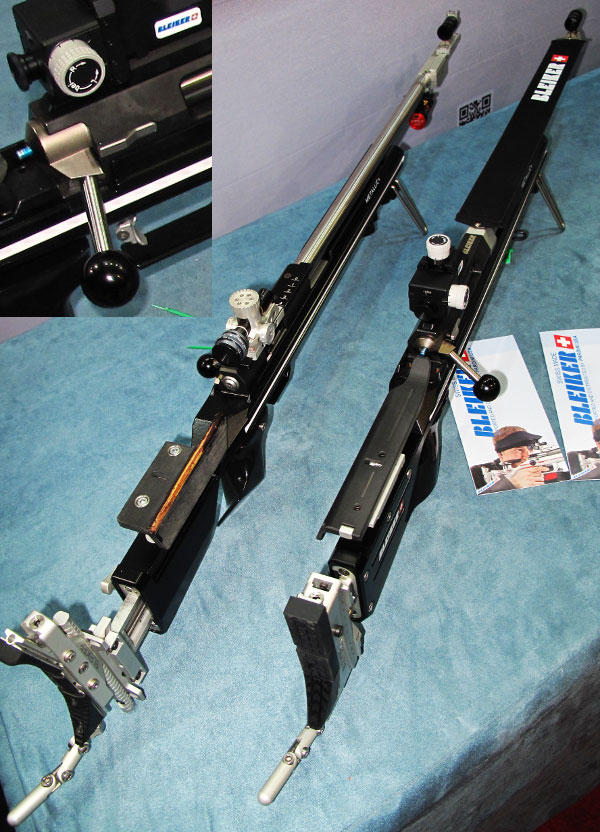
You are looking at $20,100 of Competition Rifles here. (Click Image for full-screen version.)
Don’t inquire about the price of a Bleiker competition rifle. As the expression goes, “If you have to ask, you can’t afford it”. At the Pardini USA booth at SHOT Show we saw a pair of bodacious black beauties — two “full-race” Bleikers, one a smallbore match rifle (.22 LR) and the other a 300m position rifle chambered in 6mmBR Norma. The combined price for the two rifles was a jaw-dropping $20,100.00. Yep, over $20K for the two. The 6mmBR rig was $10,200 while the smallbore rifle was $9,900.00.
Bleikers command such high prices because they win. At recent ISSF 300m and Smallbore Championships, Bleikers have been used by many of the medal winners. A gun is worth $10K if it can really put you on the podium or, better yet, deliver a world championship.
Take a look at this slick feature on the 300m gun. The adjustable cheek-pad automatically tilts up (for clearance) when you retract the bolt. That’s clever Swiss Engineering.
AccurateShooter.com offers dozens of FREE, printable targets for target practice, load development, and fun shooting. We also offer a few of the most popular NRA Bullseye targets. One or more of these printable targets should work for most training purposes. However, some readers have asked: “Where can we get the real targets… exactly like the ones used in NRA, IBS, and NBRSA shooting matches?”
All these vendors carry nearly all the NRA High Power and Smallbore targets, including the new, smaller F-Class targets. Germany’s Kruger Targets sells all the important NRA targets, and international (ISSF) air rifle and smallbore targets too.
Orrville Printing currently sells IBS targets for rimfire (50 yard) benchrest, short-range centerfire Benchrest (100, 200, 300 yards), Hunter BR Rifle (100, 200, 300 yards), plus the official 600-yard and 1000-yard IBS targets. National Target Company also has most of the IBS targets. NBRSA short-range, 600-yard, and 1000-yard benchrest targets are available directly from the NBRSA Business Office. Call (307) 655-7415 to order for the season.




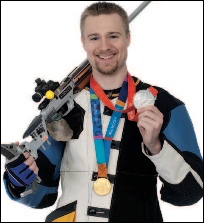 Matt Emmons competed in the Three-Position Event at the Rio Olympics his fourth Olympic appearance. Matt has competed on the U.S. National Team since 1997, medaling in three Olympic games: Gold in 2004 in Men’s 50m Prone; Silver in 2008 in Men’s 50m Prone; and Bronze in 2012 in Men’s 50m 3X40. Although his specialty is Men’s 3-Position rifle, Emmons’ World Championship and Olympic Gold are in Men’s 50m Prone. He usually shoots an Anschütz or Bleiker .22LR rifle, with Eley Tenex ammo.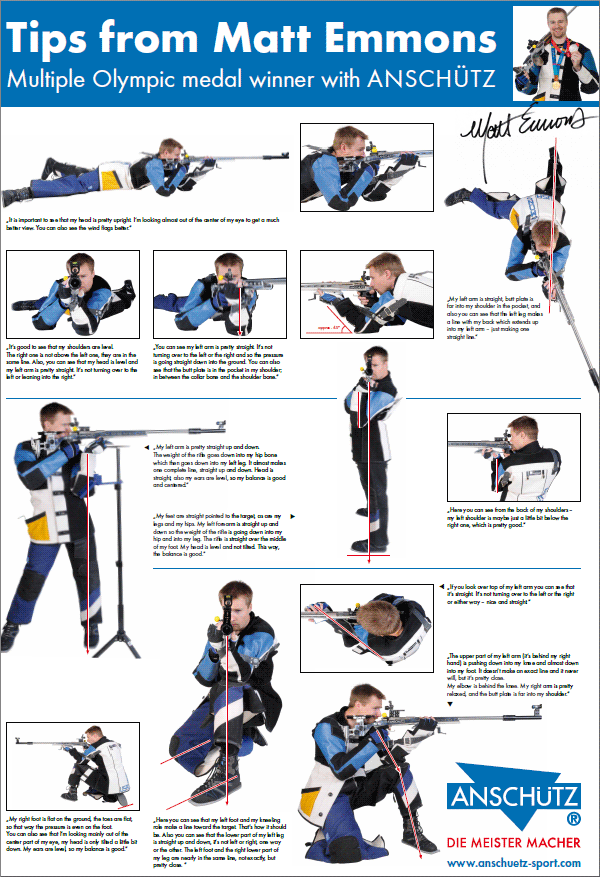


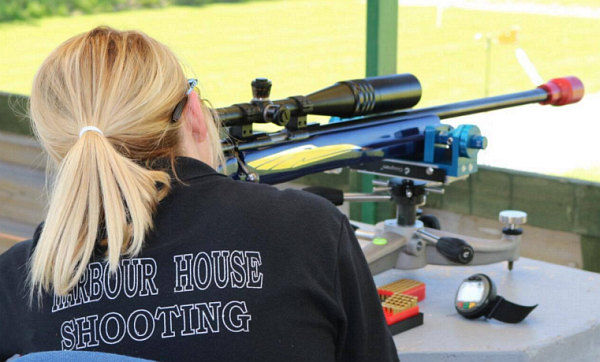


 Champion shooter Kevin Nevius grew up in a household that did not allow firearms, an unlikely beginning for one of the United States’ premier prone rifleman and gunsmiths. Once out on his own he fell in with his brother who enjoyed long-range varmint hunting. His natural bent for things mechanical (he is a professional structural engineer) soon had him tinkering with rifles, which eventually led him to building his own.