After the success of its recent winter Ballistics seminar in Michigan, Applied Ballistics has decided to take its show on the road, offering additional Ballistics seminars in three different states (Texas, Michigan, and North Carolina). These three seminars will cover a wide range of topics, with the primary focus on basic to advanced ballistics principles as applied to long-range shooting. Registration is now open for the three (3) upcoming Ballistics Seminars:
This video explains the subjects covered by Applied Ballistics Seminars:
Ballistician (and current F-TR National Mid-Range and Long-Range Champion) Bryan Litz will be the primary speaker at the spring, summer, and fall seminars. He will present material from his books and the Applied Ballistics Lab, and he will discuss his experience shooting in various disciplines. The seminar will feature structured presentations by Bryan and other noted speakers, but a great deal of time will be alloted for questions and discussion. By the end of the seminar, participants should have a much better understanding of how to apply ballistics in the real world to hit long-range targets. Along with Bryan, other respected experts will include:
Emil Praslick III – Head coach of the U.S. Palma team and retired head coach of the U.S. Army Marksmanship Unit. Emil will discuss tactics, strategy, and mindset for successful wind-reading.
Eric Stecker – Master Bulletsmith and President of Berger Bullets. Eric will be presenting on precision bullet making technology.
Nick Vitalbo – Owner of nVisti Tactical Innovations and chief engineer for Applied Ballistics. Nick will discuss the state of the art in laser rangefinders and wind reading devices.
Mitch Fitzpatrick – Applied Ballistics intern and owner of Lethal Precision Arms. Mitch specializes in Extended Long Range (ELR) cartridge selection and rifle design.
Ballistic Solvers – How they work, best practices, demos.
Weapon Employment Zone (WEZ) Analysis – How to determine and improve hit percentage.
Optics and Laser Technology – State of the Art.
The seminars costs $500.00. But consider this — each seminar participant will receive the entire library of Applied Ballistics books and DVDs, valued at $234.75, PLUS a free copy of Applied Ballistics Analytics software, valued at $200.00. So you will be getting nearly $435.00 worth of books, DVDs, and software. In addition, a DVD of the seminar will be mailed to each attendee after the seminar concludes.
On some internet shooting forums, self-declared “experts” advise new rifle shooters to stick to low-end factory rifles. These “experts” (many of whom don’t own a single really accurate rifle), claim that it will take years for a new shooter to learn how to shoot a rifle accurately. So, the argument goes, the accuracy offered by a precision-chambered rifle, with a custom barrel, is “wasted” on a new shooter.
We disagree with that viewpoint, at least when it comes to rifles shot from a rest. Certainly it takes time for a complete novice to learn how to handle the gun and to work the trigger smoothly. However, we’ve seen relatively new shooters, with help from a skilled mentor, do remarkably well with precision rifles right from the start. With a good bench gun, many new shooters can shoot well under 1 MOA on the first day. This editor has personally seen some inexperienced ladies try their hand at benchrest shooting, and within a month or two they are shooting on a par with the “good old boys” in serious competition.
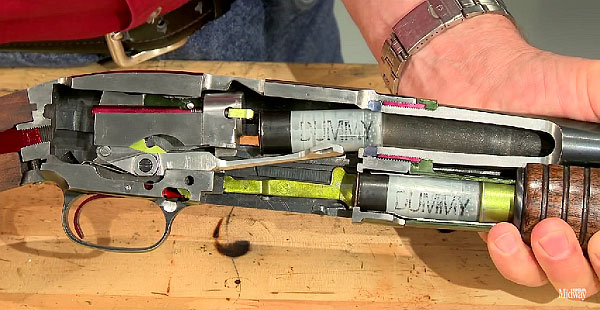
Even wonder how a pump shotgun works? Then watch this fascinating video from MidwayUSA. The operation of a pump-action shotgun is illustrated with a special cut-away version of a Winchester Model 12. The shotgun has been modified to reveal the inner workings. This cut-away Model 12 still loads and ejects dummy shells, but you can see how the lugs, slides, locks, ramps, springs and other internal parts work. You’ll be amazed how complicated this old pump-gun is. (The Model 12, Winchester’s first hammerless shotgun, is one of the most popular scatterguns ever made. Over 2,000,000 were sold.)
Skip Ahead to 3:00 to See Cut-Away in Action
To see how the Model 12 works, you can skip forward to the 3:00 minute mark in the video. The first part of the video shows how the Model 12 was “sliced and diced” to expose the inner workings. Larry Potterfield of MidwayUSA explains that “the factories often used cut-aways as sales tools to show how a specific model operated”. In addition the U.S. Military used cut-aways for training purposes.
Here is the cut-away completed. Even the pump grip has been sliced to reveal the inner workings.
Here’s a close-up, showing how the bolt retracts to eject a round.
A round has been picked up from the feed tube, and then is lifted into the chamber.
In the hit Hollywood movie “The Patriot”, the hero Benjamin Martin (played by Mel Gibson), tells his sons: “Aim small, miss small”. That advice was given to help his sons survive encounters with the British redcoats, but the “aim small, miss small” mantra can benefit target shooters as well.
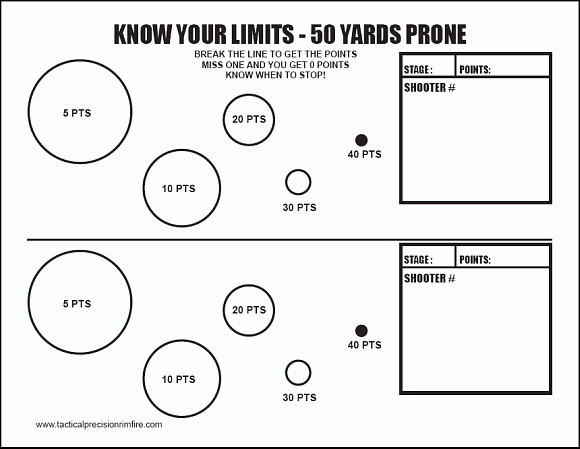
We have found that novice and intermediate shooters can often improve their accuracy simply by using targets with smaller, more precise aiming points. Inexperienced shooters can benefit by starting with a large-size aiming circle, and then progressing to smaller and smaller target dots. This lets the shooter increase the challenge as his gun-handling becomes more steady and his aim improves.
Here are two rimfire training targets with “big to small” target circles. Start with the largest circles, then move to the smaller ones in sequence. This systematic drill provides increasing challenge shot-by-shot. Novices often are quite surprised to see their accuracy improve as they move from bigger to smaller aiming points. That provides positive feedback — always a good thing.
Right Click and “Save as” to download printable PDF versions of these targets.
Guest Article By Michelle Gallagher, Berger Bullets
Let’s face it. In the world of firearms, there is something for everyone. Do you like to compete? Are you a hunter? Are you more of a shotgun shooter or rifle shooter? Do you enjoy running around between stages of a timed course, or does the thought of shooting one-hole groups appeal to you more? Even though many of us shoot several different firearms and disciplines, chances are very good that we all have a favorite. Are we spreading ourselves too thin by shooting different disciplines, or is it actually beneficial? I have found that participating in multiple disciplines can actually improve your performance. Every style of shooting is different; therefore, they each develop different skills that benefit each other.
How can cross-training in other disciplines help you? For example, I am most familiar with long-range prone shooting, so let’s start there. To be a successful long-range shooter, you must have a stable position, accurate ammunition, and good wind-reading skills. You can improve all of these areas through time and effort, but there are other ways to improve more efficiently. Spend some time practicing smallbore. Smallbore rifles and targets are much less forgiving when it comes to position and shot execution. Long-range targets are very large, so you can get away with accepting less than perfect shots. Shooting smallbore will make you focus more on shooting perfectly center shots every time. Another way to do this with your High Power rifle is to shoot on reduced targets at long ranges. This will also force you to accept nothing less than perfect. Shoot at an F-Class target with your iron sights. At 1000 yards, the X-Ring on a long range target is 10 inches; it is 5 inches on an F-Class target. Because of this, you will have to focus harder on sight alignment to hit a center shot. When you go back to the conventional target, you will be amazed at how large the ten ring looks.
Also, most prone rifles can be fitted with a bipod. Put a bipod and scope on your rifle, and shoot F-TR. Shooting with a scope and bipod eliminates position and eyesight factors, and will allow you to concentrate on learning how to more accurately read the wind. The smaller target will force you to be more aggressive on your wind calls. It will also help encourage you to use better loading techniques. Nothing is more frustrating than making a correct wind call on that tiny target, only to lose the point out the top or bottom due to inferior ammunition. If you put in the effort to shoot good scores on the F-Class target, you will be amazed how much easier the long-range target looks when you return to your sling and iron sights. By the same token, F-Class shooters sometimes prefer to shoot fast and chase the spotter. Shooting prone can help teach patience in choosing a wind condition to shoot in, and waiting for that condition to return if it changes.
Benchrest shooters are arguably among the most knowledgeable about reloading. If you want to learn better techniques about loading ammunition, you might want to spend some time at benchrest matches. You might not be in contention to win, but you will certainly learn a lot about reloading and gun handling. Shooting F-Open can also teach you these skills, as it is closely related to benchrest. Benchrest shooters may learn new wind-reading techniques by shooting mid- or long-range F-Class matches.
Position shooters can also improve their skills by shooting different disciplines. High Power Across-the-Course shooters benefit from shooting smallbore and air rifle. Again, these targets are very small, which will encourage competitors to be more critical of their shot placement. Hunters may benefit from shooting silhouette matches, which will give them practice when shooting standing with a scoped rifle. Tactical matches may also be good, as tactical matches involve improvising shots from various positions and distances. [Editor: Many tactical matches also involve hiking or moving from position to position — this can motivate a shooter to maintain a good level of general fitness.]
These are just a few ways that you can benefit from branching out into other shooting disciplines. Talk to the other shooters. There is a wealth of knowledge in every discipline, and the other shooters will be more than happy to share what they have learned. Try something new. You may be surprised what you get out of it. You will certainly learn new skills and improve the ones you already have. You might develop a deeper appreciation for the discipline you started off with, or you may just discover a new passion.
This article originally appeared in the Berger Bulletin. The Berger Bulletin blog contains the latest info on Berger products, along with informative articles on target shooting and hunting.
In the real world of self-defense, you can’t stand still like a bullseye target shooter*. You may need to move to cover, go to the aid of a family member, or otherwise move while being able to shoot. We’ve seen a variety of “move and shoot” drills, but most involve walking a few steps, then stopping, then moving again.
Here’s a drill that raises the degree of difficulty to another level entirely. In this video, instructor Dave Harrington engages 24 targets (one with a double-tap), while striding briskly (and continuously) on a powered treadmill. That’s right, Harrington stays on the treadmill for nearly a minute, and goes 25 for 25 with two (2) mag changes. (Shots 7 and 8 are a silhouette double-tap, for a total of 25 shots.) Harrington makes it look easy. But do you think you pull this off with no misses?
Shooting from Treadmill — Firing Sequence Starts at 1:20
Our friend Dennis Santiago, who also is a firearms instructor, says Harrington’s treadmill drill is no mean feat: “OK, this I am impressed by. This is not easy.” Another viewer commented: “That, I assure you, is a whole lot harder than it looks to run it clean like [Harrington] did.” As Harrington notes, a treadmill “is extremely unforgiving … you either possess the skill or the treadmill will take you to school.”
*That’s no knock on our bullseye shooters. They are very skilled. However, self-defense is a different challenge altogether.
You probably know Dustin Ellermann from the Top Shot TV show. Dustin, a self-trained “natural” marksman, was the Season 3 Champion. You may not know that Dustin also runs a Christian Camp for young people, Camp His Way. One of the Camp’s special programs is a weekend marksmanship camp taught by Dustin.
Multi-Activity Marksmanship Camp
At these sessions, the young campers get to shoot, practice archery, throw tomahawks, ride horses, and even try out blow-guns. Dustin reports: “This past weekend we had another amazing Marksmanship Camp. We had a great group of campers and of course lots of fun shooting/throwing/riding/slinging! Thanks to all our sponsors for helping us make this weekend awesome: 5.11 Tactical, Elzetta Design, NextLevel Training, Volquartsen Custom, GhostTargets.com, Cold Steel and more.” CLICK for equipment list.
Notice the young campers always wear ear and eye protection when shooting firearms. That’s as it should be. We wish adult shooters, including benchrest, smallbore, High Power, and F-Class competitors, followed this important safety practice.
New shooters are the future of our sport. If we want to “stem the tide” and resist pressures to close gun ranges and limit firearms use, we need to get new people involved in the shooting sports. And the first step in that process is getting first-timers to the range. One of the most successful efforts for enlisting new shooters is the NSSF First Shots Program. First Shots is a free introductory program of NSSF that teaches newcomers firearms fundamentals, safety and local regulations in a classroom setting, followed by a live-fire session with certified instructors. Around the country, First Shot Seminars provide free instruction by trained firearms instructors, with guns and ammo provided at no charge to participants.
First Shots Hosts 200 New Shooters at Houston Ranges
Last weekend, Houston, Texas hosted a successful series of First Shots seminars, as part of the First Shots “Big City Tour”. Four ranges in the Houston area — The Arms Room in League City, Spring Guns and Ammo in Spring, American Shooting Centers in Houston and High Noon Indoor Pistol Range in Crosby — welcomed more than 200 new shooters for training and some fun shooting. “A big thank you goes out to all of the participating ranges who gave a Texas welcome to the participants and the First Shots team,” said Tisma Juett, NSSF’s First Shots manager. Next stop on the First Shots Big City Tour is planned for Atlanta, Georgia. If your shooting facility is located in that vicinity and you’d like to be a host for this event, please contact Juett at tjuett@nssf.org. To find a First Shots Seminar near you, visit the First Shots Online Calendar Webpage.
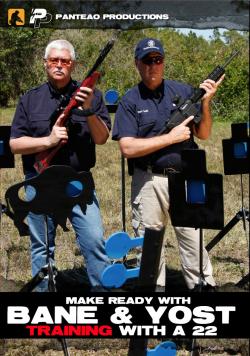
Looking to purchase a rimfire firearm for training? A new DVD covers the many options available among .22 LR handguns and rifles. This Training with a 22 DVD, hosted by Michael Bane and Tom Yost, covers rimfire guns, gear, targets, and shooting tips.
Training with a .22 is a great way to practice your shooting skills while saving money and having fun doing it. (Of course we wish rimfire ammo was cheaper and easier to find these days.) Michael and Tom talk about selecting the right handgun and rifle, accessories, backstops and targets, competitive shooting, using a .22 for self-defense, training with a .22, drills, and more. This video covers a lot of ground. You’ll see a wide variety of fun, reactive targets. We like the fact that the video features a large arsenal of semi-auto pistols AND revolvers, plus bolt-action, lever-action, and self-loading long guns. (Check out the sweet 1911-style Kimber Rimfire Target pistol in the trailer below). Price of the video is $44.99, or $35.99 for Panteo Productions Club Members.
Watch Trailer for DVD (many firearm types shown)
Michael Bane has been active in competitive shooting and training for decades and he hosts many popular TV shows on the Outdoor Channel including Shooting Gallery, Gun Stories, and The Best Defense. Tom Yost has been involved in the shooting industry for over 30 years as a competitor, consultant, and instructor.
Sniper’s Hide has released its first-ever, full-length DVD: Day One: Precision Rifle Training for the Tactical Shooter. This 91-minute DVD focuses on the fundamentals of marksmanship and is the first in a series being produced by Frank Galli and his crew at SnipersHide.com. Since 2009 Sniper’s Hide has offered subscription-based online training videos from within the Sniper’s Hide forum. The Day One DVD is the next evolution in Sniper’s Hide video-based training. The DVD run-time is 1 hour and 31 minutes, with a heavy emphasis on the basics. Day One Precision Rifle Training for the Tactical Shooter is available now in the Sniper’s Hide Store for $60.00.
Companion “Day One” Digital Book for iPads
Sniper’s Hide also offers a companion Day One interactive digital book for iPad users. This iBook features text, photos, and video instruction with a heavy focus on the fundamentals of marksmanship. Designed to compliment the Day One DVD, the interactive “Day One” iBook features instructional text plus video clips from the Day One DVD. Following the same block of instruction as the DVD, this iBook gives the end user another way to view the instruction. Precision Rifle Basics for the Tactical Shooter for iPads can be purchased for $12.99 from the iBookstore or iTunes store.
Watch Sample Video from DAY ONE: Precision Rifle Training
SnipersHide.com is one of the most popular online communities for tactical-style shooters. The Sniper’s Hide Forum now boasts over 75,000 registered members, and Sniper’s Hide also sponsors major shooting competitions which draw the best tactical shooters in the country.


 In the hit Hollywood movie “The Patriot”, the hero Benjamin Martin (played by Mel Gibson), tells his sons: “Aim small, miss small”. That advice was given to help his sons survive encounters with the British redcoats, but the “aim small, miss small” mantra can benefit target shooters as well.


 Position shooters can also improve their skills by shooting different disciplines. High Power Across-the-Course shooters benefit from shooting smallbore and air rifle. Again, these targets are very small, which will encourage competitors to be more critical of their shot placement. Hunters may benefit from shooting silhouette matches, which will give them practice when shooting standing with a scoped rifle. Tactical matches may also be good, as tactical matches involve improvising shots from various positions and distances. [Editor: Many tactical matches also involve hiking or moving from position to position — this can motivate a shooter to maintain a good level of general fitness.]
 You probably know Dustin Ellermann from the Top Shot TV show. Dustin, a self-trained “natural” marksman, was the Season 3 Champion. You may not know that Dustin also runs a Christian Camp for young people,


 Looking to purchase a rimfire firearm for training? A new DVD covers the many options available among .22 LR handguns and rifles. This
  Sniper’s Hide has released its first-ever, full-length DVD:


