Our IT guy, Jay (aka JayChris in the Forum), was having some issues with his .260 AI. A load with known accuracy had suddenly and mysteriously stopped shooting well. Jay couldn’t figure out what was going wrong. Then he remembered he had cleaned his brass using a powerful ultrasonic machine.
He inspected his brass carefully and saw that the ultrasonically-cleaned necks were so “squeaky clean” that he was actually scratching the jackets on his bullets when seating them. As well, Jay noticed that it took more force to seat the bullets and the seating force became less uniform case to case. Jay solved the problem by applying NECO Moly dry-lube inside the necks of his brass before seating the bullets.
The Perils of Ultrasonic Brass Cleaning by JayChris
I rotate my brass so that I can keep track of each firing, so I keep a “clean/ready to load” bin and a “fired” bin. I have 400 pieces of .260 AI brass. So, all of it was on its first firing (after doing a Cream of Wheat fire-forming) until I hit the 400-round mark. To my surprise, things went south at the 500-round mark. The first time I noticed it (according to my range log) was at a match last year, when I dropped several points and had some vertical stringing issues. After that match, I had 400 rounds through the barrel and all of my brass had a single firing on it. So, it was time to clean.
I have used an ultrasonic cleaner for a while now. I recently got a more powerful Ultrasonic cleaner, although I don’t know if that makes a difference. My brass comes out dry and squeaky. Emphasis on the “squeaky”.
I found that my new US machine may have been getting the necks TOO clean. After ultrasonically cleaning my brass, I had noticed that it required a little more force to seat the bullets, but I didn’t really think too much about it. But then, after going over my ordeal with a shooting buddy and going over my process in minutiae, we had an “AH HA” moment when it came to cleaning (he uses good ol’ vibratory cleaning).
So, I used some moly dry-lube to pre-lube the case necks and took some rounds out to test at 200 yards. I used my last known good load and sure enough, the vertical flyers disappeared! I shot two, 10-rounds groups with .335 and .353 MOA vertical dispersion, which is consistent with the results I was originally getting.
Other folks have suggested necks may get “too clean” after ultrasonic cleaning. It was pretty sobering to actually witness, first hand, what can happen when brass is “too clean”. I had read some discussions of issues with neck friction/bullet seating after ultrasonic cleaning, but, frankly, I dismissed the idea. Now I understand. The “too clean” effect doesn’t seem to affect my Dasher at all (perhaps because Dasher necks are very short), but on the bigger .260 AI, it definitely does.
Close-Up Photos of Case-Necks
Here are photos Jay took with a microscope. You can see the difference between tumbled brass and ultrasonically-cleaned brass. Jay says: “Here, in sequence, are the Ultrasound-squeaky-clean case neck, a case neck after treatment with NECO moly dry-lube (you can see the particles that will help coat the neck during seating), and, finally, the neck from a case cleaned with corncob media in a vibratory tumbler. You can clearly see how much smoother the inside of the tumbled neck is. Yes, it’s dirty, but it’s also very, very smooth.
Close-Up of Scratched Bullet
Here is a close-up of a bullet that was seated in an ultrasonically-cleaned (“squeaky clean”) neck, with no lubrication. You can clearly see the damage done to the jacket — in fact, in a couple spots you can see the lead core through the scratches! Jay also observed that quite a bit more seating force was required to seat the bullet in a “squeaky clean” neck.
NOTE: The bullet jacket is naked — NOT coated in any way. It looks a little dark because of the shadow from the microscope lens, and the high contrast.
Lyman has introduced a number of new products for 2013 for gunsmiths and hand-loaders. An impressive new offering is the new, large-capacity Turbo® Sonic Power Pro Ultrasonic Cleaning machine. This new unit, one of the largest and most powerful on the market, can ultrasonically clean items up to 34″ in length. The Lyman Power Pro’s large, stainless-steel heated tank and ten transducers allow gunsmiths, armorers, and gun-owners to quickly clean a wide variety of metal items. Designed for high-volume cleaning or for larger-than-normal items, the new Turbo Sonic Power Pro’s 34.75″-long* heated stainless steel tank can easily handle most barreled actions, upper receivers, as well as multiple handguns. The Power Pro includes both a timer and adjustable heat control (you can select temps up to 175° F).
With an MSRP of $1395.00 and a 70-lb shipping weight, this is a big, heavy, and costly unit. But if you need a hard-working machine for big jobs, this may be worth the investment.
Ten Transducers Do the Job Fast
The Power Pro’s TEN high-output transducers aggressively clean and degrease items, both inside and out. In fact, the Power Pro is such an effective cleaner that Lyman recommends that cleaned parts immediately be treated with Lyman’s Turbo Sonic Gun Lube. Changing from cleaning to lubrication is easy with the built-in drain system. Lyman now offers both cleaning concentrate and parts lubricant in gallon containers.
(*Note: the tank is listed as 35.75″ in product photo, but Lyman’s spec sheet states 34.75″.)
How-To Video: Ultrasonic Brass Cleaning (Click Arrow in lower left to start video)
Video playback requires HTML5. This may not work with older browser versions.
Product tip from EdLongrange. We welcome reader submissions.
With top-quality cartridge brass approaching $1.00 per case, it’s more important than ever to get maximum life from your match brass. Annealing can extend the useful life of your brass, and ultrasonic cleaning allows you to eliminate carbon build-up inside cases that have been fired numerous times. You can certainly do annealing and ultrasonic cleaning yourself, but to get the best (and most consistent) results, you’ll need to invest in quality equipment and spend a good deal of time and effort learning how to use it properly. Likewise, turning case necks requires expensive tools, and it takes time and practice before you’ll get perfectly-turned necks.
DJs Brass Offers Annealing, Cleaning, and Neck-Turning
If you don’t have the resources to purchase annealing and ultrasonic cleaning machines, or if you don’t have the time to neck-turn hundreds of cases — don’t fret, there is an affordable option. DJsBrass.com, run by benchrest shooter Darrell Jones, offers annealing, ultrasonic cleaning, neck-turning, and complete brass prep services (including OAL trimming) at very reasonable rates. Darrell will anneal 100 cases for $15, and he’ll neck-turn your cases (any caliber), starting at $30.00 per hundred. Even if you’re a skilled neck-turner, if you just acquired a new caliber, it might make sense to send the work to Darrell, instead of purchasing new expander mandrels and turning arbors.
False-Shoulder Forming for Wildcats
Do you shoot an “improved” short-necked wildcat like the 6mm Dasher? Want your fire-forming to go without a hitch? Darrell can take your parent brass and create a false shoulder so you get a good crush fit in the chamber. If you’re running a tight-necked chamber he can create a false shoulder AND turn the top half of the neck to fit your chamber.
Video Shows Annealing Process
In the video below, Darrell explains the wide variety of brass restoration services he offers. Darrell says he can “bring your brass back to life” and we have found that to be true. We had some 6mmBR brass with no-turn necks that started to lose their “competitive edge” after just 7-8 loadings. The neck tension had become inconsistent from case to case, and bullet seating force (measured with a gauge-equipped K&M arbor press) varied widely. We were seeing unexplained flyers, and ES had nearly doubled compared to when the brass was fresh. Annealing the cases really made a difference. The neck tension was much more consistent and bullets seated more uniformly with less “spiking” of seating force. Paying $15 for annealing is a lot cheaper than buying a new box of brass for $80.00 or more!
Darrell offers a variety of services at affordable rates. To order work by Darrell, visit DJsBrass.com, or call (205) 461-4680:
Case Annealing Only
Cost: $15.00/100 for standard cases; $20.00/100 for magnum cases.*
Combination Service (Cleaning and Annealing)
Ultrasonic Cleaning, Check for split necks, Anneal case necks.
Cost: Starting at $20.00/100 standard and $25.00/100 for magnum cases.*
Full Service (Case Prep, Cleaning, Annealing)
Uniform primer pockets, Chamfer, Ultrasonic cleaning/polishing, Anneal case necks.
Cost: Starting at $30.00/100 and up.*
Neck Turning or Trim-to-Length Custom Order Service
Cost: Starting at $30.00/100 for standard cases.*
(Darrell can also resize necks or false shoulder your cases. Call for quotes.)
*Add USPS flat-rate return shipping. Call (205) 461-4680 for quotes on miscellaneous, military bulk brass or high volume discount. Note: Prices subject to change.
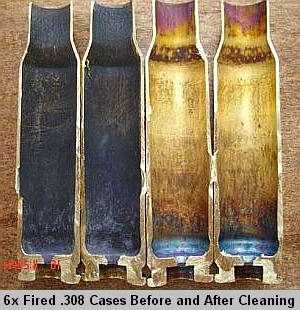
As a cartridge case is reloaded multiple times, burnt powder residue and carbon builds up on the inside of the case. Unless the case interior is cleaned in some fashion, eventually you’ll see a reduction in case capacity. One of our Forum members from Australia wonders about the effects of reduced case capacity: “If the capacity of the case decreases as the crud builds up, then it effectively reduces the chamber size. Wouldn’t that change the pressure produced from that of an equivalent clean case?”
Ultrasonic Cleaning Example:
Interesting Test of Case Capacity Changes
Forum member Fred Bohl has actual test results that can help answer the above question. Fred proved that, over a 20-reload cycle, the case capacity of uncleaned cases did, indeed, decline a small amount. However, surprisingly, this did not seem to affect the actual chronographed velocity of the load. ES did increase, but Fred believes the higher ES was due to changes in case-neck tension, rather than due to the slight reduction in case capacity.
Fred reports: “Back when beginning to use ultrasonic case cleaning, part of the motivation was to get the inside clean based on the assumption that allowing burnt residue to build up inside cases would affect capacity, and, ultimately, performance. An experiment was done to test this hypothesis. The load used, 30.5 grains of RL15 behind 107gr SMKs in a 6mmBR, was selected for best group and lowest ES in prior load development. It turned out to be 92% of initial case capacity and neither “full” or compressed. (I would suspect that different powders, load weight, and total case capacity might produce very different results.)
We took 30 cases of identical initial capacity and tracked three lots of 10 each:
LOT 1: No Internal cleaning LOT 2: Cleaned with media in tumbler LOT 3: Cleaned with Ultrasound machine
Each case (in each lot) was shot and reloaded 20 times. The simplified results after 20 reloads of each lot were as follows:
Lot 1 (not cleaned) – 0.3 to 0.4 gr. loss of capacity, 5 to 8 fps greater ES.
Lot 2 (tumble cleaned) – 0.1 to 0.3 gr. loss of capacity, 4 to 6 fps greater ES.
Lot 1 (ultrasonic cleaned) – no loss of capacity, no detectable change in ES.
FINDINGS There was no detectable correlation of velocity change to the lots. An oddity was that on very hot days Lot 1 velocities were, occasionally, slightly higher. [Editor’s note: That does suggest that the carbon build-up inside the uncleaned cases might cause a slight increase in pressure that shows up on hot days. Fred has posted that “A local shooter reported doing the 20 reload, no clean test on a .308 that gave a loss of capacity of 2.0 grains, doubled ES and signficant velocity changes. However, I don’t have any details on his load weight or powder.”]
NOTE: From results of another ongoing test, I believe the above differences in ES are probably due more to variance in bullet grip tension than case capacity. The ultrasound cleaned cases (LOT 3) did maintain the lowest ES, but we are not 100% sure of the reasons why. More consistent bullet seating might be the reason.
[Editor’s comment: Jason found that with his ultrasonically-cleaned cases, the inside of the necks got so “squeaky clean” that he needed to use dry lube in the necks. Jason uses the $10.95 dry lube kit from Neconos.com. This applies ultra-fine Moly powder to the neck using small carbon steel balls]


 Our IT guy, Jay (aka JayChris in the Forum), was having some issues with his .260 AI. A load with known accuracy had suddenly and mysteriously stopped shooting well. Jay couldn’t figure out what was going wrong. Then he remembered he had cleaned his brass using a powerful ultrasonic machine.
 I have used an ultrasonic cleaner for a while now. I recently got a more powerful Ultrasonic cleaner, although I don’t know if that makes a difference. My brass comes out dry and squeaky. Emphasis on the “squeaky”.


 Ten Transducers Do the Job Fast
 DJs Brass Offers Annealing, Cleaning, and Neck-Turning