|
|
August 9th, 2014
Most of us can figure out how to zero our rifles at 100 yards. But do you know how to get a solid zero at long range — as far as 1000 yards? You need to know your ballistics, otherwise you may waste a lot of ammo “sprayin’ and prayin'”. You definitely need to know your exact muzzle velocity, within a few FPS. This is not as simple as it seems, because it is not uncommon for chronograph results to be off by 10 to 20 fps or more, just through calibration error. Accordingly, you may want to test with a pair of chronos and record the results from each (you may be surprised at the variances).
 Video Illustrates Zeroing Process Video Illustrates Zeroing Process
The process of zeroing rifles for long range is covered in a new “Firearm Science” video from the NRA. This video features George Reinas, a popular competitor on the Top Shot TV Show. George demonstrates how to adjust his scope to compensate for bullet drop at long range. Our friend Dennis Santiago was involved in the making of this video, which was filmed at the Burbank Rifle & Revolver Club in Southern California. The video is narrated by the talented Jessie Duff, one of America’s best action shooters.
 When zeroing at long range, you should first consult a good ballistics program. Select your baseline zero distance (such as 100 yards), then plug in the MV along with salient environmental factors: Altitude, Air Pressure, Temperature, Humidity. After you enter bullet BC, your ballistics program will calculate the drop to the target, expressed in MOA or Mils. Some programs will actually list the number of clicks up from your current zero. When zeroing at long range, you should first consult a good ballistics program. Select your baseline zero distance (such as 100 yards), then plug in the MV along with salient environmental factors: Altitude, Air Pressure, Temperature, Humidity. After you enter bullet BC, your ballistics program will calculate the drop to the target, expressed in MOA or Mils. Some programs will actually list the number of clicks up from your current zero.
You can print out the data from your ballistics solver as a “drop chart” that can be attached to your rifle stock. If you shoot at various altitudes you may need multiple drop charts.
August 9th, 2014
Quality .30-caliber bullets aren’t cheap. But here’s a deal that should make you take notice. Midsouth Shooters Supply has major-maker 175gr HPBT bullets in 500-count lots for just $99.01. That’s right, ninety-nine bucks for FIVE hundred 175-grainers from one of USA’s leading bullet makers. (Clever boys can probably figure out the source).

If you need match-grade .30-caliber bullets for your F-TR or tactical rifle, this is a very good deal — you’re effectively paying just $19.08 per hundred. We haven’t seen these kind of prices on .30-caliber bullets in a long time. If you’re interested, act soon — quantities are limited.
NOTE: These over-run bullets are also listed as OEM blem. That means there may be some cosmetic flaws, such as water spots or discoloration. But they should shoot fine.
August 8th, 2014
Berger Bullets is now in the ammo business, offering high-quality, loaded ammunition for competition, hunting, and tactical applications. Berger will sell ammo through its new company, Applied Ballistics Munitions (aka “ABM” or “ABM Ammo”). See ABM’s ammunition offerings at www.abmammo.com.
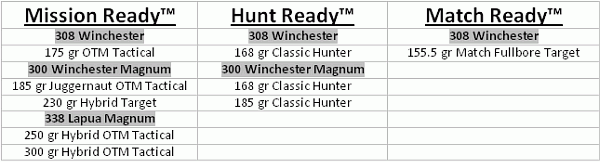
 ABM Ammo will offer precision rifle ammunition for three popular cartridge types: .308 Winchester, .300 Winchester Magnum, and .338 Lapua Magnum. There are three product lines. The “Mission Ready” line is designed for military and tactical use. In addition, ABM will offer “Hunt Ready” ammo for precision hunters and “Match Ready” ammunition for target shooters. ABM Ammo will offer precision rifle ammunition for three popular cartridge types: .308 Winchester, .300 Winchester Magnum, and .338 Lapua Magnum. There are three product lines. The “Mission Ready” line is designed for military and tactical use. In addition, ABM will offer “Hunt Ready” ammo for precision hunters and “Match Ready” ammunition for target shooters.


Each product line is loaded with the Berger bullet that best fits a given application. Each of the bullets used have been proven performers among the hand loading community for years and in some cases, decades. The chart below shows the current bullet selections for each of the three product lines:
ABM Ammo Components are Tested Lot by Lot
ABM uses high quality components and tooling to produce the most consistent ammunition possible. In a process developed by ballistics expert Bryan Litz, ABM ammo has been engineered and tested in the Applied Ballistics laboratory. ABM actually tests each individual lot of components used in the loaded cartridges to ensure quality and consistency.
Eric Stecker, President of Applied Ballistics Munitions relays, “Launching an ammunition company in today’s firearm market environment has been a challenging experience. The product will speak for itself among the shooters as to why it is so important that we pursue this effort.” To learn more about Applied Ballistics Munitions, visit www.abmammo.com.
August 8th, 2014

Story based on report by Lars Dalseide for NRABlog.com
You could say shooting is in her blood. Raised in a home where national titles were about as regular as Johnny Carson on late night, it was only a matter of time until Michelle Gallagher won a National NRA Rifle title of her own. Or, as is the case this year, a fourth National NRA Long Range Rifle Championship.
“I started shooting when I was about 7,” Gallagher explained. “Mom was taking me and Sherri (her sister) to the range ever since we were little kids. “
As with most shooters, it all started with smallbore. Working on stance, trigger control, and reading the wind, the light rifle fulfilled every shooting desire until an international match in New Zealand for the Palma World Championships. “I saw those Palma team jackets and that was it. I wanted one of those jackets. So we went home and Mid (her stepfather Middleton Tompkins) built me a Palma gun.”
Michelle Gallagher with Tompkins Trophy for the NRA Long Range High Power Rifle Championship.

Though the desire for a jacket was strong, the switch from smallbore to high power didn’t come without complications. In fact, Gallagher admits to shooting with her eyes closed for the first six months.
“It was such a big kick.”
Soon the kick wasn’t so big. Using the skills she acquired in smallbore, Gallagher rose through the ranks until winning her first NRA Long Range High Power Rifle title three years later. With two more championships under her belt, she ultimately achieved her initial High Power goal in 2007 with a spot on the United States International Palma team.
Jacket and all.
Preparing for the NRA Rifle Championships
Gallagher doesn’t shoot much of the sling rifle these days. In fact, the last time she wrapped said sling around her left arm and sent a few shots 1000 yards down range was the 2013 NRA Long Range High Power Championships. Which begs the question — how did she manage to win without any practice?
“I’ve been shooting F-Class.”
Now how does shooting on a bipod make you a better sling rifle shooter?
“You have to take the targets into consideration,” she began. “On F-Class targets the 10 ring is [the size of the High Power] X-Ring. So the wind calls have to be spot on, there’s not as big a cushion as you get with sling rifles. And I think that helps a lot.”
Another part of Gallagher’s preparation that helps a lot is her relationship with her parents. World class shooters on their own, their status has changed from mentors to peers. An odd situation at first, the family eventually found a way to make it work.
“They still help me a lot, but they ask for my advice as well. They taught me a great deal and I’ve tweaked that with my own experience. Now we’re building off of each other rather than just me asking for advice.”
Michelle (right) gets advice from mother Nancy Tompkins (left) while SSG Brandon Green looks on.

Rediscovering her NRA Long Range stride 13 years after her last win means Michelle is likely to stick around the sling rifle arena for a little while longer. The thrill of the NRA Championships still puts a twinkle in her eye: “There’s just something about shooting here at Camp Perry … It’s just special.”
August 7th, 2014
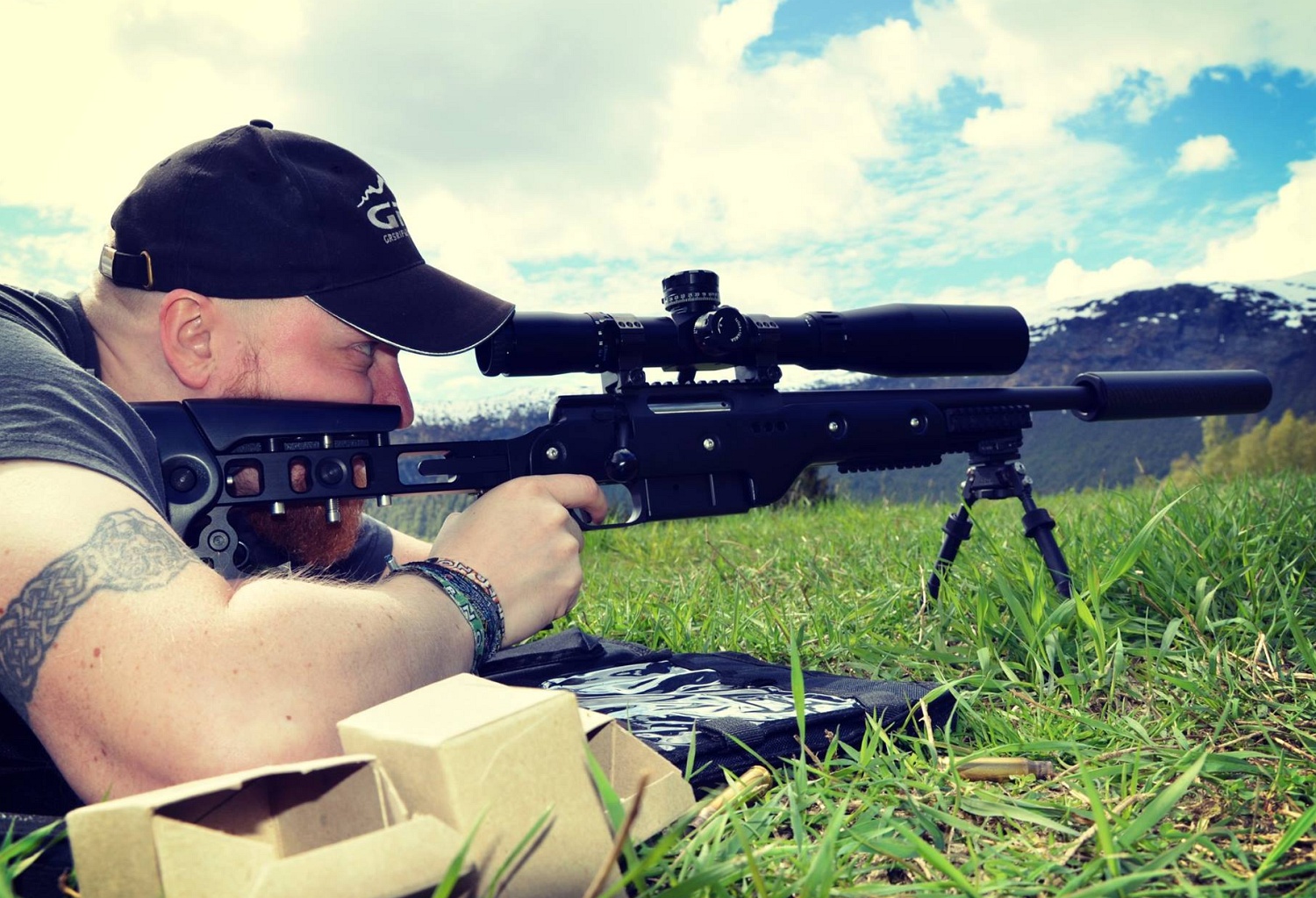
GRS Riflestocks is a Norwegian company that has built its reputation on intelligently-designed, high-quality laminated wood stocks. GRS wood stocks, for competition and hunting, are distributed in the USA by Kelbly’s. Ergonomics have always been a key feature in GRS designs, making GRS stocks very comfortable for the shooter.
CLICK IMAGE for Full-size Photo

 GRS Aluminum Chassis Systems GRS Aluminum Chassis Systems
Now GRS is moving into a new product area — developing an aluminum chassis system for long range applications. The first GRS metal stocks should be ready this month for European delivery (though it could take longer to export to USA). The new GRS metal chassis system will be offered for many popular actions:
Remington Short Action & Long Action
Sig Sauer SSG 3000/Sauer 200 STR
Howa Short Action & Long Action
Tikka T3
Initially, these stocks will be right-hand only, though a left-hand version may be offered in 2015. GRS has not yet released any pricing details for its aluminum chassis systems.

Excellent Video Shows How GRS Stocks Are Made — Plus Shooting in Norway
Product Tip from EdLongrange. We welcome reader submissions.
August 7th, 2014
The 2014 NSSF Rimfire Challenge World Championship (RCWC), will be held October 3-5, 2014, at the Old Fort Gun Club in Fort Smith, Arkansas. Competitors will be challenged with a variety of rimfire stages for both pistol and rifle. “Old Fort Gun Club’s experience running organized competition makes them a perfect fit for hosting the biggest Rimfire Challenge event of 2014,” said Zach Snow, Shooting Promotions Manager with NSSF. This past April, Old Fort ran a hugely successful Rimfire Challenge Regional Match with 125 shooters.

The NSSF Rimfire Challenge program was developed to introduce newcomers to competition target shooting by providing individuals and families with a safe, fun, and exciting first-time experience using .22-caliber handguns and rifles and steel targets. Formerly known as the Ruger Rimfire Challenge, the NSSF assumed administrative responsibilities for the fast-growing program in 2014.
Online competitor registration is available now for the Rimfire Challenge World Championships. Shooter participation is limited to 200, so competitors are urged to sign up now.
Rimfire Challenge World Championship Online Registration Form | RCWC Event Schedule

“We are definitely looking forward to hosting the Worlds,” said Bill Striplin, President of Old Fort Gun Club. “We think the layout of our shooting bays and their close proximity to one another will be a great thing for these new shooters. Our range setup helps a big match like this flow smoothly from stage to stage, and that really helps make a long day on the range as stress-free as possible.”

August 6th, 2014
Michelle Gallagher is now the 2014 NRA Long Range High Power Rifle Champion. Michelle shot a perfect Palma score to win the multi-match championship. When the dust settled, Michelle edged out her mom, Nancy Tompkins, by a single X. Readers asked about Michelle’s choice of bullets. In the Long Range Championships, Michelle used the Berger .30-caliber 155.5gr Match Fullbore Target bullet (for Palma), as well as the 6.5mm 140gr Match Hybrid Target bullet.
Here are some photos from the Long Range championships, courtesy GONRAMedia.
CLICK HERE to see more GONRAMedia photos from Camp Perry.
John Whidden, a three-time NRA Long Range Champion, had a pair of long-range rifles built on modified Anschutz aluminum small-bore stocks. John’s scoped rig (first photo) features a Kelbly Panda Action. The iron sight version (second photo below) has a Winchester action. John has done these conversions for other shooters.


Long Range is not a man’s world by any means. The top two LR places at Perry were claimed by ladies.

Tubeguns built with Gary Eliseo chassis systems were popular on the firing line.

Yes, that is a John Deere Mirage Band shielding this shooter’s barrel.

This service rifle shooter found a way to shield his sights and remember his loved ones.

This competitor transformed a Sinclair loading block into an elevated ammo caddy. Clever piece of kit!

“Wagons HO!”. Shooters await the long ride to the pits for target duties.


August 6th, 2014
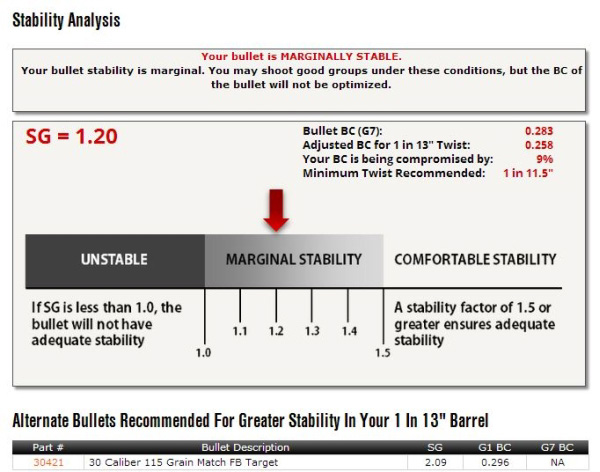
Berger Bullets has improved its online stability calculator. Tests have shown that bullets can suffer from reduced BC if the bullet rpm (spin rate) is less than optimal, even if barrel twist rate is otherwise fast enough to stabilize bullets in flight. Now, the improved, free Stability Calculator can determine if you need a faster-twist barrel to enjoy the best BC from your bullets.
CLICK HERE for FREE Berger Twist Rate Stability Calculator
By Bryan Litz, Chief Ballistician for Berger Bullets
We’re happy to announce a major upgrade to our Twist Rate Stability Calculator which is free to use on the Berger Bullets webpage. The old stability calculator was pretty basic, and would simply return a gyroscopic stability number based on your bullet, twist rate, and atmospheric conditions. This was used to determine if your barrels twist rate was fast enough to stabilize a particular bullet or not, based on the Gyroscopic Stability Factor (SG) being greater than 1.4.

Stability and BC — How Bullet RPM Affects Ballistic Coefficients
The new calculator still calculates SG, but also goes much further. In addition to calculating stability, the upgraded calculator can also tell you if your stability level is harming the effective BC of your bullets or not. Extensive testing has proven that bullets fired with stability levels between 1.2 and 1.5 can fly with excellent precision (good groups), but suffer from a depressed BC, sometimes as much as 10%. Shooting the bullets from faster twist rate barrels allows for the bullets to fly better and realize their full BC potential.
August 6th, 2014
Report by Kelly Bachand, for Kelly’s Gun Sales Blog.
Tuesday, August 5th, was the first day of the actual competition. The weather forecast was for rain with an 80% chance of thunderstorms. We somehow snuck through on that 20% and had great shooting weather all day. We shot 300 yards, 600 yards, and 800 yards on Tuesday with 15 shots at each. For the 300-yard line and part of the 600-yard line the wind came out of the west, as usual. Part way through the 600-yard line it started to switch and for the rest of the day it only came out of the north east or directly out of the east.

Int’l Fullbore Targets — More Challenging Than NRA Targets
The ICFRA (International Confederation of Fullbore Rifle Associations) targets are sometimes smaller than the NRA targets we are used to shooting in the USA. The 300-yard target has an especially small bullseye; it must be just 2.5″ across or something. Interestingly, these targets are also 5-V targets as opposed to our 10-X targets. This means the maximum points that can be scored with each shot is 5 points (instead of 10) and the tie-break ring is called the V-Ring (instead of the X-Ring). As a rehearsal for the 2015 World Long Range Championships, I think the match is off to a great start. There have been some logistical issues that have come up (and they only would have by running this match), so I’m very hopeful that the match directors will have all of their ducks in a row next year.
In a match like this, with the relatively calm wind conditions we had today, the top few shooters will likely go the whole day without dropping a single point and they’ll do it with a pretty high V-count. That means scores of 75 with 10+ Vs at every yard line are likely what it takes to find yourself towards the top (75-15V is the maximum score possible). I had a 75-9V at 300 and I was quite pleased with the group I shot, it must have been just a few inches tall. As one of the previous US Palma Team members, all of my shots in this match are being plotted and evaluated as part of the US Palma Team try-outs. It’s a very good incentive to break great shots.
Trigger Certification Rules
One of the fun things about shooting with ICFRA rules is that after someone shoots a possible (gets all the possible points, like 75 out of 75) they have to immediately get their trigger pull-weight tested. [That’s interesting] because you get to watch your friends come off the line and you immediately know how they did and can quickly give them a thumbs-up and rush over to congratulate them.
There is some really great shooting going on. I saw a lot of high scores shot at 800 yards. One under-25 lady from across the pond (Chloe Evans) spent most of today showing all the rest of us how it is done. It looks like she finished the day with a 225-36V. For the day, I had a 224-30V out of a possible 225-45V. I highly recommend following the scores online:
CLICK HERE for Current Fullbore Match Results from NRA website.
August 5th, 2014
One of our Forum members complained that he wasn’t able to set his primers flush to the rim. He tried a variety of primer tools, yet no matter what he used, the primers still didn’t seat deep enough. He measured his primers, and they were the right thickness, but it seemed like his primer pockets just weren’t deep enough. He was mystified as to the cause of the problem.
Well, our friend Boyd Allen diagnosed the problem. It was the decapping rod. If the rod is adjusted too low (screwed in too far), the base of the full-diameter rod shaft (just above the pin) will contact the inside of the case. That shaft is steel whereas your case is brass, a softer, weaker metal. So, when you run the case up into the die, the shaft can actually stretch the base of the primer pocket outward. Most presses have enough leverage to do this. If you bell the base of the primer pocket outwards, you’ve essentially ruined your case, and there is no way a primer can seat correctly.
The fix is simple. Just make sure to adjust the decapping rod so that the base of the rod shaft does NOT bottom out on the inside of the case. The pin only needs to extend through the flash hole far enough to knock the primer out. The photo shows a Lyman Universal decapping die. But the same thing can happen with any die that has a decapping rod, such as bushing neck-sizing dies, and full-length sizing dies.

Whenever you use a die with a decapping pin for the first time, OR when you move the die to a different press, make sure to check the decapping rod length. And it’s a good idea, with full-length sizing dies, to always re-check the height setting when changing presses.
Lee Universal Decapping Die on SALE for $9.89
Speaking of decapping tools, Midsouth Shooters Supply sells the Lee Universal Decapping Die for just $9.34 (item 006-90292), a very good deal. There are many situations when you may want to remove primers from fired brass as a separate operation (prior to case sizing). For example, if your rifle brass is dirty, you may want to de-cap before sizing. Or, if you load on a progressive press, things will run much more smoothly if you decap you brass first, in a separate operation. The Lee Universal Decapping Die will work with cartridges from 17 Fireball all the way up to 45-70. However, NOTE that the decapping pin supplied with this Lee die is TOO LARGE for LAPUA 6.5×47, 6BR, 220 Russian, and Norma 6 PPC flash holes. Because the pin diameter is too large for these brass types, you must either turn down the pin, or decap with a different tool for cases with .059″ flash-holes. Otherwise, the Lee Decapping Die works well and it’s a bargain.

|