|
|
October 19th, 2014
 One of our readers asked “What effect does altitude have on the flight of a bullet?” The simplistic answer is that, at higher altitudes, the air is thinner (lower density), so there is less drag on the bullet. This means that the amount of bullet drop is less at any given flight distance from the muzzle. Since the force of gravity is essentially constant on the earth’s surface (for practical purposes), the bullet’s downward acceleration doesn’t change, but a bullet launched at a higher altitude is able to fly slightly farther (in the thinner air) for every increment of downward movement. Effectively, the bullet behaves as if it has a higher ballistic coefficient. One of our readers asked “What effect does altitude have on the flight of a bullet?” The simplistic answer is that, at higher altitudes, the air is thinner (lower density), so there is less drag on the bullet. This means that the amount of bullet drop is less at any given flight distance from the muzzle. Since the force of gravity is essentially constant on the earth’s surface (for practical purposes), the bullet’s downward acceleration doesn’t change, but a bullet launched at a higher altitude is able to fly slightly farther (in the thinner air) for every increment of downward movement. Effectively, the bullet behaves as if it has a higher ballistic coefficient.
Forum member Milanuk explains that the key factor is not altitude, but rather air pressure. Milanuk writes:
“In basic terms, as your altitude increases, the density of the air the bullet must travel through decreases, thereby reducing the drag on the bullet. Generally, the higher the altitude, the less the bullet will drop. For example, I shoot at a couple ranges here in the Pacific Northwest. Both are at 1000′ ASL or less. I’ll need about 29-30 MOA to get from 100 yard to 1000 yards with a Berger 155gr VLD @ 2960fps. By contrast, in Raton, NM, located at 6600′ ASL, I’ll only need about 24-25 MOA to do the same. That’s a significant difference.
Note that it is the barometric pressure that really matters, not simply the nominal altitude. The barometric pressure will indicate the reduced pressure from a higher altitude, but it will also show you the pressure changes as a front moves in, etc. which can play havoc w/ your calculated come-ups. Most altimeters are simply barometers that read in feet instead of inches of mercury.”
As Milanuk states, it is NOT altitude per se, but the LOCAL barometric pressure (sometimes called “station pressure”) that is key. The two atmospheric conditions that most effect bullet flight are air temperature, and barometric pressure. Normally, humidity has a negligible effect.
It’s important to remember that the barometric pressure reported on the radio (or internet) may be stated as a sea level equivalency. So in Denver (at 6,000 feet amsl), if the local pressure is 24″, the radio will report the barometric pressure to be 30″. If you do high altitude shooting at long range, bring along a Kestral, or remember to mentally correct the radio station’s pressure, by 1″ per 1,000 feet.”
You can do your own experimental calculations using JBM Online Ballistics (free to use). Here is an extreme example, with two printouts (generated with Point Blank software), one showing bullet trajectory at sea level (0′ altitude) and one at 20,000 feet. For demonstration sake, we assigned a low 0.2 BC to the bullet, with a velocity of 3000 fps.
Trajectory of Bullet fired at Sea Level
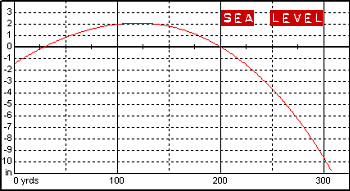 Trajectory of Bullet fired at 20,000 feet

if you want to learn more about all aspects of External Ballistics, ExteriorBallistics.com provides a variety of useful resources. In particular, on that site, Section 3.1 of the Sierra Manual is reprinted, covering Effects of Altitude and Atmospheric Pressure on bullet flight.
October 18th, 2014
Frank Galli (aka “Lowlight”), the head honcho of Sniper’s Hide, has created a good 15-minute wind-reading video for the Scout web network. This video, a segment from the Sniper’s Hide Day One DVD, covers many of the important basics of wind reading. It’s a helpful introduction for those getting started in long-range rifle shooting.
Click Image to Go to Video Playback Page:

Quote 1: “On the range, people describe the wind as the Great Equalizer. Next to your drop, drift from wind is the second most important consideration for the long range precision rifle shooter. Unlike drop, which is predictable, the wind is a constantly changing factor.”
Quote 2: “Wind is like water. It’s important to understand how terrain will effect the wind, how it will change the direction, velocity and consistency. It’s responsible for turbulence, it’s responsible for unseen changes that will throw our shot off. Wind will ebb and flow just like waves crashing on the beach. We need to understand the frequency and velocity of each wave.”
CLICK HERE to Watch Wind-Reading Video.
October 18th, 2014
 In another month or two many Eastern and snow-belt shooting ranges halt operations for the winter. If you’re an avid rifleman who enjoys shooting regularly, the dark days of winter can bring withdrawal pains. The closure of outdoor ranges can mean months of forced inactivity… unless you have an all-weather indoor shooting solution. In another month or two many Eastern and snow-belt shooting ranges halt operations for the winter. If you’re an avid rifleman who enjoys shooting regularly, the dark days of winter can bring withdrawal pains. The closure of outdoor ranges can mean months of forced inactivity… unless you have an all-weather indoor shooting solution.
Some clubs maintain their own indoor air rifle ranges where you can continue to shoot and train throughout the winter. If there are no such facilities nearby, Creedmoor Sports now offers a great solution for those who want to shoot indoors — even in your own basement or garage.
Creedmoor’s patented 10m Air Gun Range provides a target holder and a curtain-type backstop capable of stopping pellets with a muzzle velocity up to 600 fps. The target boxes can be positioned at various heights for prone, kneeling, and standing. Creedmoor says the hardened steel target boxes provide 100% containment for any pellet passing through the target.
The 10M Air Gun Range is available either in a 3-station configuration for $1514.00 (item 3AGR), or as a one-station (single-point) range for $325.00 (item AGR-SINGLE). Creedmoor’s Air Gun Range is a proven, heavy duty product — the only Air Rifle target system ever tested and approved by the U.S. Military. This system is currently being used in more than 600 schools nationwide, as well as the new CMP shooting facility in Alabama. The 3-station range easily dis-assembles for transport and storage, fitting inside a 34″ x 10″ x 8″ carry duffle.

The Portable Air Gun Range comes with a durable curtain/ backstop that sets up quickly and easily. The curtain provides ample stopping power for air pellets. However, this is NOT to be used with high-energy pneumatic hunting rifles (such as the .357 Benjamin Rogue) or rimfire or centerfire rounds. This is for standard airguns only. That could be a $100 Crosman, or a $3600.00 Model 9003 S2 Anschutz:

October 18th, 2014
While devotees of this site are hard-core accuracy addicts, who normally shoot tiny groups with sophisticated Benchrest and Varmint rifles, we should not overlook the pure fun of shooting a simple rifle at reactive targets.
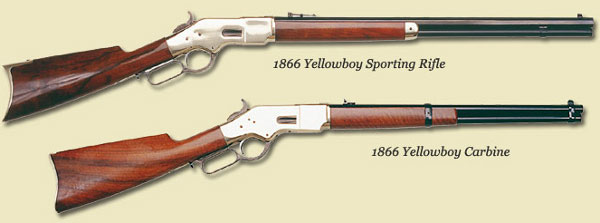

Nailing a nice, tight 1/4-moa group is very satisfying. But for pure unadulterated shooting fun, it’s hard to beat a slicked-up “race-ready”, Winchester-clone lever gun. In fact, this editor’s favorite rifle for “fun shooting” is my 20″ Uberti Model 1866 “Yellowboy” Lever gun. Shooting light-loaded 38 SPL rounds at steel targets from a standing position offers old-fashioned shooting satisfaction. On the “fun meter” this tops the scale. My rifle features a slicked-up action and lightened trigger. After a “CodyMatic” action job by cowboy gunsmith Cody Conagher, my Yellowboy’s lever can be cycled with just one finger. Trigger pull is about a pound and a quarter. The high-gloss, blued octagonal barrel is very accurate and the mirror-finish bore cleans up easily.

Based on the Model 1866 Winchester, Uberti’s Yellowboy, and its Model 1873 “older brother”, feature a toggle-link action that is extremely smooth. The toggle action design also keeps the linkages separate from the chamber so the gun runs extremely clean. After firing a hundred rounds or more, all you need to do is wipe off the bolt and breech-face with some solvent and run a bore-snake down the bore a few times. To be honest, the Yellowboy is more fun to shoot at steel than my AR Carbine. And maintenance-wise, for every five minutes I spend maintaining the 1866, I’ll spend an hour detail-stripping and cleaning the AR. The shooting-to-cleaning ratio favors the lever gun by orders of magnitude.

These Italian-made Winchester clones are very handsome, with nicely figured wood under a durable clearcoat. You can polish the brass receiver to keep it shiny, or leave it alone to develop an authentic, dulled patina. Uberti’s Model 1873 features a steel receiver with gorgeous color case-hardening.

After the fun factor, what’s the best thing about Uberti lever guns? Resale value. I can sell my 1866 for quite a bit more than I paid for it. Over the past decade, the price of Italian-made Uberti lever guns has been steadily rising. This means that older rifles fetch a premium on the used market.
October 17th, 2014
This past week, the Western CMP Games have been underway in Phoenix, Arizona. (The Creedmoor Cup matches continue through Sunday, October 19.) The CMP has just released a large collection of photos from the 2014 Western Games. Here are some of our favorites. You’ll find over 1300 more images from this week’s activities online. CLICK HERE to view all the 2014 Western CMP Games photos, organized by day, October 10 through October 14.

M1 Carbine Match was very popular.

There was some shade for the Rimfire Sporter Match, at least during the prone stage.


Eye, Ear, and Cranial (Sun) Protection

Vintage Sniper Rifle Match competitors try to keep cool

A Small Arms Firing School (SAFS) was conducted on Friday, October 10.

Checking out the line-up of M1 Garands at the CMP Sales tent.

Two competitors sported vintage U.S. Marine Corps uniforms. Semper Fi!
 

DCM Emeritus Gary Anderson demonstrates use of sling in military rifle clinic.


October 17th, 2014
Natchez Shooters Supplies just announced a major 3-Day SALE on big name reloading gear. Prices on high-quality RCBS, Redding, Hornady, Lyman, and MEC products have been slashed. But this sale runs for three days only — the deals expire 10/19/2014. (NOTE: we are not sure if this means end of day 10/19 or if the deals expire at 11:59 pm on 10/18 — be forewarned).
If you are in need of a reloading press, electronic powder dispenser, or a vibratory tumbler, this is a great opportunity to save some serious coin. For example, the RCBS Chargemaster, which sells elsewhere for $340.00 – $375.00, is just $289.99. That price is way lower than we could find elsewhere. CLICK HERE for Natchez SALE
CLICK graphic below to see larger version with more products:
 Sale tip by EdLongrange. We welcome reader submissions.
October 16th, 2014
IBS Match Report by Jim Bauer
This year’s IBS 600-yard National Championship was held September 27-28 at the Memphis Sport Shooting Association (MSSA) range, a wonderful 185-acre shooting facility. The 600-yard Nationals event was well-attended with 70 shooters. This was tough field of talented trigger-pullers, including world record-holders and past 600-yard champions. One competitor commented, “You don’t have to make much of a mistake and you are in the middle of the pack. Make two mistakes and you are at the back.” This says a lot for the quality of shooters attending this year’s event.

To demonstrate the talent of the shooters, and the accuracy of their rifles, consider these numbers. During the event, the field of competitors shot a total of 1,128 targets. Amazingly, 210 targets, roughly one-fifth of the total, had 5-shot groups under 2.10 inches. And 62 were less than 1.5 inches. Eleven targets had 5-shot groups measuring under one inch! Yes, sub-inch at 600! The smallest group shot at the Nationals was a tiny 0.624″ by Ben Peters. Donna Matthews shot the best overall target of 0.859″ with a score of 50. Amazingly, Donna’s 0.859″/50 was just one of ninety (90) perfect, 50-point scores.

CLICK HERE for Complete Results from 2014 IBS 600-Yard Nationals
Scroll to Bottom of Document for Top 20 Equipment List
Astonishing Rifle Precision at 600 Yards
There were sixty-two groups under 1.5″ (i.e. sub-quarter MOA) shot during the IBS 600-yard Nationals. And there were eleven groups under 1 inch. (All groups are five shots.) What’s more, three shooters had 16-target Aggregates under 2 inches (i.e. under 1/3-MOA). That’s stunning — the level of precision in today’s 600-yard game is amazing.
Total Targets Shot – 1128
Sub-2″ Groups Fired – 210
Groups Fired Less than 1.500″ – 62
Sub-1″ Groups Fired – 11
Small Group – 0.624″ (Ben Peters)
Best Single Target – 0.859″/50 Score (Donna Matthews)
Perfect Scores of 50 – 90
These impressive numbers demonstrate how competitive the 600-yard game is these days, and how hard it is to win (even when Mother Nature cooperates).
Ryan Hunt Wins Championship in Tight Battle
When the smoke cleared, Ryan Hunt was the Two-Gun winner, earning the title of 2014 IBS 600-yard National Champion. Congrats to Ryan, who finally won the Championship after finishing near the top three years running. Closely following Ryan were Steve Wilson in second and Darrell Dacus in third. To prove how tough this year’s event was, consider this: Hunt’s 16-target Group Aggregate was a mere 1.8868″, while second place Steve Wilson had a 1.9524″, and third-place Darrell Dacus had a 1.9744″. Those three marksmen all shot stunning, sub-2″, 16-target Aggregates! And the difference between first and third place (with 16 targets shot over two days) was a mere 0.0876″. Think about that….

The top three shooters in Light Gun (LG) overall were Bo Wass, followed by Ryan Hunt and Steve Wilson. LG group winners were Ryan Hunt followed by Spencer Lamm and Johnny Powers. In LG score, Bo Wass was #1, followed by Justin Roberson and past champion Sam Hall. Heavy Gun Group was won by Steve Wilson with Ben Peters and Mike Moses in second and third. (NOTE: Bo Wass shot a standard 6mmBR, not a 6BR improved, showing the parent cartridge is still competitive at 600.)
The top three shooters in Heavy Gun (HG) overall were Darrell Dacus, followed by Steve Wilson and Ryan Hunt. (Note: Darrell shot a straight 6mmBR with Berger 105s, not a Dasher.) HG score was won by Jim Bauer followed by Andy Ferguson and Darrell Dacus. Top Youth shooter was Rory Jacobs (5th Place Heavy Gun Overall). Among the lady shooters, Sally Bauer took top honors, finishing in 7th place in the Two Gun Overall. Donna Matthews also shot well finishing with 5th place in Light Gun score. To see all the standings, with complete match results, visit the IBS Long Range Results webpage.

Equipment: 6mm Dasher and Vapor Trail Bullets Dominate Memphis Match
The 6 Dasher was definitely the dominant cartridge shot this year, with the original 6mmBR a distant second. In the action department BAT was a runaway first with only two other manufacturers being listed. Barrels were a little more evenly distributed. Krieger and Brux had 8 entries each and Bartlein with 3. Nightforce scopes were well represented with 16 out of the Top 20 shooters (Top 10 LG and Top 10 HG). March, Leupold, and Sightron filled out the rest of that list. Lapua made a clean sweep with no other brass manufacturer listed. To our surprise, ALL Top 20 shooters used CCI 450 primers. Varget was the powder of choice with LRM (Long Range Match pull-down), IMR 8208 XBR, and Norma 203B each being mentioned once. Notably, in the bullet category, there was a new “most popular projectile” this year. Vapor Trail bullets were used by 10 out of the Top 20 competitors with Berger coming in second with 7 of the Top 20. Spencer and Fireform bullets each had one Top 20 selection.
Great Conditions in Memphis
We had great weather conditions to shoot this year. Mornings had temps in the mid 50s with minimal wind to start. The mirage showed up later in the morning but didn’t seem to affect the competition. The three full relays enjoyed temperatures in the mid-80s with mostly sunny skies. The afternoons were relatively calm and sunny to finish the shooting day. On both days, shooting finished around 2:00 and the rest of the day’s events were completed by 4:00 to 5:00 pm, leaving plenty of time to get cleaned up to go out for the evening.

Praise for the Match Organizers
We have to give lots of credit to the Range Official Malcom Koleas and the target crews for their flawless and determined execution of Relay changes, along with providing, clear, repetitive directions to the shooters. All competitors could easily see the results of the many hours of hard work that went into making this match run so well. Many thanks to Mike Moses, David Dorris, and the rest of the crew that made this shoot so special.
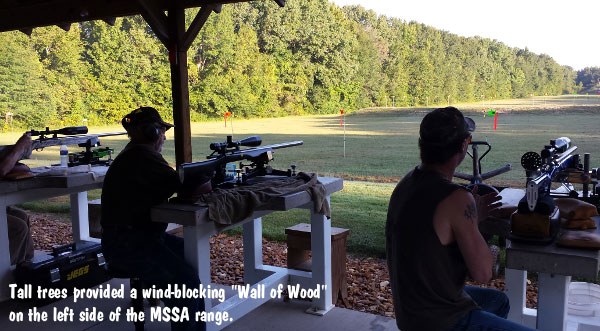
Thanks again to Memphis Sport Shooting Association and all other range owners for giving us a place to practice the shooting disciplines we enjoy. The MSSA range is open to their membership 7 days a week and can host almost every shooting discipline one can imagine. If you have get a chance, please take the time to visit this facility, a first rate club for sure.
October 16th, 2014
If you’ve never tried ultrasonic cleaning, you should. This process is great for cleaning small gun components, AR innards, carbon-caked suppressors, and even jewelry. Ultrasonic cleaning also transforms old, dirty brass, getting cartridge cases clean inside and out (including the primer pockets). With a big-enough ultrasonic cleaning tub, you can even clean complete AR uppers. One word of caution — we do NOT recommend ultrasonic cleaning for any blued parts or blued firearms.

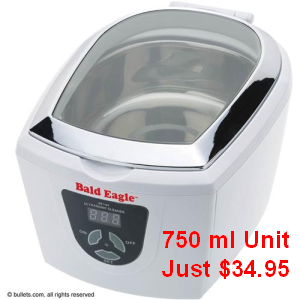 Bald Eagle Ultrasonic SALE Bald Eagle Ultrasonic SALE
Right now Bullets.com is offering very attractive introductory prices on the new Bald Eagle line of ultrasonic cleaning machines. There are five models to choose from, starting at just $34.95 for a 750 ml capacity small parts cleaning unit. The general-purpose 2.5 liter unit (which will hold hundreds of cartridge cases), runs $139.50.
A large-capacity 6 liter unit (that makes short work of big jobs) is $295.00. The jumbo, industrial-grade 7-liter unit, with a 25.5-inch-long dunk tank, is $495.00, marked down from $650.00. Compare these prices against those of other similar-capacity machines and you’ll see they represent good values. These introductory prices will be in effect through 12/31/14.

October 16th, 2014
 You know we like to save you guys money. Well right now Brownells.com is offering FREE STANDARD SHIPPING on domestic orders of more than $50.00 ($50.01 would qualify). This deal can easily save you $15, $20, or more on a typical shipment of gun parts, tools, and/or shooting accessories (savings depend on weight and size of order). To get FREE SHIPPING on your next Brownell’s order, use Discount Code GS4 during check-out when shopping at Brownells.com. You know we like to save you guys money. Well right now Brownells.com is offering FREE STANDARD SHIPPING on domestic orders of more than $50.00 ($50.01 would qualify). This deal can easily save you $15, $20, or more on a typical shipment of gun parts, tools, and/or shooting accessories (savings depend on weight and size of order). To get FREE SHIPPING on your next Brownell’s order, use Discount Code GS4 during check-out when shopping at Brownells.com.
NOTE: This is a limited time offer, so place your order soon if you want to get FREE SHIPPING. If you snooze, you loose.

October 16th, 2014

Conventional brass jags work great — except for one thing. They can react to solvents, leaving a blue “false positive” on patches. In recent years, jag-makers have experimented with many different materials in an effort to cure the solvent-reaction problem. Today we have polymer jags, nickel-plated jags, and stainless steel jags. And the latest innovation is the aluminum jag from Dewey.
 J. Dewey Mfg. is now producing a series of “Copper Eliminator” jags and brush adapters made from aircraft-grade aluminum with the same hardness as brass. Dewey claims that its new aluminum jags will not become embedded with grit or particles that could harm your bore. At the same time, Dewey’s aluminum jags will not react to ammoniated bore solvents that can turn patches blue green when used with brass jags. Dewey aluminum jags are offered with either male OR female 8/32 threads. The $4.95 aluminum jags and $3.50 brush adapters are offered in a wide variety of calibers. You can order from Dewey Mfg. or Sinclair Int’l. J. Dewey Mfg. is now producing a series of “Copper Eliminator” jags and brush adapters made from aircraft-grade aluminum with the same hardness as brass. Dewey claims that its new aluminum jags will not become embedded with grit or particles that could harm your bore. At the same time, Dewey’s aluminum jags will not react to ammoniated bore solvents that can turn patches blue green when used with brass jags. Dewey aluminum jags are offered with either male OR female 8/32 threads. The $4.95 aluminum jags and $3.50 brush adapters are offered in a wide variety of calibers. You can order from Dewey Mfg. or Sinclair Int’l.
Story Tip from Boyd Allen. We welcome submissions from our readers.
|


