This evening (Wednesday, April 15th), Shooting USA television spotlights the National Matches and CMP events at Camp Perry, Ohio. This is a “must-watch” episode for anyone interested in High Power shooting. The National Matches at Camp Perry are the World Series of American shooting sports, attracting the nation’s top pistol and rifle marksmen. There are individual competitions, such as the Vintage Sniper Match, or the M1 Garand Match featuring legendary firearms. Then there’s the National Trophy Infantry Team Match, known as the Rattle Battle among competitors, simulating an assault by an Infantry Squad. Catch this episode of Shooting USA on the Outdoor Channel. Vintage military rifle fans take note — this week’s show also features an American classic, the m1903 Springfield.
Eastern Time – 3:30 PM, 9:00 PM, 12:30 AM (Thursday)
Central Time – 2:00 PM, 8:00 PM, 11:30 PM
Mountain Time – 1:30 PM, 7:00 PM, 10:00 PM
Pacific Time – 12:00 Noon, 6:00 PM, 9:30 PM
The 1903 Springfield on Tonight’s Show
The U.S. Rifle, Model of 1903, better known as the 03 Springfield, continues to attract praise today. While its design was initially borrowed, its accuracy, quality and service record proved to be a fine military bolt-action rifle in the trenches of WW I and on into World War II. “It was a beautifully made gun, extremely, extremely well balanced,” says Firearms Historian Garry James.
History of the National Matches and Camp Perry
In 1903, President Theodore Roosevelt’s vision of skilled marksmen among American citizens came to life as the National Matches; civilians on the firing line with the service weapon of the day, preparing for training in case of a time of war. T.R.’s vision is now a tradition, attracting thousands of people for five weeks of shooting competitions each year at Camp Perry in Ohio.
The National Matches have been held at Camp Perry since 1907. The range is located along the shores of Lake Erie in northern Ohio near Port Clinton. The site was first acquired in 1906, in response to the need for a larger facility for military training and the NRA’s shooting programs. In 1906 Gen. Ammon B. Crichfield, Adjutant General of Ohio, ordered construction of a new shooting facility on the shores of Lake Erie, 45 miles east of Toledo, Ohio. The original land for Camp Perry was purchased in 1906, and the reservation was named after Commodore Oliver Hazard Perry, the American naval commander who won the Battle of Put-in-Bay during the War of 1812.
On August 19, 1907, Cpl. L. B. Jarrett fired the first shot at the new Camp Perry Training Site. And that year, 1907, Camp Perry held its first National Pistol and Rifle Championship events. This location has hosted the annual NRA National Matches ever since. Today, over 4,000 competitors attend the National Matches each year, making it the most popular shooting competition in the western hemisphere.
Here’s a great video from German ammo-maker GECO (part of the Swiss RUAG group of companies). Employing advanced 3D rendering and computer graphics, this animation unveils the inside of a pistol cartridge, showing jacket, lead core, case, powder and primer. Next the video shows an X-ray view of ammo being loaded in a handgun, feeding from a magazine.
Then it really gets interesting. At 1:32 – 1:50 you’ll see the firing pin strike the primer cup, the primer’s hot jet streaming through the flash-hole, and the powder igniting. Finally you can see the bullet as it moves down the barrel and spins its way to a target. This is a very nicely-produced video. If you’ve ever wondered what happens inside a cartridge when you pull the trigger, this video shows all. They say “a picture’s worth a thousand words”… well a 3D video is even better.
For Best Viewing, Click Gear Symbol and Select HD Playback Mode
Allan D. Cors of Naples, Florida was elected by the National Rifle Association Board of Directors as President of the 144-year-old Association. The election took place in Nashville, Tennessee following the 144th Annual Meeting of the NRA. A lifelong hunter and competitive shooter with a passion for collecting World War II military vehicles, Cors has served as president of the NRA Foundation and is a member of the NRA’s Executive Committee. He was a principal advocate for the establishment of the NRA’s Political Action Committee. Cors served as a counsel with the Judiciary Committee in the U.S. House of Representatives. He also served as the director of government affairs and senior vice president at Corning for 34 years.
“I am humbled by the support of my fellow 5 million-plus NRA members and 75 board members. At a time when our country is disillusioned with government and its leaders, the public’s faith in the NRA has never been stronger,” said Cors. “This trust is a result of the NRA’s steadfast loyalty to upholding the Second Amendment and it is a testament to the diligence and prescience of Wayne LaPierre – a man who has dedicated his life to the NRA.”
Wayne LaPierre Retains Executive VP Post
The board of directors also re-elected Wayne LaPierre as NRA’s executive vice president. LaPierre has served in this leadership role since 1991 and has spearheaded NRA’s efforts to restore the relevance and sanctity of the Second Amendment. Upon his re-election, LaPierre reappointed Kyle Weaver to the position of executive director of NRA General Operations and Chris W. Cox to the position of executive director of NRA Institute for Legislative Action.
Pete Brownell Elected First VP, and Richard Childress Elected Second VP
Pete Brownell was elected NRA First Vice President. Brownell, who previously served as NRA Second VP, is also the current chairman of the National Association of Sporting Goods Wholesalers (NASGW), an active member of the U.S. Army’s Command and General Staff Foundation Board, and vice chair of the Iowa Economic Development Authority Board. NASCAR legend Richard Childress of North Carolina was elected NRA Second Vice President, filling the spot formerly held by Pete Brownell.
Report by John Morgan-Hosey
Civilian Service Rifle (CSR) is a shooting sport in the United Kingdom shot with bolt action rifles and ‘Straight-Pull’ derivatives of semi-auto centerfire rifles. Why do the UK shooters use manual-operating versions of popular self-loaders? Well, that’s because of legal restrictions. Civilian ownership of semi-auto centerfire rifles was banned in the United Kingdom in 1987.
Give credit to the ingenuity of competitive shooters in the UK. The ban on semi-autos has not stopped shooters from adapting modern rifles such as the AR15. In fact, CSR is the UK NRA’s fastest growing shooting discipline. There are four classes for competitors:
1. Historic Class — Vintage Rifles, mostly Lee Enfields with iron sights.
2. Iron Sights Class — all non-Historic Rifles with Iron (open) sights.
3. Practical Optic Class — Rifles with bipods (and scopes 4.5X or greater magnification).
4. Service Optic Class — Rifles without bipods (and scopes with no more than 4.5X power).
Surprisingly, shooters in the Service Optic Class dominate these matches. So you don’t need a high-magnification scope or a bipod to do well. The most popular rifles are modified AR-platform rifles. These are set-up in the UK with no gas system to ensure they comply with our laws. Side-charger cocking handles are fitted to allow the rifles to be operated easily while in the shooting position. You can see in the photo above a modified AR with the Union Jack on the buttstock. Notice the bolt handle on the right. This opens and closes the bolt.
This video clip shows the side-charging ARs in use.
Note the side bolt handle that cycles the action on this non-semi-auto AR.
Here shooters advance 100 yards to engage the targets at the next firing line.
Dave Wylde Sets Impressive Record at the Civilian Service Rifle League Match.
The last matches in the 2014/15 CSR League took place on Sunday, 5 April. With final places in all four classes up for grabs, the fine weather and light winds made for some impressive scores, none more so than Dave Wylde in Service Optic Division. Dave scored a mighty impressive 246 (of a possible 250) in the PM Match. Breaking 235 is tough enough and scoring over 240 a rarity with the match includes standing snap shooting at 100 yards, a sitting rapid at 200 yards, and prone snap shooting at 300 yards with and two run downs to raise the shooters heart rate.
The most popular class, Service Optic, had Peter Cottrell retaining the trophy for the fourth consecutive year with a score of 993. Adam Chapman pushed him hard all season to finish a close second on 987 points, with Bill Ellis, one of the most consistent CSR shooters, third with 972.
Civilian Service Rifle Grows in Popularity
As CSR continues to grow in popularity, the sale of ‘Straight-Pull’ AR-platform rifles is increasing year after year. Accordingly, the United Kingdom NRA is allocation more range space at the Bisley National Shooting Centre to accomodate the increasing number of competitors.
On April 9, 2015, the California Fish and Game Commission (CFGC) adopted regulations to ban the use of traditional lead-component ammunition for all hunting in the state by July 1, 2019. The Daily Caller reports: “In a unanimous vote, the Commission opted to phase out lead bullets, which hunters’ groups are calling a de-facto ban on hunting in the state.” The new regulations will be implemented in multiple phases, starting with the 2015 hunting season. These tough new regulations were issued pursuant to legislation passed in 2013 by the California legislature and signed by Gov. Jerry Brown.
The National Shooting Sports Foundation is worried that California-style ammo bans will be adopted in other states. To some observers, California’s ban on lead-based ammunition was designed more to reduce gun sales and halt hunting than it was ever intended to help the environment. The NSSF has shown that the elimination of traditional lead ammo will do little, if anything to improve the environment in any meaningful way. What such bans WILL do is raise the cost of ammo and make it more difficult to hunt. The NSSF explains: “Anti-hunting groups use the supposed harm caused by traditional ammunition as a wedge issue to further their ultimate political agenda of banning hunting across the country.” The NSSF has provided the real facts via an infographic and the YouTube video embedded below.
Sporter Chronograph Kit includes: Bayonet Sensor, 3.5 foot Data Cable, Remote Display (with Battery), Strap with thumb nut, Two V-block spacers, and compact storage box.
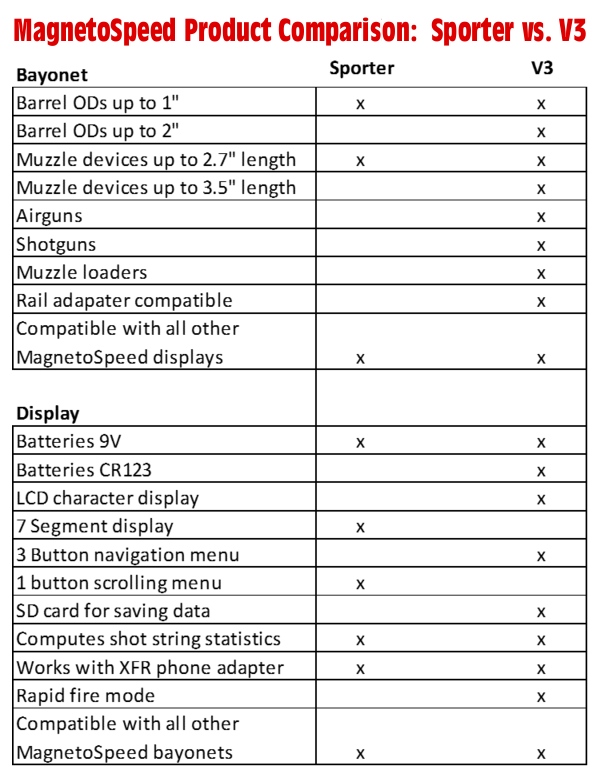
Magnetospeed has just introduced a new bayonet-style chronograph that is less than half the price of previous MagnetoSpeed models. This is big news for shooters who always wanted a MagnetoSpeed but found the $399.00 cost (for V3 model) too pricey. The new Sporter Chronograph will cost just $189.00. It offers most of the features of the more expensive models (see chart below for details) and has a updated sensor. The MagnetoSpeed Sporter chronograph kit was designed to be used on barrels from 1/2 inch up to 1 inch in diameter. In can also accommodate muzzle brakes and flash hiders up to 2.7 inches in length. MagnetoSpeed says its new Sporter is “Ideal for contoured rifle barrels (sporter barrels) and long-barreled revolvers.”
See $189.00 Sporter Chronograph Features Reviewed in Video
MagnetoSpeed Sporter features
Simple, one-button cycling display (shows recent shot velocity and statistics).
Three sensitivity settings for fine-tuning.
Easy access battery compartment, with 9V Battery included.
Integral, quick-attachment system, with metal buckle, nylon strap, screw-in tensioner, and dual V-block spacers (thick and thin).
Bayonet works with Muzzle Brakes and Flash-hiders up to 2.7″ long.
Q: Will the Sporter Chrono work with thicker barrel (i.e. greater than 1″ diameter)?
A: The manufacturer recommends the $399.00 V3 model for thicker barrels. But, wink-wink, if you have a 1.25″ barrel you can get this to work, based on what we’ve seen. If you need to go really fat (up to 2.0″ diameter), get the V3. Magnetospeed also says the V3 is needed for airguns, shotguns, and muzzleloaders.
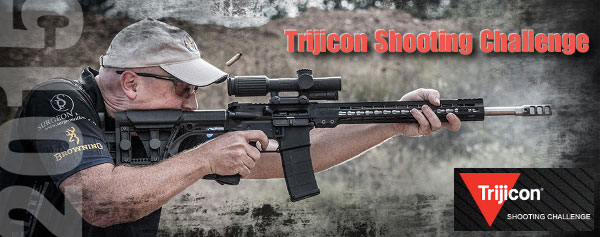
Want to win fifty thousand bucks? That’s possible if you sign up for the 2015 Trijicon Shooting Challenge. Registration just opened for this multi-gun mega-event, one of the richest shooting matches in American history. We’re talking serious money here… shooters will be competing for over $100,000 in match cash, and over $200,000 in prize table awards. The first prize is $50,000. And get this — you don’t even have to bring ammo. The match sponsors provide all the guns and ammunition for the event.
Competitors need to be versatile. This is a multi-gun event with pistol, rifle, shotgun, and combined arm segments. There will be divisions for ladies and men, juniors and adults. The entry fees are substantial, $395.00 for adults, $195.00 for juniors, but remember the ammo is free. The match will be held October 21-24, 2015 at the Rockcastle Shooting Center in Kentucky. Click HERE to REGISTER.
R. Lee Ermey, aka the “Gunny”, has a new Television Show on the Outdoor Channel. We’ll be tuning in to GunnyTime with R. Lee Ermey when it debuts April 15, 2015 (yep, Tax Day). Ermey has an impressive resume — An 11-year veteran of the U.S. Marine Corps and active High Power competitor, the Gunny has appeared in numerous feature films and has also starred in critically-acclaimed TV series on HBO, TNT, Showtime and History Channel.
The all-new, half-hour series produced features weapons and weapons technology – past, present, and future. While consulting with top experts, Ermey will demonstrate both historic weapons and modern high-tech firearms and military gadgets. The Gunny also test-drives a variety of weaponized vehicles, such as a Tomcar TM5 with an M249 S.A.W. mounted on it.
Watch Show Preview Trailer
In the show Ermey will be assisted by knowledgeable experts including Craig “Sawman” Sawyer, a retired U.S. Navy SEAL, Grady Powell, retired U.S. Army Special Forces Sergeant, and our friend Kirsten Joy Weiss, ace rifle shooter and host of the popular Sharp Shots YouTube Channel.
This is the kind of family-friendly, “feel-good” story we like. Texan Richard King created a rimfire benchrest rifle using a classic Martini Mark III smallbore action. He fitted the gun with a new flat, wide forearm and a new buttstock, allowing the gun to sit steady on the bags and track smoothly. The narrow action was also fitted with a cantilevered top rail to hold a high-magnification scope.
Here is Vicki King, with Martini Mark III and her trophy.
But here’s the best part. Richard provided this updated classic to his wife Vicki, who proceded to win a rimfire benchrest match (Vintage class) with the old Martini. Richard reports: “Here is my lovely wife with her High Overall Vintage trophy. That is a Martini Mark III that I re-stocked in walnut for 50-yard, .22-caliber benchrest matches. It’s great to have her shooting with me again.” FYI, last summer Richard and Vicki celebrated their 50th wedding anniversary!
Bravo Richard — kudos to you AND to your lovely bride. It’s great to see a couple shooting together. It’s also great to see a classic rifle brought back to the winner’s circle with some inspired stock-work and other upgrades.
Here is Richard King, with his handiwork — an updated Martini Mark III smallbore rifle.
In a major victory for firearms and ammunition retailers, a Federal District Court in Colorado has thrown out a Brady Center-backed lawsuit arising out of the Aurora, Colorado, movie theater shooting. The Federal Court ruled that: “The federal and state immunity statutes prohibit the claims of liability for the sales of ammunition in this case.” If you are involved in sales of guns or ammunition, whether as a distributor or retailer, we strongly recommend you read the entire U.S. District Court decision by Richard P. Matsch, Senior District Judge. The Judge’s memorandum cites many important principles of law. CLICK HERE for Dismissal Order.
The case, Phillips v. Lucky Gunner, was brought by the parents of an Aurora shooting victim against several web-based businesses from whom the shooter, James Holmes, purchased materials. The plaintiffs sued two web-based ammo vendors, Lucky Gunner LLC and The Sportsman’s Guide, as well as suppliers of various tactical gear.
Brady Center lawyers representing the family members alleged that the Internet business practices of the FFLs did not include “reasonable safeguards” to prevent persons such as Holmes from purchasing their respective products.
The court found that the Protection of Lawful Commerce in Arms Act (PLCAA) as well as a Colorado preemption statute required dismissal of the Brady Center’s lawsuit. In dismissing this action, the court followed legal precedents that have consistently found the PLCAA to be constitutional.
Highlights of Court Decision:
The ammunition sellers are also protected by the Protection of Lawful Commerce in Arms Act, 15 U.S.C. § 7901 et seq. (“PLCAA”). Enacted in 2005, the PLCAA generally prohibits claims against firearms and ammunition manufacturers, distributors, dealers, and importers for damages and injunctive relief arising from the criminal or unlawful misuse of firearms and ammunition, unless the suit falls within one of six enumerated exceptions. 15 U.S.C. §§ 7901–7903.
The Colorado legislature specifically limited suits against ammunition sellers to those where the plaintiff requests “damages” for relief, except in a product liability action which includes “any remedy.” Section 13-21-504.5(1). Subsection (2) precludes liability of the ammunition sellers for the actions of Holmes in any type of action. The plaintiffs’ claims of negligence, negligent entrustment and public nuisance based on the sales of ammunition to Holmes are barred and “shall” be dismissed. C.R.S. § 13-21-504.5(3).


 The 1903 Springfield on Tonight’s Show
 Here’s a great video from German ammo-maker


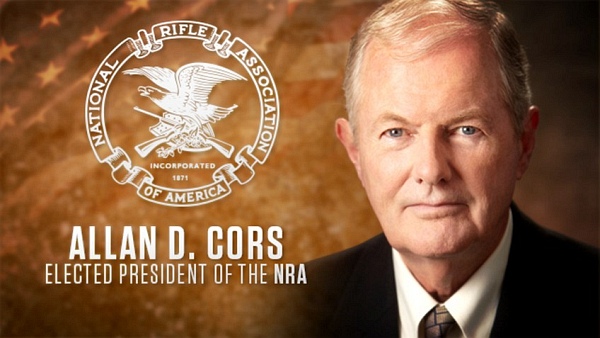 Allan D. Cors of Naples, Florida was elected by the National Rifle Association Board of Directors as President of the 144-year-old Association. The election took place in Nashville, Tennessee following the 144th Annual Meeting of the NRA. A lifelong hunter and competitive shooter with a passion for collecting World War II military vehicles, Cors has served as president of the NRA Foundation and is a member of the NRA’s Executive Committee. He was a principal advocate for the establishment of the NRA’s Political Action Committee. Cors served as a counsel with the Judiciary Committee in the U.S. House of Representatives. He also served as the director of government affairs and senior vice president at Corning for 34 years.