IBS Report by Randy Jarvais
The 2015 IBS 100/200 Score Nationals were held August 22-24 in Augusta, Maine at the Capitol City Rifle and Pistol Club. By all accounts, the 2015 Score Nationals event was another success. Fifty-three guns participated in this year’s Score Nationals, with 38 Varmint for Score (VFS) and 15 Hunter rifles registered. Nine shooters competed for the 2-Gun award. Mike Niblett shot great to win the Varmint for Score (VFS) Grand Agg, while finishing first at 200 yards and second at 100 yards. Mike’s impressive 500-39X Grand Agg total was just one point shy of the current IBS record. Kudos to Mr. Niblett! Dean Breeden won Hunter Class with Randy Jarvais in second — and that was also the result for the 2-Gun Grand Agg (Breeden first, Jarvais second).
Equipment Report
Among the Top 10 VFS shooters, nine shot a 30 BR, while the 10th campaigned an unidentified 30-caliber cartridge. Six of the Top 10 VFS shooters used Hodgdon H4198 powder, three used Vihtavuori N130, and one loaded with Hodgdon H322. Krieger barrels were used by five of the Top 10, with two Bruxes, two Liljas, and one Rock Creek. There were a wide variety of bullet choices. VFS Winner Mike Niblett used a Hillbilly 118-grainer while 2-Gun winner Dean Breeden used 115gr “10X” bullets in both his rifles (VFS and Hunter).
Southerners Shine in Augusta
From a Maine perspective, every USA destination is south, but the true South was well represented in both number and quality of shooters. To illustrate, in the 100-yard leg of VFS class only one person north of the Mason/Dixon line was able to crack the top seven positions, and he had the home field advantage. For match One, five shooters shot 5X targets, but from then on it was the Jerry Powers show. Powers, from North Carolina, put together a string of three 5X targets before faltering with a 3X during match four. Undaunted, Powers finished strong with another 5X. He needed to, as his 23Xs were but one better than both Mike Niblett of Kentucky and Jim Cline of South Carolina.
Eight VFS Shooters Post 500-Point 100/200 Grand Aggregates
At the Capitol City Range, the 100-yard targets are downhill, while the 200-yard targets are near level with the benches. While the benches are covered there is little covered area aft for equipment in waiting. With the prospect of showers for the entire weekend, Club members rigged tarps, hoping to provide a dry haven if needed. For the most part, ‘Tarp City’ worked sufficiently well. Fortunately, after Friday’s rain, the remainder of the weekend was mostly free of any heavy precipitation.
Score Nationals competitors line up for the Rifle Weigh-In process. The blue tarps provided a little extra protection from the elements.
Thunder and Lightning, then Drizzle on Sunday
Although the weather was very nice while shooting the 100, shortly thereafter the sky opened up with an impressive display of thunder and lightning. Although that front passed, Sunday’s weather started as overcast with drizzle and showers, but no lightning. Winds started mild but as the day unfolded and the sun was able to break through, so did the wind — it became down right gnarly during some relays. The wind was gusty, and constant switching from 11:30 to 12:30 was problematic, creating vertical issues. Even so, nine shooters were able to shoot 250s at 200 yards on Sunday, all from the VFS class.
Tough Competition in Hunter Division
In IBS, Maine is the last stronghold of hunter classification shooters, thus it was no surprise that the Hunter class was the National’s largest in recent memory. At 100 yards, five Hunter shooters shot perfect 250s on Saturday. Dean Breeden nailed a 250-19X followed by Randy Jarvais with 250-18X. Third place went to K.L. Miller who out-dueled Peter Hills and Tim O’Mara who were the other two 6-power shooters to shoot the coveted 250.
In the 6-power Hunter class, the battle between Breeden and Jarvais continued on Sunday. Breeden started better and maintained a 2X lead through match three. Skip Plummer, a long-time 6-power shooter (with a very “stock”-locking rig), shot three straight 50-point targets (on targets 2, 3, and 4) to threaten the two leaders.
Breeden shot a 50-1X on his fifth and final 200-yard target and watched through his spotter, while Jarvais dropped one point on his very last shot for record at 200. The order of finish for the five-target, 200-yard leg was Breeden (249-6X), Jarvais (248-5X) and Plummer (247-8X). Sweeping both the 100- and 200-yard legs gave Breeden (499-25X) the Hunter Grand Agg with Jarvais (498-23X) placing second.
Breedan Wins 2-Gun Aggregate… Again
The 2-Gun is a recent award and as yet has been contested but a few times. That doesn’t diminish the feat that there has been but one winner of the award, Dean Breeden. Prior to match 5 on Sunday, Jarvais had the Xs to dethrone Breeden from the 2-gun award, but this is a score game. Match 5 is now a nightmare memory for Jarvais, losing the last shot with each gun. So close yet so far! Breeden on the other hand proved again why he is the competitor to beat. With all the chips on the table, Dean did what he needed to do — dropping just a single point in the entire match. Breedan finished with 999-50X (for both guns) to secure another 2-Gun title, followed by Randy Jarvais (997-55X) two points back. That was tough for Randy, but as Orland Bunker observed: “All the Xs in the world means nothing if you don’t have the points.”
Every Shooter Was a Winner
The Capitol City Rifle and Pistol Club offered a rich prize table. Thirty Benchrest vendors donated nearly $9000.00 worth of hardware and shooting supplies. That generosity allowed each shooter to receive a door prize. In addition, a Nightforce Competition scope was raffled off, with the proceeds earmarked for new concrete benches. Wyatt Fox of New Hampshire was the lucky winner of the Nightforce.
All shooters received a door prize. Lucky Wyatt Fox (above right) received a Nightforce scope.
BIG news in the shooting sports industry — Ruger has entered the ammo business. Ruger now offers high-tech handgun ammunition, using licensed polymer-composite, lead-free bullet technology. According to the Shooting Wire: “Ruger’s new lead-free ammunition will be produced under a licensing agreement with Savannah, Georgia-based PolyCase Ammunition.”
Ruger’s new ARX line of lead-free ammo features injection-molded bullets that are much lighter than conventional projectiles, caliber by caliber: 56 grains for .380 ACP, 74 grains for 9x19mm, 107 grains for .40 SW, and 114 grains for .45 ACP. The lighter bullets fly faster, but ARX ammo still offers reduced perceived recoil.
Ruger ARX Ammo with Injection-Molded Matrix Bullets
The fluted projectiles are injection-molded from a copper/polymer matrix. This offers many advantages. First, being completing lead-free, these bullets can be used at indoor facilities that prohibit lead-based ammo. Second, because the composite bullets weigh 30% less than comparable lead-based projectiles, shooters experience noticeably less recoil (even though velocities are higher). Third, the composite matrix bullet has low-ricochet properties. When these bullets strike metal, they are designed to disintegrate (into a powder), rather than ricochet. This makes them well-suited for indoor use, or use with metal plates.
Shooting Wire Editor Jim Shepherd reports that ARX ammo delivers on its low-recoil promise: “Having spent time testing the PolyCase ammunition (largely in Ruger firearms), I know the reduction in felt recoil isn’t just hype. While firing PolyCase ARX ammunition in calibers ranging from .380 in small concealed carry pistols (including a Ruger’s LCP) up to .458 SOCOM in modern sporting rifles, the lessened felt recoil was noticeable.”
PolyCase Molded Bullet Design Technology
For over a century most bullets have been mass-produced with a process called cold-forming. Lead and copper were shaped with brute force in punches and dies to create projectiles. While this is still a viable and effective way to produce bullets, other manufacturing methods are now available. By applying injection-molding technology, Polycase has developed a new type of bullet that has many advantages, as least for handgun applications. Bullets weigh approximately 70% as much as lead bullets with similar profiles. Lighter weight means higher velocities and less recoil. In addition, PolyCase bullets are lead-free, and low-ricochet — two qualities important for indoor and close-range training. The injection-molding process also reduces weight variations (compared to cast lead bullets), and ensures excellent concentricity. Molding also allows unique shapes that are impossible to produce with conventional bullet-making methods (see photo).
C’mon admit it — you’d love to have one of these on your work desk or loading bench. The aluminum cylinder holds six (6) pens in 0.75″-diameter holes. Dirty Harry would be proud.
We think this handsome wheelgun cylinder is a clever desktop organizer, and it’s certainly a “conversation starter”. The wheelgun pen-holder is hefty enough to function as a paperweight as well as a handy storage unit for pens and pencils. The price is $17.06 at Amazon.com. Click this link to order: Revolver Pen Holder.
These four photos show the substantial changes in the shock wave and turbulence patterns for the same 7.5mm bullet at different velocities. The “M” stands for Mach and the numerical value represents the velocity of the bullet relative to the speed of sound at the time of the shot. Photos by Beat Kneubuehl.
“Going transonic” is generally not a good thing for bullets. The bullet can lose stability as it enters the transonic zone. It can also become less slippery, losing BC as a consequence of dynamic instability. In this video, Bryan Litz of Applied Ballistics analyzes what happens to bullet stability (and BC) as projectiles approach the speed of sound. Transonic effects come into play starting about Mach 1.2, as the bullet drops below 1340 fps.
Transonic Ballistics Effects Explainedby Bryan Litz
What happens when the bullet slows to transonic speed, i.e. when the bullet slows to about 1340 feet per second? It is getting close to the speed of sound, close to the sound barrier. That is a bad place to fly for anything. In particular, for bullets that are spin-stabilized, what the sound barrier does to a bullet (as it flies near Mach 1) is that it has a de-stabilizing effect. The center of pressure moves forward, and the over-turning moment on the bullet gets greater. You must then ask: “Is your bullet going to have enough gyroscopic stability to overcome the increasing dynamic instability that’s experienced at transonic speed?”
Some bullets do this better than others. Typically bullets that are shorter and have shallow boat-tail angles will track better through the transonic range. On the contrary, bullets that are longer… can experience a greater range of pitching and yawing in the transonic range that will depress their ballistic coefficients at that speed to greater or lesser extents depending on the exact conditions of the day. That makes it very hard to predict your trajectory for bullets like that through that speed range.
When you look at transonic effects on stability, you’re looking at reasons to maybe have a super-fast twist rate to stabilize your bullets, because you’re actually getting better performance — you’re getting less drag and more BC from your bullets if they are spinning with a more rigid axis through the transonic flight range because they’ll be experiencing less pitching and yawing in their flight.
To determine how bullets perform in the “transonic zone”, Bryan did a lot of testing with multiple barrels and various twist rates, comparing how bullets act at supersonic AND transonic velocities. Bryan looked at the effect of twist rates on the bullets’ Ballistic Coefficient (BC). His tests revealed how BC degrades in the transonic zone due to pitching and yawing. Bryan also studied how precision (group size) and muzzle velocity were affected by twist rates. You may be surprised by the results (which showed that precision did not suffer much with faster barrel twist rates). The results of this extensive research are found in Bryan’s book Modern Advancements in Long Range Shooting.
Bryan notes: “A lot of gunpowder was burned to get these results and it’s all published in layman’s terms that are easy to understand”. If you’re interested in learning more about transonic bullet stability, you may want to pick up a copy of Bryan’s book.
The new, 37th Edition of the Gun Trader’s Guide has just been released. This fully-illustrated resource features current market values for thousands of rifles, pistols, and shotguns. This 37th Edition, now with over 1000 photographs, includes dozens of new entries added since the previous edition. Along with the Blue Blue of Gun Values, the Gun Trader’s Guide is one of the two definitive resources on gun prices. If you buy or sell firearms, the Gun Traders’ Guide is a must-have item that will pay for itself. Over two million copies of the Gun Trader’s Guide have been sold to date. Order soon to be one of the first to own the new 37th Edition. Amazon’s price is $23.24.
If you don’t want to lug the big book around, a Kindle (electronic) Edition of the 2014 Gun Trader’s Guide to Rifles is available for just $16.17. This 608-page eBook edition of the 2014 Guide can be viewed on a Kindle, iPad, laptop, or your home computer. This is handy if you want to access gun values at a gunshop, estate sale, or auction.
Get Books Fast from Amazon.com
You can order the Gun Trader’s Guide, the Blue Book of Gun Values and other popular firearms and shooting books through the AccurateShooter.com Bookstore. To save you time, we’ve collected the best books on shooting, reloading, hunting, and gunsmithing all in one location. Ordering, secure billing, and shipping are all handled efficiently by Amazon.com.
If you’ve been considering the new Nightforce SHV scope for a hunting application, head over to LongRangeHunting.com. There you’ll find an in-depth field test of the 4-14x56mm SHV by Nicholas Gebhart. This is a very thorough review — Gebhardt checks every feature of the scope and comparison tests the SHV against the more costly Nightforce NXS 3.5-15x50mm. Gebhardt even put the SHV scope in his freezer for a weekend to ensure there was no fogging.
Overall, Gebhardt was very pleased with the SHV: “Optical clarity, image brightness, contrast and resolution were all extremely good.” The tester also liked the MOAR reticle in his scope. He didn’t think it was too “busy” though he thought the hold-over lines would benefit from numbers: “Nightforce’s MOAR was easy to use and provided a clear sight picture for engaging small targets. The line thickness is perfect for both precise shot placement and visibility. My personal preference however would be for the even hash marks to be numbered for the entire lower portion of the reticle.” Gebhart noted that the SHV’s side parallax knob had yardage marking numbers that proved accurate (and handy to use) — most other scopes just have lines.
Nightforce SHV vs. Nighforce NXS
How did the new SHV stack up against the NXS in a side-by-side comparison? Gebhardt was impressed with the $995.00 SHV, saying it held its own with the pricier NXS model: “I took about 30 minutes to evaluate the optics of the SHV and see how it compared to an older Nightforce NXS 3.5-15X50. Both of these scopes are made in Japan but given the price differential, I expected to see some difference in the optical quality. To my surprise, I couldn’t find any optical difference between the two except for a very slight possibility of a brighter image with the SHV.”
Nicholas Gebhardt has been an active hunter primarily pursuing mule deer, antelope, coyotes and prairie dogs since he was old enough to legally hunt. Nicholas is also a precision rifle competitor and a Captain in the Montana National Guard.
If you have been waiting to purchase a chronograph… now is a great time to buy. You can get the new-model MagnetoSpeed Sporter for under $180.00. You can set up this device in a few minutes, and you never have to go downrange to fiddle with a tripod or fuss with wires. The MagnetoSpeed Sporter is simple and effective — a no-hassle solution.
We’re impressed by the Sporter chrono (as are other shooters — this unit is selling out nationwide). Like the V3, the Sporter faithfully records shots, even in complete darkness. Shot strings are recorded digitally and can be transferred to a smart phone via MagnetoSpeed’s XFR accessory (and Apps).
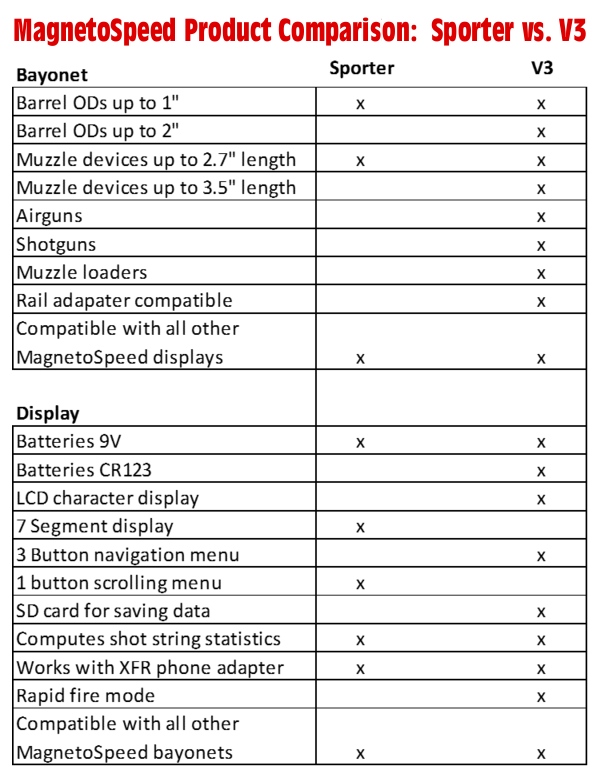
The MagnetoSpeed Sporter chrono is less than half the price of previous MagnetoSpeed models. This is big news for shooters who always wanted a MagnetoSpeed but found the $379.00 cost (for V3 model) too pricey. The new Sporter Chronograph costs just $179.99 at Sinclair Int’l and Brownells. It offers most of the features of the more expensive models (see chart below for details) and has a updated sensor. MagnetoSpeed says its new Sporter is “Ideal for contoured rifle barrels (sporter barrels) and long-barreled revolvers.” The Sporter Chronograph Kit (shown above) includes: Bayonet Sensor, 3.5 foot Data Cable, Remote Display (with Battery), Strap with thumb nut, Two V-block spacers, and compact storage box.
Is the MagnetoSpeed good enough? Well consider this, Derek Rodgers uses one of the original (full-size) MagnetoSpeed Chronos for his load development. Rodgers is the only man on the planet to have won BOTH the F-Open and the F-TR National Championship. ‘Nuff said.
See MagnetoSpeed Sporter Chronograph Features Reviewed in Video
Q: Will the Sporter Chrono work with thicker barrel (i.e. greater than 1″ diameter)?
A: The manufacturer recommends the $399.00 V3 model for thicker barrels. But, wink-wink, if you have a 1.25″ barrel you can get this to work, based on what we’ve seen.. If you have a really fat barrel (up to 2.0″ diameter), get the V3. Magnetospeed also says the V3 is needed for airguns, shotguns, and muzzleloaders.
Click Image for Full-Screen Photo
The Sporter Chrono attaches quickly and easily. It has a 3.5-foot-long cord, and will work with Muzzle Brakes and Flash-hiders up to 2.7″ long.
Here is the best deal we’ve ever seen on NRA Life Memberships. Read carefully — you not only get $100.00 off the price of an NRA Life Membership, but you get a SECOND Life Membership for FREE. That’s right, you can get TWO Life Memberships for $900.00 total (i.e. $450.00 each). NOTE: This is a limited-time offer good for one week. The two-for-one lifetime membership deal expires October 6, 2015. This is a great way to get a Life Membership for both you and your spouse.
Along with the Life Membership offer, the NRA is offering big savings on 1-year, 3-year, and 5-year memberships. For a limited time, a 5-year membership is now just $100.00. That works out to just $20.00 per year. Consider this, with your NRA membership you also get a free print magazine (American Rifleman, American Hunter, or 1st Freedom), and $2,500.00 worth of firearms insurance (activation required). Check it out:
If you are an NRA member, you should activate your ArmsCare insurance right now. Don’t delay. Your NRA ArmsCare insurance won’t become effective until you activate it!
NRA Membership Offer Tip from EdLongrange. We welcome Reader Submissions.
2015 WSC Champion Bruce Piatt with $25,000 check. At right is Diana Muller, WSC women’s champion.
Bruce Piatt out-gunned 218 competitors to win the 2015 NRA World Shooting Championship (WSC), a 12-stage event that required mastery of all types of firearms. How did Piatt manage the win? Versatility. Unlike many top competitors who shoot one or two disciplines, over the past 30 years Piatt has shot anything (and everything) he could fit into his schedule. Piatt told reporters: “If it goes bang, you can count me in — whether it’s Sportsman’s Team Challenge, SOF Tactical, Precision Long Range, and Bianchi Cup — I’ll shoot anything.”
Piatt’s WSC performance earned him a $25,000 check from the NRA. Piatt has been noted for his ability to “break down” stages, creating a “plan of attack” that caters to his strengths. That ability gave Piatt a “winning edge” in the complex WSC match. Piatt out-shot many of the best action shooters in the world, including 2014 WSC champion SFC Daniel Horner of the USAMU, who finished second this year. Here are the Top 20 final standings. Note that Nightforce Optics Marketing Manager Sean Murphy finished eighth overall, pretty impressive for a fellow with a full-time job in the business world.
Bruce Piatt has won multiple world and national shooting titles. He is a 5-time Bianchi Cup National Champion and 5-time winner of the SOF World Tactical 3-Gun Championship. A former law enforcement officer, Piatt has won the USPSA Law Enforcement Division National Championship 20 times. Piatt is the founder of Bruce Piatt Training Concepts LLC, which offers Police, Military, and Civilian shooting instruction and pistol-smithing classes. For more information, visit www.BrucePiatt.com.
Here’s 2014 F-TR National Champion James Crofts, with his PR&T-built rig.
Are you ready? The 2015 F-Class Nationals event is just three weeks away. The combined mid-range and long-range F-Class National Championships will be held October 23 – 31, 2015 in Phoenix, Arizona.
For 2015, the Nationals will include both Mid-Range and Long-Range competitions. The NRA F-Class Mid Range National Championship will be held 23-27 October 2015. The F-Class Long Range National Championship then runs from October 27 through 31. The competition consists of two different Divisions: F- Open and F-TR (Target Rifle). Each Division is made up of five different Categories: High Master, Master, Expert, Sharpshooter and Marksman. There will also be a series of four-person team matches. The event is limited to 320 competitors maximum. All matches will be held at the Ben Avery Shooting Facility outside Phoenix.
You’ll see some serious hardware on the firing line at Ben Avery. Here’s a modern F-Open rig with a handsome maple stock. The gun, belonging to David Mann of Texas, shoots as good as it looks.
Under Two Inches at 500 Yards
To be competitive at the Nationals, one needs a tack-driving rifle and an ultra-accurate load. Shown below is one of Paul Phillips’s F-TR load development targets at 500 yards. The total 5-shot group size is under two inches. Impressive. That’s with 200gr Bergers, Varget powder, and large primer Lapua brass. Paul tell us: “The X-Ring is 5 inches at 1000 yards (equivalent to 2.5 inches at 500). We strive to be all in the X-Ring. However, wind is the big obstacle. A gust of wind can move you 1-2 feet away.”
F-Class National Championship Registration and Deadlines
Competitors must submit the official Registration & Entry Form (include NRA Membership ID#). Entries MUST be accompanied by check, money order or NRA Points. Make Check payable to Desert Sharpshooters Rifle Club.
Fees are $375.00 for both Mid-Range and Long-Range matches (combined), or $200 for just one match only (either Mid-Range or Long-Range). Team Matches cost $60 per entry.
Mail Entry Forms and checks to:
Middleton Tompkins
P.O. Box 11684
Prescott, AZ 86304.
Phone: (928) 776-8576.
Entry Deadline: The deadline for entries is 6:00 PM Monday, 12 October 2015. Entries after this time are considered late entries and may be accepted to fill vacancies on existing relays only. An additional $20.00 will be charged for late entries, on top of the basic fees.
2014 F-Class Nationals Photos copyright Nightforce Optics, used with permission.


 Overall, Gebhardt was very pleased with the SHV: “Optical clarity, image brightness, contrast and resolution were all extremely good.” The tester also liked the MOAR reticle in his scope. He didn’t think it was too “busy” though he thought the hold-over lines would benefit from numbers: “Nightforce’s MOAR was easy to use and provided a clear sight picture for engaging small targets. The line thickness is perfect for both precise shot placement and visibility. My personal preference however would be for the even hash marks to be numbered for the entire lower portion of the reticle.” Gebhart noted that the SHV’s side parallax knob had yardage marking numbers that proved accurate (and handy to use) — most other scopes just have lines.




 2015 WSC Champion Bruce Piatt with $25,000 check. At right is Diana Muller, WSC women’s champion.


