We like to let our readers know about special offers that can save you big bucks on a major purchase. Right now Cabela’s is offering 10% off plus FREE shipping on all orders of $99.00 or more. To qualify, use the coupon code “5TENOFF” during check-out. Or, use the barcode printed below when shopping in a Cabelas store. This offer is good through 11:59 pm EDT on Monday September 7, 2015.
Here are the details of this offer. NOTE: the 10% Off + free shipping offer does NOT apply to firearms, though the offer IS valid for ammunition purchases. CLICK HERE for more details.
- $99 minimum order required, excluding gift cards
– Additional shipping charges for large or heavy items still apply
– Good on Standard Express shipping to U.S. Deliverable Addresses ONLY
– Not valid with any other offer
– Not valid on firearms
– Not valid on boats, gas-powered motors, ATVs/UTVs
– Not valid on gift certificates, gift cards, services, or licenses
– Offer cannot be used on prior purchases
– Cabela’s reserves the right to exclude certain products from this promotion
– Not available to Cabela’s employees
The days of black rifles at Walmart are over apparently. Walmart plans to halt sales of AR-platform rifles and other mag-fed semi-automatic rifles (as well as certain semi-auto shotguns with capacities of 7+ rounds). Currently, AR-15s and other “modern sporting rifles” are sold in roughly one third of the company’s 4,600 U.S. stores. Walmart is the USA’s largest vendor of rifles and ammo, so this is a significant policy change that will impact sportsmen across the country.
Walmart says that its decision to stop selling semi-auto rifles is prompted by reduced demand for AR-type rifles, rather than by political pressures. Walmart spokesman Kory Lundberg told Bloomberg Business, “If you have a product customers aren’t buying, you phase it out,” he said. Shoppers “were buying shotguns and rifles, and so we are increasing assortment in that.” Lundberg stated that Walmart would sell down its remaining AR inventory to zero as stores transition from summer to fall merchandise. (Source: CTD Shooter’s Log, August 28, 2015).
In a recent CNN interview, Walmart CEO Douglas McMillon said: “Our focus, as it relates to firearms, should be hunters and people who shoot sporting clays, and things like that. So the types of rifles we sell, the types of ammunition we sell, should be curated for those things. We believe in serving those customers, we have for a long time, and we believe we should continue to.” But when asked if he would discontinue sales of semi-automatic long guns, McMillon said, “Yes.”
READ MORE About Walmart’s Decision to Halt AR Sales
We are re-publishing this article at the request of Forum members who told us the information proved very valuable. If you haven’t read this Safety Tip before, take a moment to learn how you can inspect your fired brass to determine if there may be a potential for case separation. A case separation can be dangerous, potentially causing serious injury.
On the older Riflemans’ Journal blog, GS Arizona wrote an excellent article about cartridge Case-Head Separation. We strongly recommend that you read this article. It examines the causes of this serious problem and he explains the ways you can inspect your brass to minimize the risk of a case-head separation. As cases get fired multiple times and then resized during reloading, the cases can stretch. Typically, there is a point in the lower section of the case where the case-walls thin out. This is your “danger zone” and you need to watch for tell-tale signs of weakening.
The photo at the top of this article shows a case sectioned so that you can see where the case wall becomes thinner near the web. German scribed a little arrow into the soot inside the case pointing to the thinned area. This case hadn’t split yet, but it most likely would do so after one or two more firings.
One great tip offered involves using a bent paper clip to detect potential case wall problems. Slide the paper clip inside your case to check for thin spots. The author explains: “This simple little tool (bent paper clip) will let you check the inside of cases before you reload them. The thin spot will be immediately apparent as you run the clip up the inside of the case. If you’re seeing a shiny line on the outside and the clip is really hitting a thin spot inside, it’s time to retire the case. If you do this every time you reload, on at least 15% of your cases, you’ll develop a good feel for what the thin spot feels like and how it gets worse as the case is reloaded more times. And if you’re loading the night before a match and feel pressured for time — don’t skip this step!”
Bergara USA offers a new metal-chassis rifle for tactical shooters, such as PRS competitors. Dubbed the Bergara Premier Series Tactical Rifle (aka BPR-17), this new rig features an XLR chassis, and is chambered in .308 Win or 6.5 Creedmoor. With a $2,200.00 MSRP, Bergara’s new rig costs less than a full custom, but it is WAY more expensive than the new Ruger Precision Rifle which sells for $1100-$1250 (street price) at most dealers. For Bergara, this may be a case of “too little, too late” — at least when compared to the new Ruger rifle.
The Bergara Premier Tactical is built with Bergara’s Premier action (which featurs a coned bolt nose and breech for smooth feeding). Notably, this rifle is fitted with a Timney 517 flat trigger with safety, adjustable from 1.5 – 4 pounds. The 416 stainless barrel has a Dead Air suppressor-ready Key Mount Brake. Both barrel and action are Cerakote finished in matte black.
The XLR chassis features an adjustable length of pull (11.25 – 14.75 inches) and adjustable cheek height. The lightweight chassis buttstock features QD flush cups on both sides, ambidextrous cheek rest, mono-pod provision and an enclosed design. For more information, visit www.bergarausa.com.
Bergara Premier Tactical Rifle Specifications:
Calibers: .308 Win., 6.5 Creedmoor
Action: Bergara PREMIER Action
Stock: Custom chassis stock by XLR
Trigger: Timney 517 flat trigger with safety, adjustable from 1.5 – 4 lb.
The Kestrel weather meter is an invaluable tool for shooters. While the standard model Kestrels can record wind and atmospheric conditions, the advanced Kestrel 4500 Shooter’s Weather Meter with Applied Ballistics incorporates a built-in ballistics program developed by Bryan Litz of Applied Ballistics. This is a very powerful tool, but it can be a bit complicated to program at first.
In this detailed 22-minute video, John McQuay of 8541 Tactical shows how to input firearm specs, MV, and BC into a Kestrel 4500 NV (Applied Ballistics model). This handy unit combines a Kestrel Weather meter with a full-fledged ballistics computer.
Step-by-step the video shows how to set up all the important variables. The video shows how to input Muzzle Velocity, Bullet BC (G1 or G7), Zero Distance and the other key ballistics variables. In addition, the video explains how to input gun-specific data such as bore height, barrel twist rate, and barrel rifle twist direction (right-hand vs. left-hand). (Twist direction comes into play in long range spin drift calculations).
If you own a Kestrel 4500 NV (Applied Ballistics), we think you’ll find this video helpful — particularly when it comes to setting up some of the lesser-known data items. The video also offers tips on navigating through the menus most efficiently.
Based on its external appearance, a modern riflescope may seem simple. It’s just a tube with two or three knobs on the outside right? Well, looks can be deceiving. Modern variable focal-length optics are complex systems with lots of internal parts. Modern scopes, even ‘budget’ optics, use multiple lens elements to allow variable magnification levels and parallax adjustment. We had a chance to look inside a riflescope thanks to a product display from ATK, parent of Alliant Powder, CCI, Federal, RCBS, Speer, Weaver Optics. ATK sliced open a Weaver Super Slam scope so you can see the internal lens elements plus the elevation and windage controls. We thought readers would like to see the “inner workings” of a typical modern rifle scope, so we snapped some pictures. The sectioned Super Slam scope was mounted inside a Plexiglas case, making it a bit hard to get super-sharp images, but you can still see the multiple lenses and the complex windage and elevation controls.
Old eyes not up to the task of inspecting your brass and bullets anymore? Need a magnified view so you can check bullet meplats and polymer tips for defects? Want to very carefully inspect a reamer before you run it into an expensive new barrel blank? Well then you can use this handy gadget — a high-resolution microscope that can be plugged into a laptop or tablet computer. It costs only $35.00 — about the same as a box of match bullets.
The Plugable Digital Microscope is Amazon’s #1 Best Seller among digital microscopes. This $35.00 unit offers 10X to 250X magnification — more close-up power than you’ll ever need in your reloading room. Surrounding the “viewing” lens is LED halo light with convenient brightness adjustment control. This built-in light is very handy when inspecting the innards of complex parts.
This Digital Microscope works with Windows, Apple (iOS), and Linux operating systems. It can plug in to the vast majority of modern computers and mobile devices via a standard USB 2.0 port. The Plugable Microscope uses an industry-standard webcam chipset and sensor, so you can probably run the unit without needing to install software. However, if you have an older operating system, drivers are available free from www.Plugable.com”. Free third-party software is also available that lets you capture still pictures and video.
Hodgdon Powder Company, distributor of IMR powders, issued the following PRODUCT SAFETY WARNING AND RECALL NOTICE for six (6) lots of IMR 4007 SSC powder on September 2, 2015:
IMR Legendary Powders is officially announcing a product safety warning and recall notice for IMR 4007SSC on the six lot numbers listed below.
IMR has received reports that this particular powder in 1-lb and 8-lb containers may have become unstable due to possible rapid deterioration. Use of this product from these lot numbers may result in spontaneous combustion, fire damage or possible serious injury.
What to do (with Affected Lots of IMR 4007 SSC):
1. Stop using this product immediately! Fill the powder container with water which will render the product inert and safe for disposal.
2. Mail, email or fax a copy of the powder label showing the lot number to the contact information below to include your name, address, phone and email.
3. Replacement choice of any other IMR smokeless powder product will be shipped to you for no charge.
4. If you have loaded the powder subject to this recall into ammunition, we recommend that you pull the bullets, remove the powder and wet the powder with water for safe disposal.
IMR deeply regrets any inconvenience this may cause, but we believe in safety first. Contact information: IMR Powder Company, 6430 Vista Drive, Shawnee, KS 66218, email help@imrpowder.com, imrpowder.com, call 1-800-622-4366 or 913-362-9455 and fax 913-362-1307.
Legendary shooter Jerry Miculek holds multiple world records, and has amassed over 80 major championship titles. He is considered “one of the fastest trigger fingers” on the planet. In this video, Jerry puts his skills to the test, using a Barrett m82A1 .50 BMG in a timed speed run. Watch the video, starting at the 1:20 mark, to see this amazing speed run.
Watch Miculek Shoot .50 BMG Offhand. Action Starts at 1:20:
Jerry shoots six (6) .50 BMG rounds in under one second (0.98 to be precise). And Jerry did that standing (offhand) without a rest. What can you say… the man is a beast.
If you look carefully, in this frame you can see a .50-Cal bullet in flight forward of the muzzle brake.
Jerry was a bit apprehensive at first: “This is by far the most horsepower I’ve had in my hands ever in my life. So the learning curve is going to be kind of really abrupt.” But as he shoulders the big Barrett and gets ready to punch six rounds on the clock, Jerry gets enthusiastic: “This is going to be fun guys … six rounds .50 BMG … Time to rock and roll!”
After filming this video, Jerry did more drills with the Barrett and he actually brought down his split times. Jerry reports: “I managed to get it down to 0.16 splits and I outran the bolt a few times. You can actually see that in the closing slow-motion footage. You just can’t expect such a massive gun to cycle as quick as a 1911 or your M&P/ Glock type pistols unfortunately.”
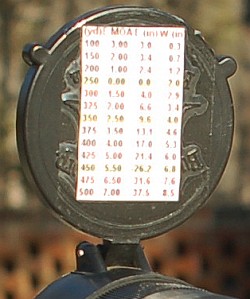
Here’s a great tip from Forum member Greg C. (aka “Rem40X”). Greg has created a trajectory table with windage and elevation data for various distances and wind speeds. Greg prints out a compact version of his drop chart to place on his rifle. While many shooters tape a ‘come-up’ table on their buttstock, Greg has a better solution. He tapes the trajectory table to the outside of his front flip-up scope cover. This way, when he flips up the cover, his data is displayed for easy viewing right in front.
With your ‘come-up’ table on the flip-up cover you can check your windage and elevation easily without having to move up off the rifle and roll the gun over to look at the side of the stock. Greg tells us: “Placing my trajectory table on the front scope cover has worked well for me for a couple of years and thought I’d share. It’s in plain view and not under my armpit. And the table is far enough away that my aging eyes can read it easily. To apply, just use clear tape on the front objective cover.”


 On the older Riflemans’ Journal blog, GS Arizona wrote an excellent article about cartridge


 Here’s a great tip from Forum member Greg C. (aka “Rem40X”). Greg has created a trajectory table with windage and elevation data for various distances and wind speeds. Greg prints out a compact version of his drop chart to place on his rifle. While many shooters tape a ‘come-up’ table on their buttstock, Greg has a better solution. He tapes the trajectory table to the outside of his front flip-up scope cover. This way, when he flips up the cover, his data is displayed for easy viewing right in front.


