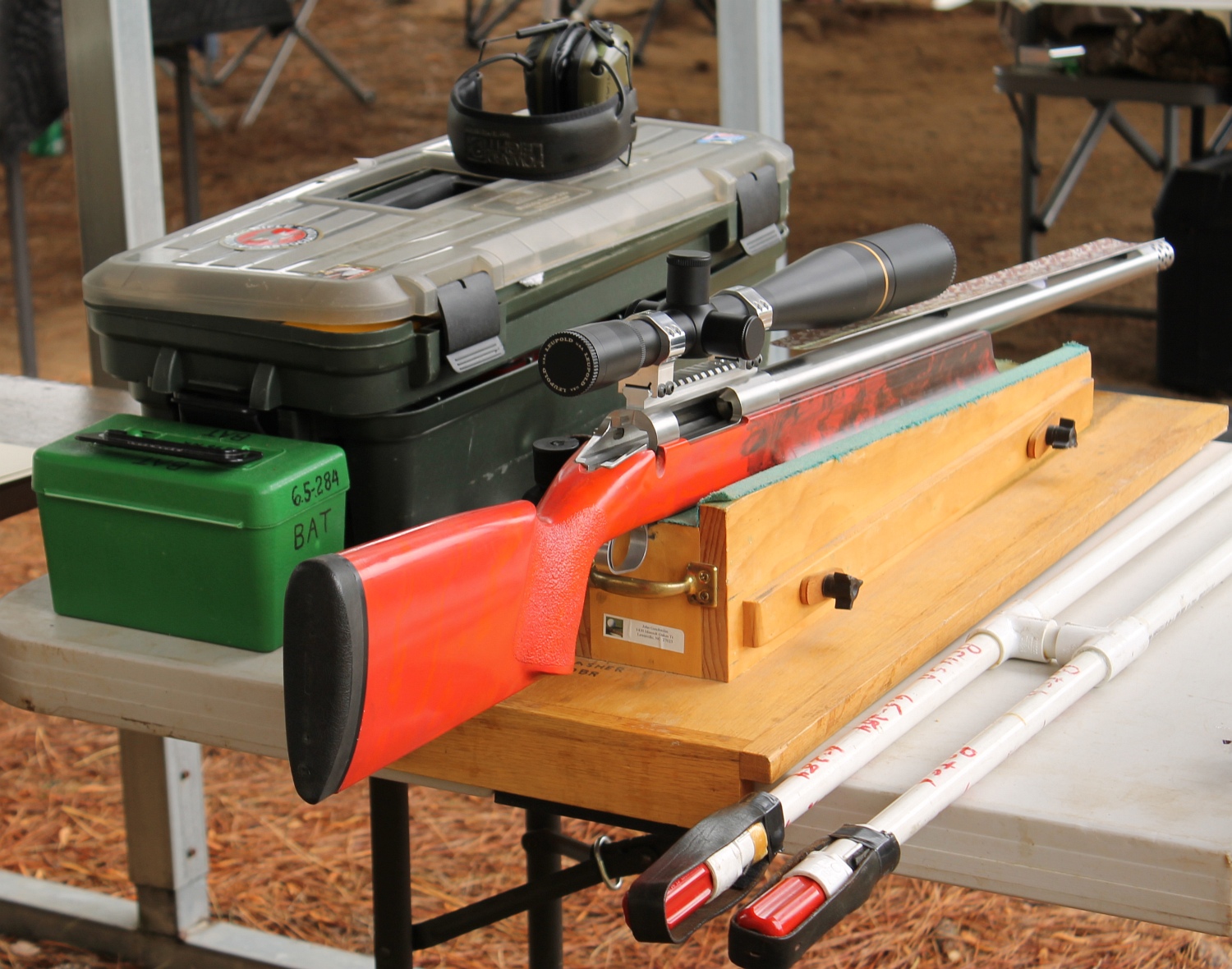
We saw some interesting gear at a 600-yard IBS match at the Piedmont Gun Club (Rutherfordton, NC). On display were a variety of hand-made wood cleaning cradles designed to fit on table tops. These typically employ a box-style design, with layer of cloth or other padding to cushion the underside of the stock. On display were both single-rifle cleaning cradle/boxes and dual-rifle rigs. This is a good do-it-yourself project that can be built with simple tools.
Click Photos to View Large Versions
Notice that these cradle-boxes feature an extended lower section in the rear. This lower “lip” butts up against the edge of the table so the whole assembly stays in place. In the photo above it appears that the lower section may actually be cut from a rubber block, but we’re not sure.
Hunting season is right around the corner. Here’s a good deal if you need a reliable, accurate hunting rifle with a proven pedigree. The Tikka T3 is popular with game hunters around the globe. Right now when you buy any new Tikka rifle you’ll get $150 in Beretta Bucks to apply towards the purchase of Beretta gear, Tikka and Sako accessories, and even Sako ammunition. This offer ends October 31, 2015. Visit www.Tikka.fi for complete details and redemption instructions.
All Tikka rifles are included in this promotion — pick whichever model you prefer, from the basic T3 Hunter with wood stock all the way up to the T3 Sporter with accessory rail and adjustable cheek-piece and buttplate. Other popular models include the T3 Lite and the T3 Super Varmint (shown above). If you’re wondering how Tikka rifles perform in the field, here is a detailed BushBrothersNZ video review of the T3 Lite. This review spotlights the T3’s controls and functions, with particular attention to the operation of trigger, safety, and bolt.
New Zealand Video Review of Tikka T3 Lite Rifle
*Eligible guns include all Tikka rifle models bought at retail, in the United States, between the dates of August 1, 2015 and October 31, 2015. Offer limited to one (1) $150 credit per Tikka rifle purchased. $150 credit will be issued in the form of Beretta Bucks for online redemption only at www.BerettaUSA.com. Beretta Bucks must be redeemed by April 30, 2016. No substitutions or exchanges permitted.
People are still complaining that affordable .22 LR rimfire ammo can’t be found. Well folks, we found some. Just call Bullets.com or Midsouth Shooter’s Supply and get yourself some Norma Tac-22 or Match-22. This is good stuff, at reasonable prices. Check out this review of Tac-22 by rimfire specialist .22 Plinkster. This Norma ammo won’t win rimfire benchrest matches, but it is plenty good enough for fun shooting, offhand practice, and tactical rimfire games.
.22 Plinkster Review of Norma Tac-22 Ammunition
Summary by .22 Plinkster (see 4:30 time mark): “I’m pretty impressed with it … I think it’s a really good deal. For six dollars and fifty cents [per box] you can’t go wrong with a box of this ammo. Out of a good bolt gun, this ammo will drive tacks.”
With all the talk about the new Norma Dasher brass coming in the fall from Bullets.com, we thought it was time to feature a special rifle chambered for the 6mm Dasher wildcat. This gun has a great story behind it. Forum member Bob A. (aka “Killshot”) used his “Forum Classifieds Special” to beat all comers in the F-Class Division in the American-Canadian Match and the Long Range Regional Match in 2013 in Sacramento, CA. Bob’s 6mm Dasher sports a blue-printed Rem 700 action. Who says you need a high-dollar custom action to run with the big dogs? In fact, this same gun, built with components sourced from AccurateShooter Forum Classified Ads, set a Sacramento F-Class range record of 200-17X a few years back. In this story, Bob talks about the build, and he explains his methods for loading ultra-accurate Dasher ammo.
Bob’s Budget-Build Dasher F-Classer
I wanted to build a proper rifle for F-Open but needed to keep it simple and, well, cheap. I found a solid “base” to build on in the form of a Dave Bruno-built, “pre-owned” 6-6.5×47 Lapua that I located in the AccurateShooter Forum classifieds in late 2011. The base action was a trued and blue-printed Remington 700 receiver circa 1971 with a spiral-fluted bolt. It was in a Shehane ST1000 stock painted sky blue and had a Jewell 1.5-oz BR trigger. I sent the bolt to Greg Tannel (Gretanrifles.com) to have the firing pin hole bushed and sleeved, the ejector removed and the hole filled and the face trued. I ugraded to Tannel’s Light Steel firing pin assembly while it was out.
Having the working bits completed, I needed a barrel. So I went to the AccurateShooter classifieds again and found a 1:8″-twist, 30″ x 1.25″ (diam.) Bartlein with a 0.236″-land bore. I called Dave Kiff and explained my pursuit and he recommended his PT&G “world record” 6 Dasher reamer (.2704″ no-turn neck and .104″ freebore). A month or so later the reamer and gauges arrived.
I had the barrel chambered by Marc Soulie of Spartan Precision Rifles (510-755-5293, Concord, CA). Marc is a great builder and I’m pleased to call him a friend.
The rifle got its good looks from a Pennsylvania artist named Kenny Prahl. His Prahl Designs shop (724-478-2538) added the white ghost-flames over the existing sky blue metallic paint.
Looks Great, Shoots Better
Fire-forming showed great promise — ten-shot groups of half an inch at 200 yards were typical. I lost only one case to a split neck and the “blow lengths” are good and consistent. This was followed up with load development which saw 100-yard, five-shot groups in the .1s and .2s as the rifle showed its preference for Reloder 15 over Varget powder, and for CCI 450s over all other primers. The bullet of choice was the ever-popular Berger 105gr Hybrid Target.
In February 2012 I began shooting the Dasher in monthly club matches at the Sacramento Valley Shooting Center, the home range of a number of excellent F-Class, Benchrest and High Power shooters. Using a Farley Coaxial rest up front (also picked up from a WTB ad on AccurateShooter’s Forum) and an Edgewood bag in the back, I gradually improved my gun-handling to the point where I could shoot a respectable score. This was very different from the bipod shooting I’d done in the past in F/TR.
Dasher Loading Tips
My chamber is set up for blue box Lapua 6mmBR brass. My case preparation is straight-forward. I fire-form with virgin cases right out of the box. I don’t size them but I will give the primer holes a good look and clean up the flash hole with a .058″ bit in a pin vise. To fire-form, I seat a Berger 108gr BT .030″ into the lands over a standard 6mmBR load of Varget.
For match loads, I use Alliant Reloder 15. While Varget is less sensitive to temp changes, RL15 has given me lower extreme spreads and better long range control. [Bob acknowledges that every barrel is unique, so a different powder might work better for you.]
I clean my fired cases with stainless steel media in a Thumler’s rotary tumbler after every firing. I anneal after every other firing using a Bench-Source machine which is very well made and easy to operate. I use a Whidden full length bushing die with Redding bushings for sizing.
While Varget and Reloder 15 remain in short supply, you can often find IMR 4320 powder back in the shelves of local gun stores. IMR describes IMR 4320 as follows: “Short granulation, easy metering, and perfect for the 223 Remington, 22-250 Remington, 250 Savage and other medium burn rate cartridges.” This older-generation powder is more temp sensitive than the Hodgdon Extreme propellants, but in the right application, it looks to be a viable alternative for folks who can’t source Varget, Reloder 15, and even H4895.
IMR 4320 Shoots Well in the .308 Winchester
A while back, GS Arizona wrote an excellent Riflemans Journal article, IMR 4320 — the Forgotten Powder. GS developed IMR 4320 loads for his .308 Win Palma rifle and competed with IMR 4320-powered ammo at long range matches. He concluded that: “[IMR 4320] appears to be a very useful alternative to some of the harder-to-get powders. The load is working extremely well at 1000 yards. In the [2009] Arizona Palma State Championship, several high placing competitors were using the 4320 load. We got sub X-Ring elevation at 1000 yards from several rifles, and that’s all I’m looking for in a Palma load.”
IMR 4320 Works for Dasher Shooter
Forum member FalconPilot shoots a 6mm Dasher with Berger 105gr Hybrids. Looking for an alternative to Varget, he decided to give IMR 4320 a try. The results were good. FalconPilot reports: “I’ve been looking for other options (besides Reloder 15, which I love, but it’s really dirty). While at a gun shop in Ohio, I ran across 8 pounds of IMR 4320. I had never even heard of it, much less tried it. Getting ready for upcoming mid-range shoots, I loaded five rounds with IMR 4320 to the exact same specs as my winning Varget loads for the 6mm Dasher. This recipe was 32.7 grains of powder, Wolf SMR primer, Berger Hybrid 105 jumped fifty thousandths.” Falcon pilot tested his IMR 4320 load at 600 yards:
As you can see from the photo at the top of this article, FalconPilot had good results — a 1.5″ group at 600 yards. He reports: “This group was shoot during the middle of the day, mirage bad, scope set to 25X. It looks like IMR 4320 is a [very close] replacement for Varget… with a tad bit slower burn rate.” FalconPilot tell us the accuracy with IMR 4320 rivals the best he has gotten with Varget: “This gun has always shot under 2 inches [for 5 shots] at 600 yards, and most of time shoots 1.5 to 1.7 inches.”
For comparison purposes, here are Heat of Explosion and Burn Rate values from QuickLOAD for IMR 4320, and for the popular Reloder 15 and Varget powders. You can see that these powders have similar characteristics “by the numbers”:
Manufacturer
Powder Brand
Heat of Explosion
Burning Rate Factor
IMR
4320
3890
0.5920
Alliant
Reloder 15
3990
0.5200
Hodgdon (ADI)
Varget
4050
0.6150
WARNING — When changing from one powder to another, always start with manufacturer’s stated load data. Start low and work up incrementally. Never assume that loads will be equivalent from one powder to another, even powders with similar burn rates.
What Other Forum Members Say:
I was using IMR 4320 in the mid 70s in my .222 Rem. Darned great powder and I never had a load that was not accurate from the .222 to .30-06 with that powder. — 5Spd
A fine powder overshadowed by the nouveau wave of “gotta have the newest — make me a better shot” powders. Try 4320 in a 22-250 — what a well-kept secret! IMR 4320 meters very well and is a flexible alternative to many of the hard-to-find powders so much in demand. — AreaOne
IMR 4320 was my “go to” powder in my .223 for many many years. This powder and Winchester 55gr soft point bulk bullets (the cheapest bullet I could buy at the time) accounted for thousands of prairie dogs, coyotes, and anything else that needed shooting. I still use IMR 4320 in some .223 loads and am very happy with it still. — pdog2062
I’ve been using it in a .308 Win for several years. I think it is very sensitive to temperature and always waited till the last minute to load my ammo with a close eye on the weekend forecast at the range. IMR 4320 Works pretty good for 155gr Palma and 168gr Hybrid [bullets] in my .308. — JayC
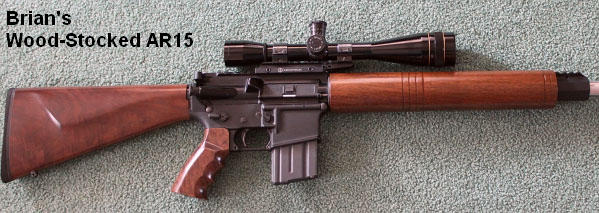
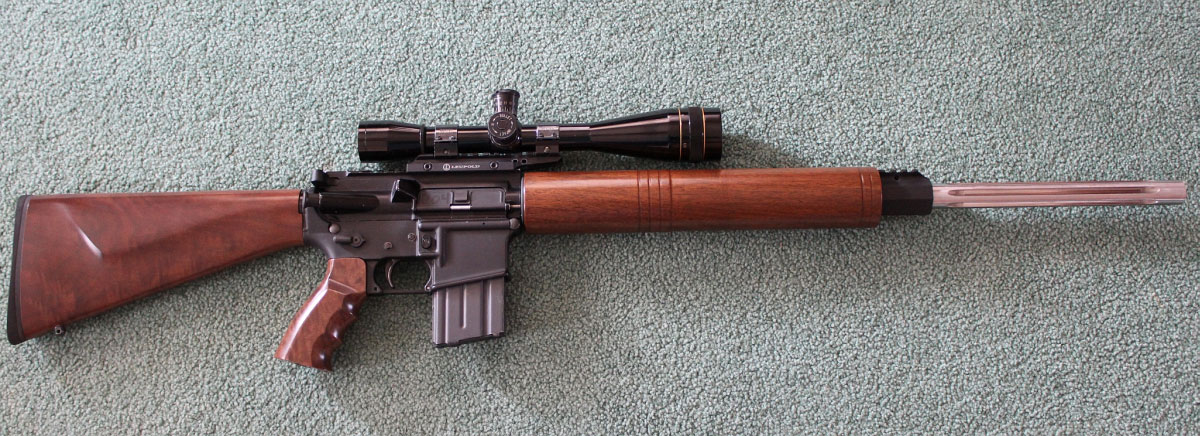
Forum member Brian V. (aka “Carbide”) wanted a new look for his “modern sporting rifle”. He was tired of looking at black plastic (or FDE, OD green) and aluminum components on his AR15. So he decided to fit wood “furniture” on the rifle. He ordered a wood butt-stock and fore-arm set made by Lucid, but he didn’t like the two-piece fore-arm of the Lucid stock set. He decided he could build something better than the commercially-available, Lucid-made wood fore-arm.
So Brian took his existing AR tubular fore-arm and epoxied a walnut sleeve to it. With a lathe, Brian then turned the walnut sleeve to his desired dimensions: 2.250″ diameter in back and 2.200″ diameter in front, so there’s a little taper. Brian says “I could have gone a little thinner.” The wood fore-end was then sanded and stained to match the Lucid-made rear section. Brian says “the stain is not quite a perfect match, but but it looks a lot better.”
Dan Pohlabel is a member of the all-conquering Team Sinclair F-TR squad. This talented group of shooters hasn’t lost a team match in years. What’s the secret of Team Sinclair’s success? Well there is not one single factor. These guys have very accurate rifles, they work hard on load development, and they practice in all conditions. In this interview, Dan Pohlabel talks about F-TR competition, reviewing the hardware (and skill set) it takes to win. He offers some great tips on developing loads. You’ll find a longer version of this interview on the Sinclair Int’l website. CLICK HERE to Read Full Interview.
Q: What do you find most challenging in F-TR Shooting?
It has to be keeping up with the competition, our sport has grown so quickly with new talented shooters. Staying at the top requires having a laser of a rifle, perfect loads, near perfect wind reading, and, of course, breaking good shots.
Q: How can novice shooters improve their game?
Seek out the local F-TR shooters and go to matches with them, listen and learn. Attend team matches and offer to score for one of the teams. As a scorer, you will sit close enough to hear the coach make wind calls and see the results on the target. Through the spotting scope you will see changes in mirage and it’s the quickest way to learn the basics of wind reading. Choosing and buying equipment is relatively easy, learning to read the wind is a journey.
Q: What’s in your range bag for match days?
Rear bag, towel, shooting glasses, canned air, ear protection, data book, pen, rifle rain cover, hat, rifle tools, timer, ammo, and bug spray.
Q: What specialized gear can you not live without?
1. A good set of elbow pads. It’s hard to keep concentrating on shooting when your elbows are rubbed raw from days of competing on them.
2. Good bug spray. We shoot from the ground but our shooting mats aren’t that big. It’s hard to concentrate with bugs crawling or chewing on you.
Q: Load Development — How do you work up a load?
First, I call Derek Rodgers and get his load data, he is the best load development shooter I know! Otherwise, here is the procedure I recommend. Measure throat length with bullet of your choice, to determine how much room is left in the case. The above measurement determines what powders you can use. We use only Hodgdon Extreme powders. Shoot a ladder test, five rounds each in 0.2 grain increments, to find the accuracy node for that bullet/powder combination. Take the best two loads and do a jump test with five rounds each, test at .005″, .025″, .060″ jump. One of these groups will be significantly better than the rest, now you can tweak that measurement +/- .002” or .005” to get the best accuracy.
Test at least three different primers to determine which offers a little better ignition for your load, a 5-shot test will usually tell you which is the best. Go back and test the two best combinations in a 10-shot test at least twice, pick a cool overcast day and also a hot sunny day and compare results. Take your final “best load” back and do a “simulated match”, 20 shots, waiting at least 20 seconds between shots. If you like those results it’s probably a reliable and accurate load.
Q: What rear bag do you use?
I use a two-bag system, large bag on bottom with a smaller bag on top. I had the bags made of marine canvas, zippered and filled with plastic beads. I can adjust the amount of fill to make them a perfect height for my shooting position. Teammate Jeff Rorer uses a similar system and mine is nearly a copy of his rear bags.
Q: How often do you practice and how many rounds do you shoot per year?
In good weather I practice a couple times a week at the local range, a couple more dry-firing practices/week at home. I typically shoot between 2,000-2,500 rounds per year.
Q: How do you prepare mentally before a match?
[I do] lots of visualization — run the video in my head of what I expect to see and of my performance. I think about the correct strategy for the conditions, staying disciplined to the strategy.
Q: What do you avoid before a shoot?
No late nights or excessive alcohol. Very little caffeine in the morning. Leave your cell turned off. Avoid emotional people.
Q: What’s your procedure on a Match day?
I arrive early, get squadding card, move gear, watch wind speed/direction, check over rifle and gear, sit and relax, visualize and focus on the most important goal of the day. Most days we shoot three relays of 20 shots. It’s important to eat and hydrate continually all day. My focus and concentration are better when I snack all day with fruit and energy bars, and lots of water. While taking my turn in the pits, I try to relax and only focus on what is ahead of me and [not] what’s already happened.
Q: What is your favorite reloading product?
My favorite reloading product is the Sinclair Premium Neck Turning Tool with Handle, I also use the expander mandrels provided by Sinclair for sizing the brass in preparation for the turning process. Correct and repeatable neck tension begins with turning necks to a uniform thickness. Sinclair also has mandrels to size the necks after neck turning that accurately size the necks for a specific neck tension.
Q: What is your preferred scope?
The scope I find the most useful is the Nightforce Competition Scope. This scope is very light-weight, has 15-55X magnification, world-class quality glass, 10 MOA per revolution on the turrets, 1/8 moa adjustments. It’s perfect for F-Class competition.
Q: What advice do you have for someone wanting to get into the sport?
Find a local club with some F-TR shooters and ask for their help. Most shooters will be happy to take you with them to a match, listen and learn while you’re there. You may find out it’s not what you thought, or you may be hooked. If you decide to jump in, start with an inexpensive rifle. This sport is expensive and you don’t need a $5000 rifle to learn good wind-reading skills. Start with a used Savage F-TR rifle and learn the basics, shoot for a year at least before making a larger investment. The money you saved buying a used Savage rifle will help pay for your divorce lawyer, LOL.
Q: What training drills do you use?
Dry-firing the rifle at home is a good way to practice when you can’t get to the range and shoot. It allows me to practice set-up, rifle handling, and position. When I can practice at a local range, I also dry-fire between shots to increase the amount of repetitions and increase the time spent in position.
Q: Who has been your biggest influence in shooting?
Eric Bair, 2006 F-Open National Champion helped me get started and gave me great advice. Most of the shooters on Team USA and Team Sinclair help each other, nobody knows all the answers but we share what we have learned. Danny Biggs, 2008 and 2009 F-TR National Champion also helped me when I was struggling to learn some of the ranges. I learned a lot from Danny.
Nightforce is bringing out a new 20-60X 80mm spotting scope that is significantly less expensive than its 82mm big brother, the 20-70X TS-82. The new TS-80 Hi-Def spotter is priced at $1595.00 MSRP compared to $2653.00 for the TS-82 (MAP “street price”). Yes, you heard that right, the new TS-80 is more than $1000.00 less expensive than its 82mm big brother. That’s a lot of hard-earned cash saved in return for the loss of just 10X magnification on the upper end. Both spotting scopes feature high-definition glass and easy-to-use, full-diameter focusing controls.
At its $1595.00 price point, the Nightforce TS-80 looks like a winner. It shares features we liked in the more expensive TS-82: Extra-low-Dispersion (ED) glass, easy-to-use zoom ring, built-in sunshade, and rubber armor on the entire body. However, on the TS-80 the eyepiece is NON-removable. That means you cannot swap in a different eyepiece (such as a fixed power 25X for greater field of view).
The TS-80 offers a lot of performance for the $1595.00 price. Most other current-production spotting scopes with comparable features and ED glass cost a lot more. Weight is 68 ounces (4 lbs., 4 oz.) — that’s fairly hefty. The TS-80 will focus from 20 feet to infinity, making it suitable for all shooting chores, even close-range pistol work. The mounting foot fits many quick-release tripods and accepts standard 1/4″ tripod screws. The TS-80 includes an integral, retractable sunshade for the front objective. Optional accessories include a protective sleeve and a fitted carrying case, shown below.
Product Tip from EdLongrange. We welcome reader submissions.
You’ve heard the rumors of a new ultra-high BC 7mm bullet from Berger. Well the rumors are true. Berger is now shipping test samples of its new 195-grain 7mm Elite Hunter Bullet, part # 28550. This bullet boasts jaw-droping 0.755 G1 and 0.387 G7 Ballistic Coefficients. Those are stunningly high numbers. Compare that to 0.674 G1 and 0.345 G7 BCs for the previous BC king amoung 7mm projectiles, Berger’s own 180 gr Match Hybrid Target.
We’re certain the “orange box” 195gr Elite Hunter will soon see use by F-Open competitors. This ultra-high BC projectile could be a “game-changer” in long-range shooting when used in cartridges such as the 7mm RSAUM, 7mm WSM and even bigger 7mm magnums. Recommended barrel twist rate is 1:8.3″, with a stated “minimum” twist of 1:9″.
We ran some numbers through the JBM Ballistics program*, comparing the new 195-grainer with Berger’s popular 180gr Hybrid. The results were eye-opening. The projected drop is significantly less. Most importantly, this new 195gr bullet moves a LOT less in the wind at 1000 yards. This should translate into higher scores for F-Class shooters — that wide ‘9’ shot may stay in the ’10’ ring. In fact, based on the JBM trajectory calculation, with a 10 mph 90° crosswind, the 195gr bullet will have over SEVEN INCHES less wind drift at 1000 yards than the 180-grainer (46.0″ vs. 53.1″). That’s a big deal, a very big deal…
Drop at 800 yards: 135.5″
Windage at 800 yards: 28.0″
Drop at 800 yards: 140.9″
Windage at 800 yards: 32.2″
Drop at 1000 yards: 237.9″ Windage at 1000 yards: 46.0″
Drop at 1000 yards: 250.0″ Windage at 1000 yards: 53.1″
Drop at 1200 yards: 380.1″
Windage at 1200 yards: 69.6″
Drop at 1200 yards: 404.2″
Windage at 1200 yards: 81.2″
* Variables were set to 55.4° F, 1000′ elevation, standard Atmosphere at Altitude, 2950 fps muzzle velocity. You can use JBM Ballistics to compare at different MVs.
UPDATE from Berger
After we broke this story, Berger Bullets wanted to clarify some points. Berger explained:
“This bullet is in the testing phase and has not been officially launched. We sent this bullet out for some public testing to make sure that we had positive feedback before we moved forward with an official launch.
We want to see how it performs in multiple rifles and different chamberings.
This bullet was made for hunting purposes, we realize there are shooters who would like to take these out for target shooting, like F-Class. However, we are not certain how they will perform. If things are successful we would like to eventually launch a target version.”
The information on the label you have pictured on your article has been updated.
Twist Rates
Minimum: 1:9″
Optimum: 1:8.3″
Ballistic Coefficients
G7 BC: .387
G1 BC: .754
How to Get Berger’s 195gr Elite Hunter Bullets
These bullets are so new you won’t find them on the Berger Bullets website yet. As Berger explained above, these bullets are still in a final testing phase. Most of the early production runs have been sent out for testing purposes. If you have specific questions, you can send an email to Berger via this CONTACT PAGE. Otherwise you can phone Berger, Mon-Fri, at 714-441-7200. Please try the email option first.
Headed to Vegas next January for SHOT Show? Then get yourself registered. Registration for the National Shooting Sports Foundation’s 2016 SHOT Show is now open for attendees. (Registration for members of the press will open in September.) The upcoming SHOT Show is slated to run January 19-22 in Las Vegas. Attendees can register now at ShotShow.org. While registering, attendees can also enroll in SHOT Show University and other seminars. CLICK HERE for Attendee Registration.
NOTE: We recommend you consider making your hotel arrangements very early. Like last year, there will be a number of major events in Las Vegas the same week as SHOT Show 2016. This means that hotel space will be heavily booked in advance. Forewarned is forearmed!
SHOT Show Sampler
In case you’ve never attended SHOT Show, here are two video highlights from last year. These two videos, created by our friends Ed and Steve, aka the 6.5 Guys, cover new-for-2015 Nightforce scopes and David Tubb’s recently released two-stage trigger.
Nightforce Optics
Nightforce showcases its F1 First Focal Plane scopes, including the new ATACR™ 5-25x56mm F1™ riflescope. With a 34mm maintube, the new 5-25x56mm F1 boasts an impressive 30 MOA of elevation per revolution, with 120 MOA of total elevation adjustment.
David Tubb
11-Time National High Power Champion David Tubb displayed his new T7T 2-stage trigger for Remington 700 actions, a major upgrade over the factory trigger. First stage and second stage are separately adjustable. Price is $350.00 for right- or left-hand versions at DavidTubb.com.




 Dasher Loading Tips
 While Varget and Reloder 15 remain in short supply, you can often find IMR 4320 powder back in the shelves of local gun stores. IMR describes IMR 4320 as follows: “Short granulation, easy metering, and perfect for the 223 Remington, 22-250 Remington, 250 Savage and other medium burn rate cartridges.” This older-generation powder is more temp sensitive than the Hodgdon Extreme propellants, but in the right application, it looks to be a viable alternative for folks who can’t source Varget, Reloder 15, and even H4895.