Top Shot Champion Dustin Ellermann has been busy up in Wyoming slaying varmints. On his Facebook Page, Dustin wrote: “I’ve been helping some ranchers out with their prairie dog infestation in Wyoming. The 17 HMR Volquartsen Custom is amazing! The Meopta Sports Optics R1r is super nice as well. Can you guess how many prairie dogs I eliminated in two days?” (Facebook users post guesses HERE.)
Dustin says the effective range of the 17 HMR is farther than one might expect: “I made hits out to 300 yards. 200 yards was easy as long as the wind wasn’t too bad.”
Dustin was very impressed with the 17 HMR cartridge: “Never paid it much attention before now because the ammo is five times more expensive than .22 LR and I mostly target shoot. However, for prairie dogs, the 17 HMR is amazing!” Dustin is now a fan of the speedy rimfire round. Consider this — Hornady’s 17 HMR ammo pushes a 17gr V-Max bullet at 2550 fps, twice as fast as typical .22 LR rounds.
Every week Brownells Merchandise Manager Paul Levy hosts a video featuring new products. We’ve seen these vid clips before, but three products in this week’s video really caught our attention. We like the new MTM Ammo Crate, and the new Durablue coating offers a great option for gun-owners who want a traditional-looking finish that is also durable. And for AR-10 owners, the gold-tone Titanium Nitride Bolt Carrier group promises smoother running with easier cleaning.
Products featured in this week’s video include:
MTM Ammo Crate. Wide, flat polymer box features O-ring seal for water resistance, and stackable shape for convenient storage. Integral handle makes for easy transport. Holds up to 85 lbs. of ammo, magazines, and any other type of supplies or gear. Available in 4½”- and 7¼”-deep models.
Titanium Nitride is an extremely robust, durable coating, and now it’s available on an AR-10 bolt carrier group. The new Prime Weaponry .308AR Titanium Nitride Bolt Carrier Group drops into AR-10 type .308 AR uppers. The tough gold-tone finish resists wear and corrosion, plus the slick surface speeds up the cleaning process.
Duracoat DuraBlue is a new spray-on coating that provides a deep, glossy finish like traditional bluing but without the worry of rust, scratches, or high cost. DuraBlue comes in an aerosol can or liquid form (for application with sprayer) in both glossy black and traditional blue. DuraBlue can be used on on all kinds of metal, even stainless steel and aluminum.
Believe it or not, legendary German gun-maker Walther Arms has never produced a .45 ACP pistol. Until now that is. You see Walther just announced that it will (finally) build a handgun, the .45 ACP PPQ, chambered for the classic .45 ACP cartridge. John Moses Browning would approve.
The striker-fired, polymer-framed .45 ACP PPQ boasts a smooth, 5.6-lb trigger with a 0.4″ normal travel and a 0.1″ reset. The 4.25-inch barrel features polygonal rifling (like HK barrels). Both slide and barrel have a hard Tenifer finish (like Glocks). The new .45 ACP PPQ includes ambidextrous controls, slide serrations, and front Picatinny rail for mounting accessories. The pistol holds 12 rounds and is equipped with three internal safeties. Overall length is 7.4 inches, and width is 1.3 inches.
Walther Arms’ VP of Sales and Marketing, Cyndi Flannigan, states: “This new caliber and product offering is a benchmark for Walther and the PPQ. We have built it to the same exacting German standards that deliver the ultimate home defense and personal protection firearm.” The new M2 .45 ACP PPQ pistol is expected to ship to dealers in early October, 2015.
The Canadian F-Class Championships took place last week at the Connaught Range outside Ottawa, Ontario. American shooters performed well, taking top honors in both the F-Open and F-TR divisions. In the F-Open class, Bullets.com President Shiraz Balolia won his second straight Canadian National Championship (he also won in 2014). This year he was shooting a .300 WSM. The long, heavy .30-Cal bullets offer a ballistic advantage… IF you can handle the additional recoil. Shiraz told us: “This [match] was particularly challenging and satisfying as there were some incredible shooters from around the world including two World Champions, three U.S. National Champions, Canadian National Champions, British Champions, and European Champions shooting alongside me. It was an honor to shoot alongside the best shooters in the world.”
A large number of American shooters ventured to Ontario for the Canadian F-Class Championships.
James Crofts shot consistently to win the F-TR division, and Paul Phillips finished second. Of Jim, the “man to beat” in F-TR, fellow competitor Tom Hittle said: “Congratulations to James Crofts for the overall win in TR. It was well deserved. Thank you for all the guidance and tips over the last couple of years.” After the match, James told us: “I want to thank a few companies that helped me get where I am. BRUX Barrels — I have now won three Nationals with Brux barrels. Jim Borden from Borden Actions — your action was smooth and precise. And Ray Bowman (PR&T) who, hands down, builds the best rifles available. I have used two different PR&T rifles to win U.S. F-TR Nationals. Proof is with the gold medals.”
In Team competition, a “dark horse” squad from North Carolina pulled off a real upset, taking Gold for the 4-man team event. The “Team NC” boys (James Hittle, Tom Hittle, Ed Shelley, and Greg Denekamp), benefited from good wind-calling by the Hittles plus some very accurate rifles. Tom Hittle remarked: “Ray Bowman of PR&T rifles were used by each team member. Thank you Ray for incredible-shooting hammers.”
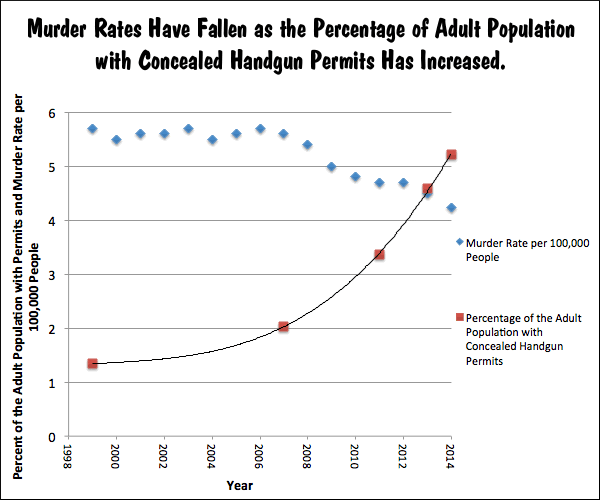
More guns, less crime — that’s the conclusion of a recently-issued report from the Crime Prevention Resource Center (CPRC). The CPRC Concealed Carry Report attributes some of the drop in crime rates to the fact that more Americans than ever before are carrying handguns for protection. In the past eight years, the number of concealed handgun permits has soared, growing from 4.6 million in 2007 to over 12.8 million this year. Overall, 5.2% of the U.S. adult population, i.e roughly one in twenty American adults, now has a concealed carry permit.
Here are some interesting findings in the 2015 CPRC Report:
5.2% of the total adult U.S. population has a concealed carry permit.
The number of concealed handgun permits is growing at an ever-increasing rate. Over the past year, 1.7 million additional new permits have been issued – a 15.4% increase in just one single year. This is the largest ever single-year increase in the number of concealed handgun permits.
Five states now have more than 10% of their adult population with concealed handgun permits.
In ten states, a permit is no longer required to carry in all or virtually all of the state. This is a major reason why legal carrying handguns is growing so much faster than the number of permits.
Since 2007, permits for women has increased by 270% and for men by 156%.
Some evidence suggests that permit holding by minorities is increasing more than twice as fast as for whites.
Between 2007 and 2014, murder rates have fallen from 5.6 to 4.2 (preliminary estimates) per 100,000. This represents a 25% drop in the murder rate at the same time that the percentage of the adult population with permits soared by 156%. Overall violent crime also fell by 25 percent over that period of time.
States with the largest increase in permits have seen the largest relative drops in murder rates.
Carry Permit Holders are Law-Abiding
Interestingly, concealed handgun permit holders are extremely law-abiding. In fact, police officers commit crimes at a higher rate (103 per 100,000, national average) than do concealed carry permit holders in Florida (12.8 per 100,000) and Texas (22.8 per 100,000).
Intro: Ron Dague wanted a new gun that was similar to his trusty .223 Rem rifle, but which fired 6mm bullets. There is a superb choice of bullets in this caliber, and Ron found that the 95gr Berger VLD could be driven to a healthy 2,604 fps by the small .223 Rem case. This 6mm wildcat based on the common .223 Rem offers excellent accuracy and very low recoil — something very important in the cross-the-course discipline. In addition, Ron’s 95gr load with Reloder 15 delivered an ES of just 4 fps over ten shots. That exceptionally low ES helps achieve minimal vertical dispersion at 600 yards.
I already had a .223 Remington match rifle, and I wanted the 6mm-223 to be as close to the same as I could make it. I installed the barreled action in a wood 40X stock to work up load data and work out any magazine feeding issues. While I was working on that, I looked for a McMillan Baker Special stock and finally found one to finish this project. I bedded the action and stock, then took the rifle to the range to check zeros on the sights and scope. I was surprised that I didn’t have to change anything on the sights. I thought changing the stock would cause sight changes. The thought went through my head, “Maybe the 40X stock isn’t all that bad”.
Here’s line-up of 6mm bullets. The Berger 95gr VLD is in the middle.
I took the new rifle to the first match of the year, a National Match Course match, and my off-hand score was 83, rapid sitting 95, rapid prone 95, and slow fire prone 197 — for total aggregate 470. This may not be my best work, but on match day the wind was blowing about 15 mph and the temp was around 40° F, with rain threatening. This was a reduced course of fire — we shot at 200 and 300 yards on reduced targets.
I used 70gr Berger bullets for this match, loaded in Remington brass with 25 grains of VihtaVuori N540 and Federal 205M primers. When I worked up loads for this rifle, N540 gave the best accuracy with the best extreme spread — 2,950 fps with an extreme spread of 20 fps on a 10-shot string. The load for 600 yards was with a 95gr Berger VLD bullet, with 23.0 grains of Reloder 15, Lapua cases, and the same Federal 205M primers. This load is 2,604 fps, with an extreme spread of 4 fps over a 10-shot string. I’ve shot this load at several 3×600 yard matches, and the accuracy has proven to be very good. At the last 3×600 match, my scores were as follows: 199-10x and 198-11X with scope, and 193-10X with iron sights. Best 600-yard score so far with iron sights was 198-12X.
6mm-223 Rem Rifle Specifications: 700 BDL action and floor plate, Bartlein 6mm 1:8″ twist, McMillan Baker Special stock in Desert Camo, Centra front and rear sights, Ken Farrell bases with stripper clip guide, Sinclair hand stop, and Jewell trigger. Gunsmith Neil Keller helped me with the metal work and instructed me on the action work and rebarreling.
The NRA’s Shooting Sports USA has a “new and improved” website. The new mobile-friendly format makes it easy to access current articles as well as locate interesting archived stories.
One great recent Shooting Sports USA article, Shooting is 90% Mental, was penned by Chip Lohman (SSUSA’s former Editor). With the help of two very smart Ph.D types, Judy Tant and Mike Keyes, Lohman examines the mental processes involved in the shooting sports. Chip’s co-authors have impressive credentials. Dr. Judy Tant is a Clinical Psychologist and National Bullseye Pistol Champion. Dr. Michael J. Keyes, is a licensed Psychiatrist and former physician for the U.S. Shooting Team.
If you shoot competitively, this is definitely a “must-read” article. The authors examine how the brain functions under stress, how “visualization” can be used to improved performance, how “brain speed” can be enhanced through proper training, and how the brain stores learned routines into “muscle memory.” And that’s just for starters — the article gives many concrete examples of techniques top shooters have employed to improve their “mental game” and shoot higher scores.
Brain Speed and Trigger Control: Research: Scientists believe that the newer frontal lobe may not be able to keep up with “deep” brain signals that transmit at nearly 300 mph. This is explained when athletes talk about “letting go,” rather than over-thinking the shot. This conscious signal can take up to 0.3 seconds from recognizing the desired sight picture to moving the trigger finger—too long to capture the opportunity for a perfect shot. However, if the signal is initiated spontaneously in the cerebellum where such procedures are thought to be stored through repetition, the reaction speed is much quicker. Signals are processed by the “deep brain” almost twice as fast as the problem-solving frontal lobes.
There are a wide variety of reloading tools designed to cut a slight chamfer in case necks and deburr the edge of the case mouth. You don’t need to spend a lot of money for an effective tool. A basic “rocket-style” 45° chamfering tool, such as the Forster, actually does a pretty good job taking the sharp edge off case mouths, particularly if you use a little scotch-pad (or steel wool) to smooth the edge of the cut. The $17.49 Forster chamfer tool, shown below, is a nicely-made product, with sharper cutting blades than you’ll find on most other 45° chamferers.
Many folks feel they can get smoother bullet seating by using a tool that cuts at a steeper angle. We like the 22° cutter sold by Lyman. It has a comfortable handle, and costs just $10.45 at MidsouthShooterssupply.com. The Lyman tool is an excellent value, though we’ve seen examples that needed sharpening even when new. Blade-sharpening is easily done, however.
Sinclair International offers a 28° carbide chamferer with many handy features (and sharp blades). The $29.99 Sinclair Carbide VLD Case Mouth Chamfering Tool will chamfer cases from .14 through .45 caliber. This tool features a removable 28° carbide cutter mounted in the green plastic Sinclair handle. NOTE: A hex-shaft cutter head power adapter can be purchased separately for $14.99 (Sinclair item 749-002-488WS). This can be chucked in a power screwdriver or used with the Sinclair Case Prep Power Center when doing large volumes of cases.
K&M makes a depth-adjustable, inside-neck chamferer (“Controlled Depth Tapered Reaper”) with ultra-sharp cutting flutes. The latest version, which costs $45.00 at KMShooting.com, features a central pin that indexes via the flash hole to keep the cutter centered. In addition, the tool has a newly-designed handle, improved depth-stop fingers, plus a new set-screw adjustment for precise cutter depth control. We caution, even with all the depth-control features, if you are not very careful, it is easy to over-cut, slicing away too much brass and basically ruining your neck. We think that most reloaders will get better results using a more conventional chamfer tool, such as the Forster or Lyman.
One last thing to note — tools like the K&M and the Sinclair chamferer are often described as VLD chamferers. That is really a misnomer, as bullets with long boat-tails actually seat easily with very minimal chamfering. In reality, these high-angle chamferers may be most valuable when preparing brass for flat-base bullets and bullets with pressure rings. Using a 22° or 28° chamferer can reduce the risk of cutting a jacket when using VLD bullets though — so long as you make a smooth cut.
Forum member Alex W. (aka “zfastmalibu”) came up with a clever adaptation of an item you may already have on your kitchen counter. By drilling a few strategically-placed holes in a wood knife-holding block, Alex created a handy, 20-round ammo holder for the bench. We’re not sure the wife will appreciate the new holes in her kitchen accessory, but we think this is a smart invention. Alex asked fellow Forum members: “What do you think, is there a market for it?” We think there is. Of course, with a ruler and an electric drill you could probably make your own version easily enough.
Get a Solid Wood Knife Block for under $25.00 Hardwood Knife blocks can be purchased for under $25.00 through Amazon.com. They are also available in bamboo ($18.14), beechwood ($39.95), acacia ($49.95), and solid walnut ($59.95).
Congratulations to the Great Britain Palma Rifle Team (GBPRT), winner of the 2015 ICFRA World Long Range Palma Team Championship match. The British team shot superbly, winning by 70+ points over runner-up Team USA. Great Britain’s 7106-827V score* set a new Palma Team Championship record, smashing the old record by 79 points. The British marksmen displayed stunning accuracy — Team GB had fully 102 more Vs than did the second-place American squad (A “V” is the equivalent of an “X” in American scoring). The Brits shoot great as a team. Consider this — Great Britain had eleven shooters with 50 or more V-bulls. Team USA had just three.
Team GB ran away with the match with a great team performance at 1000 yards on Day Two. As the GBPRT blog noted: “An awesome demonstration of GB shooting and coaching was made – superb use of the wind and the firers to not just hold our lead, but to win the range by a stonking 33 points.”
Great Britain 2015 Palma Team Highlights
Match record beaten by 79 points – 7106.827 (176 V-bulls more than last time*).
Individual record beaten by 3 points – 449.59 (Toby Raincock).
Highest 900-Yard Aggregate score – 2384.276.
Most consecutive Palma Team matches won – Four in a Row.
Great Britain’s Toby Raincock Shoots a Match for the Ages
The top individual shooter in the Team match was Great Britain’s Toby Raincock, who dropped only one point over two days to finish with 449-55V, a new record individual score that will be very hard to break. The next best individual score was the 447-49V by fellow Brit Jon Underwood. The top American shooter was John Whidden, who finished with a 445-45V.
The GBPRT website summed up the big victory as follows: “It was a glorious day for GB and more statistical analysis would tell you more of the depth of our victory[.] We won big and we were justly proud of years of hard work. The celebrations immediately after the match were wonderful and full of the beauty of our sport. All the teams gathered and shook hands. The runners up USA and South Africa were valiant fighters and all teams showed their appreciation for not only a great match but also a great win.
Team USA Takes Second
The American team shot very well in finishing second, breaking the previous Palma Team match Aggregate record in the process. Team USA enjoyed a significant 25-point margin over third-place South Africa. John Whidden had a great match, finishing as the seventh-highest shooter overall.
Team USA member Kelly Bachand praised his team-mates and coaches: “I am extremely proud to have contributed to the USA’s silver medal in the 2015 Palma Trophy match. I feel very blessed to have been counted a member of this elite group of shooters and coaches.” Team USA’s shooting members included: Kelly Bachand, SFC Shane Barnhart, Tyrel Cooper, Mark DelCotto, SSG Amanda Elsenboss, Trudie Fay, Michelle Gallagher, SFC Brandon Green, Norman Houle, Bryan Litz, Kevin Nevius, Kent Reeve, Justin Skaret, SGT Eric Smith, Nancy Tompkins, John Whidden, (SFC Russ Theurer and Wayne Budbill alternates). Dennis Flaharty was Team Captain, SFC Emil Praslick III was head coach, Robert Mead was adjutant, and line coaches were: Norm Anderson, Ray Gross, Steve Hardin, Gary Rasmussen.
Jim Mauer added a farewell note for coach Praslick: “Special shout out to SFC Praslick. [Emil] will be retiring later this fall. It has been a challenging pleasure competing against him for the last six years. I wish you the best of luck in retirement Emil! You have left a lasting impression and legacy on the Army and the entire competitive marksmanship community.”
*The previous record score was 7027-651V set in Brisbane, Australia in 2011 by Team Great Britain. NOTE: the NRA Bulletin lists Great Britain’s Final Score as 7106-825V, rather than 7106-827V as noted on the GBPRT website. We don’t understand the discrepancy, but we will list the higher total until we receive clarification.


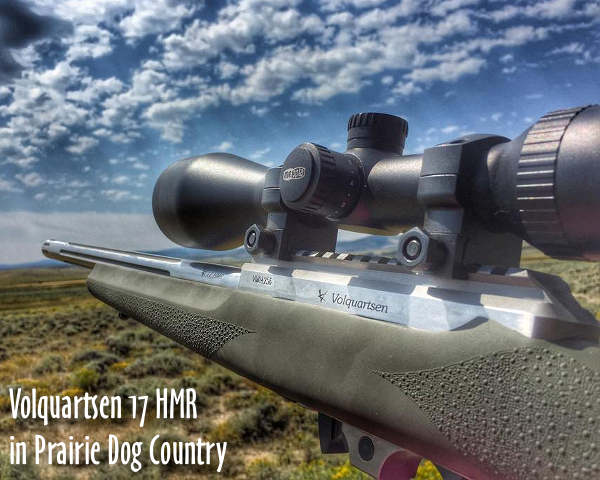
 Top Shot Champion Dustin Ellermann has been busy up in Wyoming slaying varmints. On his Facebook Page, Dustin wrote: “I’ve been helping some ranchers out with their prairie dog infestation in Wyoming. The 17 HMR Volquartsen Custom is amazing! The Meopta Sports Optics R1r is super nice as well. Can you guess how many prairie dogs I eliminated in two days?” (Facebook users post guesses HERE.)



 By Ron Dague, Sinclair Reloading Tech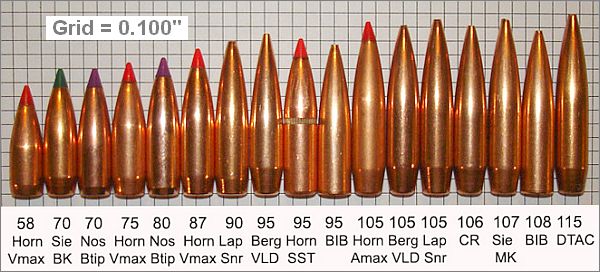

 Research: Scientists believe that the newer frontal lobe may not be able to keep up with “deep” brain signals that transmit at nearly 300 mph. This is explained when athletes talk about “letting go,” rather than over-thinking the shot. This conscious signal can take up to 0.3 seconds from recognizing the desired sight picture to moving the trigger finger—too long to capture the opportunity for a perfect shot. However, if the signal is initiated spontaneously in the cerebellum where such procedures are thought to be stored through repetition, the reaction speed is much quicker. Signals are processed by the “deep brain” almost twice as fast as the problem-solving frontal lobes.


