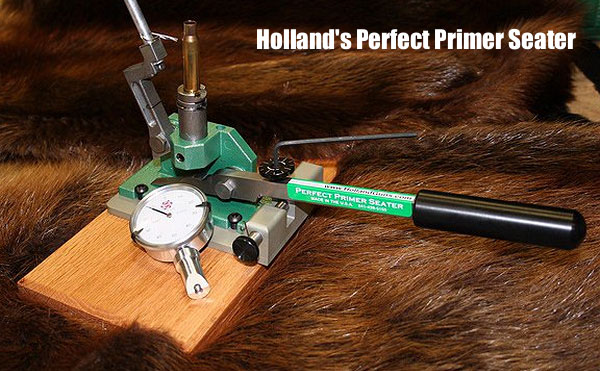
Gunsmith Darrell Holland has invented an interesting upgrade to the RCBS Auto Bench Priming Tool. If your hand starts to hurt after priming dozens of cases with a hand-held, squeeze-type priming tool, you may want to consider Holland’s invention, which he calls the “Perfect Primer Seater” (PPS).
Holland basically has modified the RCBS lever, adding a precise crush control and a means of measuring depth with a gauge. He claims this gives “an EXACT primer seating depth based on primer pocket depth and primer thickness”. With Holland’s PPS, primer seating depth is controlled with a rotating wheel that limits lever travel in precise gradations. You can buy the complete priming system for $215.00, or, if you already own the RCBS Auto Prime tool, you can purchase an adapter kit (with base, arm, adjuster, and gauge etc.) for $120.00. To order, visit Hollandguns.com then click on “Reloading Equipment”.
AccurateShooter.com Forum members often ask: “Is there a reasonably-priced ammo box that fits PPC and BR cases just right?” The answer is yes — check out the 50-round Frankford Arsenal model 512 ammo box. It is offered in transparent blue or smoke gray for $3.49 per box at MidwayUSA (or $3.99 per box at Amazon.com).
The cartridge slots are just the right size for 22BR, 6mmBR, 30BR, 220 Russian, 6 PPC, 6.8 Rem SPC, 6.5 Grendel, and 7.62×39 cartridge cases. Cells are 1.687″ high x 0.392″ square, with a divider height of 0.94″. That will hold BR-type cases securely, and fired brass won’t get jumbled if you tip-over the box.
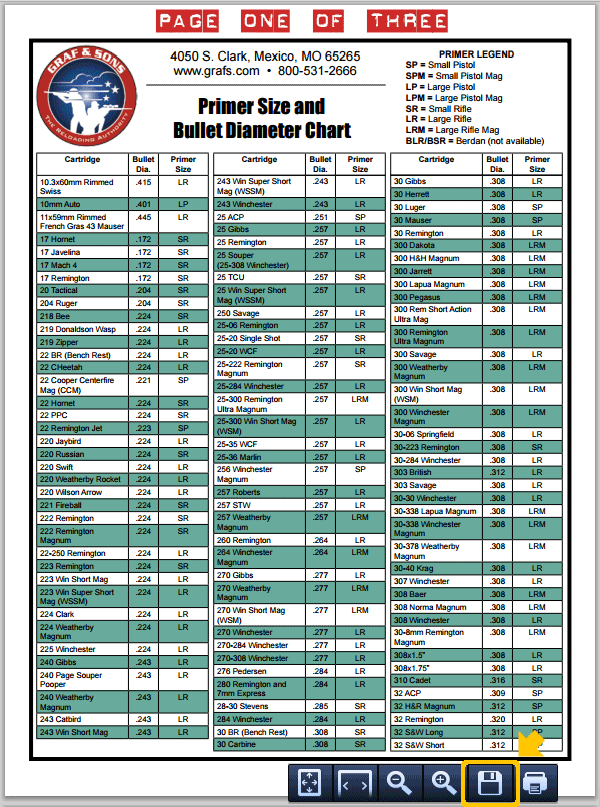
OK, guys, it’s time to practice your downloading skills. Here’s a very handy cartridge information sheet you will definitely want to save for future reference. Shown below is Page One of the Primer Size and Bullet Diameter Chart created by Graf & Sons. This chart shows the bullet diameter and primer size for more than 320 popular cartridges*. The full three-page chart is available in PDF format for easy printing.
NOTE: If you have the PDF reader installed in your browser, the Graf’s Chart may open in a new tab when you click on the image above. To save the three-page PDF file to your computer or device, click the Floppy Disc icon that appears in the lower right (after the PDF file opens). Here is the direct link:http://www.grafs.com/uploads/technical-resource-pdf-file/12.pdf.
Note: There are a few mistakes. If you are making 22 BR from Lapua brass, you’ll want a small rifle primer. Likewise with 25-20 WCF, you want a small primer.
Resource Tip from EdLongrange. We welcome reader submissions.
The Deep Creek Range near Missoula, Montana, is one of the best 1000-yard ranges in the country. Many long-range benchrest records have been set in this scenic, tree-lined facility. Now, thanks to Forum member David Gosnell (aka “Zilla”), you can see Deep Creek from the air. David attached a High-Def video camera to a quad-rotor drone. He then flew the drone over the Deep Creek Range, soaring from firing line to the target bay and back again. We think you’ll like this video. It gives you a “birds-eye view” of one of America’s elite ranges. Enjoy.
According to a new NSSF Industry Report, the total economic impact of the firearms and ammunition industry in the United States increased from $19.1 billion in 2008 to $42.9 billion in 2014, a 125% increase. Industry growth generated more jobs — a lot more jobs. In fact, the total number of “full-time equivalent” jobs rose from 166,000 to more than 263,000, a 58% increase in that period. “We have seen continued dramatic growth in the firearms and ammunition industry that is the direct result of consumer demand for our products since 2008,” said Stephen L. Sanetti, NSSF President and Chief Executive Officer. READ the Firearms and Ammunition Industry Economic Impact Report.
What cartridge would your chose to hit targets at long range … extremely long range, as in 2500 yards? Well, for ace competitive shooter Darrell Buell, the answer is the .338 Allen Magnum, a .408 Cheytac necked down to .338. This “super-sized” cartridge flings .338-caliber, 300-grain Berger Hybrid bullets at 3450 fps. That delivers some impressive ballistics at ultra-long range. Darrell got to “test-drive” a .338 Allen Magnum rifle at 2500 yards (1.42 miles) while teaching a Long-Range Seminar at the Legion Operator Training Group (OTG) Facility in Blakely, Georgia.* The rifle belonged to Christopher Sykes.
Shown below is the 338 Allen Magnum (AM) next to a .308 Winchester round loaded to an extremely long OAL. The .338 Allen Magnum is a wildcat based off the .408 Cheytac (Cheyenne Tactical) parent case. The cartridge’s inventor, Kirby Allen, states: “The .338 Allen Magnum, when loaded with a 300gr SMK, offers a legit 500 to 600 FPS velocity advantage over the 338 Lapua Magnum”.
Darrell says: “Yeah, it’s a beast [but] with that brake, it kicks less than my .308 competition rifle. It’s got more energy at 2500 yards than a .45 ACP has at the muzzle. The .338 Allen cartridges are standing next to the SEB Joy-pod, along with a standard .338 Lapua Magnum cartridge. With the excellent muzzle brake on the .338 Allen, I could spot my own hits with just the slightest twitch of the joystick. The rifle was not particularly heavy, consequently the pod would hold the crosshairs where you left them without a hand on the joystick.”
The $52.99 RCBS Precision MIC is a well-made and useful tool for measuring cartridge headspace and bullet seating depth. The Precision Mic measures from a datum point on the case shoulder to the base. Unfortunately the Precision MIC is not specifically made for the 6mmBR Norma, 22BR, 6XC or 6.5×47 Lapua cases. Don’t despair. Reader Caduceus devised a clever way to adapt a .308 Win Precision Mic for short cases that match the .308 Win in rim diameter and case body diameter. He simply creates a spacer out of a pistol cartridge. He trimmed a 9mm case to 0.511″ and “found this to be a perfect fit which gave a zero micrometer reading when the FL-sized 6BR case was placed in it.” We expect many readers already own a Precision Mic for their .308s. Now you can adapt this tool for the 6BR family of cartridges, for no extra cost. Cut the spacer shorter for the 6.5×47 Lapua and 6-6.5×47 cartridges.
How to Use the Precision Mic with a Spacer Caduceus explains: “I can use the .308 version of the RCBS Precision Mic to compare brass which has been fully sized in my 6BR body die with brass which has been fired in my chamber. With the spacer inserted, FL-resized cases mic 0.000″ at the datum point on the shoulder. Using the same set-up, fire-formed cases measure +0.005″. In other words, my chamber has a headspace of +0.005″ above minimum dimensions. This is fairly typical of a custom rifle set up for switch-barrel use. If I were to FL-resize my brass down to minimum spec each time, this excessive working would shorten its life-cycle and might lead to case head separation. Now that I know the headspace of the chamber, I can substitute the standard shell holder on my press with a Redding +0.004″ competition shell-holder. This ensures that my cases only receive 0.001″ of shoulder set-back.”
Click HERE for a full article explaining how to adapt an RCBS Precision Mic for use with a 6BR. You can do the same thing with a 6XC or 6.5×47 case–just cut the spacer to a shorter length (for an 0.000″ mic reading). Note: You can also use this procedure with an RCBS .243 Winchester Precision Mic.
Forum member Scott S. (Sunbuilder) has built a sweet long-range varminter based on the 6.5×47 Lapua cartridge necked down to 6mm and then improved to 40 degrees, with slightly less body taper. Scott tells us that “improving the case adds about 2.0 grains to the case capacity”. This allows Scott to run the 103-108gr bullets at well over 3100 fps, with no pressure issues. Scott calls his Improved case a “Long Dasher”, a name suggested by Dave Kiff of Pacific Tool & Gauge.
6-6.5×47 Improved Works Well with Many Powders
Scott’s 6-6.5×47 Lapua Improved varmint rifle features a Stiller Diamondback action, Lilja 30″ 8-twist barrel, Richard Franklin stock, and a NightForce 8-32×56 NXS. Scott has had excellent success — his two longest groundhog hits were at 778 and 810 yards. Scott has tested many powders with his 6-6.5×47 wildcat: “I tried several powders (H4350, N160, N560, H4831sc), and primers (CCI 450, BR4, Rem 7 1/2, Fed 205Ms). I got better velocity with H4350, but my barrel likes the N160. I did find a [high-speed] node with H4350. The increased velocity potential of this cartridge is partially due to the slightly increased case capacity. The load I am shooting now is 40.5gr N160, Berger 105gr Match BT, .010″ jam, CCI BR4, .002″ neck tension at 3115 fps. This has an ES under 15 fps, and it will group under 2″ at 500 yards if conditions hold. This ‘Long Dasher’ (6-6.5×47) seems to have a lot of potential (and that’s an understatement).”
A Better Mount for the Spotter and Rangefinder
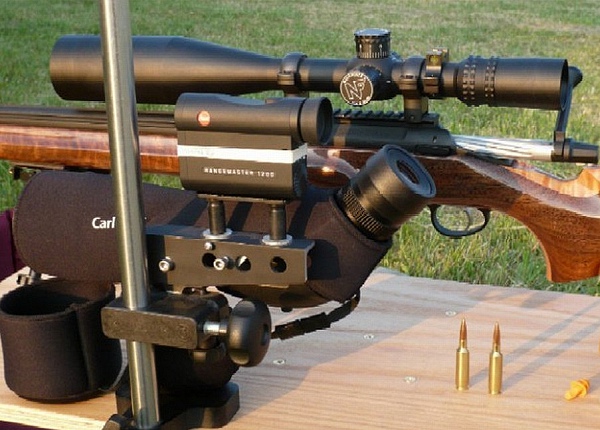
Scott designed and fabricated a very slick set-up to hold his Zeiss spotting scope and Leica CRF RangeFinder. He’s built a combo bracket that holds both units rock steady, with a parallel line of sight (same axis and elevation). Smart. Very smart. Scott explains: “I built a mount to connect my rangefinder to my spotting scope. The mount can be adjusted, so the spotting scope and rangefinder are both centered on the same object. The only way I have found to get repeatable long-range readings is to make them from a stable base.” Scott, we think you’ve got a winner here with your innovative and clever design.
Commentary by Mark Walker, Sierra Bullets Product Development Manager This story originally appeared in the Sierra Bullets Blog. Visit SierraBullets.com.
Some people love tuners and others hate them. I use them on my rifles and I’ve had more than one person ask me why on earth I would put one of those things on my barrel. I’ve even had a national long range champion tell me to unscrew it and throw it into Lake Erie on my next trip to the pits at Camp Perry. However, there are other shooters that swear by them and have many match wins to back it up.
It’s an indisputable fact that tuners do have an effect on a rifle’s accuracy, however how much is somewhat open for debate. The large heavy target barrels that we use for benchrest or f-class may not be affected as much by a tuner as a lighter weight sporter type barrel. Each barrel that I’ve installed a tuner on not only showed improvement in accuracy but also displayed a wider load window. The increased accuracy is because of the ability to adjust the tuner to the load, however I believe the wider load window is due to the added weight of the tuner slowing down the barrel vibrations. These are both very important aspects of having a very accurate rifle.
While better accuracy and a wider load window are two areas of improvement, I believe the most important feature of a tuner is the ability to adjust the tune during the middle of a match. This is especially important during matches where you must load all your ammo earlier and cannot make adjustments to the load during the match. If you happen to miss the load, instead of having to deal with a gun that isn’t shooting you can make an adjustment to the tuner and hopefully improve the accuracy of the rifle.
While I’ve laid out several ways that a tuner can help, there are also a few ways that tuners can cause problems. They add weight so if you are shooting a discipline that has weight limits on the rifle, you may not be able to install a tuner and still make weight. Sometimes, a barrel just doesn’t show improvement with a tuner installed. These are few and far between, but it is something to consider. If you make an adjustment to the tuner in a match, you need to make sure you move it in the right direction. Adjusting a tuner in the wrong direction can cause very large groups. And finally, if they aren’t tightened properly, tuners can come loose during firing which will cause a lot of problems as well.
As you can see, tuners have both positive and negative aspects. In my personal experience, the positives far outweigh the negatives so I will continue to use them on all of my competitive rifles. If you’ve been thinking about installing a tuner, hopefully some of the information that I’ve presented will help you make an informed decision.
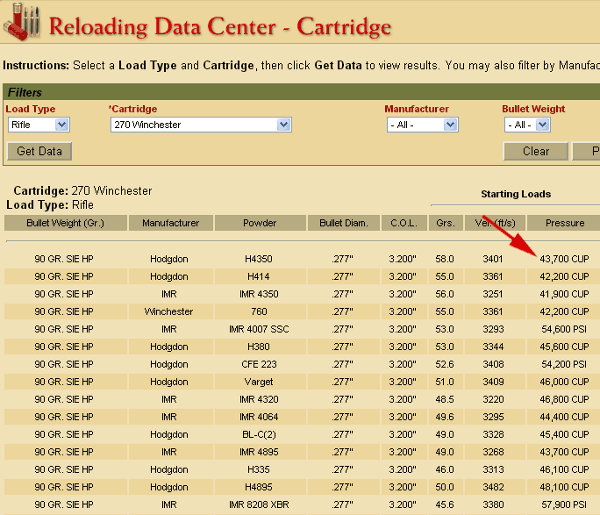
When you look at a loading manual with load data, you will usually see pressure ratings for stated load. Sometimes these are listed in PSI numbers, which most people correctly understand to be Pounds per Square Inch of pressure. However, powder-makers also commonly list pressure in CUP numbers. CUP stands for Copper Unit of Pressure. You may be asking — “What exactly is a CUP, and what is the origin of that unit of measurement?” You may also be wondering — “What’s the difference between CUP pressures and PSI pressures?” On Hodgdon’s Facebook Page, you’ll find answers to these questions.
Q: What is CUP?
A: Copper Unit of Pressure (CUP) is a measurement used in the ammunition industry to determine the chamber pressure created by a cartridge load. Originally, a precisely formed copper slug was placed in a fixture over the chamber. When the cartridge was fired, the amount of crushing measured on the slug allowed engineers to determine the pressure.
These days, modern electronic transducers provide faster, more accurate measurements of chamber pressures in pounds per square inch (PSI). CUP and PSI are measured to different scales and are NOT interchangeable.


 AccurateShooter.com Forum members often ask: “Is there a reasonably-priced ammo box that fits PPC and BR cases just right?” The answer is yes — check out the


 Caduceus explains: “I can use the .308 version of the RCBS Precision Mic to compare brass which has been fully sized in my 6BR body die with brass which has been fired in my chamber. With the spacer inserted, FL-resized cases mic 0.000″ at the datum point on the shoulder. Using the same set-up, fire-formed cases measure +0.005″. In other words, my chamber has a headspace of +0.005″ above minimum dimensions. This is fairly typical of a custom rifle set up for switch-barrel use. If I were to FL-resize my brass down to minimum spec each time, this excessive working would shorten its life-cycle and might lead to case head separation. Now that I know the headspace of the chamber, I can substitute the standard shell holder on my press with a Redding +0.004″ competition shell-holder. This ensures that my cases only receive 0.001″ of shoulder set-back.”



 When you look at a loading manual with load data, you will usually see pressure ratings for stated load. Sometimes these are listed in PSI numbers, which most people correctly understand to be Pounds per Square Inch of pressure. However, powder-makers also commonly list pressure in CUP numbers. CUP stands for Copper Unit of Pressure. You may be asking — “What exactly is a CUP, and what is the origin of that unit of measurement?” You may also be wondering — “What’s the difference between CUP pressures and PSI pressures?” On Hodgdon’s