Advancements in barrel technology in recent decades have been impressive. Today’s premium barrels deliver accuracy that could only have been dreamed-of decades ago. And now a new development promises to help barrel-makers craft the most uniform, consistent, and stable barrels ever.
What’s the new technology? You may be surprised. It’s not a surface treatment, or a cryogenic bath. The latest development in barrel manufacturing is Degaussing — the process of de-magnetizing metal objects. Degaussing is now used in many industries to uniform metallic products and to prevent unwanted interactions with magnetic fields. LEARN MORE.
Degaussing is the process of decreasing or eliminating a remnant magnetic field. It is named after the gauss, a unit of magnetism, which in turn was named after Carl Friedrich Gauss.
At the recent IWA show in Germany, Vallon GmbH, a German manufacturer of degaussing machines, told us that two major Wisconsin barrel-makers have purchased Vallon industrial degaussing units. The units sold to the American barrel-makers are similar to Vallon’s EMS unit show below. This can degauss (i.e. de-magnetize) 50 barrel blanks in one pass.
The Vallon degausser works by passing the barrel steel through a coil. Vallon explains: “The density of magnetic field lines is at its maximum in the coil centre, and is strongly decreasing towards the outside. If a ferromagnetic work piece (steel) is introduced into the coil, the field lines are concentrating and flooding the work piece. The conductivity of steel is up to 800 times higher than that of air. Degaussing is done during a continuous movement of the work piece, leading out of the coil. Decreasing field strength is achieved by a slow extraction from the coil.”
How Degaussing Improves Barrel Steel and Rifle Performance
So what does magnetism have to do with barrel performance? How can degaussing help make a barrel better? Vallon’s scientists tell us that degaussing has three major benefits. First, it aligns ferrous elements within the barrels, strengthening the steel at the molecular level from the inside out. Second, by reducing static surface charges, degaussing reduces chatter during drilling, which creates a straighter bore with a better surface finish. Lastly, there is evidence that degaussed barrels produce slightly more velocity. When a copper-clad bullet spins through a non-degaussed (magnetically-charged) barrel, this creates waste electrical energy. The energy expended reduces velocity very slightly. You can see this effect yourself if you spin a copper rod in the middle of a donut-shaped magnet. This creates an electrical charge.
Here a barrel is checked after degaussing with a Vallon EMS. The meter records a zero magnetic value, showing complete degaussing success.
Degaussing Will Add $50.00 to Barrel Cost
We know what you’re thinking: “All right, degaussing seems beneficial, but how much will this add to the cost of my new barrel?” Based on off-the-record conversations with two barrel-makers, we estimate that degaussing will add less than $50.00 to the cost of a new barrel blank. That’s a small price to pay for greater accuracy and barrel life.
Ask a Sailor — F-Class Champion and U.S. Navy Veteran Explains Degaussing
We asked reigning F-TR Champion James Crofts about barrel degaussing. A U.S. Navy veteran, he immediately understood the potential benefits of this process. “I served in nuclear submarines. Since before World War II, the U.S. Navy degaussed its subs and smaller warships. This had many benefits. Principally, it helped reduce the risk of triggering magnetic mines. But that wasn’t the only benefit — the degaussing process gave the steel greater resilience and longevity. And that’s why the Navy degaussed non-combat vessels as well. Will a degaussed barrel shoot better? Honestly I can’t say. But based on my Navy experience, I bet degaussed steel will be more uniform and will last longer. I’m glad somebody is trying this out on rifle barrels. Put me on the waiting list!”
The above photo show a U.S. nuclear submarine during a degaussing (also called “deperming”) session. This reduces the vessel’s electromagnetic signature, making it more stealthy. Deperming also adds to the vessel’s longevity. With steel-hulled ships, static electricity builds up as the hull slices through the water. A powerful, constant static charge will cause the steel to deteriorate. Degaussing (deperming) helps prevent this, extending the life of the hull.
These days, everything is “tactical”. Along with tactical rifles, there are tactical shoes, tactical lunch-boxes, tactical seat-covers, and yes, even tactical bacon. So we guess it’s no surprise that the tactical community now has it’s own pay-to-play talkline, 1-900-TAC-TALK, modeled after those “adult” chatlines where you pay by the minute for a little aural stimulation. With the new Operator Hotline you won’t hear sexy girls talk. Instead the “operators standing by” are, well, “operators” in the tactical sense. For just $3.99 per minute you can talk about tactics, weapons, and gear. On special request, the chat hosts will even work the actions of real weapons. The Operator Hotline claims that all comms are secure so you can reveal your “deepest, most secret tactical fantasies”.
Preview the Operator Hotline in this Video (No Charge)
The Operator Hotline is a pay-per-minute interactive phone service. For just $3.99 per minute you can “talk tactical” with real operators decked out in full tactical gear. Why anyone would want to do that is beyond us. But this new service has proven very popular with young American males.
Tactical Products — Why They Appeal to Men
Tom Clopin, a product designer for a major outdoor company, wasn’t surprised that a fantasy chat-line has been launched, given the fact that tactical products are sold to fulfill macho role-playing fantasies. The designer told us: “You have to understand something. Most products are sold on image not function. Tactical gear is no different. In fact this market is more about costume play and gear fetishism than it is about function or utility. Make something look sort-of milspec, put a bunch a useless loops on it and call it tactical, and it will sell. Selling Molle gear to wannabee operators is just like selling leather chaps to Harley-riding, wannabee land pirates.”
In February we announced that the firearms collection of famed gun writer Elmer Keith would be sold at auction. The Keith Estate auction, conducted March 11-16, drew interest from around the globe, and bidding was strong. When the dust settled, and all the individual lots were totaled, Keith’s remarkable collection sold to various bidders for $1,905,458!
High-priced highlights from the auction are shown below. NOTE: You can see more than 60 other Elmer Keith firearms, along with a list of final auction prices. The Guns & Ammo website has a detailed, illustrated report on the Elmer Keith auction with dozens of high-quality photos.
Lot 1038: Colonel Jim Corbett’s .450/.400 “Tiger Rifle” (Sold for $264,500.00)
Dangerous Game Rifles in Collection
The legendary “Corbett Tiger Rifle”, a Jeffery boxlock .450/400 was used by famed hunter Edward James “Jim” Corbett. This rifle was featured in Corbett’s book Man-Eaters of Kumaon. Two of the man-eating tigers Corbett hunted were believed to have killed over 800 humans in the Kumaon Hills of India.
Lot 1005: Colt SAA No. 5 .44 Special “The Last Word in Sixguns” (Sold for $80,500.00)
This famous revolver started as a Colt SAA, but then was heavily modified. The top strap of the frame was welded up into a flat-top target configuration, with an adjustable rear sight added. The hammer was modified with a Bisley-type target spur. The unique grip of the Number Five was created by marrying a modified Bisley backstrap to a Single Action Army trigger guard. His most famous pistol, Keith called this handgun “The last word in fine six-guns”.
Lot 1041: Westley Richards Droplock .476 NE (Sold for $69,000.00)
Used by Elmer Keith on safari in Tanzania, this was Keith’s preferred Elephant Rifle.
Lot 1020: Smith & Wesson Triple Lock Target Revolvers. (Sold for $39,100.00)
This rare set belonged to Gerrit Forbes and Ed McGivern before being acquired by Elmer Keith.
Photos courtesy of James D. Julia Auctioneers, Fairfield, Maine.
The Hickory Groundhog and Egg Shoot, the richest varmint shoot East of the Mississippi, is just days away. Now in its 35th year, the hugely popular Hickory Shoot will be held this upcoming Saturday, April 4, 2015 starting at 8:00 am. If you have any questions call Larry Willis of Bull’s Eye Sporting Goods, (704) 462-1948.
In years past over $7,000 worth of prizes and cash has been awarded. The normal course of fire is three sets of paper groundhog targets at 100, 300, and 500 yards, and NO Sighters. Shooters can also compete in an Egg Shoot for cash and other prizes. The basic entry fee is just $25.00 per gun. That’s cheap for a chance to win a bundle of cash, plus valuable prizes such as Shehane stocks and Nightforce optics. So get your best rifle, load up some ammo and head to the Hickory range located at 8216 Will Hudson Road, Lawndale NC 28090. The practice range will be open until 6:00 pm Tuesday-Thursday, but will close at 1:00 pm on Friday.
How to Get to the Hickory Shoot
Anatomy of a Hickory-Winning Rig — Brady’s Record-Setting 6BR
If you wonder what kind of rifle can win the big money at the Hickory Shoot, have a look at Terry Brady’s 42-lb 6BR. In 2010, Terry Brady won the Custom Class in the Hickory Shoot, setting an all-time record with a 99 score*. Terry was shooting a straight 6mmBR with 105gr Berger VLD bullets. His rifle looks “normal”, but it was actually purpose-built for Groundhog shoots, which have no weight limit in Custom Class. The fiberglass Shehane Tracker stock was stuffed with lead shot from stem to stern, so that the gun weighs nearly 42 pounds with optics. The Hickory winner, smithed by Mike Davis of Zionville, NC, featured a BAT DS action with a straight-contour, gain-twist Krieger barrel. The twist rate starts at 1:8.7″ and increases to 1:8.3″ at the muzzle. Terry was shooting a relatively moderate load of 30.5 grains Varget with Danzac-coated bullets. This load absolutely hammered, but Terry thinks the gun might shoot even better if the load was “hotted up a little.”
Minimal Recoil and Insane Accuracy at 500 yards
In the picture above you see the Hickory winner fitted with a 5″-wide front plate. This was crafted from aluminum by Gordy Gritters, and Terry said “it only adds a few ounces” to the gun. Mike Davis installed threaded anchors in the fore-end so the plate can be removed for events where forearm width is restricted to 3″. The plate is symmetrical, adding 1″ extra width on either side of the Shehane Tracker stock. Gordy can also craft a 5″ plate that offsets the rifle to one side or the other. Terry hasn’t experimented with an offset front bag-rider, but he thinks it might work well with a heavier-recoiling caliber. Terry actually shot most of the Hickory match without the front plate so he could use his regular 3″-wide front bag. Even with the plate removed, Terry’s Hickory-winning 6BR barely moves on the bags during recoil, according to Terry: “You just pull the trigger and with a little push you’re right back on target.” With this gun, Terry, his son Chris, Chris’s girlfriend Jessica, and Terry’s friend Ben Yarborough nailed an egg at 500 yards four times in a row. That’s impressive accuracy.
*The Hickory employs “worst-edge” scoring, meaning if you cut a scoring line you get the next lower score. One of Terry’s shots was right on the edge of the white and another was centered right between white and black at 3 o’clock. Accordingly he only received 27 points for each of the 300 and 500-yard stages. Under “best-edge” scoring, Terry would have scored even higher.
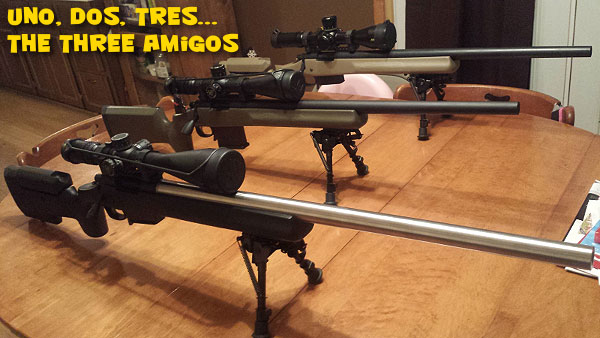
Jerod’s Tactical Trio
Many guys are lucky to have just one accurate tactical rifle fitted with a custom barrel and high-end optics. Well forum member Jerod (aka Stinnett1981) has three!
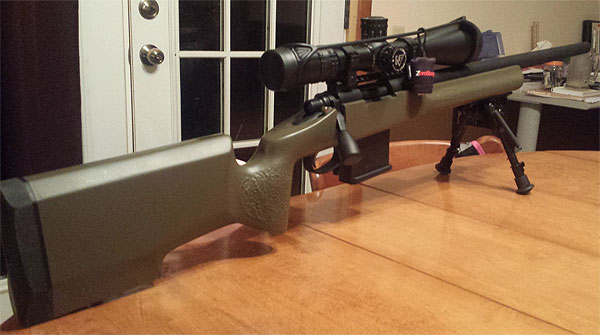
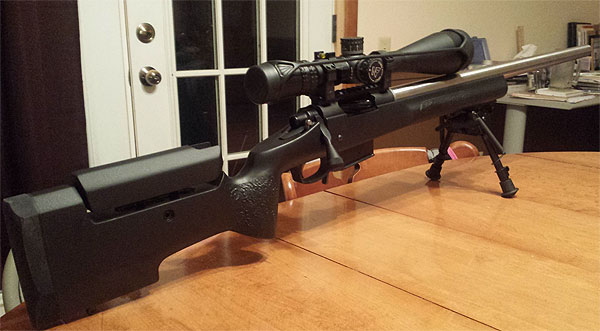
Jerod calls his tactical trio the “Three Amigos”. All are built with Manners Composite stocks and Bartlein barrels. But there are three different chamberings. In order below (from top to bottom) are: .308 Win (Bartlein 5R, 1:10″ twist); .223 Rem (Bartlein 5R, 1:8″ twist);,and 6.5×47 Lapua (Bartlein 5R 1:8.5″ twist). Read on for a full description of each build.
The tan rifle is Jerod’s .308 Winchester. It has a Manners T4A stock, trued Rem 700 SA, Badger M5 DBM, and Bartlein 5R 10-twist HV contour finished at 23″. The optic is a Bushnell XRS 4.5-30X50mm FFP with G2 reticle scope.
The Green rifle is a .223 Remington. This has a Manners T4 stock, trued Rem 700 SA, Badger M5 DBM, and Bartlein 5R 8-twist HV contour finished at 23″. On top is a Nightforce NXS F1 3.5-15X50mm FFP with MLR 2.0 reticle scope. Jerod says: “This scope and reticle are awesome.”
The Black rifle is chambered for the 6.5-47 Lapua. Components are: Manners T4A stock, Stiller TAC 30, Badger M5 DBM, Bartlein 5R 8.5-twist bull barrel (1″ at muzzle) finished at 26″. The scope is a Nightforce NXS 8-32X56mm with NP2DD reticle.
These days, a smartphone is an indispensable tool for a serious shooter. Smartphones can forecast the weather, direct you to the range, map your terrain, calculate your ballistics, photograph your targets, and even measure wind velocity (with a $35.00 plug-in impeller).
Having all those capabilities is great… until your battery goes flat. Even the most advanced smartphone on the planet is nothing but a useless paperweight when you run out of juice. Thankfully there’s an affordable fix for that problem — back-up Li-ion battery packs with built-in solar chargers.
There are a variety of external power-packs on the market, some with solar panels, some without. These will charge smartphones, tablets, PDAs, and other mobile devices. We like the units with solar chargers because they can recover a little energy when you’re outdoors. You still need to plug them in to get a full charge BEFORE before you head to the range. But once fully charged, these back-up battery devices can get your smartphone back in action and keep it running all day long.
We like the Poweradd portable chargers*. These feature lithium-ion batteries, solar panels, and tough weatherproof shells. We’ve tried two models, the 8000 mAh Apollo 3 ($29.99, dual-port), and the original 7200 mAh Apollo ($19.99, single port). We purchased the 7200 mAh Poweradd (Photo above) before its third-generation bigger brother was offered. The original 7200 mAh Apollo has served us well. It can fully charge most smartphones a couple times, or smaller tablets once. As long as you make sure the Poweradd is fully charged before you leave home (since the solar charger is slow and secondary), this unit does everything it claims. This editor’s first-generation Poweradd Apollo has done yeoman duty for many months now. It has revived both an iPhone and a tablet. If I were to purchase a Poweradd unit now, I would get the Apollo 3, mainly because it offers two (2) charging ports compared to one (1) on the original Apollo. That lets you charge two devices at once.
7200 mAh
8000 mAh
10000 mAh
23000 mAh
* If you need even more power, consider the Poweradd Pro. This 23000 mAh powerpack offers Multi-Voltage (5V 12V 16V 19V) output, and has enough juice to run a modern laptop. It comes with a complete set of jacks/cables so it can work with almost any device. This kind of capability doesn’t come cheap — the Poweradd Pro sells for $109.99, more than five times the cost of our 7200 mAh Apollo.
Report by Boyd Allen
This pistol belongs to Dan Lutke, a Bay Area benchrest shooter who publishes the results for the Visalia matches to the competitors and the NBRSA. He has been an enthusiastic competitor for an number of years, at various ranges, notably Visalia and Sacramento. The action is a Remington XP-100, to which a Kelbly 2 oz. trigger has been fitted. On top is an old Japanese-made Tasco 36X scope (these were actually pretty darn good). The Hart barrel (a cast-off from Dan’s Unlimited rail gun) was shortened and re-chambered for the 6x45mm, a wildcat made by necking-up the .223 Remington parent case. The custom stock/chassis was CNC-machined by Joe Updike from 6061 Billet Aluminum to fit the XP-100 action and mount a target-style AR grip with bottom hand rest. The gun was bedded and assembled by Mel Iwatsubu. In his XP-100 pistol, Dan shoots 65gr custom boat-tails with Benchmark powder.
TEN Shots in 0.303″ (0.289 MOA) at 100 Yards
How does Dan’s XP-100 pistol shoot? Look at that target showing TEN shots at 100 yards, with eight (8) shots in the main cluster at the top. The ten-shot group measures .303″ (0.289 MOA), as calculated with OnTarget Software. Not bad for a handgun! What do you think, can your best-shooting rifle match the 10-shot accuracy of this XP-100 pistol?
This diagram shows the most common 6x45mm wildcat, which is a necked-up version of the .223 Remington parent cartridge. NOTE: The dimensions for Dan Lutke’s benchrest version of this cartridge may be slightly different.
ACAD drawing by Peter Gnanapragasam CC by SA 3.0, via Wikimedia Commons. Title Added.
Story tip from Boyd Allen. We welcome reader submissions.
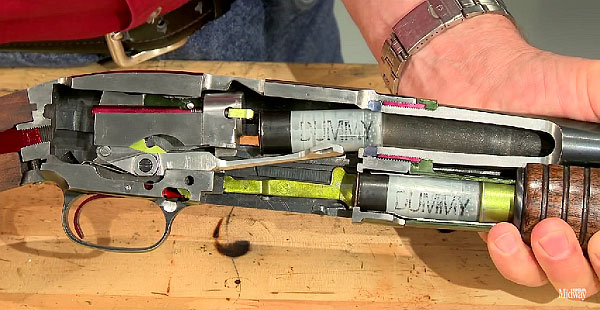
Even wonder how a pump shotgun works? Then watch this fascinating video from MidwayUSA. The operation of a pump-action shotgun is illustrated with a special cut-away version of a Winchester Model 12. The shotgun has been modified to reveal the inner workings. This cut-away Model 12 still loads and ejects dummy shells, but you can see how the lugs, slides, locks, ramps, springs and other internal parts work. You’ll be amazed how complicated this old pump-gun is. (The Model 12, Winchester’s first hammerless shotgun, is one of the most popular scatterguns ever made. Over 2,000,000 were sold.)
Skip Ahead to 3:00 to See Cut-Away in Action
To see how the Model 12 works, you can skip forward to the 3:00 minute mark in the video. The first part of the video shows how the Model 12 was “sliced and diced” to expose the inner workings. Larry Potterfield of MidwayUSA explains that “the factories often used cut-aways as sales tools to show how a specific model operated”. In addition the U.S. Military used cut-aways for training purposes.
Here is the cut-away completed. Even the pump grip has been sliced to reveal the inner workings.
Here’s a close-up, showing how the bolt retracts to eject a round.
A round has been picked up from the feed tube, and then is lifted into the chamber.
Here’s a chance to save $50-$80 on a Nikon scope. These optics will work fine for a hunter or varminter. Now through April 26, 2015, shooters can save up to $80 on select Nikon PROSTAFF 7 and MONARCH 3 long-range riflescope models. PROSTAFF 7 series scopes feature a 30mm main body tube and ample elevation adjustment range. Both PROSTAFF 7 and MONARCH 3 product lines offer multi-coated lenses, a 4x zoom ratio, and spring-loaded instant zero-reset turrets. These Nikon optics are covered by Nikon’s No-Fault Policy and Limited Lifetime Warranty. CLICK for Rebate info.
To learn more about Nikon’s Long Range Precision promotion for PROSTAFF and MONARCH optics, visit www.nikonpromo.com.
In most parts of the country it’s still too early for a prairie dog safari. Spring has barely sprung, and the critters haven’t come out to play. If you are missing the fun of a prairie dog hunt, here’s an arcade-type shooting game that lets you blast the critters to your heart’s content. Just use your mouse to move the crosshair and click to shoot. A hit on a can is worth one point, a hit on a prairie dog is worth two.
Hint: Try re-centering the crosshair after each shot — that way you never have to move more than halfway across the screen when the p-dog pops up. Go to it and have fun!
WARNING: LOUD AUDIO with SHOOTING NOISES!! If you click on this link, a page will load and very loud audio starts running automatically. If you are at work, turn down your speakers!
NOTE: When the new page loads, if you click “Play Game” the loud talking will stop.


 Ask a Sailor — F-Class Champion and
 These days, everything is “tactical”. Along with tactical rifles, there are tactical shoes, tactical lunch-boxes,


 Jerod’s Tactical Trio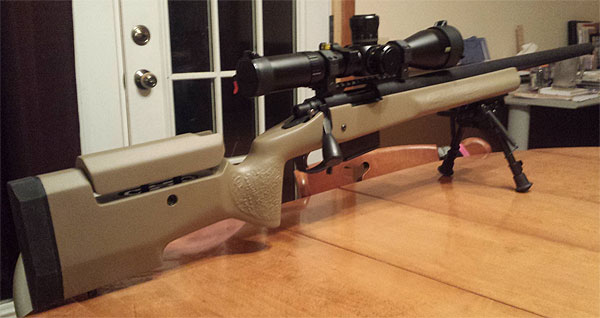
 These days, a smartphone is an indispensable tool for a serious shooter. Smartphones can forecast the weather, direct you to the range, map your terrain, calculate your ballistics, photograph your targets, and even measure wind velocity (with a



 In most parts of the country it’s still too early for a prairie dog safari. Spring has barely sprung, and the critters haven’t come out to play. If you are missing the fun of a prairie dog hunt, here’s an arcade-type shooting game that lets you blast the critters to your heart’s content. Just use your mouse to move the crosshair and click to shoot. A hit on a can is worth one point, a hit on a prairie dog is worth two.


