The National Shooting Sports Foundation is pleased to announce that registration is now open for its 2016 Fall Shooting Sports Fantasy Camps in Tulsa, Oklahoma. There will be two (2) sessions this October, each with 33 spots available.
Watch Highlights from the First-Ever Shooting Sports Fantasy Camp in Las Vegas:
The NSSF 2016 Fall Shooting Sports Fantasy Camp will take place at the world class United States Shooting Academy in Tulsa, Oklahoma. Two date options will be offered:
NSSF has lined up seven of our country’s top professional shooters for this premier event, including the first family of shooting, Jerry and Kay Miculek and Lena Miculek-Afentul, world class professional shooter, Bruce Piatt, 3-Gun pro couple Dianna and Ryan Muller, and Top Shot Season 4 winner Chris Cheng.
In addition to learning from today’s best shots, you’ll also be provided all meals, hotel accommodations, a swag bag full of premium shooting gear and more! You will need to provide your own travel arrangements and the camp registration fee of $3,495.
Camp Placements Will Sell Out Soon
If you are interestested, we recommend that you register soon — don’t delay. NSSF’s first Fantasy Camp (held this past spring in Las Vegas) sold out immediately. There are only 33 slots available for each date choice. For more information visit www.shootingsportsfantasycamp.com.
Readers who have just recently discovered the Daily Bulletin may not realize that AccurateShooter.com has hundreds of reference articles in our archives. These authoritative articles are divided into mutiple categories, so you can easily view stories by topic (such as competition, tactical, rimfire, optics, shooting skills etc.). One of the most popular categories is our Technical Articles Collection. On a handy index page (with thumbnails for every story), you’ll find over 120 articles covering technical and gunsmithing topics. These articles can help you with major projects (such as stock painting), and they can also help you build more accurate ammo. Here are five popular selections from our Technical Articles archive.
Stress-Free Pillar Bedding. Richard Franklin explains how to do a top-quality bedding job, start to finish.
OnTarget Software Review. Our Editors test free software that measures shot groups with great precision. We explain how to use the program and configure advanced features.
Savage Action Tuning. Top F-TR shooter Stan Pate explains how to enhance the performance of your Savage rifle by optimizing the torque settings of the action screws.
Complete Precision Case Prep. Jake Gottfredson covers the complete case prep process, including brass weight sorting, case trimming, primer pocket uniforming, neck-sizing, and, case-neck turning.
Stock Painting Instructions. Step-by-step guide for stock painting by expert Mike Ricklefs. Mike shows both simple coverage and fancy effects.
Jewell triggers are still the most-used triggers on competition benchrest and F-Class rifles and they are also popular for hunting, varmint, and tactical rifles (with or without safeties). While a Jewell trigger can work for years with minimal maintenance, if the trigger becomes gunked up, it may be necessary to disassemble the trigger for a thorough cleaning. Our friends Ed and Steve, aka the 6.5 Guys, have produced a helpful video that shows how to disassemble and then reassemble a Jewell trigger.
Why You May Need to Disassemble Your Jewell Trigger — the 6.5 Guys
Jewell triggers are a popular choice in the sport of long range precision shooting, and like everything else require regular cleaning and maintenance. In most cases they can be cleaned with charcoal lighter fluid or dropped into an ultrasonic cleaner. Should the situation require, they can be completely disassembled according to the Jewell Trigger Manual.
We ran into a situation where we had to dissemble a trigger due to the entrapment of some sticky dirt that couldn’t be removed with an ultrasonic cleaner. Our first step was to find some step-by-step instructions but we couldn’t find anything.
Recognizing that other shooters might be in the same situation we produced a step-by-step guide and video, published in full on 65Guys.com. These instructions will work with a left- or right-handed trigger. In our case we worked with a left-handed BR model trigger with safety and bolt release.
Step-by-Step Instructions are provided on 65Guys.com website. We recommend you read all the instructions carefully before you even think about disassembling your trigger. This video explains the process so you can get a sense of what is involved.
If you have a 6.5 Grendel rifle and recently purchased ammunition from Prvi Partizan (PPU), do NOT LOAD or shoot this ammunition. PPU, the manufacturer, is recalling ALL of its 6.5 Grendel ammunition.
This recall applies to ALL PPU-made 6.5 Grendel ammunition.
DO NOT USE OR SELL THE FOLLOWING PRODUCTS:
PRVI 6.5 Grendel Ammunition Box
PP6.30 6.5 Grendel FMJBT 110-grain
PP6.31 6.5 Grendel HPBT 120-grain
According to PPU: “Because of different chamber sizes in certain rifles, 6.5 Grendel cartridges may be subjected to excessive chamber pressure. Use of these products may result in firearm damage and possible serious personal injury.”
If you have any 6.5 Grendel ammunition or brass manufactured by PPU, please email info@ppu-usa.com or call (203) 375-8544 to arrange for its return and replacement.
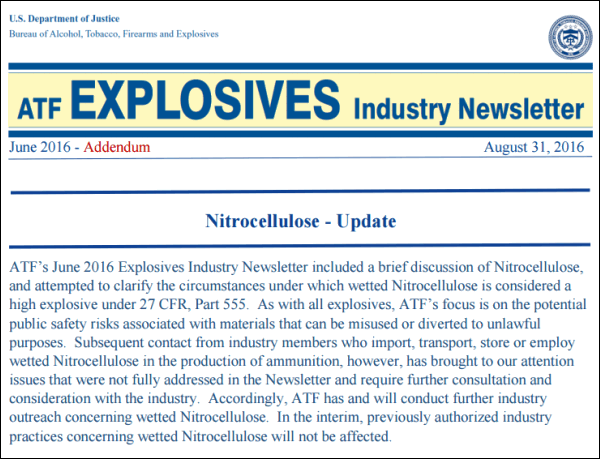
There has been a hue and cry on some internet sites about changes in smokeless powder classifications by the Federal Bureau of Alcohol, Tobacco, Firearms and Explosives (ATF). Writers have been concerned that recent interpretations by the ATF would make it much more difficult to store and transport reloading powders, which in turn could lead to price increases and/or powder shortages. Concern arose over the potential re-classification of “wetted” Nitrocellulose as a “high explosive”. Since “high explosives” are subject to more stringent rules, such re-classification would alter the way common smokeless propellants could be lawfully stored and transported.
Thankfully, there is good news. On August 31st the ATF issued an Addendum to its June 16 ATF Explosives Industry Newsletter saying that its policies regarding smokeless powders containing Nitrocellulose will not change… at least for now:
Based on this “Addendum”, it seems the ATF has tabled its proposal to classify Nitrocellulose-based smokeless powders as “high explosives”.
The NRA Institute for Legislative Action (NRA ILA) confirms that the ATF has backed off, so that current practices for powder storage and transport can continue unchanged. Thus hand-loaders should NOT face an impending powder shortage and/or price hikes. Here is the NRA ILA’s report:
ATF Delays Any Changes to Nitrocellulose Regulation
Earlier this summer, ATF released an Explosives Industry Newsletter that changed the agency’s treatment of nitrocellulose, the primary component in smokeless powders used in modern ammunition. This change had the potential to seriously disrupt ammunition supply in the United States because it changed a long-standing ATF policy that exempted properly “wetted” nitrocellulose from treatment as an explosive under federal law.
NRA and [shooting industry representatives] raised these concerns to ATF and any change in ATF’s treatment of nitrocellulose is now officially delayed. In an addendum to the earlier newsletter, ATF announced that it “will conduct further industry outreach concerning wetted Nitrocellulose. In the interim, previously authorized industry practices concerning wetted Nitrocellulose will NOT be affected.”
While the addendum doesn’t indicate that ATF has permanently abandoned this change to nitrocellulose regulation, smokeless powder manufacturers will be permitted to continue normal operation, at least for the time being. NRA will continue to work to ensure that any future change to nitrocellulose regulation will not affect ammunition supply.
ATF Industry Newsletter Caused Concern
The cause for firearms industry concern was the ATF’s statement about Nitrocellulose published in the June 2016 ATF Explosives Industry Newsletter. The key language is shown in the right column below. According to the NRA ILA, the ATF has, at least for the time being, decided NOT to change its policies regarding the storage and transport of “wetted” Nitrocellulose. Accordingly, “smokeless powder manufacturers will be permitted to continue normal operation”.
The 2016 World Speed Shooting Championships (WSSC) were held August 25-27 at the Hogue Action Pistol Range in San Luis Obispo, California. This prestigious U.S. Practical Shooting Association (USPSA) match attracted 125 competitors from around the world, who competed in eight precisely-configured Steel Challenge stages. At the WSSC, it’s all about speed — getting hits on steel in the shortest possible time. And no one on the planet is better at that than Max Michel Jr., King of the Steel Challenge.
This year, Max Michel captured another World Championship title, finishing 0.85 seconds ahead of second place K.C. Eusebio, with B.J. Norris placing third. This was Max’s fourth straight WSSC title and his seventh overall. We’d call that dominance. At this year’s competition, Max logged a best-ever overall score of 74.84, while setting a new world record on the final stage (Outer Limits). Max now owns the overall course world record and seven (of eight) stage world records.
Not to be outdone by Max, Taurus® Team Captain Jessie Duff took her sixth consecutive Ladies Open WSSC Title, and Duff won the Overall Single Stack World Speed Shooting Championship as well. As in years past, Jessie dominated the Women’s Division, but she was most proud of her Single Stack Overall Victory: “To win an overall championship title has been a dream of mine since I started shooting, something I’ve spent all my time working towards. I couldn’t be more proud to win the overall Single Stack title with my Taurus, allowing them to share in this victory with me!”
With a 30-year heritage, the WSSC Steel Challenge Match draws the world’s top speed shooters — both men and women. The three-day match is unique in that competitors shoot different guns each day: Rimfire on Thursday, Iron Sights on Friday, and the full-boogie Open guns on Saturday. The stages are precisely set up with exact Steel Challenge target spacing and distances. That creates an equal playing field at all WSSC events so stage record times can be set at any WSSC venue.
Can a budget-priced Savage shoot like a Sako TRG 22? Well, adding a custom “pre-fit” barrel and a state-of-the-art chassis system can transform a “Plain Jane” Savage into a serious tactical rifle. And now Kinetic Research Group (KRG) offers a new fully-adjustable chassis that’s just the ticket for a Savage tactical conversion. Just get a used Savage action, spin on a Criterion, Pac-Nor, or Shilen pre-fit barrel, and add the new 180-Alpha Chassis from KRG.
KRG offers 180-Alpha Chassis for Savage rifles. This fully-adjustable, light-weight (3.5 lbs) chassis fits Savage short action rifles with 4.4″ action bolt spacing. The 180-Alpha features tool-less cheek-piece height adjustment, spacer Length-of-Pull (LOP) adjustment, buttpad height adjustment, and plenty of accessory mounting positions. Suggested retail price for the 180-Alpha starts at $768.00 for the side bolt-release version. A bottom-release model is slightly more.
Compare KRG’s 180-Alpha Chassis to the hardware on the real deal — a Sako TRG 22 with adjustable, folding stock (model JRSM416, shown below). This SAKO TRG22 rifle in .308 Winchester retails for $5,198.00. With KRG’s 180-Alpha chassis you can put together an ergonomically-similar tactical rifle for thousands less.
Using the KRG Chassis, a take-off Savage action, and a premium pre-fit barrel, you can build a similar system for around $1540.00. Here’s how we get that figure: $370.00 for Criterion pre-fit barrel, $400.00 for action (YMMV), and $768.00 for stock (Total $1538.00).
KRG produces other adjustable, modular chassis systems for bolt-action rifles. KRG’s popular Whiskey 3 Chassis system fits the Tikka T3, Remington® 700™, Sako M995, Badger M2008, and 700 Long Action. The KRG X-RAY Chassis fits the Rem 700 Short Action, and Tikka T3, and the 180 X-RAY fits the CZ-455, Howa 1500, and Weatherby Vanguard platforms.
Product Tip by EdLongrange. We welcome reader submissions.
Ruger has created a series of videos showcasing competitive shooting competitions including: Rimfire Challenge, Metallic Silhouette, Biathlon, IDPA, SCSA (Steel Challenge), USPSA, and Cowboy Action shooting events. Log on to Ruger’s Beginner’s Guide to Shooting Competitions webpage to see informative videos for these sports. Rimfire Competition is affordable and fun, Silhouette is a great family sport, and the Steel Challenge is the ultimate pistol speed-shooting event.
INTRO to RUGER RIMFIRE CHALLENGE Matches
INTRO to STEEL CHALLENGE Pistol Competition
Ruger also offers many other cool videos, both on its Video Webpage and on Ruger’s YouTube Channel. On YouTube, you’ll find a great four-part Tactical Carbine video series, hosted by Dave Spaulding, winner of the 2010 Trainer of the Year award by Law Officer Magazine. There are also a number of videos featuring the Ruger Precision Rifle (RPR) a popular (and affordable) rig for Tactical/Practical shooting competitions. The video below explains the RPR’s adjustments:
Cabela’s is running a very attractive promotion right now. You can save 10% off nearly everything on the Cabelas.com website, except firearms. To sweeten the deal even more, Cabela’s is offering free ground shipping on most items, for orders totaling $99.00 or more. Act quickly guys, this Cabelas.com offer expires Monday, 9/5/2016, at 11:59 pm Eastern Time. To get the 10% Off all sale items, use Discount Code 6TENOFF during checkout. NOTE: This Labor Day Special applies to most goods including Ammunition, but not firearms. This is an online special only, not valid at Cabela’s retail stores. Some heavy or oversized items will require paid shipping and handling. CLICK HERE for INFO.
Here is the fine print:
– Offer not valid at Cabela’s retail stores.
– All oversized and additional fees still apply.
– Additional items will require paid shipping and handling.
– Standard U.S.A. shipping and handling only (U.S. deliverable addresses).
– Offer cannot be used on prior purchases or in combination with any offer or rebate.
Emil Kovan is one of the top F-Class shooters in the world. He won the 2014 United States F-Open Championship. Earlier this month Emil finished second in F-Open Division at the 2016 Canadian National F-Class Championship in Ontario. Emil actually tied Open-class winner Shiraz Balolia for overall score AND “V”-count, but Emil was awarded second on the tie-breaker.
“What are the best components for an F-Open class rifle, and why?” That’s a question that I get asked all the time and will try to answer in this article. Two months ago, I was contacted by Duane, a gentleman I met at the 2015 F-Class Nationals. He was interested in building a rifle with the new Master Class Low Profile F-Open Stock, created by Carl Bernosky and Alex Sitman of Master Class Stocks.
I have known Alex Sitman for many years, and use his stocks exclusively, but was not very familiar with his new Low Profile F-Open stock. After a brief conversation with Alex, I placed an order, and had the stock inletted and bedded at my shop in a month. My first impression was “Wow that’s a long stock” — the forearm is significantly longer than on the original Master Class F-Class prone stock. I bolted the barreled action in, and squeezed the end of the forearm and barrel together, the stock flexed a little bit, but not as much as other designs that I have tested. I think that’s due to having “more meat” in the receiver area. The full stock depth continues farther forward that on some other “low profile” designs. That makes the stock stiffer in the vertical plane, reducing the hinging effect forward of the action. The stock was finished in gloss black per the customer’s request. Interestingly, I found that the multiple layers of paint and clearcoat stiffened the stock up quite a bit.
CLICK IMAGE below for full-screen version
Low Center of Gravity Tames Torque
Compared to the original Master Class F-Open stock, the barrel sits about an inch lower. Lower center of gravity equals less torque, and that is very important when shooting heavy bullets in fast twist barrels. Another significant improvement is that the toe of the stock is flat and parallel to the forearm. I added a 3/4″ track rail in the rear, and milled the underside of the fore-end to create two parallel “rails” in the front to help the stock track better.
One of the biggest reasons why I like Master Class stocks, is the pistol grip. I don’t shoot “free recoil” and a comfortable pistol grip is super important to me when selecting a stock. The new Master Class Low Profile stock shares the same grip as the old model. This allows the stock to accommodate either a “hard hold” style or a more free-recoil style of shooting — whatever the rifle’s owner prefers. This design versatility is one reason I recommend Master Class stocks. Shooters may experiment with either shooting style to find what suits them best.
Cartridge Choice — A 40° .284 Win Improved
Duane decided to have the barrel chambered for my 284 KMR IMP (Improved) wildcat. What is .284 KMR IMP and why choose it over the straight .284 Winchester? Improved by definition means “made better”, I took a great cartridge, and modified it to increase capacity, reduce pressure, and increase brass life.
There are many “improved” variants of the original .284 Winchester: 7mm Walker, .284 Shehane, .284 Ackley and so on. My version, the 284 KMR IMP, shares the .010″ blown-out sidewalls of the .284 Shehane, but I have further increased the case capacity by changing the shoulder angle from 35 to 40 degrees. The 284 KMR IMP allows you to almost match magnum cartridge velocity in a standard-bolt-face action. If you want to run 180gr-class 7mm bullets over 2900 FPS, it is cheaper and more convenient to have a barrel chambered in 284 KMR IMP than to spend $650 for a magnum bolt.
Tuning Loads for the .284 Win Improved Cartridges
The 284 KMR IMP seems to have two nodes, one around 2820 fps and other at 2940 fps. My match load clocks at 2935 fps with single-digit ES. Note –I selected that load based on accuracy, NOT raw speed. A lot of novice (or hard-headed) shooters make the mistake to push their cartridges to the max, and disregard more accurate loads at lower velocity.
The sport of F-Class is rapidly growing, and the equipment used is improving constantly. I remember that only few years ago, an F-Open rifle that could shoot sub-one-inch of vertical at 300 yards was considered competitive. Now, we are pursuing sub-one-inch vertical at 600 yards! It takes a great rifle to approach that goal, but it is also up to the shooter to learn and experiment as much as possible in order to achieve success.
Dies for an Improved .284 Win Cartridge
One of the biggest challenges in campaigning a wildcat cartridge has been obtaining great dies. When searching for custom dies, it almost seems like that the odds are stacked against us. The most common problem is wait-time — custom die orders can take months to be completed. Also, most custom die makers want you to send them two or three cases, each fire-formed three times. I find that funny because if could somehow properly size the cases for three fire-forming cycles, I would not need a sizing die.
Custom-made dies should size the case just right, but sometimes the die’s internal dimensions are slightly off, and this leads to problem number two: dies sizing too much (or even worse) too little. I had a one “custom” die that would not size the bottom of the case enough. This made the extraction of fired cases very difficult. I feel that the best option (if available) for shooters interested in wildcat chambers is to have their gunsmiths make the dies. I offer that die-making service in addition to barrel chambering.
BAT Machine “M” Action
Duane decided to use a BAT M action for this rifle, and I think that he could not have made a better choice. We are blessed with many good match-quality receivers: Barnard, BAT, Borden, Kelbly, Nesika, and Stiller just to mention a few. These are all very well-made and suitable for F-Class. Among BAT Machine Co.actions, I like BAT models M, MB, and 3LL best. I prefer these because because of their size (large bedding footprint) smoothness, timing, options available, and last but not least visual appearance.
Trigger: I recommend and use Jewell triggers. Other good options are: Kelbly, CG Jackson (good 2-Stage) Anschutz (best 2-Stage for Bat and Kelbly actions), Bix’N Andy, and David Tubb.
Barrel: Duane made another good choice here. He decided to go with a Brux 1:8.5″-twist, 4-groove cut-rifled barrel. If you look at the F-Class and Long Range benchrest equipment lists, you will see that cut-rifled barrels are currently dominating. Many records have been shot with both button-rifled, and cut-rifled barrels. I have shot both, and prefer cut-rifled barrels. I am not saying that button-rifled barrels are not capable of shooting as well as cut-rifled barrels, but on average, in my experience, four out of five cut-rifled barrels (from top makers) will shoot well, vs. three out of five buttoned barrels. YMMV, but this is what I’ve observed.
Scope: Duane’s rifle was fitted with a Nightforce 15-55x52mm Competition scope with DDR-2 reticle. This optic is ultra clear, reasonably lightweight (28 oz.), super reliable, and has 1/8 MOA clicks — what you want for long range F-Class competition. In this 15-55X NF model, I like the DDR-2 reticle best, because fine cross hairs (FCH) are hard to see in heavy mirage. The DDR-2 has a heavier horizontal line, with a center dot. March scopes are also very popular and very well-made.
Thanks for reading, and keep ‘em in the middle…
Emil Kovan Competition History:
– 2014 F-Class Open National Champion
– 2016 F-Class Open Canadian Championship, Silver Medal (tied for first on score)
– 2015 F-Class Open National Championship, Silver Medal
– F-Class Open National Championship Teams, 2015, 2014, 2013, Shooting Team Member
– Over 15 wins in Regional and State Championships in Palma, F-TR, F-Open


 The NSSF 2016 Fall Shooting Sports Fantasy Camp will take place at the world class United States Shooting Academy in Tulsa, Oklahoma. Two date options will be offered:




 Emil Kovan Competition History:


