Editor: The following statement was released by Leupold & Stevens Inc. on August 3, 2016. We publish the statement as it was released, without modification.
Leupold® Files Lawsuit Against Nightforce Over Patent Violations
Leupold & Stevens, Inc., has filed a civil suit in the U.S. District Court of Oregon alleging patent violations by Lightforce U.S.A., doing business as Nightforce. In the suit, Leupold & Stevens, Inc., alleges that Nightforce is marketing and selling products that infringe on a variety of patents owned by Leupold & Stevens, Inc. and is seeking all available remedies.
The lawsuit is based on six patents for riflescope adjustments, internal optical mechanisms, and flip covers.
Leupold & Stevens, Inc., has been pioneering riflescope and sporting optics technology since 1947, when it developed a non-fogging riflescope charged with nitrogen. Today, Leupold® has been granted over 151 patents and design registrations in 18 countries, representing Leupold’s continued commitment to innovation and development of sports optics. For more information on Leupold products, please visit us at www.leupold.com.
Leupold & Stevens, Inc. is committed to protecting its intellectual property and the innovations developed by its engineering and design teams.
Founded in Oregon more than a century ago, Leupold & Stevens, Inc. is a fifth generation, family owned company that designs, machines and assembles its riflescopes, mounting systems and tactical/Gold Ring® spotting scopes in the USA. The product lines include rifle, handgun and spotting scopes; binoculars; rangefinders; mounting systems; and optical tools, accessories and Pro Gear.
Initial Response from Nightforce Optics
We contacted Nightforce Optics regarding the legal action commenced by Leupold. A spokesman for Nightforce provided this response: “We have investigated [Leupold’s] claims and we are confident there is no infringement. We look forward to full and fair competition with Leupold in the future.”
We first ran this story a few years back. But it’s still a very interesting subject for benchrest shooters. Shown above, the 30 BR (a 6mmBR necked up to .30 Caliber) currently rules the benchrest-for-score game. However, a 30 BR Improved offers some potential advantages, particularly when the winds are strong or tricky. In this article Al Nyhus explains his 30 BRX wildcat. Running Hodgdon H4198, Al says he gets an easy 150 -200 FPS more than the conventional 30 BR. That can translate to less drift in the wind. It also lets you pursue a higher speed node, which can lead to improved accuracy with some barrels.
Forum member Al Nyhus is a top-level score shooter who has competed successfully with the 30 BR cartridge in VFS (Varmint for Score) matches. Al has been working on an “improved” 30 BR cartridge that delivers extra velocity. Al’s 30 BRX cartridge is inspired by the 6mm BRX cartridge, popular in 600-yard benchrest and across-the-course competition. The 6mm BRX cartridge maintains the same sidewall profile and shoulder angle as the parent 6mmBR case. Likewise, the 30 BRX retains the 30° shoulder used on the popular 30 BR cartridge.
Al reports: “Thought you might like to see what I’ll be working with in my VFS gun this season. It’s a true 30 BRX — a 30 BR with the shoulder moved forward 0.100″ with the standard BR shoulder angle. Stan Ware of SGR Custom Rifles built one last season for Steve Grosvenor and I was really impressed by the performance of Steve’s gun. The 30 BR barrel on my VFS gun needed replacing, so the new 30 BRX got the nod.”
30 BRX Delivers 150-200 FPS More Velocity than 30 BR
Al says his 30 BRX gives a solid 150-200 fps speed gain over the 30 BR at the top, while needing just 2.5-3.0 more grains of Hodgdon H4198 to do so. A 30 BR case holds on average 40.8 grains of water, while the 30 BRX holds 42.3 grains (roughly 4% more). So the 30 BRX delivers a 7% increase in velocity with a mere 4% increase in H20 capacity. That’s pretty good efficiency. [Editor’s Note: Assuming 34 grains of H4198 is a typical 30 BR match load, Al’s increase of 2.5-3.0 grains for the 30 BRX represents roughly a 7.5-8.5% increase in actual powder burned. That explains the higher velocities.]
Why did Nyhus decide to try an “improved” 30 BR?
Al explains: “The 30 BRX was created to operate at a [higher] velocity level than can be achieved with the standard 30 BR case, while at the same time keeping the easy-tuning characteristics of the standard 30 BR case. We also wanted to use the same powders currently used with the 30 BR and maintain similar operating pressures.” Is the 30BRX harder to shoot because of the increased velocity? Al doesn’t think so: “In a 13.5-lb HV gun, the 30 BRX case is a pleasure to shoot with just a flea bite of recoil.”
Will the 30 BRX Replace the 30 BR in Score Competition?
The 30 BR is already an exceptionally accurate cartridge that dominates short-range Benchrest for Score competition. Will the 30 BRX make the standard 30 BR obsolete? Nyhus doesn’t think so. However, Al believes the 30 BRX offers a small but important edge in some situations: “On any given day, it’s the shooter that hits the flags best and makes the fewest mistakes that ends up on top. No amount of velocity will save you when you press the trigger at the wrong time. Missing a switch or angle change at 200 yards that results in 3/4″ of bullet displacement on the target can’t be compensated for with another 200 fps. That’s the hard fact of benchrest shooting. But on those days when, as Randy Robinett says, ‘our brains are working’, the BRX may offer enough of an advantage to turn a close-but-no-cigar 10 into an ‘X’ at 200 yards. Or turn a just-over-the-line 9 into a beggar 10.” Given the fierce competition in Score matches, an extra 10 or another X can make the difference between a podium finish and also-ran status.
Shooting Sports USA has published an informative article covering prescription eyewear for shooters. In The Right Rx for Aging Eyes, writer Chris Christian reviews vision issues with Doctor of Optometry Alexis Rodriguez. Christian notes that many shooters have difficulty focusing on their sights as their eyes age. Even if you use scopes more of the time, we recommend you read this article, which explains the physiology (and bio-mechanics) of human vision.
Shooters experience vision issues as they get older, explained Dr. Rodriguez: “Presbyopia is the medical term that describes the natural deterioration of the eyes with age.” As people get older, the ability of the eyes to focus on near objects is diminished, due to the loss of elasticity of the crystalline lens inside the eye and the gradual deterioration of the ciliary muscles that help in bending the lens to focus. Rodriguez says the first symptoms usually occur around age 40, although some will experience them later. This normally starts with blurriness when looking at close objects. From that first point, this natural deterioration will continue to worsen until around the age of 65, where it normally stabilizes, and virtually all elasticity of focus is gone.
To overcome focus problems associated with aging eyes, Dr. Rodriguez often recommends a modified bifocal design for shooters. The lower insert is set to the shooter’s Sight Distance (SD) instead of a standard “reading” distance and the insert lens is moved upwards in the lens to a point in line with the bottom of the pupil. This allows the shooter to maintain a constant head position to access the lower lens and reduces image jump.
Wouldn’t it be nice to have a print resource at your fingertips that has hundreds of true-size cartridge illustrations, plus technical descriptions of thousands of popular cartridge types? That could be a real time-saver. It’s no wonder this book is an Amazon best-seller in its category.
If you’re a serious shooter, the latest 5th Edition of the Ammo Encyclopedia belongs in your library. This 1008-page book by Michael Bussard is probably the most comprehensive and up-to-date book in print covering current and obsolete cartridges and shotshells. The Ammo Encyclopedia is a massive resource work. The 5th Edition now boasts 105 chapters, covering thousands of handgun, rifle, and shotgun cartridges from the past century and a half.
One of the best features is a 12-page color section depicting actual size drawings of 265 current rimfire/centerfire cartridges and shotshells. You won’t find that many “life-size” cartridge drawings in one place even on the internet. Cartridge profiles and ballistic charts have been expanded to include all new factory cartridges. The authors have even included air rifle pellets and historical images and charts. Softcover, 1008 pages — edited by S.P. Fjestad.
Comments from guys who bought the book:
“This book contains a vast array of information on many modern and even obsolete ammunition. Definitely recommend for any modern reloader novice or experienced.” – Duggaboy460
“It’s a great reference book for individuals who reload their own ammunition. There is a lot more info in this Edition. Everyone who likes this information should have it in their library.” – Reloader
“I like the general and technical comments that are available for each and every cartridge. Information that predicts if a cartridge will stay in production for many more years or rapidly become obsolete.” – RSL1
In this video, Bryan Litz of Applied Ballistics talks about Density Altitude and the effect of atmospheric conditions on bullet flight. Bryan explains why you must accurately account for Density Altitude when figuring long-range trajectories.
Bryan tells us: “One of the important elements in calculating a fire solution for long-range shooting is understanding the effect of atmospherics. Temperature, pressure, and humidity all affect the air density that the bullet’s flying through. You can combine all those effects into one number (value) called ‘Density Altitude’. That means that you just have one number to track instead of three. But, ultimately, what you are doing is that you are describing to your ballistics solver the characteristics of the atmosphere that your bullet’s flying through so that the software can make the necessary adjustments and account for it in its calculations for drop and wind drift.”
Bryan adds: “Once you get past 500 or 600 yards you really need to start paying careful attention to atmospherics and account for them in your ballistic solutions”. You can learn more about Density Altitude in Bryan’s book, Applied Ballistics for Long Range Shooting (Third Edition).
General Scientific Definition of Density Altitude
Density altitude is the altitude relative to the standard atmosphere conditions (ISA) at which the air density would be equal to the indicated air density at the place of observation. Density altitude can be calculated from atmospheric pressure and temperature (assuming dry air). Here is the formula:
Air is more dense at lower elevations primarily because of gravity: “As gravity pulls the air towards the ground, [lower] molecules are subject to the additional weight of all the molecules above. This additional weight means the air pressure is highest at sea level, and diminishes with increases in elevation”.*
Both an increase in temperature, decrease in atmospheric pressure, and, to a much lesser degree, increase in humidity will cause an increase in density altitude. In hot and humid conditions, the density altitude at a particular location may be significantly higher than the true altitude.
The 2016 Rio Olympic Games kick off today with the Opening Ceremony. Shooting sports will be a part of these Olympics with competitions for rifle, pistol, and shotgun. From August 6 though August 14, Olympic shooters will compete in Brazil’s ultra-modern Olympic Shooting Center, originally created for the 2007 Pan-American Games at a cost of $53.5 million.
SFC Michael McPhail, shown above, is currently ranked #1 in the world in the smallbore 50m prone rifle discipline. He’s one of the favorites to win Gold in 2016.
With Rio just one hour ahead of the Eastern Time zone, Americans will enjoy great “real-time” coverage of the 2016 Summer Games. NBCUniversal will present 2,084 hours of Olympic programming across 11 affiliated TV and Cable networks.
Olympic Shooting Event Schedule
Note: All times are listed in Eastern Standard Time, one hour AFTER Rio Local Time. These are events with USA competitors.
Friday, August 5
7:00 pm Opening Ceremony
Saturday, August 6
7:30 am – 10m Air Rifle Women
9:30 am – Finals 10m Air Rifle Women
12:00 pm – 10m Air Pistol Men
2:30 pm – Finals 10m Air Pistol Men
Sunday, August 7
8:00 am – 10m Air Pistol Women
8:00 am – Trap Women
10:00 am – Finals 10m Air Pistol Women
2:00 pm – Finals Trap Women
Monday, August 8
8:00 am – 10m Air Rifle Men
11:00 am – Finals 10m Air Rifle Men
Tuesday, August 9
8:00 am – 25m Pistol Women Precision Stage
11:00 am – 25m Pistol Women Rapid Stage
2:30 pm – Finals 25m Pistol Women
Wednesday, August 10
8:00 am – 50m Pistol Men
8:00 am – Double Trap Men
11:00 am – Finals 50m Pistol Men
2:00 pm – Finals Double Trap Men
Thursday, August 11
8:00 am – 50m Rifle 3-Position Women
11:00 am – Finals Rifle 3-Position Women
Friday, August 12
8:00 am – 50m Rifle Prone Men
8:00 am – Skeet Women
9:30 am – Skeet Men Day 1
10:00 am – Finals 50m Rifle Prone Men
11:15 am – 25m Rapid Fire Pistol Men Stage 1
2:00 pm – Finals Skeet Women
Saturday, August 13
8:00 am – 25m Rapid Fire Pistol Men Stage 2
8:30 am – Skeet Men Day 2
11:30 am – Finals 25m Rapid Fire Pistol Men
2:00 pm – Finals Skeet Men
Sunday, August 14
8:00 am – 50m Rifle 3-Position Men
12:00 pm – Finals 50m Rifle 3-Position Men
You’ll find more information on Team USA and Olympic Shooting Competition on these websites:
For anyone interested in accurate rifles, this is absolutely a “must-watch” video. Watch blanks being cryogenically treated, then drilled and lathe-turned. Next comes the big stuff — the massive rifling machines that single-point-cut the rifling in a precise, time-consuming process. Following that you can see barrels being contoured, polished, and inspected (with air gauge and bore-scope). There is even a sequence showing chambers being cut.
Click Arrow to Watch Krieger Barrels Video:
Here is a time-line of the important barrel-making processes shown in the video. You may want to use the “Pause” button, or repeat some segments to get a better look at particular operations. The numbers on the left represent playback minutes and seconds.
Krieger Barrel-Making Processes Shown in Video:
00:24 – Cryogenic treatment of steel blanks
00:38 – Pre-contour Barrels on CNC lathe
01:14 – Drilling Barrels
01:28 – Finish Turning on CNC lathe
01:40 – Reaming
01:50 – Cut Rifling
02:12 – Hand Lapping
02:25 – Cut Rifling
Based on the questions we get on a daily basis on our 800 (Customer Support) line, twist is one of the most misunderstood subjects in the gun field. So let’s look deeper into this mystery and get a better understanding of what twist really means.
When you see the term 1:14″ (1-14) or 1:9″ twist, just exactly what does this mean? A rifle having a 1:14″ twist means the bullet will rotate one complete revolution every fourteen inches of the barrel. Naturally a 1:9″ turns one time every nine inches that it travels down the barrel. Now, here’s something that some people have trouble with. I’ve had calls from shooters thinking that a 1:14″ twist was faster than a 1:9″ because the number was higher with the 1:14″. The easiest way to remember this is the higher the number, the slower the twist rate is.
Now, the biggest misconception is that if a shooter has a .223 with a 1:8″ twist, his rifle won’t stabilize a 55gr bullet or anything lighter. So let’s look at what is required. The longer a bullet is for its diameter, the faster the twist has to be to stabilize it. In the case of the .223 with a 1:8″ twist, this was designed to stabilize 80gr bullets in this diameter. In truth the opposite is true. A 1:8″ will spin a 55gr faster than what is required in order to stabilize that length of bullet. If you have a bullet with good concentricity in its jacket, over-spinning it will not [normally] hurt its accuracy potential. [Editor’s Note: In addition, the faster twist rate will not, normally, decrease velocity significantly. That’s been confirmed by testing done by Bryan Litz’s Applied Ballistics Labs. There may be some minor speed loss.]
Many barrel-makers mark the twist rate and bore dimensions on their barrel blanks.
Think of it like tires on your truck. If you have a new set of tires put on your truck, and they balance them proper at the tire shop, you can drive down a street in town at 35 MPH and they spin perfect. You can get out on the highway and drive 65 MPH and they still spin perfect. A bullet acts the same way.
Once I loaded some 35gr HP bullets in a 22-250 Ackley with a 1:8″ twist. After putting three shots down range, the average velocity was 4584 FPS with an RPM level of 412,560. The group measured .750″ at 100 yards. This is a clear example that it is hard to over-stabilize a good bullet.
Twist-rate illustration by Erik Dahlberg courtesy FireArmsID.com. Krieger barrel photo courtesy GS Arizona.
22Plinkster Tours CCI/Speer Idaho Factory
Trickshot artist and YouTube host 22Plinkster recently got a chance to tour the CCI/Speer production facility in Lewiston, Idaho. This large plant produces both rimfire and centerfire ammunition. While touring the plant, 22Plinkster was allowed to capture video showing the creation of .22 LR rounds from start to finish. This is a fascinating video, well worth watching.
This revealing video shows all phases of .22 LR ammo production including cupping, drawing, annealing, washing, drying, head-stamping, priming, powder charging, bullet seating, crimping, waxing, inspection, and final packaging. If you’ve got ten minutes to spare, we really recommend you watch the video from start to finish. You’ll definitely learn some new things about rimfire ammo.
.22 Plinkster was literally up to his neck in ammo while touring the CCI/Speer Idaho ammo plant. He says: “This was truly a dream come true for me. I can’t thank the people at CCI and Speer enough for allowing me to do this. I couldn’t possibly show everything that went on at the factory. However, hopefully I showed you enough for you to grasp the concept of how rimfire [ammo] is made.”
Speer Brothers Brought Ammo Production to Lewiston
Here is an interesting historical footnote. Today’s large CCI/Speer operation in Idaho can be traced back to the companies founded by the Speer brothers. After settling in Lewiston in 1944, Vernon Speer started Speer Bullets. A few years later, in 1951, Vernon’s brother Dick (with partner Arvid Nelson) started Cascade Cartridges Inc., a producer of small-arms ammunition and primers. Yes, as you may suspect, Cascade Cartridges Inc. is now CCI, a Vista Outdoor company, and one of the largest manufacturers of primers and loaded ammunition. Today, the CCI/Speer Lewiston plant produces both Speer bullets and CCI-branded ammunition and primers. Vista Outdoor’s predecessor, ATK, acquired the plant in 2001. Vernon Speer died in 1979, and Dick Speer died in 1994.
Chuck’s Pair of Pennsylvania Dashers
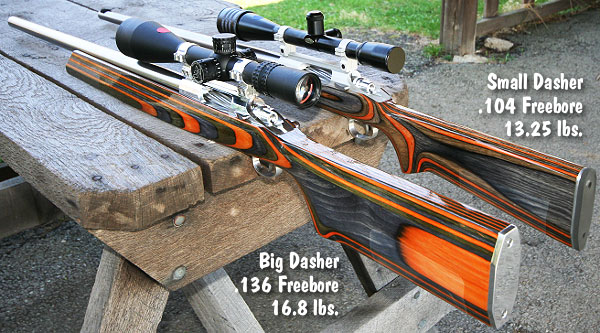
There’s been a lot of interest in the 6mm Dasher cartridge lately, so we thought we’d showcase a matched pair of Dasher rifles belonging to a Forum member. The 6mm Dasher began as a wildcat improved version of the 6mmBR Norma cartridge. The 6mm Dasher has been very successful in competition, and now factory Norma-made Dasher cartridge brass is available from Bullets.com.
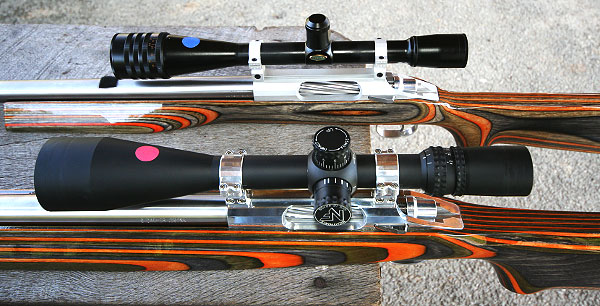
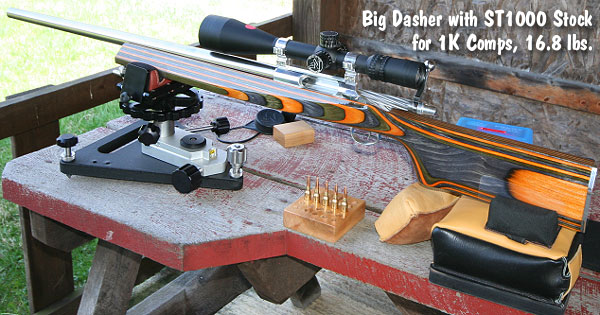
Forum Member Chuck L. (aka “Ridgeway”) has created a handsome duo of 6mm Dashers for competitive benchrest and varmint matches in Pennsylvania. Both guns are built on Kelbly Panda RBLP actions, with Bartlein 8-twist barrels, and Shehane Laminated Tracker Stocks. However, the two rifles are not exact twins, as you can see. One, which we’ll call the Big Dasher, is built on a Shehane ST1000 Tracker stock. The other gun, the Small Dasher, sports Shehane’s “Baby Tracker” stock — a design used with great success by Richard Schatz. The Big Dasher, optimized for 1000-yard competition, also has a slightly longer freebore — 0.136″ vs. 0.104″ for the Small Dasher.
Specifications for the Dasher Duo:
Small Dasher (13.5-pounder): Chambered for 6mm Dasher with approximately .104 freebore and a .264 NK. (No way of knowing exactly since it freebore was done in a separate operation by Kelbly.) Components are: Shehane Baby Tracker stock, Kelbly Panda RPLB action, Bartlein 1:8″ LV barrel at 26 ¾”, Kelbly Rings, Weaver T36, Jewell trigger. The barrel was chambered by Kelblys and the stock was bedded, glued and balanced by a shooting buddy (Forum Member johara1). I clear-coated the stock with auto urethane. Total weight is 13 lbs., 4 ounces.
Big Dasher (1K Light Gun, 17-pounder): Chambered for 6mm Dasher with a .136 freebore and .264 neck (PTG Reamer). Components are: Shehane ST-1000 stock, Kelbly Panda RPLB action, Bartlein 1:8″ HV 5R barrel at 28″, Shehane +20-MOA rings, Nightforce NXS 12-42x56mm, Jewell trigger. The barrel work, pillar installation, and bedding was done by Dave Bruno. The stock was clear-coated by Chuck with auto urethane. Chuck also made the rear butt plate and balanced the rifle. Total weight: 16 lbs., 13 ounces.
Chuck tells us: “I don’t get out shooting competition as much as I want due to time and family, but when I do compete, I shoot a Groundhog match at Southfork Rifle Club in Beaverdale, PA. Info on Southfork Club events can be found at Southforkrifleclub.com. The Southfork match is basically a 100-, 300- and 500-yard match with one sighter the entire match and 5 shots at each yardage for score. The Small Dasher, with the shorter ‘Baby Tracker’ stock, was set up for the Southfork Rifle Club’s ‘Light Unlimited’ class which has a 13.5-lb max weight.” (Editor: ‘unlimited’ is a misnomer for a weight-limited category.)
Chuck adds: “The Big Dasher with the heavy ST-1000 stock is set up for 1000-yard benchrest matches in Light Gun class. I hope to shoot a couple 1K matches with it at Reade Range in southwest Pennsylvania. I am still in load development for this rifle since it was just finished in January. One ironic thing is, it shoots the same load I’m shooting out of the lighter gun rather well. The only difference between the two chambers is the freebore is roughly thirty thousandths longer on the 1K gun (Large Dasher). I will also shoot this at Southfork in the ‘Heavy Unlimited’ class.”
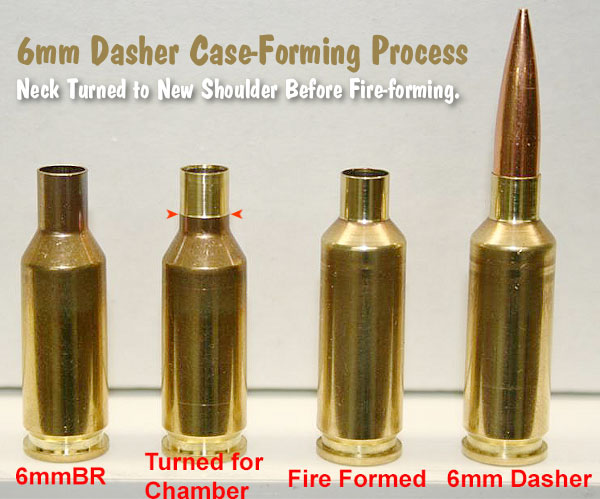
Dasher Case-Forming: Neck-Turn then Fire-form with Bullets Hard in Lands
To fireform, I turn my cases down to fit the chamber and stop where the false shoulder makes snug contact with the chamber. Fire-forming rounds are loaded up with a 29-grain charge of H4895 or Varget and a 108gr Berger bullet seated hard into the lands about 0.020″ past initial contact with the rifling. It takes about three firings to make a nice clean Dasher case with a sharp shoulder. I anneal about every 3-4 firings. I have many cases that have about 10+ firings on them and they are still shooting well. The primer pockets are a little looser, but still hold a primer.
Both Dashers Group in the Ones at 100 Yards
My main bullet for both rifles is the 107gr Sierra MK, loaded with Reloder 15 powder, Lapua cases and CCI 450 primers. My main load for the Small Dasher is 33.0 grains of Reloder 15. This load shoots in the ones at 100 yards. For the Big Dasher, I’m still working on a load, although the same 33.0 grain load shoots in the ones in the heavier gun as well. I’m still looking for more velocity and my ‘max’ node. So far, I’ve gone well above 33.0 grains of RL 15 without pressure signs, but that load produces vertical at 100 yards, so I’m going to tinker with the load until I see pressure or it starts to shoot.


 Forum member Al Nyhus is a top-level score shooter who has competed successfully with the