This is a very interesting development. Federal will produce a line of Federal Gold Medal ammunition loaded with Berger Bullets match projectiles and GM Match primers. The new Gold Medal Berger ammo will initially be offered for: .223 Remington, 6.5 Grendel, 6.5 Creedmoor, and .308 Winchester. We expect this ammo to attract the attention of tactical and PRS shooters — Berger projectiles are currently favored by top PRS competitors. Depending on caliber, three different high-BC bullet types will be used: BT Target, Hybrid OTM, or Juggernaut OTM. These all feature a boat-tail design with a high BC for bullet weight. The 6.5 calibers will use Berger’s popular 130gr Berger Hybrid OTM bullet while the .308 Win uses the 185gr Juggernaut.
This new Gold Medal Berger ammo uses Federal Gold Medal match primers, Federal brass, and specially-formulated propellants. All the ammo is well under SAAMI-spec max OALs to function 100% in magazines. Federal says this ammo will “adhere to Federal Premium’s strictest specifications for accuracy, pressure and velocity”. This new GM Berger ammo line could be a match-worthy alternative for guys who don’t want to hand-load. We’re going to try some in 6.5 Creedmoor and see how it performs in terms of accuracy, ES/SD, ballistics, and temp stability. Should be an interesting test…
FEATURES of Gold Medal Berger Ammo:
• Most popular bullets at Precision Rifle Series events
• High ballistic coefficient
• Less wind drift and drop (than typical factory ammo)
• Excellent long-range accuracy
• Gold Medal match primer
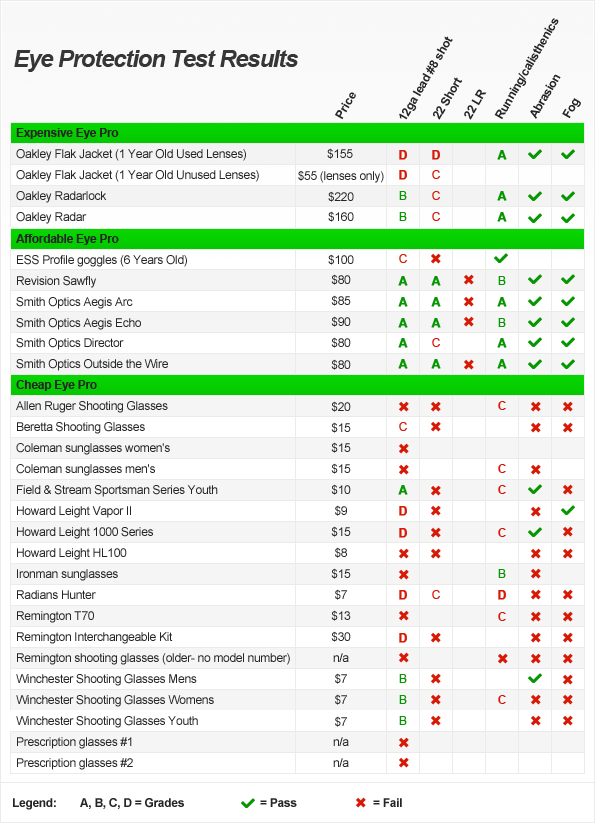
If you’re one of those folks who doesn’t wear eye protection, you need to check out the LuckyGunner Labs Eye Protection Test. For those who DO wear safety glasses — don’t assume that everything is OK. Just because you purchased name-brand “safety glasses” doesn’t mean that you are getting truly effective protection. In fact, many forms of protective eyewear sold today are flimsy, or poorly made. Consequently, they won’t stop even low-energy, slow-velocity fragments.
Two years ago, LuckyGunner Labs conducted very extensive field tests of 28 types of eyewear, ranging in price from $7 to $220. Remarkably, some of the most expensive safety eyewear performed no better than $10 items. Many of the products failed shockingly — with the lenses coming right out of the frames when hit with pellets. LuckyGunner recorded these kind of failures even with ANSI Z87-“approved” eyewear. The reason is that the Z87 test is not tough enough: “The basic ANSI standard is referred to as Z87, and you’ll see this marked in a number of locations on most eye protection marketed to shooters. However, the Z87 impact standard involves a .25″ steel ball traveling at 150 fps — this is fine for protecting eyes from debris that might fall or be thrown, but is not extremely relevant to shooters, who are dealing with objects traveling at much higher velocities.”
Standard
Impact speed
Caliber/Size
ANSI Z87.1-2003
High Velocity
150 feet/second
45 meters/second
0.25″ diameter steel ball
(25 caliber)
Mil-PRF-31013
Vo ballistic test
640-660 feet/second
195 meters/second
0.15 inch diameter steel projectile (15 caliber)
The testers recommend you select eyewear that meets military specification (above and beyond ANSI Z87). The MIL-PRF-31013 Standard covers projectiles up to 650 feet per second. This is much more stringent. Additionally, you want to replace often-used protective eyewear every year or so. Long-term exposure to UV radiation can weaken polycarbonate and lessen its ability to withstand impacts.
SUMMARY — What to Look for in Protective Eyewear
THE GOOD — Eyewear Protects Against Direct Hit with .22 Short Bullet
APEL Revision Sawfly eyewear was shot with a .22 Short, pushing a 29 grain bullet at 710 fps. That’s not powerful by modern firearm standards, but this might be fairly representative of a ricochet bullet fragment. The Sawfly lens stopped this 29gr bullet with minimal damage to the cheek area.
THE BAD — Remington Eyewear Lenses Separate. Right Lens Enters Eye Socket
The most gruesome example was the cheap Remington eyewear which shed both lenses back towards the eyes, one of which embedded itself into the eye socket. The real-world implications of this action are disturbing to say the least.
THE UGLY — Prescription Glasses Failed Miserably
Many ranges don’t see any need for protective eyewear beyond prescription glasses. However, most prescription lenses offer little if any protection. If the prescription lenses are glass, this can create more problems. As shown below, these prescription glasses offered no ballistic protection, and, in fact, proved more dangerous to the eyes due to the flying glass shards.
Results Chart, Video Clips, and Photos copyrightLuckygunner.com.
Summary and Conclusions:
For faster-moving projectiles such as ricochet fragments, you need high quality, tested eye protection. LuckyGunner recommends eyewear with a single (one-piece) lens for any activity where your face might be struck by small, fast-moving objects. Individual lenses detach from the frames once a certain level of force is reached, and they are driven back into the eye sockets, where considerable damage may be done. There are good examples of protective eyewear with two separate lenses, but a broad, one-piece lens distributes force much better.
A wide, comfortable, and preferably soft rubber nosepiece is critical. Along with good “arms”, this will serve to keep the eye protection in place and will also reduce the chances of the lens being driven down or back into the face with enough force to damage the orbital bones.
A frame that connects across the top of the lens, not individual arms which attach to the outside corners of the lens, is recommended. This will reduce the chances of the lens detaching from the frame under impact (it’s still possible, just less likely). Some types of eye protection actually use the frame to absorb impact and distribute force.
NOTE: Andrew, the author of the LuckyGunner Eyewear report, was a former Navy Corpsman. Accordingly, he is familiar with health and safety matters.
What anti-corrosion products really fight rust effectively? You’ll hear many opinions, but what do actual field tests reveal? One rifle shooter, who posts on YouTube as BlueonGoldZ, wanted to separate myth (and marketing claims) from reality, so he completed his own long-term rust test using metal samples. First he used ordinary tap water spray, and then he did a second, longer-duration test with a salt-spray solution. Nine different products were tested: Break Free CLP, Corrosion-X, Frog Lube, M-Pro 7, Outers, Pro-Shot Zero Friction, Rem Oil, Slip 2000, and Tetra Gun Triple Action CLP.
BlueonGoldZ initially examined each product for its “beading” properties with a normal tap water spray. But the main test involved many multiple weeks of exposure after a “dense” salt-water spray. (No rust formed after two weeks tap water exposure, so the test was accelerated with salt-water exposure).
The clear winners in the test, as shown by the screen shot above, were Corrosion-X (Best), and Frog-Lube (Second Best). The photo shows the test samples two weeks after being sprayed with salt water. The results are pretty dramatic — you can see with your own eyes what happened. We think this is a very useful bit of real-world research.
Results from Similar Long-Term Salt Exposure Test
Unfortunately, BlueonGoldZ’s test did NOT include Eezox, which we have found to be extremely effective (on a par with Corrosion-X). In another long-term test of corrosion preventatives, the two best rust fighters were Eezox and Corrosion-X in that order. Since that test was completed, Corrosion-X, already an excellent product, has been enhanced. CLICK HERE for Long-Term Salt Exposure Test Report.
Schmidt & Bender 5-25×56mm PM II SFP Review Test conducted by RifleShooter.com
For police and military use, the Schmidt & Bender PM II (Police Marksman) is the gold standard of extreme use rifle optics. Other high end scopes aspire to the PM II’s level of durability, optical clarity, repeatability, and performance. With our assistance, RifleShooter.com recently conducted an in-depth test of Schmidt & Bender’s 5-25×56 PM II, Second Focal Plane (SFP) version. Here are the results…
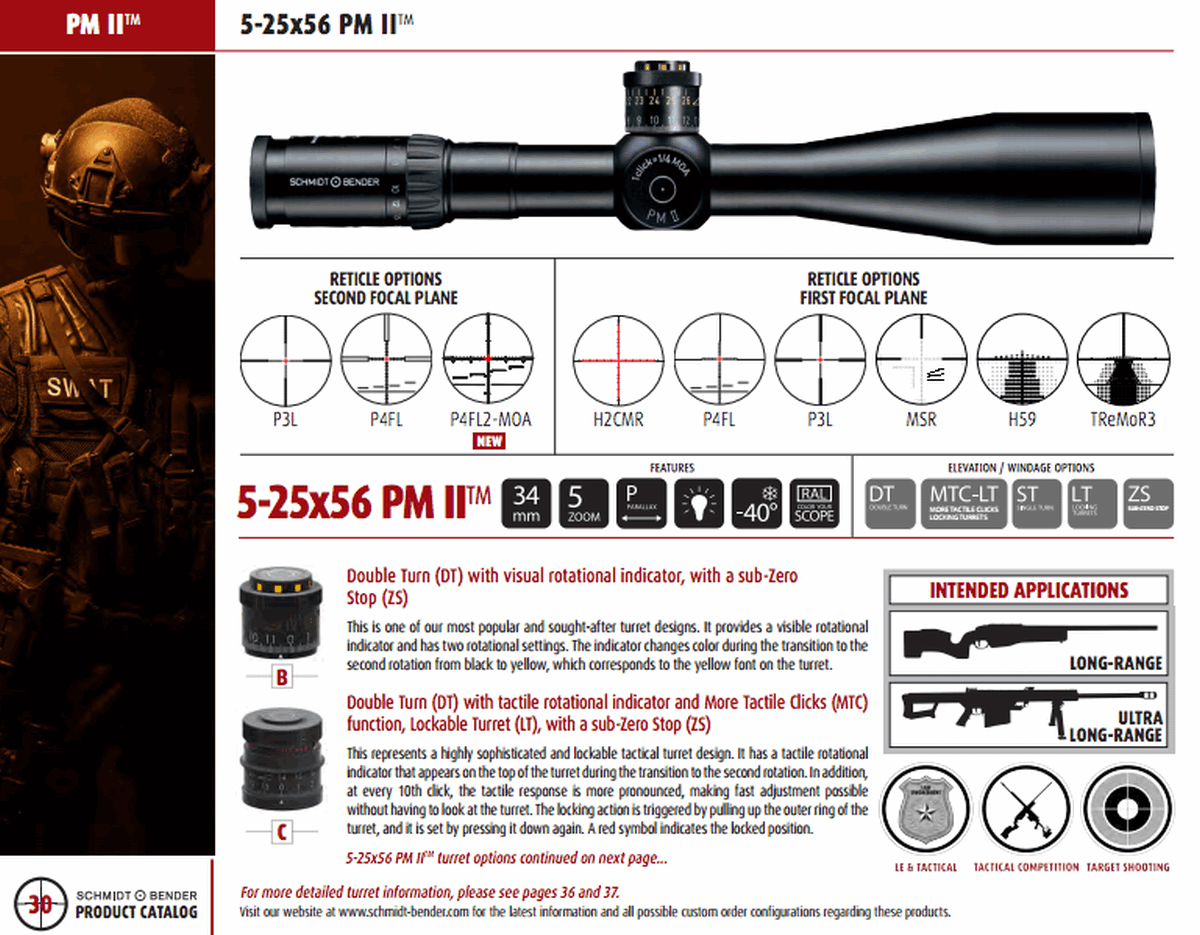
The test scope is a 5-25×56 PM II (SKU: 677-911-995-A8-A2) with a Second Focal Plane (SFP) P4FL2-MOA reticle; double-turn elevation with rotation indicator; single turn windage; 1/4-MOA click values; illuminated reticle; and side adjustable parallax from 10 meters to infinity. This is an impressive beast — a big, sturdy, well-made optic.
Schmidt & Bender scopes have sophisticated features and a wide array of available options. The many options and features of the 5-26x56mm PM II are explained in this Schmidt & Bender video:
Second Focal Plane (SFP) Reticles
The Second Focal Plane (SFP) reticle design works well for long-range target shooters, benchrest shooters, hunters, and law enforcement. Often, SFP reticles are associated with Minute of Angle/MOA-based reticles. For target shooters who like to dial-in the elevation corrections, frequently SFP is the preferred reticle type. Also, these reticles are offered with thinner lines and markings to aid in target shooting, by not covering up as much of the target area, which is absolutely necessary in such cases as F-Class and Benchrest shooting. With a SFP reticle the size/width of the reticle lines stay constant at all magnifications.
Tall Target and Box Tests
Commentary by Rifleshooter.com Editor
To get an idea of how the PM II tracked I wanted to conduct a tall target and box test. I set up a couple of ISPC targets at 100 yards (below).
The target on the left is for the tall ladder test, the target at the right is for the box test.
With the scope zeroed* I set up a tall target test at 100 yards. I placed a 1″ orange dot on a pair of targets (above, left). We then used a four foot level to draw a plum line moving up from the dot and fired the three shot group below.
I dialed 30 MOA of elevation on the scope and fired another group. Measuring the distance between the two groups, would indicate how well the scope is tracking.
Since 1 MOA is 1.047″ at 100 yards, 30 MOA would be 31.41″ (30 x 1.047″ = 31.41″), looking at my tape measure, everything checked out (above).
Next I conducted a quick box test and set up an IPSC target with a orange paster at 100 yards. To do this I first Fired one round with the scope zeroed, then…
Dialed 6 MOA left, fired one round
Dialed 15 MOA up, fired one round
Dialed 6 MOA right, fired one round
Dialed 6 MOA right, fired one round
Dialed 15 MOA down, fired one round
Dialed 6 MOA left and fired one round
After this, you want to see two holes close to each other on the first target, as well as the correct spacing dialed in between each hole, so how did the PM II do?
Well, it worked like a champ! The rest of my time with the PM II has been equally impressive.
— It’s a lot of scope. The PM II is pretty much the best scope you’ll be able to buy anywhere in the world. There is a reason they are in such widespread Military and Law Enforcement use, it has earned its reputation.
— Great zero stop. The PM II has the easiest-to-adjust turret and zero stop system I have ever used. On the PM II, Schmidt & Bender’s exclusive “Sub Zero Stop” system allows movement below zero. On the test scope it was 1.75 MOA. This is a great feature if you switch ammunition or elevation and need to bump your zero down.
— Tracks well. This was to be expected with its widespread use by military units throughout the world.
— Crisp, precise adjustments. The tactile feel of the knobs is exceptional.
— Crystal clear glass. Great light transmission and reticle.
This Schmidt & Bender catalog page shows reticle options for the 5-25×56 PM II:
Click image to zoom
Turrets and Controls — How They Work
On the right side of the optic, you’ll notice a .250 MOA single-turn windage adjustment knob. On the top you’ll note the .250 MOA elevation adjustments. The tactile feel of each “click” is impressive — crisp and precise. A large parallax knob is located on the left side of the turret. The smaller knob located closer to the eyepiece is the adjustment knob for the illuminated reticle.
Here the view from behind the scope. Note the DT (double turn) elevation turret. At its current setting in the photo above, it is still on the first revolution (.250 MOA below 0) and as adjustments within the first revolution are made, you’d read the white numbers. During the second revolution, the windows in the top of the turret turn yellow, as shown below.
Test Rifle — .300 Win Mag in Accuracy International AICS AX Chassis
For testing and evaluation purposes I mounted the PM II in Spuhr ISMS mount on a custom made .300 Winchester Magnum rifle. Testing was done with handloaded ammo: Sierra’s 195-grain Tipped MatchKings over Norma brass and Hodgdon H4831SC powder.
This is the test rifle I used. It was built primarily with parts from Brownells.
Here is the Schmidt & Bender 5-25x56mm PM II SFP (foreground) alongside three other S&B products: 5-25×56 PM II FFP (Desert Tan), 12-50×56 PM II, 3-20×50 PM II
Better Pricing, Better Warranty, Better Availabilty
In addition to increased production and availability, Schmidt and Bender has reduced retail pricing on PMII models 14-19% depending on the model. S&B Marketing Director Kyle Brown commented, “S&B improved its warranty in the USA for 2017, and now offers a USA 20-Year Transferable Limited Warranty. We have reduced our pricing to be competitive; and have greatly increased our on-hand inventory levels to supply our customers with complete and on-time deliveries.”
Schmidt & Bender has made an effort to support the Precision Rifle Series (PRS). Brown said “for 2017 we have made a very hard push to become more active in PRS with our brand and with our products.”.
To learn more about Schmidt & Bender optics, CLICK HERE.
* Zeroing Process for PM II: The zero stop and turret settings are controlled by set screws. Zeroing is a breeze. You don’t have to move caps, insert shims, move clutch mechanisms, and so on. Simply loosen the screws, swing the turret back to “0” and you are all set. To establish a 100-yard zero, I hung a target at 50 yards, fired one round, dialed a correction, fired a confirmation shot and moved back to 100 yards. I fired one round at 100, made a correction and was zeroed. That’s it, three rounds, done.
According to a Precision Rifle Blog survey, the MasterPiece Arms (MPA) chassis system is the second most popular stock in the PRS game, and it’s gaining ground fast. MPA was second only to Manners Stocks in popularity among the top 100 PRS shooters. Remarkably, the MPA chassis experienced a nine-fold increase in use in 2016 over the previous year. This thing is really catching on.
Here MPA President Phil Cashin Shows How to Set Up the MPA BA Chassis:
2015 PRS Champion David Preston (who is currently ranked #1 in Precision Rifle Series standings) favors MPA Chassis systems: “I chose the MPA BA Chassis because of its adjustability, versatility, and company’s willingness to adapt to shooters needs and suggestions. It’s the most comfortable and reliable stock on the market.”
One reason the MPA Chassis works so well is that MPA’s president, Phil Cashin, is an active PRS shooter who regularly tests out features in competition. He also gets feedback from other PRS competitors: “We’re always implementing feedback and suggestions from shooters into our products. In fact, the idea for our EVG grip, which has a rest on it to better support your trigger finger, came directly from a suggestion that David Preston, 2015 PRS Champion, gave me at a match.”
New MPA BA Competition Chassis
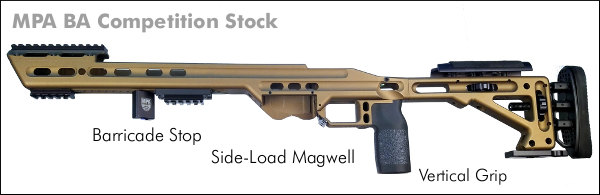
The “latest and greatest” MPA stock system is the MPA BA Competition Chassis. This offers the best features of the original MPA BA Chassis system plus some new, notable enhancements. With the elimination of the monopod, weight is reduced. A movable barricade stop comes standard. The buttstock offers full adjustability for length-of-pull, cheek height, and buttpad height/cant.
Rotating, Multi-Position Barricade Stop — Aids stability when shooting on a variety of barricades. Trinity Rail System — Allows closer bipod when shooting off oil drums or similar props. Modified Magazine Well — This “Ryan Castle” magwell allows fast side-loading of mags into chassis. Rear Bag-rider Attachment — Improves tracking/stability in rear sandbag.
MPA Production Class Rifle with Savage Action
Along with its chassis systems, MPA offers a complete rifle for the PRS Production Division:
To fit PRS Production Class Rules (PCR), MPA has developed the new $1999.99 BA Lite PCR Competition Rifle built around a Savage Model 12 short action. The Savage action is upgraded with a Rifle Basix 2-lb trigger, and the adjustable, MPA BA Lite Chassis offers a bag rider, barricade stop, and even a built-in bubble level. Bipods can be attached up front to a rail, with optional spigot mount. MPA PCR Rifles come with stainless Bergara barrels, 22-26 inches in length, fitted with MPA muzzle brakes. Chamberings offered are: 6mm Creedmoor, 6.5 Creedmoor, 6-6.5×47 Lapua, 6.5×47 Lapua, .243 Win, and .308 Win. The PCR rifle includes a 10-round AICS-type magazine.
High-quality loading blocks precisely sized for your cartridge types make the reloading process easier. Bullets.com now offers acrylic loading blocks that set new standards for this kind of product. Precision CNC-machined from solid acrylic, these beautiful loading blocks were designed by a member of the U.S. Shooting Team. Dimensions are ultra-precise and these blocks even have a primer recess in each hole so the cases sit perfectly. You can order blocks for a variety of rifle cartridge types: .223 Rem Family, .308 Win Family, .308 Tall (.30-06), RSAUM and WSM Magnum, Magnum Tall, .338 LM Family, .50 BMG. In addition, there are blocks for most popular pistol cartridges: .380/9mm, .38 SPL, .38 Super, .40 SW, .44 Magnum, .45 ACP. These blocks are affordable, starting at just $10.95. The popular .308 Win Family blocks are $11.95.
Click photo to view full-screen image:
Tech Insight — Acrylic Machining Process
The folks at Bullets.com tell us that machining acrylic is not as easy as it seems. Making precision blocks is a multi-stage process involving special equipment. Solid slabs are first machined flat so they are parallel. Then several custom cutters are used to craft precisely-arranged holes with nice chamfers on each hole as well as the outside edge. Every hole bottom has a milled, secondary primer pocket so the primers don’t contact the bottoms. The see-through blocks are finished to a nice sheen.
On the Shooting Sports USA website, there’s a great profile of Kevin Nevius, one of America’s leading competitive marksmen. Kevin is best known for his smallbore success but he has also an impressive record in long-range centerfire competition — In 2005 and 2006 he won the Sierra Trophy at Camp Perry in 1000-yard competition. This was followed by smallbore National Championships in 2008, 2010, and 2014. This story, penned by gunwriter Hap Rocketto, covers Kevin’s career, which has included multiple championships and many records.
“My brother got me into long range varmint hunting and I started building my own guns very early,” Nevius told Dan Holmes in a Pronematch.com interview. “I had a hunting friend who shot indoor smallbore who started me in three position and I was hooked.”
Here are highlights from Hap Rocketto’s Profile of Kevin Nevius:
Champion shooter Kevin Nevius grew up in a household that did not allow firearms, an unlikely beginning for one of the United States’ premier prone rifleman and gunsmiths. Once out on his own he fell in with his brother who enjoyed long-range varmint hunting. His natural bent for things mechanical (he is a professional structural engineer) soon had him tinkering with rifles, which eventually led him to building his own.
Everything fell into line for him in smallbore during the 2008 season. After shooting a series of training matches in which he was most successful, he arrived at Camp Perry at the peak of performance and won his first National Smallbore Rifle Conventional Prone Championship. Kevin came back strong in 2010, winning the inaugural individual National Smallbore Rifle Metric Prone Championship, as well as the team title at Bristol, IN. [Kevin then won the Smallbore Conventional Prone Championship in 2014 with a practically perfect score of 4799-390X (LINK).]
Along the way, Nevius has won some impressive national records. In conventional competition he co-holds the 1200-shot metallic sight aggregate record of 1200-102X. He was just one shot short of perfection in the 480 aggregate, where he holds the civilian record of 4799-412X, just one point behind, and 11 Xs ahead of, Joe Hein’s 4800-401X open record.
Kevin Nevius hopes to build a smallbore rig capable of 3/8-MOA at 100 yards.
Building the Ultimate Rimfire Prone Rifle
Kevin is not just a great trigger-puller. He also smiths his own rifles. His current goal as a gunsmith is to build a rimfire rifle that will shoot 3/8″ groups at 100 yards. That’s a big challenge — 3/8-MOA represents very good accuracy for a centerfire rifle with handloaded ammo. But if any rimfire smith can build a rifle that will shoot that well at 100, it’s probably Kevin.
At the request of our readers, we provide select “Deals of the Week”. Every Monday morning we offer our Best Bargain selections. Here are some of the best deals on firearms, hardware, reloading components, and shooting accessories. Be aware that sale prices are subject to change, and once clearance inventory is sold, it’s gone for good. You snooze you lose.
1. Brownells — Rock Chucker Supreme Reloading Kit, $199.99
Everything you see above can be yours for just $199.99, after manufacturer’s rebate. Right now, Brownells is selling the Rock Chucker Supreme Master Reloading Kit for $269.99. That’s a great deal considering all the hardware you get. Heck, the Rock Chucker press alone is worth $150.00+. Next, you can save $20.00 and get Free Shipping with Brownells CODE M3T. (We confirmed that code works on 5/20/17). So the Brownells delivered price is $249.99 (using Code M3T). But here’s the real incentive — this Rock Chucker Supreme Kit qualifies for a Buck$ or Bullets Rebate — choose either $50 or 500 Speer bullets. If you take the fifty bucks ($50), that reduces your net cost to just $199.99 for the entire RCBS Reloading Kit. That’s a total steal.
Here’s a “killer deal” if you need a high-quality scope for PRS and tactical games. This Vortex Viper PST 6-24x50mm scope features an illuminated EBR-2C reticle with Mil-based hash marks. The tactical-style turrets have 0.1 Mil clicks with zero-stop. The 6X low-end magnification is wide enough for closer targets, while the 24X top end is plenty of magnification for long range. The 23 oz. scope, which features a rugged, 30mm one-piece main tube, carries Vortex’s full warranty. Note this is a First Focal Plane (FFP) scope. You can save hundreds with this deal — this optic sells elsewhere for up to $1049.00. NOTE: This item is showing “back-order”, but EuroOptic.com is expecting a big shipment this week — so place your orders now.
3. Amazon — Plano Double Rifle Case with Wheels, $114.92
This Plano Double Scoped Rifle Case is an Amazon Best Seller for good reason. It offers the functionality and durability of an SKB-type hard case for HALF the money. This is under $115.00, while the equivalent SKB is around $240.00, so you can buy two Planos for the price of one SKB. The 51.5″ interior will fit most scoped competition rifles up to about 29″ barrels (measure your own rifle to make sure). The handles are convenient and beefy and the wheels make this case easy to move through airports and parking lots. This is a very tough, roomy case for the money. Plus Amazon is offering FREE Shipping.
Need a good set of rugged, affordable binoculars for hunting or varmint work? Then check out the Steiner AZ830 at $126.30. These are essentially identical to the respected Steiner Military Marine binoculars which sell for $220 or more. The only differences are the color and the packaging. The AZ830s are a black “house brand” created for Amazon by Steiner. Other than the color (black vs. OD Green) everything is the same. Same bright glass, same auto focus system, some tough rubber armor, same rock solid Steiner Heritage Warranty. We highly recommend these AZ830 binoculars. For under $130.00, you can’t beat them.
Editor’s Note: With these AZ830 Steiner binoculars, once you adjust the eyepieces, everything from 20 yards to infinity is in focus. This is a huge advantage in the field. I own the virtually identical Steiner 8×30 Military Marine model which has the same focus system.
Thinking of putting together an accurate AR for the new PRS Gas Gun series (or 3-Gun matches)? Here’s a good place to start. Aero Precision now offers a $193.49 kit with stripped Upper and Lower Receivers — both with a durable Flat Dark Earth (Magpul FDE) Cerakote finish. Just add barrel, buttstock, trigger group, controls, and your bolt carrier group. Note: This Kit will work with the .223 Rem and similar-length, larger-caliber cartridges such as the 6mmAR and 6.5 Grendel. If you want to shoot a 6.5 Creedmoor, you’ll need an AR10 platform rifle.
6. Midsouth — Hornady LnL Auto Charge Scale/Dispenser, $159.99
The Hornady Lock N Load Auto Charge Electronic Scale/Dispenser is now on sale for just $159.99 at Midsouth Shooters Supply, discounted way down from the regular $226.24 price. That’s the lowest price we’ve seen on this product in a long time, making this a real bargain. If you are looking for an affordable, combo digital scale and powder dispenser, this is a great deal. By comparison, the new RCBS ChargeMaster Lite sells for around $250.00 and is back-ordered at many vendors. That means you can save at least $90.00 by buying RED instead of GREEN.
7. CDNN — Remington RP9 9x19mm Pistol, $249.99 with Rebate
Here’s a killer deal on a modern, full-size, 9mm pistol. The striker-fired Remington RP9 is similar to Smith & Wesson’s popular M&P9, but we prefer the Remington’s grip ergonomics, and the RP9 is much less expensive. The RP9 comes with three (3) grip inserts and two (2) 18-round magazines. CDNN’s retail price is $299.99, but this pistol qualifies for a $50 mail-in Rebate from Remington. That knocks your net cost down to $249.99. That’s a heck of a bargain for a nicely-designed, American-made pistol. We’ve shot this Remington RP9 pistol and definitely prefer its ergonomics/controls over those of the full-size 9mm Glock 17.
8. Bass Pro — Federal Value Pack .22 LR, 325 Rds for $19.99
This Federal Auto-Match .22 LR ammo is just 6.2 cents per round — the kind of pricing on bulk rimfire ammo we used to see in the “good old days”. Act quickly, this $19.99 Federal .22 LR Ammo deal at Bass Pro Shops won’t last long. Each box contains 325 rounds — enough ammo for many sessions at the range. The bullets are 40 grains, solid lead.
9. Home Depot — 72″ Wood Workbench for $75.36
This patented Home Depot workbench assembles in a few minutes. Simply unfold the legs, pop in the shelf, and you are ready to start your project. Made from Premium 2×4 Hemlock fastened with glue and screws, this workbench is a great value. The bench (72″ wide x 35″ high x 22″ deep) can easily be stored when not in use. NOTE: The wood is unfinished (can be painted or stained).
The CMP Eastern Games were a huge success, thanks in no small part to the mobile electronic target system. The event, which drew 360+ competitors, took place April 28 – May 2 at Camp Butner in North Carolina*. The Kongsberg electronic targets allowed the CMP to run relays more efficiently, and the targets eliminate the need for competitors to do pit duty. GSM Matches, which typically run four relays each day, saw days with a total of nine and 10 relays during its scheduled times, while the Vintage Sniper and other matches finished in record time.
“The electronic targets are phenomenal,” said brothers Richard and Jonathan Mast, who attended the Eastern Games along with other family members. Jonathan added, “It was the best shooting experience I’ve ever seen as far as immediately finding out where you’re shooting – best I’ve ever had.”
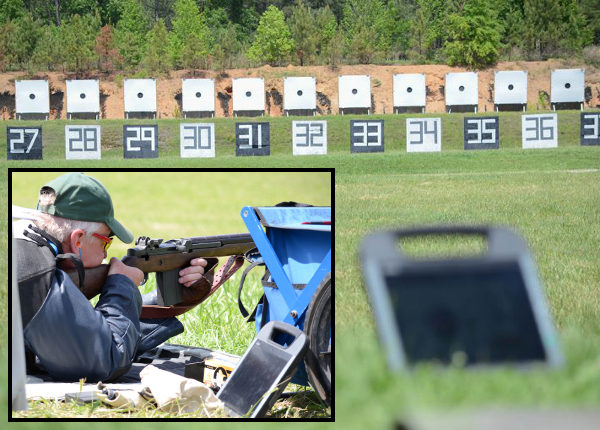
Throughout the event at Camp Butner, competitors had the opportunity to fire on CMP’s mobile electronic highpower target range. The Kongsberg targets contain internal microphones that locate shot position. The scores are instantly calculated by computer and then wirelessly transmitted to portable, tablet monitors on each firing point.
The new targets were well received. Competitors observed that the targets simplify the process for the shooter and provide immediate feedback and scoring. Shooter Caleb Mast noted: “This makes it easier for people who don’t have equipment, like a scope, to get in. All you pay is the registration fee, and I just brought what I’m wearing and was still able to score well enough to get my feedback on the monitor.”
*The Eastern Games ran April 28 through May 2, 2017. The Creedmoor Cup Marches were held May 3-7, 2017, following the Eastern Games. SEE Match Schedule.
A unique, comprehensive Cartridge Comparison Guide is available as a 340-page, spiral-bound book. Covering over 250 cartridges, the updated Second Edition of the Cartridge Comparision Guide is the product of many years of labor by Andrew Chamberlain, a Utah-based hunter. Andrew says his $36.95 Guide “compares every factory available cartridge from the 17 calibers up to the 50 caliber cartridges”. (Sorry, most wildcat cartridges are not covered.) Chamberlain’s Guide also compiles cartridge data from major ammunition manufacturers such as Barnes, Federal, Hornady, Norma, Nosler, Remington, Sierra, Swift, Weatherby, and Winchester. It shows the optimal velocity achieved for each bullet weight and calculates bullet energy, recoil, and powder efficiency. Large color photos illustrate handgun and rifle cartridges.
The Cartridge Comparison Guide provides data for thousands of cartridge/bullet/velocity combos. Quick reference data sheets and ballistics charts cover Trajectory, Velocity, and Energy out to 500 yards. The Cartridge Comparison Guide also offers a firearms lexicon, plus Appendices covering Cartridge Selection for Game Animals, Bullet Selection/Design, Bullet Expansion, Wound Channel Characteristics and more.
New Content in Second Edition of Cartridge Comparison Guide
The Cartridge Comparison Guide (Second Edition) costs $36.95 plus shipping and tax. CLICK HERE to visit the Online Store where you can order the 340-page book. Here’s what’s new in the Second Edition:
Addition of Shotgun Ammunition (Both Slug and Shot loads).
Momentum Calculation for all Rifle, Shotgun and Handgun loads.
Integration of Shotgun Slug Ammunition with Center Fire Rifle Data Tables.
Factory Load Summary Added (Shows manufacturers and loads produced).
One factory load and one hand load for every bullet weight available in each cartridge.
Over 90 pages of additional ballistics content (roughly 35% more than in First Edition).











 Champion shooter Kevin Nevius grew up in a household that did not allow firearms, an unlikely beginning for one of the United States’ premier prone rifleman and gunsmiths. Once out on his own he fell in with his brother who enjoyed long-range varmint hunting. His natural bent for things mechanical (he is a professional structural engineer) soon had him tinkering with rifles, which eventually led him to building his own.




 A unique, comprehensive


