For today’s Saturday at the Movies special, we provide a selection of videos showcasing rifle and pistol cartridge types — from tiny .17 caliber cases to huge 20mm cases. Two of the videos use advance computer animation to provide 3D views of dozens of cartridge types. Then there are some expert commentaries by Jerry Miculek and Ron Spomer discussing the characteristics and performance of various cartridge types. Finally, we provide two videos that discuss rimfire cartridges and show how .22 LR rounds are produced in a modern CCI factory.
90 Different Rifle Cartridge Types in Computer Animation
In this rifle ammunition comparison animation there are 90 different cartridge types, from very small (.22 Flobert) to very, very big (20mm Vulcan). This video employs sophisticated, 3D CAD animation to showcase 90 different rifle cartridges, one after the other, in sequence. It covers from .17 Caliber up to 20mm. Obviously a lot of time and effort went into this video, but it really is cool to see so many different cartridge types in one 3.5-minute video.
After the full line-up is complete at 1:41, the video then provides other smaller comparison, such as multiple large hunting cartridges (2:15) and .22 Caliber cartridges (2:45, see above). All the cartridge models are made using Autodesk Inventor software, and then the “line-up” animation was completed with Autodesk Showcase.
Cartridge Types Included (in Caliber Order, then Metric Order):
1) .17 HM2
2) .17 HMR
3) .204 Ruger
4) .218 Bee
5) .22 Flobert
6) .22 Hornet
7) .22 LR
8) .22 Magnum
9) .22 PPC
10) .22 Short
11) .220 Jaybird
12) .223 Rem/5.56x45mm
13) .223 WSSM
14) .224 Weatherby Magnum
15) .225 Winchester
16) .240 Weatherby Magnum
17) .243 Winchester
18) .25 Remington Auto
19) .250 Savage
20) .25-06 Remington
21) .256 Winchester Magnum
22) .257 Roberts
23) .260 Remington
24) .264 Winchester Magnum
25) .270 Weatherby Magnum
26) .270 Winchester
27) .280 British
28) .280 Remington
29) .284 Winchester
30) .30 Carbine
31) .300 H&H Magnum
32) .300 Rem Ultra Magnum
33) .300 Savage
34) .300 Winchester Magnum
35) .300 Win Short Mag (WSM)
36) .30-06 Springfield
37) .303 British
38) .30-30
39) .308 Norma Magnum
40) .308 Winchester
41) .32 Winchester Special
42) .325 WSM
43) .338 Lapua Magnum
44) .35 Whelen
45) .350 Remington Magnum
46) .375 H&H Magnum
47) .376 Steyr
48) .408 Cheyenne
49) .416 Remington Magnum
50) .416 Weatherby Magnum
51) .444 Marlin
52) .450 Marlin
53) .450 Nitro Express
54) .458 Win Magnum
55) .45×70
56) .460 Weatherby Magnum
57) .465 H&H Magnum
58) .470 Nitro Express
59) .50 BMG / 12.7×99 NATO
60) .500 jeffery
61) .505 Gibbs
62) .577 Nitro Express
63) .577 Tyrannosaur
64) .600 Nitro Express
65) .700 Nitro Express
66) .950 JDJ
67) 4.6×30 mm
68) 4.6x30mm
69) 5.6×50 Magnum
70) 5.7x28mm
71) 5mm/SMc
72) 6mm LEE
73) 6.5×55 Swedish
74) 6.5×6 mm Schuler
75) 6.8mm Remington SPC
76) 6mm PPC
77) 6×45 mm
78) 7mm Weatherby Magnum
79) 7mm Remington Magnum
80) 7mm Rem Ultra Magnum
81) 7.62×39 mm FMJ
82) 7.7×58 Arisaka
83) 7.95×57 Mauser
84) 8mm Remington Magnum
85) 9.3×62 mm
86) 9.3×64 Brenneke
87) 14.5×114 mm
88) 20mm Vulcan
89) 25mmx137mm
90) 30mmx173 mm
Ammunition Size Line-Up — from Tiny to Massive
This animation video shows the size comparison of ammunition from a 2.34mm rimfire caliber to the massive 800mm caliber shell of the Schwerer Gustav railway cannon used by German forces in World War II. This video includes many common rifle and pistol cartridges/calibers, but also includes large artillery ammunition. This video has very good CGI Graphics. Below is part of the line-up from the .17 Remington Fireball (far left) to the famed .50 BMG (far right):
Ammunition Types Showcased in this video:
2.34mm rimfire
2.7mm Kolibri
3mm Kolibri
4.25 mm Liliput
.17 Hornady Mach 2
.17 Remington Fireball
.17 Hornady Magnum Rimfire
.22 Long Rifle
.22 Winchester Magnum Rimfire
HK 4.6×30mm
4.6×36 Loffelspitz
5.45mmx18 MPTs
5.7×28mm SS190
.280 British 7×43
.297/230 Morris Short
.297/230 Morris Long
.30 Pedersen 7.65×20mm
7.92×33mm Kurz
.300 Winchester Short Magnum
8×50mmR Mannlicher
.499 LWR
.577/450 Martini–Henry
.600 Nitro Express
.470 Nitro Express
.50 Beowulf
.50 BMG
20×102 M55A3
25×137 M793
Popular Cartridges/Calibers for Self-Defense and Hunting
This video focuses on popular calibers/cartridges used for self-defense and hunting. It provides a quick but informative overview of the capabilities (and intended uses) of many types of pistol, rifle, and shotgun ammunition. The video discusses the pros/cons of various cartridge types and explains how you would select ammo for a particular purposes (e.g. skeet loads vs. defense shotshells). If you are considering buying a carry pistol and are undecided about caliber choice, this is a good video to watch.
Flattest-Shooting Cartridges by Caliber (Ron Spomer)
In this 15-minute video, hunting expert Ron Spomer examines a variety of standard and wildcat cartridges from .17 caliber all the way to .338 caliber. For each caliber, Ron picks a flat-shooting “winner” and provides some ballistics comparison tables. This video is quite popular, with over 550,000 views on YouTube.
Ammo Types and Calibers — Jerry Miculek Explains the Basics
In this video, legendary shooter Jerry Miculek talks about popular types of pistol and rifle ammunition and the various bullet options used for plinking, competition, and self-defense. Jerry, one of the greatest pistol shooters on the planet, provides useful insights on cartridge selection and bullet choices. Jerry notes: “There are a TON of different types of ammunition” so he explains the basics. And Jerry answers common questions such as: “What is the difference between ball and hollow-point bullets?” and “What type of gun takes rimmed cartridge versus rimless?”.
.22 Caliber Rimfire Cartridges — Some Key Facts Revealed
We recommend all .22 rimfire shooters watch this video from Old English Outfitters. It explains some important facts and clarifies some common misconceptions about to .22 caliber ammunition. To learn more about modern .22 LR rimfire ammo, we also recommend the video below, which shows how CCI .22 LR ammunition is manufactured, start to finish.
BONUS Video — How .22 LR Ammunition Is Made
YouTube host 22Plinkster toured the CCI/Speer production facility in Lewiston, Idaho. While touring the plant, 22Plinkster was allowed to capture video showing the creation of .22 LR rounds from start to finish. This is a fascinating video, well worth watching.
This revealing video shows all phases of .22 LR ammo production including cupping, drawing, annealing, washing, drying, head-stamping, priming, powder charging, bullet seating, crimping, waxing, inspection, and final packaging. If you’ve got ten minutes to spare, we really recommend you watch the video from start to finish. You’ll definitely learn some new things about rimfire ammo.
Ruger Super GP100 Revolver in 9mm Luger (9x19mm)
Wouldn’t it be cool if you could shoot your 9mm semi-auto pistol ammo in an ultra-accurate revolver? Well you can. Ruger adapted its existing Super Redhawk frame to create the Super GP100 9mm Luger (9x19mm) revolver. As you can see, the Super GP100 9mm features a stubby 8-round PVD-coated cylinder to better fit the 9x19mm round. According to Guns.com the 9mm GP100 “uses a cylinder and extractor cut for moon clips to speed up reloading [and] sports a 6-inch half-lug sleeved and shrouded barrel with an 11-degree target crown[.]”
Watch this GunBlast video review to see how this unique Ruger 9x19mm wheelgun performs. Reviewer Boge Quinn said this a “competition grade gun” with nice fit and finish. Out of the box the Super GP100 9mm had a 9.5-lb double-action pull and a 4.5-lb single action trigger pull. It took a while for the pull to smooth out Quinn noted. Also, he said that if you do NOT use the supplied moon-clips it is awkward to remove the spent cartridges: “You don’t have to use a moon clip, but I don’t know why you wouldn’t… it just works great that way.”
The 9×19mm Parabellum (aka 9mm Luger) cartridge was introduced in 1902 by German weapons manufacturer Deutsche Waffen und Munitionsfabriken (DWM) for the Luger semi-auto pistol. Now 120 years later, Ruger brings us a sturdy, 6″-barrel revolver for this popular cartridge. Ruger adapted its existing Super Redhawk frame for this Super GP100 9mm revolver. In this video, Ruger engineer Mark Gurney explains the features of the Super GP100 9mm revolver:
Super GP100 9x19mm Features
Triple-locking cylinder locked into the frame at front, rear and bottom for more positive alignment and dependable operation.
High-strength stainless steel cylinder is fluted and shortened to reduce overall mass and increase rotational speed. Cylinder has PVD finish for durability and ease of extraction.
Polished and optimized internals, a centering boss on the trigger, and centering shims on hammer deliver a smooth double-action trigger pull with crisp/consistent let-off.
Cylinder and extractor are cut for moon clips to speed reloading during intense competition. Ships with three full moon clips and moon clip tool. The ejector and chamber mouths have a light chamfer to aid loading with moon clips.
Hogue hardwood grip is hand-finished for a smooth, polished feel. Grip frame accommodates a wide variety of custom grips.
Transfer bar mechanism provides security against accidental discharge.
Cold hammer-forged barrel has precise rifling for accuracy and longevity.
Barrel features 11° target crown for competitive-level accuracy.
You’ve heard the adage — “The couple that plays together, stays together.” Here’s a story about a talented husband and wife who compete together in precision rifle matches. Shooters Tim and Regina Milkovich have done well in competition, including both placing in the Top 10 at the popular CowTown Accurized AR Match a while back. Regina took third with a nearly-clean run, dropping only one shot on Stage 5 to end with 49 points and an overall time of 49.50. Tim followed closely behind, placing sixth with 48 points and a time of 37.95.
This match, held at the CowTown Range in Peoria, Arizona, is designed to test and build shooters’ long range skills. Shots are taken from normal PRS-style positions and supports. Each match consists of five stages with targets ranging from 100 to 700 yards. Each stage has a 20-round maximum, and the match typically requires 40 to 50 hits.
Tim and Regina, who are both sponsored by Nosler, can often be found competing together at individual and team matches. At this match, both shot ARs chambered in .223 Rem loaded with Nosler .22 caliber 77gr Custom Competition bullets.
This video is from a past Cowtown Accurized AR match.
Regina is a Top Female PRS Shooter
Regina is one of the top female precision rifle competitors in the country. She is one of only two women to ever win a national-level Precision Rifle Series (PRS) match. Just a few years ago Regina was a novice in the PRS/NRL game. Now ranked as a Master Class shooter, today she is a respected, top-level competitor.
Time is a Veteran Who Shoots Many Disciplines
Tim is a military veteran with service in the U.S. Marine Corps, U.S. Army, and U.S. Air Force. He has been shooting competitively since 1986 in multiple disciplines including Pistol Silhouette, Bullseye Pistol, USPSA, IDPA, and 3 Gun. Tim has a Master Class ranking in most of the disciplines he shoots.
Tim also shoots bolt-action rifles. Below are his 6.5×47 Lapua cartridges loaded with Nosler 140gr RDF bullets and Varget powder. Photos from Tim Milkovich Facebook Page.
AR-Type Rifle Event in April at Camp Atterbury, Indiana
The NRA Competition Shooting Division is launching the America’s Rifle Challenge, an all-AR-based program to build and test skills for shooters of all levels. On April 19, 2025, at Camp Atterbury, Indiana (south of Indianapolis), the NRA will hold the America’s Rifle Challenge, a one-day, AR-based competition with two levels giving participants a fun intro to the action shooting sports with AR-15 type rifles. The NRA will provide prizes and awards for competitors and winners (plus a free lunch). Match Fees are $45 for NRA Members and $55 for non-members.
After the action concludes, the NRA will provide a FREE BBQ lunch for all competitors and one immediate family member or friend. American Rifleman TV and ShootingUSA will be filming the match and conducting interviews with competitors and spectators.
America’s Rifle Challenge Event Levels:
Level 1: The Level 1 course of fire is conducted from 10 out to 100 yards with competitors firing from different positions under time constraints. Level 1 is intended for AR owners new to competitive shooting. This event focuses on building skills to improve accuracy, speed, and mechanics. L1 matches are conducted from 100 yards and inward, with a balance of both time and accuracy being measured in every event. There are currently five total stages of fire in this match, with more in development. NOTE: Level 1 is limited to the first 32 competitors (4 squads). Space in level 1 is limited, so sign up quickly.
Level 2: The Level 2 course of fire covers the full spectrum of what is possible with an AR. L2 matches are conducted from 500 yards inward. Competitors will face a variety of stages designed to test skills — shooting and moving, positional shooting skills, long-range precision, speed, stage planning, and use of barricades, as well as close-quarters exercises. Level 2 offers a higher round count and more dynamics to the stages. NOTE: Level 2 is limited to the first 60 competitors (6 squads).
America’s Rifle Challenge Match Gear Requirements:
AR rifle in .223/5.56, .300 Blackout, or .308 Win
Level 1 Ammo Requirement: 125 Rounds (bring 180 Rounds)
Level 2 Ammo Requirement: 150 Rounds (bring 200 Rounds)
All firearms must have Empty Chamber Indicator
At least three magazines
Magazine holders
AR Sling required
Hearing protection
Eye protection
NOTE: The NRA plans to release the full NRA America’s Rifle Challenge rule book as well as NRA ARC requirements for clubs/ranges no later than August 1, 2025. Follow the NRA Competitive Shooting Facebook page for more information.
AR-platform rifles can be maintenance-intensive beasts. But some AR owners make the situation worse by not regularly cleaning important small parts, or by using too much oily/greasy lubricants in the wrong places. A properly maintained and lubricated AR15 can shoot hundreds of rounds (between cleanings) without a problem. If you learn where (and where not) to apply lubricant, you’ll find that your AR will run more reliably and the task of cleaning the bolt and bolt carrier will be less of a burden.
Here is a good video that explains AR-15 Cleaning and Maintenance. In this 30-minute NSSF video, Gunsite Academy instructor and gunsmith Cory Trapp discusses the proper way to clean and maintain the AR-15 carbine. Very knowledgeable, Trapp provides rock-solid advice for AR owners. Along with cleaning procedures, this video explains how to inspect key components and how to function-test your AR before each shooting session.
If you want to keep your black rifle running smoothly and reliably, you must clean it regularly and follow the correct maintenance procedures. Here’s another good video that explains how to properly disassemble and clean AR-platform rifles.
Take-Down and Full Cleaning of AR15 by Jerry Miculek
Here ace shooter Jerry Miculek takes down and cleans an AR-platform rifle belonging to his daughter Lena. This is a good video because Lena’s rifle was “run hard and packed up dirty” so you can see where carbon and grease build up. This 35-minute video is very thorough. Jerry is one of the nation’s top action carbine shooters, so listen carefully to his advice on cleaning and lubrication.
Wouldn’t it be nice to have a print resource that has hundreds of true-size cartridge illustrations, plus technical descriptions of thousands of popular cartridge types? That could be a real time-saver. It’s no wonder this Ammo Encyclopedia book is an Amazon category best-seller.
If you’re a serious shooter, the latest 7th Edition of the Ammo Encyclopedia belongs in your library. This 928-page book by Charles Priore Jr. and Lisa Buening is probably the most comprehensive and up-to-date book in print covering current and classic cartridges and shotshells. The Ammo Encyclopedia is a massive resource work. The 7th Edition, released in October 2022, now boasts 100+ chapters, covering thousands of handgun, rifle, and shotgun cartridges. This 928-page softcover book sells for $39.99 on Amazon (#ad). That’s a good deal — 20% off list price.
One of the best features is a full-color section depicting actual size drawings of over 300 current rimfire/centerfire cartridges and shotshells. You won’t find that many “life-size” cartridge drawings in one place even on the internet. Cartridge profiles and ballistic charts have been expanded to include many new factory cartridges. An expanded Trademark Index lists contact information for all current ammunition manufacturers.
For the 7th Edition, over 150 cartridge types have been added. And dozens of previously proprietary cartridges now have individual profiles. An expanded color section shows current centerfire, rimfire, and shotshell cartridges in full color. Plus updated Ballistic Tables provide muzzle velocity, dimensions, and page numbers for the corresponding cartridge profile pages.
Comments from guys who bought the book:
“[The Ammo Encyclopedia is] better than Cartridges of the World. Much better editing and more accurate.” — John Guibert
“The amount and depth of detail provided is beyond impressive. An enormous amount of time and thought went into this latest version of the Ammo Encyclopedia.” — BW Kreisler
“I have many books on firearms and ammunition acculmulated over a few decades. This is by far the best and most comprehensive book on ammunition that I have ever seen. It is a must have reference source for everthing ammunition whether for current or obsolete and the history behind them.” – Eric
Photo 1: Three Near-Equal-Weight 7mm Bullets with Different Shapes
TECH TIP: Bullets of the same weight (and caliber) can generate very different pressure levels due to variances in Bearing Surface Length (BSL).
This article, from the USAMU Facebook Page, concerns reloading safety. In the relentless quest for more speed and flatter ballistics, some hand-loaders load way too hot, running charges that exceed safe pressure levels. Hint: If you need a mallet to open your bolt, chances are your load is too hot. Stay within safe margins — your equipment will last longer, and you won’t risk an injury caused by over-pressure. In this article, the USAMU explains that you need to account for bullet shape, diameter, and bearing surface when working up a load. Don’t assume that a load which is safe for one bullet will be safe for another even if both bullets are exactly the same weight.
How Bullet Profile and Bearing Surface Affect Pressure Levels
Today, we continue our handloading safety theme, focusing on not inadvertently exceeding the boundaries of known, safe data. Bullet manufacturers’ loading manuals often display three, four, or more similar-weight bullets grouped together with one set of load recipes. The manufacturer has tested these bullets and developed safe data for that group. However, seeing data in this format can tempt loaders — especially new ones — to think that ALL bullets of a given weight and caliber can interchangeably use the same load data. Actually, not so much.
The researchers ensure their data is safe with the bullet yielding the highest pressure. Thus, all others in that group should produce equal or less pressure, and they are safe using this data.
However, bullet designs include many variables such as different bearing surface lengths, hardness, and even slight variations in diameter. In fact, diameters can occasionally range up to 0.001″ by design. Thus, choosing untested bullets of the same weight and caliber, and using them with data not developed for them can yield excess pressures.
This is only one of the countless reasons not to begin at or very near the highest pressure loads during load development. Always begin at the starting load and look for pressure signs as one increases powder charges.
Bullet Bearing Surface and Pressure
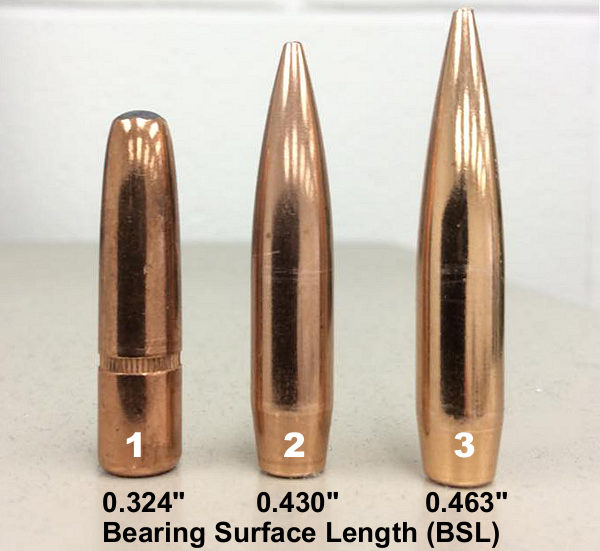
Bullet bearing surface length (BSL) is often overlooked when considering maximum safe powder charges and pressures. In Photo 1, note the differences in the bullets’ appearance. All three are 7 mm, and their maximum weight difference is just five grains. Yet, the traditional round nose, flat base design on the left appears to have much more BSL than the sleeker match bullets. All things being equal, based on appearance, the RN/FB bullet seems likely to reach maximum pressure with significantly less powder than the other two designs.
TECH TIP: Bullets of the same weight (and caliber) can generate very different pressure levels due to variances in Bearing Surface Length (BSL).
Bullet 1 (L-R), the RN/FB, has a very slight taper and only reaches its full diameter (0.284 inch) very near the cannelure. This taper is often seen on similar bullets; it helps reduce pressures with good accuracy. The calculated BSL of Bullet 1 was ~0.324″. The BSL of Bullet 2, in the center, was ~0.430″, and Bullet 3’s was ~ 0.463″. Obviously, bullets can be visually deceiving as to BSL!
Some might be tempted to use a bullet ogive comparator (or two) to measure bullets’ true BSL for comparison’s sake. Unfortunately, comparators don’t typically measure maximum bullet diameter and this approach can be deluding.
Note: Due to time constraints, the writer used an approximate, direct measurement approach to assess the bullets’ different BSLs. While fairly repeatable, the results were far from ballistics engineer-grade. Still, they are adequate for this example.
Photo 2: The Perils of Measuring Bearing Surface Length with Comparators
In Photo 2, two 7mm comparators have been installed on a dial caliper in an attempt to measure BSL. Using this approach, the BSLs differed sharply from the original [measurements]. The comparator-measured Bullet 1 BSL was 0.694” vs. 0.324” (original), Bullet 2 was 0.601” (comparator) vs. 0.430” (original), and Bullet 3 (shown in Photo 2) was 0.602” (comparator) vs. 0.463” (original). [Editor’s comment — Note the very large difference for Bullet 1, masking the fact that the true full diameter on this bullet starts very far back. You can use comparators on calipers, but be aware that this method may give you deceptive reading — we’ve seen variances just by reversing the comparators on the calipers, because the comparators, typically, are not perfectly round, nor are they machined to precision tolerances.]
Thanks to the U.S. Army Marksmanship Unit for allowing the reprint of this article.
Spring is just two days away (March 20, 2025). That means the shooting season in many areas will be starting soon. If you need ammo for your rifles and handguns it pays to comparison shop. Smart shooters can benefit by price-shopping to get the best deals on factory-loaded ammunition, particularly for popular cartridge types such as .22 LR, 9x19mm (9mm Luger), .357 Mag, .223 Rem (5.56×45), and 6.5 Creedmoor. It this article we list 15 reliable online sources for factory-loaded ammo. You may want to bookmark this page so you can quickly scan and price-check multiple vendors. In addition, you can use a service such as AmmoSeek.com.
Why Should You Shop for Ammo Online?
By shopping online for ammo, you can save money, get a wider selection, and get bulk discounts. GunDeals.com explains: “Online purchases [can] save you a lot of money [and can] also save your time… one of the most important advantages is definitively the huge selection.” With online retailers you can quickly compare prices, and you will often get a discount on a large order (300 rounds or more) that is not available in local stores. Note, with some large vendors such as Cabela’s and Sportsman’s Warehouse you can order online then pick up in a local store.
Are There Restrictions on Online Ammo Purchasing?
In most (but not all) U.S. states is it legal to order ammunition online to be shipped to your residence. However, you MUST check your State and local laws and regulations. In some states and/or cities, it is ILLEGAL to purchase ammunition online for shipment across state lines with direct delivery. For example, in California, all ammo must be purchased from a licensed ammo dealer/vendor with a state background check (so much for the Second Amendment)*. Likewise Washington DC, and Hawaii do not allow online ammunition purchases. And there are restrictions in New York City. In Alaska there are multiple shipping regulations that impact ammo deliveries from online sales so many vendors do not ship to Alaska.
*In some instances ammo can be purchased online from an out-of-state seller who will then ship to an authorized, in-state California vendor who may transfer the ammo for a fee with background checks as required by CA law.
In response to the rapidly growing number of first-time gun buyers in the USA, the NRA’s Education & Training Division is offering multiple Online Gun Safety Courses that can be done online at home. The six NRA Online Gun Safety Courses ARE:
Each course, lasting from one to eight hours, is available online at NRAInstructors.org. To Access the 0nline training options, first CLICK HERE. Then under the Heading “DISTANCE LEARNING”, you will see options. CLICK the small gray box at the left of the title to select the course. IMPORTANT — Next you MUST SCROLL to the bottom of the NRA webpage to SEARCH. Select your state or Zip code, then you will get a list of the moderated online courses in your area.
Here is the Procedure to Follow:
1. CLICK HERE to Access ALL Course Listings
2. Select a “Distance Learning” Course.
3. Scroll Down and SEARCH for your State or Zip Code.
4. Review Course Dates and Times.
For example, here are the listed NRA online safety courses for Texas only. Elsewhere (in other states), YOUR list will be different!
NRA ONLINE Training Courses Sample List
The listed “blended” courses typically involve an online lecture segment followed by hands-on training at a range at a later time. Though range time is an important part of the classes, there is still a wealth of knowledge available in the online programs. “The NRA recommends that all new gun owners seek professional training at the range, but that doesn’t mean you can’t get a head start on learning the basics of firearm safety at home”, said Joe DeBergalis, Exec. Dir. of NRA General Operations.
At the request of our readers, we provide select “Deals of the Week”. Every Sunday afternoon or Monday morning we offer our Best Bargain selections. Here are some of the best deals on firearms, hardware, reloading components, optics, and shooting accessories. Be aware that sale prices are subject to change, and once clearance inventory is sold, it’s gone for good. You snooze you lose.
NOTE: All listed products are for sale to persons 18 years of age or older. No products are intended for use by minors.
1. Peterson Cartridge — New Direct Sales, with 10% OFF
⏺️ Now buy cartridge brass direct from Peterson and save 10%
If you’re looking to grab some top shelf brass consider going straight to source with the Peterson Cartridge ‘Buy Direct’ Sale. Peterson brass is now available direct from the manufacturer and for a limited time you can save 10% on your entire purchase. This 10% Off promo is good through March 31, 2025. With direct sales you also get fast delivery.
2. Graf & Sons — Hornady Lock-N-Load Kit, $526.49
⏺️ Full-featured complete reloading system, now 10% Off
If you are getting started in reloading Hornady makes it easy with its Lock-N-Load Classic Deluxe Single Stage Reloading Press Kit. This combo, the most complete single stage reloading package Hornady offers, includes Single Stage Press, powder measure (with bracket), digital scale, case prep tools, powder trickler, bullet puller, priming tool, reloading manual and much more. This big kit includes 21 different tools — basically everything you need to reload except dies.
3. CDNN Sports — Walther Pistol Sale, plus 3 Free Mags with PDP
⏺️ Sale on centerfire and rimfire Walther handguns, FREE Mags or StopBox
We like the triggers, ergonomics, and accuracy of Walther handguns — both rimfire and centerfire types. And right now you can get major savings (up to 50%) with the CDNN Walther Pistol Sale. Plus, along with a major discount you can get 3 FREE Magazines with a Walther PDP model pistol. Or, with the purchase of a Walther P22 rimfire pistol you get a FREE StopBox locking case ($99 MSRP).
4. Amazon — Vevor 50″ Rifle TSA-Std Hard Case, $134.99
⏺️ Good waterproof hard case with wheels — great value (may be $107.09)
Protecting your firearms requires a good, tough transport case. The VEVOR 50″ Rifle Case features 3 layers of fully-protective foam, solid locking points, wheels, and a IP67 waterproof case. This VEVOR gun case meets all TSA gun case requirements, making it a good choice for marksmen and hunters who travel by air. At just $134.99 this is a good deal — cheaper than other sturdy, wheeled rifle cases of similar size. NOTE: This has bounced down to $107.09 multiple times on 3/17/2025 (See PHOTO). Try to grab one at that $107.09 low price.
⏺️ Quality Electronic muffs plus rest good for rifle sight-in
For sighting-in rifles and load testing a quality rest is important. One affordable option is the Birchwood Casey Alpha Shooting Rest. With a combo sale now at MidwayUSA you can get this Alpha Rest PLUS Walker’s Razor Slim Electronic Earmuffs ($60 value), both for just $139.99 total. This rest works well for sighting-in hunting and varmint rifles and it also can secure your rifle for cleaning and maintenance. This Birchwood Casey rest/muffs combo is now $120.00 off the regular MidwayUSA price — a 46% discount.
6. Midsouth — 2000 Rounds Aguila .22 LR Ammo, $114.99
⏺️ Good reliable rimfire ammo for just six cents a round
Here is one of the best deals on rimfire ammunition that we’ve seen in years. Right now at Midsouth, you can get 2000 rounds of Aguila .22 LR High Velocity 40gr ammo for just $114.99 on sale. As shipped in four 500rd boxes, that works out to just $2.87 per 50 rounds (6 cents per round). This Aguila ammo works well for both rimfire pistol shooting and rimfire rifle plinking.
Ever serious shooter should have a handy shooting mat that protects you and your gear on the ground. One very affordable and versatile option is the BZTAC Waterproof Tactical Foldable Shooting Mat (#ad). Lightweight, comfortable and water resistant, this mat has a closed-cell-foam interior plus a sealed surface layer that’s easily wiped clean. Fully extended this mat measures a big 75″ long x 22″ wide, yet weighs just 1.25 pounds. Folded in half it works for sitting or kneeling positions. Conveniently, this mat can fold up into a compact 15″ x 11″ rectangle that’s easy to store and transport.
8. Creedmoor Sports — Hornady One Shot Case Lube, $11.95
⏺️ Very effective and handy case lube favored by users
Are you looking for a easy way to lube a lot of brass without having to manually rub each case with lube? Try Hornady One Shot Spray Case Lube. This popular lubricant has no petroleum, teflon, or synthetic silicone ingredients so it will not contaminate your powder or primers. Just “spray and go” to prep cases for sizing (both in single stage and progressive presses). This One Shot lube is popular with handloaders from many disciplines — F-Class, ELR, PRS/NRL and more.
9. Amazon — Kynup 6″ Digital Calipers, $19.99 with Coupon
⏺️ Digital waterproof calipers for use at home and at the range
Every handloader needs a good set of calipers. One affordable option (now just $19.99 with coupon), is the Kynup 6″ Stainless Digital Calipers (#ad). These “waterproof” calipers have a highly visible screen plus a 6-inch (150mm) measurement range with accuracy to ±0.001 inches or 0.02 mm. The Splash Proof micrometer is constructed of stainless steel and has a strong frame with lockable head. Note: List Price is $29.99, but you can click a $10.00 Off coupon button to lower your net cost to $19.99.
As an Amazon affiliate, this site can earn revenues through sales commissions.








 Bullet 1 (L-R), the RN/FB, has a very slight taper and only reaches its full diameter (0.284 inch) very near the cannelure. This taper is often seen on similar bullets; it helps reduce pressures with good accuracy. The calculated BSL of Bullet 1 was ~0.324″. The BSL of Bullet 2, in the center, was ~0.430″, and Bullet 3’s was ~ 0.463″. Obviously, bullets can be visually deceiving as to BSL!


