Eurooptic vortex burris nightforce sale


teslong borescope digital camera barrel monitor


As an Amazon Associate, this site earns a commission from Amazon sales.


February 8th, 2026

Sunday GunDay: Eye-Catching Rifles — The Beauty of Wood

doan trevor figured wood walnut stock custom wood laminate sunday gunday

For this 2026 Super Bowl Sunday, we celebrate the beauty of highly-figured wood with a collection of custom rifles. In our Shooters’ Forum, there is a long-running Gun Glamour thread that showcases many beautiful wood-stocked rifles. Today we feature some very handsome rifles from that Forum Thread as well as other rifles we’ve featured in the Daily Bulletin.

Two F-Open Beauties with Walnut Laminates

Delaware F-Open F-Class rifle Cerus Brux barrel Panda Action

Cerus-stocked Special from Cigarcop
Forum member Keith W. (aka “Cigarcop”) of KW Precision LLC is a talented riflesmith whose projects display outstanding finish work and attention to detail. Keith does some of the best bedding work we’ve ever seen. Back in 2018, Keith built a stunning .284 Win F-Class rig for a shooter in Delaware. It’s a beauty, that’s for sure.

Delaware F-Open F-Class rifle Cerus Brux barrel Panda Action

Check out the stunning Cerus F-Open stock. This features multiple laminations with highly-figured Walnut on the sides. This certainly ain’t your “off-the-shelf” laminated stock. This just shows the beauty that can be achieved with carefully-chosen lamination layers (plus 12 coats of clear).

Delaware F-Open F-Class rifle Cerus Brux barrel Panda Action
This beautiful F-Open rig features a laminated wood stock with stunning figured walnut on the outside.

Another KW Precision F-Open Beauty
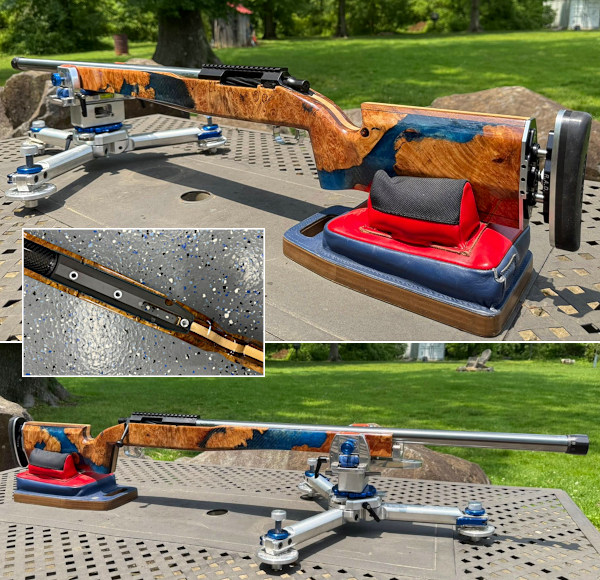
kw precision f-open stock

Here’s another stunning F-Open rig crafted by Keith of KW Precision. This features a BAT M action with BixN’Andy trigger. The 1:9″-twist Brux barrel is chambered in 7-6.5 PRC and fitted with a Cortina V2 Tuner. The handsome laminated Dennis Ray stock carries a Hart R.A.D. 2A recoil reduction system.

doan trevor figured wood walnut stock custom wood laminate sunday gunday

Shiraz Balolia F-Open twin rifles Cerus Kelbly Golden Bear action figured walnut

A Beauty for the Boss (of Grizzly.com)
This F-Class rifle belongs to Shiraz Balolia, Chairman/CEO of Grizzly Industrial. Shiraz finished the stock himself: “I installed the bottom wider track for my rear bag and also carved out the finger grooves in the grip. The blank was quite long so I cut off approximately two inches from the front end of each stock and also deepened the large tracking cavity under the fore-end. I went ahead and inlaid my name in Mother-of-Pearl on the Walnut stock.” The stock was then sent to Sims Guitar Finishing for clear coating with “wet look” finish. This rifle is chambered for the .300 Shiraz wildcat, an improved .300 WSM.

Shiraz Balolia F-Open twin rifles Cerus Kelbly Golden Bear action figured walnut
F-0pen Stock made of highly-figured Walnut with Curly Maple inner laminations.

Beautiful Rifles from our Forum Gun Glamour Thread

Here are a variety of handsome wood-stocked rifles from our Forum Gun Glamour thread. In that thread, member Kurz posted a dream gun owned by a friend in England. Kurz included a quote from a book created by the rifle’s owner: “There, with my father’s words ringing in my ears, I shall take that ‘step forward’ and order a perfect machine based on the Mauser ’98 action, built from metal and wood by master craftsmen who truly understand that ‘reliable’ and ‘mechanical integrity’ have as much relevance today as they did all those years ago.”
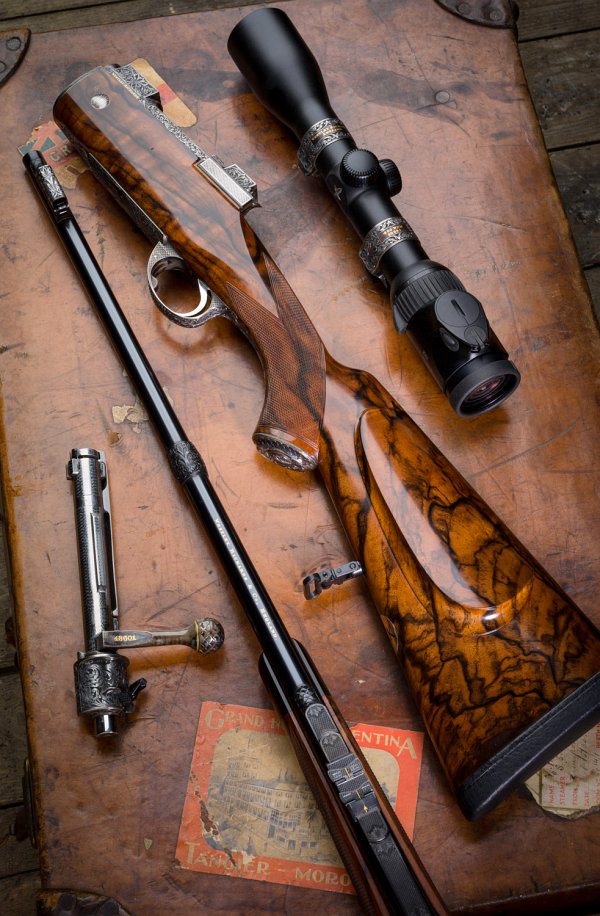
Ruger Number 1 maple walnut glamour shot

A gun can “shoot dots” and still be handsome. Here is a short-range benchrest rifle with a stunning, exhibition-grade Walnut stock. Forum member Josh B found this beauty.

Ruger Number 1 maple walnut glamour shot

Forum member JRS submitted a stunner from Europe. This beauty features a truly exquisite piece of wood with elaborately engraved receiver. It also has escutcheons and special metal work on the grip.

Ruger Number 1 maple walnut glamour shot

Lever-action Falling Block rifles can be beautiful too. This one features a color case-hardened receiver and handsome two-piece fancy wood stock. This was submitted by Forum member Kurz who notes: “Besides exhibition grade walnut, I like the variations available in spalted maple for rifle stocks.”

Ruger Number 1 maple walnut glamour shot

Here is member Oldduc’s Stevens 44 1/2, .38-55 Black Powder Cartridge Rifle, with an extra .218 Mashburn Bee barrel. Very nice blueing along with the figured wood stocks and fore-arms.

Ruger Number 1 maple walnut glamour shot

A competition rifle must be “performance first”. But that doesn’t mean they can’t be handsome too. Forum member XTR’s rifle, an F-TR rig, features Maple wood with Bubinga tips.

Ruger Number 1 maple walnut glamour shot

And wood can work for Benchrest rifles too, when cleverly fashioned in thin carbon-reinforced laminates. Photo from member mdman352.

Martini Cadet 20 Rimmed VarTarg shot

“Wood is Good” — as demonstrated by all the rifles showcased above. In the photo below, master stock-builder Doan Trevor handcrafts a highly-figured wood stock.

doan trevor wood stock stockmaker

Permalink Gear Review, Gunsmithing, Tech Tip No Comments »
February 8th, 2026

Minute of Angle (MOA) Explained by the Experts

one minute of angle

This popular video, viewed 3.9 million times on YouTube, provides a clear explanation of Minute of Angle (MOA) and how that angular measurement is used. Among novice shooters, there is much confusion over this term. In this NSSF Video, Ryan Cleckner, a former U.S. Army Sniper Instructor, defines the term “Minute of Angle” (MOA) and explains how you can adjust for windage and elevation using 1/4 or 1/8 MOA clicks on your scope. This allows you to sight-in precisely and compensate for bullet drop at various distances.

For starters, Ryan explains that, when talking about angular degrees, a “minute” is simply 1/60th. So a “Minute of Angle” is simply 1/60th of one degree of a central angle, measured either up and down (for elevation) or side to side (for windage). At 100 yards, 1 MOA equals 1.047″ on the target. This is often rounded to one inch for simplicity. Say, for example, you click up 1 MOA. That is roughly 1 inch at 100 yards, or roughly 4 inches at 400 yards, since the target area measured by 1 MOA increases in linear fashion with the distance.

More Minute of Angle (MOA) Explanatory Videos

This Gunwerks video explains that Minute of Angle subtends approximately 1″ for each 100 yards (well, 1.047″ to be more precise). That means a Minute of Angle increases in actual measured size the greater the distance of the target from the shooter.

This lengthy (24-minute) video defines Minute of Angle, and uses multiple diagrams to illustrate how MOA angular measurements works. The video also how MOA-based click values translate to point-of-impact changes at various distances.

Permalink - Videos, Optics, Shooting Skills, Tech Tip No Comments »
February 8th, 2026

Cartridge Headspace — How to Measure and Set Dies Accordingly

Brownells Headspace Gauge cutaway chamber drawing SAAMI ANSI

Do you know what the inside of a rifle chamber (and throat zone) really looks like? Do you understand the concept of headspace and why it’s important? If not, you should read the Brownells GunTech article Gauging Success — Minimum Headspace and Maximum COL. This article explains the basics of headspace and shows how to measure headspace (and length to lands) in your barrels with precision. The article also explains how to adjust your full-length sizing dies to “bump the shoulder” as needed.

Why is headspace important? The article explains: “Controlling headspace and setting proper C.O.L. also represent improved safety and reduced cost of handloading. Excessive headspace can cause case head separation and gases in excess of 60,000 PSI escaping from a rifle’s chamber. Too little headspace can result in a chamber forced bullet crimp and a bullet that becomes an obstruction more than a properly secured projectile. Excessive C.O.L. can result in a rifling-bound bullet, a condition that could result in spikes of excessive pressure.” [Editor’s NOTE: It is common for competitive benchrest shooters to seat bullets into the rifling. This can be done safely if you reduce your loads accordingly. With some bullets we often see best accuracy .010″ (or more) into the lands. However, this can generate more pressure than the same bullet seated .010″ away from initial lands contact. As with all reloading, start low and work up gradually.]

Brownells Headspace Gauge cutaway chamber drawing SAAMI ANSI

How is headspace specified? Most cartridges used within the United States are defined within ANSI/SAAMI Z299.3-4. Brownells explains: “In the case of the .243 Winchester, as an example, there are pressure specifications, cartridge drawings and, as pictured above, chamber drawings. Armed with a chamber drawing, each manufacturer producing a firearm for the .243 Winchester knows the proper standard dimension to cut chambers and set headspace. Notice there are two headspace reference dimensions for the chamber. The upper is a place in the chamber where the shoulder is .400″ in diameter; the “datum” or “basic” line. The lower is the 1.630″~1.640″ minimum – maximum dimension from the breech face (bolt face) to that point in the chamber that measures .400″.”

The actual headspace of any firearm is the distance from the breech face to the point in the chamber that is intended to prevent forward motion of a cartridge.

Finding Cartridge Length to Lands with OAL Gauge
Using a comparator on a set of calipers, you can quickly determine cartridge base-to-ogive length. This is the measurement from the base of the case to the forward-most full diameter section of the bullet, which is for convenience called the ogive. (Technically, the “ogive” is the full curve from bullet tip back to full-diameter ring). Shown here, that ogive is 0.243″ diameter.

The next step is using a modified (threaded) case with a Hornady OAL tool to determine Length-to-Lands (LTL) in your rifle’s chamber. During this measurement process, the modified case, with a bullet in its neck, is inserted in the chamber. Go slow, take your time. Here are 5 tips that will help you get repeatable and reliable LTL measurements:

1. Start with a clean chamber and clean barrel throat.
2. Make sure the modified case is fully screwed down and seated on the OAL Gauge. It can sometimes unscrew a bit during repeated measurements.
3. Insert the modified case slowly and gently, but ensure the shoulder of the modified case is fully seated on the end of the chamber.
4. Push the gray plastic rod GENTLY. It is common for the bullet to be tilted a bit. You want to allow the bullet to self-center in the throat BEFORE you apply much pressure. Then tap a couple times and push until you feel resistance. Do NOT push too hard — that will jam the bullet in the lands.
5. Repeat the measurement at least 3 more times. If you follow our instructions, you should, typically, get a repeatable measurement, within 0.0015″ or so, 3 out of 4 times.

Permalink Bullets, Brass, Ammo, Reloading, Tech Tip No Comments »