Eurooptic vortex burris nightforce sale


teslong borescope digital camera barrel monitor


As an Amazon Associate, this site earns a commission from Amazon sales.


February 24th, 2026

Reloading Powder Grain Shapes — What You Need to Know

Vihtavuori loading propellant reloading powder N133 N150 N140 N550 ball flake stick extruded perforated powders

POWDER GRAIN SHAPES — What You Need to Know

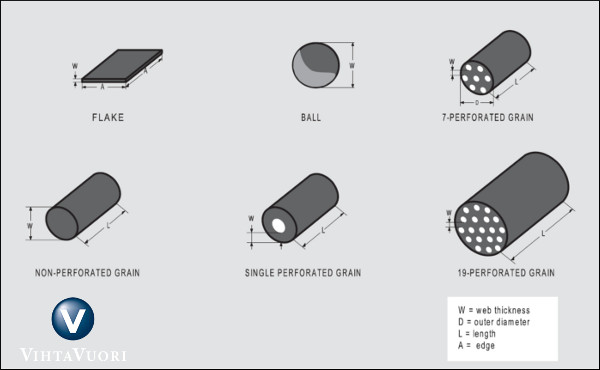
The shape of powder grains has a profound effect on the performance of the powder charge, as it concerns both pressure and velocity. There are multiple powder shapes including flake, ball, and extruded or “stick” (both solid and perforated).

So how does powder grain shape affect pressure and muzzle velocity?
In general, it can be said that powder that burns progressively achieves a desired muzzle velocity at lower maximum pressure than a powder that burns neutrally, not to mention a degressive powder. As grain size increases, the maximum pressure moves towards the muzzle, also increasing muzzle blast. Muzzle velocity and pressure can be adjusted by means of the amount of powder or loading density, i.e. the relationship between the powder mass and the volume available to it. As the loading density increases, maximum pressure grows.

All Vihtavuori reloading powders are of the cylindrical, single-perforated extruded stick type. The differences in burning rate between the powders depend on the size of the grain, the wall thickness of the cylinder, the surface coating and the composition. Cylindrical extruded powders can also have multi-perforated grains. The most common types are the 7- and 19-perforated varieties. A multi-perforated powder grain is naturally of a much larger size than one with a single perforation, and is typically used for large caliber ammunition.

Other types of powder grain shapes include sphere or ball, and flake. The ball grains are typically used in automatic firearms but also in rifles and handguns. The ball grain is less costly to produce, as it is not pressed into shape like cylindrical grains. Flake shaped grains are typically used in shotgun loadings.
Vihtavuori loading propellant reloading powder N133 N150 N140 N550 ball flake stick extruded perforated powders

Web thickness in gunpowder terminology means the minimum distance that the combustion zones can travel within the powder grain without encountering each other. In spherical powders, this distance is the diameter of the “ball”; in flake powder it is the thickness of the flake; and in multi-perforated extruded powders it is the minimum distance (i.e. wall thickness) between the perforations.

The burning rate of powder composed of grains without any perforations or surface treatment is related to the surface area of the grain available for burning at any given pressure level. The change in the surface area that is burning during combustion is described by a so-called form function. If the surface area increases, the form function does likewise and its behavior is termed progressive. If the form function decreases, its behavior is said to be degressive. If the flame area remains constant throughout the combustion process, we describe it as “neutral” behavior.

The cylindrical, perforated powders are progressive; the burning rate increases as the surface area increases, and the pressure builds up slower, increasing until it reaches its peak and then collapses. Flake and ball grains are degressive; the total powder surface area and pressure are at their peak at ignition, decreasing as the combustion progresses.

Learn More with FREE Vihtavuori Reloading APP »

Vihtavuori loading propellant reloading powder N133 N150 N140 N550 ball flake stick extruded perforated powders


This article originally appeared on the Vihtavuori Website.

Permalink - Articles, Bullets, Brass, Ammo, Reloading, Tech Tip No Comments »
February 24th, 2026

Beware Barrel Bore Obstructions — They Are Very Dangerous

Obstructed Barrel Explosion Accident kaboom
Above is a sectioned barrel showing an 80gr Sierra that was fired in a .223 bolt action with a cleaning rod in the bore. Both the bullet and the rod are still in the bore.

A Negligent Shooter Gets Lucky
“Here we have a story so filled with negligent acts that I can only marvel that the shooter survived the experience. The photo and narrative were provided by the gunsmith who took in the repair job, my comments are in italics. It’s worth reading, we can’t get enough safety warnings in our hobby.” — GS Arizona, Rifleman’s Journal

Description of Incident (with Commentary)
The shooter had a stuck case in his .223 chamber. The stuck case was actually a loaded round that didn’t fire. It wouldn’t extract because it was a .222 case that got mixed in with his .223 brass. [He had loaded the wrong brass.] I saw the loaded round with an 80gr bullet in it and a light primer strike. Negligent Act #1: Wrong brass was mixed in with the brass being reloaded.

The shooter removed the stuck case with a 3-piece aluminum rod. Negligent Act #2: Hammering out a loaded round with a cleaning rod. People have been killed doing this as the round can fire and drive the cleaning rod right into you. I remember one such incident about 5 years ago, the shooter was pounding out a stuck round, the cleaning rod went right through him, he didn’t survive.

The shooter didn’t notice only two segments of the cleaning rod came out when he removed it. Negligent Act #3: If you put anything at all down the barrel of a rifle you’d better make darn sure you got it all out before doing anything else!

He then chambered another round and fired it. Negligent act #4: If you’ve had a barrel obstruction of any kind, and if you’ve put something in the barrel, look through the barrel before proceeding! Within the past two years I know of an incident in which a benchrest shooter was killed in exactly this manner. The pressure built up and the rifle bolt came out of the receiver and into his chest.

The shooter is ‘OK’, but did not escape unscathed. He said there was a huge explosion and after regaining his senses found he was bleeding heavily from his forehead. The blood was thick enough that it ran in his eyes and he couldn’t see. In his words “I thought I was going to die”.

He has what looks like a pretty deep cut about an inch long on the side of his head, right in line with his right eye starting where the eye socket turns out to the side of the skull. And no telling what he’s got in the way of brass particles embedded in his forehead.

He was shooting on private property, and was alone when this happened. Negligent Act #5: Don’t shoot alone! Accidents happen, this is just one more example. If we could predict accidents, we wouldn’t have them. Always shoot with at least one other person.

He managed to get the bleeding stopped, or at least under control, packed his car and drove himself home without seeking immediate medical attention. Negligent Act #6: This one could have cost him his life after being lucky enough to survive the incident. There’s no way to know what’s happened just after an incident like this. He should have been at a hospital getting checked for shrapnel in the head.

The rod and slug could not be driven out. Since the barrel had a high round count there was no point in trying to salvage it. Note that the aluminum rod is expanded to a tight fit in the bore for the first couple inches. The base of the bullet is a little over 2″ from the mouth of the chamber.

What we’ve seen here is negligence and an absolute indifference to the established rules of safe reloading and gun handling, from start to finish, capped off with the shooter’s foolish avoidance of medical treatment. This shooter is lucky to be alive, but he’s surely used up all his luck. Don’t assume you’ll be so fortunate.

This article originally appeared in the Rifleman’s Journal website, which is no longer available. The Rifleman’s Journal site was created by German Salazar, who, sadly, passed in 2022. He was a great shooter who helped this website in many ways. RIP German.

Permalink - Articles, Tech Tip No Comments »
February 24th, 2026

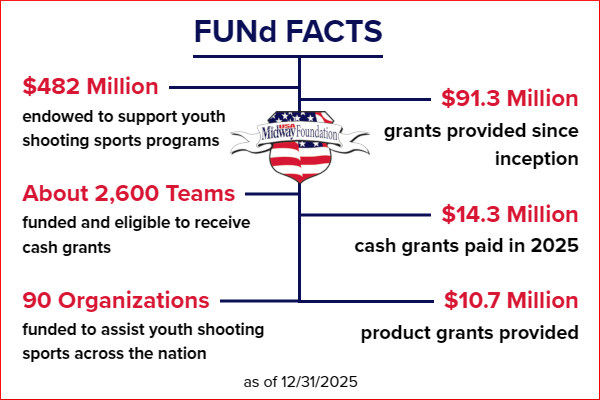
MidwayUSA Foundation Grants $7.5 Million to Youth Programs

Midwayusa foundation millions dollars grants youth shooting programs

Midwayusa foundation millions dollars grants youth shooting programsIn its latest funding cycle, the MidwayUSA Foundation paid over $7.5 million to youth shooting sports teams and organizations. This record-breaking late 2025 grant cycle provided over $5.7 million to 970+ youth shooting teams and over $1.6 million to organizations that work with youth shooting programs. Since 2008, the MidwayUSA Foundation has paid nearly $80 million in cash grants to support youth shooting sports over the years. Foundation grants assist with costs for ammunition, targets, entry fees, and travel. Grants also help cover coach certification costss.

In total, this latest funding cycle provided over $7.5 million to the youth shooting sports community. This payout includes funds to youth shooting teams, organizations, and grants were provided to certain donor-advised endowments. A shout-out to the states of Minnesota, Iowa, Missouri, and Wisconsin for being at the top of the list in cash grant recipients and dollars paid to teams. In addition to youth shooting teams, the MidwayUSA Foundation provides funds to key state, regional, and national organizations that support youth shooting sports.

Midwayusa foundation millions dollars grants youth shooting programs

Rachel Augustine of Missouri 4-H Foundation stated: “The grants we receive from the MidwayUSA Foundation play a crucial role in the success of Missouri 4-H shooting sports. They help us provide essential funding for equipment, volunteer training, and state and national contests, as well as events. Through 4-H shooting sports, youth gain confidence, leadership, and responsibility, while developing a lifelong appreciation for shooting, hunting, and the outdoors.”

Donations Are Tax-Deductible
Donations made to MidwayUSA Foundation are tax-deductible and 100% of each donation goes to the endowment of the donor’s choice — nothing is removed for operations.

Midwayusa foundation millions dollars grants youth shooting programs

The MidwayUSA Foundation is a 501(c)(3) public charity working to sustain and grow youth shooting sports by providing long-term funding to youth shooting teams. For more information please visit MidwayUSAFoundation.org or call 1-877-375-4570.

Permalink - Articles, Competition, Shooting Skills 1 Comment »