“The pessimist complains about the wind; the optimist expects it to change; the realist adjusts the sails.” — William Arthur Ward
Readers often ask us: “Is there a decent, easy-to-comprehend book that can help my wind-reading?” Many of our Forum members have recommended The Wind Book for Rifle Shooters by Linda Miller and Keith Cunningham.
New Edition — Hardback and eBook
The latest, updated edition of The Wind Book for Rifle Shooters was released in May 2020. This 144-page book, first published in 2007, is a great resource. But you don’t have to take our word for it. If you click this link, you can read book excerpts and decide for yourself. When the Amazon page opens, look below the book cover photo, and click the bar labeled “Read Sample”. This lets you preview chapters from the Wind Book, and view some illustrations. Along with the hardback edition ($21.07), Amazon offers a Kindle (eBook) edition for $14.99.
Other books cover wind reading in a broader discussion of ballistics or long-range shooting, such as Applied Ballistics for Long-Range Shooting by Bryan Litz. But the Miller & Cunningham book is ALL about wind reading from cover to cover, and that is its strength. The book focuses on real world skills that can help you accurately gauge wind angle, wind velocity, and wind cycles.
All other factors being equal, it is your ability to read the wind that will make the most difference in your shooting accuracy. The better you understand the behavior of the wind, the better you will understand the behavior of your bullet. — The Wind Book for Rifle Shooters
The Wind Book for Rifle Shooters covers techniques and tactics used by expert wind-readers. There are numerous charts and illustrations. The authors show you how to put together a simple wind-reading “toolbox” for calculating wind speed, direction, deflection and drift. Then they explain how to use these tools to read flags and mirage, record and interpret your observations, and time your shots to compensate for wind.
I believe this is a must-have book if you are a long-range sport shooter. I compete in F-Class Open and when I first purchased this book and read it from cover to cover, it helped me understand wind reading and making accurate scope corrections. Buy this book, read it, put into practice what it tells you, you will not be disappointed. — P. Janzso
If you have one book for wind reading, this should be it. Whether you’re a novice or experienced wind shooter this book has something for you. It covers how to get wind speed and direction from flags, mirage, and natural phenomenon. In my opinion this is the best book for learning to read wind speed and direction. — Muddler
Just last week hundreds of F-Class shooters competed at the 2026 Southwest Nationals in Phoenix, Arizona. The vast majority of F-TR shooters had rifles chambered for the .308 Winchester cartridge (7.62×51), but F-TR rules also allow the .223 Rem (5.56×45). There are some advantages to the smaller .223 Rem round — there’s notably less recoil, bullets and brass are significantly cheaper, and a lot less powder is required. For those who are considering campaigning a .223 Rem F-TR rifle, this story explains how an accurate .223 Rem load was developed. This load development was done by a father for his daughter who was getting started in F-Class competition.
Dad builds an F-TR Rifle for his Daughter and Develops Load
Jeremy Rowland decided to put together an F-TR rifle for his eldest daughter, who enjoys competitive shooting. For his daughter, Rowland chose the .223 Rem option because it has less recoil and components are less costly than the .308 Win. Here is Rowland’s account of how he developed a .223 Rem load. For more details (with data charts), read Jeremy’s FULL STORY on Sierra Bullets Blog.
Journey to Find a .223 Rem F-Class Load
by Jeremy Rowland, Reloading Podcast
My oldest daughter has been to several matches with me, and has even competed in several, using her .243. [A few seasons back] I decided, she would compete with a .223 Rem in F-TR. Looking for a good starter rifle, I settled on the Savage Axis Heavy Barrel since it has a 1:9″ twist. This would be a great little rifle for her to learn on. The rifle was shot unmodified, as it came from the factory. A Sinclair F-Class Bipod w/micro elevation adjustment was fitted to the front.
Next came finding the components I wanted to use for her match loads. After spending hours and hours running numbers on JBM stability calculator as well as in my iPhone Ballistic AE app, the 69 gr Sierra Tipped MatchKing® (TMK) looked really good. So that’s what I decided to go with. I jumped in head first and ordered a bulk pack of the Sierra 69 gr TMKs. I had settled on Hodgdon CFE 223 powder since it shows good velocity. I decided to go with once-fired Lake City brass with CCI BR4 primers.
Next came the testing. I decided to run a ladder test (one shot per charge from min to max looking for the accuracy node). The ladder test ranged from 23.5 grains to 25.6 grains, in 0.3 grain increments.
Bullet: 69 gr Sierra Tipped MatchKing®
Case: Lake City (mixed years, sorted by case capacity)
Primer:CCI BR4
Powder: Hodgdon CFE 223 (one round each from 23.5 to 25.6 grains)
Cartridge OAL: 2.378″
Base to Ogive: 1.933″ (.020″ off lands)
After his ladder test, Rowland settled on a load of 25.2 grains of Hodgdon CFE 223. He then fine-tuned his load with different seating depths: “I loaded up 5 rounds each at .020″ off lands, .015″ off lands, .010″ off lands, and .005″ off the lands. Here are the results from the best group for OAL/Ogive fine tuning. As you can see, I think I’ve found a winner in these 69 gr Sierra Tipped MatchKings.”
AccurateShooter’s Target Page provides over 50 FREE downloadable targets. You’ll find all types of targets — sight-in targets, varmint targets, rimfire targets, bullseye targets, tactical targets, load development targets and more. CLICK HERE for all our free targets, including our popular LOAD DEV target.
On this load development target, all your load data fits neatly in the boxes under each target. The diamonds have 1/2″ sides and you can align your cross-hairs on the horizontal and vertical lines. When we test, we crank in a little elevation, setting the point-of-impact higher. That way our shots fall in the gray circles, leaving the red diamonds intact for precise aiming.
Storm Tactical Targets — Hundreds of FREE, Printable Targets
If you want an even greater selection of targets, specialized for PRS and NRL shooters, Storm Tactical offers a vast collection of tactical targets, available in three different versions: MOA, MIL Yards, and MIL Meters. These target sets were created with input from Sniper’s Hide. Storm Tactical also created a great rimfire target set. This includes side-by-side target blocks for fun, one-on-one competition. If you shoot NRL22 or just enjoy shooting with a buddy, we highly recommend the rimfire target set.
Overall there are 299 Storm Tactical Targets in four sets.
CLICK links to launch each Storm Tactical target collection. Then you can click the download icon to save to your hard drive. OR, you can scroll up and down to select the target(s) you like which you can tell your printer to print. We do recommend downloading the complete archives. File sizes are listed.
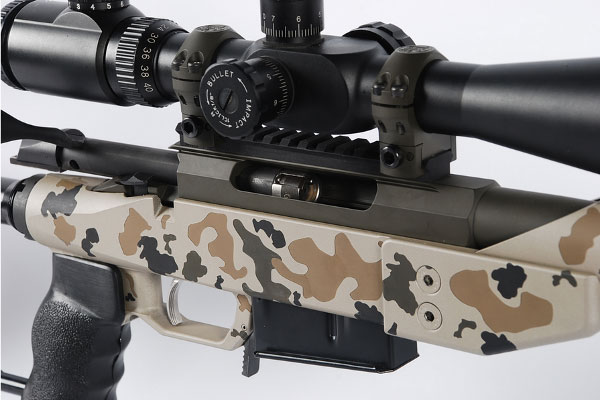
Here’s a Tikka T3 in Third Eye Tactical cerakoted chassis.
Rimfire Twin Target, for One-on-One Shooter Challenges
You’ll find this fun target on the third page of the Rimfire Target Pack. Just download the PDF file and instruct your printer to deliver page three. Or print out all six (6) rimfire targets if you like.
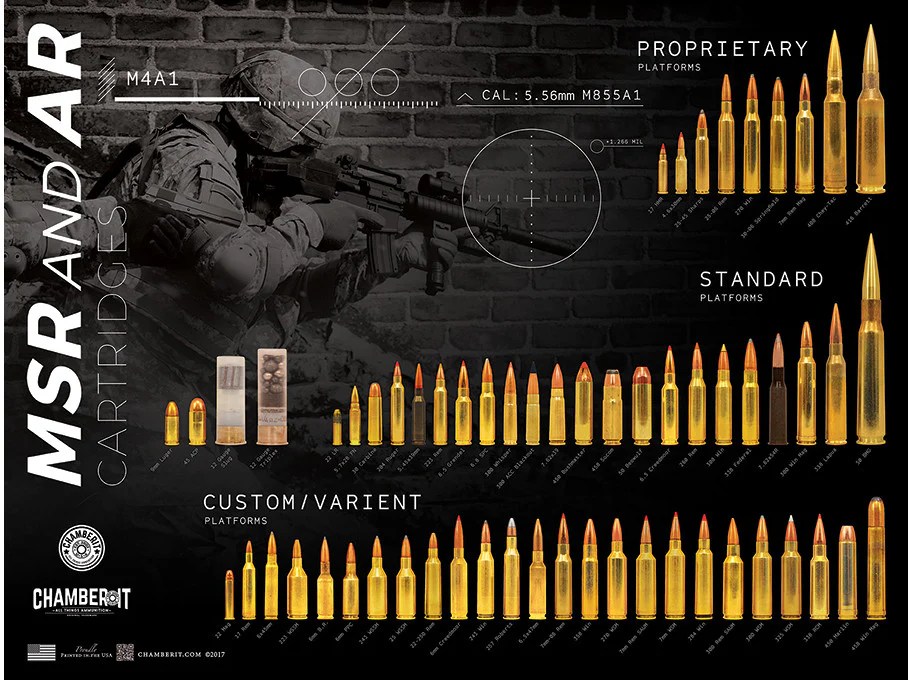
Need something for the walls of your “man cave” or reloading room? Looking for a great birthday gift for one of your shooting buddies? The creators of the Cartridge Comparison Guide offer a collection of wall posters showing ammunition types from 17 caliber rimfire cartridges all the way up to giant 35mm military rounds. ChamberIt.com currently offers 15 different large wall posters that display a huge variety of cartridge types. For example, the American Standard Poster (shown above) contains every standardized cartridge mass produced in the USA as of 2021. The cartridges are 100% to scale (life size). These posters feature full color images on high gloss / high quality 100-lb poster paper.
For example, the new MSR & AR Cartridges poster contains 60 cartridges that are commonly available in either a standard, customized, or proprietary MSR or AR platform with calibers from .17 Cal up to .500 Cal. This $14.92 poster displays 60 rifle cartridge types at true size (within 4/1000 of an inch).
MSR & AR Cartridges Poster Click to view large size poster.
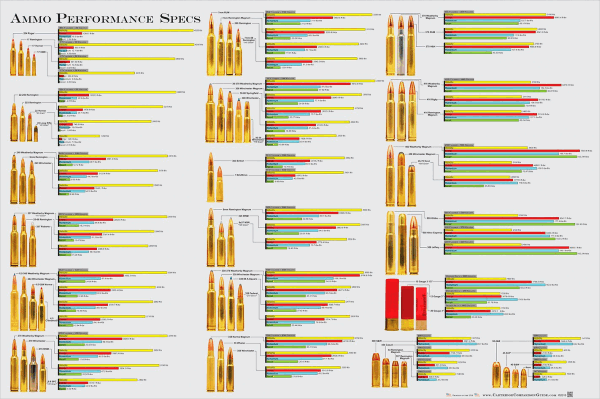
Ammunition Performance Specifications Poster
There is also an interesting Ammo Performance Specs poster. This shows dozens of popular hunting cartridges with the velocity, energy, momentum and recoil for each cartridge displayed in a bar graph.
This shows the actual size of the Ammo Performance Poster as displayed on a wall.
MIL-system scopes are popular with tactical shooters. One advantage of First-Focal-Plane (FFP) MIL scopes is that the mil-dot divisions in the reticle can be used to estimate range to a target. If you know the actual size of a target, you can calculate the distance to the target relatively easily with a mil-based ranging reticle. Watch this helpful NRA video to see how this is done:
Milliradian Definition and Yardage Ranging Formula
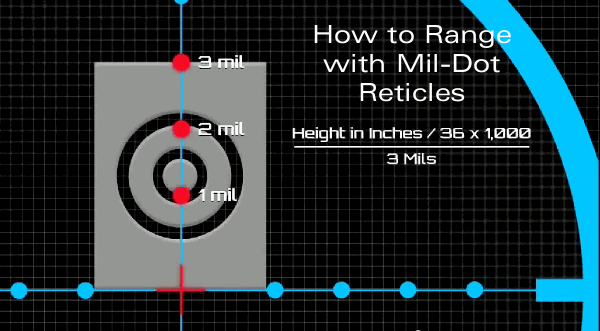
“MIL” or “Milrad” is short-hand for Milliradian, a unit of angular measurement. The subtension of 1 mil equals 3.6 inches at 100 yards or 36 inches at 1,000 yards. (In metric units, 1 mil equals 10 centimeters at 100 meters or 1 meter at 1,000 meters.) Knowing this subtension and knowing the size of the target (or a reference object near the target) allows the distance to the target to be estimated with considerable accuracy. The formula used to calculate range (in yards) based on MIL measurement is:
Height of Target in inches (divided by 36) x 1000, divided by the number of mils.
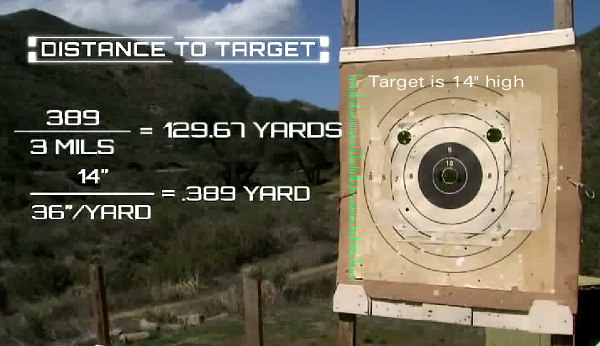
For example, if a 14″ tall target spans 3 mils from top to bottom, the distance is 129.67 yards calculated as follows: 14/36 x 1000 = 389, then divided by 3 = 129.67. You can also use a different conversion to find distance in meters.
Can You Estimate Range with an MOA-Marked Reticle? Yes You Can…
Reader Josh offers this handy advice: “It worth noting that the ability to measure range is not unique to mil-based systems. A MIL is just another unit for measuring angles, and any angular measurement will work. Considering that just about everybody knows that 1 MOA is about an inch per hundred yards, similar formulae can be developed for ranging with MOA marks. The advantage with mils is the precise relationship between units — the MOA-inch measurement is imprecise (being off by 0.047″) — so in principle MILs are a better unit”.
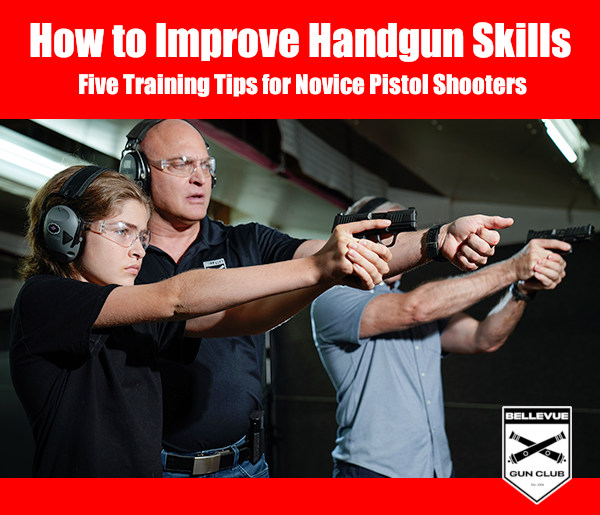
Photo from Training Program at Bellevue Gun Club, Washington State’s “premier indoor shooting facility”.
At AccurateShooter.com, our primary focus is precision target shooting with rifles. But it’s definitely fun to shoot pistols too, and we bet most of our regular readers own handguns. Here are five tips for shooting safely and accurately with handguns. These pointers will help you advance your skills and have more fun with your pistols and revolvers.
1. Make Sure Safety Is Number One
Whether you own one gun or one hundred, gun safety must always be your main priority. In this video, Smith & Wesson Team Captain Julie Golob covers the basics of gun safety.
2. Start with a .22 LR Handgun
We strongly recommend that new pistol shooters start off with a .22 LR rimfire handgun. The .22 LR cartridge is accurate but has very low recoil, less “bark” than a centerfire, and very little smoke and muzzle flash. New shooters won’t have to fight muzzle flip, and won’t develop a flinch from the sharp recoil and muzzle blast common to larger calibers. With the .22 LR, the trainee can focus on sight alignment, breathing, and trigger pull. When he or she has mastered those skills, move on to a .38 Special or 9mm Luger (9x19mm).
What gun to use? We recommend the 10-shot Smith & Wesson Model 617. This is ideal for initial training, shooting single action, slow-fire. You want to focus on sight picture and holding steady. Shown above is the 4″-barrel Model 617 which balances well. There is also a 6″-barrel version. It has a longer sight radius, but is a little nose-heavy. Both are great choices. They are extremely accurate and they boast a very clean, precise trigger.
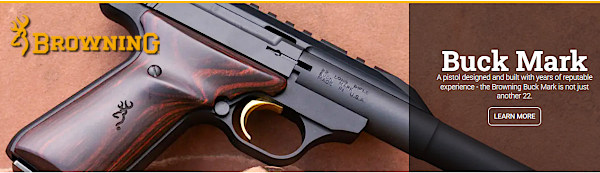
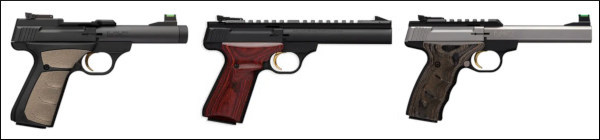
If you prefer a semi-auto .22 LR pistol, we recommend the Browning Buck Mark series. Buck Marks are very accurate and very reliable. There are now 58 different Buck Mark models, priced at $469.99 to $839.99 MSRP. Retail prices start at about $330 for a basic Buck Mark Camper 22 UFX model. Like the S&W Model 617, a good Buck Mark will serve you for a lifetime.
3. Use Quality Targets with Multiple Aim Points
It’s common for new pistoleros to start shooting at cans or clay birds at a public range. That can be fun, but it’s better to start with proper targets, placed at eye level, at 7-10 yards. We like to use targets with large, brightly colored circles. Focus on putting 5 shots in a circle.
We recommend targets that have multiple bullseyes or aiming points — that way you don’t have to constantly change your target. There are also special paper targets that can help you diagnose common shooting problems, such as anticipating recoil. EZ2C makes very good targets with bright, red-orange aim points. You can also use the bright orange Birchwood Casey stick-on Target Dots (right). These come in a variety of diameters. We like the 2″ dot at 10 yards.
Too many new pistol shooters try to move right to rapid fire drills. It’s better to start slow, practicing the basics, under the guidance of a good mentor. If you belong to a club, ask if there are certified instructors who will help out. This Editor learned pistol shooting from a seasoned bullseye shooter, who got me started with a .22 LR revolver and very close targets. Over the course of a few range sessions we progressed to farther targets and faster pace. But the fundamentals were never forgotten. When starting your pistol training, it’s wise to view some instructional videos. Top Shot Champion Chris Cheng hosts an excellent Handgun 101 Series produced by the NSSF. We’ve linked one of these Handgun 101 videos for Tip #6.
5. SLOW DOWN — This Is Not a Race
When you learned to ride a bicycle, you started slow — maybe even with training wheels. The same principle applies to pistol shooting. When you get started with handguns, we recommend you shoot slowly and deliberately. Start with the handgun unloaded — just work on your sight alignment and breathing. With snap caps in place, try some dry-firing drills. Then progress to live fire. But be deliberate and slow. With the target at 20 feet, see if you can get three successive shot-holes to touch. Believe it or not, many common pistols are capable of this kind of accuracy (but you won’t see many shooters at indoor ranges who pursue that kind of precision). Once you master your form and accuracy, then you can work on your speed.
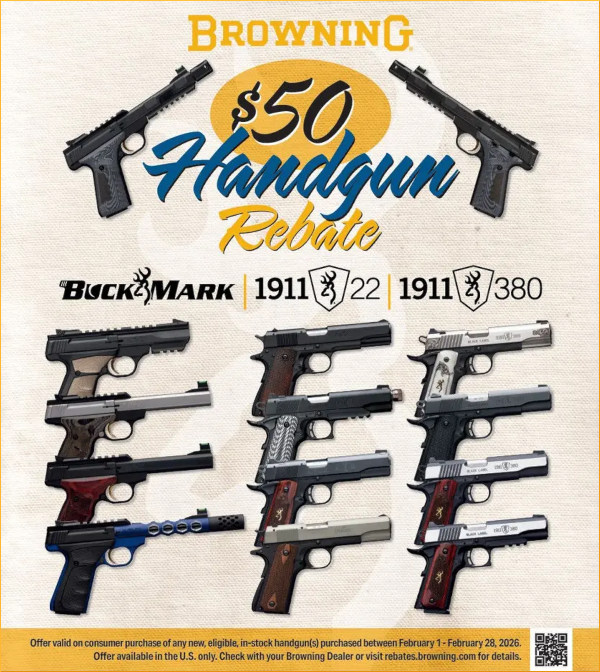
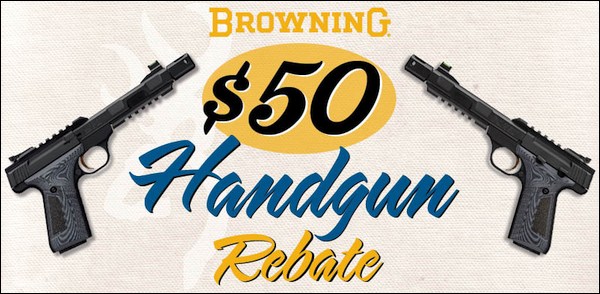
Looking for a nice, new handgun — rimfire or centerfire? Well through the end of February, 2026 you can get a solid $50.00 rebate on a new Browning pistol. This $50 Rebate Offer is valid for consumer purchases of a new, eligible, in-stock handgun purchased between February 1 and February 28, 2026. NOTE: This offer is available in the U.S.A. only.
To qualify you must buy one of three types of Browning handguns before the end of the month: Buck Mark, 1911-22, and/or 1911-380. Our first choice would be a long-barrel .22 LR Buck Mark with a scope rail. There are now 58 different Buck Mark models, priced at $469.99 to $839.99 MSRP. Retail prices start at about $330 for a basic Buck Mark Camper 22 UFX model.
Browning Buck Mark .22 LR — 58 Varieties Offered
Here’s a field test of a Buck Mark Plus stainless UDX model. This features an aluminum alloy frame with Picatinny top rail, and 5.5″ slabside stainless barrel. This model boasts black wood laminate UltraDeluxe grips, adjustable rear sight, and TRUGLO/Marble Arms fiber-optic front sight. MSRP is $759.99.
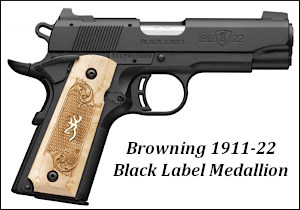
Browning 1911-22 — 85% Scale Rimfire Version of M1911
This video explores the design process behind the 1911-22, a scaled-down version of the iconic Model 1911 .45 ACP pistol. The video highlights the use of 3D modeling to determine the optimal size for a .22 caliber pistol in this format, ultimately settling on an 85% scale. The video also compares the 1911-22 to the full-size 1911, showcasing the similarities in design and functionality.
Key Terms of Browning Pistol Rebate: Offer valid only on the retail purchase of new, eligible, Browning handgun(s) purchased February 1 to 28, 2026. Qualifying purchases must be made from available in-store inventory; no rain checks or prepayments for out-of-stock retail inventory are allowed. To submit your Handgun rebate go to Rebates.browning.com, fill out the online application, and upload supporting documents as required. All applications must be submitted online no later than midnight March 14, 2026. Allow 6-8 weeks for processing and delivery of rebate. Offer valid in USA only, and void where prohibited by law.
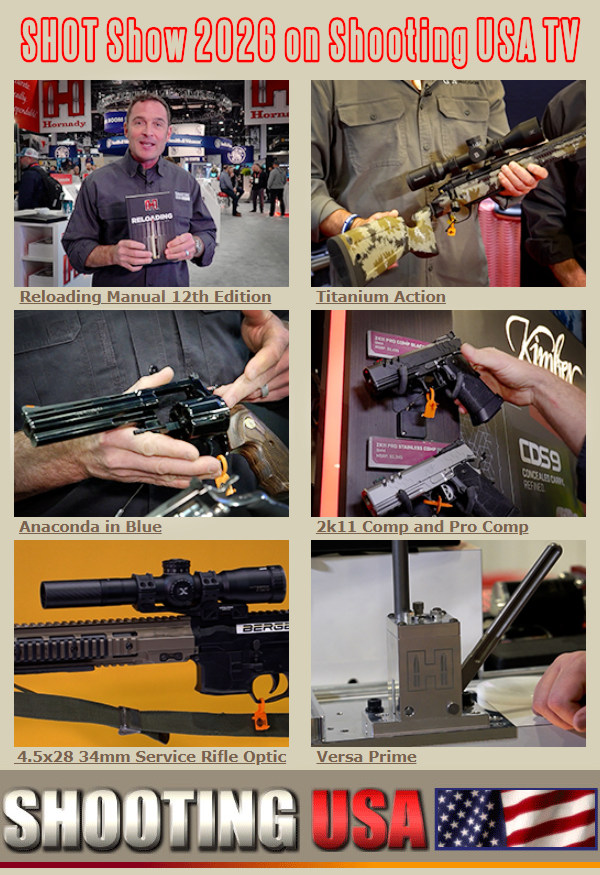
This Week on Shooting USA – The 2026 SHOT Show SHOT Show 2026 is featured on Shooting USA today on the Outdoor Channel. SHOT stands for “Shooting Hunting and Outdoor Tradeshow”. The biggest gun industry convention/tradeshow in the world, this huge event attracted over 2,500 exhibitors. Exhibits occupied over 800,000+ square feet in the Venetian EXPO and Caesars Forum.
If you watch just one episode of Shooting USA TV this year, this might well be a top choice. This episode has very good coverage of products from leading manufacturers including Colt, Smith & Wesson, Kimber, Ruger, Taurus, Les Baer, CMP, Luth AR, GA Precision, Hogue, Hornady, Integrix, FosTec, MCS and more. CLICK HERE for the February 18, 2026 SHOT Show episode highlights.
Shooting USA SHOW TIMES: This Shooting USA Episode airs Wednesday, February 18, 2026 at 9:00 PM Eastern and Pacific; 8:00 PM Central on the Outdoor Channel. If you miss the regular broadcast, you can stream the show online at any time on Vimeo for $0.99 per episode.
More SHOT Show 2026 Videos
Interested in more SHOT Show 2026 product coverage? Here are videos that cover new rifles, new pistols, plus the impressive new Nightforce NX6 line of scopes. The first two videos, covering new rifles and pistols, are hosted by True Pearce, a skilled shooter and GunsAmerica Digest Editor-in-Chief.
Q: What is the most popular gun book in the history of the planet?
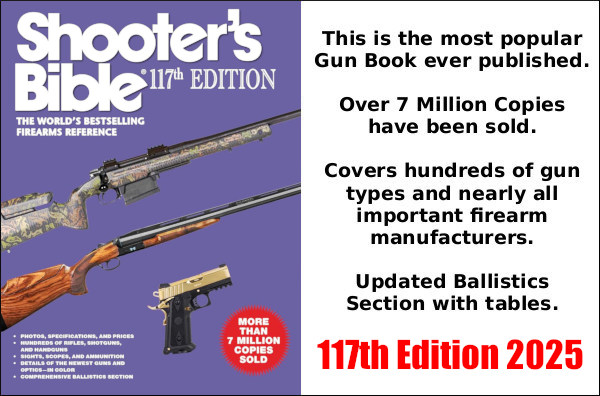
A: That distinction goes to the Shooter’s Bible, which has sold over 7 MILLION copies since it was first published over 80 years ago.
Released in October 2025, the 117th Edition of this respected resource is better than ever. This latest Shooter’s Bible boasts 608 pages with over 270 color photos and more than 1000 black-and-white photos. The latest 117th Edition features many new firearms as well as new optics. This paperback book is now just $25.35 on Amazon, 15% off the $29.99 list price. A Kindle digital edition is also available for $21.99 on Amazon.
Published annually for more than eighty years, the Shooter’s Bible is one of the most comprehensive firearms reference guides in print. The publishers claim that “nearly every firearms manufacturer in the world” is included. The 117th Edition also contains new and/or enhanced sections on ammunition, optics, and accessories, along with updated handgun and rifle ballistic tables. There are also extensive charts of currently available hunting and match bullets for hand-loaders.
While many shooters are now using the internet to get reloading data and equipment specifications, the Shooter’s Bible remains a valuable resource with a great legacy. As one recent Shooter’s Bible purchaser explains: “While it’s true that much of the information contained in the Shooter’s Bible can be found on the Internet, there are many of us who would first rather relax in our easy chair and page through the book at our leisure. If you find an item that catches your fancy, you can then follow up by going to their Web site.”
Another buyer observed: “This [117th edition] is proof that, even with all the attacks on our 2nd Amendment right over the years, the industry has persevered and grown. I hope the day never comes when there will no longer be a reason to publish the Shooter’s Bible.”
The Shooter’s Bible contains a vast collection of firearms product information and descriptions. Hundreds of firearms are listed, complete with specifications and photos. Products from nearly all commercial gun makers on the planet are included.
More Great Gun Books From Shooter’s Bible Publishers
The Tactical Hyve YouTube channel currently hosts over 1,100 videos! Here are three of our favorite Tactical Hyve videos focusing on pistol marksmanship. These videos cover basic essential techniques as well as advanced handgun skills used in competition. These videos feature highly-skilled handgun experts.
1. How to Aim a Pistol with Iron Sights or Red Dot
We recommend this video for persons training for a CCW permit, or who are getting started in pistol shooting competition. The video shows proper technique for using iron sights. In addition, it offers some important advice for shooting with Red Dots. Shooting with Red Dot sights can be easier than with iron sights because you only have to put the dot on the target, rather than align front blade with rear notch. But it does take some familiarization to get things right. And persons with astigmatism can have challenges with Red Dot sights.
2. Get Your Sights Back On Target Fast
This popular video covers a very important skill for both pistol competition and defensive handgun use — getting your sights back on target quickly. This informative video covers grip, sight picture, trigger control, and how to handle recoil and muzzle rise. If you’re considering action pistol or 3-gun matches, definitely watch this video.
3. Five Most Common Pistol Shooting Mistakes
In this video, Myles, the founder of Tactical Hyve, talks about the five most common pistol shooting mistakes he sees in classes and how to correct them. Many folks begin pistol shooting without a qualified instructor. Or they try to imitate what they see on TV. This can lead to new pistol shooters forming bad habits. This video helps handgunners correct those bad habits. This popular video has 1.9 million views.


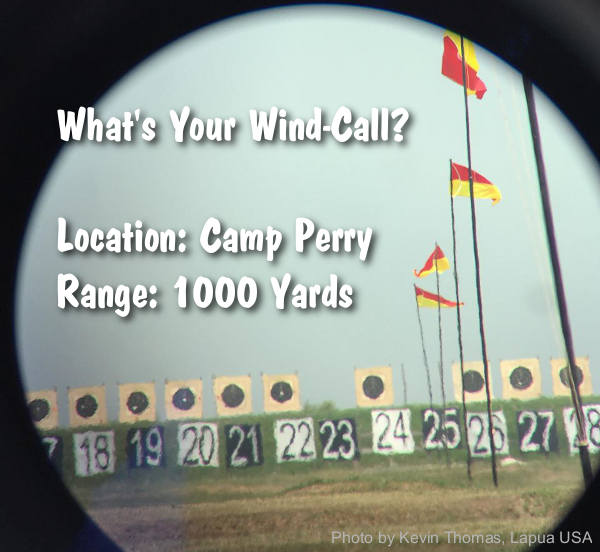
 Readers often ask us: “Is there a decent, easy-to-comprehend book that can help my wind-reading?” Many of our Forum members have recommended The Wind Book for Rifle Shooters by Linda Miller and Keith Cunningham.


 If you want an even greater selection of targets, specialized for PRS and NRL shooters,






 It’s common for new pistoleros to start shooting at cans or clay birds at a public range. That can be fun, but it’s better to start with proper targets, placed at eye level, at 7-10 yards. We like to use targets with large, brightly colored circles. Focus on putting 5 shots in a circle.