Springtime is turkey hunting season throughout the USA. The official spring wild turkey hunting season is set regionally by each state. In a few states, turkey season has already commenced, while most other states open their turkey seasons in early April, with the spring seasons running for 3-5 weeks. CLICK HERE to read Outdoor Life Magazine’s Turkey Hunting Resource page. This includes articles on How to Hunt Turkeys, Best Turkey Calls, Turkey Hunting Camo Gear, and Recommended Turkey Loads.
Sportsman’s Warehouse has an online page about Spring Turkey Hunting. This has features on recommended shotguns, clothing & footwear, decoys & calls, blinds & chairs, and even turkey cooking. CLICK HERE for the Sportsman’s Warehouse Turkey Hunting Page.
And Sportsman’s Warehouse has an excellent, detailed “how to” article, the Beginner’s Guide to Turkey Hunting. That feature includes the Outdoor Dan video featured above.
Saturday Showcase Spring Turkey Hunting Videos
With over 2 million views, this Canada-in-the-Rough video shows effective turkey scouting, calling, and shooting. This action-packed turkey hunting compilation features 30 turkey kill shots with shotguns.
Get Zone — At the Ranch Turkey Hunting Videos
GetZoneHunting.com has a vast video library for hunters, with hundreds of helpful videos on all types of hunting. In time for spring turkey season, GetZoneHunting offers a big collection of turkey hunting videos: At the Ranch – Turkey. On that page you’ll find 13 turkey hunting “how-to” videos. Here are links to five GetZone Turkey Hunting videos with valuable information from skilled, experienced hunters. Click each of the photos below to watch those five videos on theGetZone site.
At the Ranch – Turkey offers solid advice for turkey hunters. These five videos will help you better understand turkey behavior and have success on your hunt. Click any photo to watch the particular video on the GetZone website. (Work Warning — When each GetZone video opens, it may immediately launch an annoying commercial with loud AUDIO!). There are eight more turkey hunting videos on GetZone’s Turkey Hunting HQ Page.
At the Ranch: Shot Placement for Turkeys — CLICK to Watch Video
At the Ranch: Turkey Hunting Essentials — CLICK PHOTO to Watch Video on GetZone.com
At the Ranch: The Differences Between a Jake and a Tom — CLICK PHOTO to Watch Video on GetZone.com
At the Ranch: Early vs. Late Spring Turkey Hunt — CLICK PHOTO to Watch Video on GetZone.com
At the Ranch: How to Plan a Turkey Hunt — CLICK PHOTO to Watch Video on GetZone.com
Free Printable Turkey Target from AccurateShooter.com
As a special bonus for our readers, here is a free, printable Turkey Target, so you can practice for your turkey hunting adventure, This special Turkey Bullseye Target was created by our friend and Forum member Pascal (aka “DesertFrog”). CLICK HERE for FREE Turkey Target.
In April 2020, the National Rifle Association (NRA) launched NRAWomen.com, a website dedicated to the fastest-growing group of firearm owners — America’s women. This website serves the increasing number of female gun owners, huntresses, and competitive shooters. Female involvement in firearms is growing significantly. Consider these numbers: Statistica estimates that 19% of women in the USA owned firearms in 2020, while 23% of women surveyed in a 2011 Gallup Poll stated they owned a gun.
Jessie Harrison is one of the greatest female pistol shooters on the planet.
Here are three excellent Articles from the NRAWomen.com website, all worth reading. For each example, Click the Photo or direct link to read the full article on NRAWomen.com.
1. Flying with Firearms — What You Need to Know
We recommend that any gun owner, female OR male, should definitely read this article. It is one of the better discussions on the web of airline travel with firearms, covering international travel as well as domestic flights. The article notes that you should obtain U.S. Customs Form 4457 before flying overseas with a firearm.
“Flying with a gun is actually a lot easier than you’d probably expect. You need a couple of specific gear items, and you need to know the proper procedure, but it’s a relatively simple process. I’ve flown with long guns and handguns dozens of times around the country and around the world. The process is generally the same, but with some additional steps and maybe additional hassle depending on the airport [and personnel.]” READ FULL ARTICLE on NRAWomen.com.
2. Modular Safes — Smart Option for Easier Moving
The second article features a great video showing how to assemble a modular safe in under 30 minutes. This article also explains the benefits of modular gunsafes — primarily easier transport and installation.
“Modular safes have been around for a few years now and are becoming more popular. Here’s why: The safe comes delivered to you in panels, so you can bring them into your home one at a time and put it together anywhere you like. This makes it easy to carry up and down stairs, onto elevators or anywhere! Security — Is it as secure as one that comes pre-assembled? The answer is, absolutely.” READ FULL ARTICLE on NRAWomen.com.
3. Rimfire .22 LR Handguns for Self-Defense
This article looks at a wide variety of .22 LR pistols and revolvers. The author discusses the pros and cons of a rimfire defense gun, concluding that while the stopping power is limited, having some protection is better than going unarmed.
“Over the last few months we’ve seen the launch of new handguns chambered for .22 LR that sport the same looks and features as center-fire handguns designed for daily concealed carry. The models I’ve had a chance to work with so far include the compact Taurus TX22 semi-automatic pistol, the pocket-size Ruger Lite Rack LCP II, Kel-Tec’s P17 semi-automatic and the Taurus 942 8-shot snubnose revolver.” READ FULL ARTICLE on NRAWomen.com.
Here’s a new option for hunters and tactical competitors who want to range targets and call windage/elevation corrections using their spotting scopes. Vortex is now offering Reticle Eyepieces for its Viper HD spotting scopes. Available in both MRAD and MOA versions, these fixed-power 33.5X eyepieces feature ranging reticles with handy hash marks. This allows target ranging, plus competitors can “make accurate shot calls… with subtension lines for holdover and windage corrections.”
Vortex states: “The all-new eyepiece makes measuring target range and calling shot corrections easy, with a diopter ring that allows shooters to get the reticle dialed to their eyes, and level with the horizon line, no matter how their scope is setup.”
Powering the new eyepiece is a fixed, 33.5X magnification ocular lens. This provided plenty of power most hunting and competition scenarios. The eyepiece glass is protected with ArmorTek and XR lens coatings. These easily-installed ranging eyepieces, both MRAD and MOA, are designed for a wide field of view so user won’t miss a single vapor trail or bullet splash.
Ranging MRAD — Hashmarked ranging reticle using MRAD-based subtension lines for ranging, holdover, and windage corrections. Secondary ranging references facilitate rapid range estimating.
Ranging MOA — Hashmarked ranging reticle using MOA-based subtension lines for ranging, holdover, and windage corrections. Secondary ranging references facilitate rapid range estimating.
These eyepieces have fixed, 33.5-power magnification. “Street Price” is about $200.00.
Performs as Promised — Prevents Mess at Home or at Range
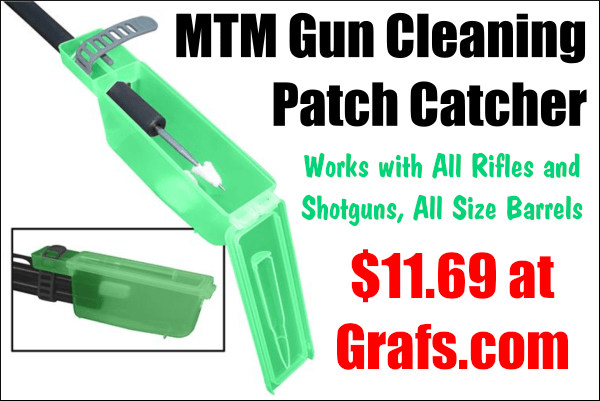
When cleaning rifles, wet and dirty patches can make a real mess. And solvent spray from the muzzle is another issue. Here’s a solution — the MTM Gun Cleaning Patch Catcher. Simply slip it over your barrel to contain all the patches pushed out the muzzle and retain solvent spray/drips. No more mess and stains on your bench/table. When cleaning tasks are done, simply remove the Patch Catcher and dump the contents into the trash. The MTM Gun Cleaning Patch Catcher is just $11.69 at Grafs.com, $12.99 at Brownells, and $13.49 at MidwayUSA.
This handy see-through green container fits on the end of your rifle or shotgun barrel. It works with all patch types and bore sizes and fits virtually all barrel diameters, large and small. Slip the MTM Gun Cleaning Patch Catcher over your barrel to contain all the patches pushed out the muzzle. When cleaning tasks are done, simply remove the Patch Catcher and dump the contents into the trash. Watch the video to see how the MTM Patch Catcher works.
We’ve tried this product and it definitely helps keep work surfaces and floors clean. No more messes on the bench or spray from solvents. Purchasers do like this product — it has 78% five-star reviews on Amazon.
One owner explains: “This box straps over the muzzle end of a barrel and keeps the mess completely contained. Excess cleaning solvents collect in the bottom. Patches fall off the jag and are captured as well when the cleaning rod is withdrawn. It also completely contains the splatter burst when a bore brush exits the muzzle of whatever firearm is being cleaned.” (D.J. Bradley)
Here are actual user reviews from verified customers:
“It’s been a long time since I bought something that is just WOW brilliant but this patch catcher is just that. It is so simple, so neat, so clean and so effective. It fits perfectly on all my rifle barrels and catches patches, brush spray and most importantly most of the smells of solvents. I can now clean my rifles in the house without inviting the wrath of my darling wife.” — Emmitt P. (Amazon)
“The MTM Patch Catcher works great! It is easy to adjust to different size barrels, and … all the gunk stays in the trap! Now, no more cleaning up the work bench/floor area after gun cleaning. This trap is a must have! I never knew I needed one of these until I got the MTM one from Graf’s. My buddy had a different brand, and it was hard to use. On his, the trap that holds the dirty patches and ‘juice’ would not stay in place, and some times most of the gunk ended up on the floor.” — Michael T (Grafs.com)
“This little device is more than a patch catcher. It also contains that dirty, smelly spray when a bore bristle exits the barrel. With the [MTM Patch Catcher] top open, it will also catch spray cleaners and lubes when used on small parts.” — TwoBoxer (Amazon)
Gun Variant Q & A — Yes it works with ARs and Muzzle Brakes
Q: Has anyone used this with an AR15?
Answer: It works quite well — goes on and off easily. Slide it on the barrel until you can tighten the strap behind the flash suppressor. — Cactus
Q: Does this fit securely if you have a standard muzzle brake?
Answer: Yes, I regularly use this product on all of my rifles including my Savage 111 Long Range Hunter with a factory brake. It really keeps the smell down with the top closed. Also stops the splatter of a stiff brush exiting the muzzle. Great Product! — Iklwa
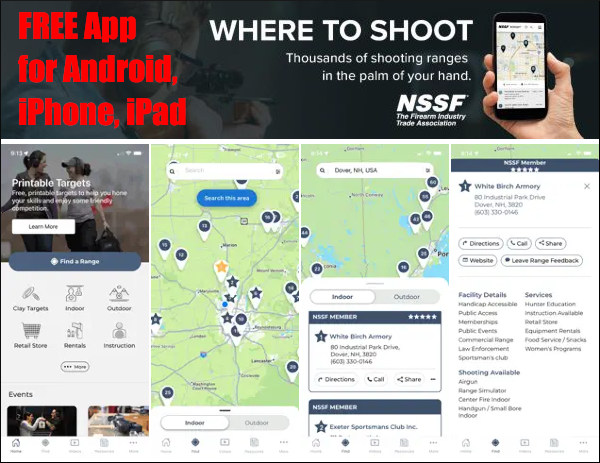
NSSF, the Firearm Industry Trade Association, has released a NEW and Improved Where To Shoot mobile App. This FREE mobile device App allows target shooters, hunters, and outdoor enthusiasts to locate shooting ranges throughout the USA. “Finding a safe, welcoming place to shoot should be simple,” said Joe Bartozzi, NSSF President/CEO. “The redesigned Where To Shoot App provides … accurate, up-to-date range information, training tools and more.”
Available for iPhone, iPad, and Android devices, the updated App provides fast, convenient access to the country’s most comprehensive directory of shooting ranges.
The Where To Shoot mobile App is available for FREE Download through the App Store and Google Play. Users can also search for ranges online at WhereToShoot.org.
A Faster Way to Discover Places to Shoot
The refreshed Where To Shoot app introduces a streamlined design and enhanced search tools that allow users to quickly find shooting facilities wherever they are — whether at home or traveling.
Key Features Include:
Nationwide Shooting Range Directory — Access one of the most comprehensive databases of shooting ranges in the United States. Events and Training Opportunities — Discover shooting events, instructional programs and other opportunities to improve skills. Mobile-Optimized Experience — Modern interface allows quick browsing and seamless range discovery. Location-Based Search — Instantly find ranges near your location or search by ZIP code, city, or state. Detailed Range Listings — View contact info, directions, and facility details before planning your visit. Indoor and Outdoor Range Filters — Identify facilities with your preferred shooting environment.
“The Where To Shoot platform has long been one of the most valuable tools for connecting target shooters with ranges,” said John McNamara, NSSF Vice President, Member Services. “This redesigned app strengthens that connection by making it even easier for people to discover local facilities and for ranges to showcase the experiences and services they offer.”
NSSF Requests Range Owners to List Their Facilities
NSSF encourages shooting range owners and operators to add or update their listings free of charge at WhereToShoot.org. By keeping listings current, ranges can help shooters easily discover safe, well-managed shooting venues. Enthusiasts can also help expand the directory by encouraging ranges that are not yet listed to create a free listing.
When shooting pistols do your shots normally land smack dab in the middle of the target? If not, you may have some technique problems that are causing your shots to move off center. Top Shot Champion Chris Cheng has produced a good video for the National Shooting Sports Foundation (NSSF) that helps handgunners diagnose accuracy issues. By shooting 3-shot groups and looking at the pattern and location of the shots, you can see what you’re doing wrong (or right). Here are some examples. Note, this process works best for shooters whose shots fall typically in one target zone. If your shots are all over the target, your form is inconsistent and problems will be harder to diagnose.
1. Low Left — Jerking Trigger: Here we see three (3) shots at the 7 O’clock position. This shows that the shooter is jerking the trigger, meaning that the shooter is pulling the trigger too quickly and therefore forcing the barrel to drop when breaking the shot. This is a very common problem, particularly with novices who are reacting to the noise/recoil of the pistol.
2. 9 O’Clock — Too Little Trigger Finger: If we see three (3) shots at the 9 O’clock position, what this can be indicative of too little trigger finger on the trigger. And therefore with every shot, the shots are getting pushed to the left. Try moving your trigger finger on to the pad of your index finger. Also try dry firing drills.
3. High Left — Anticipating Recoil: In this next example, we see three shots around the 11 O’clock position. What could be happening here is that the shooter is anticipating the recoil, and is actually lifting the gun up when he shoots. We recommend slowing down, working on your breathing, and, again, do dry-firing drills.
4. 3 O’Clock — Too Much Trigger Finger: Finally, if you see three (3) shots at the 3 O’clock position, this can indicate that there is too much trigger finger on the trigger. Therefore when the shot breaks the shooter is pulling each shot to the right. Note: Each of these descriptions is for a RIGHT-handed shooter. If you are a left-handed shooter you’ll want to reverse those descriptions.
How fast can you shoot a bolt-action rifle? We doubt you can out-pace the ace “Stangskyting” shooters from Scandinavia. Some of these guys can run more than two rounds per second, including mag changes! That’s impressive. Bulletin reader C. Lemmermann from Denmark told us: “In Scandinavia we have this competition called ‘Stangskyting’. It’s similar to the ‘Mad Minute’ but we only have 25 seconds to hit the target [at] 200-300m distance with a 6.5×55 [target rifle].” In the Stangskyting video below a shooter named Børklop puts 16 rounds on target in just 25 seconds. (He starts with a round in the chamber and cycles through three, 5-round magazines).
Børklop’s performance, with just a sling and iron sights, is impressive. He’s shooting a Sauer 200 STR target rifle with 5-round magazine. Note that Børklop manipulates the Sauer’s bolt with his thumb and index finger, while pulling the trigger with his middle finger. As good as Børklop is, some Stangskyting competitors are even better. Roy Arne Syversrud from Oslo, Norway tells us: “The best shooters in Norway can do 21 shots in 25 seconds, changing the mag three times.”
Here’s another Stangskyting video. Check out the speed with which John Olav Ågotnes works that action — simply amazing!
This Guy Could Break the “Mad Minute” Record
Børklop’s rate of fire, 16 rounds in 25 seconds, is the equivalent of 38.4 rounds in 60 seconds. That’s a notable number because the record for the “Mad Minute”, a British Army marksmanship drill, is 38 rounds in one minute. That record was set in 1914 by Sergeant Instructor Alfred Snoxall, and still stands. So as you watch Børklop, keep in mind that Snoxall shot that fast for a full minute with a Lee-Enfield nearly 100 years ago!
Børklop has an average cycling time of 1.56 seconds per shot, starting with a round in the chamber. To beat the record of 38 rounds, he would need to make seven mag changes in sixty seconds. All those mag swaps could reduce his average time per shot, making it difficult to achieve 38 hits in a minute. But, if Børklop could use 10-round mags with his Sauer STR, this guy has the skills to break the record.
To emphasize the capabilities of the WWI-era British shooter who set the record, Snoxall shot as fast as Børklop does, but Snoxall reloaded with stripper clips. Snoxall’s SMLE (Lee-Enfield) rifle also had relatively crude open sights and the stock was far less ergonomic than Børklop’s Sauer STR stock.
Here’s another Stangskyting video showing John Ågotnes shooting rapidfire with his Sauer 200 STR (Scandinavian Target Rifle) chambered in 6.5×55. By our count, Ågotnes manages 17 shots within the 25-second time period. That rate of fire (17 in 25 seconds) equates to 40.8 rounds in one minute!
He who dies with the most toys wins — right? Well Sinclair has another interesting gadget you can add to your reloading bench. The Sinclair Case Neck Sorting Tool lets you quickly sort brass by neck-wall thickness. For those who shoot “no-turn” brass, this can improve neck-tension consistency. Large variances in neck-wall thickness can cause inconsistent neck “grip” on the bullet. Generally, we’ve found that more consistent neck tension will lower ES and (usually) improve accuracy. We know some guys who shoot no-turn 6mmBR brass in competition with considerable success — but their secret is pre-sorting their brass by neck-wall thickness. Cases that are out-of-spec are set aside for sighters (or are later skim-turned).
Watch Case Neck Sorting Tool Operation in Video
How the Case Neck Sorting Tool Works
Here’s how the Sinclair tool works. Cases are rotated under an indicator tip while they are supported on a case-neck pilot and a support pin through the flash hole. The unit has a nice, wide base and low profile so it is stable in use. The tool works for .22 through .45 caliber cases and can be used on .17- and .20-caliber cases with the optional carbide alignment rod. The MIC-4 pin fits both .060 (PPC size) and .080 (standard size) flash holes. Sinclair’s Case Neck Sorting Tool can be ordered with or without a dial indicator. The basic unit without dial indicator (item item 749006612) is priced at $59.99. With this standard tool you can use your own dial indicator with standard specifications. You can also buy the tool complete with dial indicator (item 749007129) for $89.99. IMPORTANT: This sorting tool requires caliber-specific Case Neck Pilots which must be ordered separately.
Editor’s Comment: The purpose of this Sinclair tool is rapid, high-quantity sorting of cartridge brass to ascertain significant case-neck-wall thickness variations. Consider this a rapid culling/sorting tool. If you are turning your necks, you will still need a quality ball micrometer tool to measure neck-wall thickness (to .0005) before and after neck-turning operations.
Looking for a superb illustrated coffee table book about guns? Yes there is such a thing, a great book we highly recommend — The Illustrated History of Fireams (2nd Edition). This full-color 320-page hardcover book features more than 1,700 photos compiled by NRA Museums curators Jim Supica, Doug Wicklund, and Philip Schreier. This Second Edition includes 300 photos more than the original, plus dozens of new profiles of important persons who influenced firearms development.
This follow-up to the best-selling original NRA Museums book is loaded with great images, historical profiles, and technical data on old, new, and currently-manufactured firearms that have changed history. Covering the earliest matchlocks to modern match-grade superguns and everything in between, The Illustrated History of Firearms provides a fascinating education on how guns evolved, where they originated and how they worked.
The Illustrated History of Firearms, 2nd Edition
– Authored by the experts at the NRA Firearms Museums
– Published by Gun Digest Books
– 9 ½ x 11 1/2 inches, hardcover with dust jacket
– 1,700 full-color photos
– 320 Pages
– Price: $49.99 (MSRP); $29.33 on Amazon
The Illustrated History of Firearms, 2nd Edition (hard-cover) is available from Amazon direct for $29.33. Amazon also lists lightly used versions of the book starting at $9.71 (plus $3.99 shipping) from a variety of other book vendors. You’ll also find the book at major bookstores such as Barnes & Noble, but it’s probably easier to purchase online.
This hefty 516-page book covers “Pistols, Rifles, Revolvers, Machine And Submachine Guns Through History”. This major resource is illustrated with 1100 photographs, and covers the whole spectrum of guns.
Priced at $31.36 on Amazon, this book would make a great gift for a gun collector, and could be a nice addition to a local gun club library. The Illustrated World Encyclopedia of Guns has proven very popular with buyers, earning 83% five-star ratings on Amazon among verified purchasers.
Historic American Arms — Teddy Roosevelt’s Lever Guns
These two lever action rifles, owned by President Theodore Roosevelt, are part of the NRA Museum collection. First is a Winchester 1886 rifle known as the tennis match gun because Roosevelt used winnings from a tennis match to buy it. Below that is a suppressed Winchester model 1894 rifle. Roosevelt liked to shoot varmints around Oyster Bay (Long Island, NY) with this gun so he wouldn’t disturb his neighbors — the Tiffany and Du Pont families.
About the NRA Museums
The NRA opened the original National Firearms Museum at its Washington DC Headquarters in 1935. In 2008 the Francis Brownell Museum of the South West opened at the NRA’s Whittington Center in Raton, NM. Then, in 2013, the National Sporting Arms Museum opened at the Bass Pro Shops store in Springfield, MO. Every year, at these three museum facilities, over 350,000 persons visit to see the impressive exhibits and many of America’s most famous firearms. For more information, visit www.NRAMuseum.org.
It’s easy to lust for those rare showpiece rifles at high-end auctions, but the author cautions readers to target the best deals, stick to your plan, and honor your monetary limits.
Buying at Gun Auctions — Be Crazy, Crazy Good
By Dave Buffington
“They’re crazy!” — You hear that all the time about live gun auctions. People love to rant about how people pay too much money for too many guns at too many auctions. It’s natural. And wrong.
I’ve been attending live gun auctions regularly for more than a decade — as many as 40 a year. I’ve learned that for every item that sells for a silly price, several sell for fair money and some — more than a few — have turned out to be great buys.
Two years ago, I bought a competition-grade STI 1911 in excellent condition for $670 at a live auction. And at the height of the gun-buying frenzy a while back, I scored a highly desirable, rarely-found Anschütz 54.18 MSR in new-in-box condition for just $1,800. I then flipped that Anschütz for $3,000 just two weeks later. That $1200 gain represents a 66% profit — not bad for a little savvy shopping at an auction.
This beautiful SAKO L461 Vixen was a great auction buy … and it is half-MOA accurate as well.
Sweet SAKO L461 Score at Auction
Can you score an awesome deal at a live auction? Absolutely. Above is a .222 Rem SAKO L461 Vixen I got at auction for $1500.00 including Leupold Vari-X II 3-9x40mm scope. Note the highly-figured stock. My SAKO L461 is the “deluxe” model with rosewood forearm tip and grip cap. A similar .222 Rem SAKO L46 (below) with fairly plain wood (and no scope) is selling for $3995.95 at the Custom Shop, a Montana purveyor of fine firearms. I got my SAKO for 38% of the Custom Shop price! SAKO fans will note that the L461 has an internal top-loading 5-shot magazine while the older L46 has a 3-round removable clip. And most folks believe that the newer L461 model (like mine) has a better trigger.
Compare the author’s $1500 Auction-purchased SAKO L461 (above) with this $3995.00 Custom Shop Inc. SAKO L46. This is proof that live auctions can deliver some impressive bargains:
Can you make a mistake? Yes, I’ve bought junk and paid too much for it. But I’ve learned that knowledge is the best vaccine against gun buying mistakes. That’s our next topic.
Know The Auctions
Finding live auctions takes a bit of research, especially during the pandemic. But estates still need to be settled, collections still need to be shrunk and so, guns still need to be sold. Read your local newspaper and shoppers guides. Use online auction search services like AuctionZip.com.
And once you’ve found an auction, know the auctioneer’s rules. Some do background checks. Some don’t. Some charge sales tax. Some don’t. Some charge a “buyer’s premium”. Some don’t. If you’re not sure, ask.
Know Your Targets — Stick to Your List and Avoid Impulse Buys
Especially at the all-gun auctions, it’s easy to be entranced by all the handsome-looking hardware, but some of my worst gun buys have been the impulse buys made at auctions.
So start with a list of guns you want — for target shooting, collecting, whatever — and stick to it. Get to know those guns, research them and for goodness sake, know the potential pitfalls. Some Winchester 52s are prone to the “crack of death”. Certain Brownings from the late 60s and early 70s are afflicted with “salt wood”. You need to know which ones.
Know The Bidding Process
Auction newbies tend to worry a lot about how to bid. I know I did. But don’t. Remember, it’s the job of the auctioneer to get your bid, and once a good auctioneer spots you as a bidder, believe me, he won’t lose you.
The key is to get spotted. So don’t be shy. The auctioneer will likely start the bidding at some reasonable number. As a matter of theater, he’ll then start going down until someone actually bids. Then he’ll start going up again. When you’re ready to jump in, raise your hand and make sure the auctioneer spots you. If you’re not sure, shout something. (“Here!” works fine.) After that, don’t fuss about technique. Just nod yes or no the next time the auctioneer looks at you. (Ziegler Auction photo by Nathan Merkel)
Do understand one small but important detail: The price the auctioneer calls is the price he is looking for, not the price he has. For example, if you’ve bid $250, you’ll then hear him calling for the next increment up — such as “$300, $300, do I hear $300?”.
Misunderstanding that process can lead you to bid against yourself. 99% of auctioneers won’t let it happen, but as I can attest, it’s still embarrassing.
Know Your Price Limits
Auction fever is much like buck fever. You’re struggling to be still while you’re heart is doing its best rendition of “Wipe Out”. So you must, absolutely must, agree with yourself on the maximum price you’ll bid for a gun before the bidding starts. And be sure that maximum price reflects the true purchase cost, including sales tax, background check fees, and the buyer’s premium, if any.
Sticking to that limit is critical. First, because you don’t want to end up spending the mortgage money, but also, because there’s always another opportunity around the corner.
For example, on a cold, damp day last fall, I went to a small outdoor auction in hopes of getting a good buy on a Mauser-made, numbers-matching K98k. Ha! Despite the fact there were fewer than 50 bidders braving the drizzle, the gun sold for a whopping $3,200. (I bailed at $1,500.)
Is this the K98k that sold for $1,200? Or $3,200? The Karabiner 98 kurz (German for “carbine 98 short”), often abbreviated Kar98k or K98k, is a bolt-action rifle chambered for the 7.92×57mm Mauser cartridge.
But just two weeks later, I went to a warm, dry indoor auction with more than 200 bidders in the building. Yet I still managed to get a Mauser-made, numbers-matching K98k for just $1,200, a difference of a whopping $2,000. Crazy? Yes… Crazy good.







 He who dies with the most toys wins — right? Well Sinclair has another interesting gadget you can add to your reloading bench. The Sinclair


 Know The Bidding Process
 Know Your Price Limits


