This popular video, viewed 3.4 million times on YouTube, provides a clear explanation of Minute of Angle (MOA) and how that angular measurement is used. Among novice shooters, there is much confusion over this term. In this NSSF Video, Ryan Cleckner, a former Sniper Instructor for the 1st Ranger Battalion, defines the term, “Minute of Angle” (MOA) and explains how you can adjust for windage and elevation using 1/4 or 1/8 MOA clicks on your scope. This allows you to sight-in precisely and compensate for bullet drop at various distances.
For starters, Ryan explains that, when talking about angular degrees, a “minute” is simply 1/60th. So a “Minute of Angle” is simply 1/60th of one degree of a central angle, measured either up and down (for elevation) or side to side (for windage). At 100 yards, 1 MOA equals 1.047″ on the target. This is often rounded to one inch for simplicity. Say, for example, you click up 1 MOA. That is roughly 1 inch at 100 yards, or roughly 4 inches at 400 yards, since the target area measured by 1 MOA increases in linear fashion with the distance.
More Minute of Angle (MOA) Explanatory Videos
This Gunwerks video explains that Minute of Angle subtends approximately 1″ for each 100 yards (well, 1.047″ to be more precise). That means a Minute of Angle increases in actual measured size the greater the distance of the target from the shooter.
This lengthy (24-minute) video defines Minute of Angle, and uses multiple diagrams to illustrate how MOA angular measurements works. The video also how MOA-based click values translate to point-of-impact changes at various distances.
A while back our Aussie friend Stuart Elliot of BRT Shooters Supply filmed some interesting videos at the QTS range in Brisbane, Australia. Stuart told us: “I was shooting in an Air Gun Benchrest match here in Brisbane, Australia. I finished my target early and was awaiting the cease fire and took a short, slow-motion video of windflag behavior.” You may be surprised by the velocity changes and angle swings that occur, even over a relatively short distance (just 25 meters from bench to target).
Here are windflags in slow motion:
The flags show in the videos are “Aussie Wind Flags”, developed by Stuart Elliot. For many years, these were sold in the USA by Butch Lambert, through Shadetree Engineering & Accuracy.
Here is a video in real time:
Stuart says this video may surprise some shooters who don’t use windflags: “Many people say the wind doesn’t matter. Well it sure does — whether for an airgun at 25 meters or a long range centerfire at 1,000.” This video illustrates how much the wind can change direction and velocity even in a small area.
Here’s a very cool 3D Animation showing pistol rounds being chambered and fired in a semi-auto handgun. Computer-generated graphics provide a look inside the cartridge at the moment of ignition as the primer fires and the flame front moves through the ignited powder. It’s really kind of mesmerizing. If you’ve every wondered just what happens inside your cartridges the moment that firing pin strikes, then watch this video. It has racked up 6.1 million views on YouTube with over 48,000 likes.
Watch Video to See Handgun Ammo Being Chambered and Fired:
Mute Enabled — Click Speaker Icon to Hear Audio. Firing Sequence Starts at 1:28.
This animated video from German ammo-maker GECO (part of the Swiss RUAG group of companies) reveals the inside of a pistol cartridge, showing jacket, lead core, case, powder and primer. Employing advanced 3D rendering and computer graphics, the video shows an X-ray view of ammo being loaded in a handgun, feeding from a magazine.
Then it really gets interesting. At 1:28 – 1:50 you’ll see the firing pin strike the primer cup, the primer’s hot jet streaming through the flash-hole, and the powder igniting. Finally you can see the bullet as it moves down the barrel and spins its way to a target. This is a very nicely-produced video. If you’ve ever wondered what happens inside a cartridge when you pull the trigger, this video shows all. They say “a picture’s worth a thousand words”… well a 3D video is even better.
Looking for a good load for a new rifle? Or perhaps you want to try a new powder and bullet combo for an existing rig. One of the best places to start for load data is Hodgdon’s online Reloading Data Center for pistol, rifle, and shotgun reloaders. Check out the Reloading Data Center at www.HodgdonReloading.com.
In the Data Center, you’ll find thousands of load recipes for pistol, rifle, and shotgun. Rifle shooters will find dozens of loads for their favorite Hodgdon, IMR, and Winchester powders such as H4198, H4895, Varget, H4350, and IMR 8208 XBR. And Hodgdon’s Reloading Center is “mobile-friendly” so it works well with smartphones and tables. Navigation is easy, and you can set the search criteria easily choosing your favorite powder or bullets. After choosing a cartridge, you can pre-select specific bullet weights and powder types. That quickly delivers just the information you want and need. You won’t have to scroll through scores of entries for bullets or powders you don’t use.
NOTE: This shows results for two bullet weights and two powder choices. With more powders and bullets selected you will get more results. The “BUY NOW” buttons link to the Hodgdon webstore.
Reloading Center is Smartphone-Friendly
Mobile users will notice that the current Hodgdon Reloading Center is “user-friendly” for smart-phone and tablet users. Controls have been optimized for touch-screens, and buttons are large and easy to use.
How to Get Started with Handloading
Getting started in Reloading? Ultimate Reloader offers a helpful introductory video that covers the basics. In addition, a recent Ultimate Reloader article reviews the types of reloading presses, plus the other gear you’ll need, from dies to powder dispensers.
Cheaper Than Dirt (CTD), a Texas-based vendor of firearms, gun accessories, and ammo, has created a very complete web page on AR-15 assembly from start to finish. If you are thinking of building an AR, or upgrading your upper, trigger group, or buttstock, we recommend that you read CTD’s DIY ARs — Building Your Own AR-15 page. This illustrates all the components you will need for a complete AR build.
In addition, the page has a series of videos showing how to assemble each element of the AR-15. We’ve included five of those videos in today’s Saturday Movie Showcase. There a total of ten CTD AR-15 videos in the series. View them all on the CTD AR-15 Playlist on YouTube.
Then, as a closer, we offer another video — the Ten Mistakes to Avoid When Building an AR-15. Worth watching BEFORE you start an AR project, this useful video now has 2.1 million views!
Installing the Fire Control Group
Installing the Safety Selector and Pistol Grip
Installing the Take-Down Pin and Buffer Tube
Installing the Bolt Catch
Field-Stripping the Bolt-Carrier Group
Mistakes to Avoid When Assembling an AR-Platform Rifle
This popular Tactical Toolbox video (with 2.1 million views) is definitely worth watching BEFORE you start your own AR project. It explains the common mistakes that even careful builders can make when assembling an AR-type rifle.
The January 2023 issue of Shooting Industry (SI) presents a look at new-for-2023 products many of which will premier at SHOT Show 2023. This is the second installment in SI’s 2023 New Product Showcase with items from 60 brands, including CZ-USA, Federal, Mossberg, Ruger, Sako, Savage, Steiner and more. The upcoming February 2023 SI issue will have additional New Product Showcase features.
Along with the New Product Showcase, the January 2023 Issue of Shooting Industry magazine has many other articles of interest. A discussion of 2023 gun industry trends predicts declining sales in the months ahead. A tech article covers new night-vision and thermal optics. For gun stores and ranges there is a helpful article explaining how to prepare for OSHA inspections. CLICK HERE for FREE January 2023 Digital Edition.
PICK SIX — Six Notable New Products for 2023
Here are six notable new items from SI’s January 2023 Issue New Product Showcase. CLICK HERE to see more products from the January Showcase.
CZ 600 Range Rifle
The CZ 600 Range is part of the new 600-series rifle family from CZ-USA, currently offered in 6mm Creedmoor and .308 Winchester. The 600 Range features a 24″ 1:10″-twist heavy hammer-forged barrel wtih threaded, suppressor-ready muzzle. Remarkably, CZ-USA guarantees 3/4-MOA 5-shot accuracy at 100 meters with match factory ammo. Notable features include: adjustable trigger, 60º bolt throw with large allow bolt knob, controlled feed, 2-position safety, Rem 700 scope base hole pattern, and magazine lock (selectable). The handsome, laminate wood stock boasts a tool-less height-adjustable cheek piece, and monopod Picatinny rail attachment. MSRP is $1199.00. Weight before optics is 10 pounds and OAL is 44.9″.
Escort SDX12 and SDX410 Semi-Auto AR-Style Shotguns
The Escort SDX12 and Escort SDX10, are part of the Versatile Tactical Shotgun series crafted by Hatsan, a Turkish company. The SDX12 is 12 gauge while the SDX10 is .410 gauge. Both are offered in black or FDE Cerakote. These gas-operated, semi-automatic shotguns have detachable alloy upper receivers and polymer lower receivers. The stock features a pistol grip, adjustable cheekpiece (comb), soft rubber buttpad, and an ergonomic fore-end grip. Picatinny sight rails are integrated into the receiver and fore-end/handguard. Other features include: reversible bolt-charging handle, detachable carrying handle, sling loops, and adjustable front and rear sights. A set of flip-up front and rear sights are also included along with 5-round magazines. Length is 37.6″ and weight for the SDX12 is 9.0 pounds.
Savage Arms 1911 Pistol
Surprise from Savage — it is now offering a Government-style 1911 pistol with a stainless steel frame and slide. New for 2023, the Savage 1911 features a 5″ stainless barrel with 11° target crown, dual recoil spring, flared and lowered ejection port, titanium firing pin, and ambidextrous slide lock safety.
A variety of sight options are available for the new Savage 1911: Novak Lo-Mount adjustable tritium bar rear sight and tritium Mega Dot Glow Dome Yellow front sight (Rail and Two-Tone versions); Novak Lo-Mount Black rear sight and white dot front sight (stainless and black Melonite non-rail versions); ambidextrous slide lock safety; and VZ G10 Grips. The new Savage 1911 pistol is currently offered in two chamberings: .45 ACP or 9mm Luger (9x19mm).
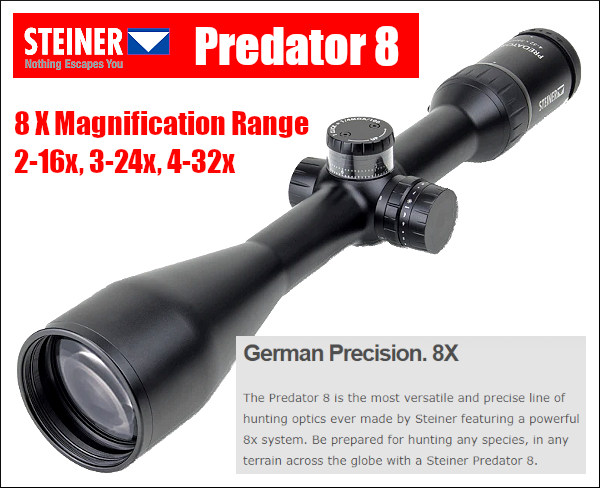
Steiner Predator 8 Scopes with 8X Zoom Ratio
Steiner Optics had a new line of Predator 8 riflescopes with three different 8X zoom ranges: 2-16×42mm, 3-24×50mm, and 4-32×56mm. Features include: illuminated reticle with 11 brightness settings, tactile 1/4 MOA ballistic turret, and fog-proof/waterproof design. There is exceptionally wide field of view at teh lower magnifications, and high-contrast lens coatings ensure crisp images even in low light. The different numbered turret rings allow the shooter to customize the turret for quick elevation adjustment at pre-selected distances. The 2-16x42mm and 3-24x50mm riflescopes come with the Steiner E3 second focal plane reticle while the 4-32x56mm has a Special Competition Reticle (SCR). The Predator 8 2-16x42mm (MSRP $2069.99) is the lightest and most compact of the lineup and includes a rear focal plane E3 Ballistic reticle, with cascading subtensions and windage dots.
KOR 5er VRS Gun Case Insert (Foam Replacement)
KOR’s patented Vacuum Rigidizing Structure (VRS®) 5er insert is a foam replacement system for existing gun cases. The technology eliminates the need to cut, pluck, or customize interior foam. This, KOR claims, allows gun owners to have “one case for everything in their safe”. The VRS system “customizes interior by conforming to contents”. The interior is filled with “rigidizing beads” which provide a custom fit. You can change the rifle or accessories and the VRS adapts to the new contents using a vacuum pump. KOR states that its VRS system has “no shifting contents, corrosion, crushing, abrasion, or rust inside.” The 5er VRS insert is compatible with many case types from Pelican and SKB.
MDT TIMBR Frontier — Wood Stock with Internal Metal Chassis
The MDT Timbr Frontier has the look and feel of traditional stock with the benefits of a modern chassis with V-block. The buttstock and fore-end are made of clear-coated Birch hardwood laminate attached to an aluminum micro-chassis and bottom metal. The Timbr Frontier stock offers adjustable Length of pull, adjustable cheek riser, and interchangeable rubber over-molded grips. You can easily add accessories to the M-LOK fore-end and buttstock. With a weight of just 4 pounds, the Timbr Frontier stock works for hunting as well as target shooting. The stock can take standard AICS pattern magazines.
LEE Precision has a new six-station Progressive Press with some impressive engineering. Given its very affordable $364.50 street price and the features, this new Six Pack Pro 6000 Progressive Kit will definitely draw some customers away from Dillon, RCBS, and Hornady.
This press has clearance for magnum rifle cases, offers auto-indexing, and does not require a set of separate tool heads. Just swap the dies in and out quickly using LEE Smart Lock bushings.
The press includes the combination tool rack, bin bracket and free ammo bin. When you purchase the full Six Pack Pro 6000 Kit, shown at right, this comes complete with LEE Breech lock reloading dies (your choice of cartridge), Universal Case Feeder, Auto Drum Powder measure, and appropriate shell plate.
You can buy the Six Pack Pro 6000 Kit set up for a variety of cartridge types: 9mm Luger, .32 S&W, .380 ACP, .38 SPL/.357 Magnum, .40 SW, .44 SPL/.44 Magnum, .45 ACP, .45 Colt, 300 Blackout, .223 Remington, and 6.5 Creedmoor. Each set comes with the dies and shell plate you need for that cartridge type.
The included dies for pistol cases are: Carbide full length sizing die, powder-through expanding die, bullet seating die. For rifle cartridges .223 Remington and 6.5 Creedmoor you get: Full length sizing die, short or long charging die, easy adjust dead length bullet seating die, and factory crimp die.
Key Features of New LEE Six Pack Progressive Press:
Six stations
Very affordable price
Automatic priming system
Simple and reliable automatic indexing
Clearance sufficient for largest magnum rifle cases
Cartridge changeover in seconds, change primer size with no adjustments
Dies secured with LEE Smart Lock Bushings — no turret or tool heads needed
John Lee, President of LEE Precision, is proud of this new product: “I am pleased to announce the Six Pack progressive is now shipping. The Six Pack is the heaviest, most capable progressive press, we have ever made. The Six Pack is also one of the easiest presses to setup and operate. The only ‘adjustments’ are setting the dies and selecting and installing the correct primer size. The Six Pack Pro kit includes everything you need to start reloading a specific cartridge. The kit includes our new ‘Smart Lock’ Breech Lock quick change bushings.”
For the very first day of 2023 we present a precision rifle built with a relatively new cartridge — the 6GT. Developed by George Gardner of G.A. Precision and Tom Jacobs of Vapor Trail Bullets, the 6GT was designed to have the efficiency of a 6mm Dasher without the need for case forming. It was also designed with a longer case body so it feeds better from magazines. Even with the added capacity, the 6GT is still very efficient, and can achieve good velocities with less powder than a 6mm Creedmoor.
Today’s Sunday Gunday feature rifle was smithed and tested by Gavin Gear of UltimateReloader.com. Gavin did all the gunsmithing — chambering the barrel, fitting the muzzle brake, and even laser engraving the barrel. In building this 6GT rifle, Gavin used top-tier components: BAT TR action, Krieger 28″ 1:7.5″-twist 4-groove 6mm barrel, TriggerTech Diamond Rem 700-compatible trigger, and Area 419 Hellfire Muzzle Brake. The barreled action was then fitted in a handsome and rugged MDT ACC Chassis. On top is a Zero Tech 4.5-27×50mm FFP Trace Advanced scope in 30mm Hawkins Precision high rings.
We recommend you watch the video above — it covers the rifle build, load development, and then features some remarkable shooting sequences across snowy hills in the Pacific Northwest. Gavin’s team actually used a drone to capture overhead footage of the location.
After developing a promising load with Berger 109gr LRHT bullets, Varget powder, and Alpha brass, Gavin literally headed for the hills to test his new rifle at longer ranges, shooting from bipod. His load had shot well under half-MOA at 100 yards in testing so he was hoping he could hit multiple steel targets positioned at 340 yards, 760 yards, and 1000 yards. Indeed he did, proving the rifle’s great accuracy and Gavin’s fine trigger-pulling skills. You can see the hits at these time points in the above video:
340 Yards — 18:15 time | 760 Yards — 19:00 time | 1000 Yards — 19:54 Time
Gavin’s 6GT Hit Highlights on Steel out to 1000 Yards
Building Gavin’s 6GT Precision Rifle
Gavin Gear did all the gunsmithing on this project, using his own Precision Matthews TL-1660 lathe for the chambering with an Alpha carbide 6GT reamer. The barrel work took about four hours total. Shown below is the reamer cutting the chamber, which was finished with a 0.170″ freebore and 0.270″ neck diameter. For other brands of brass you might want the chamber to have a larger 0.272″ neck diameter.
Chambering the Krieger barrel with Alpha carbide 6GT reamer, 0.170” freebore, .270″ neck diameter.
This project when smoothly, with Gavin able to install the barreled action in the MDT Chassis and fit the buttstock in an hour or so. So total build time was about five hours. One nice “finishing touch” on the project was laser engraving the 28″ Krieger barrel — a process you can see in the video below.
Laser engraving of Krieger 28″ barrel.
About the 6GT — Sort of a 6 Dasher on Steroids
6GT Cartridge Design Features
The 6GT was designed to have an optimal length and capacity for mag-fed PRS/NRL tactical rifles. The 6GT is longer than a 6mmBR and 6 Dasher, but shorter than a 6mm Creedmoor and 6.5×47 Lapua. That gives the 6GT ample case body length to feed reliably from a magazine, while the case capacity is sufficient to run popular powders at reasonable pressures. It has a 35-degree shoulder angle.
On paper the 6GT seemed like the perfect cartridge for PRS- and NRL-style centerfire competition. It has the low recoil of a 6 Dasher, with good feeding and mag compatibility. With the 6GT, a competitor can push 6mm 105gr bullets at 3000+ FPS or run heavier bullets at ~2950 FPS. With this 28″ Krieger barrel, Gavin actually achieved 3004 FPS running 109gr Bergers.
Gavin started with quality Alpha Munitions brass. The cases were then annealed with an AMP Annealer and trimmed to length with a Henderson powered trimmer (see video below). After sizing with a Forster Co-Ax press, Federal SR Primers were seated using a Primal Rights competition seater. Next the powder was measured with an A&D FX120i force restoration scale. Finally, the Berger 109gr LR Hybrid Target bullets were seated with a Forster Micrometer die, again using the smooth Forster Co-Ax press.
Initial Load Testing with Berger and Hornady Projectiles
Before it got cold and snowy, Gavin did load development, shooting from a bench with a Sinclair front rest. The Krieger cut-rifled barrel was accurate right from the start and Hodgdon Varget powder proved to be a very good choice for the 6GT.
Gavin’s 6GT boasts a MDT ACC short action chassis with SRS-X Elite buttstock, vertical grip, and MDT CKYE-POD Bipod.
Gavin did initial load testing with both Hornady 110gr A-Tip Match and Berger 109gr Long Range Hybrid Target bullets. The Berger 109gr LRHT bullets were the most promising. A variety of charge weights were tested, with Gavin settling on 34.6 grains of Varget. This delivered fine accuracy with a 3004 FPS muzzle velocity. Group size measurements with this load are shown in the chart. At 100 yards, four three-shot groups averaged 0.361 MOA, and the rifle produced a nice 0.387 MOA (0.405″) five-shot group.
———————————————— Winter Wonderland for Shooters ———————————————–
Coming Soon — Ultimate Reloader Rifles Business
Gavin Gear is in the process of opening his own gunsmithing business. He will be offering a variety of custom-built rifles for multiple disciplines — hunting, PRS/NRL, ELR, and other competitive disciplines. Gavin explains: “Ultimate Reloader is gearing up to do custom rifle work for the general public starting (hopefully) in Spring 2022. We will most likely start with complete custom rifle builds using parts from our inventory. We will focus on high-end, bolt-action rifle builds and gunsmithing, primarily Remington 700 and clones. We will entertain limited gunsmithing work outside of complete builds (i.e. chambering, muzzle threading).
UltimateReloader.com offers some of the most thorough firearms and reloading tool tests on the internet. And UltimateReloader’s YouTube Channel has hundreds of great videos that showcase reloading tools, accurate firearms, precision optics, gunsmithing methods, and top-tier reloading components. For today’s Saturday at the Movies feature, we showcase six great videos recently created by Gavin Gear and his UltimateReloader team. These videos highlight a superb Long-Range Target Camera, the remarkable AMP Press, the new Hornady PRC cartridges, and other interesting topics. On this final day of 2022, enjoy our Saturday Video Showcase.
With the high price of centerfire powders, bullets, and brass, everyone should have an accurate .22 LR rimfire rifle for marksmanship training and competition at 25 to 200 yards. In this video, Ultimate Reloader’s Gavin Gear tests the impressive Anschutz 54.18 BR50-U7 match rifle using a quality Sinclair Int’l front rest. Anschutz offers several versions of the 54.18 and BR-50. There are two barreled actions available: 20″ threaded and 25.9″ non-threaded. Gavin tested the 20″ threaded model with the U7 stock. In this video, Gavin tested the trigger with a sophisticated TriggerScan TS-11. The trigger was superbly repeatable at a measured 3.8 ounces. Gavin also did a bore examination. He then tested the Anschutz with a variety of premium ammo. In this rifle, Lapua Midas+ producing the smallest groups. FULL STORY HERE.
This video features the impressive, high-tech AMP Bullet Seating Press. The AMP Press combines a motor driven ram, a distance sensor, and a load cell to deliver extremely accurate and precise force/distance bullet seating measurements. The AMP Press offers unrivaled consistency in the bullet seating process. And as the AMP Press is linked to a computer, seating data can be stored and you can chart variations in seating resistance. A wealth of precise data is collected during the bullet seating process. This helps you optimize your brass prep and annealing for the best, most consistent results. FULL STORY HERE.
Past 400 yards or so, it can be difficult to see bullet holes on paper, even with spotting scopes. That’s why we recommend a high-quality wireless target camera. The best long-range target cameras on the market are produced by Longshot Camera Systems. The Longshot Target Cam provides a live WiFi camera feed. This comes back to your shooting station and you can view the image with a laptop or mobile device. You don’t need internet coverage and no separate tall antennas are required. Simply place the camera unit next to your target and the receiver unit close to your rifle or bench. The Longshot system is completely self-contained. Longshot produces a variety of cameras starting at $449.00 for the LongShot Marksman. We recommend the $899.00 LR-3 unit which works out to two miles! In this video Gavin Gear of UltimateReloader tests the LR-3 at long range. PRODUCT INFO HERE.
This video examines how muzzle brakes reduce recoil. Just how important is bore clearance for a muzzle brake? Should you have an exit diameter that’s just slightly larger than bullet diameter, or will a larger diameter work well also? Along with no brake at all (bare muzzle), Ultimate Reloader tested multiple different brake bore clearances on a 6.5 Creedmoor rifle: 0.010″ over bullet diameter, 0.020″, 0.030″, 0.050″, 0.100″, and 0.200″. The testers expected to get the best recoil reduction with the tightest fit. Surprisingly, this wasn’t quite the case.
Using all brake configurations (all bore clearances) Ultimate Reloader saw a significant reduction in recoil, almost half, as compared to a bare muzzle: “What we didn’t expect was how close together the rest of the clearances would cluster. All of the clearances that we tested had good recoil reduction.” FULL STORY HERE.
Dillon Precision continues to be the leader among progressive press makers. Dillon offers the largest variety of progressives, the most accessories, and legendary customer service. In this video, Gavin Gear of Ultimate Reloader looks at a variety of Dillon machines to help buyers decide which progressive best suits their needs. Featured Dillon progressives include: Square Deal B, Xl750, and RL1100. Along with basic press feature, Gavin shows the operation of Dillon’s automated bullet feeder and case feeder accessories. The video also provides pricing summaries with various configurations. FULL STORY HERE.
Hornady’s PRC (Precision Rifle Cartridge) family of cartridges are becoming quite popular. The 6.5 PRC fits in a short action, while the 7mm PRC and 300 PRC both require a long action. The 7mm PRC is a long-action centerfire hunting cartridge designed to shoot 180gr bullets at 2950+ FPS. The 6.5 PRC is a good hunting cartridge that can fit a standard-length action. And, a number of top F-Open shooters are necking up the 6.5 PRC for 7mm bullets. This 7-6.5 PRC wildcat has shown excellent F-Class accuracy with a higher velocity node than the .284 Winchester. Along with these two cartridges, Hornady has a 300 PRC that can shoot the big .308-caliber bullets. In this video, Ultimate Reloader analyzes and compares each of the three PRC cartridge types. FULL STORY HERE.
With major forest fires this past year in Western states, many have wondered about hazards faced by gun owners in fire zones. This important video shows what really happens when loaded ammunition burns. You will probably be surprised. Contrary to Hollywood notions, the ammo doesn’t ignite in a massive explosion. Far from it… basically the rounds “cook off” one by one, and the bullets release at relatively low velocity. We’ve featured this SAAMI research project before, but it is worth reprising for those who have not yet seen the burn tests.
A few years back, SAAMI released an important video concerning ammo and fire. With professional fire-fighters standing by, over 400,000 rounds of ammo were incinerated in a series of eye-opening tests. If you haven’t had the chance to view this video yet, you should take the time to watch it now
The Sporting Arms and Ammunition Manufacturers’ Institute (SAAMI) has produced an amazing 25-minute video that shows what actually happens to sporting ammunition involved in a fire. This video shows the results of serious tests conducted with the assistance of professional fire crews. We strongly recommend you watch this video, all the way through. It dispels many myths, while demonstrating what really happens when ammunition is burned, dropped, or crushed.
Watch SAAMI Ammunition Testing Video
Video Timeline
2:10 Impact Test (ignited outside firearm)
3:40 65-foot Drop Test
5:08 Bullet Impact (.308 Win firing)
7:55 Blasting Cap Attacks
9:55 Bulldozer and Forklift Tests
12:20 Boxed Ammo Bonfire
15:37 Bonfire without Packaging
17:21 Retail Store Simulation Burn
20:55 Truck Trailer Burn
Over 400,000 rounds of ammunition were used in the tests. Some of the footage is quite remarkable. Testers built a bonfire with 28,000 rounds of boxed ammo soaked in diesel fuel. Then the testers loaded five pallets of ammo (250,000 rounds) in the back of a semi-truck, and torched it all using wood and paper fire-starting materials doused with diesel fuel.
The video shows that, when ammo boxes are set on fire, and ammunition does discharge, the bullet normally exits at low speed and low pressure. SAAMI states: “Smokeless powders must be confined to propel a projectile at high velocity. When not in a firearm, projectile velocities are extremely low.” At distances of 10 meters, bullets launched from “cooked-off” ammo would not penetrate the normal “turn-out gear” worn by fire-fighters.
We are not suggesting you disregard the risks of ammo “cooking off” in a fire, but you will learn the realities of the situation by watching the video. There are some amazing demonstrations — including a simulated retail store fire with 115,000 rounds of ammo in boxes. As cartridges cook off, it sounds like a battery of machine-guns, but projectiles did not penetrate the “store” walls, or even two layers of sheet-rock. The fire crew puts out the “store fire” easily in under 20 seconds, just using water.
Additional Testing: Drop Test, Projectile Test, Crush Test, Blasting Cap Test
Drop Test
The video also offers interesting ammo-handling tests. Boxes of ammo were dropped from a height of 65 feet. Only a tiny fraction of the cartridges discharged, and there was no chain-fire. SAAMI concludes: “When dropped from extreme heights (65 feet), sporting ammunition is unlikely to ignite. If a cartridge ignites, it does not propagate.”
Rifle Fire Test
SAAMI’s testers even tried to blow up boxes of ammunition with rifle fire. Boxes of loaded ammo were shot with .308 Win rounds from 65 yards. The video includes fascinating slow-motion footage showing rounds penetrating boxes of rifle cartridges, pistol ammo, and shotgun shells. Individual cartridges that were penetrated were destroyed, but adjacent cartridges suffered little damage, other than some powder leakage. SAAMI observed: “Most of the ammunition did not ignite. When a cartridge did ignite, there was no chain reaction.”
Bulldozer Crush Test
The test team also did an amazing “crush-test” using a Bulldozer. First boxes of loaded ammo, then loose piles of ammo, were crushed under the treads of a Bulldozer. A handful of rounds fired off, but again there was no chain-fire, and no large explosion. SAAMI observed: “Even in the most extreme conditions of compression and friction, sporting ammunition is unlikely to ignite. [If it does ignite when crushed] it does not propagate.”
Blasting Cap Test
Perhaps most amazingly, the testers were not able to get ammunition to chain-fire (detonate all at once), even when using blasting caps affixed directly to live primers. In the SAAMI test, a blasting cap was placed on the primer of a round housed in a large box of ammo. One cartridge ignited but the rest of the boxed ammo was relatively undamaged and there was no propagation.


 This animated video from German ammo-maker




 LEE Precision has a new six-station Progressive Press with some impressive engineering. Given its very affordable


 The Sporting Arms and Ammunition Manufacturers’ Institute (
 We are not suggesting you disregard the risks of ammo “cooking off” in a fire, but you will learn the realities of the situation by watching the video. There are some amazing demonstrations — including a simulated retail store fire with 115,000 rounds of ammo in boxes. As cartridges cook off, it sounds like a battery of machine-guns, but projectiles did not penetrate the “store” walls, or even two layers of sheet-rock. The fire crew puts out the “store fire” easily in under 20 seconds, just using water.


