Product Review by F-Class John
Case preparation is critical for precision reloading. One must trim cases, debur/chamfer case mouths, clean necks, spruce up primer pockets and do other important tasks. Complete case prep can involve many separate processes, each requiring its own tools. With each of those tools comes additional cost as well as the need for more storage and bench space. To make case prep easier, faster, and more convenient Lyman created the Case Prep Xpress. The Case Prep Xpress, introduced a few years back, combines up to five prep stages into one well-built, stable, versatile unit. Watch this video to see the machine in action:
The Case Prep Xpress features five (5) independently-turning spindles all with the common 8/32 thread. This allows you to attach multiple tools supplied with the unit PLUS many other screw-on prep tools. For our testing we started out using a variety of the 12 included tools and found they cover the majority of case prep tasks. Lyman supplies deburr and chamfer tools, pocket uniformers, reamers and cleaners, as well as an assortment of neck brushes.
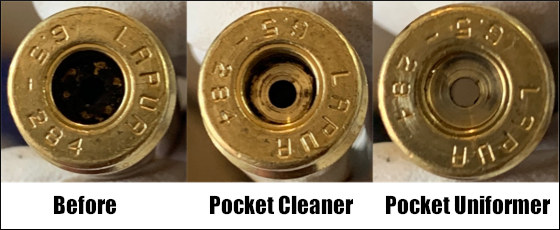
The deburr and chamfer tools worked really well, creating beautiful bevels all while leaving a nice flat edge across the top of the neck which is critical for accuracy and brass life. We found the primer pocket cleaning tool did a good job, but for truly clean pockets we recommend using the primer pocket uniforming tool, which very efficiently removes even hard residues.
The benefit of having interchangeable heads is that you can add your own accessories. We like to use a bore brush with bronze wool wrapped around it for use inside our necks. This worked perfectly once we screwed it in. In fact, we couldn’t think of any 8/32-threaded accessory that wouldn’t work well on this machine. Another great design feature is how all the accessories are oriented straight up. This allows for perfect visual alignment of your cases onto the tools which is critical — especially when performing cutting operations such as primer pocket uniforming.
Along with the five power stations there are six female-threaded storage spots on the sides where tools can be placed to ensure they don’t get lost. We like this feature since there will be more than five accessories you want to use and having them easily available is a great feature. You can keep 11 tools right on the machine (5 on top, 6 on the sides). That way you don’t have to dig through storage bins.
The Case Prep Xpress has a removable front bin to hold brass shavings, and there are two circular trays on either side of the bin. In front is a long tray that holds the provided brush. This makes it relatively easy to clean off brass shavings and other debris from case prep processes.
SUMMARY — Versatile Case Prep Xpress Is A Good Value
For the money, Lyman’s Case Prep Xpress is tough to beat. It performs multiple tasks well while being stable and easy-to-use. Yes there are some multi-spindle prep centers that offer variable or fast/slow RPM spindles while the Lyman’s spindles are all fixed RPM. (See, e.g. the RCBS Brass Boss). However those other systems don’t include all the convenient on-board storage of the Case Prep Xpress, and are more expensive. The Lyman Case Prep Xpress sells for $150-$170 “street price”. It’s currently on sale for $146.99 on Amazon. This makes the Lyman Case Prep Xpress a fine value — it offers great versatility while saving space and saving money compared to buying five or more separate, powered tools.
This Saturday, September 24, 2022, is National Hunting and Fishing Day.
There are over 9.2 million hunters in the United States. The fees paid by hunters are essential to support conservation efforts and to protect/maintain habitats.
These infographics explain the vital role that American hunters play in protecting wild species in North America. Currently 60% of state Fish & Wildlife Agency funding comes from excise taxes and licensee fees paid by hunters and anglers. The system has provided billions of dollars for conservation over the past nine decades. Since the late 1930s, hunters, target shooters and the firearms industry have been the nation’s largest contributors to conservation, paying for programs that benefit America’s wildlife.
The Pittman-Robertson Act generates $700 million annually, which is distributed by the U.S. Fish and Wildlife Service to state fish and game agencies across America.
To help serve America’s many millions of new gun owners, Winchester has created a good online information site for first-time ammunition and firearms buyers as well as those just getting started in the shooting sports. Winchester’s New Shooters Site has many helpful articles plus a series of videos.
A novice long-range competitor is now the first-ever USA King of 1 Mile. Clay Rhoden, the talented head honcho of Longshot (target cameras), won the match with a superb performance. Clay hit every single shot, without a miss, for the first five targets, all the way out to 1699 yards. There were two additional targets beyond one mile — Target 6 at 1909 yards and Target 7 at 2391 yards. Clay went 4 for 10 at these longer distances, but his perfect shooting out to 1699 yards still gave him a comfortable margin of victory.
Amazing FACT: Clay Won the 2022 USA Ko1M in only his sixth shooting match ever!
In winning the 2022 Ko1M match, Clay beat some living legends, including David Tubb, a 6-time NRA Nat’l Long Range Champion and 2019 NRA ELR HG Champ. Clay’s remarkable victory is doubly impressive if you consider that Clay had previously shot only five other rifle matches (at any distance) in his whole life. This was truly a stellar win for a new shooter. Huge congrats to Clay and his Global Precision Group (GPG) team. Clay’s GPG teammate Ray Gross took second overall.
Clay earned his one-mile Ko1M title shooting a very accurate 33XC rifle with BAT action, Bartlein barrel, Manners ELR Light stock, Bix’N Andy trigger, and a Nightforce ATACR 7-35x56mm scope. The ammo, which was developed and loaded by Paul Phillips, featured Berger 300gr Hybrid OTM bullets in Peterson brass pushed by Vihtavuori N565 powder and Federal 215 primers.
2022 King of 1 Mile USA Championship — The Winning Formula
Report by Clay Rhoden, Longshot Target Cameras
The 2022 (first ever) USA King of 1 Mile event is a match I will not soon forget! Before going any further, I want to thank Jay Monych and Alex Cordesman for putting this match together and for opening each day with prayer and the Pledge of Allegiance.
This was only my sixth match ever to shoot and boy was it a blast! I had no expectations going into the match and my focus was on trying to stay calm and collected. I didn’t shoot until the second day, but my teammate, Ray Gross, shot on the first day. I thought we did OK during his qualification run, but I felt that I let him down as a spotter by under-doping the wind calls on the first two targets. Regardless, it was enough to get him into the finals and gave him another shot at the win.
When it was my turn to shoot, I did my best to keep my heart rate down and keep from getting excited. I also prayed throughout the day and prior to shooting, asking the Lord to help me win if it was His will, and to help me gracefully accept the loss if it wasn’t. Additionally, I asked that If I won, He use the win to His glory, and He has and is! My wife and I are going through the beginning stages of the domestic adoption process and the first bit of real money will be due soon and what do you know, it just so happens to be $4,000, the exact amount of money that I won in the match!
The top 19 shooters advanced to the Ko1M FINAL (Targets 5,6,7). In 20th, Paul Phillips just missed out.
My prayers were answered, and I was the only shooter to pull off a flawless run during the qualifier, going 3 for 3 on Targets 1-4. That secured us the top spot going into the finals and after randomizing the list, I remained at the top as 1st shooter in the finals and Ray as the 3rd. Conditions during the finals were worse as it was later in the day and the mirage had really come out to play. I was able to continue my flawless run onto T5 going 5 for 5, then I got 1st, 3rd, and 5th round impacts on T6, and a 4th round on T7. Thankfully, that was enough to secure the win.
Rifle, Scope, and Ammo
I was shooting a brand new 33XC rifle that had about 30 rounds through the barrel from practicing before the match. The gun has a BAT Machine left-hand feed, right-hand eject action, Bartlein barrel, sitting in a Manners F-Class stock with a modified custom TCS weight-tuning butt system. On top was a Nightforce ATACR 7-35x56mm FFP MOAR scope with NF high rings. The BAT action was bedded by Alex Sitman with machine work by GA Precision. The stock allowed me to add a good bit of weight to the back of the gun. That combined with a Tubb 5-star muzzle brake created a smooth and predictable recoil that allowed me to stay on target and help spot my impacts.
Team GPG Captain Paul Phillips loaded all the Ammo for Clay Rhoden and other Team GPG members.
Equally important if not more important than the rifle is the ammunition, and I have to give credit where credit is due. Paul Phillips loaded all the ammunition for the whole team and it shot lights out. We used Peterson Brass, Federal 215M primers, Vihtavuori N565 powder, and Berger 300gr Hybrid OTM bullets. During the match we observed that the guns and ammo performed so consistently shot after shot, that if we got an impact, we just need to run the same hold because the gun is going to put the next round in the exact same spot as the last one.
I was asked “What did your wife and kids say when you put on your crown?” The first thing my wife said when I put it on was, “You look like a whitewalker from Game of Thrones.” I’m not sure what to think of that but she did have a point. My kids thought it was cool and I tried tell them that I was a King now and that they were going to have to listen better, but they saw straight through that.
Preparation for the King of 1 Mile Match
I received my rifle a few weeks before the match and shot it for the first time only a couple of days before the match during a team practice at the Kaian Vista Ranch, a central Texas ranch owned by GPG teammate James Devoglaer. Upon arriving at his ranch, we zeroed the guns, confirmed velocities, and checked to make sure that everything was level. After that, we practiced team communication and spotting on the KVR’s long-range hunter course with 6.5 Creedmoors and then did a couple simulated matches with our competition rifles on the KVR’s ELR course. This allowed us to practice communication between shooter and spotter, as well as verify the predictions from our Kestrels. This practice significantly boosted my confidence going into the match!
Wind Calls and Spotting
In ELR, this is where the team really comes into play, and thankfully, Team GPG just happens to have some of the best wind callers in the world. I shot on the second day of the match and while I was doing my best to stay calm before shooting, my teammates were discussing the wind and the anomalies they had experienced when they shot and factoring all of that into our starting wind calls. Once our time began, it was up to Ray and I to get it right and Ray was on top of it! We were able to make first-round impacts on Targets 1 (1263 yards) through Target 6 (1909 yards). On T7 (2391 yards) our assumption about what the wind was wrong and cost us a couple impacts but thankfully, we were able to parlay those learnings and capitalize on them when it was Ray’s turn to shoot. Ray and I were shooters 3rd and 1st respectively in the finals, which was good from the perspective of applying what we had just learned from when I shot, but bad for me because I was the wind guinea pig for everyone in the finals.
Becoming Part of Team GPG
I lucked into being part of Team GPG last year when I went to help Paul run our Longshot cameras during a team practice. After the practice Paul asked if I wanted to shoot his .416 Barrett and of course I couldn’t say no to that, so I got behind the gun and shot a 4″ group at 2000 yards. A few weeks later, Paul asked if I wanted to join the team and the rest is history. I was just fortunate enough, as a completely inexperienced shooter, to get on a team with some of the best shooters in the world!
Being part of a team and trusting your teammates is such a critical part of ELR and I couldn’t ask for a better team. Each one of us comes from a different background and has different specialties, and we do an excellent job of leveraging all of that to perform at the highest level. Paul and Ray have years of experience shooting competitively. James has years of experience with competitive shooting, hunting, and training, while I have experience with cameras and technology that helps to verify our impacts. Additionally, we are all shooting clone rifles and can instantly leverage what we learn during the match from one shooter to the rest of the team. Paul Phillips even also helped design the new Manners ELR Light stock we used.
Big Prize Table and Major Cash Awards
The sponsors really stepped up for this match and donated $65,000 – $70,000 worth of prizes plus $5,500 in cash! It was an awesome experience being called up first, getting a trophy, belt buckle, and giant check for first place. I also got to walk the prize table first and got an amazing custom lightweight hunting rifle in .30 Nosler from Alamo Precision Rifles (see photo). At this point, I think it’s definitely fair to say that I’m hooked!
Now it’s time to prepare for our next match, the King of 2 Miles. Hopefully, Lord willing, Team GPG will be able to pull off more podium finishes at the end of September.
Conclusion: Philippians 4:13 states “I can do all things through Christ, who gives me strength.” There is no way I could have done this without my faith in God and without my team! I am so blessed and grateful to be able to say that I won the King of 1 Mile!
Longshot Products — How They Are Employed for ELR
There is no way that I would have been in this sport or even aware of the sport if it weren’t for the products we make at Longshot. Originally, rather than buying a spotting scope or binoculars, I developed our long-range camera system to solve the problem of seeing my shots at 100 yards to help zero my first rifle. Shortly thereafter, I was introduced to the idea of 1000-yard shooting. Then, not too long after, I was introduced to Extreme Long Range (ELR) shooting.
For all these disciplines, our Longshot target cameras solve the problem of being able to see and confirm impacts, no matter the condition. And the “reach” of the system is great. The current Longshot LR-3 UHD camera has a guaranteed 2-mile range with open terrain.
As a relatively new shooter and novice long-range and extreme long-range shooter, Longshot cameras have played a critical role in my development as a shooter. With our cameras, I’m able to instantly and precisely associate environmental conditions or a breakdown in fundamentals to a specific result on the target. I truly believe that this along with the people that I have met while running this business have helped me to achieve so much so quickly.
Longshot Hawk Spotting Scope Cameras Used During Ko1M Match
While our long range UHD targets cameras can only be used for scoring during a match, Team GPG uses Longshot’s Hawk Spotting Scope Camera to take pictures of the targets prior to the match and create plot books for each shooter. We then use these to take notes and call corrections during the match. This process helped me get a fourth round impact on T7 during the match. We were able to see a super small poof of dust, plot it on our sheet and call a precise correction to bring us on target.
Click Arrow to Watch Hawk Spotting Scope Camera Video
Background Report from Paul Phillips, Team GPG Captain
Team GPG approached the 2022 inaugural USA King of 1 Mile event the same as we approached the 2019 King of 2 Miles where we finished 1st, 3rd, and 4th out of 80 shooters. This year, at the Ko1M in Texas, we had the same amazing results with first-place and second-place finishes out of 94 Ko1M competitors.
Our team GPG approach begins with making sure our rifles and ammunition are producing half-MOA or better accuracy along with single-digit SDs. We then make sure we have very accurate 100-yard zeros and our optics are plumb and level.
We then utilize a custom PDM (Personalized Drag Model) from Applied Ballistics and verify all of our ballistics with multiple Kestrels and Applied Ballistics analytics.
Once this all matches up, then we simply input all of the distances and environmentals and we are ready for competition. For wind calling we use the Kestrel for wind speed and direction and use analytics to get the values. Just before we shoot we register any last second pick-ups or let-offs to start shooting.
For team communications and team work we spent the day at the KVR ranch located in Lometa, TX owned by Team GPG member James Deboglaer. James put us through his hunter course and we used this as a way to communicate and make sure we were on the same page.
With good elevations and wind along with great team work and communications we were able to produce our first- and second-place results.
Paul Phillips Crafted All the Ammunition and Did Load Development
Paul told us: “I’m doing all of the load development, loading ammo, ballistics and initial wind estimations for my shooters. I also did all the ballistics solutions using AB Analytics.”
Rifle Specifications and Components
All the team’s guns and ammo were GPG spec 33XC builds, with ammunition loaded by Paul Phillips. Clay’s 33XC round has the 300gr Bergers running 3250 FPS MV. GPG team rifles feature these components:
BAT actions
Bartlein barrels
Bix’N Andy triggers
Manners ELR Light stock
Nightforce ATACR scopes
Accutac bipod
GA Precision Gunsmithing
Paul Phillips Load Dev
Alex Sitman bedding
Manson Reamers
Hollands level
Tubb brakes
Berger 300gr Hybrid OTM .338 Cal bullet
Peterson cartridge brass
Vihtavouri N565 powder
Fed 215 primer
Hunting season is here. For hunters that means many hours may be spent searching for animals through spotting scopes and binoculars — “glassing” for game. And when the hunter does find a good buck or doe, he’ll need to know the animal’s precise distance, so that demands a good laser rangefinder. Being carried in the field, the scopes on hunting rifles need to be tough and durable, and every hunting scope should have good low-light performance. And when the hunter finally takes his shot, his scope better be properly zeroed. Today’s Saturday at the Movies showcase is all about Hunting Optics. We offer eight great videos that help you select the right riflescope, spotting scope, rangefinder, and binoculars for your next hunt.
Comparison of Seven Popular Deer Hunting Scopes
This is summary review of seven (7) popular hunting scopes, as available in 2020 (there may be newer variants). This video consist mostly of manufacturer-created marketing content with a few minutes of independent reviews. Consider this video a place to start when shopping for a new hunting optic. You’ll want to check independent reviews when you select a particular model. The seven riflescopes featured in the video are: Athlon Optics Argos BTR, Leupold VX-3i 3.5-10x50mm, Leupold VX-R 4-12x40mm, NightForce SHV 5-20x56mm, Nikon Buckmasters II, Vortex Crossfire II, Vortex Viper HS SFP.
Optics Selections for Mountain Hunts
Here’s a good video by an avid hunter who treks in remote, mountainous zones. The host has learned what works… and what’s worth the weight to carry: “I’ve found that the combination of 10×42 binoculars and a 27–60x80mm spotting scope is the sweet spot for mountain hunting. This pairing balances weight with reach, allowing me to keep moving but also reach out and see well-hidden animals. In some cases, I will make use of an 18×56 binocular, but this is reserved for non-backpack hunts. With 25 years of mountain hunting experience, I can whole-heartedly recommend my preferred binocular pair as a fantastic and versatile set-up for northern mountain hunts at the very least.”
Ultimate Spotter Test — 19 Spotting Scopes Reviewed
The producers of this remarkable 19-product spotting scope comparison state: “If you are looking at choosing the best spotting scope for hunting… you are in the right place! We tested these 19 spotting scopes to find the best compact spotting scope, best 65mm spotting scope, and best 85mm spotting scope out there. We also wanted to find the best values on the market, and I think we definitely did that. While we certainly couldn’t test them ALL, we were able to put together this incredible lineup of some of the best spotting scopes out there to help you find what is going to work for your specific needs.”
First Focal Plane vs. Second Focal Plane Scopes
For the last century, Second Focal Plane (SFP) scopes have been most common on hunting rifles. Now there are an increasing number of First Focal Plane (FFP) optics favored by hunters. The main reason is that the reticle mark values (in Mils or MOA) are constant relative to the target size at all magnification levels. That is handy for hold-offs and hold-overs. On the other hand, a SFP scope maintains a constant reticle size and line thickness at all zoom values. For most hunting shots, taken inside 300 yards, that really should be fine. Many hunters feel they can spot their prey more easily without a busy reticle that obscures small details at higher magnification. This video explains the pros and cons of both reticle types. The final decision is up to you — much will depend on the terrain you hunt and the distances you shoot.
The Complete Optics Selection for For Deer Hunting
In this video, Vortex optics techs explain the optics package deer hunters will want to take into the field. Along with a good medium-power zoom riflescope, you’ll want binoculars and (probably) a spotting scope. You’ll also want a Laser Rangefinder (LRF) or laser-equipped binoculars. As the team points out, the LRF is not just to range your prey right before you take a shot. A top-quality LRF can range a reflective object as far as 1500 yards away. That helps you decide whether you want to hike a mile to reach that buck you see way out on the next ridge.
MOA vs. MIL — What you Need to Know
These days, scope manufacturers offer a wide selection of both MIL (Milliradian) and MOA (Minute-of-Angle) based optics. We do think that MOA is still predominant in the lighter-weight, lower-cost (sub-$500) scopes marketed for hunters. There are pros and cons for both angular measurement systems. One MIL is 3.6″ at 100 yards, while one MOA is 1.047″ at 100 yards. If you grew up thinking in inches, a 1/4-MOA click-value hunting scope might work best. If you shoot PRS or have other MIL scopes you may prefer a MIL-value optic for your hunting rifle. Both choices will do the job.
Comparison of Eight Laser Rangefinders
The Backfire team purchased eight rangefinders and tested them in the field. Most of the products are under $500. This is a good review if you are looking for a compact LRF at a moderate price. Looking at performance for the price, for the hunting market, the reviewers favored the Leupold RX-1600 and the waterproof Vortex Ranger 1800. COMMENTARY: If you can afford it, we recommend that serious hunters consider top-end laser rangefinder-equipped binoculars such as the ZEISS Victory RF and Leica Geovid.
How to Zero Your Hunting Rifle Efficiently
Last but not least, here’s a great video from Vortex that shows you how to quickly and efficiently sight-in and zero your hunting rifle before heading out into the field. This video explains a simple procedure that lets you get a solid zero in just three shots. Of course you probably want to fire a few more rounds to confirm your zero before you head off to your hunting grounds, but this will let you get on-target with a minimum amount of time and ammo expended. This helpful video has over 3 million views on YouTube!
Fouling Shots and Cold Bore Condition
If you recently cleaned your rifle, you may want to fire two or three fouling shots before you start this procedure. But keep in mind that you want to duplicate the typical cold bore conditions that you’ll experience during the hunt. If you set your zero after three fouling shots, then make sure the bore is in a similar condition when you actually go out hunting.
Are laser sights really useful on a handgun? Yes, and not just in low-light situations. That said, many folks who own laser-equipped handguns do not train effectively with the laser. For many gun-owners, the laser is just a toy, a gimmick that is used a few times and then ignored. Those gun-owners miss out on some of the most important advantages of a laser sights, benefits you can get from formal training with your laser-equipped pistol.
Crimson Trace has produced a series of TRAINING Videos that may change your mind about lasers. If you shoot a handgun you should watch these videos. They show how laser sights can help diagnose and correct common handgun-shooting errors (such as flinching and anticipating the shot). The videos also show how to improve sight alignment and get your sights on target quickly.
Training with Laser Sights, Full 12-minute Video
Covers Muzzle Awareness, Sight Alignment, Target Acquisition, Trigger Control
This video shows how training with laser sights can: 1) improve muzzle direction awareness; 2) aid with sight alignment; 3) speed up target acquisition; and 4) improve trigger control. The video also demonstrates the obvious advantage of laser sights in low light conditions. Numerous firearms experts are featured in this video filmed at Arizona’s Gunsight Academy.
Training With Lasers — Trigger Control
Training with laser sights helps diagnose and improve trigger control errors by showcasing the importance of “surprise break” and follow-through. Lasers quickly diagnose errors such as recoil anticipation, jerking the trigger, and breaking the wrist.
Training with Lasers — Sight Alignment
Training with laser sights can improve/correct alignment. The laser provides a visual indicator of proper sight alignment, allowing shooters to quickly see any errors before taking a shot. Additionally, lasers can enhance sight alignment on popular sub-compact carry guns with small, low-profile sights.
Muzzle Awareness — All-Important for Safe Shooting
Training with laser sights improves a shooter’s muzzle awareness. A daylight-visible laser shows the gun operator where his or her muzzle is pointing at all times. This helps teach proper safety practices.
Fans of Heavy Artillery should visit Fifty Caliber Shooters Association (FCSA) website. There you’ll find range maps, photo collections and animated slide-shows On the FCSA photo gallery page, you’ll find a map. Click on any gray range link to see images from that venue. There are also a series of articles covering FCSA competition along with the “care and feeding” of the big 50-caliber rifles.
For today’s Sunday GunDay feature we offer a short history of the legendary .50 BMG cartridge, along with some fun photos from FCSA matches in the Western USA.
About the .50 BMG Cartridge
The .50 Browning Machine Gun (.50 BMG, aka 12.7×99mm NATO or 50 Browning) is a cartridge developed for the Browning .50 caliber machine gun in the late 1910s, entering official service in 1921. Under STANAG 4383, it is a standard cartridge for NATO forces as well as many non-NATO countries.
John Browning had the idea for this round during World War I in response to a need for an anti-aircraft weapon, based on a scaled-up .30-06 Springfield design, used in a machine gun based on a scaled-up M1919/M1917 design that Browning had initially developed around 1900. According to the American Rifleman: “The Browning .50 originated in the Great War. American interest in an armor-piercing cartridge was influenced by the marginal French 11 mm design, prompting U.S. Army Ordnance officers to consult Browning. They wanted a heavy projectile at 2700 FPS, but the ammunition did not exist. Browning pondered the situation and, according to his son John, replied, ‘Well, the cartridge sounds pretty good to start. You make up some cartridges and we’ll do some shooting’.”
Are you a died-in-the-wool .50 BMG fan? Got a hankerin’ for heavy artillery? Then visit the FCSA Photo Gallery page. There you’ll find hundreds of photos from Fifty Caliber Shooting Association (FCSA) matches and 50 Cal fun shoots in eleven states plus Australia, Switzerland, and the United Kingdom. To access the photos from the Gallery Page, start by selecting a state/country and then click on the colored buttons for the event date (e.g. 2015-04).
Photo sets go all the way back to 2002, so you can see the evolution of the hardware over the years. Sample multiple archives to see the differences in terrain from one range to another — from Raton’s alpine setting to the hot, dry Nevada desert. This Gallery is really a treasure-trove of .50-Cal history. Here are a few sample images.
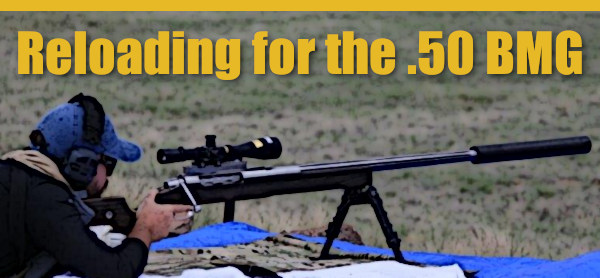
Reloading Powder and Special Tools for .50 BMG
Alliant’s Powder for 50-Caliber Applications
In 2009 Alliant unveiled Reloder 50, a slow-burn-rate powder designed primarily for long-range, .50-caliber rifle shooters. According to Alliant, the burn rate is “a little slower than Winchester 860″ and the powder is showing excellent lot-to-lot consistency. Load density is optimized for the 50 BMG and similar cases. Like Reloder 17, Reloder 50 employs a process which penetrates the kernels with the burn-rate-controlling chemical. This should allow a longer, flatter pressure curve, yielding more velocity than conventional powders can deliver. Alliant says that Reloder 50 offers “superior velocity and the ability to burn cleaner (with less residue)”. Reloder 50 comes in both 1-lb (#150527) and 8-lb (#150528) containers.
Forster and Lyman .50 BMG Trimmers
Big Fifty enthusiasts asked for a dedicated .50 BMG case trimmer, so Forster and Lyman created .50 Cal trimmers specifically for that cartridge. Forster’s cutter tip on its .50 BMG Case Trimmer is much sharper than the cutter on the Lyman 50 Cal AccuTrimmer. However, with the Forster tool you will pay more for that superior cutting ability — the Forster .50 BMG trimmer is $95.53 at Midsouth compared to $75.09 at Midsouth for the Lyman .50 BMG trimmer. Go head and pay the extra money for the Forster — the cutter head is much sharper, and we prefer the Forster’s collet-style case-holder. Bottom line — the Forster gets the job done more quickly, with less effort.
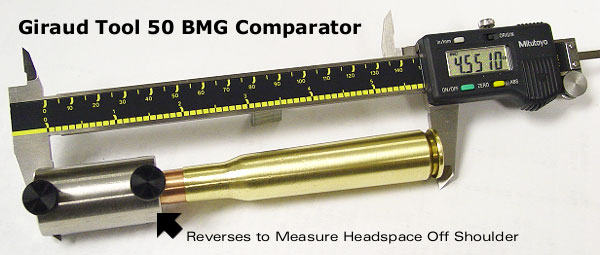
Giraud .50 BMG Case/Bullet Comparator Giraud Tool makes a comparator for 50-Cal cartridges. The double-ended comparator is quite versatile. In one orientation you can measure base-to-ogive bullet length and also measure cartridge OAL from rim to bullet ogive. When reversed, you can use the comparator to measure cartridge headspace. The $33.00 Giraud .50 BMG Comparator gauge is constructed of 303 stainless and fits most any vernier, dial, or digital caliper. CLICK HERE for more info.
What is Parallax?
Parallax is the apparent movement of the scope’s reticle (cross-hairs) in relation to the target as the shooter moves his eye across the exit pupil of the riflescope. This is caused by the target and the reticle being located in different focal planes.
Why is it Important?
The greater the distance to the target and magnification of the optic, the greater the parallax error becomes. Especially at longer distances, significant sighting error can result if parallax is not removed.
How to Remove Parallax
This Nightforce Tech Tip video quickly shows how to remove parallax on your riflescope.
While keeping the rifle still and looking through the riflescope, a slight nod of the head up and down will quickly determine if parallax is present. To remove parallax, start with the adjustment mechanism on infinity and rotate until the reticle remains stationary in relation to the target regardless of head movement. If parallax has been eliminated, the reticle will remain stationary in relation to the target regardless of eye placement behind the optic.
To shoot tight groups and high scores from the bench, or in prone F-Open competition, a quality front rest is essential. And a good rest is also very valuable when zeroing rifles, testing loads, and shooting varmints from a portable bench. Today’s Saturday video showcase includes multiple video reviews of some of the best front rests on the market — great products from SEB, Rodzilla, 21st Century, Lenzi, and Sinclair Int’l. In addition, the lead-off video from F-Class John covers some of the less expensive rests as well as SEB Joy-Pod coaxial bipods.
Review of Many Popular Front Rests from $250 to $2200
If you are shopping for a front rest, definitely watch this comprehensive 42-minute video from start to finish. This is probably the most informative video about premium shooting rests available on YouTube. Top F-Class shooter and video-maker F-Class John covers a wide selection of front rests, with some observations about coaxial bipods as well. John covers the impressive new SEB NEO-X, the easy-to-transport SEB Mini-X, the excellent Rodzilla Rest, the innovative 21st Century Hybrid Rest, the sleek Italian Lenzi Rest. And at the end of the video John reviews the very affordable Caldwell Fire Control Rest ($249.99 on Amazon), explaining how it can be a decent choice for shooters on a limited budget.
NEW SEB NEO-X — Set-Up in the Field
Still in its final prototype stage, the innovative SEB NEO-X raises the bar for transportable coaxial front rests. An innovative design with hinged legs allows the 20-lb NEO-X to be transported in a small case. Once the legs are extended however, the NEO-X has proven to be very stable. And this new coaxial rest offers very precise, easy-to-use controls. A swivel head speeds up deployment, as the allows you to quickly align the rest top to the target. Users have confirmed the NEO-X works great and is very stable. In the video above ace F-Class shooter Erik Cortina (below) shows how to quickly deploy the NEO-X in the field.
Rodzilla T-Rex — High Quality, Big Footprint, Advanced Features
The impressive Rodzilla T-Rex front rest offers outstanding stability with smooth, precise performance. Designer/builder Rod Brakhage (the Rod in Rodzilla) started from the ground up to create a user-friendly, match-ready, modular front rest on the market. The T-Rex weighs just over 21 pounds, and the T-Rex has a large footprint, rivaling the largest rests on the market. That provides exceptional stability, even with heavy-recoiling rifles.
The T-Rex boasts an adjustable joystick that extends from 15.5″ to 21″ in length. With this adjustability, no matter what your stock length or design, you can find a comfortable position without having to stretch uncomfortably. Rodzilla delivers the T-Rex in a custom-designed hard carry case that fits it perfectly and still has room for additional feet and accessories. The T-Rex can be ordered with excellent Sand Feet.
21st Century Hybrid-X Front Rest
Lateral Control Arm, Vertical Elevation Knob
The innovative 21st Century Hybrid-X front rest offers the “best of both worlds”. It allows precise lateral movement (for wind holds) with no elevation change. The entire center section of the rest rotates as one unit for fast, perfect horizontal alignment to target. Then adjust vertical precisely with the rotary knob on the outboard end of the control rod. Our Daily Bulletin Hybrid-X article has a full description with multiple photos of this unique rest. See additional Hybrid-X Video.
Sinclair Int’l Competition Front Rest — Sturdy and Stable Design
The Sinclair Int’l Competition Rest is a classic heavy and very stable rest that works great on the bench. Weighing 30+ pounds, with a 1″-thick steel base, this rest has a very low center of gravity and is ultra-stable. Currently priced at $699.99, the Sinclair Competition Rest is less than half the cost of the more exotic front rests.
Horizontal (windage) movement is controlled with a large rear knob which uses dual sets of twin tapered roller bearings for a non-binding windage operation. Nearly four feet of windage adjustment is offered at 100 yards. Elevation changes are made with the large wheel. With its mass and low COG, this Sinclair Rest is very stable. And because of its ability to hold elevation shot to shot, this rest has been popular with long-range benchrest competitors who often shoot quick strings of 5 or 10 shots.
SEB Mini-X and SEB Mini — Transportable Joystick Tripod Rests
The original SEB Mini was an innovative collapsible tripod rest with a coaxial top. On its introduction the SEB Mini became immediately popular with varminters, F-TR shooters, and anyone who wanted an affordable, easy-to-transport front rest that offered easy, precise and rapid adjustment of windage and elevation with the Joystick. Building on the success of the original SEB Mini, the new SEB Mini-X offers an improved head design, and new adjustable “ankle” units on all three legs. This makes it easier to level the Mini-X on uneven ground. The Mini-X has proven very successful in competition, winning major F-Open matches. Folding into a very compact package, it is easy to transport in airline luggage. Yet it offers a very stable shooting platform with precise, effortless joystick control of elevation and windage.
Hunting season is coming soon in many parts of the nation. If you’re thinking about what bullets to use for your annual game hunt, you’ll find some VERY valuable information here. Federal has created an award-winning Bullet Breakdown Video (below) that demonstrates how various hunting bullets perform in ballistic gelatin. This and other videos are found on Federal Premium Ammunition’s YouTube Channel. The Bullet Breakdown Video features four bullet types used in Federal Ammo: Nosler Ballistic Tip; Sierra GameKing; Trophy Bonded Tip; and Barnes Triple-Shock X-Bullet.
NOTE: You may want to lower the video sound level before playback.
Federal’s high-resolution, slow-motion video-graphy helps demonstrate which loads are the best for specific uses. The ultra-slo-mo footage provides a detailed view of each bullet penetrating ballistic gelatin blocks. These blocks closely mimic animal tissue and clearly display performance characteristics.
“The Bullet Breakdown Video is a great tool for hunters trying to decide on ammunition type,” said Federal’s Jason Nash. “Properly preparing for the hunt is crucial-and not all bullets are made the same. The bullet is the one link between hunter and game and can be the difference between success and failure. This video helps show hunters how different bullet construction affects terminal performance[.]” For more info, visit www.FederalPremium.com.




 Being part of a team and trusting your teammates is such a critical part of ELR and I couldn’t ask for a better team. Each one of us comes from a different background and has different specialties, and we do an excellent job of leveraging all of that to perform at the highest level. Paul and Ray have years of experience shooting competitively. James has years of experience with competitive shooting, hunting, and training, while I have experience with cameras and technology that helps to verify our impacts. Additionally, we are all shooting clone rifles and can instantly leverage what we learn during the match from one shooter to the rest of the team. Paul Phillips even also helped design the new Manners ELR Light stock we used.


 Fans of Heavy Artillery should visit



 Alliant’s Powder for 50-Caliber Applications



 The


 Federal’s high-resolution, slow-motion video-graphy helps demonstrate which loads are the best for specific uses. The ultra-slo-mo footage provides a detailed view of each bullet penetrating ballistic gelatin blocks. These blocks closely mimic animal tissue and clearly display performance characteristics.


