Ever wondered how the parts inside an AR-15 work together? Just exactly how does the reciprocating bolt carrier feed rounds from the magazine? How do the elements in the trigger group work and reset after each shot? How does the gas system bleed gas from the barrel and operate the bolt carrier? These and other questions are answered in this eye-opening video from 45Snipers. Using “cutaway” 3D computer animation, this 5-minute video shows all features of an AR15 inside and out. This fascinating firearms animation allows the viewer to look inside the upper and lower receivers, into the bolt carrier, chamber, barrel, and magazine. There’s a second AR-15 Video that shows all the internal and external parts of the AR-15 Rifle. CLICK HERE for AR Parts Animation.
2. How an AK-47 Works — With Parts Assembly
This animation shows how the AK-47 (officially Avtomat Kalasnikova model 1947) rifle functions. This very realistic video shows the component parts of the AK47 coming together. They you can see how the fire control system works to ignite the primer, sending the bullet down the barrel. Next you see how the gas piston pushes the bolt carrier rearward to chamber a new 7.62x39mm cartridge.
Tech Note: This high-quality 3D animation was created by Matt Rittman using Cinema 4D and After Effects software. Corona renderer was used in order to create realistic materials and reflections. Credit Forum member Captain Dave F. for finding this video.
3. How a Pistol Cartridge Fires
This cool 3D video from German ammo-maker GECO (part of the Swiss RUAG group of companies) unveils the inside of a pistol cartridge, showing jacket, lead core, case, powder and primer. Uusing advanced CGI rendering, the video shows an X-ray view of ammo being loaded in a handgun, feeding from a magazine. Then it really gets interesting. At 1:32 – 1:50 you’ll see the firing pin strike the primer cup, the primer’s hot jet streaming through the flash-hole, and the powder igniting. Finally you can see the bullet as it moves down the barrel and spins its way to a target. If you’ve ever wondered what happens inside a cartridge when you pull the trigger, this video shows all.
For Best Viewing, Click Gear Symbol and Select HD Playback Mode
4. How a Rifle Cartridge Fires
This CGI video shows what happens inside a rifle chamber and barrel when a cartridge fires. The 3D computer animation reveals every stage in the process of a rifle round being fired. X-Ray-style animation illustrates the primer igniting, the propellant burning, and the bullet moving through the barrel. The video then shows how the bullet spins as it flies along its trajectory. Finally, this animation shows the bullet impacting ballistic gelatin. Watch the bullet mushroom and deform as it creates a “wound channel” in the gelatin.
Watch Video – Cartridge Ignition Sequence Starts at 1:45 Time-Mark
If you are a gunsmith, or do any machine works on firearms, you need to know about ITAR, the International Traffic in Arms Regulations which are enforced through the U.S. Department of State (DOS). ITAR applies to companies that create sophisticated weapons systems. However, under DOS interpretations in recent years, ITAR may also apply to persons and businesses that do simple, basic gunsmithing tasks. That could require filling out lots of paperwork, and paying the Fed’s hefty fees, starting at $2250 per year. A Guidance Statement issued by the DOS Directorate of Defense Trade Counsels (DDTC) in July, 2016 (under the Obama Administration) gave rise to serious concerns that DOS was going to require every gunsmith to register under ITAR, under threat of massive fines and penalties. READ About DDTC ITAR Guidance.
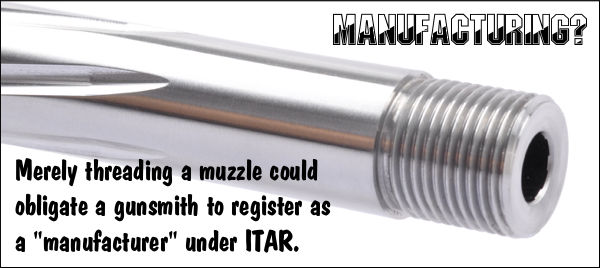
Thankfully, it appears that the Trump Administration is working to narrow the scope of ITAR so that it would NOT apply to basic gunsmithing activities, and not apply to common gun accessories that are not exported. IMPORTANT: Changes have NOT been made yet, but it appears the Feds are heading in the right direction, with the DOS willing to modify its definition of “manufacturing” so ITAR would not embrace basic gunsmithing tasks such as threading a muzzle.
The Gun Collective reports that: “The Directorate of Defense Trade Counsels (DDTC) is working on revising the ITAR regulations which will help the gun industry[.] Gunsmiths having to pay hefty fees, register and comply with ITAR may no longer be a problem if this goes through as planned. Fortunately, we don’t have to wait for Congress to take action, but rather an agency, which appears to be taking initiative to get it done. As always, time will tell, so be sure to keep your eye on the Federal Register….”
While nothing has happened yet, it appears that this administration is working to revise ITAR. For members of the firearms industry, this is a big deal and will be beneficial to all. There is no reason that a gunsmith should be required to register and comply with ITAR to simply thread a muzzle. It will also allow companies to more easily export their products around the world. (Source: The Gun Collective)
The Gun Collective further noted that: “The topic that will be of the most interest to us would be the definition of manufacturing[.] You may remember DDTC’s July 2016 letter, which issued “Guidance” as to who would have to register under ITAR [and suggested] that now gunsmiths would have to register as well. The definition of manufacturing is an important one to define and one that had broad ranging implications as the industries covered under ITAR are wide ranging, everything from the firearms industry to airplanes and missiles. The Guidance stated that ITAR registration was required for gunsmiths who machined or cut firearms, such as the threading of muzzles or muzzle brake installation which required machining. At a hefty $2,250 a year to register, ignoring all of the other things that go along with ITAR, it is easy to see why this would be problematic for most small businesses.”
Here is the key language in the DDTC’s “ITAR Registration Requirements – Consolidated Guidance” Ruling of 7/22/2016:
2. Registration Required – Manufacturing: In response to questions from persons engaged in the business of gunsmithing, DDTC has found in specific cases that ITAR registration is required because the following activities meet the ordinary, contemporary, common meaning of “manufacturing” and, therefore, constitute “manufacturing” for ITAR purposes:
a) Use of any special tooling or equipment upgrading in order to improve the capability of assembled or repaired firearms;
b) Modifications to a firearm that change round capacity;
c) The production of firearm parts (including, but not limited to, barrels, stocks, cylinders, breech mechanisms, triggers, silencers, or suppressors);
d) The systemized production of ammunition, including the automated loading or reloading of ammunition;
e) The machining or cutting of firearms, e.g., threading of muzzles or muzzle brake installation requiring machining, that results in an enhanced capability;
f) Rechambering firearms through machining, cutting, or drilling;
g) Chambering, cutting, or threading barrel blanks; and
The latest issue of Shooting USA magazine has a detailed EIGHT-page feature on the Kestrel wind meter. This story covers the development of the Kestrel and explains the advanced technologies now offered with the hand-held Kestrel systems.
The eZine version of Shooting Sports USA (SSUSA) is available for free online. In the latest December 2017 issue you’ll find two excellent articles of interest to all serious rifle shooters. One covers the development of the Kestrel weather meter, which has evolved to serious levels of sophistication. Now premium Kestrels include built-in ballistic calculators and they can “talk” with mobile devices, sharing command functions and data. The second article covers shooting skills. In the first of a three-part series, Glen Zediker talks about NRA High Power rifle competition. Glen spotlights the skills you must master to move from the beginning level, Marksman, to higher levels.
Kestrel Technology Today
The December SSUSA issue features the origin of ballistics-enabled Kestrel weather meters. SSUSA’s Editor John Parker covers the history of the Kestrel, and explains how more and more features were packed into the handheld device as it evolved. Today’s Kestrel is so much more than an impeller with wind speed/direction read-outs.
The impressive Kestrel 5700 Elite with Applied Ballistics software is the latest model of a product that revolutionized long-range shooting by combining ballistic computer and weather meter in one portable device. Shooters can select either G1 or G7 ballistic coefficients, or to be even more specific they can select bullets from the Applied Ballistics custom curves library. With the Kestrel and its software, shooters can plot very precise trajectories, even to extreme long ranges.
Marksman to High Master
High Power Rifle competition originally evolved from the U.S. military course of fire. Climbing the classification ranks in NRA High Power Rifle can be daunting — it requires focus, practice and commitment to move up the ladder from Marksman all the way to High Master.
In Glen Zediker’s three-part series, “Climbing the High Power Ladder”, Glen shares his tips for competitors that are looking to improve their skills beyond the intermediate level. The first installment focuses on stepping past Marksman classification to Sharpshooter. Read PART ONE HERE. In the months ahead, look for parts Two and Three in future SSUSA issues. These will cover the next stages in the climb: Expert, Master, High Master.
DVD Resource for High Power Training
If you’re serious about improving your High Power skill set, we suggest you view a DVD by David Tubb, 11-time National High Power Champion. David’s instructional DVD, “The Art & Technique of the Modern Match Rifle”, is a great resource for any High Power or position shooter. This 2-disc DVD provides over 4.5 hours of instruction and shooting demonstrations. We can confirm that this video is packed with great information — novice High Power and prone shooters who apply David’s methods should definitely improve their scores.
David has included highlights from that DVD in a shorter promo video. While the shorter video is a sales tool, it’s very informative in its own right. Watch the video and you’ll learn a great deal just by watching how David shoulders his rifle, and how he adjusts and maintains his shooting position. David shows examples of prone, sitting, and standing positions. In the short “trailer”, David also provides helpful tips on adjusting sights, and placing the spotting scope.
If you shoot Service Rifle, High Power, or prone, you can benefit from watching this short sampler video. The full 2-disc DVD is available for $49.95 from Creedmoor Sports. With over 4.5 hours of content, the DVD covers all the across-the-course positions, the set-up and use of aperture sights and diopters, High Power and long range targets, the approach method in offhand, proper placement and use of spotting scopes. The DVD includes bonus footage of David shooting strings in all of the across-the-course positions.
You can spend thousands on a fancy new rifle, but all that expensive hardware won’t perform at its best if you have poor trigger technique. One key element of precision shooting is trigger control. Our friend Kirsten Joy Weiss has produced a good video that shows how to refine your trigger technique for better accuracy. In this video, Kirsten talks about the actual placement of a shooter’s index finger on the trigger. It is important to have the finger positioned optimally. Otherwise you can pull the shot slightly left or slightly right.
Kirsten tells us: “Finger placement on the trigger might not seem like a big deal, but it actually is. The reason for this is because, depending on where your index finger is placed on the trigger, [this] translates to different muscle interactions with the gun.” Watch this video to see Kirsten demonstrate proper finger placement (and explain problems caused by improper finger positioning).
When you pull the trigger, you only want to engage the last section of your finger, in order to avoid unwanted muscle engagement and to achieve a smooth shot. Remember there is a “sweet spot” between the crease (first joint) and the tip of the finger. If you position the trigger in that “sweet spot”, you should see an increase in your accuracy. Don’t make the mistake of putting the trigger in the crease of your finger, as shown below.
Effects of Incorrect Finger Placements
You want to place the trigger shoe between the end of your finger and the first joint. If you place the trigger on the very tip of you finger you’ll tend to push the rear of the rifle to the left when engaging the trigger, causing shots to go right (for a right-handed shooter). On the other hand, if you put the trigger in the crease (first joint), you’ll tend to bring the rear of the rifle to the right, causing shots to fall left. This is illustrated below for a right-handed shooter.
Timney Triggers has stepped up to help preserve the history of American firearms. Recently Timney pledged $500,000 to the Cody Firearms Museum renovation project. The Buffalo Bill Center of the West recently announced its plan to fully renovate the Cody Firearms Museum, opening Summer 2019. Total project cost is estimated at $12,000,000 to house the 7000+ firearms in the Museum’s collection. The National Endowment for the Humanities and Institute of Museum & Library Services have provided large grants. Notably, however, the Timney Triggers’ donation is the first substantial contribution from a major gun industry company.
The CFM is planning a two-floor renovation that will cater to both firearms enthusiasts and the general public. Currently, there are approximately 3,000 firearms on display. After renovation, the museum will boast over 4,500 firearms on display, multiple shooting simulators, and hands-on inter-active displays. According to CodyEnterprise.com: “The plan is to produce a special exhibit of the collection’s top 75 guns and sprinkle other firearms exhibits throughout the rest of the 325,000-square-foot museum. That includes placing guns in the Buffalo Bill Museum, the Draper Museum of Natural History, the Whitney Western Art Museum and the Plains Indian Museum.”
John Vehr, Owner of Timney Triggers, stated: “Our industry must support and appreciate the benefits derived from having the finest gun museum in the world educate hundreds of thousands of people who visit AND are new to guns, on the historical importance and the positive aspects of our industry.”
Curator of the Cody Firearms Museum Ashley Hlebinsky commended Timney Triggers: “When we set out to plan the new museum, we wanted to make sure that not only our historic roots were fostered in the new museum, but that we would acquire representation from newer companies or companies whose stories haven’t been told previously in museums, solidifying their place in history.”
Many of our readers are thinking of trying out PRS-type competition. Tactical matches are becoming more popular every season. Along with F-Class, tactical/practical disciplines are the fastest-growing forms of competitive rifle shooting. Rich Emmons, one of the founders of the Precision Rifle Series (PRS), has written an insightful article about getting started in the tactical game. This will help PRS novices pick the right equipment and understand the game. Here are highlights from Emmon’s “PRS — Intro to Competition” article, originally published on the PRS website. You may also want to read the current PRS FAQ Page.
Precision Rifle Series — Intro to Competition
by Rich Emmons, PRS President
Tactical Shooting with a precision rifle is not like other disciplines, there is no set course of fire or format. That is what makes it so fun!
First, you have to ask yourself what do you want to accomplish. When I was introduced to long range shooting, immediately a light turned on for me, once I saw how easy it was to hit 300–600 yard targets. What I quickly learned from my first competition and the many that followed was there is so much to learn and shooting in competition put everything you thought you knew to the test. So back to the question: “What do YOU want to accomplish?”. The reality is you may not know yet, you just think it is cool to have a bad ass rifle and scope that can make almost any shot. Now if you’ve got that rifle and scope, it’s time to take it to the next level.
Watch PRS 2016 Championship
Getting Started — What to Expect
If you’re reading this, you have probably already have been bitten by the long range shooting bug. It can seem quite intimidating to just jump in with a new bunch of shooters you don’t know and shooting lingo you don’t quite understand yet. But here is the key — show up and shoot! I guarantee you if you show up to a match as a new shooter, other experienced shooters will guide you along and give you help on anything you need.
AUDIO: Click Button to hear Rich Emmons Talk about the Precision Rifle Series.
Now, a couple things you should just expect. You’re not as good as you think you are. Don’t expect to come into your first match and beat all the veterans. That just doesn’t happen unless you have had some really good coaching or other shooting competition experience to get you ready for this type of competition. If possible, find a local rifle club that has monthly long range matches, or any type of match will help prepare you for a larger PRS event. Getting involved with a rifle club and starting out shooting monthly matches is definitely the way to jump into competition shooting.
The Gear You Need
The first question that many ask is: “What kind of rifle/caliber/scope do I need?” The easiest answer to this is, the best you can afford. It’s no secret the gear is expensive. It took me several years of buying sub-par gear and eventually trading up to figure this out. Now, a guy can get a real sense of pride of doing it on the cheap, or with a factory rifle. I’ve seen many old Savage 10FPs take down custom rigs that cost 10 times as much. And if that’s all you can afford, then eventually you will learn the limitations of yourself or your gear. As for choice of cartridge/caliber, the respected Precision Rifle Blog has analyzed three years worth of match results (2014, 2015, 2016) from the best tactical shooters in the nation. CLICK HERE to read an article that reveals what the “top guns” use. (CLICK HERE for PRB cartridge survey covering 2012-2014.)
Making Good Ammo
Producing quality reloads is something you have to master. It’s not hard at all, you just have to pay attention to detail, and eventually you are going to do something stupid like mis-priming your brass, or skip a row of brass when dumping your powder. Everybody has their own horror story of some reloading failure that cost them a stage or even a match. So load to perfection, work with your rifle to find what load it likes the best, then start your practice.
Practice Makes Perfect
You want to become ONE with your rifle, learning everything you can about its functionality. Getting comfortable with the operation of your rifle is key. Learn the feel of your trigger, dry-firing until you wear the paint off your bolt handle. Learn how the rifle works best — pay attention to little things like the sound and feel of the bolt feeding a round from the mag (or when it doesn’t). Learn how to remove a jammed round quickly, learn how to reload a magazine quickly. Learn to scan across a field and find targets in a quick manner, seeing the targets with your eye and coming into the scope on target. These are some of the basic practices that separate the new shooters from the seasoned ones.
The November 29, 2017 episode of Shooting USA TV features the Vintage Sniper Rifle at Talladega Marksmanship Park in Alabama. Vintage Sniper Rifle matches have proven popular with competitors of all ages, from 18 to 80. These matches are conducted with two-man teams, using vintage rifles with old-style optics. Most shooters use bolt-action rifles such as the 1903 Springfield and Swedish Mauser, but there is also a semi-auto class popular with Garand shooters. You can watch this episode on the big screen or view this episode on YouTube. Click the arrow below to start the 48-minute show:
Broadcast Times: Wednesday 9:30 PM Eastern Time; 1:30 AM ET (Thurs). Earlier in Central, Mountain, and Pacific Time Zones. Check your local listings for the Outdoor Channel.
Vintage Sniper Rifle Competition at Talladega
In this episode, Shooting USA features the Vintage Sniper Match at the CMP’s Talladega Marksmanship Park. This is a popular two-man team event, for shooter and spotter, using military rifles in service up to 1953. One added challenge is the time limit. The team has only 20 seconds to complete each shot — That’s 20 seconds for the spotter to read the conditions, and for the shooter to pull the trigger.
File photo from Vintage Sniper match at Camp Perry. At Talladega, there are video target monitors at each shooting station.
Guns of Grandfathers…
In this episode two USAMU marksmen, SGTs Daniel Crody and Robert Shoup, compete with an Springfield M 1903 A4 reproduction topped with a vintage optic. “For me it holds a little bit of sentimental value,” says SGT Crody. “I did have two grandfathers in World War II. It is definitely a pleasure holding a piece of history…”
“It’s a match that brings a different type of competitor out. It brings a nostalgic competitor out. You’ll see World War II time-period rifles, sniper-type rifles that were used during World War II, Korean War era,” says the CMP’s Chief Executive Officer, Mark Johnson. “The optics are either original optics or current reproduction of old optics.”
Who can identify this vintage European rifle, with its unusual scope mount?
BONUS: PRS Competition — the GAP Grind
NOTE: This 11/29/17 Shooting USA episode is a double feature that includes coverage of the GAP Grind, the biggest PRS tactical match of the year. Official called the Bushnell GAP Grind Pro-Am, this is a tough tactical/practical match in Tennessee with 300 competitors. Conducted in association with the Precision Rifle Series (PRS), the GAP Grind features a Pro/Am format — new shooters partner with an experienced shooters for the two-day, 25-stage event. For the featured event, Shooting USA’s John Scoutten teamed up with novice shooter Jen Hodson.
Politicians need to justify their existence. That means they are constantly fiddling with statutes, and writing new laws, even when none are needed. With legal requirements constantly in flux, it can be difficult for gun owners to keep track of their responsibilities under state and federal law. Thankfully, USLawshield.com has prepared summaries of recent federal and state legislation. Short videos summarize the 2017 law changes which may affect gun owners. The primary video (below) covers changes to federal law. Then there are state-by-state summaries for Florida, Georgia, Missouri, Oklahoma, Texas, and Virginia.
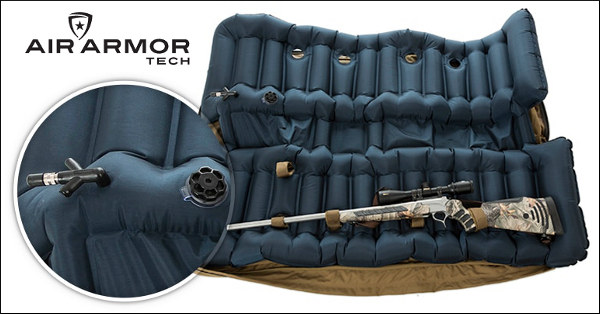
The Air Armor Tech Long Gun Case (LGC) holds multiple firearms up to 52″ OAL. When deflated, the 8-lb LGC stows in a 18″ x 9″ diameter roll. The LGC easily holds two long rifles with optics. The LGC comes complete with internal tie-downs for rifle and pistol, plus external shoulder straps for field carry.
Here’s something new and clever — a gun case with inflatable air chambers to protect the rifle. This definitely could have benefits for hunters and tactical shooters. This new Air Armor Tech military-grade gun case was recently tested by American Rifleman magazine. This gun case was developed by Blaine “Rock” Tompkins, a retired fighter pilot.
American Rifleman’s tester liked the product: “Typical foam-filled soft cases are inexpensive but don’t offer all that much padding. While hard cases provide more protection, they are bulky and take up a lot of storage space. Air Armor Tech’s inflatable gun cases … provide plenty of padding while being lightweight and easy to store. The three-pipe inflation system allows both of the 3-inch-thick (when fully inflated) air bladders to be quickly inflated.” Air Armor Tech offers two sizes, the Long Gun Case (LGC) that holds guns up to 52″ OAL, and the Mid-Length Gun Case (MLGC) that holds firearms up to 42″ OAL.
Air Armor Tech’s cases aren’t cheap — the LGC is $549 while the smaller MLGC is $499 — but when you consider your investment in rifle and optics, maybe this makes sense, particularly for hunters. Inside the bag are twin air bladders (see photo above) that cushion your guns. When deflated, the Air Armor Tech case can be rolled into a something the size of a sleeping bag.
Here are three videos that show the Air Armor Tech case works — and how it even floats. This air-cushioned bag definitely offers added protection for expensive firearms and optics.
Air Armor Tech Gun Case Features
Air Armor Tech Case on River Trip
Air Armor Tech Extended Field Test Report
“Air Armor Tech sent me a military grade inflatable rifle case to review. I’ve been using it for a couple of months on hunting trips, trips to the range and just about anything else I take a rifle or shotgun to. After using it for months, I can state without hesitation that the Air Armor Tech rifle and shotgun case is the toughest, lightest, handiest and best-made rifle case I have ever owned. It also protects my long guns better than anything I have ever tried. Besides, it even floats.” — Gun Guy, 09/25/17
Do you enjoy shooting pistols for sport, or perhaps you carry a handgun for self-defense? If you’re like most of us, you might benefit from a “refresher course” on the fundamentals of handgun shooting. The NRA has created a useful Infographic that covers important basics of handgun marksmanship — key things such as Sight Alignment and Trigger Control. Here are the first two (2) lessons. Click the link below to see all SIX (6) training topics: Sight Alignment, Sight Focus, Trigger Control, Breath Control, Hold Control, and Follow-Through.
Video Shows Sight Alignment, Grip, Stance, Trigger Control and More
In this USAMU video, SGT Shane Coley talks about the basics of sight alignment and trigger control. But then SGT Coley talks about other important control factors such as grip, arm position, and body stance. For rapid-fire shooting, you need to have a good arm and body positioning to control recoil and get back on target quickly. This video is a valuable complement to the NRA Infographic because it demonstrates all the important pistol fundamentals during live fire, at the range.




 Marksman to High Master
 DVD Resource for High Power Training


 Guns of Grandfathers…