Sinclair International has produced an eight-part video series on metallic cartridge reloading, hosted by Sinclair’s former President Bill Gravatt. The entire series can be viewed (for free) via Sinclair’s YouTube Channel. While this set of videos starts with the basics, it covers many more advanced aspects of reloading as well. Accordingly, both novice and experienced reloaders can benefit from watching the eight videos. We think everyone should watch Video No. 2. Introduction to Reloading Safety, which provides guidelines for safe reloading practices.
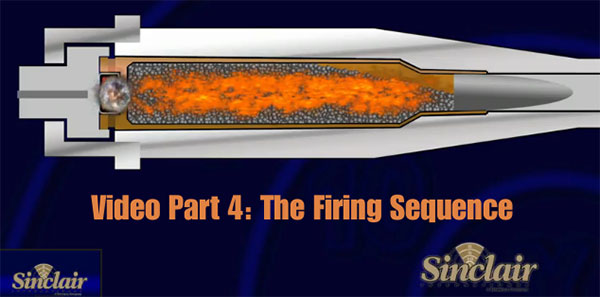
Watch Firing Sequence Video
We also strongly recommend Video No. 4 to readers who are getting started in reloading. This “How Things Work” segment covers the sequence of events inside the chamber (and barrel) when the cartridge is fired. The video includes helpful graphics that show what happens to the primer, powder, cartridge, and bullet when the round is fired. The video also illustrates “headspace” and explains how this can change after firing. We think this video answers many common questions and will help reloaders understand the forces at work on their brass during the firing process.
Do you really know (and understand) the gun laws in your home state? Do you know when the use of deadly force is allowed? Do you know if the “Castle Doctrine” applies in your state or whether your state has a “Stand Your Ground” law in effect? If you ever carry a firearm for self-protection, you should know the answer to these and other important questions. Thankfully there are some excellent, up-to-date resources that explain the gun laws in five key states: Colorado, Florida, Oklahoma, Pennsylvania, and Texas. These gun law treatises, published by U.S. Law Shield, provide the text of important gun laws, along with expert commentary from experienced attorneys. The books provide clear explanations of gun laws in easy-to-understand language.
Gun Law Seminar Programs in Eleven States
In addition to its Gun Law books (offered for five states), U.S. Law Shield conducts legal seminars in 16 states across the country: AR, CO, FL, GA, KS, MD, MO, NC, NJ, OH, OK, PA, SC, TN, TX, and VA. At these Gun Law Seminars, you can ask questions and get state-specific answers from Law Shield Independent Program Attorneys in each jurisdiction. CLICK HERE to find a seminar in your state.
Popular YouTube Channel Smarter Every Day recently released a fascinating video featuring rifle suppressors with see-through acrylic sleeves. The team filmed shots through the suppressors using ultra-high-speed (110,000 frame per second) cameras. When played back in super-slow-motion, you can see the flame propagate through the suppressor and the bullet move through each baffle before it exists the muzzle. Notably, you can see different internal flame effects depending on the baffle design. Watch the results in the video below — it’s mesmerizing:
See Through Suppressor in Super Slow Motion (110,000 fps) — Click Arrow to Watch:
The high speed transparent silencer video is pretty neat. It certainly demonstrates, to some extent, the violence that happens inside centerfire rifle suppressor when firing.
At Thunder Beast Arms Corp. we have carefully studied the forces/pressures operating inside suppressors. The “uncorking” pressure when the bullet exits the muzzle is typically in the 8,000 to 15,000 psi range, but some combinations of cartridge and barrel length can extend this up to the 25,000 psi range. Job #1 of a suppressor designer is to build a suppressor that won’t explode. Job #2 is to build one that quiets down the muzzle report significantly. Doing that well, with the minimum amount of material, is the tricky part.
Suppressor design is both art and science, and we approach our R&D from three sides: experience, experimental testing, and computation.
There are a lot of opinions about how to design a quiet suppressor. Many of these are based on preconceived notions of how suppression “should work”. These theories may or may not work when built and tested in the real world. Where the rubber hits the road is experimental testing. I would say that a majority of knowledge about “How to design a quiet suppressor” comes from building hundreds or thousands of prototypes and testing them with good equipment in a cogent experimental process. Some of those theories pan out, but many of them do not.
Thunder Beast Arms Tests its Suppressors in the Lab and in the Field.
Scientific Software Aids Design
We have also made a large investment in computation fluid dynamics (CFD) and finite-element analysis (FEA) software and use it in addition to other computer-model analysis to look at the physics that occurs inside the suppressor. This type of analysis gives information about material effects that is pretty much impossible to get any other way. Even so, the computer cannot tell you how to design a
suppressor, and the results must always be checked and compared to reality.
Thunder Beast Arms Corporation was started ten years ago with the goal of producing the best precision rifle suppressors. Our current ULTRA series in .223, 6.5 mm, .308, and .338 calibers provides industry-leading suppression performance with very light weight.
Hunter always wears proper ear protection. Here he got behind an empty rifle on closed range.
Here is a great “feel-good” family story from Forum Member Jonathan T. (aka “sniperjwt”). Father Jonathan explains how he introduced his son Hunter to precision shooting, at the ripe young age of six. Hunter took to shooting like a fish to water. Now seven years old, Hunter is shooting half-MOA (or better) and hitting steel at 800 yards with ease. What’s more he even finished second in a St. Thomas, Pennsylvania Ground-Hog match — beating nearly all the ground-ups (including his Dad) in the process.
You’ve got to watch this video — It’s priceless. This kid has talent.
Like Father, Like Son — Teaching My Boy How to Shoot
by Jonathan T.
“Focus on your trigger… squeeze it easy”. If I’ve said it once I’ve said it 1000 times. Not because he isn’t listening, but just so he knows how important it is.
Last year, at the age of six, Hunter started showing a lot of interest in going with me to the local shooting range. Of course I was happy to let him tag along and see what it was all about. Most fathers hope that their son will pick up the same interest so they can share something that they both enjoy. Teaching a kid to shoot can be very difficult, but also very rewarding.
The first couple of times I just let him watch and I would go over the safety aspects of shooting and things to watch out for. After several range sessions he was no longer content with just watching and wanted to get in on the action. My first concern was recoil. He was not a big 6-year-old and I did not want to get him flinching because we all know how hard that is to overcome. I started him with a .223 Rem with reduced loads. I haven’t been concerned with where he hits on the target. In fact I often wait until he is done shooting to even look at the target. My focus is on making sure his mechanics are right and his trigger control is what it should be. But as you can see, he learned fast…
Hunter’s first really good group, shot at age 6. This is six shots at 100 yards with a Savage .223 Rem.
After a couple range sessions, he wanted to shoot in one of the local groundhog matches I attend. I told him we would practice some more and if I thought he was ready we would go to the last match of the year in 2016. I ended up letting him shoot in that match, but he struggled a bit as it is a timed event. Overall he was happy with how he did and I was happy he enjoyed himself. Over the winter we continued to practice and he continued to improve each time we went out. In March he turned seven years old, but he is still a little guy weighing only 42 pounds. When this year’s 2017 matches started, he was very excited that I had told him he could go to all of them when he didn’t have baseball games. The first several matches he still struggled a little but he was getting better each time.
Seeing how well Hunter shoots, one Forum member joked: “I’m gonna try Hunters under-the-armpit position. If it works for him….”
Half way through the summer when we were at a match at Shippensburg Fish & Game, Hunter had an “AH-HA” moment. He was shooting at 320 yards and his first two sighters were good so I had him move over to the score side of the target. The first two shots were in the 9 Ring, but he jerked his third shot and it went over into the sighter side of the target. He did not know where it went and I just told him to get another one and shoot again. After he got his target back he looked at me and said “someone shot my target”. I asked him why he said that and he pointed to a bullet hole and said someone shot it right here. I explained to him that on his third shot where he jerked the trigger that is where it ended up. He looked at me and then the target and it was as if a light-bulb went off. Bingo — he finally understood why I kept telling him to focus on the trigger and squeeze it easy.
After the match I let him shoot at 540 yards with the gun we mostly use in matches — a Savage Model 12 F-Class .223 Rem with a Sightron 10-50x60mm scope. Our “go to” load is Varget in Lapua brass with Berger 73gr bullet. He hit the plate just high of middle on the first shot and then commenced to put 12 shots within about a 4″ circle on the plate. After about shot 8 or 9 he asked if he could shoot at something else because he couldn’t even tell where he was hitting as the plate was splattered with hits.
Hunter Hammers Steel at 800 Yards
About a month later we were at the same range after a match and he wanted to shoot some more so I let him try his hand at 800 yards. At that distance there is a large 4’x4’ plate and he thought he was going to shoot at it but I told him I wanted him to shoot at a smaller 8″x11″ plate instead. I dialed in the elevation and told Hunter to get comfortable and “send it when he was ready”. He thought his first shot missed because he did not hear it immediately (as he would at shorter ranges). I told him that he did hit the target and to load another one. The next three were all hits.
On his fifth shot I had him hold just off the left edge because a wind flag suggested it would be blown to the right. But that was not the case, so shot five was a miss. We corrected the hold and he put the last four rounds on the plate. Hunter made 8 hits out of 9 shots on a 8″x11″ target at 800 yards! Not bad for a 7-year-old with a .223 Rem. Oh, and yes, the one miss was my bad wind call.
Hunter Beats the Big Boys at St. Thomas Ground Hog Shoot
The Groundhog match at St. Thomas is one of our favorite matches. Well, at this September match, Hunter would turn some heads for sure. At 100 yards he shot a perfect 100 with three Xs. I told him after he shot the 100-yard relay that his trigger control was not real good and if he wanted to do good at 200 and 300 that he would have to do better. At 200 yards there was a night-and-day difference in his trigger control. It was as close to perfect as I have seen him do. He ended up with a 48-1X at 200. At this time we both had 98 scores but he had 4X and I had 5X. I was joking around with him before the 300-yard relay and he even had me text my wife and tell her we were tied.
After I scored 44 in my 300-yard relay I told him, “Buddy, if you get a 45 or better you will beat me” his response was, “OK Dad, I’ll do that”. After some sighters, his first shot was a 10. I again told him that the trigger control was perfect and to do four more just like that. Hunter’s second shot was a 10. Now I got excited. His third shot was low and right in the 9 ring. Fourth shot was high and left in the 9 ring. Now I am shaking in excitement. Last shot was an 8 low and right cutting the hole of the third shot. I quickly did the math in my head and when he looked up at me I was grinning from ear to ear. I asked him if he knew what score he shot and he replied that he did not. I said a 46, and now he had a huge smile on his face. I let him come over to the spotting scope and look through it and when he got done I gave him a big hug and told him how proud of him I was.
Hunter’s final score was a 144-4X. Only one other competitor (of any age) had a higher class score — 146-3X. So, at seven years of age, Hunter earned a second place finish! But it turned out his superb shooting created a problem…
After the match was over I was called into the club office. Apparently a Junior Shooter had never finished this high and they were unsure how to handle awards since Juniors aren’t charged an entrance fee. I told them that I didn’t care how they handled it. I was just happy that he did as well as he did and he sure was happy that he beat Daddy. In fact Hunter’s score of 144-4X is the 4th highest score of the year in that class. To top things off this was the first time I had let him load his own cartridges from start to finish (under my supervision of course).
Father and Son Spending Quality Time Together
As much as I enjoy Hunter’s interest in shooting, I love the fact that we have something we can spend quality time doing together. At the table after the match, Hunter was sitting next to a well-respected shooter everyone calls “Cowboy”. This gentleman leans over and says “Son, you don’t know how lucky you are, the only thing I did with my dad was work in the garden”. My hope is that one day he will know how lucky he is… Right now I know how lucky I am to be able to spend time with my son doing something we both enjoy.
Todd Jarrett is one of the world’s best handgun shooters. A multi-time World Champion, Todd knows a thing or two about semi-auto pistols, particularly 1911s and 1911-based raceguns. Jarrett holds four World titles, nine National titles and has won more than 50 Area championships, as well as many other action shooting events. Jarrett is the only USPSA Triple Crown Winner and he holds four USPSA National titles: Open, Limited, Production, and Limited-10. Jarrett revealed in an interview that between 1988 and 2001 he shot about 1.7 million rounds during practice: “I had a gun in my hand for two hours every day for 10 years to develop my skill level”.
In the video below, Todd explains how to get the proper grip on your handgun, and how to employ a proper stance. We’ve watched many videos on pistol shooting. This is one of the best instructional videos we’ve seen. Todd explains, in easy-to-understand terms, the key elements of grip and stance. One very important point he demonstrates is how to align the grip in your hand so that the gun points naturally — something very important when rapid aiming is required. If you watch this video, you’ll learn valuable lessons — whether you shoot competitively or just want to have better control and accuracy when using your handgun defensively.
Related Article: Thumbs-Forward Shooting Grip for 1911s
“Shooting semiautomatic pistols using the thumbs-forward method really becomes useful … where speed and accuracy are both needed. By positioning the thumbs-forward along the slide (or slightly off of the slide) you are in essence creating a second sighting device: wherever your shooting thumb is pointing is where the pistol is pointing. This makes it incredibly fast to draw the pistol, get your proper grip, and press forward to the target without needing to hunt around for the front sight.” — Cheaper Than Dirt Blog, 9/13/2010.
Here Todd Jarrett nails three steel targets and a pop-up orange clay bird. Watch full video below.
If you are a fan of 3-Gun competition, tune in to Shooting USA this week. The latest episode, which airs Tuesday October 3 and Wednesday October 4, features the 2017 USPSA Multi-Gun Nationals in Boulder City, Nevada. You can see many of the nation’s top 3-Gun shooters attacking some very challenging stages with pistols, rifles, and shotguns. CLICK HERE for TV Schedule.
Multi-gun competition has evolved considerably since it started 30 years ago. The firearms are more sophisticated, the optics are better, and the stage times are much faster. Still, the challenge remains the same: How fast can you shoot multiple targets, with the score determined by speed and accuracy? For the best in the sport, the answer is very fast indeed, but Match Director Pete Rinsing has a few tricks up his sleeve to challenge competitors on never-before-seen courses of fire at the USPSA Multi-Gun Nationals held in April 2017.
Todd Jarrett highlights from 2017 USPSA Multi-Gun Nationals. Check out 300-yard prone rifle at 00:30, and blazing rifle-pistol-shotgun transitions at 00:50:
Most people compete in the Tactical Division, including 8-time Champion, SFC Daniel Horner of the U.S. Army Marksmanship Unit. Competitors in that division are not allowed a bipod, so many competitors utilize structures on the stage to stabilize their long gun. Regardless of division, the USPSA Multi-Gun Nationals is a true test of manipulating three different weapons, under pressure, on run-and-gun courses of fire. And the pressure is definitely on when a National Championship is on the line.
It’s hunting season, and we know many readers will be pursuing a prize buck this fall. But how will your hunting load perform? That depends on shot placement, energy, and terminal ballistics.
You’ve probably heard the term “Terminal Ballistics”. But do you really know what this refers to? Fundamentally, “Terminal Ballistics” describes the behavior of a projectile as it strikes, enters, and penetrates a target. Terminal Ballistics, then, can be said to describe projectile behavior in a target including the transfer of kinetic energy. Contrast this with “External Ballistics” which, generally speaking, describes and predicts how projectiles travel in flight. One way to look at this is that External Ballistics covers bullet behavior before impact, while terminal ballistics covers bullet behavior after impact.
The study of Terminal Ballistics is important for hunters, because it can predict how pellets, bullets, and slugs can perform on game. This NRA Firearm Science video illustrates Terminal Ballistics basics, defining key terms such as Impact Crater, Temporary Cavity, and Primary Cavity.
External Ballistics, also called “exterior ballistics”, is the part of ballistics that deals with the behavior of a non-powered projectile in flight.
Terminal Ballistics, a sub-field of ballistics, is the study of the behavior and effects of a projectile when it hits its target.
Deep Creek is a beautiful range, lined with tall timber on both sides.
Report by Jamey Williams
The second phase of the Northern Rockies Long Range Tournament was held at the Deep Creek Range outside Missoula, Montana last weekend. The F-Class portion was held two weekends before, under very different but also favorable conditions. The F-Class event was at the tail end of a very bad fire year, and the conditions were hot, dry, and at times, smoky. Nonetheless, great scores were fired, including a pending National Team Record by the Washington F-Open Team.
This past weekend was very different, with low temps, rain, and fog — a very dramatic shift in a very short time. The 1000-yard team matches on Friday took place under a light rain, and several cleans were fired — a prelude of thing to come. Saturday brought cold conditions and fresh snow on the surrounding mountains. While it was cold and cloudy, several shooters fired high scores with some only dropping only a handful of points or less over the Palma match and the 1000-yard match. This brought us into Sunday morning with a fog starting to settle over the range during the 800 yard stage of the last Palma match. As the day went on, the conditions gradually improved and with some outstanding shooting, a couple of pending NRA National Records were set.
This past weekend was time for the sling-shooters, the “hard-holders” who shoot prone with sling, coat, and glove. There were some very impressive performances — including two pending records, one by an All National Guard marksman SSG John Coggshall, and the other by Kerry Spurgin, who shot incredibly well, to break a long-standing Open Record.
Note: The upper left image shows SSG Coggshall at Deep Creek in 2010.
SSG John Coggshall of the Connecticut Army National Guard and member of the All National Guard Rifle Team fired an outstanding 1093-61X (out of a possible 1100 points), earning him the NRA Silver medallion. This score should earn him the Service Category National Record for the Long Range Regional Aggregate by one point and a bunch of Xs over the previous record set by SGT Eric Smith, USAR. SSG Coggshall previously held this record, which was set several years ago at the Deep Creek Range in Montana. Along with Palma rifle, Coggshall has a lot of experience shooting smallbore as well as service rifle. His Team Coach described him as a hard-holder who can hold half the X-Ring with his iron-sighted Palma rifle.
L to R: Todd Branin, Kerry Spurgin, SSG John Coggshall
Also having a fantastic weekend was U.S. Palma Team member, Kerry Spurgin of Hillsboro, Oregon. Spurgin (above center) was an All-American Rifle Team shooter for Murray State University in Kentucky, and brother to Patricia Spurgin, 1984 Olympic air rifle Gold medalist. Spurgin started out day three of the tournament with an strong score fired in mildly foggy conditions at the 800-yard line, a 149-14X. He continued to fire very well, and ended the individual matches with the Gold Medallion and a pending Open and Civilian record score of 1097-75X. With less than perfect conditions, Spurgin managed to only drop three (3) points all weekend, breaking a National Record that had stood for 17 years.
Deep Creek Range
The Deep Creek Range in Missoula, MT is one of the nicest places to shoot in the Intermountain West region. The range is located in the mountains within a few minutes drive of Missoula, and there is camping on-site. When conditions are good at Deep Creek, records get broken. To learn more about shooting at Deep Creek, contact Jamey Williams at jameydan[at]gmail.com.
Here is an aerial view of the Deep Creek Range (Drone video by David Gosnell):
Are laser sights really useful on a handgun? Yes, and not just in low-light situations. That said, most folks who own laser-equipped handguns do not train effectively with the laser. For many gun-owners, the laser is just a toy, a gimmick that is used a few times and then ignored. Those gun-owners miss out on some of the most important advantages of a laser sights. Go to Training with Laser Sights Page.
Crimson Trace has produced a series of training videos that may change your mind about lasers. If you shoot a handgun you should watch these videos. They show how laser sights can help diagnose and correct common handgun-shooting errors (such as flinching and anticipating the shot). The videos also show how to improve sight alignment and get your sights on target quickly. Watch the video and you’ll see how the laser can improve your aiming and your trigger control.
Training with Laser Sights, Full 12-minute Video
(Covers Muzzle Awareness, Aiming, Trigger Control)
This video show how training with laser sights can: 1) improve muzzle direction awareness; 2) aid with sight alignment; 3) speed up target acquisition; and 4) improve trigger control. The video also demonstrates the obvious advantage of acquiring and maintaining sight picture in low light conditions. Numerous firearms experts are featured in the video while they are shooting and training at Arizona’s Gunsight Academy.
Training With Lasers — Trigger Control
Training with laser sights helps diagnose and improve trigger control errors by showcasing the importance of “surprise break” and follow-through. Lasers quickly diagnose errors such as recoil anticipation, jerking the trigger, and breaking the wrist.
Muzzle Awareness — All-Important for Safe Shooting
Training with laser sights improves a shooter’s muzzle awareness. A daylight-visible laser shows the gun operator where his or her muzzle is pointing at all times. This helps teach proper safety practices.
The science behind annealing during the manufacture of new cases is well-established. What happens after that, when we repeatedly reload and anneal those same cases, has always been somewhat of a “dark art”. To help separate scientific fact from fiction, the creators of the Annealing Made Perfect (AMP) Annealer machine have conducted detailed studies of cartridge brass. The AMP Team’s studies offer some remarkable insights, while disproving a number of myths about annealing. Will annealing tighten your groups? The evidence of these studies shows it could.
The test results are fascinating. The team compared brands of brass, sectioning brass to examine both alloy composition and thickness from case mouth to case-head (bottom). They also examined how carbon build-up affects next tension. And they determined how brass changes over multiple loading cycles. They even did a series of bullet-pull tests to analyze factors affecting neck tension. Here are some of the key subjects in the reports:
Brand by Brand Analysis — How the cartridge brass alloy varies among different manufacturers. Bullet Release and Neck Tension — Tensile Bullet-Pull tests show factors affecting neck tension. Neck Tension and Carbon — How carbon build-up inside the neck affects “neck tension”. SS Tumbling and Hardness – How tumbling with stainless media affects brass hardness. Case Cleaning (Ultrasound and Tumbling) — How case cleaning affects annealing. Multiple Loadings — How brass performs when annealed every reload over 10+ cycles.
You really should read the reports — there are some fascinating revelations. The AMP team made longitudinal sections of various cases to show different case wall thicknesses and head geometry. These examples also show how the hardness of the case varies from the case mouth to the case-head. Both virgin and used, annealed cases were examined.
Bullet-Pull Tests — Using advanced tensile test equipment, AMP experimented with different combinations of dies, reloading sequences, and neck hardness to ascertain the best practice.
Carbon Inside Your Case-Necks May Be a GOOD Thing
AMP’s testers found carbon in necks can be beneficial: “Even with identical interference fit and neck hardness, as the carbon layer increased (microscopically), the force to draw the bullet decreased. It would appear the carbon acted as a lubricant. Interestingly, the [pull force] standard deviation also improved, i.e. the case to case variation in the force required to draw the bullets decreased.”*
Read the Full Test Reports
The AMP team’s objectives were to clarify some misconceptions on just what annealing does and does not do, and also to establish the best practices for consistent results. They have consulted with three independent certified metallurgy laboratories to produce some definitive information. So far, the Stage 1 and Stage 2 reports have been released. The studies include a report on the general physical properties of cartridge brass, including grain structures, hardness scales, time/temperature annealing information, and what can cause de-zincification.
The FULL REPORTS, including comprehensive appendices, are found here:
Examining Different Brands of Brass — What the Tests Revealed
Is Lapua brass harder than Norma? Is Lake City better than Remington? You’ll find answers to these and other questions in AMP’s annealing studies. One of the key findings in Stage 2 of Amp’s research is that brass from different manufacturers does vary in the distribution of material in the walls of the case.
Stage Two Conclusions:
— Different brands of the same cartridge cases can require different annealing power settings due to differing case wall thickness in the neck and shoulder region. The greater the mass of brass to be annealed, the greater the power requirement. Lot to lot variation within the same brand can occur for the same reason.
— The bushing die used in this set of tensile bullet pull tests gave significantly more consistent results than the standard neck die with expander ball.
— Cases should be annealed every reload in order to get the best repeatability.
Case Variations: Brand to Brand, and Lot to Lot
Here is a sample from AMP’s test report:
Analyzing Different Brands of Brass
In our Stage One report, we demonstrated that there is insufficient variation in alloy composition between brands to account for the variations we experience when annealing different brands of the same cartridge case. We therefore sought to confirm that it is the mass of brass to be annealed which accounts for the difference. Below are sectioned samples of four different brands of .223 Remington cases.
Both the Lapua and Norma neck walls are 314* microns (0.01236”) at the mouth. The Lapua neck wall thickens to 348 microns at the junction of the neck and shoulder, and the Norma neck thickens to 325 microns. Through the shoulder, however, the walls of both cases thicken to 370 – 380 microns. Once past the shoulder, they both taper back to 314 microns, before starting to thicken again, moving towards the case head.
The Lapua case requires AMP Program 47 to anneal correctly. It is the heaviest of the four cases tested through the shoulder region. The Norma case, which is only slightly lighter through the same region, needs Program 43.
The Remington case is very similar to the Lapua and Norma cases in the neck region, but it actually thins fractionally through the shoulder and front section of the body. The AMP program setting for Remington 223R is P32.
The Lake City case is the thinnest throughout of all four samples. It only requires Program 28.
The above samples clearly demonstrate that the mass of brass to be annealed is critical to the power requirement for correct annealing.
To see how the AMP Induction Annealing Machine works, watch this video:
* However, in Stage Two of AMP testing, the testers experimented with clean, carbon-free necks with dry lube. There was some indication of greater tensile pull consistency with dry-lube, but AMP plans to do more testing.




 The high speed transparent silencer video is pretty neat. It certainly demonstrates, to some extent, the violence that happens inside centerfire rifle suppressor when firing.


