At the IWA Trade Show in Germany a few years ago, a correspondent for The Firearm Blog interviewed Woody Woodall, who runs Lothar Walther’s USA operation. While many shooters assume that Walther hammer-forges most of its barrels like some other European barrel-makers, in fact Lothar Walther USA uses the button rifling technique for most of its US-made barrels.
In the video below, created for The Firearm Blog, Woodall explains that button rifling involves some extra steps to ensure a good result: “The extra work that goes into it is that you’ve got to make rifling, stress relieve it, and have it come out the right size. And it takes a lot of skill to do that. Lothar Walther invented button rifling in 1925, if a better way of making rifling came out, we’d be glad to go to it.”
Woodall explains that hammer forging is a good method for mass production, but it is costly to set up: “Hammer forging is relatively new, it came out in 1934, but did not come into prominence until the 1950s…. But the cost of [hammer forging] in the world today is getting above what the market will bear for barrels. [Hammer forging] is more complicated. As the hammers hit the barrel the barrel gets longer, but the hammers have to hit uniformly so the barrel [stays] straight. There’s a higher failure rate in that. There’s also some surface delamination that can occur, and some other issues. So if you’re hammer forging, you really have to pay attention to the details. So, it’s like button rifling, only ten times more complicated. It’s for super-high-volume production… The large companies tend to use the hammer forging, intermediate size companies tend to use the buttoning, and craft companies tend to use the cut rifling. All three [methods] can make an equally accurate barrel.”
Keanu Reeves, the A-List Hollywood actor who starred in The Matrix, Speed, Point Break, and other hit movies, is a talented shooter. For his role in the popular John Wick series of movies, Reeves has done extensive training with our friend Taran Butler, one of the nation’s top 3-Gun competitors. Check out this video showing Keanu Reeves running through some multi-gun stages. The actor’s speed on target is outstanding, and his transitions are very fast. We’ve run some multi-gun matches in the past. Trust us, it takes a lot of training and dedication to get this fast. You also need good equipment.
Watch Keanu Reeves Display Impressive Multi-Gun Speed in this Video:
Editor’s Comment: All long-range competitive shooters should watch this excellent video — whether you shoot with a team or as an individual. Three cameras were used so you can watch the shooter, the range flags, and the target simultaneously. After a discussion of scoring, the actual shooting starts at the five-minute mark in the video. Under the guidance of wind coach Gary Rasmussen, former U.S. F-Class Open Team Captain Shiraz Balolia shoots 100-7X for ten shots, following Gary’s wind calls. Shiraz is the President of Grizzly Industrial
Team Shooting with a Coach Shiraz tells us: “We come across a lot of shooters who have never shot under a coach. This video was produced to give shooters a basic understanding of shooting with a coach and the importance of releasing a good shot. In a team setting, you basically leave all the decision-making to the coach and aim where you’re told to aim. I’ve worked with Gary many times and it shows in the comfort level we have with each other. The coach plots the shots or a plotter advises the coach of any grouping that is not centered.”
Watch Gary Call the Wind and Shiraz Shoot 100-7X for Ten Shots
For best viewing, click the YouTube settings button to watch in 720p or 1080p HD (high definition).
Shiraz was shooting a 7mm F-Open rig: “My .284 Shehane rifle takes about 10 to 12 shots to settle down and that is probably why we made several scope adjustments while shooting. It is a great caliber and a step up from a straight .284 Winchester. The wind was relatively calm, but sometimes that slow wind with subtle angle changes can be very deceiving.”
The video was shot the first week of May 2013 at a range in Custer, WA located about 20 miles from Bellingham, Washington. The production team included Shiraz Balolia, Gary Rasmussen, three cameramen, and a target puller. Big Thanks to Grizzly Industrial for providing the camera crew and post-production talent.
Whidden Gunworks makes great sizing and seating dies. The Whidden full-length sizing die with neck bushing is very popular because it allows you to “tune” the neck tension by using different bushings, with larger or smaller inside diameters. In this video, John Whidden explains how to choose a the right bushing size for use with your neck-sizing and full-length sizing bushing dies.
For most applications, John suggest starting with the caliper-measured outside diameter of a loaded cartridge (with your choice of bullet), and then SUBTRACT about three thousandths. For example, if your loaded round mics at .333, then you would want to start with a 0.330 neck bushing. John notes, however, that you may want to experiment with bushings, going down a thousandth and up a thousandth. With thin In addition, as your brass ages and the necks harden, you may want to change your bushing size.
Quick Tip: Try Flipping Your Bushings
You may also want to experiment with “flipping” your neck bushings to alternate the side that first contacts the neck of the case. (One side of the bushing is usually marked with the size, while the other side is unmarked.) So try “number side up” as well as “number side down”. Some folks believe that one side of the bushing may allow a smoother entry, and that this can enhance concentricity. Other people think they can get very slightly more or less neck tension depending on how the bushing is oriented. This is a subtle effect, but it costs nothing to experiment. If one bushing orientation proves better you can mark the “up” side with nail polish so that you can always orient the bushing optimally. NOTE: We have confirmed that some bushings are actually made with a slight taper. In addition, bushings may get distorted slightly when the brand name and size is stamped. Therefore there IS a reason to try both orientations.
This illustration shows headspace measurement for the popular .308 Winchester cartridge, which headspaces on the shoulder. Image copyright 2015 Ultimate Reloader.
In this Brownells Tech Tip, Brownells gun tech Steve Ostrem explains what headspace is and why it’s one of the most critical measurements for nearly all firearms. Even if you’re an experienced rifle shooter, it’s worth watching this video to refresh your understanding of headspace measurements, and the correct use of “GO” and “NO-GO” gauges.
Headspace Definition
In firearms, headspace is the distance measured from the part of the chamber that stops forward motion of the cartridge (the datum reference) to the face of the bolt. Used as a verb, headspace refers to the interference created between this part of the chamber and the feature of the cartridge that achieves the correct positioning. Different cartridges have their datum lines in different positions in relation to the cartridge. For example, 5.56x45mm NATO ammunition headspaces off the shoulder of the cartridge, whereas .303 British headspaces off the forward rim of the cartridge.
If the headspace is too short, ammunition that is in specification may not chamber correctly. If headspace is too large, the ammunition may not fit as intended or designed and the cartridge case may rupture, possibly damaging the firearm and injuring the shooter. (Source: Wikipedia)
Headspace Gauges
Headspace is measured with a set of two headspace gauges: a “Go” gauge, and a “No-Go” gauge. Headspace gauges resemble the cartridges for the chambers they are designed to headspace, and are typically made of heat-treated tool steel. Both a “Go” and a “No-Go” gauge are required for a gunsmith to headspace a firearm properly. A third gauge, the “Field” gauge, is used (as the name implies) in the field to indicate the absolute maximum safe headspace. This gauge is used because, over time, the bolt and receiver will wear, the bolt and lugs compress, and the receiver may stretch, all causing the headspace to gradually increase from the “factory specs” measured by the “Go” and “No-Go” gauges. A bolt that closes on “No-Go” but not on “Field” is close to being unsafe to fire, and may malfunction on cartridges that are slightly out of spec. (Source: Wikipedia)
To learn more, read Brownell’s longer article Headspace Gauges and How to Use Them. Among other things, this explains the relative lengths of “Go”, “No-Go”, and “Field” gauges. The “Field” is actually the longest: “The GO gauge corresponds to the SAAMI (Sporting Arms & Ammunition Manufacturer’s Institute) minimum chamber length, while the FIELD gauge usually matches the maximum chamber depth, or slightly less. NO-GO gauges are an intermediate length between minimum and maximum, that, technically, is a voluntary dimension. A firearm that closes on a NO-GO gauge and does not close on a FIELD gauge may not give good accuracy and may have very short cartridge case life from the ammunition re-loader’s standpoint.”
Our friend Gavin Gear of UltimateReloader.com got his hands on Hornady’s all-new, pyramid-style Lock-N-Load Iron reloading press. This single-stage press features a unique, open-front design that makes it easier to place and remove cases during reloading processes. The compact footprint of this Iron Press also allows for a variety of placement options.
This video shows the new open-front Hornady Iron Press:
Gavin installed the Iron Press on his bench which features horizontal metal channels (for placement flexibility). Gavin reports: “The arrival of this press is great in its timing. I’m just about to move from progressive loading of 6.5 Creedmoor (for the Ruger Precision Rifle) to single-stage precision reloading. This will be the perfect press for that task! Based on the feedback and questions I’ve gotten recently, I’ll compare the consistency between progressive presses and single-stage presses.”
To raise the Iron Press higher, Gavin used an Ultramount from Inline Fabrication: “I was hoping to make slight modifications to the Ultramount in order to adapt it for use with my Ultimate Reloader bench system, and that worked out just fine! Here’s a picture of the Ultramount bolted down: I can easily slide it side to side to make room for other items on my bench.” NOTE: After taking the pictures shown here, Gavin rotated the Ultramount 180 degrees. This moved the whole press forward (towards the operator), providing more bench clearance for the Iron Press linkage and handle.
Over the past five years we’ve tested many target cams. Important qualities you’ll want in a target cam system are: ease of set-up, good video resolution, effective range (good signal quality/strength), and the ability to use WiFi-enabled devices for viewing. Caldwell’s new Long-Range Target Camera offers all these things, making it an impressive new product for the price — $357.02 at Midsouth Shooters Supply. If this target camera system proves rugged and reliable, then we predict it will be a big seller for Caldwell. (There are other target cam systems on the market that cost twice as much, yet lack key features of the Caldwell system). We recommend you watch the video — it shows the complete set-up process and how to use the free App.
This video shows system set-up and actual Target Cam output on a WiFi-enabled tablet:
The Ballistic Precision LR Target Camera by Caldwell is a complete kit with video camera, long-range trasmitter/antenna, base receiver, mounting stands, batteries, battery chargers, and fitted storage case. This system allows you to stream HD video to any WiFi-enabled smartphone, tablet, or laptop. Caldwell claims a range (in ideal conditions) of up to one mile. Based on our experience with similar systems, that may be a bit optimistic, but we see no reason why this could not be a solid 1000-yard system, given good line-of-sight from transmitter to receiver. This Caldwell system features both an elevated transmitter and an elevated receiver. That should provide good broadcast + reception capability over long range. An elevated transmitter works better in typical terrain than systems placed on the ground. The Caldwell LR Target Camera is so new that we have not yet tested it, so we can not verify range. But it appears that Caldwell did its engineering homework. We do wish, however, that Caldwell had shielded the camera in an armored housing.
The Caldwell LR Target Camera is very versatile, allowing you to both watch and record video and/or stills on any WiFi-enabled device. Rechargeable lithium ion batteries will run the target cam up to to 6 hours continuously. (For extended use there’s an external power jack). A free iOS/Android Mobile App allows you to record video, save still pictures, add notes, calculate group size, and save session info.
Caldwell LR Target Camera Features:
— High Definition (720p) camera delivers sharp image with good detail.
— WiFi output is compatible with Android, iPhone and most tablets.
— System can stream live HD video, record video, and save still images.
— Camera, transmitter, and receiver are contained in sturdy, waterproof housings.
— Breaks down into custom-fitted storage case for easy transport.
— Rechargeable Lithium-Ion batteries for extended use.
— External power jack for more permanent installation.
— Target Camera Mobile App for iOS and Android devices.
— Includes two collapsible, tripod-base Antenna/router stands.
— Positionable, spring-loaded camera clamp.
This video includes interviews with Walt Berger and tube-gun builder Gary Elesio. This is our final Berger SW Nationals video for 2016, so enjoy the highlights from Ben Avery — see you next year.
The 2016 Berger Southwest Nationals are now history. This was a great match, with an incredible level of talent. There were numerous “big names” on the line, including reigning F-Open World Champion Kenny Adams, 10-time National High Power Champion Carl Bernosky, past National Long-range Champion John Whidden, current National Mid- and Long-Range F-TR Champion Bryan Litz, and Derek Rodgers, who won the F-TR division at last year’s SW Nationals. With a strong performance this week, Derek topped the F-TR field again, securing his second straight SW Nationals F-TR title.
Top Five Shooters by Class
F-TR Top Five
F-Open Top Five
Sling Division Top Five
Derek Rodgers
James Crofts
Niklas Montin
Bryan Litz
Ian Klemm
John Myers
Larry Bartholome
Jim Murphy
Emil Kovan
Danny J. Biggs
Patrick McCann
Oliver Milanovic
Robert Stekette
Nancy Tompkins
Tom Whitaker
In team competition, the Michigan F-TR Team scored a narrow victory over tough competition from the USA F-TR Team and the X-Men. In the F-Open Division, Team Lapua-Brux shot superbly at 1000 yards to capture the Aggregate title, finishing ahead of Team Grizzly and Team Berger. The Ethnic Fringe Team from the UK had strong performances in the Sling Division Team events.
With his 2016 victory, Derek Rodgers has secured back-to-back F-TR titles at the Berger Southwest Nationals. He says he likes his new McMillan F-TR stock. View yesterday’s feature video for a revealing interview with Derek. In that video, Derek discusses the best bullet and powder choices for F-TR.
Members of the winning Lapua-Brux F-Open team were all smiles. They deserved to be proud — they set a new SWN record in the 1000-yard team match. Left to right: Bob Sebold, Pat Scully, Erik Cortina, Steve Harp.
Here is F-Open Winner John Myers of Texas, along with Berger’s F-Open Perpetual Trophy. John is interviewed in today’s video, linked at the top of this story. John’s F-Open rifle is chambered for the 7mm Walker, a .284 Win Improved similar to the .284 Shehane.
Sling Division (Palma rifle) winner Patrick McCann is congratulated by Bryan Litz of Applied Ballistics. Pat has recently returned to competitive shooting after a lengthy hiatus. Pat’s a great competitor who has won the National XTC Championships Twice. Nancy Tompkins lead the “Any Rifle” Sling category. As Forum member Rheurer observed: “No intro needed for the nicest person in the sport.”
Today’s the final day of the Berger Southwest Nationals, with individual Sling, F-TR, and F-Open matches on tap. The competition remains tight, with many shooters within striking distance for podium positions. Predictions are for light and variable winds for the day. We’re sad to see the fun come to a close. This is a special event, drawing top shooters from around the nation. As James Crofts told is: “It’s always great to see good friends and fellow shooters from far and near….”
One shot left… will that last bullet end up in the X-ring? We hope so…
If you’ve never shot this match, you should. You’ll squad alongside the nation’s best long-range shooters, and you’ll enjoy a superb facility. The desert range at Ben Avery is something special — check out a “birds-eye view” with our latest video from the match. This video also includes an interview with Derek Rodgers, the only man who who has earned both F-Open AND F-TR National titles. We strongly recommend you watch this video.
“Must-Watch” SWN Video has aerial view of Ben Avery plus highlights from Saturday
Yesterday, Saturday, marked the conclusion of the Team events. In the F-TR division, Michigan extended its lead to win Gold while the U.S. Rifle Team (USRT) held on for silver for the overall team title. Notably, ten of the twelve shooters making up the top three squads are members of the USRT, as are the top two coaches. Congrats to all.
Phil Kelley reports that Saturday’s F-TR team match went down to the wire: “It was a fun 1000-yard team day at SW Nationals. Good to use a teammate’s backup gun to finally be competitive at something. Congrats to Team Michigan for the big win, both for the day and overall. There was great competition today with Michigan winning by 1 point (and some Xs) over X-men and X-men getting Team Virginia/USA by 1 point and some Xs. Great shooting by all.”
Phil added that: “Dan Lentz continues to perform well with another great day and maintains the overall lead going into the final day. Derek Rodgers, Bryan Litz, and Jim Crofts are on his heels but Dan looks confident.” Tomorrow, here on the Daily Bulletin, we will provide final individual results from the match, along with all the final team results.
Snapshots from the Berger Southwest Nationals
Here’s one of the new Borden wide-body actions in a Shurley Brothers stock. The timing on this action is insanely good, making it very smoooooth to operate.
This Scottish shooter showed some style on the range, with his traditional Scottish tweed cap. That’s classy. No floppy boonie hat for this dapper lad.
Take a look at the very useful information card. Note that it shows mirage patterns and provides suggested windage and elevation corrections for all yardages.
Check out the handsome, 3D-effect Stars and Stripes finish applied to this F-TR Rifle. Note that the right-handed shooter is running a Left-Bolt, Left Port action, with a SEB Joy-Pod up front.
Here’s the brand-new F-Class front rest from Competition Machine. This 38-lb beast features a belt-drive elevation adjustment, joy-stick windage, and rotary pivoting head to align with your target.
Rewards for Berger SWN Participants
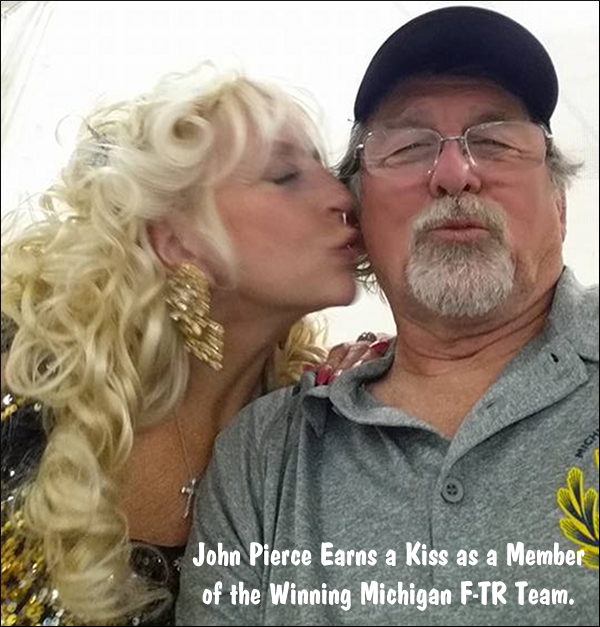
The Berger SW Nationals has one of the richest prize tables in the shooting sports. This Saturday night, nearly 400 participants received a variety of participation prizes and raffle awards. In addition, winners were announced for some of the events which concluded earlier in the week. Gunsmith John Pierce came up a big winner with a kiss from his lady and a Team Trophy for the Michigan F-TR Squad.
The Individual Palma Match kicked off Friday at the Berger Southwest Nationals. While still mostly calm, conditions were more variable and tricky. James Crofts told us that you had to watch both the mirage AND the flags, because sometimes a change appeared on the flags before you could see anything in the mirage. The top shooters were scanning the range constantly for any velocity or angle change. If you don’t pay attention to the flags, James said, “you’ll be out in the nine ring”.
Watch Video with Highlights from Day 3 of Berger SWN, including James Crofts Interview:
Our good friend John Whidden, a past National Long-Range Champion, brought his “A Game” Friday, topping the Sling Division with 449-33X. Competition was fierce with five sling shooters finishing with the same 449 points, separated only by X-Count: Whidden (33X), Oliver Milanovic (31X), Rick Hunt (25X), Michael Barlow (25X), and Steven Powell (22X).
John Whidden file photo from 2015
In F-Open, the top three shooters for the day were: Ken Padilla (448-25X), John Myers (447-32X), and Kenny Adams (447-24X). In F-TR Dan Lentz topped the Field with 447-24X, followed by Derek Rodgers and Justin Bertino (both at 445-23X). Ryan Pierce noted that Dan Lentz’s performance for the day beat all but three of the F-Open shooters: “Extremely impressive is Dan Lentz 447-24X F-TR score [which] tied Kenny Adams’s third-place F-Open Aggregate. Shooting .308 Win off a bipod and keeping up with the 7mms and 30 Cal magnums is outstanding. Good shooting Dan.”
Interesting Hardware
New Speedy F-Open Stock (Jeff Reed, owner)
F-Open competitor Jeff Reed has a new F-Open rig with the brand new Speedy Gonzales laminated stock. Jeff says he loves the stock, saying it “tracks like a dream”. Jeff also likes the recoil-reduction system fitted at the rear of the stock. This really makes a difference for the big calibers says Jeff. If you’re curious, that’s an IOR Valdada 12-52x56mm scope with a 40mm main tube on top of Jeff’s rifle. It features 25 MOA of elevation in one rotation of the turret.
Spotting Scope Mounted to Front Rest
Gunsmith Richard King of Texas has mounted his spotting scope directly to his Farley front rest. Very clever. This puts the spotter eyepiece just a few inches from his riflescope eyepiece so he can move easily from one optic to the other. This set-up also reduces the amount of gear Richard carries to the line. No separate spotting scope base, stand or horizontal mounting arm is required. This is a simple, elegant solution. We bet, with a little tinkering and design work, a similar system could be mounted to a SEB or Bald Eagle front rest. Note, it may appear that the lens is obscured by the front clamp, but that’s just the camera angle. We looked through the spotting scope and everything is clear.


 At the IWA Trade Show in Germany a few years ago, a correspondent for The Firearm Blog interviewed Woody Woodall, who runs Lothar Walther’s USA operation. While many shooters assume that Walther hammer-forges most of its barrels like some other European barrel-makers, in fact Lothar Walther USA uses the button rifling technique for most of its US-made barrels.


 Shiraz tells us: “We come across a lot of shooters who have never shot under a coach. This video was produced to give shooters a basic understanding of shooting with a coach and the importance of releasing a good shot. In a team setting, you basically leave all the decision-making to the coach and aim where you’re told to aim. I’ve worked with Gary many times and it shows in the comfort level we have with each other. The coach plots the shots or a plotter advises the coach of any grouping that is not centered.”

 Quick Tip: Try Flipping Your Bushings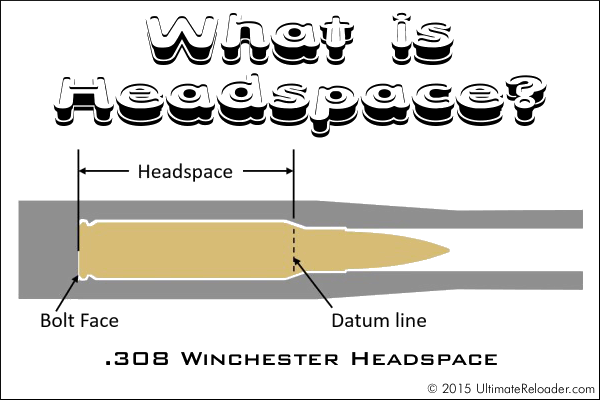
 Headspace Gauges