Forum member Thomas Haugland from Norway has produced an excellent video that covers practical field shooting skills for hunters. In his video, Thomas (aka ‘Roe’ on Forum and Sierra645 on YouTube) shows how to verify his zeros from bipod and he demonstrates improvised field rests from the prone, kneeling, and sitting positions.
Thomas explains: “In this video I focus on basic marksmanship techniques and making ready for this year’s hunt. As a last check before my hunting season, I got to verify everything for one last time. My trajectory is verified again, the practical precision of the rifle is verified. I also practice making do with the best [improvised] rest possible when an opportunity presents itself. After getting knocked in the face by a 338LM rifle during a previous filming session, I had to go back to basics to stop [flinching]. I include some details from bipod shooting that hopefully some hunters will find useful. Fingers crossed for this years season, good luck!”
Thomas has produced many other quality videos for his Sierra645 YouTube Channel. On his “Langholdsskyting” YouTube Channel, you’ll find 30 more nicely-made videos (in both English and Norwegian) about hunting and precision shooting.
Spectacular Scenery
Below you’ll find a great video by Thomas that demonstrates up/down angle (incline) shooting. This video features some amazing scenery from Norway along with angle estimation sequences and use of the ACI (Angle-Cosine Indicator). Even without the technical tips, this video is well worth watching just to see the jaw-dropping Norwegian scenery! Yes that’s Thomas standing on the top of the peak in the photo (above right).
Terrible news. The Rutland Plywood plant in Rutland, Vermont burned down last week. Rutland was a major supplier of laminated wood stock blanks. Now the plant is nothing but ashes. Sadly, in the aftermath of this terrible fire, we can expect shortages of laminated blanks for some types of stocks.
A massive, five-alarm fire engulfed the Rutland plant on the morning of 21 August, eventually burning the facility to the ground. 100 fire-fighters from six departments fought the fire, but the conflagration was too large, too fierce and the factory was reduced to cinders. Watch this amateur video to see the Rutland blaze in all its hellish power:
Rutland Plywood Plant Inferno
After combing through the aftermath of the blaze, investigators ruled out arson. According to David Sutton, a fire investigator: “It was in an area of some machinery that has been known to start fires in the past and the evidence we found in that room where that occurred, it appears that may have happened again.” Thankfully no one was killed or injured, but the plant was a total loss. The Rutland Plywood Plant employed 170 person in Vermont. Now those plant workers must find new jobs.
Richard Franklin Low-Rider Stock made with Rutland Desert Camo Laminated Plywood
News tip from Shiraz Balolia, Bullets.com. We welcome reader submissions.
While many folks enjoy the convenience of an electronic powder scale/dispenser such as the RCBS Chargemaster, some hand-loaders still prefer to use a traditional balance beam. Balance beam scales are simple, compact, and don’t suffer from electronic “glitches”. Morever, even if you use a digital dispenser at home, when you’re doing load development at the range, a balance-beam scale may be more convenient. A scale doesn’t require electrical power, so you don’t need to bring battery packs or string long power cables. Just bring some kind of box to shelter your beam scale from the wind.
While designs like the RCBS 10-10 are decent performers as built, they can be made much more precise (and repeatable), by “tuning” of key parts. Forum member Scott Parker optimizes a variety of popular beam scales, including the Ohaus 10-10 (USA-made model), RCBS 10-10 (USA-made model), RCBS 5-10, Lyman M5, Lyman D5, and others. You send Scott your scale, he tunes the key components, tests for precision and repeatability, and ships it back to you. The price is very affordable ($65.00 including shipping in USA).
Scott tells us: “I have tuned several 10-10s. They all have turned out very sensitive, consistent and hold linearity like a dream. If only they came that way from the factory. The sensitivity after tuning is such that one kernel of powder registers a poise beam deflection. For repeatability, I remove the pan and replace it for the zero 10 times. The zero line and the poise beam balance line must coincide for each of those 10 tries. I then set the poises to read 250.0 grains. I remove and replace the pan 10 times with the calibration weight. For linearity, the poise beam balance line and the zero line should coincide within the line width. This is roughly one half a kernel of powder. For repeatability, the poise beam balance line must return to that same balance point ten times. I then adjust the poises back to zero and recheck the zero. I have a master’s degree in chemistry, thus I am very familiar with laboratory balances. Email me at vld223 [at] yahoo.com or give me a call at (661) 364-1199.”
The video above, created by British shooter Mark (aka 1967spud), shows a 10-10 beam scale that has been “tuned” by Scott Parker. In the video, you can see that the 10-10 scale is now sensitive to one (1) kernel of powder. Mark also demonstrates the’s scale’s repeatability by lifting and replacing a pan multiple times. You can contact Mark via his website, www.1967spud.com. To enquire about balance-beam scale tuning, call Scott Parker at (661) 364-1199, or send email to: vld223 [at] Yahoo.com.
Video tip from Boyd Allen. We welcome reader submissions.
The Hots Shots TV show was broadcast on the NBC Sports Network (formerly Versus). This show followed four competitors — three shooters and an archer — as they trained for, and competed in, matches around the country. One of the featured shooters was 3-gun and revolver ace Jerry Miculek. Here’s a sample from Episode 4 of Hot Shots. In the video below, Miculek explains how he prepares for a major match — in this case the Steel Challenge, held each year in Piru California. Jerry explains: “Put in some practice, but don’t get burned out. You don’t want to have your best runs on the practice range. I want to try to wait for the match… staying a little hungry for a good performance.”
NBC Sports Network assembled some of the best shooters on the planet for the Hot Shots series: Jerry Miculek, K.C. Eusebio, Patrick Flanigan, and Randy Oitker. Miculek, an expert with rifle, pistol, and shotgun, has won 14 International Revolver Championships and is a top 3-Gun competitor. Our Friend K.C., formerly with the USAMU, was the youngest USPSA Grandmaster at the age of 12. Patrick is a world-class shotgunner who has re-defined the world of exhibition shooting. Randy is a true phenom with bow and arrow, having won over 17 National Pro Archery titles.
At the Canadian F-Class Championships last week Shiraz Balolia won the F-Open Individual Championship, and Shiraz was a member of the winning Team USA America Match Team, and the winning USA 4-man F-Open team. If you want to see how a world-class F-Open pilot works his magic, check out this video. After a discussion of scoring, the shooting starts at the five-minute mark in the video. Under the guidance of wind coach Gary Rasmussen, Grizzly Industrial President Shiraz Balolia shoots 100-7X for ten shots, following Gary’s wind calls.
NOTE: Shiraz shot with wind coaches in the team matches at the Connaught Range in Canada. However, during the individual championship matches he had to make his own wind calls, dialing windage corrections or holding off as he saw fit. It wasn’t easy. Shiraz told us: “It’s been a while since I had 5 1/2 minutes of left wind on my .300 WSM and was holding left 3+, then holding right 3 1/2 just two shots later!”
Pair Firing in Canada
According to Shiraz, “One thing that was different about the Canadian Nationals was that they were pair fired. One shoots, other scores, other shoots, and so on. With this slower, pair method of shooting, every shot can be in a different condition. Unlike the USA Nationals where a guy can rattle off the whole string in less than 4 to 5 minutes in one or two conditions, you would be hard pressed to get off two or three shots each in five minutes. This is the way the next World Championship is going to be shot — with pair firing.”
Watch Gary Call the Wind and Shiraz Shoot 100-7X for Ten Shots
For best viewing, click the YouTube settings button to watch in 720p or 1080p HD (high definition).
Team Shooting with a Coach Shiraz tells us: “We come across a lot of shooters who have never shot under a coach. This video was produced to give shooters a basic understanding of shooting with a coach and the importance of releasing a good shot. In a team setting, you basically leave all the decision-making to the coach and aim where you’re told to aim. I’ve worked with Gary many times and it shows in the comfort level we have with each other. The coach plots the shots or a plotter advises the coach of any grouping that is not centered.”
At the Canadian Championships, Shiraz used a .300 WSM. In this demo video, Shiraz was shooting a 7mm F-Open rig: “My .284 Shehane rifle takes about 10 to 12 shots to settle down and that is probably why we made several scope adjustments while shooting. It is a great caliber and a step up from a straight .284 Winchester. The wind was relatively calm, but sometimes that slow wind with subtle angle changes can be very deceiving.”
There’s a chap in Poland named Łukasz Pietruszka, who is a bonafied “Wizard of Wood”. Lukasz handcrafts unique custom stocks, selling them through his LP Gunstocks company. Many of his most eye-catching stocks are for airguns (particularly Field Target rifles), but he also produces fine stocks for rimfire and centerfire hunting rifles. Lukasz is a master carver who includes exquisite details on many of his stocks. Some of these designs, crafted from exotic hardwoods, raise stock-crafting to an art form.
Check out the figure on this Turkish Walnut stock by Łukasz Pietruszka.
You can see a variety of Lukasz’s stocks in a video sampler. If you’re a fan of fine wood, you’ll love this video. So pull up a chair, grab your favorite beverage, and enjoy this 16-minute video interlude.
Watch Video in High Definition
NOTE: We recommend you view this video in high definition, in wide screen format. To do this, start the video, then click on the gear-shaped icon at the lower right-hand corner of the video frame (it’s located just to the right of the clock icon). If you have a fast internet connection, select 720P or 1080P from the pop-up menu. (1080P is the highest resolution.) Now select theater mode or full-screen mode using the small icons on the lower right of the frame.
Radical ‘Shockwave’ from LP Gunstocks
Here is a truly amazing bit of craftmanship. The images below show a one-of-a-kind Shockwave stock created by Łukasz for a Steyr Field Target air rifle. Over the top? Perhaps… but you have to admire the imaginative design and exquisite worksmanship.
Video find by Boyd Allen. We welcome reader submissions.
Watch this video guys. You’ve got to see this Automated Target Trailer to believe it. The clever folks at MGM Targets have created the world’s first transportable, programmable, compressor-powered Electro-Pneumatic Pop-Up Steel Target Trailer. And get this — it even reads credit cards and bills them wirelessly! We kid you not. Check it out:
Ten Automated Targets on Trailer
This is one impressive piece of target technology. MGM Target’s P2P Automated Range is the only trailerable, “Pay to Play” live-fire target system on the planet. It offers 10 separate plate targets each with its own electro-pneumatic lifter, so the plates can rise and lower in a infinite series of variations. MGM’s “Reaction Mode®” option runs as fast as the shooter can knock the targets down! The lifters are driven by an 45 PSI compressor (that’s also part of the trailerable package.)
Much like operation systems used at a DIY carwash, a stand-alone control pedestal houses the credit card reader, and the game selection keyboard. The shooter swipes his/her credit card, then chooses one of 10 pre-programmed game option / shooting scenarios. Shooters have several options including various timed games, Random Plates, and “Dueling Tree” for man-on-man competition.
Designed to be a cash generator for public and private commercial ranges, the system combines the proven technology and durability of MGM’s electronic ‘Pop Up’ trailer with a credit card reader/integrated cell phone system. This technology is presently in use at private ranges and military bases.
If you own your own range, this could be the ultimate toy… and you can get your shooting buddies to pay for it with their credit cards. (Default “pay to play” rate is $5 for 10 minutes.) Commercial inquiries are invited — contact MGM at 888-767-7371 for information.
Can you form a wildcat cartridge such as the 6 Dasher without expending primer, powders, and bullets? Absolutely. Using the hydro-forming method you can form improved cases in your workshop with no firing whatsoever, so there is no wear on your precious barrel. Watch this video to see how it’s done:
6 Dasher Case Hydro-Forming Demonstration:
Forum member Wes J. (aka P1ZombieKiller) has produced a helpful video showing how to form Dasher cases use the Hornady Hydraulic forming die kit. This includes a two-part die (body and piston), and a special shell holder. To form the case, you insert a primer in your virgin brass, top the case off with with a fluid (water or alcohol), then run the case up into the Hydro-forming die. A few stout whacks with a hammer and your case is 95% formed.
Hydro-Forming Procedure Step-by-Step:
1. Insert spent primer in new 6mmBR brass case.
2. Fill with water or alcohol (Wes prefers alcohol).
3. Wipe excess fluid off case.
4. Place case in special Hornady shell-holder (no primer hole).
5. Run case up into Hydraulic forming die.
6. Smack top piston of forming die 3-4 times with rubber mallet or dead-blow hammer.
7. Inspect case, re-fill and repeat if necessary.
8. Drain alcohol (or water) into container.
9. Remove primer (and save for re-use).
10. Blow-dry formed case. Inspect and measure formed case.
Wes achieves very uniform cartridge OALs with this method. He measured ten (10) hydro-formed 6 Dasher cases and got these results: two @ 1.536″; 2 @ 1.537″; and 6 @ 1.538″.
Three or Four Whacks Produces a 95%-Formed Case
With a Hornady hydro-forming die, hydraulic pressure does the job of blowing out the shoulders of your improved case. The process is relatively simple. Place a spent primer in the bottom of a new piece of brass. Fill the case with water, and then slip it into a special Hornady shell-holder with no hole in the middle. Then you run the case up into the forming die. Now comes the fun part. You gently insert a plunger (hydraulic ram) from the top, and give it three or four stiff whacks with a mallet (or better yet, a dead-blow hammer). Remove the plunger and you have a 95% formed case, ready to load.
Hornady supplies a shell holder made specifically for the hydro die; there’s no hole in the bottom of it. Just insert a spent primer into the primer pocket and you’re ready to go. The spent primer combined with the solid shell holder, keeps the water from seeping out of the primer pocket. The primer pushes out a little bit during this process, but it’s impossible for it to come out because of the way the shell holder is designed. The shell holder has a grove which allows the case to slide out of the shell holder even when the primer protrudes a bit.
Story tip from Body Allen. We welcome reader submissions.
Most of us can figure out how to zero our rifles at 100 yards. But do you know how to get a solid zero at long range — as far as 1000 yards? You need to know your ballistics, otherwise you may waste a lot of ammo “sprayin’ and prayin'”. You definitely need to know your exact muzzle velocity, within a few FPS. This is not as simple as it seems, because it is not uncommon for chronograph results to be off by 10 to 20 fps or more, just through calibration error. Accordingly, you may want to test with a pair of chronos and record the results from each (you may be surprised at the variances).
Video Illustrates Zeroing Process
The process of zeroing rifles for long range is covered in a new “Firearm Science” video from the NRA. This video features George Reinas, a popular competitor on the Top Shot TV Show. George demonstrates how to adjust his scope to compensate for bullet drop at long range. Our friend Dennis Santiago was involved in the making of this video, which was filmed at the Burbank Rifle & Revolver Club in Southern California. The video is narrated by the talented Jessie Duff, one of America’s best action shooters.
When zeroing at long range, you should first consult a good ballistics program. Select your baseline zero distance (such as 100 yards), then plug in the MV along with salient environmental factors: Altitude, Air Pressure, Temperature, Humidity. After you enter bullet BC, your ballistics program will calculate the drop to the target, expressed in MOA or Mils. Some programs will actually list the number of clicks up from your current zero.
You can print out the data from your ballistics solver as a “drop chart” that can be attached to your rifle stock. If you shoot at various altitudes you may need multiple drop charts.
GRS Riflestocks is a Norwegian company that has built its reputation on intelligently-designed, high-quality laminated wood stocks. GRS wood stocks, for competition and hunting, are distributed in the USA by Kelbly’s. Ergonomics have always been a key feature in GRS designs, making GRS stocks very comfortable for the shooter.
CLICK IMAGE for Full-size Photo
GRS Aluminum Chassis Systems
Now GRS is moving into a new product area — developing an aluminum chassis system for long range applications. The first GRS metal stocks should be ready this month for European delivery (though it could take longer to export to USA). The new GRS metal chassis system will be offered for many popular actions:
Remington Short Action & Long Action
Sig Sauer SSG 3000/Sauer 200 STR
Howa Short Action & Long Action
Tikka T3
Initially, these stocks will be right-hand only, though a left-hand version may be offered in 2015. GRS has not yet released any pricing details for its aluminum chassis systems.
Excellent Video Shows How GRS Stocks Are Made — Plus Shooting in Norway
Product Tip from EdLongrange. We welcome reader submissions.


 Forum member Thomas Haugland from Norway has produced an excellent video that covers practical field shooting skills for hunters. In his video, Thomas (aka ‘Roe’ on Forum and Sierra645 on YouTube) shows how to verify his zeros from bipod and he demonstrates improvised field rests from the prone, kneeling, and sitting positions.
 Thomas has produced many other quality videos for his Sierra645 YouTube Channel. On his “Langholdsskyting” YouTube Channel, you’ll find 30 more nicely-made videos (in both English and Norwegian) about hunting and precision shooting.

 At the Canadian F-Class Championships last week Shiraz Balolia won the F-Open Individual Championship, and Shiraz was a member of the winning Team USA America Match Team, and the winning USA 4-man F-Open team. If you want to see how a world-class F-Open pilot works his magic, check out this video. After a discussion of scoring, the shooting starts at the five-minute mark in the video. Under the guidance of wind coach Gary Rasmussen,
  Shiraz tells us: “We come across a lot of shooters who have never shot under a coach. This video was produced to give shooters a basic understanding of shooting with a coach and the importance of releasing a good shot. In a team setting, you basically leave all the decision-making to the coach and aim where you’re told to aim. I’ve worked with Gary many times and it shows in the comfort level we have with each other. The coach plots the shots or a plotter advises the coach of any grouping that is not centered.”

 Watch Video in High Definition


 Ten Automated Targets on Trailer

 Hydro-Forming Procedure Step-by-Step:
 Hornady supplies a shell holder made specifically for the hydro die; there’s no hole in the bottom of it. Just insert a spent primer into the primer pocket and you’re ready to go. The spent primer combined with the solid shell holder, keeps the water from seeping out of the primer pocket. The primer pushes out a little bit during this process, but it’s impossible for it to come out because of the way the shell holder is designed. The shell holder has a grove which allows the case to slide out of the shell holder even when the primer protrudes a bit.
 Video Illustrates Zeroing Process
 When zeroing at long range, you should first consult a good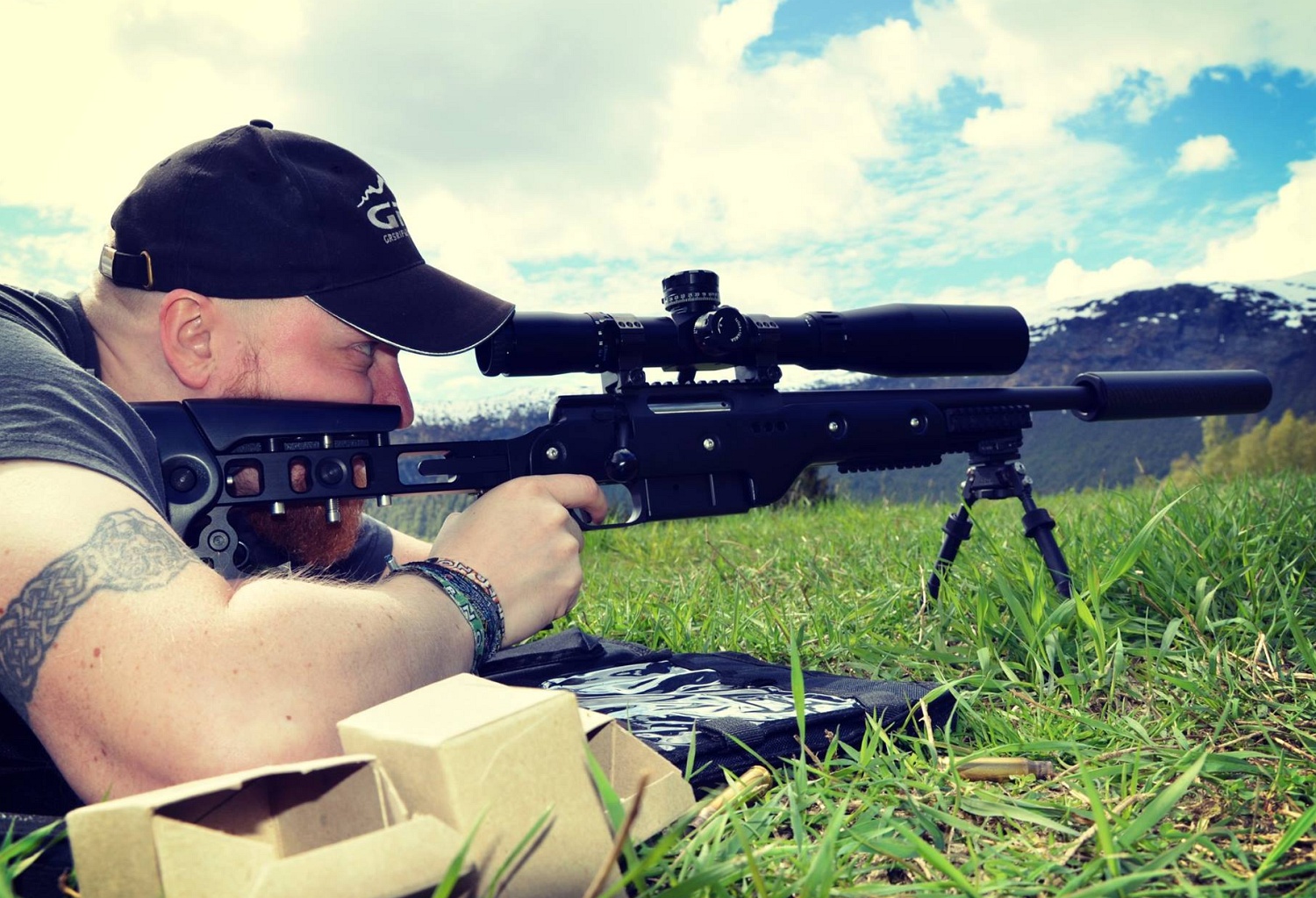
 GRS Aluminum Chassis Systems


