The Berger Southwest Nationals (SWN) have kicked off at the Ben Avery Range in Phoenix, Arizona. Overall attendance has been impressive for this important shooting event. Approximately 275 shooters have registered. On Wednesday (February 5th) roughly 200 shooters competed in a 600-yard Mid-Range event, with three 20-shot matches. The wind clinic on Tuesday the 4th was also well-attended with 130 or so participants.
In addition to the rifle competition (continuing through Sunday), there will be other fun events. On Friday, after the 1000-yard match, there will be a SWAP meet.On Saturday, there will be a Banquet dinner at the Ben Avery Indoor Range.
The Mid-Range match was tightly fought. We don’t have official results yet, but we’re told that Jim Murphy was at the top in F-TR, followed by Lige Harris, Gerry Wiens, Grant Ubl, and Eric Stecker.
Next up is a 4-person Team match (800, 900, 1000 yards) starting bright and early on Thursday. AccurateShooter.com will be reporting directly from the match. Watch the Daily Bulletin for photos from the match and interviews with the shooters.
To learn more about the Berger Southwest Nationals, watch this video featuring footage from the 2013 event. Helpful interviews with last year’s competitors provide useful insights into conditions at Ben Avery. One regular shooter at Ben Avery told us: “On a typical day, when the wind builds it is pretty gradual and progressive. But when it starts to die, it can drop off quickly, with a pretty big change from shot to shot.”
Watch Berger SW Nationals Preview Video
Berger SWN Events Schedule (Thursday – Sunday)
The remaining action starts at 9:00 am each morning, Thursday through Sunday.
Thursday, 6 February 2014, 9:00 AM 4-Man Palma Team Match: 15 shots for record at 800, 900 and 1000 yards.
(Divisions – Palma, F-Open, F-TR)
Practice available to those not shooting with a team.
Friday, 7 February 2014, 9:00 AM – Start of Grand Agg Individual Palma Match: 15 shots for record at 800, 900 and 1000 yards.
(Divisions – Palma, F-Open, F-TR)
Swap Meet – after conclusion of fire at 1000-yard line.
Saturday, 8 February 2014, 9:00 AM Individual 1000 Yard Matches: Two 20-shot matches at 1000 yards. Any Rifle-Iron Sight (Any sight for F-Class shooters). (Divisions – Palma, Any Rifle-Iron Sight, F-Open, F-TR) 4 Man Team Match: 20 shots at 1000 yards. Any Rifle-Iron Sight (Any sight for F-Class shooters). (Divisions – Palma, Any Rifle-Iron Sight, F-Open, F-TR
Sunday, 9 February 2014, 9:00 AM Individual 1000 Yard Matches: Two 20 shots matches at 1000 yards. Any Rifle-Any Sight (Any sight for F-Class shooters). (Divisions – Palma, Any Rifle-Any Sight, F-Open, F-TR)
Few people love double-action revolvers as much as Jerry Miculek, and nobody on the planet shoots them better. Jerry is the undisputed double-action wheelgun master of the universe, having won just about every revolver competition you can imagine.
Jerry has long wanted a wheelgun that could shoot widely available 9mm ammo, using moon clips. Jerry finally convinced Smith & Wesson to build such a beast — officially dubbed the S&W 929 JM Signature Series. It features an 8-shot cylinder, enhanced internals, premium barrel, and a removable compensator. Jerry says “this thing is built exactly to my specifications. This is what I have been wanting forever.”
In the video above, Jerry tests one of the first-ever 929 revolvers. During the “unboxing”, Jerry is grinning from ear to ear. He actually says: “It’s like Christmas guys [with] a brand new toy.” When he gets his hands on the new gun, you can see his enthusiasm. At the end of the video, Jerry takes the new 929 out to his backyard range, and does an 8-shot rapid fire test. The gun shoots impressively fast and flat, and you can tell Jerry has a new “sweetheart” revolver. Jerry says “Wow — I don’t know if this is love or lust, but I’m likin’ it already guys.” Watch the video to see a pretty cool new S&W, and the legendary Jerry Miculek in his element.
With the Berger Southwest Nationals kicking off February 4, 2014 in Phoenix, Arizona, we thought our readers might enjoy a very interesting interview with the top decision-makers at Berger Bullets, namely company founder Walt Berger, plus Eric Stecker, Berger’s Executive Vice President.
This interview covers a wide range of topics in seven (7) separate segments. We’ve embedded the first two interview sections in this article, with links for the other five below.
Sinclair Int’l has released a 7-part series of video interviews with Walt Berger (founder of Berger Bullets) and Eric Stecker (Berger’s Exec. VP and Master Bulletsmith). The series is hosted by Bill Gravatt (who was Sinclair’s President at the time the interview was filmed). You can watch Parts 1 and 2 of the interview here, and we’ve provided links to the remaining Parts 3 through 7. All seven interview segments offer interesting material. Part 6 mentions the Berger Reloading Manual (many years in the making). Part 7, over 13 minutes long, contains interesting discussions of bullet testing and the hunting performance of Berger VLDs.
NOTE: You can view this entire video series (and many other videos) on Sinclair’s YouTube Channel Page.
Looking to start a new enterprise? How about entering a field where consumer demand greatly exceeds supply right now — the ammunition business. If you have $38,000 or so you can get your own automated ammo-making machine from Ammo Load Worldwide, Inc., an American-run business located in Lewiston, Idaho. There’s also an 11-station, computer-controlled “Mark L” rifle ammo machine that’s a bit pricier — $77,000 with accessories. Sure that’s a tad more expensive than a Dillon XL650, but with a Mark L you can produce three thousand .223 Rem rounds per hour with the push of a button.
Watch Ammo-Loading Machines in Action:
Mark X Pistol Cartridge Loading Machine (about $38,000)
For over 30 years Ammo Load machines have served ammunition manufacturers, commercial loaders, private shooting ranges, and numerous law enforcement agencies. The Mark X Ammo Load machine (for pistol cartridges) has a maximum production rate of just over 5,000 cycles per hour. Many users produce between 3,000 and 5,000 rounds per hour. The primary factors governing the quality and quantity of ammunition produced are the components (particularly the cases), the caliber, and the capabilities of the operator.
The Mark X Ammo Load machine for pistol cartridges has nine (9) stations: Case Check, Size and Deprime, Primer and Primer Disk Check, Belling, Powder Feed, Powder Check, Bullet Seating, Bullet Crimp, Final Sizing. There are checks (with shut-offs) for case feed, primer feed, bullet feed, and powder load. The Mark X comes complete with shell case feeder, primer feed tube, powder flask, and bullet feed tube.
Mark L – Automatic Rifle Ammunition Loader (About $77,000)
In 2009 Ammo Load Worldwide introduced the Mark L automatic rifle ammunition loader in .223 and .308. Many proven features from the Mark X pistol machine have been incorporated into the Mark L to provide precise and consistent rifle cartridge loading at approximately 3,000 to 3,600 rounds per hour. All of the sensors and switches use fiber optic technology to increase precision and reduce maintenance. The Mark L utilizes a 3-station powder drop; the manufacturer claims this maintains charge weights to within 1/10th of a grain.
Mark L Rifle Cartridge Loading Machine has 11 stations:
1. Sizing/Checking*
2. Mouth Flare
3. Priming
4. Primer Check / 1st Powder Drop
5. 2nd Powder Drop
6. 3rd Powder Drop
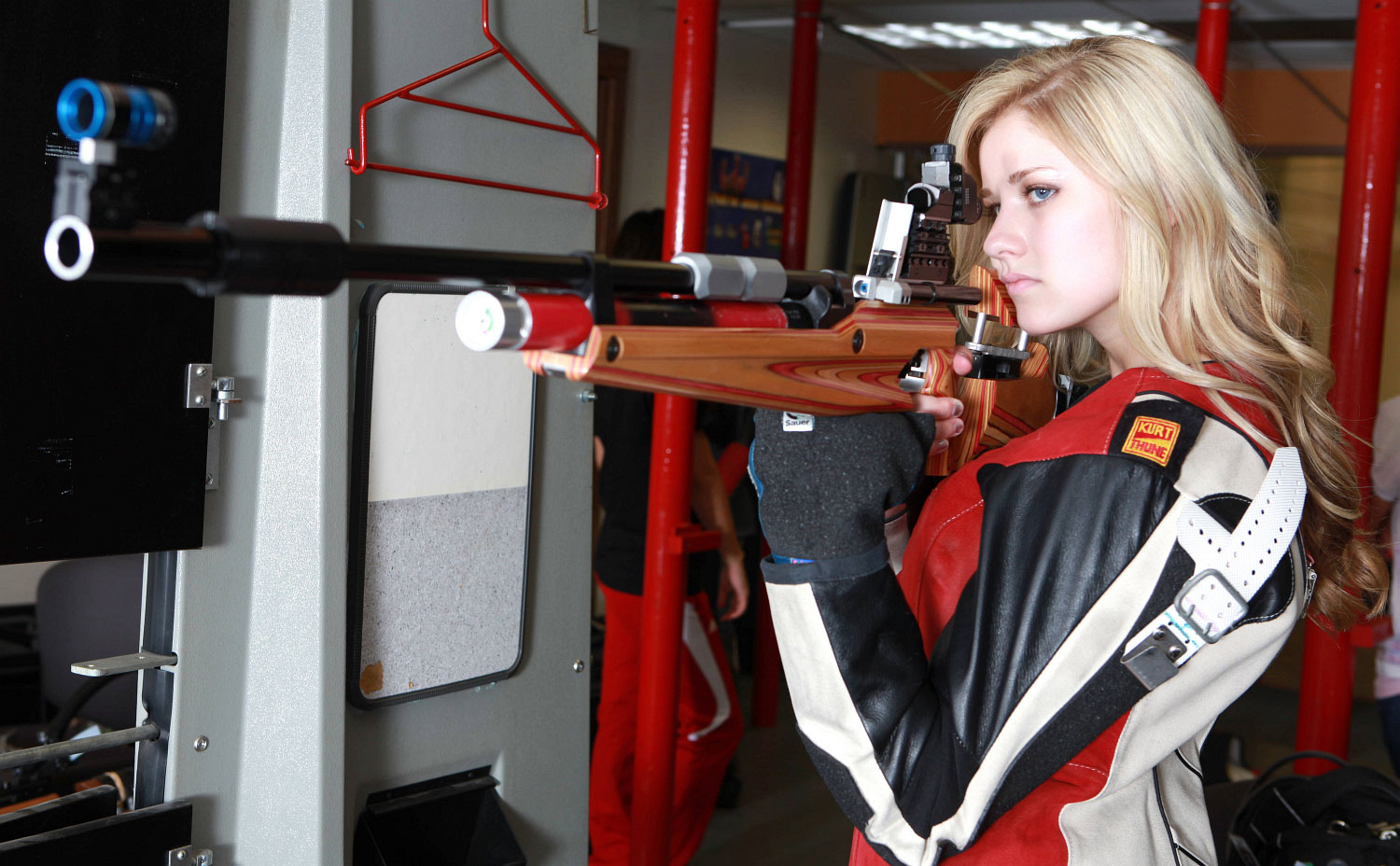
Shoot like a girl? That’s a source of pride at the University of Nebraska-Lincoln. The Nebraska Huskers womens’ shooting team, Nebraska Rifle, has a strong tradition of excellence. Led by Coach Stacy Underwood, the Huskers are ranked among the top teams in the country. In the past 10 years, the Huskers have earned four Top-5 finishes in the NCAA Championships, and Nebraska has had over 30 All-American selections, as well as individual national champions.
This video spotlights some of the current members of 2013-14 Nebraska Rifle Team: Alexandrea Lorentz, ReAnn Wilson, Magdalena Mical, Lauren Phillips, Rachel Martin, Denise Martin, Sunny Russell, Marissa Major, Jaycee Carter, and Kelsey Hansen.
Nebraska Rifle Team Member Kelsey Hansen
The 2014 season is going well for the Nebraska Team. Just this past weekend the No. 8-ranked Huskers completed a sweep of two matches against Air Force, scoring a 4,679-4,671 win over the Falcons. Follow the team via the Nebraska Rifle News Page
Here is a more detailed video that shows the Nebraska Training Range, complete with electronic targets. This is one of the most advanced collegiate shooting facilities in the nation.
Getting to Know Coach Stacy Underwood
Q: What is your coaching philosophy?
A: Rifle is the only NCAA sport where you compete against yourself without awareness of how your fellow competitors are doing, until you’re finished. Only then are scores compared. So my athletes have to be totally self-contained — in motivation, discipline, and focus.
Even more, my athletes have to be supremely calm. A minute waver of even hundredths of a millimeter at the rifle barrel end can throw a shot way off a center target that’s the size of a pin head at 10 meters away. Very slight differences in breathing, heart rate, pulse strength, and muscle twitch amplify that waver.
Finally, rifle is a sport of slight differences. A perfect individual match score is 1200 points. A perfect team score is 4800 points. Perform at 96 percent of perfection and you’ll be marginally competitive. Perform at 98 percent of perfection and you’ll be setting NCAA records. It’s in that two percentage point spread that you find greatness in rifle.
So, given these rigors, I’ve organized my coaching philosophy around the idea of “just 1 percent more”. I’m asking each team member to give just 1 percent more in all areas- academics, personal development and performance.
Sounds simple, but think about what’s involved. Every team member has to deliver. To deliver, they’ll have to organize all the areas of their lives so they’re always ready mentally and physically. Any issues that come up can be referenced by “what will get us just 1 percent more”. They can learn from each other what works. Their lives – mind and body – will be in sync and at peace. That will give them calm. So my efforts will focus on helping each one achieve their goal. I expect great individual surprises, and from that, a great team result.
One of the most popular features of our Shooters’ Forum is the Official ‘Pride & Joy’ Rifle thread. There you’ll find dozens of interesting rifles, with photos and descriptions supplied by proud owners. Yesterday, one of the more interesting ‘Pride & Joy’ rifles appeared. This was a “senior citizen” — a 72-year-old Russian Mosin-Nagant bolt gun. But this is not like any Mosin Nagant you’ve ever seen before. It has been brought into the 21st Century with a handsome target stock and some first-class upgrades, including Lothar Walther barrel and Timney trigger. Here’s a look at a very nice Russian rifle, belonging to Forum member Ben C. (aka “Grimstod”):
CLICK TO See Full-Screen Photo:
Video Shows Rifle Shooting Sub-Half-MOA from Bipod (in the Snow):
Name of rifle: Smyert Mk3 (Modified Mosin Nagant)
Make: Izhmekh/Izhevsk (“Izzy”) High Wall
Model: 91/30 | Year: 1942
Scope mount: Rock Solid (looks like an action sleeve)
Scope: SWFA 20x42mm MRAD
Gunsmith: Sheppard
Bolt handle: Rock Solid with Surgeon tactical handle
Bipod: Versa Pod
Total Weight: 18.6 lbs
Grimstod’s Moisin Nagant Custom Shoots Under 0.5 MOA From Bipod
Even in harsh winter conditions, the rifle shot well. (I guess we should expect that for a Russian gun). The photo below shows a group shot from bipod. (The video shows Grimstod’s snow-bound range session). Grimstod calculated the group at 0.394 MOA measuring from outside edge to edge. Using our On-Target software, which measures center to center of most distant shots, we came up with 0.428 MOA. Still that’s impressive for an ancient action being shot in the dead of winter with snow falling. To learn more about this rifle (and view photos of the build process), visit the SurplusRifleForum.com.
At the SIG Sauer booth at SHOT Show, we had a chance to interview Max Michel, Sig Sauer’s Pistol Team Captain. Winner of multiple speed shooting world championships, Max is widely considered to be the fastest pistol shooter alive. How fast? Watch the video below. Max puts 18 shots on three targets with two (2) reloads, in a total of 4.79 seconds. That’s right, drawing from holster, he sends 18 rounds in under five seconds, with two mag changes in the process. That works out to a rate of fire of 225 rounds per minute — faster than a 19th-century Gatling Gun.
Max Michel on Fire — 18 rounds with 2 Mag Changes in Under 5 Seconds:
How did Max manage that incredible speed run? “I ate my Wheaties that morning”, Max joked. But in fact, Max acquired his amazing shooting skills the hard way — through years of dedicated practice. We asked Max about the kind of training required to attain “world-class” speed (and accuracy) with a handgun. It has taken him decades to reach this level of perfection. Max started shooting competitively while in elementary school (at age 8 or 9). He recalls coming home from school and dry firing for hours. He has spent thousands of hours practicing over the past two decades. Interestingly however, Max does most training drills at half speed. Watch the video to learn why Max trains at half speed:
Train to Win — Max Michel Reveals His Training Strategies:
At age 32, Max Michel is a legend within the world of competitive shooting. A four-time World Speed Shooting Champion, six-time USPSA National Champion, and three-time US National Steel Champion, Max is a dominant force in pistol shooting sports. Born and raised in New Orleans, Louisiana, Max began shooting when he was just 5 years old. In 1999 Max joined the USAMU’s Action Pistol Team and served in the U.S. Army for 10 years as an Army shooter and trainer. Today, Max is recognized worldwide as a top-tier athlete and instructor.
If you have wondered why so many gun control laws are illogical, impractical, and misguided, here’s one simple answer. The politicians who draft these laws may be misinformed, misguided, and well, just plain ignorant. Here’s proof. In the video below, California State Senator Kevin de León (D-Los Angeles) advocates anti-gun legislation at a press conference. Sen. de León makes a series of blunders and mistakes. He confuses magazine capacity with the rifle’s bore size, referring to “.30 caliber” when in fact the gun is a .223/5.56mm. He then says it “has the ability with a 30-caliber clip [sic] to disperse with 30 bullets within half a second. Thirty magazine clip [sic] in half a second”. We think he means that the gun fires 30 rounds in 0.5 seconds, but even that is preposterous. Have a good look at the kind of politician that is writing California’s laws these days. Would you trust this guy to park your car, much less protect your Constitutional rights?
To be honest, we don’t know why Sen. de León believes new legislation is needed to ban this “Ghost Gun”? This firearm* is already restricted under existing California law. It also appears to be a short-barreled rifle (SBR), meaning that it is already regulated as a Class III firearm in all fifty states. (In the United States, it is a federal felony to possess an SBR without fling a BATFE Form 4, and paying a $200 tax to the BATFE.) As one web journalist observes: “It’s hard to trust Democrats when they say completely… inept things like this.”
*The term “Ghost Gun” has been used to describe plastic guns that evade metal detectors, and/or arms built from 80% lowers or unregistered receivers. But it is already against the law in California to create or sell a functioning AR15-type rifle that carries no serial number.
Over the past few years, interest in F-Class competition has grown dramatically. At the 2013 SHOT Show we had a chance to talk about F-TR competition with U.S. National F-TR Team members Mike Miller and Stan Pate, two of America’s top F-TR shooters. We are reprising this interview for readers who may have missed it the first time around. If you shoot F-TR (even if you’re a High Master), we think you’ll learn a few things from this interview.
In this interview, Mike and Stan agreed to share their vast store of knowledge about long-range shooting. In a wide-ranging dialog, we discussed many topics of interest to F-Class shooters: position set-up, bipod shooting techniques (and hardware), gun-handling, and bullet selection. In addition, Mike and Stan offer some great advice on wind reading and precision reloading. These general tips will benefit all competitors, no matter what their discipline.
If you shoot F-TR or you are considering getting involved in this fast-growing shooting sport, definitely watch this 14-minute video interview from start to finish. Mike and Stan are true F-TR gurus whose knowledge of the F-TR game has been gleaned from years of top-level competition. If you shoot a .308 from a bipod, we guarantee you can learn much from Mike and Stan. If you follow their advice, we bet you’ll see your scores improve in future matches.
Watch Video for Tips from U.S. National F-TR Team Members Mike Miller and Stan Pate
Report by Jason Baney, EuroOptic.com
At Media Day at the Range, some of us were privileged to shoot a very accurate new tactical rifle — the Sako TRG M10. People have been clamoring for this “bad-ass” multi-caliber rifle, which has not yet been released to the public. The M10 was one of the top submissions for the PSR (Precision Sniper Rifle) contract and we can see why. The ergonomics, function, and adjustments are very smooth and intuitive. As proof, though I had never previously handled an M10, much less practiced with one, we managed to complete our video in just one take. I was quickly able to figure out the adjustments and get shots on target. That bodes well for a serious tactical rifle designed for combat.
When compared to previous Sako TRG models, the M10 is notable for its modular construction, wide range of adjustments, and, of course, its ability to shoot multiple cartridge types (.308 Win, .300 Win Mag, .338 Lapua Mag). As with other PSR submissions, Sako’s M10 has user-changeable barrels that can be switched easily.
Watch Jason Shoot Sako TRG M10 at 960 Yards
The M10 is currently only available to the military market, but the hope is to push it to the commercial (civilian) market after military orders are filled. When this happens, EuroOptic plans to be one of the first vendors to offer TRG M10s to civilian customers. We do not know the price of the TRG M10 at this time — we asked Sako reps but they wouldn’t even venture a guess.
This 8-minute Video Covers Sako M10 Features in Great Detail:


 Few people love double-action revolvers as much as Jerry Miculek, and nobody on the planet shoots them better. Jerry is the undisputed double-action wheelgun master of the universe, having won just about every revolver competition you can imagine.





 A: Rifle is the only NCAA sport where you compete against yourself without awareness of how your fellow competitors are doing, until you’re finished. Only then are scores compared. So my athletes have to be totally self-contained — in motivation, discipline, and focus.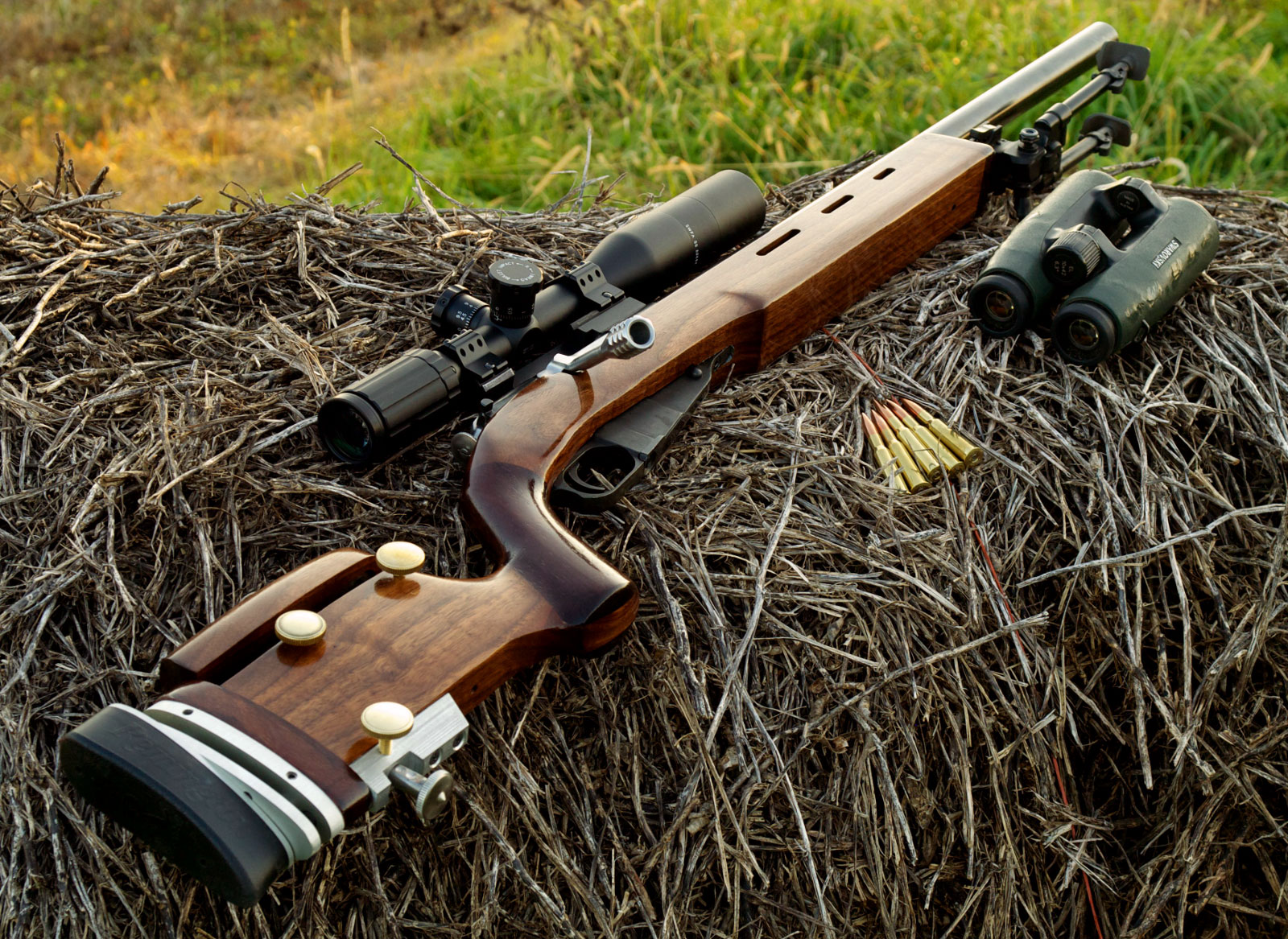


 If you have wondered why so many gun control laws are illogical, impractical, and misguided, here’s one simple answer. The politicians who draft these laws may be misinformed, misguided, and well, just plain ignorant. Here’s proof. In the video below, California State Senator Kevin de León (D-Los Angeles) advocates anti-gun legislation at a press conference. Sen. de León makes a series of blunders and mistakes. He confuses magazine capacity with the rifle’s bore size, referring to “.30 caliber” when in fact the gun is a .223/5.56mm. He then says it “has the ability with a 30-caliber clip [sic] to disperse with 30 bullets within half a second. Thirty magazine clip [sic] in half a second”. We think he means that the gun fires 30 rounds in 0.5 seconds, but even that is preposterous. Have a good look at the kind of politician that is writing California’s laws these days. Would you trust this guy to park your car, much less protect your Constitutional rights?
 Over the past few years, interest in F-Class competition has grown dramatically. At the 2013 SHOT Show we had a chance to talk about F-TR competition with U.S. National F-TR Team members Mike Miller and Stan Pate, two of America’s top F-TR shooters. We are reprising this interview for readers who may have missed it the first time around. If you shoot F-TR (even if you’re a High Master), we think you’ll learn a few things from this interview.


