Service Rifle shooters and varminters burn through a lot of ammunition. If you’re shooting more than 250 rounds of ammo a month, you may want to consider getting a progressive press — at least for your practice and varmint ammo. New technologies have made today’s progressives more efficient than ever. RCBS has developed a rifle-bullet feeding system that works with the RCBS Pro 2000 Progressive. The bullet-feeder can also be fitted to some Dillon units with modifications. There are four main components to the RCBS rifle-bullet feeder system: 1) base and two-piece adjustable column; 2) collator (bowl and motor); 3) drop tube and shutoff assembly; and 4) bullet feed die assembly.
Our friend Gavin Gear has tested the RCBS bulet feeder on an RCBS Pro 2000 for his UltimateReloader.com website. You can see his hands-on video review above. I’m pleased Gavin did this review because I have a Pro 2000 myself, and I can confirm that it is a very good machine. It is sturdy, the rotary-style powder measure is very precise, and the strip primer system works great. (I can change from small primer feeding to large primer feeding in a couple of minutes — honest.) I’ve also found the strip primer system virtually foolproof — so long as you insert the strips in the right direction! I haven’t used the Bullet Feeder yet, but you can see the Pro 2000 in action with the feeder in Gavin’s video above.
On UltimateReloader.com, Gavin puts the RCBS Bullet Feeder through its paces. Gavin writes: “As you can see from this picture (at left), the RCBS Rifle Bullet Feeder adds quite a bit of overall height to the progressive reloader.This is the case with all bullet feeders that use a collator (some add more than others). One of the reasons that these units are tall is to allow for a sufficient ‘buffer’ of dropped bullets so that the collator can keep up with fluctuations in loading speed and to allow enough ‘stack weight’ on the column of bullets so that they drop/feed correctly.” As fitted to the Pro 2000, Gavin says the bullet feeder system achieves “very efficient loading with excellent COL consistency and bullet concentricity.”
The feature documentary, A Girl and A Gun, shows the female perspective on firearms. In popular media, guns (and shooting) are more often associated with men and masculinity. When the media does cover the role of women shooters, it often gets the story wrong. The classic Hollywood portrayals of pistol-packin’ mamas, tomboy sharp-shooters, femme fatales, and high-heeled, cold-blooded assassins are caricatures. In truth, the typical woman who hangs out at rifle ranges and keeps ammo in her purse is the girl-next-door, the single mom, a hard working sister or aunt. Maybe she’s a realist or has learned tough lessons from life; either way, she cares about her personal safety and may even find salvation, comfort or something satisfying in possessing a gun.
A Girl and A Gun is available “On-Demand” through cable/satellite systems nationwide, including Cablevision, Comcast, Cox, DirecTV, DishNetwork, Time-Warner, and Verizon Fios. You can even download the movie via iTunes. A Girl and A Gun is also being shown in theaters nationwide this week. For screening dates and locations, CLICK HERE.
Breaking through stereotypes, A Girl and A Gun reveals America’s diverse and far-ranging female gun community. It depicts how this community is portrayed by the media and targeted by the gun industry; and shows, through personal stories, how guns change women’s lives. The intimate and graphic portrayals in A Girl and A Gun are of women who’ve carved themselves a home in the gun community, but their personal journeys in one way or another reflect the same issues every woman faces today.
Watch A Girl and A Gun Trailer
Reviews
“A unique angle on the gun control issue…’A Girl and a Gun’ visits everyone from soccer moms to victims of violence, many of whom find empowerment, safety and sometimes more than a bit of ambivalence in their gun ownership. Czubek has crafted a far more even-handed film than Michael Moore’s ‘Bowling for Columbine,’ stirring much food for thought while still taking some comically surreal detours.” — CityArts, Seattle
“Cathryne Czubek meets a wide variety of gun-owning women in her debut doc A Girl and a Gun, most of whom don’t fit the two or three stereotypes outsiders likely expect…some will challenge conventional wisdom; a couple have deeply affecting personal stories.” — Hollywood Reporter
The International Shooting Sports Federation (ISSF) has a great new product for iPad users. The ISSF now offers a multi-media “eZine” optimized for Apple tablets. The free, downloadable ISSF Magazine covers competition shooting around the globe. You’ll find match reports, interviews with shooters, and coverage of the gear and ammo that win matches. Packed with plenty of photos and videos, ISSF’s iPad magazine is rich with interactive content. The latest issue features 15 videos, 35 articles, and over 400 photos. That’s quite a package… and it’s all FREE (just download from the App Store). Each magazine is “self-contained” when downloaded. That means, once you download an issue, you read it start to finish, even without a live web connection.
The ISSF plans to release six (6) iPad magazines each year, covering the full range of ISSF shooting disciplines. The ISSF iPad magazine is now available to download for free from the Apple App Store. To get the ISSF Magazine App, click the App Store button on your iPad, then search for “ISSF News” in the App Store. To learn more about the ISSF’s eZine for iPad, watch this video from ISSF:
Preview Free ISSF Interactive Magazine
Gary Anderson Praises ISSF’s New Digital Magazine
ISSF Vice-President Gary Anderson states: “I’m from the old generation, but the App is perfectly easy for me to use. I encourage everyone to download the new App and use it. I think they’re going to find that this is the best new way to get information about ISSF competitions and ISSF activities. Everyone who is interested in shooting should take advantage of this.”
Gear Review by Mark LaFevers With its innovative “moving die/static cartridge” design, the new RCBS Summit Press definitely demonstrates “out of the box” thinking. Unlike other presses, the case does not move. Rather, the reloading die comes down to the case. We are happy to report that this unique “upside-down” reloading press works great.
We have tested the new RCBS Summit Press in the workshop and in the field. We’ve now loaded hundreds of rounds with the press. It is smooth, solid, and easy to use. The spent primer ejection/capture system works great (our testers preferred the Summit’s simple, foolproof primer capture to the Rockchucker’s capture system). Most importantly, the Summit produces very straight ammo that gave excellent results on the target in actual matches.
We compared ammo loaded with the Summit with ammo loaded on an RCBS Rockchucker press. The Summit gave up nothing to the bigger press. Cartridge base-to-ogive measurements of Summit-loaded ammo were just as tight as with ammo loaded on the Rockchucker. Run-out, measured with a concentricity gauge, was the same or better (about .002 or less on bullet nose). Most importantly, the Summit loads accurate ammo. In fact, at one match, scores shot with Summit-loaded .284 Win ammo were actually better than scores shot (in the same gun) with ammo loaded on a Rockchucker:
Despite its small footprint, the Summit is very stable — it doesn’t tip, wobble, or rock. The two front mounting bolts hold it firmly in place — the Summit doesn’t need a rear anchor. This, combined with the fact that the Summit has no overhang, makes the new press ideal for a mobile application. For field use (at the range), our tester Mark LaFevers mounted the Summit press on a small platform secured to his trailer hitch (on top of a steel post). This set-up worked great, as you can see in the video below:
Watch Reloading (Sizing/Decapping, Expanding, Bullet Seating) with Summit Press
Photo shows Redding Micrometer Seating Die and .284 Win Cartridge
Mark tells us: “I think the Summit press worked out sweet mounted on the hitch pedestal. The receiver hitch pedestal I made will switch tools between a heavy barrel vise I made and the Summit press. Instead of securing the pedestal with a standard 5/8″ hitch pin, I drilled and tapped for 1/2″-13 bolt to draw the insert up tight against the receiver, eliminating wobble. For charging rounds, I bought 150 plastic test tubes with caps and racks so I can avoid weighing powder charges in the field, unless I want to make changes on the fly.”
The new Summit Press features a rugged cast-iron frame with all-steel linkages. The press is very strong with minimal flex and slop. This allows you to “bump” your case shoulders and seat bullets with great precision and repeatability. The handle can be switched from right to left side (good for southpaws), and the open-front design provides good access, facilitating quick die changes*. The 4.5-inch opening allows you to work with tall cases. Beneath the shell-holder is a spent primer catcher (not shown in photos). The new Summit press has a beefy 2-inch diameter ram, with compound linkages for plenty of leverage. A zerk fitting is included for easy lubrication. The press will accept larger bushings for oversize 1-inch dies.
*To permit his dies to be swapped from Rockchucker to Summit (and back again), with no locking ring adjustments, Mark LaFevers fabricated a new shell-holder base which positions the shell-holder .088″ higher relative to the Summit’s die port. This keeps Summit-mounted dies in the same position relative to the shell-holder as dies mounted in a Rockchucker. So, Mark can swap dies from his Rockchucker to his Summit and maintain exact COAL (when seating) and correct shoulder bump (when sizing). While Mark’s custom shell-holder base lets him swap dies quickly from one press to another, this is NOT a necessary modification. Most folks will simply re-set the locking rings.
When evaluating firearm finishes, one should consider hardness, chemical resistance, lubricity, abrasion resistance, and color. However, none of these factors are as critical as corrosion protection. The average firearm owner deals with corrosion more than any other finish-related problem. Accordingly, when selecting an exterior finish for the metal components of your guns, you should look for a product with superior corrosion resistance. Thanks to Cerakote, we now have some science to help you make that decision….
How well do various firearm finishes resist corrosion?
Watch the video below to find out.
Eight Gun Finishes Tested — With Surprising Results
Eight (8) various finishes are tested, including Blueing, Cerakote, DuraCoat, FailZero, Ion Bond, KG Gun Kote, NiBX, and Phosphate (Parkerizing). Eight metal firearm components (each with a different finish) are placed into the salt chamber to see how long it takes for each finish to show initial signs of corrosion. To provide a baseline for comparison, a “naked” 416 stainless steel barrel was also placed inside the test chamber. The test was started, and for each coating, the time was recorded when corrosion started to appear. FYI, if you thought “stainless steel” can’t rust, think again. The stainless barrel sample (along with the blued metal sample) showed visible corrosion after just 24 hours!
After 24 Hours in Salt Chamber
After 48 Hours in Salt Chamber
After 172 Hours in Salt Chamber
Salt Chamber Testing — 5% Salt Concentration at 95°F
According to ASTM B117-03, the Corrosion Test provides a controlled corrosive environment which has been utilized to produce relative corrosion resistance information for specimens of metals and coated metals exposed in a given test chamber. The salt chamber is set to a temperature of 95 degrees Fahrenheit with a 5% salt concentration. Salt Chamber testing is used to draw a comparison between metals and finishes and does not correlate to a specific number of hours of real world use.
Story tip by EdLongrange. We welcome reader submissions.
In the spring of 2004, IBS 600-yard benchrest competition was born. Piedmont Gun Club in Rutherfordton, NC was one of the three initial ranges across the country to host this new competition. Bridgeville (DE) and the Bench Rest Rifle Club of St. Louis (MO) were the other two. 600-yard benchrest was the brainchild of several IBS and club officers, Dave Tooley and Joe Goforth among them. The idea was to have a new competition at a distance far enough that short-range cartridges would not dominate, but not so far that the new mid-range discipline would duplicate 1000-yard competition. After initial “test matches” at 500 yards, in late 2003, officers at Piedmont Gun Club decided to push the targets out another 100 yards. That was the beginning of the 600-yard benchrest game.
IBS 600-Yard Match at Piedmont Gun Club (June 8, 2013) Report for IBS by Sam Hall Piedmont Gun Club is a legendary venue in the 600-yard Benchrest game because so many records have been set at this range. Throughout the 600-yard seasons at Piedmont Gun Club, June has been one of the best months for shooting small groups and high scores. Most all records have been shot there in the summer months of June, July, and August. And speaking of records, more records have been set, broken, and re-broken at Piedmont than all other IBS 600-yard ranges combined! I know of 29 separate records that have been set by just three shooters. Joel Kendrick, Terry Brady, and myself, Sam Hall. Many, many more records have been broken there also.
After a couple of rainy days, the weather cleared up for our June 8, 2013 match. It was to be one of Piedmont’s IBS 600 Yard “Shooter of the Year” points matches also. 35 seasoned veterans showed up… plus a new shooter, Jimmy Norman. There were high expectations for more records to fall. Although the weather was fair with sun and the occasional cloud, a light wind, switching from right to left, kept any records from being set this day. Many small groups were shot in the morning in the Heavy Gun session, but the switching wind picked up in the afternoon during the Light Gun competition and the groups showed it.
Thomas Parker Wins HG with a Rem-Actioned Rifle
The day started with Heavy Gun shooting first at 09:00 sharp. The wind was very light from left to right at 2-3mph with temps about 70 degrees. Thomas Parker showed us that a Remington actioned benchrest rifle can still whip the all-out custom “Race Guns” in the hands of a good shooter. Thomas won the Heavy Gun overall placing first in score (193) and second in group (1.965″) for four targets. Note: a group Agg (or aggregate) is the 4 target groups added together and averaged (divided by four). Sam Hall snuck in the small group of the day 0.986″ to help him win the HG Group Aggregate with a 1.820″. This was the only first place that Thomas did not capture. Thomas shot the standard 6mmBR cartridge, pushing Berger 105gr Hybrid bullets. His rifle featured a Remington 700 action, Brux barrel, and a custom wood benchrest stock.
Watch Heavy Gun Winner Thomas Parker Shoot at Piedmont
Mike Hanes Captures Light Gun and Sam Hall Takes the Two-Gun
After the Heavy Gun segment concluded, as always, a great lunch was served by a local church group. Lunch is held in Piedmont’s new club located just beside the 600-yard range.The club house also has bathroom facilities for men and women, a kitchen and large banquet room. Light Gun (LG) started just after the break for lunch. The winds had picked up to 5-8 mph and switching left to right now. Temps were 80-84 degrees for the rest of the day. Groups were sure not as good as they were in the morning for Heavy Gun. Mike Hanes (2012 IBS 600-yard Shooter of the Year) had small single target group of 1.423″ in LG to help him win LG Group Agg with a 2.371. Mike had second place in score with a 184 to help give him the “Overall” LG win. Mike was shooting a custom 6mm Dasher “Race Gun”. It featured a BAT dual port action, Shehane fiberglass ST-1000 stock, Jewell 2 oz. trigger, Brux barrel.
Sam Hall won the Two-Gun Overall with 8 rank points. Thomas Parker finished second in the Two-Gun with 29 rank points with Steve Jordan finishing a close third with 30 rank points. Sam said the match was great, and he invites readers to join the fun: “Come on out to Piedmont with us and give 600-yard benchrest a try. I guarantee you will be welcomed and will have a great time!”
Piedmont Gun Club — Home of the Record-Breakers
Piedmont has seven IBS 600-yard matches a year from March though September. Five matches are IBS “Shooter of the Year” matches where IBS points can be accumulated. Piedmont also has its own Shooter of the Year. All Piedmont’s 600-yard matches count toward it. They give a very nice standing trophy to the winner at the end of the year. Attendance at Piedmont for 600-yard competition is usually 30 to over 40 shooters. Most guys are regulars and have been at the 600-yard game for years. The competition is tough! I have heard many shooters say that shooting at Piedmont is like shooting at the Nationals every match. The atmosphere is very friendly though. We welcome new shooters. There is always someone there to help you when needed, whether it be a fellow shooter or range officer. On many occasions I have witnessed a fellow shooter lend his own rifle to a new shooter who wants to give it a try, someone who forgot ammo, or had equipment failures.
Not only does Piedmont Gun Club have IBS 600-yard competition, but the Club also hosts several other shooting disciplines. Piedmont has a 50-yard pistol range, trap and skeet range, 25-50-75-100 meter small bore silhouette rifle range and 50-600 yard rifle range. Piedmont hosts NRA Smallbore Rifle and 22 Cowboy Silhouette matches in March and ending in October. Piedmont also hosts three IBS 100/200 yard VFS (Varmint For Score) Benchrest matches a year including a NC State match in September 2013. They have 16 covered benches at their VFS range and 16 separate covered benches for their 600 yard range. Tommy Williams is the Club President and also is match director of the 600-yard matches to boot! Piedmont Gun Club is located in the beautiful foothills of western North Carolina.
Hardware Choices — Sam Hall Talks about 600-Yard Rigs
Over the years, 600-yard equipment has evolved. We now have a good idea of what works the best in 600-yard competition. Several varieties of long-range stocks work well so long as the geometry of the key surfaces in the fore-end and butt are parallel (or very close). Custom actions are desirable, with dual port (right bolt, left load port, right eject) or drop-port for faster shooting. The standard 6mm BR or any of its improved versions seem to be equally competitive and accurate at 600 yards. You’ll want a match-grade, stainless barrel, 26-30 inches in length, with a 1:8″ to 1:8.5″ twist rate (depending on your bullet and velocity).
Do you really need a true Heavy Gun? Both Mike Davis and I experimented with true Heavy Guns in 2007. Mine was a 61-pound, 6 Dasher built with a Shehane Aluminum Maxi-Tracker stock. Mike shot a 50-pound, 6 BRX in a massive, aluminum Bruce Baer stock. Both these “true heavies” (Mike’s and mine) had dual-port BAT actions and Brux 1:8″-twist barrels. Mike set the HG 4-target group aggregate record that year with a 1.467″ Agg and I set the HG 4-target score record with a 197. These true Heavy Guns shined when the mirage and/or wind were really bad. If they are tracking back on target well, you can rip off 5 shots in mere seconds! That said, I don’t think a “true heavy” is needed to be competitive.
Folks have certainly experimented with exotic equipment in the 600-yard game. But, for a new shooter it is good to know that fancy, ultra-expensive rifles are not necessary to win at 600 yards. You can shoot one rifle and do just as well as the man with several long-range rifles. You don’t need a separate rifle for Light Gun and Heavy Gun. Just look at what Richard Schatz has done over the years with one rifle. As the saying goes, beware of the man with one gun! To boot, matches are still being won with affordable, factory-actioned rifles. Never count out a skilled shooter with an accurate Remington- or Savage-actioned benchrest rifle — he may beat you! That was the case at our most recent match at Piedmont.
On his Facebook page, Hall-of-Fame shooter and ace gunsmith Thomas “Speedy” Gonzalez unveiled an impressive new F-Open rifle built for Bret Solomon. The rifle features Speedy’s new low-profile F-Class stock.
Bret’s gun is chambered for his 300 Solomon wildcat, shooting heavy 210gr bullets, so it can can be a real shoulder-buster, without some kind of buffer. The stock is fitted with a Ken Rucker’s Bump Buster hydraulic recoil reduction system to tame the recoil. The Bump Buster was originally designed for shotguns and hard-hitting, big game rifles. It is interesting to see this hydraulic buffer adapted to an F-Open rig.
Here you can see Bret shooting the gun, coached by Nancy Tompkins and Michele Gallagher:
Bret’s gun features a stainless Viper (Stiller) action, barrel tuner, and an innovative Speedy-crafted wood stock. Speedy says this stock design is all-new: “It is a true, low Center-of-Gravity F-Class stock, not a morphed Palma stock merely cut out on the bottom”. See all the details in this short video:
Stock Features: Glue-in or Bolt-In and Optional Carbon Pillars and Cooling Ports
Speedy explained the features of the new stock design: “Terry Leonard and I started working on an F-Class version of his stocks last year during the F-Class Nationals and came up with what he and I consider the first true low-CG stock in the sport. As you can see by the videos, there is very little torqueing of the stock during recoil. I add the carbon fiber tunnel underneath the forearms to save Terry some time. This bonds very well to his carbon fiber skeleton within the stock adding addition stiffness to the forearm to support the heavy barrels found on the F-Class rigs. We are playing with both glue-ins like we benchresters use and bolt-ins as well. The rifles on the videos are glue-ins. Bret just took delivery today of his first bolt-in employing carbon fiber pillars and the first Leonard stock ever to have cooling ports.”
Need for Recoil Reduction Follows F-Class Trend to Bigger Calibers and Heavier Bullets
In recent years we have seen F-Open competitors move to bigger calibers and heavier bullets in pursuit of higher BC. There is no free lunch however. Shooting a 210gr .30-caliber bullet is going to produce much more recoil than a 140gr 6.5mm projectile (when they are shot at similar velocities). Does this mean that more F-Open shooters will add hydraulic buffers to their rigs? Will a recoil-reduction system become “de rigueur” on F-Open rifles shooting heavy bullets?
Our friend Boyd Allen observes: “You may imagine that shooting a short magnum, or even a .284 Win with heavy bullets, involves a fair amount of recoil, and in the prone position this can be more than a little wearing. It can in fact beat you up over the course of a match. Some time back, Lou Murdica told me about having a hydraulic recoil absorbing device installed on one of his F-Class rifles, chambered in .300 WSM. Lou is shooting heavy (210-215gr) bullets so the recoil is stout. According to Lou, the hydraulic recoil-reduction system made all the difference.”
Story tip from Boyd Allen. We welcome reader submissions.
Bob Munden, one of the greatest trick shooters ever, passed away in December of last year. If you never had a chance to see Bob work his magic with a six-gun (or other firearm), here’s your chance. Tonight’s edition of Shooting USA’s Impossible Shots, features some of Bob Munden’s “greatest hits” from over the years. Before his passing, Bob was a regular on the Impossible Shots TV show.
On tonight’s episode, Munden flicks coins with his Peacemaker, making them spin like a top. Bob was famous for this and other tricks — like splitting playing cards in mid-air, and shooting the fletching off an arrow. Munden was famous both as a trick shooter and as a speed-draw specialist, with fast-draw records listed in the Guinness Book of World Records.
Air times for the Bob Munden episode on Shooting USA’s Impossible Shots are listed below. The show airs Wednesday Nights on the Outdoor Channel, and is repeated late Friday/Saturday:
The 16th annual MGM Ironman Match was held in Idaho June 2-8, 2013. Over 140 shooters competed. Present were elite professional teams, privateers, juniors, ladies, top military and LEO teams. This very demanding 3-Gun event featured 11 diverse stages of pistol, rifle and shotgun challenges. Finishing first overall in the Scoped Tactical Division was MGM-sponsored shooter Mark Hanish with 800.937 points. Last year’s champ, Daniel Horner, was second with 754.9121 points, while Travis Gibson came in third with 685.6306 points.
The aptly-named Ironman match is one of the toughest 3-Gun matches on the planet. Over the course of three grueling days, competitors must complete 11 stages (segments), shooting in excess of 900+ rounds per shooter per segment. EVERY stage requires the use of ALL three guns. The Ironman is long, intense, and you shoot till you drop! Mike Gibson, the founder of MGM Targets, and the “inventor” of the Ironman, has said: “This match isn’t for weenies or crybabies”.
MGM Ironman Has Unique Stage Designs
The MGM Ironman is an intense test of both shooter and equipment. Participants shoot a variety of classes and various scenarios including shooting from the back of a moving vehicle, from a 20-foot tower, while driving a golf cart, and while carrying a dummy.
Of course there are plenty of MGM-made reactive targets (photo right). There’s even a 285-foot-long Zipline pistol stage. You don’t see that in the typical 3-Gun match!
With creative and challenging stage designs, high round counts, and a great RO crew the Ironman is truly a unique match. Every stage has a 10-minute time limit with an average shooting time of about 7 minutes per stage. CLICK HERE for full Ironman match results.
Here is a video from the 2010 MGM Ironman. It shows many of the multi-gun stages, including the Zipline stage, filmed from multiple camera angles.
Report based on story by Lars Dalseide forNRABlog.
The NRA Bianchi Cup Championship was held May 22-25 in Columbia, Missouri. One of the premier pistol-shooting competitions on the planet, the Bianchi Cup attracts top handgunners from around the globe. From a spectator’s standpoint, one of the most exciting phases of the competition is the Colt Speed Event, where dueling duos of shooters draw and fire in under four seconds.
Nothing calls for a greater combination of agility and accuracy than the MidwayUSA/NRA Bianchi Cup’s Colt Speed Event. One of four separate stages in the Bianchi Cup Championships, the Colt Speed event begins with two shooters on the firing line. When the horn sounds, they draw and fire at six plates. The fastest finish wins. Win two out of three and you advance to the next round. Watch the video to see how it works.
Colt Speed Event at 2013 Bianchi Cup Championships


 Our friend Gavin Gear has tested the RCBS bulet feeder on an RCBS Pro 2000 for his UltimateReloader.com website. You can see his hands-on video review above. I’m pleased Gavin did this review because I have a Pro 2000 myself, and I can confirm that it is a very good machine. It is sturdy, the rotary-style powder measure is very precise, and the strip primer system works great. (I can change from small primer feeding to large primer feeding in a couple of minutes — honest.) I’ve also found the strip primer system virtually foolproof — so long as you insert the strips in the right direction! I haven’t used the Bullet Feeder yet, but you can see the Pro 2000 in action with the feeder in Gavin’s video above.
 The feature documentary,
 The
The 

 With its innovative “moving die/static cartridge” design, the new RCBS Summit Press definitely demonstrates “out of the box” thinking. Unlike other presses, the case does not move. Rather, the reloading die comes down to the case. We are happy to report that this unique “upside-down” reloading press works great.
 The new Summit Press features a rugged cast-iron frame with all-steel linkages. The press is very strong with minimal flex and slop. This allows you to “bump” your case shoulders and seat bullets with great precision and repeatability. The handle can be switched from right to left side (good for southpaws), and the open-front design provides good access, facilitating quick die changes*. The 4.5-inch opening allows you to work with tall cases. Beneath the shell-holder is a spent primer catcher (not shown in photos). The new Summit press has a beefy 2-inch diameter ram, with compound linkages for plenty of leverage. A zerk fitting is included for easy lubrication. The press will accept larger bushings for oversize 1-inch dies.


 On his
 Bob Munden, one of the greatest trick shooters ever, passed away in December of last year. If you never had a chance to see Bob work his magic with a six-gun (or other firearm), here’s your chance. Tonight’s edition of Shooting USA’s

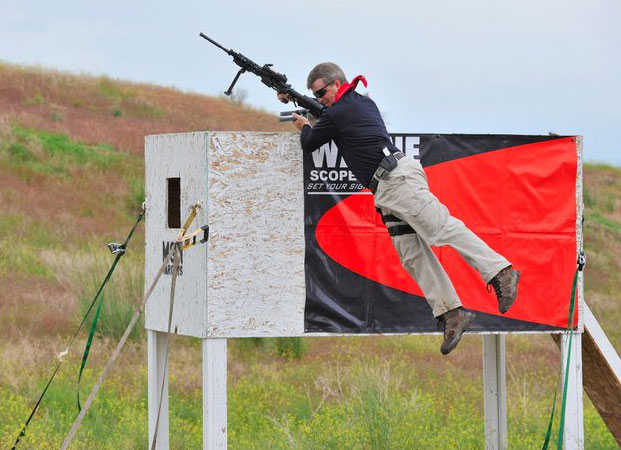


 MGM Ironman Has Unique Stage Designs
 Report based on story by Lars Dalseide for


