Want to improve your understanding of Ballistics, Bullet Design, Bullet Pointing, and other shooting-related tech topics? Well here’s a treasure trove of gun expertise. Applied Ballistics offers dozens of FREE tech articles on its website. Curious about Coriolis? — You’ll find answers. Want to understand the difference between G1 and G7 BC? — There’s an article about that.
“Doc” Beech, technical support specialist at Applied Ballistics says these articles can help shooters working with ballistics programs: “One of the biggest issues I have seen is the misunderstanding… about a bullet’s ballistic coefficient (BC) and what it really means. Several papers on ballistic coefficient are available for shooters to review on the website.”
Credit Shooting Sports USA Editor John Parker for finding this great resource. John writes: “Our friends at Applied Ballistics have a real gold mine of articles on the science of accurate shooting on their website. This is a fantastic source for precision shooting information[.] Topics presented are wide-ranging — from ballistic coefficients to bullet analysis.”
Here are five (5) of our favorite Applied Ballistics articles, available for FREE to read online. There are dozens more, all available on the Applied Ballistics Education Webpage. After Clicking link, select Plus (+) Symbol for “White Papers”, then find the article(s) you want in the list. For each selection, then click “Download” in the right column. This will send a PDF version to your device.
We Buy Guns, an online gun purchasing service run by an Indiana FFL, has expanded its operations with a new dedicated warehouse facility to support continued growth in online firearm resale activity. We Buy Guns currently generates more than 1,500 purchase offers per month through its online platform. To learn more about the We Buy Guns operation and its nationwide firearm purchasing platform, visit www.WeBuyGuns.com.
About We Buy Guns: We Buy Guns is a national online platform dedicated to the simplified, legal, and secure purchase of firearms from individuals. Operating in all 50 states, the company prioritizes federal compliance and seller convenience, providing a streamlined alternative to traditional gun store trade-ins and private sales.
The company reports purchasing more than 11,000 firearms from sellers across all 50 states, with over $5.25 million paid out to individuals, collectors, and estates. Transactions have originated from more than 4,600 municipalities nationwide, reflecting broad adoption of digital-first firearm resale. The expansion increases processing capacity as demand continues to shift away from private-party sales and toward licensed, compliance-driven solutions without friction.
“We’re seeing consistent growth from people looking for a more straightforward way to sell firearms,” said Chris Wing, Owner of We Buy Guns. “This expansion allows us to improve turnaround times while maintaining a high level of operational control.”
Review of We Buy Guns
There is a review of WeBuyGuns.com on the PewPewTactical.com website. Here are some highlights:
Webuyguns.com [works through] a federally licensed firearms dealer located in Indiana. They are Marksman Shooting Sports, LLC, an established brick-and-mortar firearms dealer operating since 2013. Selling through them means you’re covered under their license, providing you with the same reassurances as if you were conducting a transaction in a physical store.
Webuyguns.com have worked with thousands of customers from hundreds of cities around the country – 650 locations to be exact.
In conclusion, if you’re considering selling a firearm and appreciate a modern, hassle-free approach, Webuyguns.com is a reliable option to explore. This platform simplifies the process, eliminating the need for traditional in-person methods[.]
It’s now the month of May, so summer shooting season is right around the corner for the whole nation. Before you head to the range for the first time, we recommend you do some basic tasks with your firearms. Here’s some good advice on readying your rifles for the 2026 shooting season.
by Ron Dague, Sinclair International I give my rifles a pre-season check before the shooting season starts. This starts with a general inspection starting with the butt-plate or recoil pad and making sure that all the screws and adjustable parts (on an adjustable butt-plate) move freely up or down and side to side. If you got caught in rain some of these screws and adjustable parts may not move when needed. I disassemble parts as needed and put rust preventative or a light oil and/or grease on threads and sliding parts. On rifles with recoil pads and fixed butt-plates, make sure the screws are tight and that holes in the stock aren’t stripped out. Also make sure there are no cracks in the stock and around the butt-plate. And if the recoil pad is glued-on, just make sure it hasn’t come loose.
Next I take the action out of the stock and check for cracks and wear marks. I look at the bedding to make sure that oils and cleaning solvents have not damaged the bedding. While the action is out of the stock, I look for any surface rust or dirt/dust in the recoil lug area and magazine well. Clean as needed and repair or re-bed if needed.
Trigger Assembly and Action With the barreled action out of the stock, it is a good time to spray out the trigger with cleaner. I use Ronson oil or lighter fluid. [Editor’s Note: Some trigger-makers advise against using any kind of lubricant, grease or oil — so plain lighter fluid is preferred.] After the trigger is cleaned you may want to check the trigger pull weight. If you don’t feel comfortable doing this, take it to a gun smith and have it checked. It is worth every penny to not have a trigger issue and/or a safety malfunction. I also take the bolt apart and clean the firing pin spring and bolt housing with Gun Scrubber or automotive brake cleaner. Then lube the firing pin-spring and firing pin with light oil. I use Kel Lube and/or Butch’s gun oil. Put a small dab of gun grease on the [bolt locking lugs] and cocking ramp.
I will also spray the outside of the action and barrel and give that a light coating of oil for rust prevention. I clean the action with Sinclair’s action cleaning tool. Don’t forget to clean the bore. Even though you didn’t fire the rifle, this makes sure nothing obstructs your barrel.
Checking Metal Fixtures and Fasteners Next I look at the trigger guard and hinged floor plate and make sure it works as designed. Make sure there are no cracks in the trigger guard from an accidental drop. Check guard screws and /or action screws for tightness and tighten to proper spec. There are torque specs for this, but on wood stocks the wood can crush and this should be checked throughout the year as weather change can affect this. My entire collection of rifles are bedded and I just tighten them just snug with screw driver or Allen wrench. The rimfire rifles have a spec of 55 to 74 inch/lbs and I think would carry over to center fire as well. I would caution you about torque wrenches as you need a good quality wrench, and read the directions on how to use it. You can over torque if not careful. Check the swivel studs and bipod to make sure there tight as well. You may want to take scope off and check the base screws and check the rings.
Test Fire the Rifle After Maintenance
After all cleaning and is done and everything is reassembled, take a few rounds out to the range and test fire to make sure everything works as it should. Don’t forget to run 3-5 rounds through the magazine at least two times for function. I look at this as preventive maintenance on the rifle. If you give it a look over you shouldn’t have any trouble during the rifle matches or hunting trip.
Ron Dague
Certified Reloading Instructor
Certified Range Safety Officer
Email: rond [at] sinclairintl.com
Phone: 800-717-8211
This Article Originally Appeared in Sinclair International’s The Reloading Press.
Civilian Marksmanship Program (CMP) Provides $10 Million Challenge Grant for WSSC
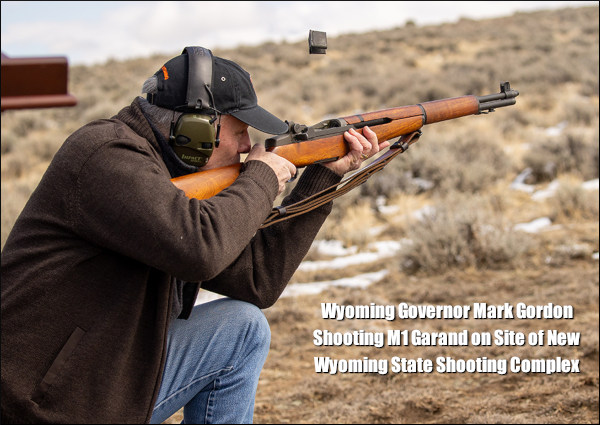
The Board of Directors of the Civilian Marksmanship Program (CMP) has approved a $10 million challenge grant for development of the new Wyoming State Shooting Complex (WSSC) in Cody, Wyoming. This marks a major milestone in the CMP’s strategic “Western Expansion”, establishing a permanent footprint to serve marksmanship enthusiasts west of the Mississippi River.
The new WSSC is now under development on 2,000 acres of state-contributed land located just seven miles south of downtown Cody. Positioned near Yellowstone National Park, the complex will become a premiere shooting sports destination, with purpose-built venues for elite competitors, recreational shooters, and youth programs.
The $10 million grant is structured as a matching initiative for three years. Under the agreement, the CMP will match new private and industry WSSC donations dollar-for-dollar, up to $10 million total.
Construction Is Underway with State Governmental Approval
The WSSC project has earned full support from the Wyoming Legislature and Governor, and it is governed by a Joint Powers Board representing city and county leadership. Construction is already underway, with core infrastructure and internal roads currently being established.
“Cody, Wyoming, is a great choice for Western expansion,” CMP Board Member and Wyoming resident Ed Newell noted following a site visit. The [WSSC] offers a unique opportunity for a high-impact partnership consistent with CMP’s mission to promote youth programs, marksmanship and firearms safety.
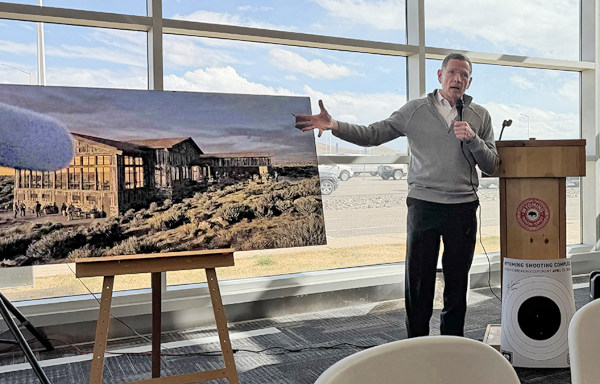
Above, U.S. Senator Barrasso shows the WSSC event center, which will include a retail area, classroom, kitchen, and a multi-purpose conference hall that can also be used for indoor archery and air gun.
The WSSC is designed to be a world-class destination for shooting sports. Its mission is to inspire youth participation, promote responsible firearm use, and serve as a catalyst for economic growth and outdoor recreation in the State of Wyoming and our nation.
Beyond the financial contribution, the CMP partnership includes key collaborative elements:
Expert Range Design: The CMP will provide technical input on range design to ensure the facility can host the organization’s signature matches and national-level competitions.
On-Site CMP Store: There’s a plan for the WSSC clubhouse to feature a CMP Store which would provide visitors with access to historic American firearms.
Nearby Buffalo Bill Museum: The WSSC’s proximity to the Buffalo Bill Center of the West, which houses over 7,000 firearms, will create a unique “view it, learn it, then buy it” experience for the more than one million tourists who visit the area annually.
Photo courtesy NRA MuseumClick Photo to View Larger Image
With today’s polymer-framed Glocks and Kel-Tecs, aesthetics have been sacrificed on the altar of functionality. Not so in the early 20th century — in that period, the best firearm designers created guns that looked as good as they worked. One example is the classic Colt Woodsman. This design came from the legendary John Moses Browning and was later refined by Colt before the pistol’s introduction in 1915. The Colt Woodsman’s frame design evolved over time in three distinct series: Series One 1915–1947, Series Two 1947–1955, and Series Three 1955–1977. Shown above is a stunning Carbonia-blued and engraved Third Series model with ivory grips.
Engraved Colt Woodsman from NRA Museum
In the NRA Museum’s Robert E. Petersen Gallery are many fine engraved arms. This Colt Woodsman .22 pistol is one of the Third Series guns that were made until 1977. Heavy barrels in either 4.5 or 6 inch lengths were offered in this variation. The Museum’s staff says: “We think the poised golden rattlesnake near the serial number is the [best] embellishment without putting down in any way the ivory grip panels or gold outline inlays.”
You can see this lovely Colt and countless other fine firearms at the NRA Museum in Fairfax, Virginia. The Museum is open every day from 9:30 am to 5:00 pm, and admission is free.
The Colt Woodsman was made in many variations, with different barrel lengths and contours and finishes. Here is a Colt Woodsman Third Series Match Target with 6″ Blued frame and slab barrel. Photo from Sam Lisker’s ColtAutos.com.
Here is a Colt Woodsman First Series Match Target with 6.5″ undercut slab match barrel and basic blued finish. Photo from Heritage Auctions.
Here is a Colt Woodsman Bullseye Match Target Pistol (6.5″ barrel) with blued finish and early factory “elephant ear” stocks with Colt medallions. This was owned by Philip Judd, an avid marksman who was 1952 Camp Perry Champion in the 500-yard .30-06 rifle competition. Photo from Sam Lisker’s ColtAutos.com.
This photograph and all images for this story are by Bill White, aka “CT10Ring” in our Forum.
AccurateShooter Forum member Bill White (aka “CT10Ring”) is not your typical member. For 37 years, Bill worked in NYC as a studio photographer specializing in still lifes and products. A neighbor visiting Bill’s home in Connecticut with a .270 Sako inspired Bill to revive his interest (obsession?) with shooting after a 25-year drought. And he owns a few Sakos now! With his gun hobby renewed, for many years Bill drove to the Western USA to shoot long range steel and a LOT of prairie dogs in season. He loved the life of the varminter, so it made sense for him to move West after retiring. He choose Idaho as his new home.
From his Idaho base, Bill enjoys long-range target shooting. But his favorite gun pastime has been varmint hunting in nearby states — the Dakotas, Montana, and Wyoming. Bill found prairie dog shooting rewarding and mapped out a western circuit route of ranches and National Grasslands in SD, ND, MT, and WY. Every year he loads up his truck and hits the road, often doing a grand circle route, visiting prairie dog havens in multiple states. In this article we feature photos from Bill’s annual “grand circle” varmint safari.
For his many cartridge types, Bill learned about reloading methods, loads, and vendors (and more) primarily from AccurateShooter.com. We start today’s story with the biggest caliber rifle he shoots regularly, his 6.5-284 Winchester. Bill favors this rig for his long-range steel shooting. He also uses it for prairie dog shooting, but only “sparingly”, because he wants to preserve barrel life, and he has many other dedicated varmint rigs.
6.5-284 for Long Range Steel Targets (and Sometimes Varmints)
In his home state of Idaho, Bill likes to shoot steel at long range. For distance work, Bill favors his McMillan-stocked 6.5-284 Win. This rifle was crafted in 2012 by Bob Green of York, PA, using a 1:8″-twist 28″ Krieger HV barrel (.298″ neck). The trued Rem 700 action was purchased from Long Rifles in Sturgis, SD. Bill did the Cerakote and bedded the action. For his 6.5-284, Bill loads 139gr Lapua Scenars, H4831sc powder and BR2 primers. He shoots both steel and varmints with this rifle, but the varmint work is limited because the 6.5-284 cartridge tends to be a barrel burner. The photo below from an Idaho range was taken near a 500-yard target, looking back at the firing line.
In the Varmint Fields — Traveling Light
Once situated, Bill (shown above) prefers to walk to Prairie Dog towns with a shooting mat, two bipod-equipped rifles slung up, rear bag, water, and his trusty Leica 10X42 GeoVid binoculars. While he has used a portable bench, he prefers to shoot from bipod, firing down from a mound if possible. This allows him to set up a line-of-fire that minimizes cross-wind effects. Bill notes: “While I often start early, end-of-day shooting has worked worked well for me. A setting sun shows targets better, the wind is usually down, and it’s not so hot. Often you can spot the bullet trace and that’s fun.”
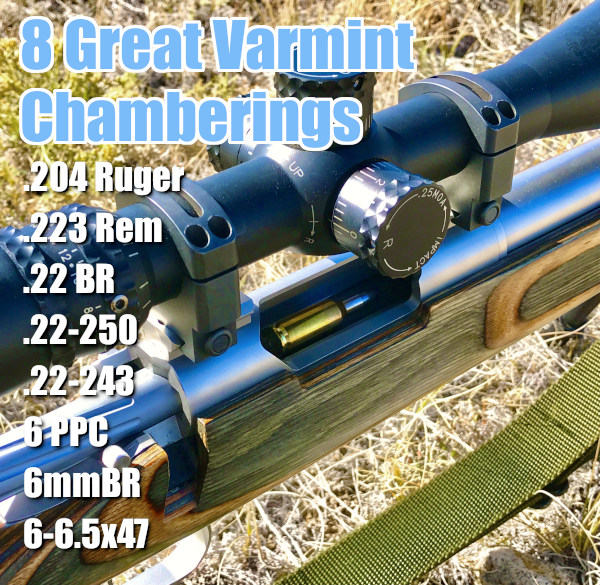
Eight Great Varmint Cartridge Types — .204, .224, .243 Calibers
Here is one of Bill Reid’s 6mmBR (6BR) rigs. Like his Sako 6 PPC, this is exceptionally accurate.
Bill has a large rifle collection, most of which see duty in the varmint fields of Montana, North Dakota, South Dakota, and Wyoming. Here are his key “take-aways” for his eight favorite varmint chamberings: .204 Ruger, .223 Rem, .22-250, .22 BR, .22-243, 6 PPC, 6mmBR, and 6-6.5×47 Lapua (aka 6×47).
.204 Ruger — This delivers great velocity with the little .20-caliber bullets, with mild recoil. The .204 Ruger easily reaches out to 400 yards, but heavier winds do move the tiny bullet around. Tremendous splat factor under 250 yards. I use Sierra 39gr bullets with IMR 8208 XBR in a Sako 75. Even now, .204 Ruger ammo is relatively easy to find.
.223 Remington — Probably the most popular centerfire rifle round in the USA, the .223 Rem offers inexpensive brass, and is a great choice for AR-15 owners. If you run short on ammo, you can find it nearly everywhere. I often bring one AR-15 and one .223 Rem bolt gun on varmint safaris. My Rem 700 5R 1:9″-twist barrel likes 53gr V-Max bullets.
.22 BR — My .22 BR is my first choice for most prairie dog missions. Accuracy is superb with necked-down 6mmBR Lapua brass — quarter-MOA and blazing fast. With the right twist rate, this chambering can shoot anything from 40gr FB bullets to 80gr VLDs. Load development is easy. Below is my .22 BR ammo for another varmint trip. I use 55gr Sierra BlitzKings with Varget in my 1:12″-twist Shilen-barreled rifle. 60gr Bergers are very accurate with a fairly flat trajectory for useful distances.
.22-250 Rem — A classic varmint cartridge, the .22-250 with 50gr V-Maxs delivers spectacular hits. If three P-Dogs happen to be lined up, I’ve witnessed one .22-250 shot take ‘em all out with a triple hit. I currently have five .22-250-chambered rifles: 3 Sako 75s, one Rem 700, and a single shot Nesika that shoots tiny groups. I favor the very deadly Berger 52gr Varmint HP. Making a custom .22-250? With a 1:8″-twist barrel you can use the full weight range of .22-cal bullets, while spinning the lighter bullets fast for “red mist” effect. Remember this cartridge can be a barrel burner. Don’t shoot too many rounds too quickly.
.22-243 Win — This wildcat is even more potent than the .22-250, delivering devastating results on P-Dogs. Run a .243 Win case slowly through a full-length .22-243 die, with plenty of lube to form the brass. I start with Lapua .243 Win brass. There can be some issues necking-down the brass. Watch for donuts forming at the neck-shoulder junction. I bought my .22-243 rifle not sure how it would perform. But now I love shooting it. My .22-243 delivers half-MOA groups with 41.0 grains RL-22 and Hornady 75gr Amax bullets. With those 75-grainers, it’s great in the wind and good to 600 yards easily.
6 PPC — You may consider the 6 PPC a benchrest competition cartridge only, requiring fire-forming. However I have an original Sako 75 single-shot 6 PPC rifle that I load with Sako-headstamp 6 PPC brass (see below) so no fire-forming is required. This Sako 75 came with a test target that measured 0.113″! With my 6 PPC Sako, I found that 58gr V-Maxs, pushed by Vihtavuori N133, are potent out to 300 yards.
6mmBR — The 6mmBR Norma (6BR) offers a nearly unbeatable combination of accuracy, efficiency, and tunability. With the 6BR and a fast twist barrel, you can shoot everything from 40gr flat-base bullets to the latest 105-110gr match bullets. I load Lapua brass, Vihtavuori N135, and Hornady 58, 65, and 75gr bullets for my Krieger 1:14″-twist HV barrel. While this cartridge is capable of long-range accuracy, I usually limit my 6BR shots to 350-400 yards.
6-6.5×47 Lapua — In this story’s lead photo is my 6-6.5×47 Lapua varmint rifle, with Surgeon action and Manners stock. I Cerakoted the barreled action and then bedded the action. Shown below is 6-6.5×47 ammo I loaded for recent testing. Note how I separated different bullets and powder loads into multiple, labeled bags. Hodgdon H4350 is a great choice for this cartridge — 39 grains H4350 with 105gr Amax was the winner here, but 88gr Bergers also shot well. This cartridge has tremendous “critter dismantling” abilities out to 600-700 yards.
Six Tips for Novice Long Range Varmint Hunters
1. Take twice as much ammo you think you may need. The fields could be particularly rich, or, because of wind or other variables, you may have far more misses than expected.
2. When possible, set up with the wind at your back (or, alternatively, directly ahead). This will minimize the effect of cross-winds. Set up a stake with a ribbon to show wind direction.
3. Bring at least two rifles. Ideally one would be a low-recoil rifle with cheaper components for the closer shots. Then bring a rifle with higher-BC bullets for longer shots where wind is a bigger factor.
4. Check the weather before you head out. Prairie dogs like sunshine and calm conditions. If a cloudy, very blustery day is predicted, considering staying in town and cleaning the rifles.
5. Bring plenty of water on a trip. An adult male should be drinking at least 64 ounces of water (or other liquid) every day — more if it’s very hot or you are sweating a lot.
6. Preferably always hunt with a companion. If you do go out solo, have a Garmin inReach SatComm/GPS for emergencies if there is no cell coverage in your location.
Veteran Varmint Hunter Shares his Secrets
Where to Find Abundant Prairie Dogs — Generally, black-tailed P-Dogs are found in the Western high desert, in the same states/areas where cattle are raised. You’ll find good hunting in Montana, North and South Dakota, Colorado, and Wyoming. There are good hunting grounds on private ranches, BLM tracts, and U.S. National Grasslands. To find specific locations, I’d suggest calling the USFS, BLM, and State Fish & Game. Some have lists of ranches that allow P-Dog shooting. Give the agencies a call before your trip and then check in with ranchers. IMPORTANT: You need a current hunting license in some states.
How to Connect with Ranch Owners– A good varmint adventure can begin with a local connection. Stop into the local Ag/feed store and the town breakfast spot. I bet you’ll find some retired ranchers having coffee together who may direct you to a place that needs rodents thinned out. Let’s say you’re in Roundup, Montana. Stop by a local store and ask what ranchers allow PD shooting. Keep in mind that ranchers may be wary of allowing a total stranger to sling lead on their place. Show respect and if you had a good experience, send a thank-you note. A guided shoot is worth considering — the outfitter will know where the P-Dogs are and he has arrangements with landowners. He may even supply benches. I’ve taken two guided trips, with excellent results, one near Sturgis, SD, and the other on Sioux tribal land near Rosebud, SD.
Getting Set Up — I start early in the a.m. to mitigate mirage. Plus there is usually less wind at that hour. I prefer to drive to within half mile or so of a PD town, then walk and shoot prone. Most shooters like to set up a rotating bench on a knoll. This is a tried-and-true way to shoot long distances accurately, especially if you are on top of a hill and can shoot 360 degrees. I once shot from a rotating bench, but I prefer walking now. Some country is quite stunning and that’s half the fun — being out in nature. But yes there are negatives to shooting prone — ground hazards and tall grass can impede your vision.
Equipment for a Serious P-Dog Safari — In the field, I normally carry two rifles with Harris 9-13″ bipods, backpack, a rolled-up shooting mat, at least two liters of water, food, ammo, two rear bags, and binoculars. A good laser rangefinder comes in handy. If you prefer shooting from a bench you may want to have a front rest and a spotting scope. Many guys will shoot prone from the bed of a truck. That gets you off the ground without the need to haul around a heavy bench. But some locations restrict vehicles. Before a P-Dog trip, I make a detailed pack list and check off as I load my truck and camper. I would suggest bringing waterproof rubber or muck boots. June in South Dakota can be cold and wet, and the mud there is not to be believed. Don’t attempt to drive off road in it!
It’s good insurance to bring an extra 5 gallons of fuel for your vehicle in a jerry can and 2 gallons of H20. There may be NO shade for miles and dehydration is a real possibility. Having a couple heavy duty tarps will provide a sun shade and cover your gear in a rainstorm. I bring a 16″ X 20″ plywood target backer, a stand, and paper targets. This allows me to check zero on each rifle before I head out to the Dog Town.
Western Varmint Country Vistas
Taking Photos on Shooting Adventures
Bill knows a thing or two about taking pictures, having been a professional photographer in NYC for many decades. He uses modern digital cameras for both his outdoor and indoor work. Most photos in this story were taken with a Canon EOS 5DSR MKIV. We asked Bill for some tips on taking good photos. Here are his FIVE Top Tips for Photography:
1. Take photos in the early a.m. and later p.m. when the light has definition. Mid-day results will not be so nice.
2. Use the highest-resolution camera available that fits your budget. Yes lens quality, focus, and exposure controls make a big difference.
3. When feasible, shoot using a manual setting with the lens wide open (for shallow focus). Set the focus on the most important object/subject in the frame.
4. Photoshop is useful, especially when RAW images need to be corrected to show the scene more faithfully, or enhance it.
5. After you take a picture, before you post it on social media, learn to crop the image, straighten the horizon, and do other basic fixes. This can make a big difference.
The NRABlog has interviewed seven prominent lady shooters, asking them for tips for other lady shooting sports enthusiasts, particularly new shooters. Top female competitors such as 2016 Bianchi Cup Winner Tiffany Piper and Team S&W Co-Captain Julie Golob offer good advice on competitive shooting as well as using firearms for self-defense. Read the full article here.
Here Are Some of the Top Tips from Leading Ladies:
Theresa Vail, Hunter and Host of NRA All Access “If you’re new to shooting or wanting to start, find some girlfriends that are interested in trying it with you. Having female friends go to the range with you takes the pressure off and makes a typically male-dominant arena much less intimidating. There is such thing as strength in numbers!”
Tiffany Piper (Action Pistol): The best piece of advice I would give is practice makes perfect. In New Zealand, we barely get enough range time with our noise restrictions so muscle memory and technique are key. Study up on shooting techniques, watch YouTube videos of other professional women shooters, and try out what you see. Don’t get intimidated thinking it’s a male’s sport[.]”
Julie Golob (Team S&W, 3-Gun and Pistol): “If something isn’t clear, just ask about it! Shooters are some of the best people you’ll ever meet, but we can be confusing and use a lot of shooter slang and lingo. When in doubt, ask!”
Tori Nonaka (Team Glock): “I always recommend to new shooters to first concentrate on the basics of gun safety. That way they will be more comfortable when they next learn about the particular gun…. Their confidence will grow as they familiarize themselves with their specific weapon. Then, it’s all about practice at the range.”
Corey Cogdell (Olympic Trap Shooter): “It’s empowering for women to know how to use a firearm in a sporting atmosphere as well as for self-defense. So if you are new to firearms, check out your local gun club and take a lesson! There you’ll find instructors and other shooting sports enthusiasts who will be more than willing to help you.”
How about a game of “Cartridge Chess”, with chess pieces sourced from your own ammunition collection? We think the concept of a Cartridge Chess Set is pretty clever, and it’s bound to be a conversation-starter at home or at the hunting lodge. With a little creativity, our readers could make their own Chess Sets like this, using a variety of cartridge types.
Create Your Own Cartridge Chess Set
This is a 3-D rendering originally found on the Cheaper Than Dirt Facebook page. We’d like to see a chess set with actual cartridges (assembled without powder or primers), perhaps with .32 ACP pawns and the 50 BMG and .338 LM as King and Queen.
Challenge: How many cartridge and shotshell types can you identify? The Pawns look like 9mm or 40sw pistol cartridges, while the Rooks (Castles) are obviously 12ga shotgun shells.
What’s Wrong with This Picture?: How many of you sharp-eyed chessmasters noticed a mistake in the placement of the “Royals” in the Cheaper Than Dirt 3-D rendering. Hint — look at the grid layout (top left) for the correct placement of Kings and Queens.
Women are becoming an increasing percentage of firearms owners. Gun ownership is no longer male-dominated. One study suggests that, in recent years, nearly half of all new gun sales have been to women. In addition, it is estimated that women now represent 42% of American gun owners, and that number increases with every passing year.
Gun journalist Dan Wos of The Loaded Mic podcast channel has made interesting observations about the increase in gun ownership by ladies. Citing a series of studies, Wos observed that women in the USA are now buying nearly half of all new firearms. Many of these ladies are first-time gun owners who are motivated by a desire for self-protection.
On Ammoland.com, Dan Wos has an article “Don’t Believe the Spin: Women are Empowering the 2nd Amendment”. Here are highlights:
Let’s look at the actual numbers. In 2021 a Harvard University study found that nearly half of all gun purchases between 2019 and 2021 were by women. 42% of gun owners in America are women (a 14% rise over the previous five years.) The total number of women who became gun owners during that two-year period is almost 3.5 million.
In an article by Harvard T.H. Chan School of Public Health, it was said that “women accounted for about half of all gun purchases between 2019 and 2021, and that new gun owners are more likely to be female.” This [indicates] the trends in firearm purchases moving forward.
Not surprisingly, the largest spike in gun sales occurred during and shortly after the violent left-wing riots in several cities across America in 2020. According to a survey conducted by Professor Matt Miller at Northeastern University, between January 2020 and April 2021, gun purchases rose from 13.8 million to 16.6 million. Almost 50% being women and approximately 5.4 million brought [firearms] into homes that had not previously had them.
About Dan Wos and The Loaded Mic
The Loaded Mic is a one-hour, weekly web show hosted by Second Amendment Advocate, author and commentator Dan Wos. Dan became a popular and respected voice in the gun rights community after the release of his book Good Gun Bad Guy, now a three-book series. You can access full episodes in video format on The Loaded Mic’s Rumble Video Channel.
Today, April 22, 2026, Shooting USA TV will feature products from the 2026 SHOT Show event. The Shooting USA team were in Las Vegas for the annual Shooting Hunting and Outdoor Trade (SHOT) event held in late January. New products in all categories — guns, optics, ammo, hunting gear, reloading equipment and more — were on display at this major annual trade show.
Shooting USA SHOW TIMES: This Shooting USA Episode airs Wednesday, April 22, 2026 at 9:00 PM Eastern and Pacific; 8:00 PM Central on the Outdoor Channel. If you miss the regular broadcast, you can stream the show online on Vimeo for $0.99 per episode. Or you can get unlimited streaming for $2.99 per month on Vimeo. There are also many videos available on Shooting USA’s YouTube Channel.
SHOT Show 2026 Highlights
SHOT Show 2026 featured impressive new offerings from hundreds of manufacturers. To learn more about new-for-2026 products, check out the SHOT Show Blog which had these recent features:
SHOT Show is one of the biggest trade shows of the year among ALL industries. This year there were thousands of exhibitors spread out over two exhibit halls the combined size of 14 football fields (19 acres)! This is the 9th largest trade show in the USA, promoting an industry that supports over 380,000 jobs and generates over $26 billion in wages.
Savage Revamps Multiple Rifle Models
As displayed at SHOT Show 2026, Savage Arms has updated its rifle line-up, including the Savage 110, signaling a major refresh across multiple platforms. While specifics are still limited, these changes point toward improved features and modern refinements throughout the lineup. This video features GunsAmerica Media Editor True Pearce, who recently tested many new firearms at Industry Day at the Range.
Century Arms ATA ALR — Affordable Precision Rifle
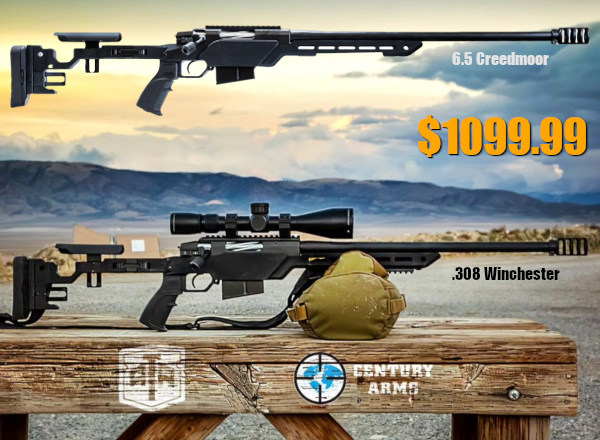
At SHOT Show, Century Arms showcased the new ATA ALR Tactical Rifle. Chambered in .308 Win or 6.5 Creedmoor, this modular rifle comes complete with adjustable aluminum chassis and muzzle brake. This could be a good starter rifle for PRS/NRL competition that does double duty as a hunting rig. And the ATA ALR is just $1099.99. That’s a great deal — you can pay that much just for an aftermarket chassis system.
Smith & Wesson New Metal-Frame Handguns
Smith & Wesson showcased many impressive new handguns at this year’s SHOT Show. This video covers some very impressive S&W handguns that feature aluminum and steel frames. The first pistol is the S&W SPEC VI with aluminum frame, ported barrel, and pre-installed Aimport optic. Next the reviewer covers the impressive steel-framed HD series pistols — both standard and competitor models. With good ergonomics and triggers, these are great for action pistol games.
NEW Nightforce NX6 Scope Family for 2026
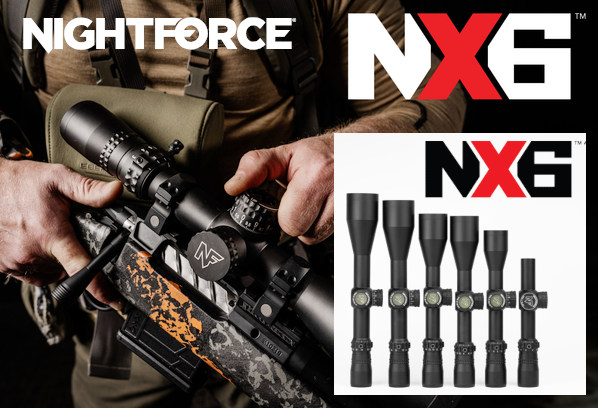
Nightforce’s new NX6 riflescopes offer lightweight configurations with an impressive 6X magnification range across the series. NX6 options include: NX6 1-6x24mm, 2-12x42mm, 3-18x50mm, 4-24x50mm, and 5-30x56mm. NX6 scopes are designed for wide field of view and good clarity. The FieldSet turret system provides great repeatability and tracking while offering ease of use and configurability, allowing shooters to convert from capped to exposed dials and custom Bullet Drop Compensating (BDC) dials.




 I give my rifles a pre-season check before the shooting season starts. This starts with a general inspection starting with the butt-plate or recoil pad and making sure that all the screws and adjustable parts (on an adjustable butt-plate) move freely up or down and side to side. If you got caught in rain some of these screws and adjustable parts may not move when needed. I disassemble parts as needed and put rust preventative or a light oil and/or grease on threads and sliding parts. On rifles with recoil pads and fixed butt-plates, make sure the screws are tight and that holes in the stock aren’t stripped out. Also make sure there are no cracks in the stock and around the butt-plate. And if the recoil pad is glued-on, just make sure it hasn’t come loose.
 With the barreled action out of the stock, it is a good time to spray out the trigger with cleaner. I use Ronson oil or lighter fluid. [Editor’s Note: Some trigger-makers advise against using any kind of lubricant, grease or oil — so plain lighter fluid is preferred.] After the trigger is cleaned you may want to check the trigger pull weight. If you don’t feel comfortable doing this, take it to a gun smith and have it checked. It is worth every penny to not have a trigger issue and/or a safety malfunction. I also take the bolt apart and clean the firing pin spring and bolt housing with Gun Scrubber or automotive brake cleaner. Then lube the firing pin-spring and firing pin with light oil. I use Kel Lube and/or Butch’s gun oil. Put a small dab of gun grease on the [bolt locking lugs] and cocking ramp.
 Next I look at the trigger guard and hinged floor plate and make sure it works as designed. Make sure there are no cracks in the trigger guard from an accidental drop. Check guard screws and /or action screws for tightness and tighten to proper spec. There are torque specs for this, but on wood stocks the wood can crush and this should be checked throughout the year as weather change can affect this. My entire collection of rifles are bedded and I just tighten them just snug with screw driver or Allen wrench. The rimfire rifles have a spec of 55 to 74 inch/lbs and I think would carry over to center fire as well. I would caution you about torque wrenches as you need a good quality wrench, and read the directions on how to use it. You can over torque if not careful. Check the swivel studs and bipod to make sure there tight as well. You may want to take scope off and check the base screws and check the rings.



 Engraved Colt Woodsman from NRA Museum




 Bill knows a thing or two about taking pictures, having been a professional photographer in NYC for many decades. He uses modern digital cameras for both his outdoor and indoor work. Most photos in this story were taken with a Canon EOS 5DSR MKIV. We asked Bill for some tips on taking good photos. Here are his FIVE Top Tips for Photography:





 How about a game of “Cartridge Chess”, with chess pieces sourced from your own ammunition collection? We think the concept of a Cartridge Chess Set is pretty clever, and it’s bound to be a conversation-starter at home or at the hunting lodge. With a little creativity, our readers could make their own Chess Sets like this, using a variety of cartridge types.